Tag Archives: David Morrison

Past Perfect: Almost lost, two historic properties are back in use, receive preservation honors

Elementary Coffee Co.

Andrea Grove, owner of Elementary Coffee Co., said her favorite part of her shop’s newly refurbished home is the angled door.

Set 500 feet from the state Capitol, it makes a statement, she said, offering an opening to the dark-suited professionals of state government, the art-lovers of Midtown, the dog-walkers and joggers of the riverfront, and everyone else who passes by.

Her leased space dominates the combined building at 254 to 256 North St. that is one of two winners of the 2020 Preservation Award from the Historic Harrisburg Association.

The strategic location clearly unites not only an eclectic collection of people, but eras.  Freshly roasted coffee is served in a Civil War-era rowhome, now transformed into a sleek, chic new venue.

“This is part of the re-urbanization of America,” said Matt Krupp, a North Street neighbor whose company acquired and redeveloped the property, which includes two upstairs apartments. “Residents like the walkability of the downtown, which is a wave we were happy to ride.”

This year’s other Preservation Award recipient is the “Fox on Washington,” at the corner of S. 2nd and Washington streets. Built in 1906, this gem of brick and sandstone lies between UPMC Pinnacle, which once owned the property, and the now-shuttered Paxton Fire Station.

Originally home to the Fox Hotel and, starting in the 1930s, Santanna’s Seafood House, the three-floor structure was meticulously restored and redeveloped by Harristown Enterprises. It now houses two stylish two-bedroom apartments, and six one-bedroom units.

The handiwork of Trinity Construction Group of Steelton and Camp Hill-based architect By Design Consultants, all residences have granite countertops, wood vinyl plank living room floors, metal console washstands, tiled showers with glass enclosures, stainless steel appliances and full-sized washers and dryers.

The exterior has both original and harvested sandstone, said Brad Jones, Harristown’s president and CEO. Renovators replaced masonry, restored a sagging turret and installed architectural-series windows.

Jones said that his favorite part of the 114-year-old boutique building is the façade, offering an attractive entry both to Shipoke and downtown Harrisburg.

“They don’t build buildings like this anymore,” he said. “We’re really proud of it.”

Fox on Washington

Complete Block

Like the Fox on Washington, Elementary Coffee’s new location was once home to a restaurant, the popular Coventry eatery. Built in the late 1860s, the structure was one of the oldest remaining homes in the Capitol area neighborhood.

Krupp, working with Alli Lin, LLC, acquired the property in late 2017 from the Harrisburg Redevelopment Authority and began renovation in early 2018. Work ended in the fall of 2019.

Krupp said the south- and east-facing façade is original brick. They removed the rear of the building and installed permeable pavers to allow environmentally conscious natural drainage, providing seven parking spaces and egress.

They also removed the third-floor dormer attic, which was unusable space, and transformed it into dramatic, 19-foot-high cathedral ceiling space. The second floor holds two 800-square-foot, one-bedroom, one-bathroom apartments.

New sidewalks and trees were added in the front, along with custom-made curved windows on the front and side.

Krupp said the once-dilapidated building is a key piece of the puzzle in the “complete block” concept. Already, North Street boasts a coffee shop, upscale restaurants, a diner, eye doctor, hair salon, mechanic and gym.

“There’s been so much investment in this block in the past two years,” Krupp said.

The Impact

According to HHA’s David Morrison, the HHA Preservation Committee selected the award winners, with final approval from the board of directors. The committee examined the quality and extent of restoration, the impact on the surrounding neighborhood, and the degree to which demolition or loss was prevented or history was preserved.

The old Coventry building “adds greatly to the vibrancy of a property so close to the Capitol Complex,” Morrison said.  “They literally saved a building that would have not survived without this restoration.”

Morrison lauded the old Coventry’s “historic exterior and dramatic interior.” He ticks off the many other buildings along that leafy stretch of North Street from memory, including the state headquarters of Preservation Pennsylvania, and at Green and North streets, a building with a “very rare” cast-iron façade, typical of the 1870s and 1880s.

“That’s what makes that neighborhood very special,” he said.

Coventry was a holdback in a row of rejuvenation, he said, but is now another gem.

He added that the Fox on Washington “is the gateway to center city Harrisburg.”

“That’s one of the first things you see,” he said. “If that were to be demolished, it could have led to the entire block being demolished. The whole character of the experience of arriving in Harrisburg would have changed dramatically.”

And that’s just the exterior.

“They did a magnificent job of taking a building that was under-utilized for a number of years and finding a way to make every square foot functional and usable,” Morrison said.

Renters will enjoy living at the edge of Shipoke, he predicted, just a block away from the stately John Harris Mansion.

“It’s a very desirable neighborhood,” Morrison said. “And the historic setting is kept intact.”

Washington Street is populated with beautiful historic rowhomes, with brick sidewalks and mature trees.

“It would have been a shame to be replaced with a modern building or parking garage,” he said. “It’s the impact that we are looking for.”

Historic Harrisburg Association’s annual Preservation Celebration and Toast will be held on Sept. 20. For more information, visit www.historicharrisburg.org, contact HHA at [email protected] or 717-233-4646.
Continue Reading

Century of Grace: For 100 years, the Parkway has watched the river run

At 100 years old, this regal Front Street landmark looks good for her age, but love, care and pride have a lot to do with that.

Opened in 1920, the Parkway was one of first apartment complexes in Harrisburg and considered one of the most elegant. A century later, it remains so popular that residents still wait months for a vacancy.

“The Parkway was built to cater to the clientele in those days who wanted the prestige of a Front Street address without the maintenance of keeping a home,” said David Morrison, executive director of Historic Harrisburg Association. “It combines the graciousness of a private home in an apartment.”

The five-story complex originally was built with 30 units in a charming architectural design that Morrison described as “a blend of Georgian Revival and 20th Century International.”

Originally, all units featured a formal entrance leading into a spacious living room, three bedrooms and bathrooms, maid’s quarters and a formal dining room. Floor-to-ceiling windows still offer majestic views of the Susquehanna River.

In the 1980s, the Parkway was renovated inside and out by its then-owners. The building was reconfigured to create a new total of 34 apartments. Only six units retained floor plans as originally constructed, while others were converted into two-bedroom units.

Outside, a row of single-family garages directly behind the complex was eliminated to ease cramped parking accommodations.

“Visitors had to park several blocks away,” Morrison noted.

With this, service parking and a new rear entrance off of Bartine Street were created.

Nonetheless, much of what makes the Parkway unique remains as it was built in 1920, such as claw-foot bathtubs, hardwood oak floors and plaster ceilings, said building manager Larry Bosak. Apartment walls are topped with wooden picture rails to avoid placing nails in the plaster for wall hangings.

Bosak has served as the Parkway’s manager since 1997. His base is a first-floor office within the complex.

“Our maintenance shop is here,” he said. “Most of our stuff is done in-house.”

Bosak is proud of the Parkway’s rich history. He’s quick to point out that the building is on the U.S. Department of the Interior’s National Register of Historic Places. A plaque commemorating that honor sits outside the rear of the building.

“It’s great to be a part of history like this,” Bosak said. “It’s a dream come true for me.”

Christina Heintzelman moved into the Parkway 18 months ago. Her adopted home is an upper unit with a direct view facing the river.

“I like the view the best,” she said. “It’s absolutely beautiful. It’s also very affordable here with wonderful maintenance, and I’m surrounded by friends.”

Another plus? Heintzelman lives only 65 steps away from where she works. For the past seven years, she’s worked in the office of the Pennsylvania Council for the Blind, which is located on the Parkway’s ground floor.

The Parkway’s residents are friendly, too, she said. When not in a pandemic, building neighbors get together to grill on summer holidays and celebrate Christmas.

“We have a lot of great tenants,” agreed Bosak, equally proud of his building and its people.

Morrison returned the compliment, emphasizing that Harrisburg’s historic properties are only as good as their owners and landlords.

“It was very well built, well designed, and, importantly, has been well maintained,” he said.

The Parkway is located at 925 and 931 N. Front St., Harrisburg.


Continue Reading

History Keeper: As Harrisburg changes, Calobe Jackson Jr. tells the stories of what came before.

LeRon McCoy, Calobe Jackson and Ryan Sanders.

Calobe Jackson nimbly treads a narrow path behind his childhood home. He plants a hand on a low concrete wall.

“My dad had this wall put in, probably around 1937 or 1938,” he said.

Jackson’s memories are modest. Sweeping barbershop floors. Pears growing on backyard trees. But when Harrisburg’s history-keepers talk about Jackson, they pull out the superlatives. “Living treasure.” “Walking encyclopedia.” “Historian’s historian.”

Calobe Jackson, Jr., turned 90 in April. With his steel-trap memory and will-do attitude, he has spent decades in community service. His contributions have broadened the scope of Harrisburg’s past, even as he steps into the future as a muse for revitalization of a key piece of African-American entrepreneurial history.


Stories They Told

In 1934, World War I veteran Calobe Jackson, Sr., relocated his barbershop and his family, including 4-year-old Calobe, Jr., from Strawberry Alley to N. 6th Street.

In a mixed-race neighborhood, “Jack’s Barbershop” joined a thriving African-American business scene. German Jackson (no relation) ran the Green Book-listed Jackson House rooming house and restaurant next door. A beauty school was on the other side. At the funeral home on the corner, morticians would embalm bodies in the basement and carry them upstairs via a stairwell leading to the sidewalk.

These are the stories Jackson shares as he walks around his old neighborhood.

“You had the major African-American businesses right together, and that is very symbolic,” he said. “They were prosperous during segregation, and they’re still the most popular businesses. Most African Americans go to the African-American barbers or beauticians, the undertakers and the restaurants.”

As young Calobe worked around the barbershop, he heard the tales of old-time Harrisburg from the doctors, lawyers and politicians in the chairs.

“I was fascinated by the stories they told,” he said.

He especially loved stories of the Old 8th Ward, where a thriving, diverse neighborhood had given way to expansion of the Capitol grounds.

His step-grandfather would take Calobe to Negro League baseball games.

“All these great stars—(Josh) Gibson and (Satchel) Paige,” he said. “I saw them play.”

Jackson graduated from William Penn High School, where he ran track. He attended Lincoln University until being drafted into the Army, where his proclivity for math landed him a spot as a surveyor. His unit—possibly one of the last all-black units before President Harry Truman desegregated the armed forces—stayed stateside during the Korean War.

After military service, Jackson worked his way up to post office superintendent, a problem-solving role that energized his puzzle-loving brain. He married Betty Canady in 1957. They raised two sons and a daughter. Betty died in 1976.

Jackson served on the Harrisburg school district’s elected school board and appointed board of control. He never feared the future, from childhood days building crystal radios to his years leading establishment of the school district’s Marshall Math Science Academy and the Harrisburg High School SciTech Campus. From 2005 to 2010, he served on the board of the fledgling Harrisburg University of Science and Technology.

“Harrisburg University has some very innovative courses,” Jackson said. “These things they’re into with the (esports) gaming—that’s part of the future.”


A Toast

After retiring in 1990, Jackson started tracking down details on all the stories he had heard over the years. He and fellow historians bonded over their hours spent in the Pennsylvania State Library’s microfilm section.

He has contributed memories and meticulous research to a long string of projects—creating African-American history trails, commemorating U.S. Colored Troops, celebrating Harrisburg’s sesquicentennial, preserving cemeteries, exploring jazz and the Negro Leagues, researching Old 8th Ward residents for the Commonwealth Monument Project.

Ken Frew, librarian for the Historical Society of Dauphin County, remembers when Jackson asked for an obituary that wasn’t in the society’s files. Visiting the State Library the next day, Frew asked for two rolls of microfilm that might yield the obit, but they were loaned out. Frew went into the microfilm room, “and there’s Calobe with the two rolls.”

“When he has a lead on something, he follows through on it,” Frew said.

With Jackson’s contributions of informational gems from his own collection, Frew expanded the Historical Society’s file of African-American history from a small file to one now outgrowing a drawer.

Fellow historians marvel at Jackson’s accuracy and his generosity in sharing his knowledge.

“He’s sort of like a living Wikipedia,” said Historic Harrisburg Association Executive Director David Morrison.

HHA’s 2020 Preservation Celebration—postponed to Sept. 20 because of the pandemic—features “A Toast to Calobe Jackson.”

For HHA, Jackson worked with historian Jeb Stuart to create an African-American history route for the YWCA of Greater Harrisburg’s Race Against Racism. He also helped HHA intern Kristian Carter write about African-American businesses and, said Morrison, “the subtle segregation in that these black-owned businesses existed and thrived because people couldn’t go downtown and shop.”

“He was one of several people, and certainly the dean of African-American historians, who have helped to integrate African-American history into general history, locally and beyond,” said Morrison.

Jackson’s accuracy derives from his talent for matching memories “with actual documentation,” said Stuart. “He’s unbelievable. He’s sharp.”

Jackson provides context that makes pictures emerge from the scattered puzzle pieces of history, said arts activist Lenwood Sloan—even if it means, as in one case, sharing a racist account of a visit by 19th-century abolitionist and journalist Martin Delaney.

“You’re creating fact-based history and not legend and mythology,” Sloan said. “Memory tends to gild things. Some of the things that Calobe turns up are not that pretty.”


A Pillar

Post-World War II, most of the 6th Street African-American business corridor gave way to Capitol Complex expansion and urban renewal. One stretch survived—the historic buildings of Jackson House, Jack’s Barbershop and the corner funeral home that was originally the Ridge Avenue UMC parsonage, later known as the Swallow Mansion.

“They’re the only thing left from that time,” said Jackson.

Through late historian Hari Jones, Jackson connected with Ryan Sanders, a partner in Vice Capital with NFL veterans LeRon and LeSean McCoy. The team is revitalizing Jackson House and the former funeral home to create Jackson Square, transforming the dilapidated buildings into apartments and retail.

Jackson’s firsthand knowledge of the site helped forge a narrative of African-American entrepreneurship and its role in overall Harrisburg history, said Sanders.

“He is absolutely a pillar of this project,” he said. “Accuracy is very, very important here. As we’re telling the narrative and the storyline, we’re setting the groundwork for future endeavors on this property.”

Jackson’s memories helped give momentum to reinvigorating “an important anchor to the community,” added LeRon McCoy. “Hearing those original stories and what these buildings meant, it only cemented the idea that we wanted to rebuild them.”

As the new federal courthouse drives revitalization of N. 6th Street, noted Morrison, Jackson is enhancing the effort by helping restore the corridor as “a special boulevard of African-American heritage.”


Keeps Him Young

In every conversation about Calobe Jackson, someone references the man himself.

“He’s one of my favorite historians,” said Frew. “One of my favorite people, even if he wasn’t a historian. He’s just a good guy.”

“He’s just a heck of a nice guy,” seconded Morrison

Added Sloan: “He is a gentle man and a gentleman.”

But make no mistake, Sloan said. Jackson’s work counterbalances Harrisburg’s culture of “perpetually emerging” but largely peripatetic African-American organizations that have no place to call home—no black bookstore or art gallery or theater group with a sign out front and its own door to walk through, Sloan said. In a heritage marked by displacement, people such as Jackson are “temples of memory” pointing toward permanence.

“If it wasn’t for people like Calobe who remind us that we were here and that we thrived and survived for a time, we would be forgotten, or worse than forgotten, discounted,” Sloan said. “Calobe reminds us that we count.”

Jackson says simply that his work keeps him young.

“It keeps your mind flowing,” he said. “I’m in good health to be 90. A couple of ailments like some people get. The way my mind works, the idea of having this thirst for history, this thirst for knowledge, keeps you going.”

“A Tribute to Calobe Jackson and Harrisburg’s African-American Heritage,” will be live-streamed on Sunday, Sept. 20, starting at 5 p.m. Click here for more information and to view the event.

Support quality local journalism. Become a Friend of TheBurg!

Continue Reading

Burg Blog: Historic Credits

The long-shuttered Swallow Mansion in Harrisburg is currently under restoration.

As it does each year, Historic Harrisburg Association this past week presented its “Preservation Priority” list.

This is a summary of some of the Harrisburg area’s most threatened structures, and many of the buildings on the 2020 list should come as no surprise to anyone who cares about historic preservation locally.

On it, you’ll find such notable structures as the J. Donald Cameron Mansion (up for sale), the Riverside Firehouse (slated to be sold), several abandoned churches and a few structures, victims of negligent owners, that may be lost forever if not shored up soon (among them, the pre-Civil War Balsley House downtown and the former Gerber’s Department Store—aka the “Carpets and Draperies” building—in Midtown).

The old Harrisburg Moose Lodge, now the home of StartUp Harrisburg and Union Lofts

Each year, HHA uses this list to make the public aware of the area’s historic heritage crumbling around them—and maybe even hold owners’ collective feet to the fire.

But I’d like to use this blog post to highlight something else. In its presentation, further down, following the bad news, there is this—hope.

HHA lists a section called “prior listings,” which consists mostly of buildings that have been preserved or are otherwise no longer threatened.

The fully restored North Street building, which now houses Elementary Coffee Co. and apartments

I think it’s important to highlight the buildings that have been saved and the people who have done the expensive, hard work, often against the odds and against financial logic, to preserve them. It wasn’t long ago that these buildings were endangered.

So, an enormous thanks to:

  • Mike and Sally Wilson, who transformed the decrepit Mary Sachs and Hull mansions into the stunning Manor on Front Bed & Breakfast
  • Chris and Erica Bryce, who restored the General Henry and Elizabeth Gross Mansion next door to Manor on Front
  • Harristown Development, which saved the old Fox Hotel/Santanna’s Restaurant, turning it into a boutique apartment building
  • Vice Capital/LeRon and LeSean McCoy, who are finishing up a total restoration of the Swallow Mansion on N. 6th Street
  • WCI Partners, which restored the boarded up former Moose Lodge and several commercial buildings on the 900-block of N. 3rd Street
  • Matt Krupp and Harrisburg Commercial Interiors for saving and rebuilding two North Street buildings that now house Elementary Coffee Co. with apartments upstairs.

The Bridge, the former Bishop McDevitt High School

And, as they say, the best is yet to come.

This year, The Bridge plans to begin to transform the old Bishop McDevitt High School into co-working space and an “eco village,” Matt Long/Harrisburg Commercial Interiors has received permission to begin work restoring the Jackson Rooming House, and andCulture is completing a restoration of the Old Waterworks on Front Street.

There’s also hope that, this year, the Harrisburg school district may finally sell the William Penn building and property and that the Zembo Shrine building will change hands and find a new use.

Lastly, a million thanks to David Morrison, Jeb Stuart, Calobe Jackson and everyone at HHA for reminding this community of its historic heritage—and how important it is to preserve it.

To learn more about Historic Harrisburg Association, visit their website.

Continue Reading

Institutions for Sale: Your childhood school, your family church–going once, going twice.

William Penn High School

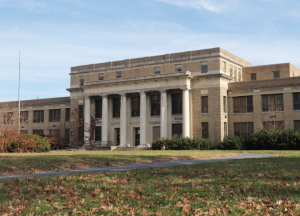
The neoclassical lintel carved “INDVSTRY” guards a door covered in peeling plywood. Inside, “AMOS” spray-painted his name on an unbroken windowpane. Outside, “L,” “D” and “M” painted their initials on the columns. The fire extinguisher lying in the grass adds a touch of irony, given the Harrisburg Fire Bureau’s growing familiarity with the vacant hulk once known as William Penn High School.

Harrisburg isn’t the only city struggling with obsolete institutional properties for sale, but a sudden flood of churches has further saturated the market. Can outdated people-gathering places be revived? Proponents hope the right alignment of creative ideas and hefty funding brings new life to old icons.


History Spared

Once, they anchored neighborhoods and hummed with activity. Now, William Penn High School is covered in vines. Choirs aren’t singing at Camp Curtin Memorial-Mitchell United Methodist Church and others closed by the Susquehanna United Methodist Conference. Zembo Shrine is active but back on the market after a sale fell through. Bishop McDevitt High School has a new owner, but its status is unclear. [Ed. note: after this story went to press, a development group announced a proposal for the Bishop McDevitt site.]

Bill Gladstone of the Bill Gladstone Group of NAI CIR is marketing six of the Methodist churches, among the many faith-based buildings crowding the real estate listings. Smaller churches tend to sell quickly, he said.

“Everybody’s starting new congregations,” Gladstone said. “They want to move out of the Holiday Inn.”

But not selling are “the bigger churches with no parking.” Many suffer from long-deferred maintenance. Inquiries trickle in, only to confront zoning and parking issues. One woman wanted to paint a church white and “attract thousands of people to come to arts events.”

Some ideas “will work,” said Gladstone, “and some won’t.”

The vast, ornate, non-ADA compliant Zembo Shrine attracted investors who saw an ideal entertainment venue—until they uncovered challenges in booking shows, Gladstone said.

“We’ve had activity,” he said. “We haven’t found quite the right buyer for it yet.”

Historic Harrisburg Association helped keep the doors open at historic Grace Church on State Street and is “trying to help find sympathetic buyers, at least for the churches that have history and architectural attributes,” says Executive Director David Morrison.

Gamut Theatre in the former First Church of God and State Street Academy of Music in the former St. Lawrence Chapel demonstrate that repurposing historic churches “becomes such a win-win, because it’s good for the building,” Morrison said. “It’s good for the organization that’s going to inhabit the building. A lot of expenses were spared, and history was spared.”

Success starts with a realistic—translation, “low”—selling price, to make up for the buyer’s upgrades, Morrison said. With institutional landmarks, “their economic value is one thing, and their community value is another thing. If you make the numbers work, there are investors and developers interested.”

Also required: time and creativity. Midtown Harrisburg’s COBA apartments sat empty for three decades before a developer acquired the building for $1, assembled the financing, reconfigured the layout and built a new elevator shaft. The result: 27 apartments in walkable Midtown.

“Thirty years went by before anybody figured that out,” Morrison said.


Offers of Interest

An old school—all those classrooms panting for conversion into lofts. What could be better? Just pay no attention to the 1,200-seat auditorium. And the gymnasium. And the cafeteria.

Philadelphia-based, multi-state developer Pennrose has made it work at Steelton’s Felton Lofts, converted from the historic Steelton High School (albeit after stepping in when the original developer backed out).

Nearly half of Pennrose’s 250 communities are the products of adaptive reuse—buildings that had “become rundown, dilapidated, an eyesore and deterrent to the values of the community,” said President Mark Dambly. “You want to make sure you have community support, because you’re going to have challenges and obstacles to overcome in order to be successful.”

Collaboration opens doors to resources and such municipal considerations as free property acquisition, waived fees, access to state and federal grants and financing, or relief from zoning and parking restrictions, Dambly said.

As for those spaces that held generations of kids staging “Oklahoma” or eating tater tots, “you want to make them generate something economically if you can, and if not, socially,” Dambly said. The Felton Lofts auditorium leans toward social, hosting community events and support services as amenities for residents.

On the revenue-generating side, look to Scranton, where the state-of-the-art Theater at North hosts such shows as an Elton John tribute tour and Judy Collins live in concert—all in a jazz-era junior high school converted in 2015 to senior-living apartments. Remarkably, the developer was Goodwill Industries of Northeastern Pennsylvania.

As for William Penn High School, now about 10 years on the market, owner Harrisburg School District “renegotiated” the listing with Landmark Commercial Realty in October, said Assistant Superintendent Christopher Celmer. Agent Seymour Barget is accepting and vetting offers.

By early 2020, the district hopes to “have a few serious offers of interest on the property that we’ll be able to sit down and evaluate,” said Celmer. “It could be a sale. It could be someone that would want to do a lease to purchase. There could be a multitude of options.”

With an active school, Camp Curtin Academy, adjoining the site, the district must also “make sure there’s a clear understanding” of boundary lines on the 25-acre property.

“If there’s an ability (for the buyer) to keep some of that history of the building, we would love to see that memorialized—what that building meant for generations that came through,” he said.


Mixed Uses

Re-imagination is hard, but it can zero in on filling community needs, said Harrisburg Economic Development Director Amma Johnson.

“Number one is mixed-use,” she said—those fashionable combos of retail and residential. Farther from the downtown-Midtown core, though, conversions could be “way more residential” until vendors dream up creative approaches to doing business.

The appetite for large institutions is primarily among “developers who have deep pockets and are creative in utilizing mixed-use space for residents—live-work, live-work-play,” added Harrisburg Historic Preservation Specialist and Archivist Frank Grumbine.

He knows, though, that those visions stumble at the sight of Gothic churches. Pittsburgh’s awesome Church Brew Works showcases potential, but “a really cool use for a big space like that is really difficult.”

“Their long-term preservation and maintenance are concerns for anybody who would purchase them,” he said.

Methodist Conference Harrisburg Superintendent Rev. Barry Robinson agrees with the primary challenges of selling large churches—“selling the buildings at a fair price over the cost of keeping them,” plus barriers due to size and condition.

“We would like for the buildings to continue to be used for houses of worship or faith-based ministries,” he said. “However, we would not deter anyone from buying the buildings for other uses.”

The city is “very flexible” about changing permitted uses while being “sensitive to the neighborhoods in which these properties reside,” Grumbine said.

Talks with developers are happening, but specifics are “still being formulated.”

“The most I can say is that the uses are mixed,” he said. “We’d like to see those buildings used as residential, commercial, even urban agriculture—a self-sustaining community within the city.”

Harrisburg Redevelopment Authority Executive Director Bryan Davis notes that developers are accustomed to relatively straightforward warehouse conversions, but repurposing unique spaces demands closer attention to the bottom line.

“It’s always nice if you’re able to find a buyer that also has a passion for historic preservation, so they have an appetite for this kind of investment,” he said. “They acknowledge the value. What that does is narrow the field of candidate buyers, which is not insurmountable.”

Neighborhoods “shudder” when beloved institutions close their doors, but Harrisburg’s monumental icons have potential, said Grumbine. William Penn is “so pretty.” And Zembo Shrine could “have a whole city within just that building.”

“There’s tons of opportunity,” he said. “It’s just who has the creativity and the money to figure it out.”

Continue Reading

From the Ashes: A historic Allison Hill firehouse was condemned. Then Jason Lloyd set his sights on it.

Jason Lloyd doesn’t mince words when asked about the condition of a unique building he purchased in 2010.

“Whatever the most horrible place you could think of, it was worse than that,” he said.

He is referring to the historic, red-brick Allison Hook & Ladder Building and, for Lloyd, a Harrisburg firefighter himself, restoring the circa-1909 building became both an obsession and a labor of love.

“There was never any grand plan,” he said. “It was just to save the building.”

Fast-forward nine years, and, today, the landmark on the 300-block of S. 14th Street has been fully restored and is back in service of the Harrisburg Fire Bureau.

The building remains privately owned, but four volunteers, constituting the revived Allison Hook and Ladder Co. No. 2, are now attached to it—though they actually respond to fires from the bureau’s modern, fully-equipped station on N. 16th Street.

“We want to help the community and put some firefighters back on the street,” said Allison Co. member Steve Austin.

Fire Bureau Chief Brian Enterline said that he was happy to see the volunteer company back and ready to return to the community.

“They have a strong link to Harrisburg fire history, and it made sense to bring them back on board,” he said.


Too Much History

In the early 1900s, Allison Hook and Ladder Co. No. 2 was founded.

At the time, it was common to have many stations, even in a small city like Harrisburg. Horses were used to pull fire engines, and communication was slow, so communities relied on firefighters located nearby.

Allison Hook & Ladder No. 2 was formed to fill this need for the Allison Hill community. Around 1908, the lot on S. 14th Street was purchased and, within a year, the two-story brick station was constructed.

The firehouse had a large number of volunteer firefighters and ran a two-piece hose and chemical wagon, as well as a ladder truck. Over the decades, the building was used for firefighter training and union meetings, in addition to serving as an active station.

But, starting in the 1950s, Harrisburg’s once-bustling stations began to fall into decline.

The city once had 14 firehouses, many volunteer-based. But, increasingly, Harrisburg’s volunteer ranks dissipated, and the force became almost fully professionalized.

Eventually, the city’s firehouses consolidated into just four and, today, there are only two working stations. Allison Hook and Ladder officially shut down in 1980. Since it was not of use to the Fire Bureau anymore, the building was sold back to the volunteer Allison Hook & Ladder Co. for $1.

Over the years, the firehouse served mostly as storage space and became dilapidated. The once-bustling firehouse was full of dirt, animal feces and trash. Windows were busted and boarded up and walls were crumbling. The historic structure was condemned.

Despite the building’s condition, Lloyd felt pulled to it.

“I said, ‘I don’t know what it will cost, I just want to save the building,’” he said. “It’s just too much history to let go.”


In Your Blood

It took 10 years of writing letters to the Allison Co. before Lloyd was offered the building.

Company President Barry Buskey explained how the volunteer group hadn’t been active for many years. Therefore, they had to reorganize simply to vote to sell the building. With no other ideas or plans for the station, they took a chance and sold it to Lloyd for $12,800 in 2010.

Thus began the second part of Lloyd’s long journey.

The 62,000-square-foot firehouse had a unique stamp tin ceiling, the original chief’s office, a spiral staircase, gear locker, four pole holes and a bedroom and meeting room.

The only problem was that you hardly could see any of it.

It took about three months of gutting the place and almost nine months of dry-walling just to get started on the renovation.

“It’s pretty much just been the firefighters working together to resurrect this place,” Lloyd said. “Once you come here and see this and get involved, it gets in your blood.”

Lloyd and other firefighters have put in years of labor, often after work or on the weekends, with most of the money coming straight from Lloyd’s overtime pay.

In the restoration, Lloyd wanted to keep the building as close to the original firehouse as possible. While much of the structure was gutted, the historic doors and wood trim remain. The upstairs bedroom was redone, but looks similar to the original. The meeting room was revamped to be a hangout space, including a bar with a back made from an old gear locker topped with antique fire helmets. Lloyd was also able to locate the fire truck that used to run out of the station and bought it, as well.

Over the years, he has collected historical items from defunct Harrisburg fire companies, as well as some from the city in general. One room, in particular, holds display cases of old postcards, photographs and other relics he found, mainly through searching online.

“It’s not a functional museum, but there’s a lot of historical stuff in here,” Lloyd said.

This past August, a number of Harrisburg’s historic preservation officials toured the resurrected Allison Hook and Ladder firehouse.

“There are people who go the extra mile because they are passionate,” said David Morrison, executive director of the Historic Harrisburg Association. “Jason has that passion. He has the vision. He has the drive when other people would’ve given up.”


A Lot of Need

With the countless hours that Lloyd and others have put into the firehouse, they hope others can benefit from it, as well. They’ve held block parties for the station’s neighbors, tours for various groups and benefits to raise money for people and organizations in need.

Enterline highlighted how the Allison Co. and the Fire Bureau at large have the same vision.

“Our goal has always been to have community-oriented fire stations,” he said.

Most recently, Allison Hook and Ladder established a community advisory board, which will consist of local leaders, business owners, clergy, educators and others. They will work together on community relations, historic preservation ideas, potential grant applications from public and private sources and fundraising activities.

A main focus is fire prevention education within Allison Hill.

“We want to try and help the community,” Lloyd said. “There’s a lot of need out here, and there’s a lot of good that can be done with the people we have. It’s all just to try and better the Allison Hill neighborhood.”


The Allison Hook and Ladder Co. No. 2 Firehouse is located at 315 S. 14th St., Harrisburg. For more information, visit www.allisonhookandladder2.org.

Continue Reading

Assessing the Past, Insuring the Future: Over a century, Penn National’s commitment to Harrisburg runs deep.

Call it an executive suite ah-ha moment.

Penn National Insurance officials brainstorming the words to describe their company produced “vibrant.” Also “innovative,” “personable” and “resilient.” Especially “resilient,” infused into a company always trying something new, “no matter how difficult the situation.”

That’s Penn National Insurance President and CEO Christine Sears talking. Around that same time, Sears and her team were preparing for Penn National Insurance’s 2019 centennial, excavating historical nuggets spanning the company’s agrarian origins to its position today providing property and casualty insurance in 11 states.

“We saw how it all came together, and we said that’s exactly right,” Sears said. “This is something that has been in our company for 100 years. We build trust, and we’re caring, and we build strong relationships. We’ve been rewarded by customers who have been loyal to us and continue to do business with us.”

Penn National Insurance is many things, all mirroring the milestones of Harrisburg and national history. It’s that building anchoring Market Square, a landmark in downtown Harrisburg’s turnaround that also leveraged historic preservation. It is a major supporter of education and civic needs. It stands among the top 10 percent of property-casualty insurers in the country.

The company dates to 1913, when enraged farmers created the Pennsylvania Threshermen’s and Farmers’ Protective Association to protest a state law limiting weights on the hulking shared equipment they drove from farm to farm.

After they won repeal in 1915, they turned their attention to workers’ compensation insurance—high on the nation’s agenda since the tragic 1911 Triangle Shirtwaist factory fire in New York. The feisty Threshermen’s Association balked at paying the exorbitant premiums charged by government and private companies. So, on Jan. 6, 1919, the Pennsylvania Threshermen’s and Farmers’ Mutual Casualty Insurance Company filed for a charter.

As the eventful decades of the 20th century unfolded, the company kept pace, branching into industrial coverage. By the 1940s, auto insurance was big. Home and fire insurance joined the lineup in the post-war building (and baby) boom. In 1967, the name changed to Penn National Insurance.

There were down times and crises, missteps and reorganizations. CEO Sears recalled that recovering from a ratings slide in the 1980s required raising additional capital while being transparent in a bid to retain the business of loyal agents.

“You constantly learn and constantly research,” she said. “You understand what’s going on and try your best to put the puzzle together.”

At Linglestown-based Enders Insurance Associates, Penn National Insurance has been “one of our team’s best partners for close to 70 years,” since the company took a chance on rookie agent Donald Enders, Sr., said grandson and Vice President Andrew Enders.

“If they make a promise, they keep it,” he said. “They communicate openly and honestly with us and their clients. They’re good community partners, and they don’t flaunt it.”


All for Harrisburg

Penn National Insurance has never strayed far from its first office in downtown Harrisburg.

By the 1990s, the company had outgrown its landlocked, three-building campus at 18th and Market streets (landlocked because the owner of Sorrento Pizza refused to sell his building, to the eternal gratitude of staff in what’s now Harrisburg school district’s Rowland Academy). The suburbs—parking, no flood plain, bigger footprint—beckoned.

Mayor Steve Reed had other ideas. His legendary persuasion, plus a $2.7 million sweetener from the state and the company’s hard-nosed negotiations for air rights and parking, convinced then-CEO Jim Taylor to build in Market Square.

Except that historic but largely gutted office buildings occupied the site. Perhaps the Senate Hotel’s brownstone façade could be incorporated into the new design. Then again, “that can be tricky, and sometimes you never know what you’re getting into,” said Historic Harrisburg Association Executive Director David Morrison, involved in the negotiations then in his first stint as HHA director.

“Lo and behold, it turned out it was a top-heavy building and didn’t have a lot of structural reinforcement,” he said.

A Penn National Insurance official said that saving the façade would cost $130,000, with no guarantee of success. Morrison counter-proposed. Why not commit $130,000 to historic preservation in the community and HHA would withdraw objection to demolition, “which may or may not be inevitable, anyway?”

The Senate façade came down. Revenue from salvage rights bolstered HHA operations. The $130,000 seeded creation of the Community Historic Preservation Fund, which now stands at more than $239,000. Trustees have disbursed $100,000 in grants and loans for historic preservation and advocacy.

“There’s not much historic preservation money out there anymore, and this is all for Harrisburg,” Morrison said.

That original deal also launched a fruitful relationship, with Penn National Insurance sponsoring HHA events, and employees serving on the HHA board and committees.

The 15-story Penn National Insurance Plaza opened in 1996.

“Local historians view our coming downtown in the late ‘90s as the turning of the tide that reversed the trend of businesses moving out of Harrisburg,” said company spokesman Christopher Markley. “Bringing 500-plus employees downtown saw revitalization of restaurants and other businesses.”


Fabric of Community

Since the days when Penn National Insurance employees volunteered at Melrose Elementary School next door to their 18th Street campus, the company has committed extensive financial and volunteer support to the Harrisburg Public Schools Foundation, the Joshua Group and Dauphin County Library System.

“They are focused on education, and not just traditional education, but all of those supplemental pieces that really make up the fabric of a community,” said Enders.

Penn National Insurance annually donates the maximum $333,333.33 allowed in earned income tax credits to the Harrisburg Public Schools Foundation, said Executive Director Chris Baldrige. Total contributions of $6.5 million have brought health education to students and families, boosted early learning, sent students to Messiah College summer camps, helped high school students earn college credits and backed STEAM learning.

“Penn National Insurance is definitely a leader in supporting Harrisburg and the foundation and supporting the students and the entire community,” said Baldrige. “They are a great example of doing good within your own neighborhood and your community.”

United Way of the Capital Region has benefitted from Penn National Insurance’s “time, talent and treasure” for decades, said Executive Director Tim Fatzinger. Dollar-for-dollar matches have generated $10.5 million in combined employee-employer donations in the last 10 years. Volunteers swing hammers and sling paintbrushes for United Way Day of Caring. Company officials serve on United Way committees, such as the IT security expert who “saves us a ton of money” by sharing his knowledge.

Charitable organizations have “fewer and fewer” local companies to call on for support, Fatzinger said.

“By choosing to stay local and to support local entities and be involved in the community, it improves quality of life for all of us,” he said.

Community involvement is “a part of our fabric,” said Sears. “If you’re at the theater or an arts event or a soup kitchen, you will likely find one of our employees volunteering. It is a good basis for what makes Harrisburg strong.”

Sears is a Steelton-raised, Bishop McDevitt-HACC-Penn State Harrisburg product who said that she has “never strayed far because I enjoy the Harrisburg hbg area.” She joined Penn National Insurance as a financial analyst in accounting in 1980 and, like many employees, grew her career from the inside up.

Today’s diverse workforce generates “different perspectives, (helping) us be able to be more agile, to have different thought processes,” Sears said.

She believes that Penn National Insurance has been a good, stable corporate citizen and employer, “and through that, we have contributed to the community both from an intellectual capacity, but as importantly, from a community and philanthropic opportunity.”

Her hope for the next 100 years?

“Absolutely more of the same,” she said. “That we just continue to be able to thrive and change and be resilient and continue to make a contribution.”


Penn National Insurance is located at 2 N. 2nd St., Harrisburg. For more information, visit their website.

TheBurg thanks Russ Banham, author of “Penn National Insurance: 100 Years of Helping People Feel Secure and Making Life Better When Bad Things Happen,” for historical background.

Continue Reading

Old is new again as Vintage Vault opens New Cumberland shop

Vintage Vault Gallery in Cumberland has numerous rooms of vintage and used items, displayed here and below.

Vintage Vault Gallery has provided customers with vintage finds without the prices of big city vintage shops for the last several years.

Now, the Middletown-based store is serving even more customers with the opening of its second location in New Cumberland.

“I don’t want to just be a single-generational store,” said David Morrison, co-owner of Vintage Vault Gallery. “This store is diverse. There’s a little bit for everybody.”

Morrison originally started the shop when he realized he had an overflow of vintage objects. After outgrowing his original, Mechanicsburg location, Morrison moved his store to Middletown.

“I was collecting stuff that just sat in my house, and so everybody told me to open up a store,” he said. “I think it becomes an addiction when you start collecting stuff.”

The multi-room New Cumberland location mostly holds items from the mid-20th century, differentiating it from the more antique-centered Middletown store. Morrison sells a wide assortment of objects, including furniture, clothing, dishware, décor and collectable items, for affordable prices. The store also offers delivery.

Morrison says that he finds items from real estate clean-outs, auctions and out-of-state businesses. Although he runs a car dealership full-time, he said that, as soon as he’s out of work for the weekend, he’s on the road searching for new finds.

“I love the thrill of the chase, and it’s fun finding really cool stuff that other people don’t have,” he said.

According to JoLynn Weist, chair of the New Cumberland Business and Professional Group and the owner of Weist Hardware, small businesses like Vintage Vault Gallery are revitalizing New Cumberland, filling abandoned properties with galleries, restaurants and other businesses.

“I think this store has a great potential to bring in a lot of different people, and younger people,” Weist said. “People who maybe might not have been to New Cumberland before might come into this store, and it’s part of a unique mixture of stores that we have in town right now.”

Currently, Morrison has a Carlisle Vintage Vault Gallery in the works, but he said that he someday hopes to expand his business to about seven or eight stores.

“Obviously, I’m a local business,” Morrison said. “Small businesses are making a comeback. The small guy who doesn’t have a big overhead like me can run a big space like this, and the real estate prices are going down because so many big-box stores are going out of business. I encourage everybody to support small businesses.” 

Vintage Vault Gallery is located at 300 Bridge St., New Cumberland. The Middletown store is located at 17 S. Union St., Middletown. For more information, visit https://vintagevaultgallery.net/.

Continue Reading

History Restored: HHA, Midtown Action Council repair, replace Harrisburg history markers

The timeworn historical marker for the Payne-Shoemaker Building on N. 3rd Street sits temporarily in the Historic Harrisburg Resource Center awaiting refurbishment.

If you want to know which famous author visited Harrisburg in 1842, you can venture over to Market Square, near the site that once housed the Eagle Hotel.

There, you’ll discover one of the 113 historical signs scattered throughout the city, chock full of tidbits from Harrisburg’s past. Originally part of the “Harrisburg History Project,” many of these aging, worn-out signs are now being refurbished, thanks to Historic Harrisburg Association and the Midtown Action Council.

Spoiler alert—the author was Charles Dickens.

Originally installed between 2002 and 2004, most of the signs are badly in need of repair and replacement. The city replaced 30 of the panels in late 2017, but many others need work.

“The city was wonderful in allowing us to keep them up to date,” said David Morrison, executive director of HHA.

HHA currently has 40 panels to be replaced, 10 of which were ordered new and 30 that were found in storage. They will also be getting new stands for some of the signs, which have been damaged, hit by cars or aged over time.

Historical markers can be found all over the city, including in such areas as Midtown, downtown and Allison Hill. They include images from the state Archives accompanied by text highlighting historical sites and buildings.

“It’s available 24/7,” Morrison said. “It’s not like a museum that locks up at night.”

This new replacement panel soon will be inserted into the State Arsenal marker.

Harrisburg historian Jeb Stuart, who writes the text for each marker, explained the two-fold purpose the signs serve. They educate Harrisburg residents and visitors on the history of the city and provide a tourist destination.

“This is one of the most extensive systems anywhere for a city of this size,” said Stuart.

For the refurbishing, a majority of the funds have come through a Dauphin County gaming grant, which awarded Midtown Action Council $13,652 last year for the project. However, further fundraising will be needed to complete the replacement.

Morrison and Stuart hinted at the possibility of one or two new historical markers, but haven’t released information on that yet.

The markers hopefully help to brand Harrisburg as having a lot of history out there,” Stuart said. “A lot of people look at them.”

Now that’s a good sign.

Continue Reading

Dreaming of a Green Christmas: Nonprofits depend upon the giving time of year.

For Bethesda Mission, it starts with the Thanksgiving food drive. Mail campaigns and Giving Tuesday follow. The venerable service organization has even added a family Christmas event to its holiday fundraisers.

“It’s crazy,” said Director of Development Cindy Mallow. “We live for these couple of months here.”

What would nonprofits do without the holidays? The answer is—sacrifice a lot of money.

While many are diversifying their revenue streams, nonprofits continue relying on year-end events and appeals for as much as one-fourth of their annual income, for their very own, extended Black Friday.

Historic Harrisburg Association, founded in 1973, dove into holiday events in its first year.

The then-new organization sought to “revitalize the neighborhoods that had been devastated by the flood of 1972 and to awaken the public to the value and the beauty of historic urban neighborhoods,” said HHA Executive Director David Morrison.

Its Candlelight House Tour, still going strong, “was a way to showcase it and for the general public to get involved.”

“Simply seeing these houses was a form of education and advocacy, for people to say, ‘Oh, we had no idea these homes could be so charming,’” Morrison said.

In 2017, Bethesda Mission launched a new event. “A Tremendous Christmas at Italian Lake” brought carriage rides, Santa Claus, carolers, vendors, and a Christmas tree lighting to a park that normally slumbers in winter hibernation.

“Italian Lake has been a hidden gem for years,” said Mallow.

Sponsors for each activity keep the overall event free, with minimal fees for some activities. New this year: a skating rink.

“It’s not real ice,” Mallow admitted. “But it’ll be fun for the kids.”

While the concept was being developed, Mallow envisioned “this New England, small-town Christmas, where the whole town gets together, and they sing Christmas carols and go for carriage rides and light the Christmas tree.”

“Even though Harrisburg is not that small New England town, we felt it was important to make it a family event and bring the community together,” she said.

The holidays also give the arts a time to shine.

Susquehanna Chorale performed its first Christmas concert the year after Linda Tedford founded the ensemble in 1981. She strives to create “a place of peace and beauty” for patrons.

“If choirs are going to perform, financially and repertoire-wise, the holiday season is rich with possibilities,” said Tedford. “It’s such a good time to bring people together, and I think people are hungry for that, especially in these days.”

The transformative magic “happens for the artists, as well,” even though they’ve “done the grunt work” to prepare, said Susquehanna Chorale alto Anne Moul. The singers, all volunteers, commit the time because Christmas music and carols are “part of the fabric of our families and our country.”

“The reward far exceeds the effort,” she said. “The satisfaction of creating an artistic product of high quality and mixing with other people. We all bring our gifts, vocally and artistically, and we’re molded by the master gardener.”


Amazing Thing

Nonprofits also seize the opportunity to “friend-raise” during the holidays, spotlighting their missions, promoting future events and cultivating supporters.

Charitable givers, especially younger people, crave two things in their giving—an experience and the knowledge that their dollars make a difference, said Avrum Lapin of Philadelphia-based consultant The Lapin Group. Events are “a way for people to participate,” even if ticket sales can’t match the income-generating power of galas (“and those are becoming less popular,” she added.)

Holiday events derive their power from being “part of the fabric of the community.”

“They help organizations meet their budgets, and they keep people close,” Lapin said. “It strengthens the sense of engagement and community.”

While Bethesda Mission generates half of its annual income during the year’s last quarter, and one-fourth during December, year-end outreach also raises awareness of the extent of its services—men’s shelter, women’s shelter, community center and medical and dental clinics.

“We accept no government funding, so we rely 100 percent on donations to keep us running,” said Mallow. “We feel we have to be out there spreading the word.”

Holiday events and appeals are opportunities to remind audiences of an organization’s value to the community, and that “we are doing what you would like us to do,” said Tedford. Donors are investing not just in concerts but in the chorale’s educational outreach to young people with futures as “singers, teachers, donors, attendees, board members.”

“We know these people value the arts,” said Tedford. “We are their voice.”

Of course, December weather can upend the best-laid plans. Susquehanna Chorale has only canceled once, but with the prospect of a single ice storm wiping out one quarter of annual revenue, “we pray a lot,” said Tedford.

Morrison recalled the year that a blizzard struck during Elegant Progressions, the black-tie progressive dinner benefitting HHA and the Kidney Foundation of Central Pennsylvania. Patrons were stranded at the hors d’oeuvres house “with a full bar but no food.”

“Here was the amazing thing,” he said. “We offered a refund to anyone who wanted a refund. The vast majority of people said, ‘Keep our donation. We know you had expenses.’ It minimized what would have been a catastrophe. It was more of a catastrophe in experience than a financial catastrophe.”

Like many nonprofits, HHA is diversifying its revenue base to lessen its dependence on holiday events. Monthly financial reports “don’t rise and fall nearly as dramatically as they did in years past,” noted Morrison.


Giving Heart

Lapin counsels nonprofits to stay in touch with donors and friends year-round, but still, “probably about 25 percent to 30 percent of all revenue is earned in the last couple weeks of the year.”

Donors don’t give just for the tax deduction.

“Not giving puts more money in your pocket,” Lapin noted. “[They] want to make an impact, and that’s why these nonprofits exist, with all their wonderful missions.”

“God bless them,” he said. “That’s the American way. Truly. If there’s nothing more that unifies Americans, it’s philanthropy.”

The corporate sponsors so crucial to holiday-event success show the same altruism and interest in community vibrancy, said Morrison. They may benefit from visibility and free tickets, but maybe “simply, there’s just a feeling of satisfaction. Not every sponsor is quantifying what they’re getting.”

Even tax-law changes that doubled the standard deduction, therefore setting a higher bar for charitable donation itemization, won’t disrupt the tradition of giving, said Anne L. Gingerich, executive director of the Pennsylvania Association of Nonprofit Organizations.

“People in the United States are generous anyway,” she said. “People are going to keep giving because we genuinely care about our neighbors.”

Or as Mallow put it, when the holidays come around, “people have a more giving heart.”


The Giving Season

Would you like to attend some of the holiday events mentioned in this story?

Continue Reading