Tag Archives: Commonwealth Charter Academy

Harrisburg council OKs large Midtown housing development, approves safety measure for Governor’s Residence

Artist’s rendering of a row of houses for the Midtown Redevelopment’s Market Place project

An expansive housing development in Midtown Harrisburg has the green light to proceed, as it has received a final blessing from the city.

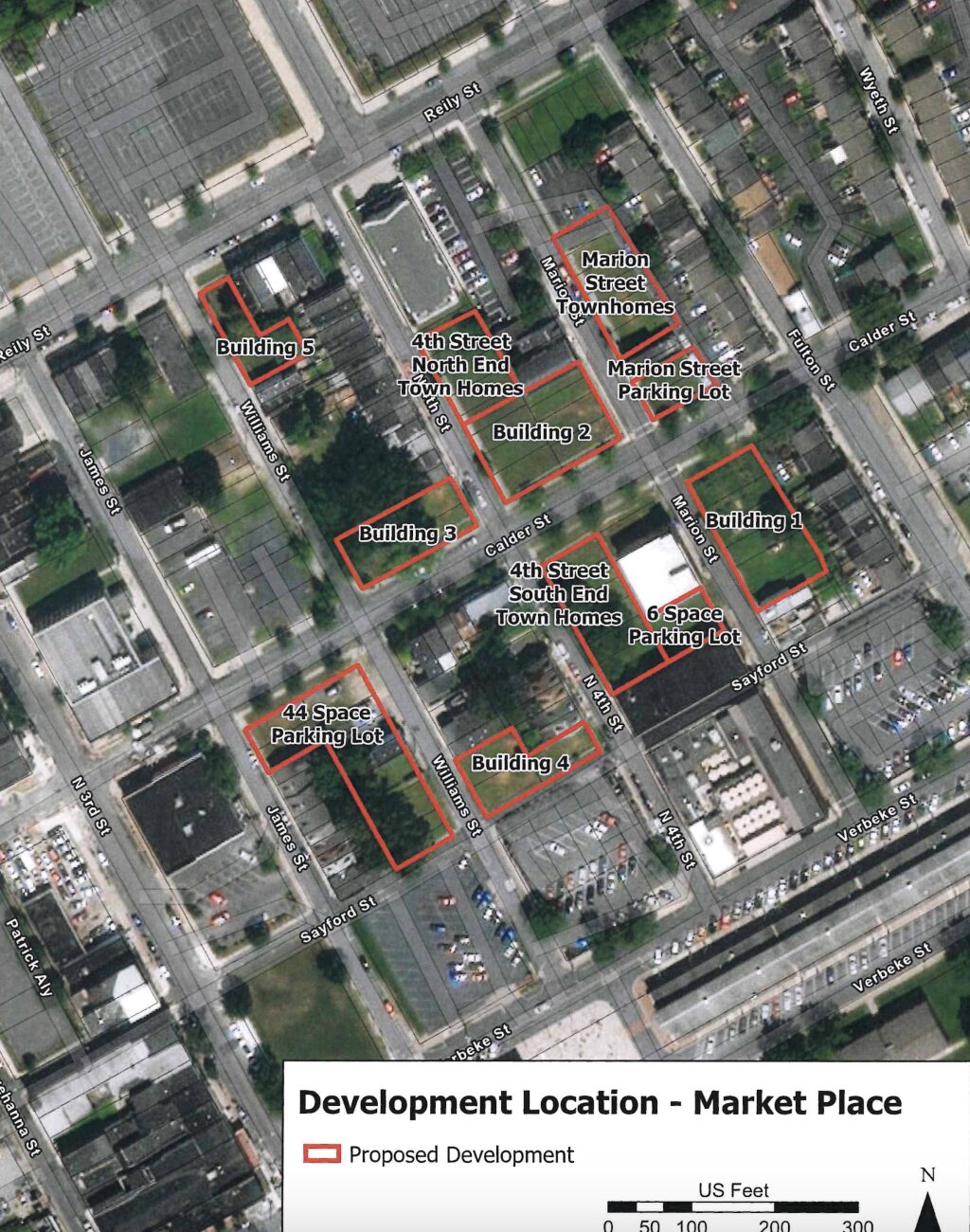
On Tuesday, City Council voted unanimously to approve the land development plan by Midtown Redevelopment LLC to construct townhomes, apartment buildings and commercial space in the area bounded by Reily, Fulton, Sayford and James streets.

A map of Midtown Redevelopment’s Market Place project

In total, the development would include 62 units across over a dozen townhomes and three 12-unit apartment buildings, near the Broad Street Market, some of which will be deemed affordable. The plan would also include 5,500 square feet of commercial space to be used as a “food hall.”

The project includes parking for residents and will have both for-sale and rental units, according to council President Danielle Hill, who added that the developers hope to break ground in November.

At the meeting, council also approved a plan by Commonwealth Charter Academy to partially demolish an old school building at 555 S. 25th St.  and construct a new building for staff and administration.

Lastly, council OK’d a resolution to negotiate and enter into an access control agreement with the commonwealth for the first block of Geiger Street, an alley adjacent to the Governor’s Mansion.

The state requested control of the street after the arson attack at the property in April. The street closure is part of their plan to improve the security of the residence.

“Any action the city of Harrisburg can take to ensure the safety of our governor and his family should be an easy yes,” Hill said, just before the unanimous vote.

All votes were 5-0, as council members Jocelyn Rawls and Ralph Rodriguez were not present at the meeting.

If you like what we do, please support our work. Become a Friend of TheBurg!

Continue Reading

Tour de Belt to return as a live event in June, adds festival at finish line

Bicyclists ride along the Susquehanna riverfront during a past Tour de Belt.

After a lengthy hiatus, the Harrisburg area’s largest annual biking event will return live this year, capped by a new festival at the finishing line.

The Capital Area Greenbelt Association (CAGA) announced on Thursday that the Tour de Belt will return as an in-person ride after two years as a virtual, “ride-when-you-can” event.

“Tour de Belt is fun-filled event for bikers, walkers, runners, and their families that promotes healthy activity and environmental stewardship,” said Neelam Zaver, CAGA board member and Tour de Belt committee chair. “It also raises much-needed funds to support one of the capital region’s most beloved outdoor resources, the Greenbelt.”

In the Tour de Belt, participants loop around the 24-mile Capital Area Greenbelt at their own pace, starting on the main HACC campus in Harrisburg. This year’s event, which takes place June 5, will finish on the adjacent campus of Commonwealth Charter Academy, where a “Finish Line Fest” will be held, featuring live music and entertainment, food trucks and other fun activities, according to CAGA.

“We think that the addition of the Finish Line Fest, this will truly become a community event for everyone to enjoy,” Zaver said. “Even if you choose not to bike in the Tour de Belt, you can come out, have a good time, and support an important cause.”

The 22nd annual Tour de Belt joins a number of other annual area events that plan to return to their regular formats following two years of interruption by the COVID-19 pandemic. For instance, Harrisburg’s Ice & Fire Festival returns fully as an in-person event on March 5.

In past years, the Tour de Belt has brought in more than 1,000 registered participants and over 100 volunteers, and organizers said that they expect potentially record-breaking participation this year. A virtual option also will be available this year, according to CAGA.

Proceeds raised by the Tour de Belt and Finish Line Fest will benefit CAGA and will be used to support improvements and maintenance of the Greenbelt. In 2021, the budget for these efforts surpassed $7 million and included increased safety of trail crossings at intersections, newly paved sections of the trail, and completion of the new Fort Hunter connection, according to CAGA.

“We’re incredibly thankful for the support of our corporate sponsors, and encourage any local businesses or organizations interested in getting involved to reach out to us at [email protected] for more information,” Zaver said. “It’s not too late to be a part of this year’s event.”

To date, sponsors of the 2022 Tour de Belt and Finish Line Fest include Lancaster County Solid Waste Management Authority (platinum sponsor), Boyer & Ritter LLC, Daflure, Dauphin County Parks and Recreation, Faulkner Subaru, Pennsylvania American Water, RKL LLP, Starr Insurance Inc., and Wilson Consulting Group.

The 2022 Tour de Belt takes place June 5, beginning at 9 a.m., on the main campus of HACC in Harrisburg, with the Finish Line Festival beginning at 10 a.m. on the nearby campus of Commonwealth Charter Academy. For more information and to register, visit their website.

If you like what we do, please support our work. Become a Friend of TheBurg!

Continue Reading

CARES Act funding under fire, as Harrisburg School District loses students to cyber charters

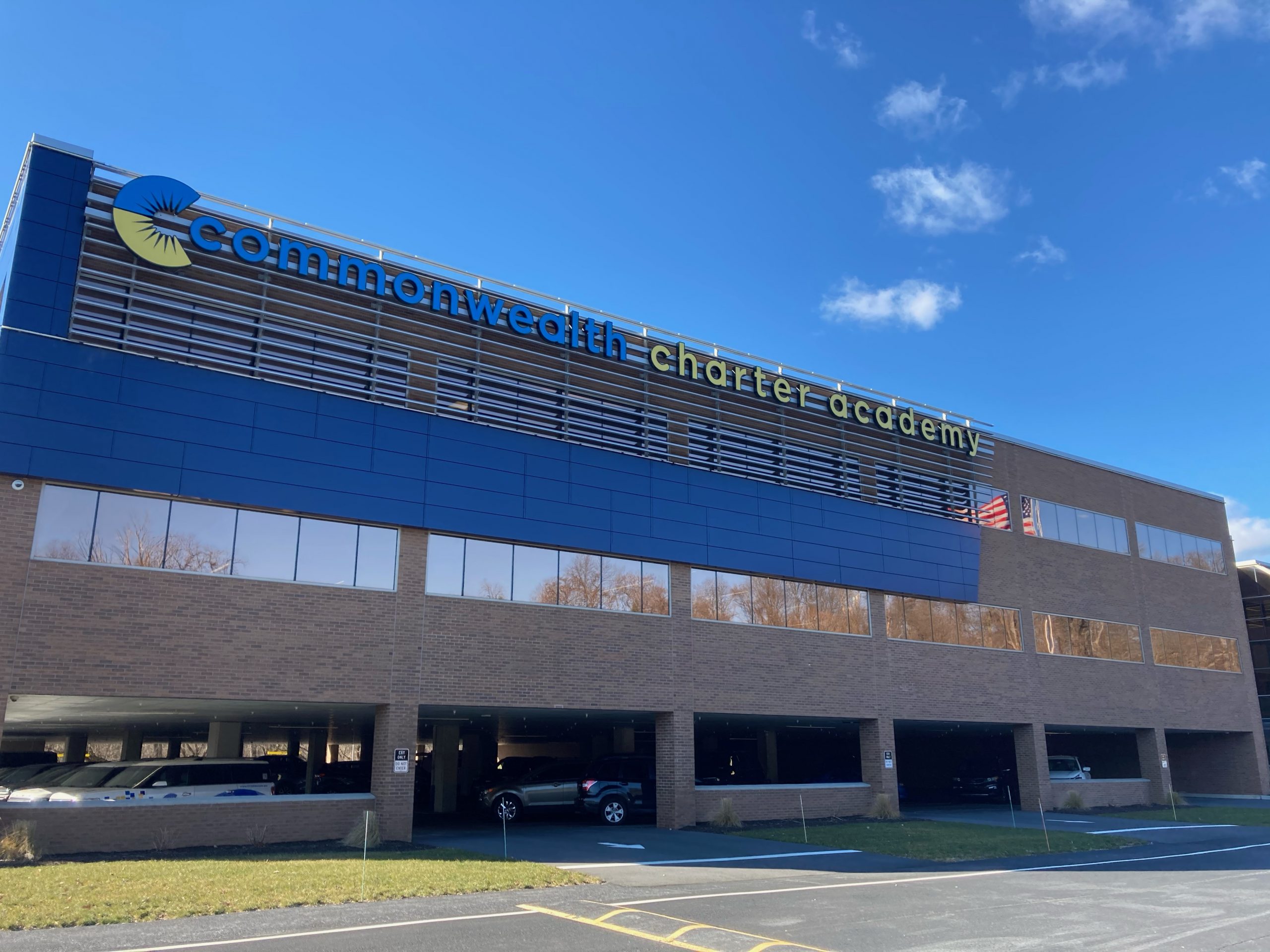
Commonwealth Charter Academy’s building in Harrisburg

Inequity has been an issue for decades, according to Acting Superintendent for the Harrisburg School District, Chris Celmer.

He was referring to what he sees as unfair funding for charter schools—specifically cyber charters.

While he’s spoken on this numerous times, this time had a new edge to it—new meaning.

Allocation amounts of second-round federal CARES Act funding recently were announced, and Celmer expressed his disappointment in what he saw.

When the pandemic hit, the Harrisburg School District had to pivot quickly, like most brick and mortar schools, closing classrooms and doling out laptops.

They scrambled to create options for students, knowing what would inevitably come and trying desperately to stop it.

The district formed the Harrisburg Virtual Learning Academy (HVLA), a cyber-only alternative to their mainstream option in which students will eventually return to the classroom.

“We understand that we need to provide options for our students and families, and we are willing to put in the time, money and effort to do so,” Celmer said.

And yet, that didn’t stop over 200 students from moving to charter schools. He said, without HVLA, which has over 200 students, the number could’ve been closer to 500.

In past years, there’s been a steady rise in students making the switch to charter. Usually, close to two-thirds choose cyber, the remaining, just over one-third, opt for brick-and-mortar, Celmer said. But during the past year, 100% of students who left for charter picked cyber schools.

With each student goes $10,000 from the school district that they must pay to the charter school, he said. For each special education student, that number jumps to $28,000. For the 200 students the district lost this year, Celmer said they are looking at a $2 to $3 million payout.

With another round of CARES funding coming down the tracks, Celmer is not happy with how money is being distributed. Sure, the district is on track to get $25 million, but what sticks in Celmer’s mind is the near $50 million the state is funneling to 12 PA charter schools.

“That is totally inequitable,” he said. “Not only is a cyber charter getting our funding, now they’re getting additional CARES funding. They’re already a cyber charter operation, they don’t have the brick-and-mortar expenses.”

The Commonwealth Charter Academy (CCA), a Harrisburg-based cyber school, will likely receive the most of the 12 charter schools—possibly $13 million.

But Tim Eller, senior vice president of outreach and government relations at CCA, disagrees with Celmer, saying the funding is fair.

From the beginning of last school year to the beginning of this school year, Eller said the student body has doubled. CCA now serves around 19,000 students.

While the school doesn’t have traditional brick-and-mortar costs, it does have expenses distinct to cyber schools, he explained. CCA supplies students with laptops, curriculum materials, printers and often subsidizes internet costs. Eller said that they also have to pay for services for small cohorts of special education students. During COVID, costs have increased as services must be one-on-one with a teacher and either at home or in a sanitary location.

“Cyber charters have unique expenses,” he said. “Districts don’t want to admit it or just don’t consider it.”

Eller noted that, under Act 13-2020, from March 13 to the end of last school year, districts did not have to pay tuition to charter schools due to the pandemic. He said that the first round of CARES Act funding helped them make up those lost funds and pay for new teachers’ salaries.

He also pointed out that, in total, $2.7 billion of the second-round CARES money is being distributed to public schools in the state, with $2.3 billion going to school districts and only $4 million to charter schools.

“These are public school students, and they deserve the same funding,” he said.

As part of his 2020-21 budget, Gov. Tom Wolf proposed charter school reform legislation that he said would create fair, predictable and equitable funding for school districts. The proposal has not been acted on.

If the reform doesn’t happen soon, Celmer believes it will never happen, given the state of education in PA today.

“This has been an issue, quite frankly, that the legislature has continued to skirt for decades,” he said. “It’s not just about the Harrisburg School District, it’s a statewide issue. Now is the time.”

Support quality local journalism. Become a Friend of TheBurg!

Continue Reading

Virtually Acceptable: Online learning gets mixed grades from Harrisburg students, families

Nazier Taylor

Nazier Taylor was always goofing off in school, self-admittedly.

He liked to “mess with” his friends and teachers. As a teenaged boy, he enjoys having a little fun. Nonetheless, he did well in his classes, he said.

When the Harrisburg School District made the switch to online learning, Nazier was happy. He got to stay home and sleep a little later. But it didn’t take long before things started going downhill.

“I always did good in school,” he said. “I hate computers now.”

At home, Nazier couldn’t focus. He would fall asleep, he said, unless he was looking at his phone. One of the biggest challenges for him was that he couldn’t keep up with his teachers. They went too fast, he said, and his mom was unable to help him.

“I was going to fail,” Nazier said.

It was his first year in high school, and he was lost.

The experience with online education has been vastly different from student to student and family to family in the school district. A few are doing well in their new environment, while others are struggling.

In August, the district decided on a 100% virtual start to the academic year. Students could either attend the new Harrisburg Virtual Learning Academy (HVLA) and commit to online learning long-term or follow the “Pathway to Classroom Instruction,” with the hope of eventually returning to brick-and-mortar learning. Acting Superintendent Chris Celmer said that about 285 students enrolled in HVLA.

However, the options aren’t looking too different today, as benchmarks that the district set in order to bring students back to the classroom haven’t been met.

In order to re-open, the district requires a three-week period of sustained COVID-19 positivity rates from 3 to 4% and incidence rates per 100,000 people below a rate of 50 in Dauphin County. There also must be a decrease in community spread of the virus.

As of this writing, these benchmarks have been met. In fact, pandemic trends have been growing steadily worse since September.

“I don’t know when kids will be back,” Chief Academic Officer Susan Sneath said. “We are trying to make the most of the situation. Nobody knows the exact right thing to do here.”

It’s a complex and difficult decision that all school districts have had to make—in-person or online? But every student seems to experience the situation a little differently.

A Challenge

During the pandemic, Nicole Smith, a fourth-grade teacher at Scott Elementary School, has been adjusting to online instruction. It has taken innovation, she said, coming up with songs and activities to engage students through a computer screen.

But it’s still not easy.

Smith has called on students before to answer a question, only to see their screen freeze mid-response.

“How much is that kid receiving from me, if it’s not working on their end?” Smith wondered.

She explained that one of the biggest issues with online schooling in Harrisburg is internet access. Many families, she said, have multiple students sharing a Wi-Fi router, slowing down the system.

When students were in school, the district had an average of one device for every five students. Now, each student needs their own device. Additionally, the district developed a program to provide free internet to students. Even with these extra measures, the district is at about 87% average daily attendance.

“We have to assume that’s 87% with secure internet,” Sneath said. “It’s a challenge.”

To access the internet and electricity, families like the Hodges have had to pay.

“The kids are home all day, every day,” said Angela Hodges, a mother of two Harrisburg students. “We are paying twice the amount we would normally pay for utility costs.”

Angela and her husband Maurice said that the extra expenses have been difficult to bear. However, they are happy to have their kids home and appreciate the district’s attempt to keep them safe.

Smith said that other barriers to effective learning are the responsibilities and distractions that many students have at home. She recalled a student who had to hold her little sibling on her lap during a class session.

“You have to be understanding of those types of circumstances,” she said.

For Nazier, getting out of his house and having a quiet place to do work has been a lifesaver.

Every Thursday night, he goes to Center for Champions, a mentorship program in Allison Hill. When the staff found out Nazier was struggling with school, they offered a desk in their office for him to work during his classes from 8:30 a.m. to 2:30 p.m. They hope to be able to do that for more students.

Ever since, Nazier has been doing better.

Support System

Phylicia Carter’s son Josiah struggled in his special education classes in the school district. He was behind where he should’ve been academically for his grade level. When the district decided to go online, Carter moved Josiah to Commonwealth Charter Academy.

While still holding her full-time job, Carter has had to help her son catch up to the sixth-grade level he is in.

“The adjustment is very difficult,” she said. “I feel like I’m in class because they are asking me to do so much. But I’m glad I made the decision I made.”

According to Celmer, about 187 students moved to charter schools between March 13 and Aug. 31, due to the pandemic. He said that the district will be reaching out to those students to encourage them to return. Harrisburg’s virtual platform is expanding, and Celmer thinks students will want to come back.

Some students that stuck with the district are doing well in the virtual world.

Siblings Maurice Jr. and Mayah Hodges said that their grades have improved while learning online.

It was a hard adjustment at first, especially for Mayah who missed her friends. But, overall, they’ve had a positive experience and have felt supported by their teachers.

Sneath said that, for most students, grades have stayed relatively stable. She hasn’t seen an “overabundance of failures” or numbers that look much different from last year.

Smith said that the virtual platform has actually allowed her to connect better one-on-one with her fourth-grade students.

She said that students can privately message their teacher if they have a question, and a teacher can do the same if a student isn’t engaged with the lesson.

Although Nazier still hates going to school on a computer, he said that his teachers have been helpful.

“School is never going to be the same again after this,” Sneath said. “So, when students do come back, how can we keep the good parts from this?”

For more information on the Harrisburg School District, visit www.hbgsd.k12.pa.us.  

To learn more about Center for Champions or to volunteer, visit www.centerforchampions.org.  

Support quality local journalism. Become a Friend of TheBurg!

Continue Reading

TheBurg Podcast: Taking Matters into Their Own Hands, August 2020

Mike Fitzgerald and Gary Dutson, both of Harrisburg, were the driving force behind Harrisburg’s Black Lives Matter mural. They explain, in their own words, what motivated them to create the mural, and they explain what the phrase “Black Lives Matter” means to them.

Tim Eller of Commonwealth Charter Academy (CCA), based in Harrisburg, expands upon the sky-high interest in Pennsylvania’s public cyber charter schools—and dispels many of the myths associated with online learning. And he explains how CCA gives back to the Harrisburg community.

Tourism is one of the hardest-hit industries as a result of COVID-19. We follow up with Mary Smith of Visit Hershey & Harrisburg for an update. She navigates through the bleak landscape but offers a few glimmers of hope. Plus, she shares staycation ideas you can find right here in your own backyard.

Plus editor of TheBurg, Lawrance Binda stops by for August’s “most Harrisburg thing”—and it’s a real treat.

Links to the stories featured and expanded on this month’s podcast:

“New Black Lives Matter Mural Painted in Midtown to Encourage Solidarity, Dialogue”

“Educated Guess”

”Vacation, Staycation”

Meet some of the Harrisburg area’s most fascinating people, and hear their own authentic stories, expanded from every month’s magazine, on TheBurg Podcast—because there’s always “more to the story.”

Hosted by Karen Hendricks. TheBurg is a monthly community magazine based in Harrisburg, Pa.; Lawrance Binda, co-publisher/editor.

Interested in sponsoring TheBurg Podcast? Contact Lauren ([email protected])

Karen Hendricks is a lifelong journalist; visit her website here.

Continue Reading

Day Off, Day On: This year, MLK Day of Service focuses on environmental justice.

Looking at our calendars can be overwhelming. Work schedules and appointments fill up the little boxes as quickly as they are checked off.

But every so often, we come across a holiday, a day off from work or school. This month it’s Martin Luther King Jr. Day, but, for thousands of people statewide, it’s no day off.

For more than 10 years, the Central Pennsylvania MLK Day of Service Committee has been providing families and groups with a way to invest in their communities for a “day on instead of a day off,” said Mike Walsh, co-founder of the committee.

This year, the theme is environmental justice, the year coinciding with the 50th anniversary of Earth Day. Service activities and informational booths will feature ways to care for the environment, while encouraging thought about the inequality in environmental protection that vulnerable populations face.

“How we treat our place affects how we treat each other,” said Chad Frey, a committee member.

Frey explained how, often, waste management sites or other pollution-producing plants are placed in communities of color—neighborhoods that don’t always have the option to voice opposition.

The education will hopefully cause people to think, “How can I lend my voice when people in the community are making decisions that may adversely impact my neighborhood?” Walsh said.

The main hub of activity will take place at Commonwealth Charter Academy in Harrisburg. Here, 300 to 500 volunteers will help pack food for Meals on Wheels, write letters to military personnel and pediatric patients at Penn State Medical Center and donate blood to the Central PA Blood Bank, said board member Eileen Jacobs.

In keeping with the theme, partners like the Pennsylvania Game Commission and the state Department of Environmental Protection will provide activities such as building bluebird boxes and offering information on composting and planting in an urban setting.

“Even if you don’t have a backyard with soil, you can still grow in pots,” Walsh said.

There will also be a table for visitors to interact with and learn about cultures from around the world, as well as a number of minority-owned businesses to check out, Jacobs said.

“It’s been incredible to see people come together from all parts of the community,” Walsh said.

Service projects outside of CCA may involve volunteering with nonprofit community groups, such as Friends of Midtown, visiting a local nursing home or helping at the Central Pennsylvania Food Bank.

While the holiday may only come around once each year, Walsh sees this as inciting yearlong engagement.

“People have learned about organizations they didn’t know existed,” he said. “King Day is a start. It’s a significant way to engage people, and Dr. King’s message resonates with everyone.”

For Frey, the day is helping to further King’s dream of “the beloved community” right here in Harrisburg. It’s a small piece of a large task, but it is helping diversity flourish in a tangible way.

“We need to try to keep hammering away in our own little pockets,” he said. “I’m hopeful for this year.”

The Central Pennsylvania MLK Day of Service is on Jan. 20. Activities at Commonwealth Charter Academy, 1 Innovation Way, Harrisburg, run from 9 a.m. to 1 p.m. For more information about all projects, visit www.centralpamlkday.org.

Businesses on the 1000-block of N. 3rd St. are holding a community drive for those in need on Jan. 20, Martin Luther King Jr. Day. Pastorante, Urban Churn, Keystone Diner, Gifted Hands barber shop, etc., donated and are giving out food, blankets, hot chocolate, socks. Urban Churn at 1004 N. 3rd St. will be serving out soup, hot chocolate, misc food items. Gifted Hands Barber Studio at 1008 N. 3rd St. will be giving out the blankets, socks and $10 haircuts.


Continue Reading

UPMC Pinnacle takes first step into Midtown with expansion to Campus Square building

The Campus Square building in Midtown Harrisburg

As UPMC Pinnacle has grown and grown, you may have wondered—where could they possibly expand to next?

Here, at least in part, is your answer: Midtown.

On Monday, a handful of Pinnacle employees will spend their first workday in the Campus Square building at the corner of N. 3rd and Reily streets in Harrisburg. Before the month is out, about 40 employees will work in that office, said Phil Guarneschelli, UPMC Pinnacle’s president and CEO.

“We are moving some administrative offices to make more room for patient services at UPMC Pinnacle Harrisburg,” Guarneschelli said. “We are very excited about this growth and the care we can provide to patients as a result.”

After a two-year construction period, GreenWorks Development opened the sprawling, 75,000-square-foot building in 2009. The building once housed HACC’s administrative offices and Commonwealth Charter Academy, a cyber charter school. Both have since moved out, and GreenWorks has been filling the building with new tenants, including lobbying firm Maverick Strategies, which relocated from downtown last year.

The move represents a branching out geographically for UPMC Pinnacle in Harrisburg. Until now, it had clustered its workers around its facilities in downtown/Shipoke and at the Polyclinic campus in Uptown. Technology, though, now allows some employees to work more distantly, Guarneschelli said.

He cited a host of factors for selecting the Campus Square building, including parking availability, competitive rental cost and LEED energy certification, as the building is geothermally heated and cooled and has a 42-kilowatt solar array on the roof.

He described his employees as “excited” to make the move.

“Many have already checked out the restaurants in the area,” he said. “But as with any move, it will take some time to acclimate.”

Samra Alic, owner of Dalicia Bakery and Coffee Shop directly across N. 3rd Street, said that she warmly welcomed her new neighbors. She recalled that Commonwealth Charter Academy students used to stop in for coffee or a pastry.

“I’m very happy about this,” she said. “With more people coming in here, it’s going to be better.”

While this is UPMC Pinnacle’s first foray into Midtown, it may not be their last.

“As we continue to grow and expand the great services of UPMC, we expect there may be times we need to shift locations to accommodate changes,” Guarneschelli said. “At this time, there are no planned moves. There is capacity at this new location if the need arises.”

Continue Reading