Tag Archives: Calobe Jackson Jr.

He Lifted Us: Lenwood Sloan was an artist, activist, visionary, friend

Photo by John Bivins

Visionaries always have their doubters. When Lenwood Sloan was collecting support for “A Gathering at the Crossroads” sculpture, naysayers sidled in to discourage potential donors.

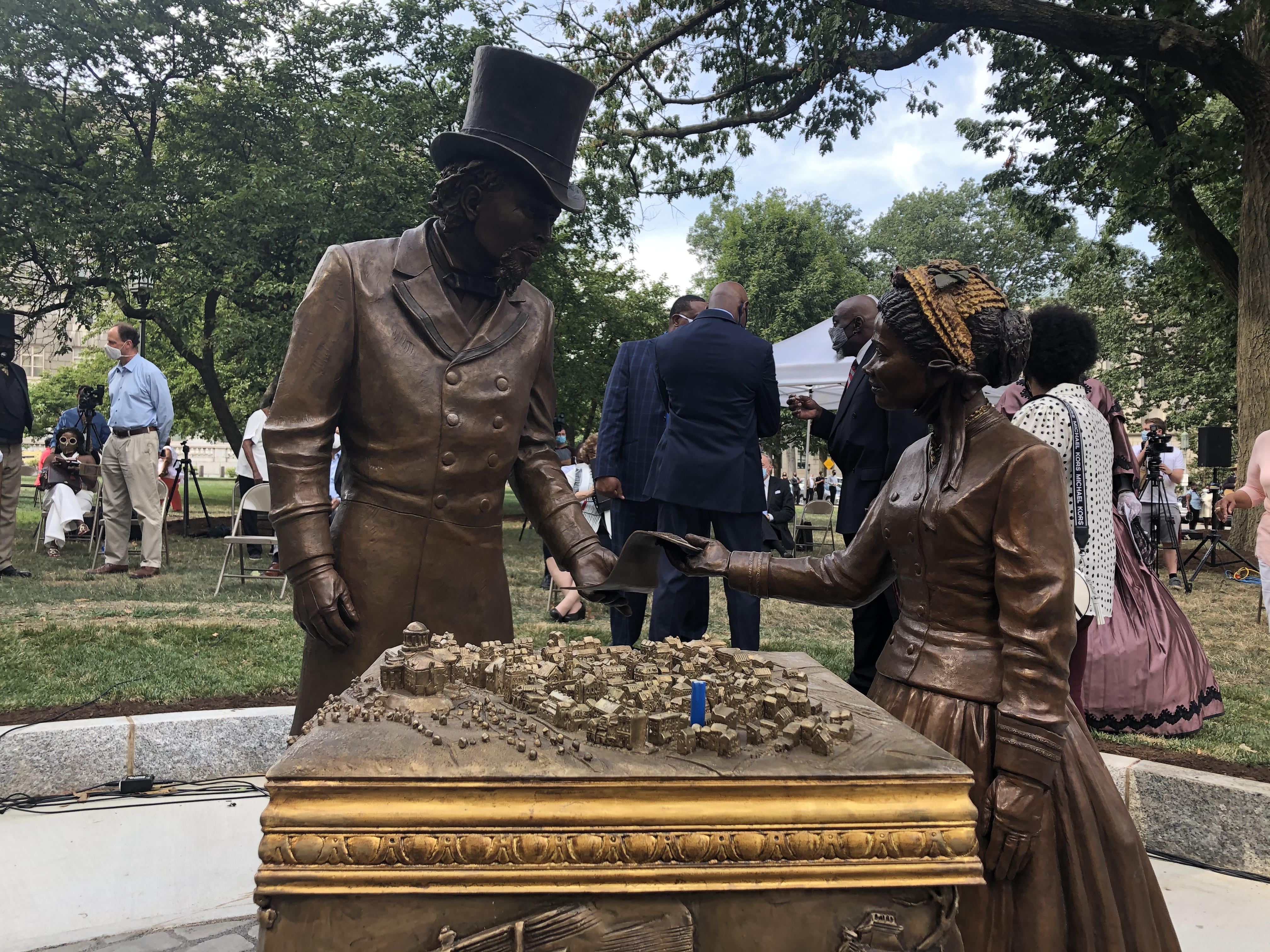
But guess what stands today in the Pennsylvania Capitol Complex? “A Gathering at the Crossroads Commonwealth Monument,” commemorating the civil rights victories of residents and visitors to the vanished Old Eighth Ward of 19th-century Harrisburg.

“He always kept his eyes on the vision, which meant that no matter what anyone was saying, no matter who was opposing him, he always rose above it, and he stayed focused on the goal,” said Yvette Davis, director of the Popel Shaw Center for Race & Ethnicity at Dickinson College in Carlisle. “No matter what point of the process we were in, he could describe that monument with such meticulous detail, you would think it had already been constructed.” 

Sloan was a “catalytic agent.” He convened people and turned dreams into reality through his talents as public historian, reenactor, actor, dancer and leader in the National Endowment for the Arts and government arts and heritage offices in Pennsylvania, California and New Orleans.

Sloan died suddenly on Dec. 26 at age 77. He left behind countless grieving but grateful friends, family members and colleagues. Anyone ever on Sloan’s famous non-bcc emails had insight into the hundreds of people he could sweep into his orbit, one change initiative at a time.


Living His Purpose

This story is about what family and friends learned from Sloan. There isn’t enough room for all of his accomplishments. In addition to “A Gathering at the Crossroads,” now a Harrisburg landmark anchoring T. Morris Chester Way (yes, another Sloan ideation), here are a few:

  • The Grand Review of the United States Colored Troops, a 2010 reenactment of Harrisburg’s 1865 Grand Review for Black troops shut out from the Union Army’s victory parade in Washington
  • The Pennsylvania Past Players, skilled reenactors animating the lives of central Pennsylvania’s abolitionists, Underground Railroad conductors and early civil rights activists
  • The International Institute for Peace through Tourism Peace Promenade in Harrisburg’s Riverfront Park
  • Pennsylvania artisan and heritage trails

“He had an incredible eye to help people realize what they might have in their backyard and to frame what I would call the embarrassment of riches in Pennsylvania to residents and visitors alike,” said Michael Chapaloney, a former colleague in the Pennsylvania Department of Community and Economic Development’s tourism office.

Raised in Pittsburgh, Sloan trained and danced with the Alvin Ailey American Dance Theater and the Joffrey Ballet. He staged his own theatrical works—his “Vo-Du Macbeth” reimagining of Orson Welles’ “Voodoo Macbeth” must have been something to see—and recreated historical dances, leading to film and television consulting that included movement specialist for “12 Years a Slave.”

To Heather Williams of College Park, Md., her Uncle Leni always had a project underway.

“He was this big, huge presence as a vessel and a visionary, and yet, there was also this part of him which I call his humble heart,” said Williams, the daughter of one of Sloan’s sisters.

Part of her mother’s massive Black art collection is in Lancaster Art Vault’s February African American art exhibit, complete with descriptions that Sloan assigned family members to write, because he walked into the gallery, struck up a conversation, “and before she knew it, they were booking a date.” 

“His purpose was to be a catalyst for change, and God gifted him with talents and with an interest in developing those talents to be able to live his purpose,” Williams said. 

After Sloan learned that erecting “A Gathering at the Crossroads” in Riverfront Park, as originally intended, required buying insurance to cover maintenance, he pivoted by working to gift it to the state, “and the state would keep it up,” said Harrisburg historian Calobe Jackson Jr. 

“He can finalize anything,” Jackson said. “Some can theorize, but he’s able to take a theory and put it together and get a final product. That’s what I like about Lenwood.” 


Moving Forward

As a public historian, Sloan encouraged people to find the family stories and mementos hidden in attics and stashed under beds. When historian and genealogist Sharonn Williams learned that she is a great-niece of Jacob Compton, the Harrisburg coachman famous for spiriting Abraham Lincoln away from would-be assassins, Sloan told her, “Your work is not done.”

Today’s policies requiring immigrants to carry papers and deporting them to unfamiliar countries echo manumission and colonialism, when slaveowners shipped enslaved people to distant states, and the children of Native Americans were forcibly assimilated, said Williams. 

“There are people around us who say, ‘That’s new. That’s different,’” Sharonn Williams said. “No, it’s not. It’s not new.”

In the wake of Sloan’s death, she added, “we need to keep moving forward, make sure that we are doing things for and in the public that will keep telling these stories.”

Davis, a Pennsylvania Past Players member and the Dauphin County Library System board president, was in awe of Sloan, “so touched and humbled and intimidated that he would take me under his wing as he would for so many other people.” 

At one Pennsylvania Past Players event, Davis’ heart dropped when Sloan asked her, without warning, to explain Pennsylvania’s coverture laws that erased a married woman’s legal identity—a topic Davis hadn’t reviewed in months. 

“Lenwood knew that I knew the answer to that question,” Davis said. “I didn’t know that I knew the answer. But in that moment, by God’s grace, it all came back, and Lenwood had such a smile on his face.”

Sloan met his husband, poet Byron Clement, through a mutual friend in New Orleans. Together for 22 years and married since 2017, they relocated to Harrisburg just before Hurricane Katrina. 

“He was pretty self-propelled,” Clement said. “He had great talent for bringing people together. He had immense energy. It took a lot of pushing to get these things through, and he’d hang in there and fight for them.” 


New Vision

Inspired by his parents’ activism and nurtured by his family, Sloan used and preserved history to generate change, even while he was the uncle who never missed a dance recital, said Heather Williams. 

“Very few people know how to love and give equally,” she said.  

Sloan was “always interested in what you were doing,” echoed Tom Weaver, former associate artistic director of Gamut Theatre Group. 

Gamut was rehearsing its 2014 Free Shakespeare in the Park production of “Antony and Cleopatra” when Sloan made the steep trek to Reservoir Park—the non-driver walked everywhere—to address the cast.

Smartly dressed, as always, Sloan shared his support for the players offering a free event to the community.

“He was so inspiring and encouraging,” Weaver said. “I don’t think anyone in that cast knew him at the time. I remember seeing their faces just light up as he was talking to them, and it injected some inspiration and some strength into that rehearsal.” 

Family and friends are discussing how to memorialize Sloan, but all agree that his greatest monument will be continuing his work.

Sloan was “adamant” that the Pennsylvania Past Players capture the spirit and humanity that drove oppressed people—of all races, ethnicities and colors—to overcome, said Davis. 

“That increases the collective self, the collective esteem of basically any community, even if you were not among the oppressed,” she said. “There is a new vision to how you can partner with the oppressed to bring justice, which also increases that group’s self-esteem with a lens toward justice, power, strength, wisdom and persistence.” 

Sloan, she added, was “the poster child for persistence.”

“It’s going to take hundreds and hundreds of feet to fill Lenwood’s shoes, and there will still be room in them. He left so many legacies. He lifted us in so many, many, many ways,” Davis said.

If you like what we do, please support our work. Become a Friend of TheBurg!

Continue Reading

A Doctor’s Life: Dr. Charles Crampton was one of Harrisburg’s most prominent Black citizens, until the system turned against him

Illustration by Ryan Spahr.

“He enters the Esquire Bar. All the big muck-a-muck politicians go there. It surprises me that they let a colored man enter. He’s certainly the only one.”
– “The Blue Orchard,” Jackson Taylor

In early 20th century Harrisburg, then called “a Northern city that still practices Southern ways,” Dr. Charles Crampton broke racial barriers.

He was vice chairman of the Dauphin County Republican Committee. State deputy secretary of health. Vote-getter for power-broker M. Harvey Taylor. Popular emcee for the era’s countless testimonial dinners and confabs. Wartime patriot and tireless civic fundraiser. Beloved high school athletic trainer. Physician whose wealth purportedly derived, at least in part, from providing the “illegal operation” sought by women of all classes and races.

And a man whose reach and influence didn’t protect him, in the end, from arrest for allegedly providing the very abortion procedures that likely had been an open secret for decades. To this day, his legacy lingers in the youth he inspired to pursue their dreams—and in the tale that his story tells of racism’s power to hem in Black Americans of accomplishment.


Inspiration to Youth

“Have you thought about college?” One question from Charles Crampton changed the trajectory of Calobe Jackson Jr.’s life. Like many other young people, he was inspired to reach higher by Crampton’s example and guidance.

As a child, Jackson, now 93 years old, lived around the corner from Crampton. Jackson’s father, whose barbershop still stands at 6th and Boas streets, would go to Crampton’s home every day to give the doctor a shave and weekly haircut.

Young Calobe sometimes stepped in for Crampton’s chauffeur—Crampton was known for his grand autos driven by white chauffeurs—to perform the daily task of hosing down the sidewalk and polishing the brass doorknobs. Crampton would give Jackon $5 or $10 for the job, “which was a lot of money then,” recalled Jackson, now a leading historian of Harrisburg history.

In August 1948, Jackson graduated from William Penn High School. Though he enjoyed academics, he figured he would follow in his father’s footsteps until Crampton offered the prospect of a senatorial scholarship to Lincoln University. Harvey Taylor, then a state senator representing the city and Dauphin County, had already awarded his allotment.

“But don’t worry,” Crampton told Jackson. “I’ll get you one from Cumberland County.” Which he did, through state Sen. George Wade.


Road to Leadership

Charles Hoyt Crampton was born in Harrisburg in 1879, probably to Benjamin and Susan Crampton. “Probably,” because he was adopted at age 7 or 8 by Col. L.F. Copeland.

A white progressive, Copeland, a lawyer and Chautauqua-circuit lecturer, “maybe did this as an experiment, to adopt a Black child and see what would happen,” Jackson said. “He gave him a chance at all possible education.”

Elected class orator for the Harrisburg High School class of 1899, Crampton was the first Black student to give an address at graduation ceremonies. Skipping undergraduate studies, he went directly to Howard University Medical School.

Returning to practice medicine in Harrisburg, Crampton “immediately leaped into popularity,” reported the Pennsylvania Negro Business Directory–1910.

He led or joined everything. Masons. Elks. Harrisburg Kappa Omega. He chaired wartime Red Cross drives. He helped desegregate city movie theaters, according to Jackson. He brought renowned Black personalities to speak in Harrisburg: contralto Marian Anderson, boxer Joe Louis, track star Jesse Owens.

“He seemed to know everybody,” Jackson said. “I understand Booker T. Washington came here at his request at one time.”


Sports Icon

Crampton’s unflagging devotion to building the Forster Street YMCA was driven by a passion for giving the city’s Black youth, barred from the all-white YMCA, an outlet for sports and team play. For 40 years, he served as athletic trainer for Harrisburg Technical High School and one of its successors, William Penn High School.

Every Thanksgiving, Crampton wound up the crowd at pre-game rallies for the annual William Penn-John Harris high school football matchup. He kept William Penn players “in tip top shape,” reported the Harrisburg Telegraph. Injured students never got a greenlight to play, no matter their star power.

When students visited his office, they might leave with a bit of life advice and maybe “treats, money to buy this and that.”

“The Blacks (working) in the schools were probably janitors, and here we had Dr. Crampton, who was this outstanding man who came out and made speeches before football games,” Jackson said. “He was a great person to be around.”

His work with youth exemplified “staunch adherence to the philosophy of true sportsmanship in play as a character building essential,” said a 1947 news report of a tribute dinner attended by Pennsylvania Gov. James H. Duff and other luminaries. “‘Dr. Charley,’ as he is known to his countless friends, is a living example of leadership in the Colored Race,” stated the Harrisburg Telegraph.


Unraveling

From the early 1930s to late ‘60s, state Sen. M. Harvey Taylor ran the city and, as Senate President pro tem, much of Pennsylvania.

Crampton hitched his star to Taylor’s political wagon, earning appointment as Pennsylvania deputy secretary of health. As county Republican Committee vice chair, he represented the Black vote. Leading the “Colored Voters for Shannon League of Pennsylvania,” he endorsed Edward Shannon’s 1934 gubernatorial campaign with, “The response among members of my race has been whole-heartedly for General Shannon. We are for him 100 per cent.”

But even as early as 1928, columnist George S. Schuyler berated what he saw as well-heeled Black leaders in Harrisburg loathe to jeopardize their lucrative political connections by fighting to desegregate the city’s Jim Crow elementary schools or open doors to better jobs for Black citizens. Crampton was one of them, Schuyler wrote in the Pittsburgh Courier, a Black newspaper. They were “sheep in the Republican fold.”

After World War II, Crampton’s fate spiraled downward. Reformers sounded the “dirge against Taylorism” in their “fight against local bossism,” in the words of the Harrisburg Evening News. Joseph A. Randall, a physician and boxing manager, rallied the Black Democratic vote. He charged that Taylor’s machine siphoned money from scholarship funds meant for the city’s Black students.

In those post-war years, Taylor was pushing a breathtakingly audacious plan to expand the Capitol grounds by razing swaths of the city’s largely African American 7th Ward, repeating history from the 8th Ward’s fall in the 1920s. Properties in the way included Crampton’s own fine home and his beloved YMCA on Forster Street.

Crampton’s attempt to straddle the gap by offering $5,000 toward public housing for the displaced embarrassed and angered Taylor, as described in “The Blue Orchard,” Jackson Taylor’s meticulously researched novelization of the story of his grandmother, Crampton’s white nurse. The rift would not heal.

In May 1953, Crampton received notice from the IRS demanding $95,791 in back taxes. That November, he was demoted from his Health Department post. Three weeks later, he suffered a heart attack.

In the days before Roe v. Wade, women in every family and every beauty parlor knew where to find abortion procedures. Those with means chose physicians for an assurance of safety and hygiene.

Was Crampton one of those physicians?

“I suspect that he was, but they couldn’t really prove it,” Calobe Jackson said.

In 1951, a new Dauphin County district attorney succeeded a friend of Crampton’s. This DA did not turn a blind eye when a Hazleton woman, in a tiff with her boyfriend, told police they had gone to Harrisburg for an abortion performed by Dr. Charles Crampton.

In November 1954, police arrived to arrest Crampton and his nurse. “That’s what you get for doing favors for people,” Crampton told them.

At trial, he would explain. “I was vice chairman of the Dauphin County Republican Committee, and I should have been treated more justly.”

Crampton denied the charge. The first jury he faced couldn’t reach a verdict. In a second trial, 42 character witnesses included his student athletes, now grown into solid citizens. The judge asked the jury whether such a respected man “could have done the things of which he is accused.”

That jury also deadlocked, and the judge ordered acquittal.

“Charles H. Crampton is a free man today!” cheered the Pittsburgh Courier.

In March 1955, 400 friends gathered at First Baptist Church in Steelton to celebrate Crampton’s 76th birthday. On Nov. 16, 1955, Crampton died at Harrisburg Hospital. He was buried not in the city he devoted his life to, but in Tyrone, Pa., home of his parents.

In April 1956, his belongings were auctioned to pay the back taxes. His home was then razed to make way for the Pennsylvania Department of Labor and Industry building.

Crampton once welcomed the 22nd meeting of the District Grand Lodge Number One, Grand United Order of Odd Fellows, a Black division, to Harrisburg.

“Honor men as you expect to be honored, be good and law-abiding citizens and treat your fellow men as you expect to be treated,” he told them, “and there will be no dividing line between the white and colored races.”

If you like what we do, please support our work. Become a Friend of TheBurg!

Continue Reading

Across Generations: Black Americans are discovering a fuller picture of their past, aided by new tools, digitization

Barbara Barksdale with photos of her ancestors.

Something was up. Sharonn Williams, an experienced Black genealogist, just knew it.

She had typed into Ancestry.com the name of a distant connection born in Charlottesville, Va., and dozens of “hint leaves” popped up from other family trees. More frightened than curious, Williams turned off the computer.

“I had to push away,” said Williams, the great-granddaughter of Ephraim Slaughter, one of Harrisburg’s last surviving Civil War veterans. “I knew that meant white blood. I knew it had to be somebody important, or there would not have been that many leaves, and because it was Charlottesville, I thought, ‘This is not going to be good. I can’t deal with that tonight.’”

Genealogy has never been a breeze. Still, for white Americans, the truth about sepia-toned ancestors usually lurks in census records, ship’s logs and church archives. But Americans of African descent have few Mayflower moments for their unnamed, enslaved ancestors. Even after the Civil War, indifference or barriers to documenting the lives of African Americans created genealogy roadblocks.

Now, social media, digitization and DNA are restoring forgotten stories to the American experience, dispelling myths and illuminating the interconnectedness of Black and white in America.

Williams’ encounter with the chasm between white and Black genealogy, and its closure through the power of technology, happened that night she entered “Betsy Hemmings” into Ancestry. Naturally, you see what’s coming. Hemmings was born at Monticello, a cousin of Sally Hemings. Williams learned that Betsy, too, was an enslaved concubine, to Thomas Jefferson’s son-in-law, John Wayles Eppes, a prominent Virginia lawyer and politician who would go on to serve in the U.S. House and Senate.

Without that link to famous whites in history, few leaves would have appeared. Betsy Hemmings’ life would have been barely traceable.

Hard Pill

Pre-internet, records didn’t come to genealogists. Genealogists went to the records. For Black genealogists, those records were less likely to be housed in archives.

Prominent genealogist Barbara Barksdale remembers chasing clues, driving around the country, pumping quarters into pay phones, hunkering in basements, and jumping over holes in the floor to put her hands on family records.

“Everything was visual,” said Barksdale, the founder of Friends of Midland, the society preserving the historic African American cemetery in Steelton. “Everything was in hand. You had to smell it. You had to sneeze from the dust of it all.”

And while the digital age is minimizing the tactile joys of genealogy—“You don’t get to sneeze your ancestors out,” Barksdale said—it is also connecting researchers with previously inaccessible records.

Harrisburg historian Calobe Jackson, Jr., notes that the details of the 1950 U.S. Census will be released this April and quickly digitized for easy access. There, in the count reflecting the post-World War II migration of Black Americans from the South to the North, he hopes to find a few previously hidden ancestors—perhaps an elderly relative living with family.

“More people will see themselves in the Census than ever before,” Jackson said. “A lot of people are going to see their relatives in the north they never knew about.”

While transcription of handwritten records has saved countless historian eyes, digitization that makes them searchable has finally come to an invaluable trove for Black Americans—the records of the Freedmen’s Bureau. Documents from the federal agency, charged with helping the formerly enslaved adjust to life after the Civil War, were once scattered and confoundingly organized. When Ancestry.com made them available online in fall 2021, historians gained searchable access to records of rations issued, refugee camps operated and relocations facilitated.

Lynette Palmer at Dauphin County’s East Shore Library.

Lynette Palmer, a Dauphin County Library System information services assistant, presents genealogy webinars for institutions nationwide. One webinar attendee found a relative in a Freedmen’s Bureau labor contract—“the first place she ever found something in writing that gave validity to this person that her mother said her family had been telling her about,” Palmer said.

“It’s given people the opportunity to fill in some holes,” she said. “Digitizing is great, but digitizing still doesn’t make them searchable. You can browse if you have a million hours in a day.”

There are shocks to prepare for. Palmer once discovered an enslaved ancestor inventoried with a plantation owner’s livestock.

“To these people, my ancestors were the same as cows and horses and other property,” she said. “If you know history, you know it was real, but seeing actual real-life documents with a price on a person—for a lot of African Americans, it’s a hard pill to swallow.”


Ties that Bind

DNA and technology are revealing an unvarnished truth—a long history of shared blood between white and Black. Much of it began with rape by slaveholders and others in positions of power.

“People want to believe the Romeo and Juliet thing, that they were in love,” said Williams, founder of Kindred Spirits genealogy workshop. “Get over yourself. We know what it was.”

Barksdale, whose DNA traces to 13 world regions, only occasionally reaches out to white relations through Ancestry, hesitant to reveal that their greats were rapists or slaveholders. Of those she has contacted, one said his long-ago grandfather must have really loved Barksdale’s long-ago grandmother. Others don’t respond.

“It’s a big difference once the whites find out they have a lot of Blacks in their history,” said Barksdale.

Through a relative who wrote a family history, Palmer found a distant grandmother descended from a slaveholder’s son.

“The proof is on multiple levels,” she said. “Here are actual documents that exist from that time that clearly say this. Then there’s the DNA piece. DNA doesn’t lie. If you share DNA with somebody, then you’re related on some level.”

Difficult conversations might follow, said Williams, but the findings also create opportunities. Through digitization, descendants of slaveholders can share family records that could fill holes in Black family trees, such as plantation logs revealing names and places where enslaved ancestors were purchased.

“Genealogy is something that is very personal, but you can’t do it in a vacuum,” said Williams. “You have to depend on the generosity of others.”


Fuller Picture

People today infected with the “crippling mindset” of believing “Lost Cause” myths are unlikely to accept the true version of events, Williams said. That would mean relinquishing power and “admitting that they are just like everybody else.”

Still, the stories must be told for a picture more encompassing than the history taught in school, said Jackson.

“The true stories are starting to come out about what really happened in American history,” he said. “There are the horror parts of slavery, and the fact that slavery did exist. We’ve even found more Black Americans that owned slaves. It’s telling the whole story.”

Black genealogists continue fighting to archive existing records for all to find. Williams was among the experienced genealogists recruited for the meticulous process of transcribing the Freedmen’s Bureau records. Barksdale once caught materials tossed out a window to her.

“And they were so moldy and filthy,” she said. “But now, those records are in the Historical Society of Dauphin County, and Dickinson College transcribed them. If we did not salvage those records, they would not be online for everyone in the world to look at.”

Of course, some stories are just plain colorful. Williams discovered her great-grandfather William was married to Carrie Jackson, and William’s brother, Daniel, was married to Mary Jackson. Just a case of brothers marrying sisters, right?

It took years, but Carrie’s obituary on that searchable godsend to genealogy, Newspapers.com, finally confirmed a hunch—that Mary Jackson was Carrie’s mother.

“I was like, ‘That can’t be right,’” Williams said. “It was so crazy. So, the mother and the daughter were in-laws.”

Every morning, Barksdale prays that she has the best of all her ancestors “wrapped up inside of me.” She turns her genealogy work for clients into positive stories of the journeys into “nooks and crannies of the world that nobody has bothered to dust off.”

“It gives them peace of mind to know who they are,” she said. “We are part of our ancestors. It helps us think about what our next steps in life could be, and how we pull forward those who are around us. It doesn’t matter if they’re Black or white. How do we help everybody in that unit get ahead? Just because there were some bad things in our lives that we found out through DNA, how do we turn that back and make it into something better and more prosperous for all of us?”


Finding Your Roots

Superheroes are popular because everyone likes origin stories, a guest once said on “Finding Your Roots with Henry Louis Gates, Jr.”

That knowledge, made increasingly possible for Americans of African descent, adds to the national dialogue about where the United States came from and where it’s going, “Finding Your Roots” executives told TheBurg in a phone interview. The popular PBS series is helping drive interest in personal genealogy and its cumulative power to reveal untold chapters in American history.

“For so long, African Americans were erased from the narrative,” said Lead Genealogist Kimberly N. Morgan. “We need to get their stories told, put them back into the narrative, and give them and their descendants as much of their agency as possible. Everybody wants to know where they come from. If we can answer that, especially for African American people in this country, it’s a really powerful gift.”

Since “Finding Your Roots” premiered in 2012, the availability of genealogical records online “has just exploded and continues to explode,” said Executive Producer Sabin Streeter. “Our sense of what’s possible, even at the professional level, has expanded, and certainly what’s possible for the person at home who wants to do their family genealogy, it seems like a tremendous shift.”

The average Black American has about 25% European heritage, said Morgan. Gather that DNA in databases, and the common threads of heritage become clear. Such findings and stories, when uncovered and shared, provide a launching pad for conversations about race.

“It’s a very quick way of telling how interconnected we are,” said Streeter. “It’s a very quick way of bringing the horror of slavery present for everybody. It is a hard thing to think about, but it is a fundamental aspect of who we are as a people.”

This season’s “Finding Your Roots” session with actor and director Rebecca Hall, whose grandfather sometimes chose to pass as Native American or white, generated “a huge amount of chatter on social media,” said Morgan. The answers to many “whys” of history will never be known, but creating context helps build understanding.

“I love that our episodes and our work are facilitating some of these conversations,” Morgan said. “You need to find a foothold into history that catches your interest and opens that door to how you relate to them, and that relation allows you to start to empathize.”


If you like what we do, please support our work. Become a Friend of TheBurg!

Continue Reading

Historic Harrisburg Association to host discussion on Underground Railroad locally

Local historians will discuss the Underground Railroad in Harrisburg. Pictured: The Commonwealth Monument, “A Gathering at the Crossroads”

Just in time for Black History Month, the Historic Harrisburg Association is giving the community the chance to reflect on Black history locally.

On Monday, HHA will host a free webinar on “The Underground Railroad in Harrisburg,” sponsored by The Foundation for Enhancing Communities.

The program will feature three prominent local historians—Barbara Barksdale, president of the Friends of Midland Cemetery; Calobe Jackson, longtime community leader, historian and author; and Norman Kelker, descendent of one of Harrisburg’s oldest families.

“Barbara, Calobe and Norman have been instrumental in helping Historic Harrisburg Association to expand its role in documenting, interpreting, publicizing and preserving Harrisburg’s rich African-American heritage,” said Dr. Dorothy King, retired professor of American Studies at Penn State Harrisburg and chair of HHA’s Education Committee.

These historians have worked for years on scholarly research and published writings, lecturing, reenactments of historical figures, and preservation of historic sites related to Harrisburg’s cultural heritage, HHA stated in a press release.

Barksdale’s Friends of Midland Cemetery is central Pennsylvania’s oldest known African-American cemetery and interment site of former slaves. U.S. Colored Troops from the Civil War and generations of community leaders are also buried there.

Last year, Jackson, at age 90, was honored by Historic Harrisburg for his lifetime of community service. He played a key role in creating Harrisburg’s first monument to Black heritage, the Commonwealth Monument at the Capitol Complex.

Kelker’s ancestor, Rudolph Frederick Kelker, was a leading abolitionist and operator of a “station” on the Underground Railroad in Harrisburg. Kelker Street in Uptown Harrisburg is named for Norman’s family, HHA said.

The three presenters will share stories from their research on the Underground Railroad in Harrisburg.

Additionally, February is the 48th anniversary of Historic Harrisburg Association’s founding, Executive Director David Morrison said. To celebrate, they plan to hold a campaign to raise money for the Midland Cemetery and the Commonwealth Monument.

“We are inviting HHA members and friends to honor Barbara Barksdale and Calobe Jackson by supporting their respective key initiatives to preserve African-American heritage,” said Morrison.

For more information, to access the Zoom presentation or to donate, visit HHA’s website.

Support quality local journalism. Become a Friend of TheBurg!
 

Continue Reading

Voices of the Past: New book tells the stories of Harrisburg’s historic African American community

In August, a new monument celebrating African American history was erected on the Pennsylvania state Capitol grounds.

The Commonwealth Monument Project came out of a desire to pay tribute to Harrisburg’s Old 8th Ward, a historic African American and immigrant neighborhood that was demolished to expand the Capitol grounds.

The best way that Lenwood Sloan, executive director of the project, could think to honor the memory was by introducing people to the families that once lived in the neighborhood.

On the monument, 100 names were inscribed. But that wasn’t enough. He wanted people to know their stories.

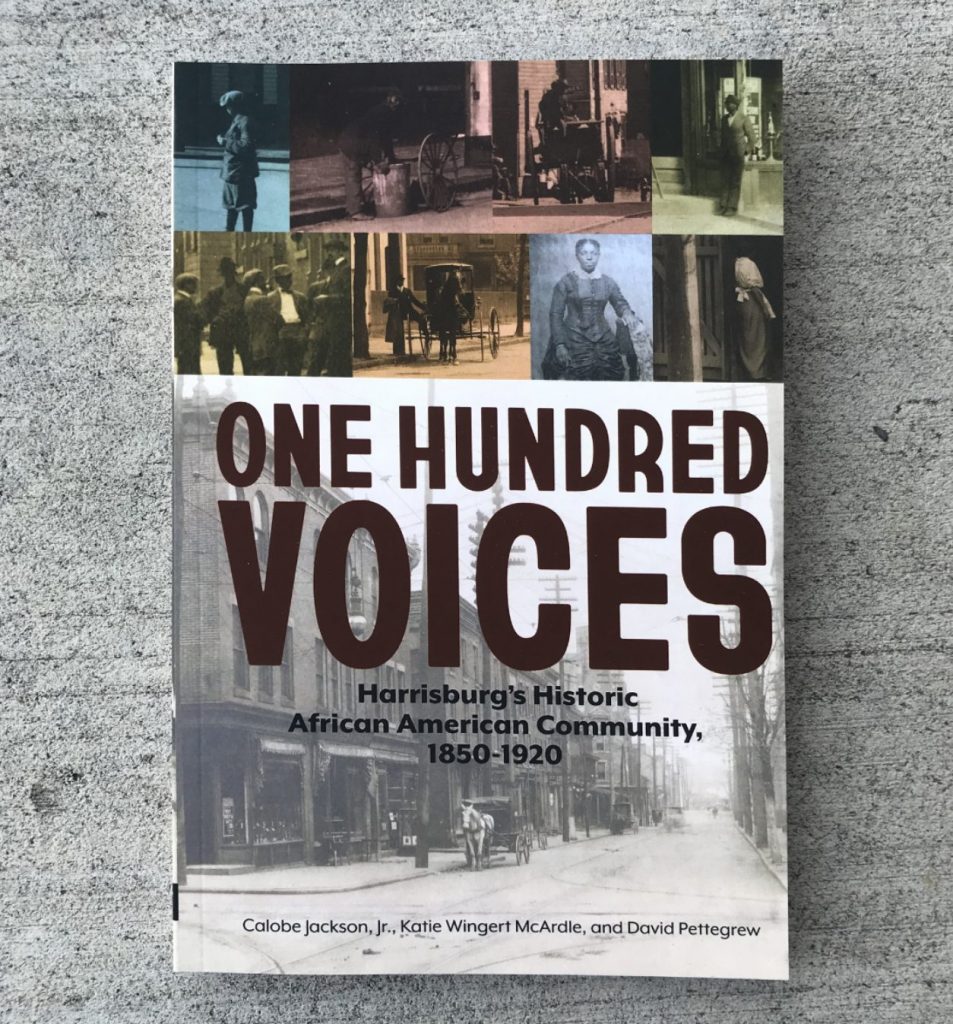
Now, each bronze-inscribed name comes to life in a new book entitled “One Hundred Voices: Harrisburg’s Historic African American Community 1850-1920.”

“We came to the revelation that we couldn’t just write their names,” Sloan said. “They are not merely names in a census, but stories that were lost to us. We need to tell the story about these people.”

Brought to Light

“Through my research in Harrisburg, I know quite a few people that were prominent in the community,” said Calobe Jackson Jr., a local historian and co-editor of the book.

Jackson has a well-earned reputation around the city as the history guy. If you need information on an old building, a historic figure or a memorable event, he’s your man. Lenwood Sloan knew this when he reached out to Jackson for a favor.

He needed a list of 100 names of African American figures from the 1850s to 1920s for the monument’s pedestal, names that would later become stories for the book. Jackson put together a file including freedom seekers, abolitionists, activists, police officers, doctors, preachers, janitors and many more. All had ties to Harrisburg and most had ties to the 8th Ward, Jackson said.

“A lot of people didn’t know about or forgot about these people,” Jackson said. “A lot of these people were Harrisburg High School graduates and teachers in the district. I’m proud that we can show students now what these past students did.”

Sloan remembers someone asking him why he was making such a big deal out of the names, especially with many of them being widely unknown.

But these jobs that seem unimportant in modern days, such as street sweeper or housekeeper, were important back then, Sloan said.

“We need to lift them up out of obscurity,” he said.

Through a grant from the Council of Independent Colleges, Messiah University was able to help with the Commonwealth Monument Project and the “One Hundred Voices” book.

Thirty Messiah students researched the historic figures and wrote excerpts on their stories for the book.

“The process of researching these individuals was pretty challenging,” said David Pettegrew, a history professor at Messiah and an editor of the book.

With some of the 100 people being less prominent, Pettegrew said they had to really look deep into archival material—a process he believes was worth the result.

“We need to do more local African American history,” he said. “This book contributes to a broader story about this resilient community who lived through change at the local level. This is Black Lives Matter historically. This is Black Lives Matter locally.”

Beginning of Discovery

Finding the stories behind the names on the list was only the start of something much bigger. Messiah students sent out graphics on social media looking for descendants of the 100 names they had learned so much about.

“Believe it or not, descendants began to contact us,” Pettegrew said.

Around 100 people with ties to the 100 names reached out to the university. Some even assisted in writing the chapters for the book.

“Getting to connect with the descendants has been the most rewarding thing,” Pettegrew said.

Even for those who may not be direct descendants of people in the “One Hundred Voices” book, Sloan believes there is a way for everyone to connect to it.

“The book helps you map your personal narrative in relation to the 100 names,” he said.

Not only is the book about individual education, but Pettegrew hopes that it will engage people in Harrisburg’s history—one that isn’t always told.

“We are hoping this is just the beginning of discovery,” he said. “We want it to inspire people to think about Harrisburg in a new way and the rich African American history.”

“One Hundred Voices: Harrisburg’s Historic African American Community 1850-1920” is free to download on the Digital Harrisburg website. Physical copies are available for purchase at the Midtown Scholar Bookstore or on Amazon. For more information, visit www.digitalharrisburg.com.  

The Commonwealth Monument is located at 4th and Walnut streets.

Support quality local journalism. Join Friends of TheBurg today!


Continue Reading

Bob’s Art Blog: A Tip of the Cap

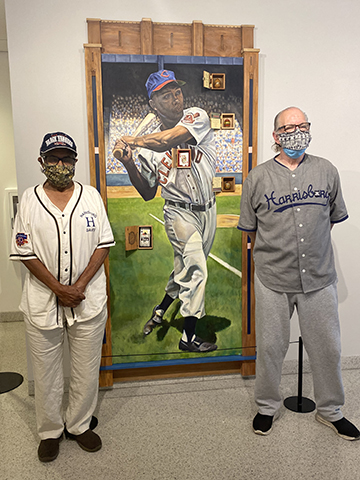
Calobe Jackson Jr. and Ted Knorr stand beside a Phillip Dewey painting of Hank Aaron.

Sports, like most other forms of entertainment, have been majorly disrupted this year. But, a couple of weeks ago, we had box seats for a baseball “event” that knocked it out of the park.

There aren’t many opportunities to hear legends talking about legends, but the Susquehanna Art Museum (SAM) now has one for the ages—one you can view yourself thanks to Ross Tyger, who captured it all for posterity.

Ted Knorr, a local expert on the history of Negro League baseball, and the eternally young Calobe Jackson, Jr., Harrisburg’s historian of 90 years, spoke rapturously on the days of Satchel Paige, Oscar Charleston, Rap Dixon and Cool Poppa Bell. Their timely talk was held in the S. Wilson and Grace M. Pollock Education Center Gallery at The Marty at SAM, standing by paintings of those illustrious stars of yesteryear.

In a history rich with lore, the Harrisburg Giants were ballplayers solicited by Colonel William Strothers way back in 1890, long playing under his leadership. The esteemed Mr. Jackson remembers going to City Island to see the Harrisburg Giants play baseball back in the 1940s with his grandfather.

In truth, the original stars like Charleston and Rap Dixon from Steelton played their ball for The Eastern Negro League Harrisburg Giants at the West End Grounds, found at the intersection of 4th and Seneca Streets, from 1924 to 1927. Knorr and Jackson Jr. feel that that site needs to be the future home of an historical marker designating it as such, believing that this honor is long overdue.

Segregation and discrimination were the obstacles that kept Negro League players from the Majors. At 42 years old, Satchel Paige was the oldest “rookie” to play in the Major Leagues once the color line was finally broken. With SAM’s fitting tribute in “Separate and Unequaled,” the exhibit rounds all the bases with its stellar stars from yesteryear shining bright in artistic splendor.

Hitting in the leadoff slot is a portrait of Turkey Stearnes, a Detroit ballplayer, in a rich oil-on-canvas with wood and found objects by contributing artist Phil Dewey. Batting second is Graig Kreindler’s “Quiet Confidence,” an oil-on-linen painting of Josh Gibson. Artistic endeavors are also offered by Paul Kuhrman and Dane Tilghman. Anecdotal stories include the St. Louis speedster Cool Poppa Bell, who started out as a pitcher for the St. Louis Stars, staring down power hitter Oscar Charleston and “fanning” him with the bases loaded. A spectator called out from the stands, “That’s one cool poppa,” and the nickname stuck. Olympic star Jesse Owens flat-out refused to race him—Bell’s speed was the stuff of legend. To illustrate this, Bell scored from first base on a teammate’s bunt. Another tells of Steelton’s own Rap Dixon slamming the first home run by a Black player in Yankee Stadium on July 5, 1930.

Phillip Dewey’s portrait of Turkey Stearnes

This early fall baseball classic borrows a “Paige” from its history in a new double play combination that rivals the famous Tinker-to-Evers-to-Chance. Harrisburg’s edition is Finestra-to-Jackson-to-Knorr. Behind the scenes, Carmen Finestra was largely responsible for bringing this special tribute to SAM for a live taping that can now be viewed. The double play was “turned” by Knorr asking Jackson Jr. about those days of yore through a splendid Q&A session. This edition recognizes all stars, young and old, starting with two veteran historians with 150 years combined of life experience between them. Jackson and Knorr share a passion and love for the rich history of Negro League baseball, especially that of the Harrisburg Giants. You’ll learn what tales they shared in SAM’s exhibit.

NPR’s talk show commentator, Scott Simon on his 4th of July broadcast, as part of his “Weekend Edition” show, eloquently referenced “the cruelty of segregation” in his moving tribute to the celebration of the 100th anniversary honoring Negro League baseball. The great memories made over those 35 years will live on through events like this anniversary celebration. A tip of the cap to these brave and talented men who “outplayed segregation to create something extraordinary and beautiful.” And a special note of thanks to Calobe Jackson Jr. and Ted Knorr for delivering a fastball right down the middle.

“Separate and Unequaled: Celebrating the 100th Anniversary of the Negro League” runs through Oct. 18 at the Susquehanna Art Museum, 1401 N 3rd St., Harrisburg. For more information, visit www.susquehannaartmuseum.org. The baseball interview is online at https://youtu.be/E-XwJ3W3K0U.

Continue Reading

The Week that Was: News and features around Harrisburg

Hundreds of protestors rallied and marched at last weekend’s Black Lives Matters protest.

Judging by this week’s news, life seems to be returning to normal around the Harrisburg area. Yes, COVID and protests still predominate, but we’re increasingly seeing a greater mix of stories. We have all our coverage listed and linked below, in the greatest number of online stories we’ve ever published in a single week.

African American Music Appreciation Month continues locally, with an online profile of musician Sourface. So, who is this masked stranger, and what about his unique style of “bedroom rap?” Our story contains some revealing details.

Black Lives Matters movement showed its strength again around Harrisburg last weekend, with a rally and a march. We were there to cover the protest, which centered around calls for unity, action and peace.

Calobe Jackson Jr. has seen it all in his 90 years—and, when it comes to Harrisburg history, he definitely knows it all. In our June magazine, we profiled this local legend, the connecting tissue between a city past, present and future.

COVID-19 continues to affect the commonwealth, despite slowly dropping case numbers. We followed the ups and downs in our daily updates, the most recent of which is found here.

Dauphin and Perry counties will enter the green stage of reopening next Friday, joining most of the rest of the greater Harrisburg area. What does green mean? Our online news story has the details.

Harrisburg was worried that a “large number” of groups planned to converge on the city on Monday, perhaps in conflict with one another. The city closed several streets as a precaution, but the rally ended up being small and calm, as our news story described.

Harrisburg Bike Share has fallen victim to the COVID-19 pandemic, as the operator running it has called it quits. The three-year-old program gained thousands of supporters, but, as our online story explains, couldn’t overcome the larger economic forces at play.

Harrisburg City Council has hired Wildheart Ministries to disassemble an enormous solar array at the former headquarters of D&H Distributing. The property’s new owner is donating thousands of solar panels, but needs them removed immediately. Our online story tells the tale.

Harrisburg Regional Chamber & CREDC held a webinar examining issues of systemic racism in the business community. As our online story states, it contained advice for businesses dedicated to fighting racism and ensuring equality in their organizations.

Home sales in the Harrisburg area predictably took a tumble in May, but prices held firm. The Greater Harrisburg Association of Realtors released its monthly report, and we have the local data in our online story.

Hudson Building has a new owner and a new plan, as a Harrisburg-area native plans to gut and rehabilitate the long-dilapidated building. What’s in store? Our online feature tells the story.

Independence Day celebration in Harrisburg will go on this year—mostly as normal. The city announced plans for its fireworks show and food truck festival, though the latter will move to City Island. For all the information, check out our online story.

Nonprofits have been hit especially hard by the pandemic. The Foundation for Enhancing Communities, along with United Way of the Capital Region, has been trying to patch financial holes until better days arrive, as described in our online feature story.

Sara Bozich is finally breaking free from her house, and she has some ideas for people itching for something fun to do. Check out her list of both in-person and online activities and events.

“Saturday Nights in the City” was so successful last weekend that Harrisburg decided to expand it in hours and scope. What’s new for this weekend? Our online story has the details you’ll need before venturing out.

Small businesses have had to get creative in order to survive during pandemic times. Our June magazine feature describes what some Harrisburg businesses are doing until times return to normal.

Summer camp is an important part of the school break for many young people, but COVID-19 has greatly affected this rite of passage. Our online feature describes how some Harrisburg area organizations are adapting to the restrictions imposed by the pandemic.

TheBurg Podcast, June edition, dropped into feeds everywhere this past week, expanding upon several features from the June magazine. And, yes, it includes an interview with the ubiquitous, yet still mysterious, Sharkman! Tune in and find out what motivates the skating fish, and hang around for other segments, as well.

Do you receive TheBurg Daily, our daily digest of news and events delivered right to your email inbox? If not, subscribe here!

Do you love reading TheBurg as much as we love writing it? If so, join Friends of TheBurg, our new membership program. Click here to find out all the details.

Continue Reading

History Keeper: As Harrisburg changes, Calobe Jackson Jr. tells the stories of what came before.

LeRon McCoy, Calobe Jackson and Ryan Sanders.

Calobe Jackson nimbly treads a narrow path behind his childhood home. He plants a hand on a low concrete wall.

“My dad had this wall put in, probably around 1937 or 1938,” he said.

Jackson’s memories are modest. Sweeping barbershop floors. Pears growing on backyard trees. But when Harrisburg’s history-keepers talk about Jackson, they pull out the superlatives. “Living treasure.” “Walking encyclopedia.” “Historian’s historian.”

Calobe Jackson, Jr., turned 90 in April. With his steel-trap memory and will-do attitude, he has spent decades in community service. His contributions have broadened the scope of Harrisburg’s past, even as he steps into the future as a muse for revitalization of a key piece of African-American entrepreneurial history.


Stories They Told

In 1934, World War I veteran Calobe Jackson, Sr., relocated his barbershop and his family, including 4-year-old Calobe, Jr., from Strawberry Alley to N. 6th Street.

In a mixed-race neighborhood, “Jack’s Barbershop” joined a thriving African-American business scene. German Jackson (no relation) ran the Green Book-listed Jackson House rooming house and restaurant next door. A beauty school was on the other side. At the funeral home on the corner, morticians would embalm bodies in the basement and carry them upstairs via a stairwell leading to the sidewalk.

These are the stories Jackson shares as he walks around his old neighborhood.

“You had the major African-American businesses right together, and that is very symbolic,” he said. “They were prosperous during segregation, and they’re still the most popular businesses. Most African Americans go to the African-American barbers or beauticians, the undertakers and the restaurants.”

As young Calobe worked around the barbershop, he heard the tales of old-time Harrisburg from the doctors, lawyers and politicians in the chairs.

“I was fascinated by the stories they told,” he said.

He especially loved stories of the Old 8th Ward, where a thriving, diverse neighborhood had given way to expansion of the Capitol grounds.

His step-grandfather would take Calobe to Negro League baseball games.

“All these great stars—(Josh) Gibson and (Satchel) Paige,” he said. “I saw them play.”

Jackson graduated from William Penn High School, where he ran track. He attended Lincoln University until being drafted into the Army, where his proclivity for math landed him a spot as a surveyor. His unit—possibly one of the last all-black units before President Harry Truman desegregated the armed forces—stayed stateside during the Korean War.

After military service, Jackson worked his way up to post office superintendent, a problem-solving role that energized his puzzle-loving brain. He married Betty Canady in 1957. They raised two sons and a daughter. Betty died in 1976.

Jackson served on the Harrisburg school district’s elected school board and appointed board of control. He never feared the future, from childhood days building crystal radios to his years leading establishment of the school district’s Marshall Math Science Academy and the Harrisburg High School SciTech Campus. From 2005 to 2010, he served on the board of the fledgling Harrisburg University of Science and Technology.

“Harrisburg University has some very innovative courses,” Jackson said. “These things they’re into with the (esports) gaming—that’s part of the future.”


A Toast

After retiring in 1990, Jackson started tracking down details on all the stories he had heard over the years. He and fellow historians bonded over their hours spent in the Pennsylvania State Library’s microfilm section.

He has contributed memories and meticulous research to a long string of projects—creating African-American history trails, commemorating U.S. Colored Troops, celebrating Harrisburg’s sesquicentennial, preserving cemeteries, exploring jazz and the Negro Leagues, researching Old 8th Ward residents for the Commonwealth Monument Project.

Ken Frew, librarian for the Historical Society of Dauphin County, remembers when Jackson asked for an obituary that wasn’t in the society’s files. Visiting the State Library the next day, Frew asked for two rolls of microfilm that might yield the obit, but they were loaned out. Frew went into the microfilm room, “and there’s Calobe with the two rolls.”

“When he has a lead on something, he follows through on it,” Frew said.

With Jackson’s contributions of informational gems from his own collection, Frew expanded the Historical Society’s file of African-American history from a small file to one now outgrowing a drawer.

Fellow historians marvel at Jackson’s accuracy and his generosity in sharing his knowledge.

“He’s sort of like a living Wikipedia,” said Historic Harrisburg Association Executive Director David Morrison.

HHA’s 2020 Preservation Celebration—postponed to Sept. 20 because of the pandemic—features “A Toast to Calobe Jackson.”

For HHA, Jackson worked with historian Jeb Stuart to create an African-American history route for the YWCA of Greater Harrisburg’s Race Against Racism. He also helped HHA intern Kristian Carter write about African-American businesses and, said Morrison, “the subtle segregation in that these black-owned businesses existed and thrived because people couldn’t go downtown and shop.”

“He was one of several people, and certainly the dean of African-American historians, who have helped to integrate African-American history into general history, locally and beyond,” said Morrison.

Jackson’s accuracy derives from his talent for matching memories “with actual documentation,” said Stuart. “He’s unbelievable. He’s sharp.”

Jackson provides context that makes pictures emerge from the scattered puzzle pieces of history, said arts activist Lenwood Sloan—even if it means, as in one case, sharing a racist account of a visit by 19th-century abolitionist and journalist Martin Delaney.

“You’re creating fact-based history and not legend and mythology,” Sloan said. “Memory tends to gild things. Some of the things that Calobe turns up are not that pretty.”


A Pillar

Post-World War II, most of the 6th Street African-American business corridor gave way to Capitol Complex expansion and urban renewal. One stretch survived—the historic buildings of Jackson House, Jack’s Barbershop and the corner funeral home that was originally the Ridge Avenue UMC parsonage, later known as the Swallow Mansion.

“They’re the only thing left from that time,” said Jackson.

Through late historian Hari Jones, Jackson connected with Ryan Sanders, a partner in Vice Capital with NFL veterans LeRon and LeSean McCoy. The team is revitalizing Jackson House and the former funeral home to create Jackson Square, transforming the dilapidated buildings into apartments and retail.

Jackson’s firsthand knowledge of the site helped forge a narrative of African-American entrepreneurship and its role in overall Harrisburg history, said Sanders.

“He is absolutely a pillar of this project,” he said. “Accuracy is very, very important here. As we’re telling the narrative and the storyline, we’re setting the groundwork for future endeavors on this property.”

Jackson’s memories helped give momentum to reinvigorating “an important anchor to the community,” added LeRon McCoy. “Hearing those original stories and what these buildings meant, it only cemented the idea that we wanted to rebuild them.”

As the new federal courthouse drives revitalization of N. 6th Street, noted Morrison, Jackson is enhancing the effort by helping restore the corridor as “a special boulevard of African-American heritage.”


Keeps Him Young

In every conversation about Calobe Jackson, someone references the man himself.

“He’s one of my favorite historians,” said Frew. “One of my favorite people, even if he wasn’t a historian. He’s just a good guy.”

“He’s just a heck of a nice guy,” seconded Morrison

Added Sloan: “He is a gentle man and a gentleman.”

But make no mistake, Sloan said. Jackson’s work counterbalances Harrisburg’s culture of “perpetually emerging” but largely peripatetic African-American organizations that have no place to call home—no black bookstore or art gallery or theater group with a sign out front and its own door to walk through, Sloan said. In a heritage marked by displacement, people such as Jackson are “temples of memory” pointing toward permanence.

“If it wasn’t for people like Calobe who remind us that we were here and that we thrived and survived for a time, we would be forgotten, or worse than forgotten, discounted,” Sloan said. “Calobe reminds us that we count.”

Jackson says simply that his work keeps him young.

“It keeps your mind flowing,” he said. “I’m in good health to be 90. A couple of ailments like some people get. The way my mind works, the idea of having this thirst for history, this thirst for knowledge, keeps you going.”

“A Tribute to Calobe Jackson and Harrisburg’s African-American Heritage,” will be live-streamed on Sunday, Sept. 20, starting at 5 p.m. Click here for more information and to view the event.

Support quality local journalism. Become a Friend of TheBurg!
Continue Reading

One Family, One History: In the month of Juneteenth, descendants of Civil War veteran Ephraim Slaughter reflect on the ties connecting their family, their city.

Family members Yvonne Pittman, Keith Mitchell and Dr. Sharonn Williams pose with a statue of Ephraim Slaughter at the National Civil War Museum.

Young Yvonne Pittman never knew that homes on the other side of her neighborhood lacked indoor plumbing until she walked into a friend’s house.

She asked her mother, “Why do they have a bathtub in the kitchen?”

“Don’t you ever say anything to them about having outdoor bathrooms,” her mother admonished.

“I didn’t realize that we didn’t have an outhouse,” Pittman says now. “We had a bathroom.”

The story of African-American life in Harrisburg encompasses integration, business and prosperity, and the power of community. It is also a tale of segregation, deprivation and loss. Three family members descended from Dauphin County’s longest-living Civil War veteran carry the legacy. All share a belief that enhanced attention to the small stories of the past can enrich the region’s historic tapestry.

They are:

Yvonne Pittman. Her grandfather, Ephraim Slaughter, was an escaped slave, Civil War veteran who lived to age 97, respected businessman and philanthropist. His story and statue are enshrined in a National Civil War Museum exhibit.

Keith Mitchell. Pittman’s younger brother. He’s a retired official from the state and federal labor departments and a National Civil War Museum board member, giving him the rare distinction of serving for a museum where an ancestor is honored.

Sharonn Williams. Pittman’s daughter, contributor to the museum’s 2016 African-American Oral History Project, and an experienced genealogist whose ancestral sleuthing uncovered links between Southern plantations and Harrisburg’s African-American community.


Why Harrisburg?

Pittman remembers Slaughter. She rode with him in Memorial Day parades. They walked hand-in-hand around their neighborhood, the 4-year-old serving as eyes for the nearly sightless elderly man.

“Pop-pop” Ephraim was actually Pittman’s step-grandfather, married to her grandmother, a widow named Georgiana Jenkins. Ephraim and Georgiana were separated by 43 years, married in a fond union that came with a quid pro quo. She would care for him in his old age, making the most of his Civil War pension. He would deed her his considerable property—an estate worth $10,000 upon his death in 1943.

Slaughter escaped slavery from a North Carolina plantation in 1863. He served with what would become the 37th U.S. Colored Troops (USCT). In 1869, he moved to Harrisburg.

Why Harrisburg?

“That’s the big question for us,” Williams said.

Maybe it was his association with the Grand Army of the Republic or the railroads rumbling through the city. Or maybe it was the age-old quest for work, including the spot he landed at the legendary Lochiel Hotel, hangout of state Capitol pols and lobbyists.

Ephraim owned homes on Boas, Capital and Forster streets, in the Capitol-area neighborhood now known as Fox Ridge. Mitchell remembers going door-to-door in the 1950s with grandmother Georgiana.

“It really didn’t hit me until later that she was actually collecting rent,” he said.

Georgiana shared Ephraim’s entrepreneurial spirit.

In a peripatetic early life in West Virginia, Williamsport and Harrisburg, she cooked on a riverboat, worked in a boy’s school and as a live-in maid, and ran a beauty salon catering to white women during the day and African-American women in the evening. She sewed dresses for her granddaughters. She could turn anything into a flowerpot, including Ephraim’s spittoon, the one he never missed even as his sight was failing.

Georgiana cooked elegant Sunday family meals of pig tongue or stuffed fish—plus her hand-churned ice cream for dessert—but saved one pot exclusively for soapmaking. She ran a boarding house catering to traveling African Americans, lodging those barred from whites-only hotels.

She also took the bus to tend her garden in Susquehanna Township and then shared its potatoes and cabbages with families living along the dirt roads of the township’s Edgemont neighborhood. She sent her children and grandchildren to the best schools available. She put her sister through college. She was auxiliary president, serving with black and white women, at Ephraim Slaughter American Legion Post 733.

“And she wasn’t even 5 feet tall,” said Pittman.

Mitchell and Pittman grew up in Harrisburg’s integrated neighborhoods and schools. Pittman befriended the sheriff’s daughter from a white family living near the Broad Street Market.

“I went to her house, and she came to my house,” she said. “We didn’t know any different.”

Mitchell, 12 years younger than his sister, moved to Susquehanna Township when his parents built a home there. In the township’s schools, most of his classmates were Jewish.

“There was never any hatred based on religious beliefs and all that,” he said. “If you had disagreements, you had disagreements because of some other reason.”

In the lives of Pittman and Mitchell, the merger of Harrisburg’s high schools dissolved longstanding friendships, while “white flight” helped reverse the integration that they knew.

“We’ve gone right back to segregation,” said Pittman. “It happened so gradually that people didn’t pay attention. Because blacks were moving to the suburbs, too, people didn’t know who was being left behind in the urban areas.”


Floodgates

As a new Civil War Museum board member, Mitchell’s “number-one priority” is closing a gap between the 18-year-old institution and the community. There, younger generations can learn the history not told in textbooks, because “you can’t know where you’re going unless you know where you’ve been.”

“Even though the museum sits in Reservoir Park, it has not become part of the community,” he said. “It’s kind of up there all by itself.”

The museum is poised to “open up the floodgates” to visitors and volunteers, agrees museum board Chairman Kelly Lewis. The 2017 agreement that settled simmering differences with the city helped guarantee preservation of the museum’s artifacts collection, and digitizing will provide access to researchers worldwide, he said.

The museum can be storyteller of not only the Civil War but its tragic aftermath, when Jim Crow laws backtracked on the freedoms won over spilled blood, Lewis said. In a play on the term Juneteenth, which recognizes emancipation, the museum is developing a “Junetruth” program countering the “Lost Cause” myth.

“There’s still aspects of the Civil War that are being fought in today’s world,” playing out in such areas as inequitable school funding, Lewis said. “It was an all-encompassing civil war, but much of the story told is about generals and battles, not about everyday people and the huge migration of slaves after the Emancipation Proclamation and the humanity of it all.”

On the museum board, Mitchell replaced revered African-American historian Harry Jones after Jones’ sudden death. Lewis hopes to expand the board, enticing more women and “people of all races and creeds to help us tell this story.”

Williams, who offers genealogy workshops, sees hidden aspects of African-American history citywide—say, in the housing project named after black abolitionist William Howard Day, and in Downey School, developed specifically as an integrated institution. Her own work—and the diligent and coalescing efforts of such locals as historian Calobe Jackson, Jr. and activist Lenwood Sloan—are bringing hidden details to light.

“It seems like they only talk about black history during February, but black history is American history,” she said. “It needs to be incorporated all the time. Harrisburg has a very rich history.”


The National Civil War Museum is located at 1 Lincoln Circle, Harrisburg. This month, it notes Civil War Days with tours of Harrisburg Cemetery and the Capitol Preservation Committee’s flag laboratory on June 21, and free admission, with demonstrations and a talk on Juneteenth by the Smithsonian’s Kelly Elaine Davies, on June 22. More information, including a schedule, can be found at www.nationalcivilwarmuseum.org.

Continue Reading

Pieces of the Puzzle: A century ago, Harrisburg’s Old 8th Ward was wiped off the map. A group of activists wants to remind us what was lost.

Burg in Focus: Harrisburg’s 8th Ward from GK Visual on Vimeo.

The stories lurk in half-forgotten memories. The images hide in boxes stashed in attics.

Harrisburg’s Old 8th Ward, a dense, crowded neighborhood squeezed between the Pennsylvania Capitol and the railroad tracks, is long gone. But through a diverse group of activists, genealogists, scholars, actors and techies, the voices and faces of a vibrant community are emerging to illuminate a crossroads of history.

Throughout 2019, they are mounting a multi-faceted history project with a reflection and re-examination of the Old 8th at its core.


Lose Track

“The Bloody 8th” inhabits our imaginations as home to speakeasies, brothels and tenements along narrow streets “into which little of God’s free air or sunlight can enter,” in the words of newspaper chronicler Howard J. Wert in 1912.

But the 8th was also home to a melting pot of residents—a gateway to the city for African Americans, Russians, Greeks and others. They ran tanneries and laundries, attended churches and synagogues, raised families, and harbored refugees along the Underground Railroad.

Still, by Wert’s time, City Beautiful proponents couldn’t abide the huddled masses teeming outside the back door of Pennsylvania’s new Beaux Arts Capitol. They envisioned a park. So, by the 1920s, most of the 8th Ward was gone, and its residents scattered.

Today, when arts activist Lenwood Sloan looks at the Capitol’s East Wing and Soldier’s Grove, he hears echoes of the past. The problem, he said, is finding tangible reminders. Other than the K. Leroy Irvis Building, named after the first African American speaker of the Pennsylvania House, no monuments recognize the contributions of African Americans to the city or nation.

That absence seems especially poignant now that it’s 2019, the 150th anniversary of the 15th Amendment, which granted voting rights to men regardless of race, and the centennial of the 19th Amendment, which finally gave women the vote. Local historian Calobe Jackson, Jr., learned that news of the 15th Amendment’s passage sent 8th Ward residents into the streets to celebrate.

“We lose track when we lose physical monuments or places of engagement,” Sloan said. “We lose track of ourselves and especially each other, and we lose track of how hard communities work to achieve the right to vote and then to sustain that right and protect that right.”

Through the project, a jigsaw puzzle of activities will recreate the sights and feels of a bustling community:

  • A monument to four key players in 8th Ward history and voting rights.
  • A search for descendants of 100 prominent residents—ministers, state workers, musicians, attorneys, baseball players, Underground Railroad conductors, and one involved with “aeroplane school”—in hope of mining their family stories and archives.
  • A Chautauqua series at the McCormick Riverfront Library and Live and Learn “informances” from the Past Players, held at Gamut Theatre. TFEC is funding both.
  • A theatrical presentation to be developed by Gamut Theatre Group. The 8th “was a rough place, but it was a lot of tough people coming together and learning what their strengths were,” said Artistic Director Clark Nicholson.
  • Posters, a website and window clings—yes, window clings—developed by Digital Harrisburg to recreate for Capitol workers and visitors the sights and stories of the 8th Ward.

One of the discovered descendants is well-known musician Jimmy Wood, whose great-grandfather, Jacob Compton, spirited Abraham Lincoln out of Harrisburg to evade assassination.

Wood didn’t know Compton, but he knew his great-uncle, Armon S. Compton, a pharmacist trained in Philadelphia who was never employed at white pharmacies but plied his trade in the 8th Ward. Wood never heard stories of Jacob’s heroism, but he remembers the spark of pride in Armon’s bearing.

“My assumption is that, besides his intellect, his pride would be based on what he knew about his image,” said Wood. “I’m hoping I can find somewhere a picture of Jacob. That would be absolutely awesome.”

Wood won’t cry over spilled milk, but the disappearance of the 8th Ward—where musicians played in clubs, a great-uncle ran a hotel and his midwife grandmother delivered babies—offers a warning.

“Bring some caution and some good sense when you decide on these kind of development projects,” he said. “It can’t always be about someone’s dollar and making a profit. People have to live somewhere. They should have some decent place.”

An aerial depiction of the Old 8th Ward.

Wild Side

Some churches and synagogues of today have their origins in the 8th Ward. They were, like residents, pushed aside “to erase this area of ‘blight,’” said Andrew Dyrli Hermeling, project manager of Digital Harrisburg, the Messiah College-Harrisburg University joint venture to digitize archival images.

Two factors drive our ongoing fascination with the 8th, said Messiah College History Department Co-chair David Pettegrew.

“It has the reputation for being the wild side of the city in the late 19th century,” he said. “The other has to do with this disturbing factor of displacement that occurs for the greater good. So, it naturally raises questions about what is the common good. It was in the name of beauty, but there’s a feeling that the state just yanked away properties. That injustice surprises people.”

Harrisburg genealogist Sharonn Williams is the great-granddaughter of Ephraim Slaughter—prominent 8th Ward leader and Civil War veteran. Williams joined the 8th Ward project because too much of the history she has researched reflects today’s political turbulence.

“You’re trying to take away my right to vote, when my right has been paid for in the blood, the sweat, and on the backs of my ancestors for hundreds of years,” she said.

Today’s “civil war over civil rights” and the devaluation of civics in education “break down understandings of the responsibilities of citizenship and the privileges of the franchise,” agreed Sloan.

“We are among the last generation where we can talk to people who were in those struggles, and also we’re in the last generation that cares enough to keep those family artifacts in the closet or under the bed,” Sloan said. “We’re saying if you’re not interested in this, don’t throw it away. Give it to the historical society. Give it to the state archives. It’s pieces of the jigsaw puzzle that help us build memory and continuity.”

For more information about Digital Harrisburg, including online history resources, visit www.digitalharrisburg.com.

Continue Reading