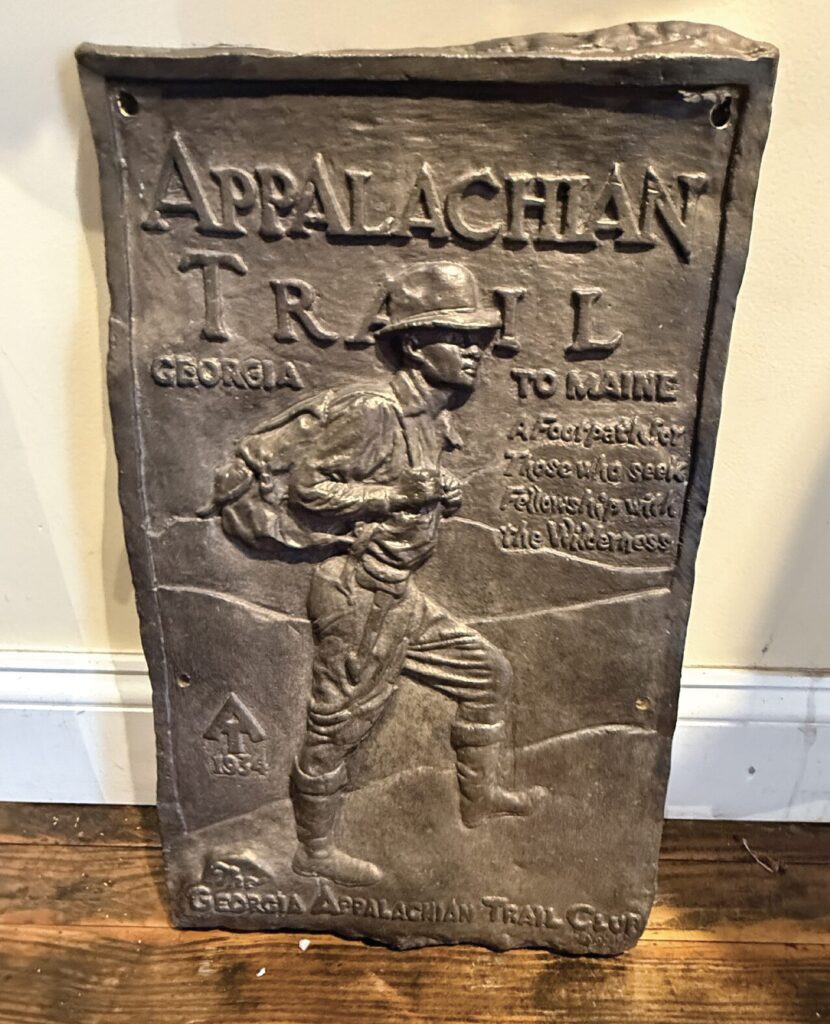
Plaque marking Center Point Knob in Boiling Springs.
Hikers of the Appalachian Trail have a saying: “The Trail Provides.”
Those who attempt to traverse the 2,190-mile footpath from Georgia to Maine, commonly known as the AT, believe the challenging journey gives one the opportunity for self-discovery, growth and resilience. Additionally, the trail provides literal resources, such as food, shelter and company.
The founders of the Appalachian Trail Museum in Gardners kept the mantra in focus while developing the project over the past 31 years.
“That was certainly the case with the museum,” said Larry Luxenberg, museum board president. “People showed up when we needed them.”
Luxenberg hiked the famed AT in 1980 with no hiking experience, a method he would not recommend to others. The journey and the people he met along the way changed his life, and, in 1994, he set out to write a book. While completing research for “Walking the Appalachian Trail,” Luxenberg noticed that, although people had been hiking the AT since 1923, no one had systematically cared for the many artifacts that told the trail’s story.
When his book was published, he set out on a new project—opening a museum. He publicly proposed the idea in 1998, the 50th anniversary of Earl Shaffer becoming the first person to thru-hike the trail. Hikers are goal-oriented and persistent, skills that proved to be necessary for opening a museum.
“For 12 years, I would tell my wife that I was going to a museum meeting,” Luxenberg recalled. “I imagine sometimes she thought it was my imaginary friend—or worse.”
One of Luxenberg’s biggest challenges was finding a suitable location. He approached the Pennsylvania Department of Conservation and Natural Resources in 2009 about taking over a 200-year-old building in Pine Grove Furnace State Park, near the trail’s midpoint, that initially served as a grist mill. A year later, more than 750 people attended the museum’s grand opening.
What initially began as a place to store artifacts evolved into a full-blown museum as volunteer plumbers, museum designers, gardeners and public relations experts began donating their services.
One of those many volunteers is Ed Riggs of Gettysburg, who hiked the trail over two years in 2013 and 2014. A heart issue paused Riggs’ first attempt. While he followed doctor’s orders, he began volunteering at the museum to maintain his connection with the land. Like his AT hike, Riggs has met many interesting people while volunteering. When he set back out to complete his quest, he saw nine people on the trail he had first met at the museum.
“Everyone who comes in here is here to talk about the trail,” Riggs said. “I can talk about the trail all day long and not feel bad that I am blabbing on and on about it.”
One day in early spring, Riggs was painting window frames outside the museum, which had not yet opened for the season. A woman asked if she could see the museum. Riggs originally said “no” but then learned he was talking to Heather “Anish” Anderson, who had hiked the Appalachian Trail, the Pacific Crest Trail and the Continental Divide Trail in one year. A large exhibit now highlights Anderson’s feat, known as the “Triple Crown” of hiking.
The museum also gives hikers an opportunity to reflect on their journey. A large contour map showing the entire trail is Riggs’ favorite exhibit.
“You could pick any part on here, and I would have a story about it,” he said.
The three-story museum also features Shaffer’s trail shelter, which was once on nearby Peter’s Mountain in Dauphin County. The museum collects artifacts from anyone willing to share. Sometimes, treasures are unearthed from unlikely places.
Sometime between 1940 and 1948, someone stole a plaque marking Center Point Knob in Boiling Springs as the trail’s mid-point. The sign depicted a hiker and was labeled Center Point Knob with the AT symbol. In 1994, builder Bruce Dunlavy found the sign in a client’s home and knew exactly what it was. The homeowner, Wilmer Harris, said he found it while digging fence post holes in his yard. Eventually, Dunlavy convinced Harris to donate the long-lost artifact to the museum.
The museum’s primary audience consists of trail enthusiasts such as Riggs and Luxenberg, but it also encourages others to join their ranks. A children’s museum gives future hikers the opportunity to try on trail boots and learn the answers to important questions, such as how to eat and relieve yourself along the trail.
As the museum celebrates its 15th year, Luxenberg is excited to see how it evolves. He is certain that, as more people complete their hike, the trail will provide new opportunities to share stories.
“Most of what has happened has come from ideas from our volunteers,” Luxenberg said. “That’s the way the whole Appalachian Trail Museum project has been since the first day.”
The Appalachian Trail Museum is located at 1120 Pine Grove Rd., Gardners. For more information, visit www.atmuseum.org.
If you like what we do, please support our work. Become a Friend of TheBurg!