Relics of a War: State Museum Displays Pennsylvania’s “Objects of Valor”

A private’s military cap marked by a bullet hole; the diary of a woman who tended to the wounded during the Battle of Gettysburg; the chair of the Union general who won the battle. These are among the “Objects of Valor” in an exhibition of that name currently at The State Museum of Pennsylvania.

The title of the exhibition is taken from one of those objects—a placard calling veterans of the 9th Army Corps, 3rd Division, to a reunion that invited guests to “tell again the story of our valor.”

“The goal of the exhibition is to demonstrate the commitment of the commonwealth to memorializing the Civil War through battle relics and personal items,” noted Brad Smith, curatorial supervisor.

Screen Shot 2013-05-30 at 11.56.13 AMObjects and artifacts drawn from the museum’s permanent collection help preserve the legacy of the Civil War. “The difficulty was in selecting those for the exhibition because our collection is so rich,” Smith pointed out.

Some 4 million visitors are expected to descend on the Gettysburg battlefield this summer to commemorate the 150th anniversary of the three-day battle that turned the tide of the war in favor of the North. The State Museum exhibition offers a more intimate and interior observance—and one closer to home.

At the exhibition’s heart and center is Peter Frederick Rothermel’s iconic narrative painting “Battle of Gettysburg: Pickett’s Charge.” Commissioned by the commonwealth and completed by the artist in 1870, it measures 16-by-32 feet and is striking for its graphic nature at a time when war was usually romanticized.

The artist did a great deal of research: visiting the battlefield, interviewing those who had fought or otherwise participated and collecting relics.

“’Battle of Gettysburg’ is pretty realistic, almost gruesome,” Smith said. “It shows dying soldiers and the chaos of battle.”

Rothermel’s painting was the IMAX of its day, he added. “People came from far and wide to see it, and, in the 1890s, it visited Philadelphia (for the Centennial Exhibition), Chicago, Boston and London, as well as Harrisburg.”

The exhibition includes an interactive component relating to the work.

Rothermel is also represented by four smaller paintings depicting other Civil War episodes in which Pennsylvania soldiers and regiments served with distinction.

One of the striking artifacts in the exhibition is the 95-volume set of books listing muster rolls of volunteers. Also shown are artillery flags, a cannon ball, a telegram from Pennsylvania’s adjutant general calling for volunteers to enlist, photographs, presentation swords and a map of the battlefield.

Lest anyone think Gettysburg only recently became a tourist destination, one exhibit case contains postcards, commemorative plates and other souvenirs that date back to shortly after the Civil War.

Another case highlights the service of women, who were factory workers, nurses and volunteers in the war. “The Diary of a Lady of Gettysburg, Pennsylvania,” a memoir by Sarah Broadhead, who tended to those hurt in battle, is featured.

“Broadhead took half the proceeds from the sale of the diary and donated them to the relief of wounded soldiers,” Smith noted.

Also honored are the contributions of the U.S. Colored Troops—the thousands of African Americans who fought on behalf of the Union in segregated units. Among related objects: the Gilmore Medal for valor, which belonged to David Ramsey, who was wounded at Fort Wagner (the battle depicted in the movie “Glory”).

The military cap, or kepi, belonged to Pvt. George Linn, who donated it to the museum in 1915. A Plexiglas rod in the cap shows the trajectory of a bullet he took. “It was a close call, but he was unhurt, “ said Smith. “So he held on to the kepi.”

Several objects in the exhibition belonged to John White Geary—including his coat, boots, saddle, medal and uniform. A Civil War general who had been mayor of San Francisco, Geary later became governor of the commonwealth.

A number of the artifacts had been inscribed. Pvt. John Rivers wrote his initials and unit into the stock of his musket, for example. Augustus Kyle of Chambersburg posted a record of his service inside his drum and also put his initials and those of President Lincoln on the drumsticks. Kyle’s great-great-grandson, a Harrisburg police officer, donated the drum in 1980.

Another drum, with a bullet hole in it, was probably the one Rothermel used in his painting.

More than half the artifacts or objects in the exhibition come from a veteran or from a spouse, children or other relatives. “It’s touching to read the stories and to preserve them in perpetuity,” Smith said. “The core message is that the commonwealth has made a conscious effort to commemorate the war.”

The exhibition is part of an initiative convened by the Pennsylvania Historical and Museum Commission and Pennsylvania Civil War 150, a statewide partnership of historical organizations and cultural institutions to market activities and events at the regional and local levels and bring quality programming to the observance.

“Objects of Valor” will remain on view indefinitely at the State Museum, 300 North Street, Harrisburg, 717-787-4980 and https://statemuseumpa.org

Continue Reading

What’s the Good News?: It’s Song, Celebration and Spirit, Once a Month at Good News Cafe

If you happen to pass by Midtown Scholar Bookstore on the first Saturday night of any month and think you hear gospel music, it’s not your imagination.

The music, which may also include Christian hip-hop, rap and bluegrass, emanates from the Good News Café. For three hours each month, the Café serves up singing, poetry, mime and dance in a casual coffee house environment with a little outreach and a lot of Christian faith thrown in.

There is also food to buy, sometimes provided by vendors at the Broad Street Market.

Screen Shot 2013-05-30 at 11.58.01 AM

“Our goal is to bring together people to express our faith fellowship and enjoy ourselves, as alternatives to clubbing and bars,” said Stephon Guyton, one of the organizers.

Guyton is also founder of Gospel Live, a Christian media company, which co-sponsors the Café along with TRUTH SPEAKS of the Zion Assembly of Harrisburg. TRUTH SPEAKS plans faith-based events.

“The two organizations … came together to do collaborative programs,” said Naydia Bonner, another Café organizer.  “We liked the idea of a café-style setting that would be more relaxed than a church atmosphere. We can worship anywhere, not just within the walls of the church.”

The non-church setting also emphasizes the fact that faith is a “lifestyle, not just for Sunday mornings,” noted Guyton, who ministers at the Café with host Laurie Mitchell. It also suggests that there is a place there for those who don’t attend church regularly.

The Café also showcases talent. In fact, it has become so popular as a performing venue that video auditions are now required for interested talent.

In addition to individual acts—some six or seven each night—an in-house band known as Salt ‘n Light performs.

“Popular” describes the monthly Café itself. The first gathering drew 30 people, “including the staff,” said Guyton. Now they “pack the whole place SRO, with as many as 250. We’ve had to ‘chase’ people away.”

There is no admission charge, although a goodwill offering (voluntary) takes place throughout the evening. But the greater attraction lies in whom you might meet.

Even though most attendees are in their 20s through 40s, there is age diversity—and also one of gender, race and ethnicity. “The Café is embraced by everyone,” said Bonner.

That includes, occasionally, homeless individuals, who have learned, according to Guyton, that “for the next three hours, they can be around people who make them feel welcome and embraced. Everyone has a place here.”

Dacia Kershaw originally came to the Cafe because of her friendship with the organizers. Soon, however, she became a regular.

“I really enjoyed it,” she said. “It’s not normally the type of thing you have in Harrisburg, for Christians to come together to sing and dance together and find fellowship.”

Kershaw loves the fact that some people who wander in out of curiosity often end up staying—and coming back. She has started attending the York Café as well.

Although she doesn’t perform, she’s happy to help out the organizers if needed—whether it’s meeting and greeting or serving food.

“I’ve met a lot of people there,” she said. “I’m always anxious for that first Saturday to come again to see them—and meet new people.”

For performing artists, the Café is a boon. It’s not easy for poets to find venues, so James Axel was thrilled when the Café opened and offered a monthly one.

“I’ve been writing on and off my whole life, but now am taking it more seriously since the inception of the Café,” said the York resident. “I go at least four or five times a year.”

What Axel loves as much as having an audience is its diversity. “There are different races, ages, denominations, yet there is no division, only unity. What we have in common is greater than what divides us,” he pointed out.

The sponsors believe the Good News Café has something unique to offer, leaving people who attend with a “wow” feeling. “They don’t expect the level and quality of the acts,” said Guyton.” We’ve reached artists as far away from D.C., Philadelphia and Pittsburgh, as well as local ones.”

It’s not unusual for attendees to make announcements about (or celebrate) wedding anniversaries or baby births; recently, her family feted the birthday of an 86-year-old grandmother.  The organizers believe the Café has created a sense of family and community. “We tell people you don’t need a babysitter—bring your kids,” Guyton said.

Some people share stories of difficult life experiences. Nor is it unusual to see individuals or groups of people praying together—on the spur of the moment.

Another Café activity is “Spotlight Testimony,” in which people volunteer stories about something good God has done in their lives.

Good News Café has expanded into York and has plans to move into Lancaster. The organizers are particularly excited that some of Good News Café’s top artists will perform at Hersheypark Amphitheatre on July 27 at 11:30 a.m. and 1 p.m.

“The Good News Café took up faster than we expected,” said Guyton. “Now people recognize us on the street. We’ve all built so many friendships. We’re blessed.”

Good News Café meets the first Saturday of the month at Midtown Scholar Bookstore, 1302 N. 3rd St., Harrisburg. For information, e-mail [email protected] or visit them on Facebook. 

Continue Reading

Perfect Pitch: Linda Tedford, A Life in Harmony

In 1981, when Linda L. Tedford put an ad in the newspaper for singers, she was scared. Would anyone want to sing or even listen to a newly formed chorale group in central Pennsylvania? Surprisingly, interest trickled in. Back then, this new group—the Susquehanna Chorale—started with 11 vocalists. They held their first concert, and Tedford discovered that, yes, people did want to listen.

“People came and loved what we were doing,” Tedford recalls. “In over 30 years, our audiences have grown and recognition has been regional and national.”

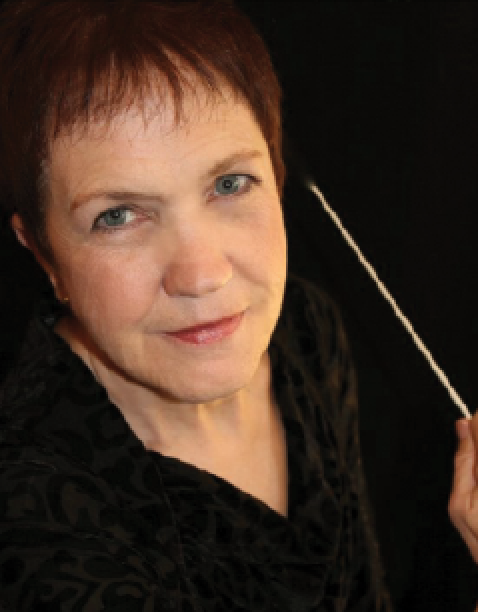
Linda Tedford

Linda Tedford

No one is more amazed than Tedford, artistic director, founder and conductor of the now 30-plus member Susquehanna Chorale, who proclaims that choral music is the ultimate expression of who she is and what she values in life.

“It is a perfect marriage of poetry and music, sung in a community of people with common goals with passions to express themselves through this unique art form,” she says. “It allows me to be who I am, whether I’m singing, conducting, listening or teaching.”

Music was part of Tedford’s DNA during her childhood in Blue Bell, located outside of Philadelphia. Her first memory was hearing her father sing; he was an engineer by day and a singer at night and on weekends. Tedford had loved singing in choirs and recalls gathering around the piano with church friends and singing hymns for hours.

But the turning point in her life was as a grad student at Temple University, where she met and studied with internationally known conductor and Grammy Award winner Robert Page. Page has greatly influenced Tedford’s career and her Chorale.

Within three years of starting the Susquehanna Chorale, Tedford and her group were selected by audition to sing at the American Choral Directors Association (ACDA) convention, and 13 years later, the Chorale became the first volunteer chorus to receive Chorus America’s prestigious Margaret Hillis Achievement Award for Choral Excellence.

Two years ago, Tedford received ACDA-PA’s Elaine Brown Award for Choral Excellence, awarded for a lifetime of outstanding choral achievement. Since 1994, she has been director of Choral Activities at Messiah College in Grantham, where she also teaches voice and graduate and undergraduate-level conducting. This year, she received the Arts Award presented by Theatre Harrisburg.

“It is an honor and a privilege to be recognized for my work in the area in the choral field,” Tedford says. “I am passionately in love with the choral art at every level.”

That love of choral art, plus music by Bach, Celtic music, choral music by American composers, Handel’s “Messiah,” Mendelssohn’s “Elijah” – the last two performed with her mentor Page – are on Tedford’s favorites list. She and her Susquehanna Chorale have traveled and performed beyond the ocean, and Tedford notes Scotland as their most memorable musical venue.

“We performed there in 1996 on a tour of the British Isles,” she recalls. “The Scots loved us and we loved them. We saw and sang Loch Lomond and participated in a ceilidh (a traditional Gaelic party gathering) complete with tea, shortbread and poetry and dancing. We were made honorary Scots.”

Recently, the Susquehanna Chorale performed Verdi’s “La Traviata” with the Harrisburg Symphony Orchestra. And, last month, Tedford and her group traveled to Hershey and Grantham for a concert entitled “Sojourn,” where audiences listened to Mendelssohn, Ola Gjeilo, Billy Joel, Carly Simon and joined in on a rousing rendition of “When the Saints Go Marching In.” In August, they’ll debut in Chautauqua, N.Y., and a new CD is in the works.

“I love variety, and this program is a perfect example,” she says.

Like any artistic group, the Susquehanna Chorale has had its challenges finding funding, talent and dedicated board members. The journey has been a hard one, Tedford admits, but she’s thrilled about the successes, the accolades and the group’s newly adopted slogan: “Enriching lives through song.”

“I am excited about all the possibilities for expansion and growth that this statement expresses,” she says. “I am grateful to my wonderful singers of all my choirs who have sung for me, listened to what I have to say and become polished ensembles in performance.”

Continue Reading

Walk This Way: Former HU Student Just Made Midtown a Whole Lot Easier to Find

Stephen Cline could have been nearly anywhere when his idea struck.

He could have been in a loud city with complex traffic patterns – or in an off-beat town of 500, where the pharmacist knows everyone’s first name, the gas station acts as a grocery store and the lone stoplight doubles as a police force.

But it so happened he was in Cincinnati, a city of nearly 300,000 people. There was business, there was culture and most importantly, there was topography, critical for a mapping ace like Cline.

He took a turn toward a street corner, in a neighborhood just like Midtown Harrisburg, and saw his inspiration.

It was a way-finding map, a detailed, thorough guide that put his finger on the tip of a neighborhood he knew nothing about. At that moment, Cline, who was set to graduate from Harrisburg University with a degree in Geographic Information Systems (GIS), knew what his final senior project would be. 

Close up of Cline's map design.

Close up of Cline’s map design.

Five months later, Cline saw his hard work pay off. The 30-year-old GIS professional released six extensively detailed way-finding maps across different points in Midtown Harrisburg and the Greenbelt. The upright gray structures, which are anchored by 70 pounds of sand, colorfully display the locations of Midtown businesses and landmarks.

“I thought we would be a perfect use-case for it, because there are a lot of things in this neighborhood that people aren’t even aware exist,” said Cline, who resides in Midtown and now works for the Tri-County Regional Planning Commission.

“A lot of major cities have way-finding signage to help people get around,” said Cline, who added that Harrisburg currently has two out-of-date way-finding maps near the Broad Street Market and Front Street. “Unfortunately, Harrisburg didn’t have a lot of that, especially in Midtown.”

Ideas like this aren’t met without backing, though. From the very beginning, Cline had support from Friends of Midtown (FOM), a non-profit organization that develops initiatives to enhance the community.

“For a few years, Friends of Midtown had been hoping to make a similar map, but had been unable to successfully partner with someone to create them,” FOM President Shawn Westhafer said. “Steve approached FOM late last year…without knowing it was something that already interested us.”

But they also operated on a tight budget. The organization was willing to finance up to $1,800 for Cline, Westhafer said, but he didn’t want to take money away from the group. So, instead, he created a supplemental crowd-sourcing fundraising page on GoFundMe.com.

Cline initially prepared a budget of eight way-finding maps, but soon revised that plan, deciding to develop just six. He set a budget of $1,400. FOM, meanwhile, was in full support, nudging Cline in the right direction by promoting his mission on their website and by word-of-mouth.

It took just 20 days for Cline to meet his goal. He even went over it, finishing with $1,450. Soon after, he began work on the signs, which cost approximately $200 to produce – between the printing of the maps, buying of the sand and production of the gray structures. 

“Between Steve’s friends and family and Friends of Midtown supporters, all necessary funds were raised, though we expect to expend funds for later map updates,” Westhafer said. 

Few hurdles needed to be jumped for the signs to be placed on sidewalks. Cline said the maps were exempt from local public space ordinances due to their purpose – directional use for pedestrians.

Most of the signs can be found in Midtown – one, for instance, sits across from the Midtown Scholar Bookstore – but Cline also made sure to place a sign near the Capitol complex.

“My big goal was to help Midtown become pedestrian-friendly and help people become more aware of the great things that already exist in our city,” said Cline, who added that he hasn‘t dealt with much graffiti or theft of the maps. “There are so many good things that people can see in this area.” 

A belief in forward progress defines Cline, who stands tall and lean at 6-foot-5.

A former NCAA Division I athlete at Penn State University who graduated years earlier with a degree in geography, Cline continues to evolve, learn and grow in this city. He picked up his second bachelor’s degree in May and is looking to fine-tune an idea that could have some legs.

“I do live here, and it’s a continual relationship,” Cline said of his way-finding maps. “For my next go-around, I was considering doing bus routes or even sub-neighborhoods.”

And even further, Cline said, perhaps a partnership with other local towns – like Carlisle or Mechanicsburg – which could implement way-finding maps in their areas.

His mind is always churning, searching for that next big idea. Whether it’s made in Harrisburg, on the west shore or in a small town of 500, really makes no difference.

Continue Reading

Family History Detectives: Locals Hunt Down Their Ancestors in the State Archives

On a windy Saturday in April, 10 would-be detectives took their seats in a reading room of the State Archives building, a 20-story “Space Odyssey”-like monolith at N. 3rd and Forster streets. The morning had featured presentations by archivists on using public records to find Civil War ancestors. Jonathan Stayer, supervisor of reference services, called the post-lunch session to order with a quick announcement. “OK, there isn’t any particular plan for the afternoon. Everybody just research whatever they’re interested in.”

“I’ve never done this before, and I’m totally lost,” someone said. Her name was Kitty, she wore a sweater with a small butterfly decal, and she had come to dig up records on her great-great grandfather.

“He was a musician, but we don’t know what kind of musician. We do have a drum. The ropes and the, what do you call it, the skin, are still intact. But we don’t know if it’s his.”

This year marks the 150th anniversary of the Battle of Gettysburg, and, for those who are marking the occasion with a bit of genealogy, some recent legislation is bearing fruit. Senate Bill 361, which passed in late 2011, moved old birth and death certificates to the State Archives, where they’re currently being digitized and made available to the public.

Michael Hengst, chief of staff for state Sen. Bob Robbins (R-Mercer County), who sponsored the bill, said the main challenge was overcoming fears of identity theft. He assuaged that by pointing out that birth certificates wouldn’t become accessible until they were 105 years old. “It’s kind of hard to pose as somebody who’s 105,” he said.

Hengst, an amateur genealogist since the age of 14, just published a hefty tome of his paternal ancestors, going back to the year 1500. One of his hopes is that the open records will simplify research for other genealogists, who often have to track down multiple incomplete documents. “One fellow came into the archives looking for regimental information,” Hengst said. “I think he thought it would be in a nice folder. It was very frustrating for him. It’s accessible, but you’ve got to be the detective.”

At a table towards the back of the room, Mark and Dorothy Gagermeier, members of the Susquehanna Trail Genealogy Club, tapped at laptop computers.

“I got interested in 1984,” said Mark.

He had come from York and had dressed for a beach vacation, in a Hawaiian shirt and blue plastic glasses. “I got hold of this software, Personal Ancestry File. I like computers, I like genealogy, and the two just sort of fit together in that program.”

He opened a window and scrolled to the end of his tree, through 12 generations. “’Georg Gaggermeier.’ They spelled it differently then. He’s from the 1650s. My ex-wife’s goes all the way back to 1200.”

Years ago, Dorothy’s brother spotted their mother’s maiden name on a plaque at Gettysburg. “We’ve gone back, but we haven’t been able to find it,” she said. On their laptops, they began combing indexes for the soldier in question, a man named John Croyle. Mark clicked his way through a maze of links. “We actually need to find… what are we on here?” He peered at the address bar.

Eventually, they found records for three John Croyles, but none was the one they needed. “Your data doesn’t match Bates,” Mark observed to Jerry Ellis (associate archivist, Records Management Services Section). He was referring to Samuel Bates, who compiled a five-volume record of Civil War soldiers from the commonwealth in 1869. It has since become the starting point for many a Pennsylvania genealogist.

“Bates isn’t always right,” Ellis replied. “He did it all in two years. We’ve been at it 150.”

James Robison, who administers a website on the history of Watsontown (mywatsontown.com), had come to beef up his section on local soldiers. He sat in front of a tall, skinny screen with an image of a list of names, several of which had the word “substitute” beside them. “People could pay for someone to take their place in the draft,” he said. “There were riots over it in New York. It was basically poor people fighting a rich man’s war.”

Outside, in a plaza, spring buds twitched furiously on a few trees. A propaganda poster hung on the wall, showing a soldier climbing some books to a city in the clouds (“KNOWLEDGE WINS”). Josh Stahlman (archivist, Arrangement and Description Section) spread out a laminated muster roll, filled with row upon row of tiny brown script. It was yellowed and full of holes, but otherwise looked like a giant sheet of loose-leaf, with the familiar faint blue lines. A researcher pored over the names. “I can’t keep track of all this in my head,” he said.

“Neither can we,” Stahlman offered, smiling.

An hour later, the Gagermeiers were sifting through large cardboard boxes of paper. “Nothing yet,” said Dorothy.

Kitty gave a big thumbs-up and grinned. “He was a drummer!”

With help from an archivist, she’d found her great-great grandfather’s name on the rolls. He had mustered as an unspecified musician, but in the “remarks” section there was a clue.

“His pay was stopped until he settled his debts for a ‘new batterhead and three snares.’ We Googled ‘batterhead’ and sure enough, it’s the—” Kitty gestured with her hands. “You know, the membrane on a drum. I’m so excited!”


For more information on what’s available at the State Archives, visit www.portal.state.pa.us/portal/server.pt/community/state_archives.

Continue Reading

The Rice Stuff: Don’t Be Afraid to Give Risotto a Stir

Many years ago, my mother was reminiscing about a trip she and my father had taken to Italy. With dreamy eyes and a wistful tone (as only my dear mother could be wistful about food), she told me about one of her most memorable dining experiences there: eating osso bucco and risotto Milanese.

What she was describing was the classic dish of the northern region of Italy. Osso bucco is veal, specifically veal shanks cut horizontally across the bone and simmered in wine and chopped vegetables.  And risotto is rice, but a very special rice called Arborio, usually made with broth, butter and Parmesan cheese. When slow-cooked on the stovetop, allowing the rice to release its starch, Arborio rice becomes silky and creamy.

My mother made this dish every now and then, most likely without a recipe. Being from the southern Italian island of Sicily, this was not a dish she would have learned to make from her own mother. I remember the meat being so tender that it fell off the bone. We had tiny spoons that we used to scoop the soft marrow from the shank bones. Even as a child, I thought this was delicious. Only in an Italian family!

But it is the risotto part of this dish that is increasing in popularity both in restaurants and home kitchens. Like pasta, risotto is a blank canvas that can be varied with the seasons or with whatever a resourceful cook has on hand. The different regions of Italy have their own risotto specialties that reflect popular local ingredients and traditions. In northern Italy, as noted above, the classic version is risotto alla Milanese, rich with butter, saffron and cheese. In the Veneto (Venice region), risotto is made with sweet springtime vegetables like baby peas or asparagus or mixed seafood fresh from the nearby sea. The natives of the Piedmont region make a hearty risotto with their prized local red wines, Barbera and Barolo, a perfect dish for a cool night.

Making risotto is not hard, although it does have the reputation as a dish that requires “slaving over a hot stove.” While some attention to its preparation is needed, such as as frequent stirring, risotto is a wonderful alternative to pasta that very much is worth trying. It is imperative that real Arborio rice be used, as well authentic Parmesan cheese and good quality chicken broth – if not using homemade. As with all Italian cooking, the quality of the ingredients is so important here. The recipe that follows is for basic risotto, a stepping stone for the many other variations that are out there.

Basic Risotto

  • In a medium saucepan, bring 4 cups reduced-sodium chicken broth to a simmer. Cover the pan and keep the broth warm over low heat.
  • In a large heavy saucepan, like a Dutch oven, melt 2 tablespoons unsalted butter over medium heat.
  • Add ¾ cup finely chopped sweet onion and sauté until golden in color.
  • Add 1½ cups Arborio rice (can now be easily found at the grocery store) and stir to coat all the grains with the melted butter. If you can find saffron threads in the spice aisle of your store, add a pinch of them here.
  • Pour ½ cup dry white wine into the pan and let it cook until it all but evaporates (several minutes).
  • Now the fun part: Add about ½ cup of the simmering chicken broth to the rice and stir until almost completely absorbed. It is best to use a soup ladle for this process.
  • Continue adding the broth, ½ cup at a time, stirring and letting each addition of broth be absorbed until adding more.
  • When all the broth has been added, a ladle at a time, the rice will become very tender and creamy. Don’t rush the process or have the heat too high. The whole process should take about 20 minutes.
  • Remove the pan from the heat and stir in another tablespoon of butter and about ½ cup of freshly grated Parmesan or Romano cheese. Serve immediately.

Risotto is a dish for all seasons. It is now early June, and the spring vegetables are here. Try adding some fresh baby peas or sliced asparagus to your risotto. If you like seafood, add some lump crab, cooked lobster chunks or calamari. Meat lovers might enjoy some cubed ham or bits of cooked lamb in their risotto. Fresh herbs go well with risotto, as does Marsala wine. Sautéed mushrooms and Italian sausage add heartiness to a winter risotto. Experimenting is part of the fun.

Well, I’m getting carried away and starting to sound like my mother. But I am excited for you to try making risotto, one of the all-time classics of Italian cuisine. You can do it!


Continue Reading

Fair Share: Harrisburg-area CSA’s Are Connecting People with Neighboring Farms, the Local Economy and Tasty Whole Foods

Navigating a modern landscape of big box grocery stores, quickie marts and fast food chains, it might feel like we’re set up for dietary failure. Although more and more stores are offering local, organic options, they sometimes come with a price tag that can steer us right back to the shelves of cheap, highly processed boxed foods. Luckily, a group of modern visionaries has your wallet, your health and waste line in mind. Look no further than your local farmers.

In recent years, the trend toward providing healthy, affordable food has really gained momentum. Not only can you enjoy fresh, wholesome and, sometimes, organic food at farmers markets, but you can also buy into a farm by purchasing a season’s share for your family before each year’s harvest. While it isn’t a new concept, community-supported agriculture (CSA) has been given new life in recent years, as people are seeking alternatives to unhealthy manufactured food products.

“The CSA movement is really getting a lot of press,” says Mike Nolan of Earth Spring Farm, located in Gardners in Adams County. “There are more and more people [getting involved in] CSAs.”

Within the CSA framework, customers pay upfront for their entire season’s share, which helps farmers cover costs ahead of time. Each week, members pick up weekly or biweekly shares (or CSA boxes) directly from the farm or at designated drop-off sites. As part of their share, members enjoy fresh vegetables, meat, eggs, milk, cheese, honey, bread and other food items at a cost that is competitive to the prices in grocery stores, while getting to know their farmer and knowing where and how their food is produced.
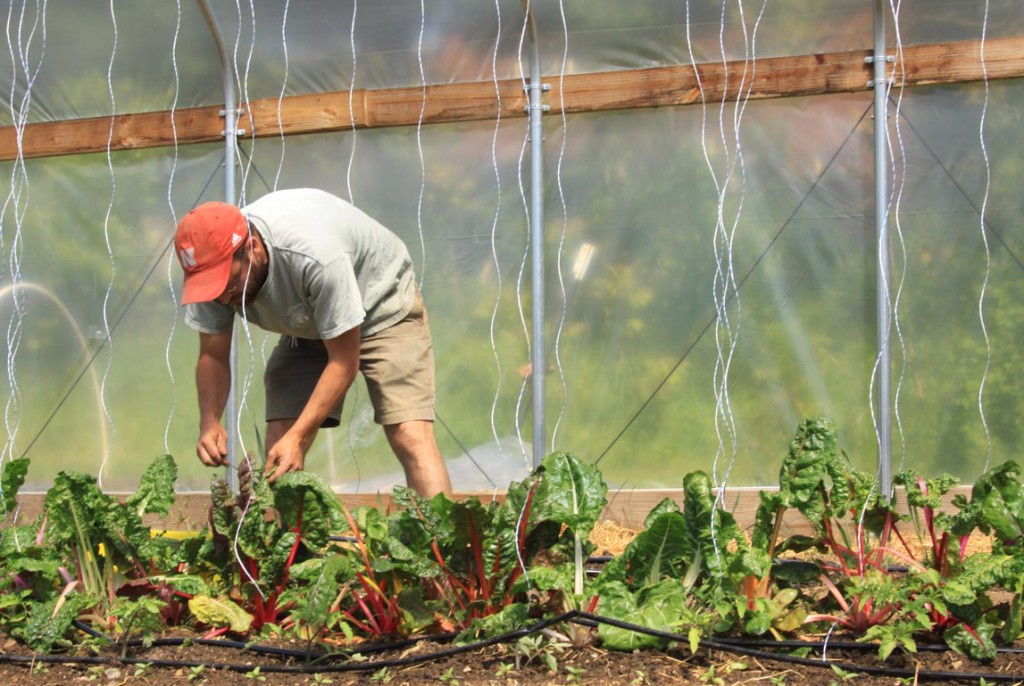
Fresh kale being tended to at Joshua Farm.

Fresh Swiss chard being tended to at Joshua Farm.

“It is important for all communities to have access to CSAs,” says Elaine Lemmon, of Everblossom Farm, East Berlin. “The food a person receives from a CSA share will almost always be fresher, more nutritious and better tasting than foods they would buy from a grocer that have been sourced from a great distance and potentially grown or raised irresponsibly.”

While living in a city can cut back your healthy, whole food options, the greater Harrisburg region is rich with agriculture and farmers who are ready to meet your healthy living needs through CSAs. Fresh, whole food is even growing within one neighborhood of the city.

CSA and the City

Harrisburg’s own Joshua Farm, the only operating urban farm in the city, is hard at work growing 35 varieties of organic vegetables to pack in CSA boxes for its 40 members. The Allison Hill neighborhood farm also serves as a drop-off point for other area farms and businesses that produce raw milk and cheese, eggs, meat, fruits, bread and baked goods.

“I wanted to offer a CSA because I had been a member of a CSA before I started farming,” says Kirsten Reinford of Joshua Farm. “I liked the connection I developed with the farm and the sense that I was providing support to a farmer and getting real benefits from that farm. Helping people to see the value of shortening the distance from farm to plate is something that is important to me.”

Reinford also believes that minimizing the producer-to-consumer gap helps communities live more sustainably and in accordance with the natural order of our planet. While most people in the United States get food from supermarkets that source their products from all over the country and the world, the local food movement continues to grow. And the people of Harrisburg are happily participating.

Reinford says that Joshua Farm has been attracting more and more consumers to their CSA—so much so that they have had to turn people away in recent years. But she is exhilarated by how the demand is helping to motivate social change.

“Every time you buy something, you are casting a vote for the kind of food system you want,” she says. “Over the decades, money has been put into fast, processed food. If we want a different system, people have to keep on voting to make that system work.”

More than just food

When you walk into a grocery store and buy a package of chicken, you aren’t buying it directly from the farmer who produced it. In fact, that chicken probably came from a factory farm, which pump out poultry at a rapid rate, unnaturally fattening their animals and often raising them in less-than-sanitary conditions. But, when you see food growing or animals grazing on a farm, or when you shake your farmer’s hand at a farmers market, you begin to get the backstory of your food. Forming relationships, and sometimes, close friendships with your food producer is another perk grocery stores don’t offer.

Twenty years ago, Terra and Mike Brownback started a CSA at their family-owned Spiral Path Farm in Loysville to bridge the gap between food source and consumer and to form personal bonds with their neighbors. “We felt it was going to be a wonderful relationship between the farm and its members, allowing us to be a direct contact to our customers and allowing our customers to have their own personal connection to the farm,” says Terra Brownback.

Nate Thomas of Breakaway Farm in Mount Joy enjoys greeting customers on his “beyond organic” farm, which offers grass-fed beef, lamb and goat; pastured pork and poultry; and wild-caught fish. “Most of our CSA customers choose to pick up at the farm,” he says. “They look at it as an opportunity to make a connection. They bring their kids and grandkids, who get to play with baby animals.”

In Duncannon, Yeehaw Farm offers a whole-diet CSA, providing its members with all-natural meats, vegetables, raw milk and cheese, eggs, some fruits, grains and value-added products. According to Judi Radel, through their CSA, the family has gotten to know their customers more intimately than they previously could by just selling their food at farmers markets.

“Running the whole-diet CSA allows us to have frequent interactions with our members,” she says. “I love that they come to our farm to pick up their food. I love that we are ‘their’ farmer.”


Locally shared perks

Operating under a local business model, CSAs provide farmers and the local economy with certain advantages that are not apparent in a corporate food structure.

“Farmers are afforded the benefit of a stable income that does not rely on government subsides,” says Lemmon.

She also emphasizes that local economies stabilize and thrive when people purchase food items from their local farmers. “Every dollar that stays in a community’s local area is equivalent to $10. Buying locally produced goods is the fastest way to secure our local economies.”

Reinford agrees. “As with any small business, dollars that are spent here, stay here and multiply, as opposed to going to line the pockets of a CEO or multinational corporation with a different tax structure,” she says.

Thomas enjoys that the upfront income from his CSA allows his farm to financially and logistically plan ahead for the season. “Farmers have so many costs during seasonal production. We like [our CSA] because it gives us a slug of money into our cash flow. [CSAs also help] get more people involved in making investments in their local economy, communities and in their own health.”

Many farmers view CSAs as a necessary business offering to start new farming ventures and to keep existing farm operations afloat during hard economic times, when many people still gravitate to grocery stores over farms. “CSAs help the farmers get established,” says Nolan. “The CSA actually helps us to make a living.”

For Brooks Smith, the CSA model allows his Newport farm, North Mountain Pastures, to enjoy guaranteed sales that it might not otherwise earn at market. “Before a farmers market, we might pack our van with $3,000 worth of food and sell about $500,” he explains. “The energy you put into that market with packing and driving can [equal] a 10-hour day, and you might not sell a quarter of what you take with you. Any way that can be simplified will help the farmer focus on what he or she wants to do, which is production.”

By voting with their dollars, CSA members not only invest in local farm businesses and the local economy, but they also invest in their own health. Brownback says that some of the most rewarding aspects of Spiral Path Farm’s CSA are the enriching learning experiences people enjoy as a byproduct of their CSA membership.

“[Our CSA members] have opportunities to visit our farm, which is beneficial to families and children,” she says. “If you start it early, kids gets an expanded opportunity to see and eat healthy food at a young age.”


Bringing real foods to a food desert

Like most other major metropolitan areas, Harrisburg isn’t a lush, green oasis where whole fruits and vegetables grow in abundance and livestock graze the land. Instead, processed, factory-farmed and mass-produced food products reign. Because vital, nourishing foods are scarce within city limits, farmers from surrounding areas are helping to fill a need for locally grown, real food through CSA offerings.

“It is very important that Harrisburg residents have access to CSAs because the Harrisburg area is considered a food desert,” says Radel. “As rich as Pennsylvania is with agriculture of many forms, most farming operations ship their food production out of the area—even out of the state and beyond.”

Parts of Harrisburg may have limited immediate access to fresh, healthy, whole foods, but the central Pennsylvanian landscape is home to a myriad of working farms, many of which offer CSAs. And a good portion of these farms have CSA drop-off points in Harrisburg, Camp Hill, Carlisle, Mechanicsburg and other neighboring towns. Participating as a member of a CSA has never been so accessible, and it can have countless positive impacts on a community’s health, social exchanges, local economy and natural environment.

For Reinford, running Joshua Farm’s urban CSA is part of a greater goal to help change Harrisburg residents’ minds about how they live, what they put into their bodies, how they treat the environment and how they interact with each other.

“I hope we are part of their overall approach to living gently and being good stewards of the world and the creation we are asked to care for,” she says. “A lot of people are motivated toward CSAs, not only because of fresh food, but also because [the food] is grown sustainably. I hope that our CSA can be part of that. I also hope that our members can feel a connection with our farm, but also with each other.”


Continue Reading

A Mayor Loses: What Exactly Went Wrong with the Thompson Administration?

Every reporter who’s covered City Hall over the past four years has his or her favorite Linda Thompson story.

Some cite the mayor’s story of goats eating “poison ivory,” as told during a press conference for a cleanup on City Island. Another reporter told me that she’s always struck by the mayor’s repeated use of the word “onerous” instead of “onus.”

Mine? The time she seemed to believe that Harrisburg Young Professionals President Meron Yemane’s first name was Yemen (as in the country) and called him that repeatedly during a high-visibility press conference.

The mayor’s verbal gaffes and off-script wanderings may have elicited chuckles, but they’re actually not indicative of Thompson, who is a smart woman, can have a good sense of humor and, when she doesn’t stray too far afield, is an effective public speaker.

So then what went wrong with Thompson’s mayoralty, which caused her to lose so decisively in last month’s re-election primary, taking just 28 percent of the total vote? The answer to that question is important not just for those interested in Harrisburg history, but even more so, for our next mayor, who must not repeat her mistakes.

In my mind, Thompson failed in three major ways that diminished her effectiveness and ultimately doomed her administration.

Exercise of Power

Harrisburg may have a strong mayor form of government, but it doesn’t have a dictator form of government. Unfortunately, from day one, Thompson seemed intent on repeating former Mayor Steve Reed’s my-way-or-the-highway approach to exercising power.

As a councilwoman, Thompson often railed against the arrogance of power of the Reed administration. Therefore, it came as a shock to many that she took up where he left off, immediately disregarding City Council, belittling the legislative branch of government and trying to ram through ordinances via public denunciations and force of will.

The brawl over her first budget, which she lost, seemed to teach her little, serving scant purpose other than to solidify an emerging bloc against her, which insisted that the council no longer be dismissed or regarded as a rubber stamp. That summer, she went to war with council again, this time getting pulled into a useless, avoidable battle over appointees to the board of the Harrisburg Authority.

As a result, the well was already poisoned by early 2011, when the city’s financial crisis hit a critical stage. By then, she didn’t want to work with City Council and City Council didn’t want to work with her. The problem: she now needed the council as the city entered Act 47. Instead of cooperating, the council revolted, rejecting two financial recovery plans and ultimately filing for municipal bankruptcy, a waste of time and money that directly led to Harrisburg being put under state receivership.

Thompson eventually learned how to work somewhat better with council – and was quickly rewarded for it as council approved funding for her spokesman, ending yet another prolonged, pointless conflict. Still, it was amazing that the former council president had to learn this lesson at all. Meanwhile, the city suffered severely from government inertia and discord.

Job Performance

Above all else, a mayor is the chief deliverer of services to the people, using the municipal staff to accomplish that mission. That’s why a local government exists at all. The people of a city pool their money to do things collectively they can’t do well individually.

Harrisburg, in its current desperate financial state, cannot afford any frills. Nonetheless, $53 million in annual revenue should be able to buy the basics in a tiny city of 49,500 people. Not for the Thompson administration.

Among the fundamental things it failed to do: complete budget audits even remotely on time; disperse HUD grants; present accurate budget figures to council; file for flood emergency funding in a timely manner; complete demolitions of dangerously dilapidated buildings; maintain streetlights; provide a serviceable website; keep the city’s major roadways maintained and striped; update publicly disclosed financial information, a failure that recently led to sanction by the SEC.

Twice, holiday celebrations were nearly cancelled as the city said it could not raise the money to hold them. After the issue became public, private donors quickly stepped up to cover the costs.

Arguably, the administration’s greatest failing has been its inability to retain qualified staff. Tired of the dysfunction in City Hall, many of the city’s best managers and employees left, taking with them the knowledge of how to run a city competently.

Mayoral Style

Thompson has referred to herself as a strong woman with a strong personality, which sometimes works to her benefit. However, there’s a difference between being strong-willed and acting intemperately, which repeatedly has landed her in trouble.

Early in her administration, several key staffers – including highly respected professionals like Joyce Davis and Chuck Ardo – left after short tenures, citing an intolerant working environment. Ardo even claimed Thompson made an anti-gay slur against City Controller Dan Miller. An ensuing media frenzy and citywide furor led to a protest in front of City Hall, during which Thompson goaded the demonstrators.

I personally never heard Thompson make a biased comment, but she usually held nothing back when speaking of people she disliked, such as Miller and her opponents on council. To her, opposition was not a matter of policy, but personal and political.

So, in Thompson’s eyes, Miller had no case when he insisted on being able to review the city’s payroll as part of his job as controller; he merely wanted to encroach on her power while coveting her job. Likewise, council members didn’t legitimately have differing viewpoints and priorities; they wanted to ding her politically to benefit Miller. She was equally thin-skinned when criticized by the press.

Then, during what should have been an innocuous press event earlier this year, she again ignited controversy by impetuously (and wrongly) blaming “some scumbag” from Perry County for Harrisburg’s illegal dumping problems. The incident may have been blown out of proportion by the media, yet it affirmed her reputation for being intemperate and even mean-spirited.

Too Little, Too Late

During the recent mayoral debates, Mayor Thompson employed a classic incumbent strategy – that voters shouldn’t change horses in midstream – then backed up her argument with a mastery of facts that may have impressed audience members who know her only from her well-publicized verbal stumbles and impulsive remarks.

Linda Thompson

Linda Thompson

I wasn’t surprised. Over four years, I’ve seen her grow in office and get better at her job, putting in long hours to do so. And I’ve always thought her early embrace of the receiver’s plan was a smart move, at least politically.

However, it was too little, too late. Practically from the start of her administration, Thompson opted for confrontation over cooperation; arrogance over understanding; compliance over competence. She never courted her opponents and never really solidified her base, which gradually eroded until she was left with no one but her most ardent supporters.

After the dictatorial Reed years, Harrisburg needed another approach to governing, yet, for too long, Thompson offered more of the same. It’s tragic both for the city and for her that she didn’t—or couldn’t—bring Harrisburg more evolved, conscientious and professional leadership.

Let’s hope our next mayor can make a clean break from Harrisburg’s recent tragic history, bringing an honest, well-run, even humble, government that does what municipal governments are supposed to do—professionally deliver critical services to residents who are paying for them.

Continue Reading

More Student Bodies: As HU Opens Its Third Residence Hall, Downtown Begins to Reap the Benefits

Come fall, a newly renovated building will open downtown, the third Harrisburg University residence hall to debut on a two-block stretch of Market Street.

Over the past couple of years, the university has made a habit of taking rundown, under-used buildings and transforming them into fully occupied residences. In the process, it has helped inject life and commerce into an area of downtown that, for many years, became desolate once the daily throng of commuters gathered their belongings and packed off to the suburbs.

Lloyd Fought, owner of the Downtown Deli & Eatery, which specializes in both breakfast and lunch, has cashed in on some of that economic activity. “Harrisburg University is 100 percent good for my business,” he said.

The university estimates that an average HU student spends $3,500 a year locally – just on food.

“Because Harrisburg University does not provide a meal plan, students are participating within the local food economy,” said Steve Infanti, HU’s assistant vice president of communications.

With 54 students living there, the new building at 319 Market St. will create a direct economic impact of $189,000 a year for local eateries, said Infanti. Together, HU’s three residence halls will house 238 students, bringing the university’s total economic impact on the downtown to $830,000 a year, he said.

Fought added that, besides feeding students, Downtown Deli caters outside events held at HU, located just down the block from his sandwich shop. In fact, he had little time to talk to this reporter because he was busy preparing for exactly that.

“Local groups and businesses can rent out space at Harrisburg University for events,” he said, rushing back to work. “They often call us to cater.”


Going Downtown

Originally known as the William Seel Building, 319 Market long has been a half-empty office building. Campaign offices and other temporary tenants have called the century-old brownstone home, but it had not been filled to capacity for years. The building was outdated and in desperate need of renovation when Brickbox Enterprises bought it last August from long-time owner, the Pennsylvania AFL-CIO.

The Seel Building is the third historic building downtown that the company bought and renovated for HU. In 2010, Brickbox rehabbed the old Governor Hotel at 4th and Market streets and then, last year, the Kunkel Building just down the block at 3rd and Market. The latter building also houses a sprawling new Subway sandwich shop on the ground floor, which, since opening in April, has become another popular eatery and hangout for HU students.

Unlike most residential properties owned by nonprofit universities, all three buildings continue to generate tax revenue for the city.

“We don’t own our residential properties,” said HU President Eric Darr. “We partner with . . . Brickbox. Because Brickbox is a business, the property will remain on the tax rolls.”

Darr said that this arrangement has been perfect for HU, as the university has sorely needed to expand its housing. “Our student body continues to grow. We simply needed more beds to accommodate our growing student population.”


319 Market Street.

319 Market Street.


New Option

While this development project is certainly good for Harrisburg, it is also one of the university’s selling points. “These aren’t the cinderblock dorms that most students are used to,” said Darr. “Prospective students and parents touring our campus are always very impressed with the student housing that we offer.”

But, even with such housing options, HU wanted to address some specific needs among students.

“All of our first- and second-year students are required to live in student housing,” said Darr. “The two apartment complexes that we already use are designed with these students in mind. However, many of our juniors and seniors were moving off-campus. We wanted to make sure they had housing options designed for them.”

Because of the high ceilings on the first floor of 319 Market St., the university will offer loft-style apartments there. Additionally, all the upper-floor apartments will be singles designed with juniors and seniors in mind.

“The student leaders who run clubs and organize student life programs wanted to stay on-campus,” says Nayeem Islam, HU’s director of student housing. “This will provide them with housing designed for them. It will have a big, positive impact on student life. The current student body president is a perfect example. She was planning on moving off-campus, but now, with the opening of 319 Market St., she has chosen to stay on-campus so she can be close and present at student activities.”

Additionally, according to Islam, the new building will allow older students additional privileges.

“Students who have been at HU for two or three years have earned certain freedoms,” says Islam. “These are students who have shown that they can live responsibly. The rules concerning 319 Market St. will reflect that.”

With the addition of the new student apartments, the young Harrisburg University continues to expand its role in the city. For a city in Harrisburg’s financial situation, downtown residential development serves as a sign of hope. For a new institution of higher education, accommodating a growing student body is affirmation that the university is on the right track.

“As Harrisburg University grows, it is important that we seek ways to help the on-campus community thrive,” said Darr. “We think that this building project will do just that.”

Continue Reading

Focus on Fresh: Local, Scratch-Made is Philosophy at Fraiche

Armen Vartan is a man who is serious about fresh food, and it’s obvious when he enthusiastically describes the dishes he serves at Fraiche, his farm-to-table BYOB located  in Camp Hill.

Photo by Anela Bence-Selkowitz

Photo by Anela Bence-Selkowitz

He celebrates his purveyors with a floor-to-ceiling chalkboard prominently displayed on the back wall of the restaurant, where customers can review a list of his suppliers, from Highbourne Deer Farms in Dallastown for succulent venison to Linden Dale Farm in Ronks for high-quality, artisan cheeses.

“I use farmers who practice methods that yield tastier, healthier produce,” said Vartan, adding that those who make it to the list practice only the best farming methods.

The 25-year-old has an up-close-and-personal relationship with his purveyors, their families, farming methods, dedication and farming philosophy, and he’s happy to share that with customers for the asking. You might even say the man micro-manages his micro-greens, but customers wouldn’t have it any other way.

Neena Agarwal, a Fraiche regular said, “I love the fact that I can eat real food at Fraiche. None of it is processed or canned, and he uses ingredients from a direct source. It’s obvious he is very passionate about his food.”

Slow-Food Harrisburg founder Curtis Vreeland said that the farm-to-table movement embraced by Vartan is gaining in popularity.

“It’s a way to shorten the connection between producers/growers and consumers and emphasizes seasonality, local availability and freshness,” he said. “For consumers, the benefits mean more nutritious and better quality ingredients, since the crops are picked close to peak maturity, rather than picked for shelf life.”

Vartan makes it a point to adhere to that concept and takes a hands-on approach, traveling four days a week to select his food and taking virtually no short cuts. “We make everything from scratch: from breads to butter, ice cream, sorbet, pasta and mayo,” he said.

The menu changes as different food comes into season, and Vartan and Chef Doug Shenk, previously of The Cellar restaurant in Camp Hill, collaborate on dishes.

“He’s a fan of ethnic food,” said Vartan, adding that there are always choices on the menu for vegetarians.

Curried dahl, a dish comprised of mixed lentil stew with radishes, carrots, mushrooms and scallions, spring garlic and goat yogurt, is the current seasonal selection. Meat-eaters can choose from venison steak, chicken and biscuits, grass-fed rib eye and pork tenderloin. For light eaters, Vartan offers a series of small plates, which include hummus, jerk trout fillets and chevre gnocchi, to name a few. Desserts range from creme brulee, to chocolate racine cake and also vary seasonally.

Décor is both simple and elegant, with butcher-block tables, topped with living herbs like oregano and basil planted in clear mason jars. Even this simple touch is carefully crafted to integrate masterfully into part of a larger concept.

“I’m going for the Japanese ‘wabi sabi’ aesthetic, which loosely translates to ‘beauty in things imperfect’ – none of it pronounced, but all of it there to be noticed. We try to bring this type of nuance into all aspects of the restaurant – somewhat of a counter to the pronounced uniformity that one usually experiences,” he said.

Works of area artists adorn the walls and are rotated out on a monthly basis.

Vartan’s goal is to leave his customers with a good feeling.

“Being in touch with how we feel not only during, but after we eat, is part of the experience at Fraiche,” he said. “I don’t only buy local – I strive for perfection at every end, finding people who absolutely love what they’re growing so that I can ensure that complete care was taken at every level with everything that appears on that menu.”

He sums it up simply with a phrase printed on all of his menus:

“It’s not only wholesome, it’s awesome.”


Fraiche

2138 Market St., Camp Hill

Monday, 11 a.m. to 2 p.m.

Tuesday – Friday, 11 a.m. to 2 p.m., 5 p.m. to 9 p.m.

Saturday, 5 p.m. to 9 p.m.

(717) 737-4380; https://www.fraichetodef.com/

Continue Reading