In Case of Emergency

I have pills on my desk. Four pills. They’re behind a scrim of foil, like Dentyne Ice, at the bottom of a large white envelope.

The envelope is open, but I won’t be taking the pills now. These pills are backup pills, pills for a crisis. I’m not talking about a minor crisis. I’m talking about something major. It would literally take a nuclear disaster to get me to swallow these pills.

I use “literally” literally. The pills are potassium iodide, to be taken in the event of a nuclear event. They will flood my body with iodine, preventing my thyroid from hosing up 131I, a radioactive isotope of iodine that can be dispersed in a nuclear meltdown.

I got the pills for free, from the Pennsylvania Department of Health, which is distributing them today in the areas surrounding the state’s five nuclear power plants. The department’s rap sheet on potassium iodide refers to it by its chemical formula, KI. What is KI? A salt compound. What does KI do? Help protect your thyroid gland. What is KI not? A “magic anti-radiation pill.”

To get the pills, I had to drive out to the Fairview Township Fire Station No. 1, on Lewisberry Road. On the way, I listened to NPR’s “Here & Now”: a story about a soldier’s tintype photos of his tour of Afghanistan, new grand jury indictments in the Boston marathon bombings, a photographer in Detroit who snaps things other than ruin porn.

The destination flag on the GPS approaches. I’m passing an empty field. I pull into an auto shop down the road, where two guys are removing a tire from a Staples truck. One of them, with short blond hair and thick glasses, tells me to drive back through two red lights and look left. Does he mean two green lights? I will drive through red lights. This could be an emergency.

At room temperature, iodine is a metallic solid that will sublime with a little heat into violet gas. The thyroid uses it to synthesize a key hormone, which is why—for people who don’t get enough in their diets—it’s advisable to consume it by way of iodized salt. One of my pills has somewhere between 300 and 700 times the recommended daily serving, which is the reason they’re to be reserved for radiological catastrophe. Conversely, in lieu of the pills, my cylinder of Morton would do no good. To achieve the pills’ prophylactic function, I’d need to swallow a kilogram of salt, and that could kill me.

The foyer of Fire Station No. 1 is sharp with the chemical smell of new paint. Pill distribution is down the hall, in a room with an electronic Bingo scoreboard mounted high on the wall.

There’s a foam-core evacuation-route map propped on a folding chair. I see that my apartment is technically outside the ten-mile radius around Three Mile Island, but that the evacuation arrows proceed up 2nd Street, right past my stoop, and continue over the George Wade bridge out of town. I think about the day when, advised not to evacuate, I will watch my southern neighbors caravan past my window, towards cleaner air.

I have to fill out a form with my name—and my address. Will they refuse me on the grounds that I’m outside the zone? I want those pills. In cases like these, a well-timed diversion is required. A volunteer looks over my sheet.

“Can I take a copy of these?” I ask abruptly, holding up a printout of guidelines I already have at the office.

“Absolutely,” the volunteer says. He puts down my paper, fills an envelope, and forks over the meds. He continues to review my paper. Will he take them back? Am I within the zone after all? No time to find out. I get out of there.

In the parking lot, an elderly couple step out of their car. They approach the building, and the man holds open the door. They’re in their seventies, possibly older—is it a generational dutifulness that brings them, or a pre-smartphone-era impulse to stay prepared? The pills are not likely to help them: a 1999 report by the World Health Organization advised that, for people over 40, the KI doses carry more risks than benefits. But what does that matter? They were born before the Cold War. I wonder about what they’ve seen.

In the car, my pills sit in the passenger seat, in their crisp and illicit sleeve, like photos taken by a private eye. I get stuck in traffic and turn on the radio. The story about the Detroit photographer is still on. They discuss a man who built a fence around his mobile home, for security purposes.

KI

Continue Reading

Whose Woods These Are

Tuesday night, around 7 p.m., a group of two dozen or so gathered outside the Benjamin Olewine III Nature Center in Wildwood Park, at the north end of town.

They were carrying flashlights, binoculars, and bags. It was National Night Out, and across the city—Midtown, Olde Uptown, Engleton, Allison Hill—neighbors had taken to the streets to mingle, eat free food, and hobnob with McGruff, the crime-noshing bloodhound. The night, begun in 1984, urges citizens to congregate outdoors, preferably equipped with a light-producing instrument, to signal to criminals that “neighborhoods are organized and fighting back.”

At the intersection of Green and Muench, this entailed petting rabbits and brandishing balloon swords. But in the hinterland beyond the Farm Show Complex, a more venturesome outing was commencing: the group would walk Wildwood’s trails til it got dark.

“Does anybody know what this tree is? Big, big leaves?” asked Sandy Lockerman, one of the park’s full-time environmental educators. She was wearing a blue polo, light khakis, and a chock-full gray Jansport.

“Pawpaw,” Lockerman explained. “They haven’t produced fruit in 15 years. It turns out they’re all clones of each other.” She indicated an installment on a nearby trunk, which looked like a Jackson Pollock made of sticks and leaves. “This is for children to hang things on and make art.”

Lockerman started the National Night Out walk three years ago. “Nobody’s supposed to be here in the park after dark,” she said. “That’s part of why it’s popular. It’s our little way of offering something to the public.”

Further along, tucked amid trees, stood a natural-materials sculpture of Gandalf the Grey, complete with a fired-clay face and a wizard staff. “This summer I came through and there was a garter snake wrapped around the hat,” Lockerman said.

She noted a roadside growth of touch-me-not, so called because the plant’s pods, when ripe, become seed grenades.

As the group walked on, the sound of barreling semis filled the air. Wildwood is adjacent to several major roads—“our little piece of paradise between the highways,” Lockerman called it.

The group paused on a bridge over Paxton Creek. Last May, a tanker truck full of diesel oil toppled on the on-ramp to Route 22-322, bursting into flame and shutting down a section of the interstate. Shortly after the accident, a maintenance worker at Wildwood spotted oil entering the park by way of the creek.

“It came down this way,” Lockerman explained. She recounted how the DEP had arrived on the scene in minutes. (“I was looking at the oil, just wishing I had a mattress to stop it,” she said later, miming propping up a mattress as a dam.) They placed booms in the creek, shut down the park, and brought in “a big truck with a super-sucker.” The spill was prevented from reaching the lake, but 11 ducklings and goslings had ingested oil and eventually died.

“If it had happened at night, it would have covered the lake and gotten to the river,” Lockerman said. “A lot of caring people put in a lot of time to help us.” Nonetheless, “it was very difficult to breathe here. It was very difficult to have ducklings in your arms that weren’t going to make it.”

It was an overcast evening, humid but cool, and not dark enough yet for flashlights. A man remarked on how pleasant it was to be out “in nature.” At that moment, a truck roared past, as loud as if it were just beyond a thin screen of trees. “Asterisk on that,” he added.

“Hear that chip, chip, chip?” Lockerman asked. “There are wood thrushes doing alarm calls over there. There’s something upsetting them.”

“Is it us?” someone asked.

“No,” Lockerman said. “It could be a snake, even a squirrel near a nest, close to their babies. They’re making a fuss!” The path wound around, affording a better view. Lockerman turned back to the group. “I just discovered the reason for the squawking. There’s a Cooper’s hawk up there. They eat other birds.”

The group stopped on another bridge, where the water below was sluggish. In summer, Lockerman said, the level is low, but “there are times when the water is up to our necks here.” Wildwood, being a wetland, is a flood-control mechanism for the city, able to hold and disperse runoff in ways pavement can’t. “It’s like a big sponge,” she explained. “The road you drove in on is a dam.”

“My son this year is doing a Lego challenge, called Nature’s Fury, to come up with a solution to Pennsylvania’s flooding problem,” a woman offered.

Lockerman nodded knowingly. “Do you know what comes in with the water? Basketballs, refrigerators, tires, kids’ sneakers.”

Someone asked what sort of devices Wildwood had for detecting floods. “Just eyesight,” Lockerman said.

As the path continued, the canopy opened. “Does anybody hear the cricket?” Lockerman asked. She unfolded a square of paper, where she’d scribbled a cheat-sheet of cricket sounds, using a CD by a Hershey-based enthusiast for reference. “It’s the Carolina ground cricket. Trill. It’s like a trill.”

A boy asked about the gender of the singing crickets.

“It’s mostly the males,” Lockerman said. “So the females can find them. That reminds me, I have an activity.” She took two Ziploc bags of film canisters from her backpack and distributed them among the group. “You have become insects, and you have no vocal chords. So what you need to do is find the two insects who make the same sound as you.”

The canisters started rattling. The group members mixed. “We’re together,” said a woman with binoculars. Lockerman went over, popped off the tops of their canisters, and peered inside. “Yup, you’re a match,” she said.

She inspected another group, all adults. “Kids cannot do this without talking,” she divulged.

“We talked,” one of the adults confessed.

“You’re not supposed to talk!” Lockerman looked around. “We still have some insects that haven’t matched. They’re wandering around the woods, trying to find each other!” At the end, she collected the canisters and held one up. “These are gold. If anyone has any film canisters you don’t want anymore, please donate them to Wildwood. You can’t find them anywhere!”

Ray Osif, in a faded ball cap and green rain jacket, with a pair of Nikon binoculars around his neck, hung towards the back of the pack. He had started volunteering at Wildwood in April, a couple of weeks before the spill. Currently, he worked at the nature center help desk, but he hoped eventually to guide walks like Lockerman.

“Right now, I’m a rookie. Little bit older of a rookie, but a rookie nonetheless,” Osif said. “Rookie’s one of the things you get to do more than once in life.”

Lockerman paused again by a field of swamp mallow, a native plant with pink flowers. “I got some stuff to show you,” she said. She began removing pelts from her backpack. The first, from a possum, had dried-out, pointy ears. In sober tones, she discussed the lottery dynamics of possum reproduction. “The mother has only 13 attachments, and she delivers 15 to 20 babies. It’s whoever gets there first.”

A woman clicked her teeth reproachfully.

“Also, possums do not hang from their tails. So let’s dispel that,” Lockerman added.

She pulled out a sizable raccoon pelt. Someone started singing: “Davey, Davey Crockett, born on the wild frontier… come on!”

Lockerman held up a snapping turtle shell. “This is a teenager,” she said. She showed with her arms that the turtles could get much bigger. A boy in the group, wearing a Star Wars T-shirt, asked if anyone had seen a YouTube video of a snapping turtle eating a watermelon. “They set it down, and the snapping turtle bit it so hard the watermelon exploded.”

The path terminated at a wooden bird-watching stand, facing out over a field of American lotus. The plants, which hold hemispheric seedpods in the middle of large cream-colored petals, cover the entire surface of Wildwood Lake. For years, Lockerman explained, the American lotus was endangered, but the population has more than recovered. “Now it’s a noxious weed in several states,” she said.

The tubers of the lotus are edible, their texture a cross between Twizzlers and celery. So are the seeds and flowers. In myth, the plants were attributed narcotic properties. Homer, in the “Odyssey,” describes an island where lotuses are the only food. Its residents lie around all day, doped up on lotus fruit.

It was getting late. The lotus petals, pale like moons, dotted a carpet of gently turning leaves. Lovely, dark, and deep: was it possible that the lotuses could drug without being ingested? Lockerman discussed another endangered species—the great egret, a slender white bird that can be spotted at Wildwood and up and down the Susquehanna. Once, she explained, great egrets were prized as sources of white feathers for ladies’ hats. Like the lotus, their population has since rebounded, though the bird remains on the state’s endangered list.

“They’re beautiful birds. Beautiful,” Lockerman said. They breed on Wade Island, south of the George N. Wade Bridge, where specialists sometimes visit to band young birds. “You have to don a hazmat suit, because as you climb up the ladder, they defecate on you and throw up on you as a mechanism to keep you away.”

By the time the group neared the center, it was completely dark. The woods were raucous with chirping, beeping, and croaking.

“I assume what we’re hearing is frogs?” one woman ventured.

“No, that’s all crickets,” Lockerman said.

“That’s all crickets?” the woman responded. She glanced around. “Scary.”

Continue Reading

Out of Time: Why Dan Miller Really Lost

As someone who has covered local elections for many years, I tend to chuckle when a candidate blames his opponent for his loss.

This happens often. A candidate loses, but accepts no responsibility for it, implying that he failed only because voters were hoodwinked or otherwise misled into casting a ballot for the other, lesser guy, who ran an unethical, nefarious campaign.

This is the clear message from former Democratic mayoral candidate Dan Miller, who officially left the race yesterday, choosing not to run in the general election as a Republican, having received 196 write-in votes on the GOP side.

In his parting words, Miller blamed “a well-funded campaign of distortions and dishonesty” against him. His statement portrayed himself as a simple, sincere man — a non-politician — who was thwarted in his commendable effort to have “an honest debate on the issues” and then fight for what was right for Harrisburg. He even distributed a worksheet showing that he was outspent $241,513 to $90,785. (Note: Papenfuse disputes this estimate of his expenditures and, in any case, financed about half of his own campaign.)

Is money important to a campaign? Damn right it is. However, it’s only part of the story, the part that Miller, an accountant, is solely focused on. There are three other vital elements to a campaign, which Miller has chosen to ignore: public persona, campaign strategy and overall messaging.

Let’s tackle the easy one first.

Miller and Papenfuse are both genial men who would never give John F. Kennedy a run for his money in the charisma or looks department. I consider public persona to be basically a draw between them, with maybe a small edge to the more outgoing Papenfuse.

Campaign strategy, then, is what began to separate the two candidates.

Miller started out well, unofficially announcing his candidacy and holding his first fundraising events way back in late 2011. This was an excellent way to start — begin early, deter competition through strong fundraising, build support and turn yourself into the inevitable nominee. But then his campaign rather petered out.

He wasn’t very visible last year, with most of his publicity tied to unflattering public spats with Mayor Linda Thompson. He then seemed completely unprepared when Papenfuse, starting in March, began to pose a serious challenge.

Miller needed to step up his game, but didn’t. He skipped debates because, he said, he couldn’t spare two hours in the evening during tax season, leaving many people puzzled over his priorities and seriousness as a candidate. He didn’t have a strong ground game or presence, was reluctant to go outside his comfort zone and had a poor social media strategy.

Meanwhile, Papenfuse came on like a house on fire.

From nowhere, more than a year after Miller had started, Papenfuse suddenly was everywhere. You couldn’t attend a clean-up, go to a community event or even walk down the street without seeing Eric Papenfuse. He made alliances quickly in nearly every neighborhood, spent days knocking on doors, engaged everyone in conversation, got community leaders to support his campaign and tweeted and Facebooked obsessively. Did his sudden omnipresence seem somewhat opportunistic? Sure, but that’s what campaigning is often about.

Now, Miller certainly was right that there was an unsavory element to the campaign, mostly in the form of negative direct mail and TV ads. I personally never saw one of the TV spots, but always considered them a waste of money for such a tiny city. On the other hand, I saw plenty of direct negative mail — from both campaigns. In my opinion, Miller gave as good as he got. I read the ads from both candidates, laughed at their silliness and threw them in the trash.

As of the first week of May, I still thought Miller would win (I had long discounted Thompson’s chances, despite the multi-candidate race). But then came the debate hosted by Harrisburg Young Professionals.

Papenfuse didn’t perform brilliantly, nor did Miller perform so poorly. But that debate — covered by all media and attended by hundreds, including nearly every influencer and thought-leader in the city — had a big impact.

It had a big impact because it showed to a mass audience that Miller’s general campaign message was, well, strange. Many average people had only begun to tune in, and he repeated to them what he had been saying all along. Only he could save Harrisburg because only he was a financial expert: he opposed the receiver, condemned the receiver’s plan and supported municipal bankruptcy.

Huh?

I’m sure that not everyone in the audience was a wild fan of the receiver or receivership. However, they recognized reality when they saw it, and the receiver and his plan had been a reality in Harrisburg for well over a year. And bankruptcy? That already had been tried and failed.

But Miller appeared oblivious to this. He seemed lost in time, suspended in a world before state Senate Bill 1151, before David Unkovic, before William Lynch, before Judge Leadbetter, before City Council’s failed bankruptcy petition. Over the previous two years, all this had happened, but it didn’t seem to make any difference to Miller, who stuck to his guns that he wanted to file Chapter 9 bankruptcy, which he called a “wonderful, wonderful thing.”

At the time, Lynch was deep into implementing his recovery plan, in negotiations for the sale of the incinerator, the long-term lease of the parking garages, revised labor agreements. Did Miller actually believe that somehow, as mayor, he could oust the receiver, nullify his plan and unilaterally declare bankruptcy? By this point, even the receiver’s sworn enemies on City Council had come around to back the recovery plan.

This was where Miller lost the election.

Following the debate, two subjects were on everyone’s mind. The first, of course, was Lewis Butts, who provided the night with much comic relief. The second, more seriously, was Dan Miller, who seemed to many people to be a man out of touch — or at least lost in time.

Miller’s message may have resonated during the previous mayoral campaign of 2009, when Harrisburg desperately needed a plan for financial recovery following the extended spending folly of Steve Reed. Miller’s plan — focused on bankruptcy — would have provided some new ideas and direction, even though it was full of assumptions that may not have been realistic (for instance, it required creditors to take a big haircut, which always seemed dubious).

But, by 2013, forced by the state, Harrisburg was well down another path. It long ago had accepted the reality of the receivership. Now, it was ready to take the best deal it could get and move on to the next phase.

The last thing most people wanted was to go back in time — or elect a mayor who thought he could. Yes, Miller retained his core group of supporters, but he had trouble attracting new voters seeking a credible alternative to Thompson. So, the once-inevitable nominee stood still while Papenfuse — a candidate for three months but one who recognized the simple reality that Harrisburg had no choice but to make the best of the receiver’s efforts — breezed right past him.


Continue Reading

Closing the Books


Monday afternoon, at a podium in the garden of his 2nd Street home, Dan Miller announced he would not be running for the office of Harrisburg mayor.

“With apologies to all those voters who supported me, especially those who wrote my name on their ballot, I have decided not to accept the Republican nomination,” Miller said. He was standing between rosebush hedges and a pink crape myrtle and reading from a prepared statement. His campaign manager, Chuck Ardo, began to distribute copies to the gathered press.

A moment later, as he answered questions, a campaign poster that had been taped to the podium popped loose and fell to the grass.

“How appropriate,” Miller said, smiling. He looked relieved.

Miller’s campaign for mayor had stalled in May, when he lost the Democratic primary to Eric Papenfuse, owner of the Midtown Scholar Bookstore. But Miller, who received 196 write-ins on the Republican side—sufficient to secure the nomination and appear on the fall ballot—spent the summer leaving spectators in doubt as to whether he’d actually run.

With Monday’s announcement, Miller marked not only the end of his campaign, but also the likely close of his nearly decade-long involvement in city politics. (Though he would not go so far as to say he would never seek office again, he said it was doubtful.) He leaves behind a commendable, if varied, legacy.

Miller was elected to City Council in 2005, where he served until he won city controller in 2009. In that time, his political persona evolved considerably.

During his run for council, he had seemed an uncontroversial and unifying figure. He was endorsed by both Mayor Reed and his opponent, Jason Smith, who was running a vicious counter-campaign for the Democratic nomination. Miller’s newsletters, often punctuated with exclamation points, were sprightly and optimistic. (“Please identify all your Republican friends and neighbors and ask them to write-in Dan Miller on May 17th,” one advised.)

In office, however, his persona hardened. He became one of Reed’s fiercest critics, taking him to task for his Western-artifacts fund and his use of the Harrisburg Authority as something like a personal mint for special projects. Often, his critiques seemed driven—predictably, given that Miller worked (and still works) full-time at Miller Dixon Drake, the Harrisburg accounting firm he founded—by a desire for transparency, accuracy, and detail.

A 2008 clip, for example, made available by Roxbury News, shows Miller questioning Mayor Reed over the sale of the Senators baseball team. Reed is typically evasive, but Miller hammers away, trying to get a firm answer on what happened to the money. When Reed repeats for a final time that he doesn’t know, Miller tersely states, “I think that’s the height of arrogance, and I’m outraged by it.” For people who watched Reed get away with so much for so long—and continue to deny, through the 2012 State Senate hearings, that he had any specific knowledge of how the city’s incinerator debt had so badly ballooned—it’s hard not to be thrilled by Miller’s persistence.

As city controller, at least at first, his stature as the city’s top watchdog began to rise. He created a separate website for his office, harrisburgcitycontroller.com, which was notably more reliable than the city’s own site and made financial reports and audits readily available to the public.

He frequently expressed a belief that transparency was critical to the city government’s health. He also publicly sparred with Mayor Thompson when, early in her term, she attempted to gag city employees, ordering that any outside requests for information be forwarded to her office.

So why did this defender of careful accounting, in a time when the city’s structural deficit and debt were spinning out of control, fail in his bid for mayor?

As Miller would have it, he was simply outspent. “Politics is about money,” he said Monday afternoon, “and we didn’t have the money.” Noting that the Papenfuse campaign spent upwards of $240,000, in contrast with his campaign’s $90,000, he complained about “oversized, full-color mail pieces and misleading TV ads.” In this sort of campaign environment, he said, the “issues took a back seat.”

It’s true that a great deal of money was spent, and that despite this, Miller was edged by a narrow margin—about 400 votes, out of around 6,500 cast. But there was more to his defeat than money.

The vigilance Miller brought to City Council and the controller’s office could come across, in debates, as spiteful and sour. He lamented the lack of an “honest debate on the pluses and minuses of bankruptcy,” but failed to make a palatable case for the pluses, especially in terms that lay voters could understand.

Besides that, Miller frequently skipped debates, often explaining his absence by reference to his full-time accounting job—a reasonable excuse, perhaps, but one that may have confused voters about his priorities. And while Papenfuse did indeed outspend him, he also out-campaigned him, going door to door, organizing street cleanups, and meticulously posting about his activities on Facebook and Twitter.

To observe Miller on his home turf—as I did on the night of the primary returns—is to understand why he was able to form as sizable a coalition of supporters as he did. That night, he was gracious, cheerful, and charming, even as it became clear that he was losing at the polls. But when it came to presenting a vision for the future, one that could both inspire and reassure, the scrutineer persona Miller had crafted proved limited. He was too intent on past failures, too ready to go on the attack.

The most telling moment at Monday’s conference may have come when Miller finished his script and looked up to take questions. His posture immediately relaxed, and he was smiling. (Later, he would say, in reference to the collapsing campaign sign, “That was great that that thing fell off at the end,” and laugh.)

He seemed to feel about the conference the way he’d come to feel about the race: happy it was over.

Continue Reading

FitCircuit Folly: Going where few exercisers have gone before.

On a beautiful summer day, Riverfront Park is a busy, noisy place.

Walkers compete with runners who compete with cyclists for space along the narrow park path. Screams of “on your left” are sometimes barely heard against a soundtrack of speeding cars and deafening motorcycles roaring down Front Street.

But there is one very calm space in the park — or actually 15 very calm spaces, where no one will bother you. These are the soft, woody ditches of ParCourse FitCircuit, a series of exercise pits along the path, each with a piece of simple metal equipment and a sign instructing you how to use it.

However, very few people do.

For the most part, the stations sit vacant all day alongside the path, a well-intended effort to encourage exercise, but now mostly used as the occasional plaything of climb-y, crawl-y children, who definitely are not in it for the total body workout.

But what if you are? What if you actually had the crazy notion to use these exercise stations, in order, as they were intended? Would you survive the experience? Or would you just be laughed at by the joggers/cyclists/skateboarders?

To find out, my girlfriend Andrea and I decided to complete the circuit as faithfully as possible. I wish I could say that we had long planned our fitness outing, but really we were just bored on a Sunday. Yet another glorious summer weekend had passed without an invitation to join a boozy pontoon boat party, so we needed something to do.

“Hey, let’s go use that exercise equipment in the park,” she said.

“Really?” I said, committed to my sad immobility, watching my beloved Washington Nationals fall behind in (and ultimately lose) another game.

“You’ll feel better,” she said cheerfully.

I doubted that, but rose from the sofa anyway and slowly changed into my baggy gym shorts. Then we set out on foot from our house farther down Front Street near the Taylor Bridge and, about a mile already expended, arrived at the course.

Near the corner of Front and Maclay streets, two large, double-sided signs introduce you to the fun about to come. One says, “Welcome to the ParCourse FitCircuit,” with an abundance of information about stretching and pulse rates and cool downs. The other is basically an ad for the sponsor, Capital BlueCross, which, back in 2009, footed the $53,000 bill for the construction.

We were fired up to start!

But wait.

Fit3Web2


We quickly saw that something was not right. The introductory sign said the first exercises, logically, were stretches and warm-ups. But the first station was not a warm-up, but a rather intimidating set of bars for the “Chin-Up” station. We then realized that the entire exercise circuit had been built backwards. We were staring at Station 15, the final, and one of the most difficult, exercises in the circuit. The first station was half-a-mile upriver.

So back it was to walking. We slowly passed the other stations, one by one, in descending order, farther and farther away from the sign that said, “Welcome to ParCourse FitCircuit.” We hoped that, by the time we reached the first station, we still would remember our instructions.

It wasn’t a completely pointless venture. Along the way, we took in the good (the wide variety of architecture along Front Street), the bad (another downed light pole lying like a corpse near Seneca Street) and the, well, interesting (let’s just say, as a general rule, that all men should wear shirts when they jog).

At the corner of Schuykill and Front, across the street from the low-slung, butt-ugly State Corrections Officers Association building, we reached our first destination, Station 1, an Achilles tendon stretch. As at all the stations, a prominent sign explained the exercise with a helpful sketch of a person performing it.

Andrea, a runner, had no problem.

I, on the other hand, am not very bendy. Sure, I have a “Y” membership and am pretty fit for some middle-aged bald guy, but flexibility is not my strong suit.

“You’re doing it all wrong,” Andrea said, a phrase she would repeat for almost the entire length of the 15 stops.

I gave it my best shot.

FitWeb3

And so it would go for the next hour as we made our way through the rest of the circuit. Andrea would perform an exercise perfectly, and I would mess it up. About the only exceptions were the Vault Bar, which no one should do without professional instruction, and the last two, the Bench Dip and Chin Up, which required more upper-body strength. We also were perplexed by why Station 3 (Leg Stretch) is located in the middle of the course, between Station 10 (Sit-Up) and Station 11 (Push-Up). There’s no explanation.

Fit1Web

After a few attempts, Andrea managed the vault.

But, in the end, the enjoyment was in the journey. Yes, it was a gorgeous day, with the stiff northerly breeze making it seem like some weird mix of August and October. However, it really was just an excuse to do something different in Riverfront Park, which, for all its flaws (weeds, cracked steps, groundhogs) remains a green gem on the wide, sparkling Susquehanna River.

It also allowed us to have some experiences we would have missed if we had just taken our usual stroll. For instance, we were nearly run down by former Friends of Midtown President Don Barnett, who, once he identified his near-victims, stopped his bike to chat for a minute. We had a nice talk about the strangely intriguing mural on the otherwise bland Governors Plaza South building. 

Later on, we met David, an older guy who lives in the River Plaza apartments and was sitting on the bench across the street (also known as Station 10). We had to ask him to please stand a minute so we could do some sit-ups on it. He complied but wanted to know if we liked football and which church we belonged to. Then he told us about his church. He was the only person we saw, besides ourselves, “using” the equipment.

Afterwards, Andrea was right, I did feel better. I could tell that I had worked muscles that I had ignored for too long and that I needed to include more stretching into my normal workout. The next day, I felt a welcome fatigue in several areas of my body, like I did as a kid following the first ocean swim of summer vacation. 

FitWeb4

Wrapping it up at the Chin-Up station. Note: Poor form.

It’s fair to say that the ParCourse FitCircuit probably wasn’t the best use of $53,000 that Capital BlueCross has ever made, as I’m willing to bet that we were the only two people all weekend (all week? all month?) to try to use the course as it was intended. But, at least on this day, it gave us an excuse to be outdoors, doing something different, in a stunning river setting, on a gorgeous day, in the city of Harrisburg.


Continue Reading

Elections Matter? Not for Some in Harrisburg

Who wants to be mayor of a town of 49,500 people?

Evidently, everyone.

If memory serves, Harrisburg had an election about two months ago, and a Democratic nominee was selected in this overwhelmingly Democratic place. Eric Papenfuse won the primary handily, and one would logically think that he could begin measuring the proverbial drapes in the mayor’s office (or, as Linda Thompson did following Steve Reed’s long tenure, replacing the drapes and the carpet and the furniture).

But this is Harrisburg, where ego triumphs over all else.

So, we remain with a scenario where two of the three losing candidates refuse to call it quits. Armed with 196 write-in votes, Controller Dan Miller continues to play a game of tease over whether he’ll run as a Republican, despite the fact that the GOP seems a very odd fit for him. And now Lewis Butts affirms that he’ll run as a write-in, even though he attended Papenfuse’s post-primary “Unity” rally, got all of 64 votes in the primary and is accused of vandalizing Papenfuse’s campaign signs.

Then there’s late-comer Nate Curtis, who doesn’t even seem to meet the residency requirements in his bid to run as an independent.

At this point, the general election should be a two-person race between Papenfuse and independent Nevin Mindlin, a serious candidate who voters will have the chance to judge come November.

As for the rest of the field — I’m all for maximum participation, but it seems these men are putting their personal ambitions over the welfare of the city, with no credible path to the mayor’s office.

That serves little purpose than to prolong the electoral melodrama, diverting our attention from the city’s serious issues in favor of a phony horse race.

There’s an old cliche that says, “Elections matter.” Except, apparently, among a group of would-be mayors in Harrisburg.


Continue Reading

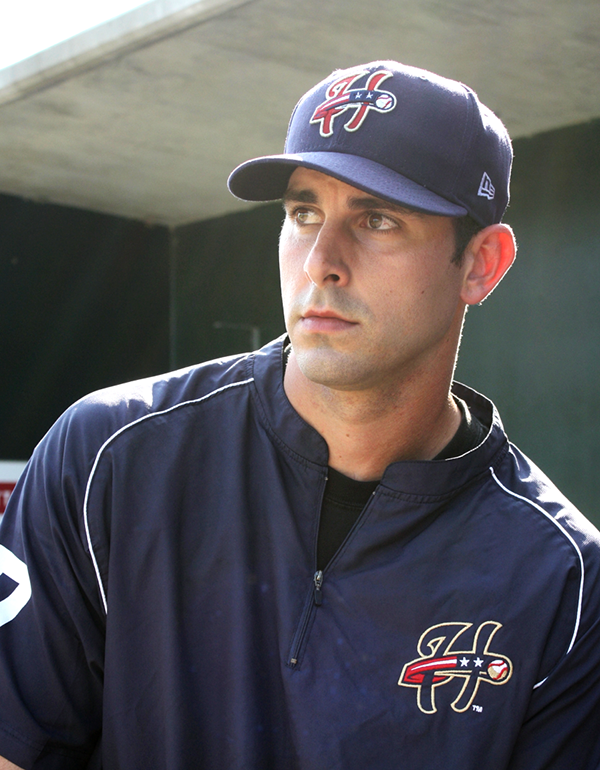
Waiting on the Show: Like most Double-A players, Jimmy Van Ostrand may never make it to the Majors, a fate he’s come to terms with.

senators_jimmy_van_ostren“Why do you want to make it, Jimmy? Is it for the money, or because it’s the top?” asks Terry Byrom, the Harrisburg Senators announcer and media relations manager.

The question implicitly rejects the possibility that Jimmy doesn’t aspire to play in the Majors. He opens his mouth to respond, but stops to rethink.

I’m at Arooga’s with Senators outfielder and utility man Jimmy Van Ostrand and Terry. The two are talking about life in the Minor Leagues.

Jimmy waxes nostalgic about some of his career highlights. A favorite memory is playing for Team Canada in the 2008 Beijing Olympics. “It was an amazing thing to be a part of,” he says, recalling how strange it felt to be in the presence of so many of the world’s most accomplished athletes; Kobe Bryant responding to his greeting in the cafeteria line by saying, “Hi, Chief,” and eating dinner with Rafael Nadal and his dad.

Van Ostrand, even seated at the stool in front of me, is a brick house. At 6-foot-4 and 210 pounds, he’s large even by professional baseball standards. Genes alone, however, don’t dictate someone’s rise to “The Show,” as the Majors are called informally, a process I hear about soon enough.

Following his graduation at Cal Polytech State University in 2006, he’s been in the Minor Leagues, a seven-year-itch that has included stints in the Houston Astros farm system and, since 2011, the Washington Nationals. He has bounced between the Senators and the Syracuse Chiefs, Double- and Triple-A teams, respectively, for the Nationals.

This means that, for almost half the year, April to August, Jimmy lives and works wherever his parent organization tells him. The rest of the year, he resides in San Luis Obispo, Calif., not far from his alma mater.

The Friday after that first meeting at Arooga’s, I went to the ballpark to shadow Jimmy at the stadium on City Island.

He shows up around 1:30, coming from the Staybridge Suites Hershey-Harrisburg, where he has been sleeping since he last re-joined the Senators earlier this season. He tells me he was playing acoustic guitar in his room earlier this morning.

Before the game, the players spend much of their day in a clubhouse beneath the bleachers. It’s a posh locker room of sorts where the players relax, eat, play cards and poke fun at each other and visiting members of the press.

When I meet up with Jimmy, he’s reviewing tapes of the opposing team’s pitchers with an employee of the Nationals. He then plays a few hands of Pluck at the card table and ridicules other player’s opinions about the previous night’s NBA final. Seniority allows such privileges.

After about an hour, Jimmy heads outside for the batting cages, meeting up with hitting coach Eric Fox, who introduces himself to me as the team’s “chief psychologist.” Fox pitches several buckets of balls from behind the net. Jimmy makes contact with nearly all of them. Few words are spoken during the ritual, which Jimmy repeats before every game.

While Jimmy bats, another player walks up. “Whaddya think?” he asks. I comment that there’s a certain peacefulness to the routine—almost a meditative quality.

He gives me a quizzical look. Then shrugs, “He must be in a good mood.”

“Why do you say that?” I ask.

“There’s a lot of stress that goes along with this job.”

“Because you’re traveling all the time?”

“Hell no. That’s the easy part,” he says, “It’s the pressure to deliver. Let me put it this way: Three out of 10 is great. Two out of 10 is terrible. Two-and-a-half out of 10 is enough to keep you in the game.”

I think about that for a minute. He throws back a handful of sunflower seeds. “Sorry to rain on your Zen parade,” he says, walking away.

*                      *                      *

After batting practice, Jimmy hangs around the clubhouse for awhile longer until it’s time for stretches and field practice.

Out on the field, things are starting to pick up. Players, coaches, groundskeepers, scouts and other employees are bustling around. A corporate group that was touring the field is clearing off, and the team spends about an hour on the field warming up.

Then it’s back to playing cards, eating his pre-game meal of salad with chicken and watching the buzz of ESPN for another hour.

Seemingly by pure instinct, Jimmy gets up from watching TV, heads over to his locker and starts getting into his uniform. While he does, a teammate calls out, “Rave in five minutes!”

Sure enough, five minutes later, dance music is blasting from the speakers, and someone is flickering the lights on and off. Jimmy begins taping up his bat.

“Is this a regular occurrence?” I ask Jimmy over the cacophony. He nods. “You’re not a raver?” I inquire.

“Sometimes,” he deadpans, never looking up. As he finishes his task, several teammates are doing a rowdy interpretive dance while the lights flash and the music blares. Jimmy suppresses a smile and heads out to the ballpark.

The stadium is filling up as we step into the dugout. The air is hot and sticky. The Senators will face the New Hampshire Fisher Cats tonight. As the designated hitter, or DH, Jimmy will only bat.

The game starts off poorly for the Senators, who are losing 4-1 by the fifth inning. In that time, Jimmy has hit the ball twice, but never made it safely to first base. In baseball statistical jargon, this means he’s 0-for-2 or simply, no hits.

I think about what I was told about the stress of the job. Each player’s batting average is prominently displayed next to his face on the screen when he’s up to bat—silently screaming whether that player is “excellent,” “terrible,” or “staying in the game.” Jimmy says that you just don’t think about it too much.

*                      *                      *

As the game goes on, I can’t help marveling at the sheer quantity of cultural artifacts that converge to create the total experience of one Minor League game. As Terry told me several weeks earlier, “Everyone here knows we’re in the entertainment business.”

He’s right. At times, the crowd seems more excited for the T-shirt cannon than they do about a great play on the field.

In between innings, children play competitive games on the field, ranging from the athletic (catching fly balls in the outfield) to the absurd (dressing up in hot dog and condiment costumes and chasing each other around the bases).

Short clips of popular movies and songs from the past century are played, rapid-fire, throughout the game. Most serve to reference, dramatize or poke fun at something that’s happening on the field.

The experience as a whole is an enormous mash-up of everything that defines mainstream American culture: competition, patriotism, music, cinema and unapologetic commercialism.

While the commercialism is a bit off-putting to someone like me, I couldn’t help but feel there’s something nostalgic, even reassuring, about the experience.

The game is played more-or-less the same as it has been played for more than 100 years; new players are always viewed within the context of the game’s history and legendary players; and cultural clips draw indiscriminately, everything from Gladys Gooding’s original organ music to Kanye West, from “Braveheart” to “Anchorman.”

Together, it creates the sense of a larger narrative that the players and fans alike are all part of. It reassures us that present adds to—rather than replaces—the past.

*                      *                      *

In the sixth inning, things start looking up for the Senators, starting with a home run deep into left field by Jimmy (it falls just short of the giant inflatable “Ollie” of Bargain Outlet fame, although Jimmy tells me he’s hit it before). It was Jimmy’s fourth home run this season, and the team rallies around him to celebrate.

The next inning, he hits a single for an RBI, pushing the Senators to a lead that they will hold for a victory. Jimmy is clearly the game’s MVP, and he finishes 2-for-4 at the plate. The word “excellent” comes to mind.

By the game’s end, the sun has gone down and the air has cooled.

The coaches and players briefly celebrate in the dugout, but, without much delay, the players head in to shower. I stay outside to watch fans throw tennis balls onto the field in a post-game competition, which is then followed by fireworks.

It’s a Friday night, and an exciting comeback victory. The team is holding their standing at the top of their league. I imagined the night would be ripe for partying.

But, in a season of 144 games in 154 days, I discovered, it takes more than that. The players trickle out one by one. Jimmy is going to watch the Stanley Cup with a buddy from the other team who had played on the Canadian National team with him back in 2008.

Jimmy is a quality player by anyone’s standard. But, at 28, his odds of being called up to the Majors are increasingly slim.

Nevertheless, Jimmy has made the most out his Minor League years. He makes much more now than he did in his rookie year for the Astros, which, like most starting Minor League contracts, paid low monthly wages, as little as $900 per month.

One of Jimmy’s teammates says that his accountant couldn’t understand how he provided for himself. “I stay with a host family during the playing season, and I stay with my parents in the off season. That’s how,” he shrugs.

As one of the managers put it to me, “By and large, these guys are barely making enough to get by.”

Jimmy now earns a salary more in line with a professional career. “Most people realize it’s not a fair system,” he says. Tight-lipped about this topic, I assume it’s to protect potential conflict in the clubhouse and future contract negotiations.

Whatever happens, Jimmy seems impervious to the stresses of life in the Minor Leagues. He says that, whenever his playing career ends, for whatever reason, he will simply continue his career in sports and athletics. He sees himself as a trainer or coach.

But he doesn’t worry too much about that. The tagline on his twitter page (@Dr_VanOstrand, a Seinfeld allusion) epitomizes what I saw in him that day. “Plan for the future but live in the moment.”

*                                  *                                  *

Jimmy didn’t answer Terry’s question at Arooga’s right away. He thought for a minute. After a few bites of quesadilla, Jimmy explained that he does hope to get called up, but it’s not necessarily just for the money or the status.

“It would mean more for me to make it to the big leagues for the people around me— coaches, family, friends growing up—than for me. I want them to see their efforts and support rewarded,” he says.

“If I don’t make it, that won’t bother me. I’ve had a great career.”

Continue Reading

Lessons from Ronn: There’s gloom and there’s hope and there’s Harrisburg.

TheBurg_CityviewWhen I first came to Harrisburg, one of the first people to engage me in a serious conversation about the city was Ronn Fink, the long-time, greatly missed co-owner of the Bare Wall gift shop on Green Street.

Ronn had been around Harrisburg for almost 40 years and, as he himself said, “had seen it all”: the decline, the floods, the porn theater/streetwalker years, the Reed era, the occasional sprigs of hope. Ronn had started out as an idealist—had even helped found the Historic Harrisburg Association—but, like many disappointed optimists, had become increasingly cynical in his later years.

On any halfway decent day, you could find Ronn perched on a folding chair just outside his shop, cigarette in hand, nose invariably buried deep in a pulp paperback. He knew everyone on the street, greeted passersby, laughed easily and welcomed good conversation.

Thus, he was eager to speak with me when, after a year or so of publishing TheBurg, I began to write more seriously about Harrisburg. I believe our talks began after I wrote a column praising a group of people who had started a new arts event called 3rd in The Burg. I could tell he thought I was naïve.

“I’ve seen Midtown on the verge of turning around so many times,” he said, shaking his head, as if to give me fair warning of my own eventual disappointment.

Then his voice lifted a little, revealing that it really didn’t take much to reach that underlying vein of hope that was his true nature.

“Who knows?” he said. “Maybe this time it will work.”

I think of that conversation frequently when I walk up N. 3rd Street in Midtown—so much potential, too many dashed hopes. Empty storefronts, a lot of great shops that never made it, and then some other dreamer shows up willing to give it a shot.

I’ve learned a lot about Harrisburg since that first talk with Ronn—some good, a lot not. But one important thing I have learned is that Harrisburg’s condition or fate isn’t the way it is just because it’s the way it is. It’s the way it is because people— individuals—make decisions that cumulatively add up.

Midtown is a great example.

Right now, Midtown is caught between two opposing forces—let’s call them “old” Harrisburg and “new” Harrisburg.

Old Harrisburg is ghetto Harrisburg, dilapidated Harrisburg, a city that looks broken down—and the individuals who are happy to keep it that way.

They’re the folks who own the rundown buildings that line N. 3rd, who seem fine with renting apartments cheaply as long as they don’t have to put a penny more into their buildings.

They’re the groups who run old-time social clubs with blocked-out windows, completely cut off from the world and community around them, prompting more than one person I know to ask, “What the heck goes on in there?”

They’re the owners of troubled bars who seem to have no problem condemning entire neighborhoods to danger and blight so they can continue to sling cheap booze.

They’re the commercial landlords who let yet another lottery ticket/cigarette/soda-and-chips joint open or, alternatively, who ask so much in rent for retail space that their buildings are always empty.

Old Harrisburg is deeply entrenched. They’ve survived, even thrived, for decades doing whatever it is they do, even as their buildings fall down around them. They’re not going anywhere.

Unless squeezed out by new Harrisburg.

New Harrisburg is where the hope lies for the city in general. Almost without exception, new Harrisburg is made up of people who’ve arrived relatively recently to settle and open businesses. They come from places where it isn’t acceptable to let your rental property go to rot or run a bar where there’s a shooting every few months. And they’re trying so hard to give Harrisburg something better.

They’re folks like Josh Kesler, who is doubling—make that tripling—down on Midtown by opening a farmer’s co-op in the Broad Street Market and renovating a long-vacant landmark building for a restaurant and art space; like Sri Kumarasingam, whose Pastorante may well be Harrisburg’s best new restaurant; like Steph and Ammon Perry, whose amazing Yellow Bird Café has become a magnet both for the neighborhood and for outsiders; like Eric Papenfuse, who, whatever you might think of his politics, is a one-man Midtown improvement machine.

And therein lies the hope for Midtown and for Harrisburg.

If Ronn were still around today, he might say that he warned me, that the forward progress I cited a few years back couldn’t be sustained, that we’ve returned to two steps forward, one step back.

I’d have to agree with him. Many of the interesting, creative new businesses that seemed to be transforming Midtown then are already gone.

But then he’d smile slightly, shrug his shoulders and say: “Who knows? Maybe this time, it’ll work.” And I’d have to agree with that, too.

Lawrance Binda is editor-in-chief of TheBurg.

Continue Reading

My Day at the Harrisburg Auction: Millions of public dollars were squandered buying Wild West artifacts. I wanted one small memento.

TheBurg_auctionI had my heart set on the spittoon.

I had no practical use for it, being neither a chewer nor a spitter. But it was the one item at last month’s artifact auction that actually pertained to Harrisburg, manufactured by the city’s own F.H. Cowden Co. sometime in the late 19th century. That was why I wanted it.

Estimated sales price: $40 to $50.

I hoped the small stoneware vessel would get lost amongst the 5,500 or so other lots up for grabs at the (mostly) Wild West auction held on City Island. Apothecary bottles, Indian-style rugs, butter churns, sheriff’s medals of dubious provenance, creepy religious statues.

A spittoon manufactured in Harrisburg, Pa.? Who’d want that?

To me, it was the perfect symbol of this singularly bizarre episode in Harrisburg history. Over a dozen or so years, former Mayor Steve Reed and his minions crisscrossed the country, quietly spending some $8.3 million in public money to buy tons of stuff for a “National Museum of the American West” he hoped to build.

In central Pennsylvania.

There was never any solid path or plan to getting this thing built, little more than the surreal notion in Reed’s head that what was needed was a Wild West Museum.

In central Pennsylvania.

For years, Reed used his appointed board at the Harrisburg Authority to OK his debt-fueled buying sprees, stuffing his treasures floor-to-ceiling into a warehouse like some publicly elected version of Citizen Kane. And, on this day, the results of that failed project were listed in a 23-page brochure as the action commenced on a steamy morning inside the Carousal Pavilion next to Metro Bank Park.

And amidst the old-timey bathtubs and old-timey oil lamps and old-timey chamber pots, there was but a single item that I saw with some connection to this city where I lived—the stoneware spittoon—and I wanted it.

Fair Warning

About a half-hour before the 10 a.m. start time, I had set off on foot from my Front Street house.

I took the river route to City Island, walking across Riverfront Park (overgrown grass, rotting tree limbs), down the ramp (missing railings, groundhog infestation), onto the river walk (cracked pavement, washed-out stairs), past the river steps (weed-choked, disintegrating) and over the Walnut Street Bridge (lights out again).

I arrived just as a guy with Guernsey’s auction house was laying down the ground rules for in-person bidding. Speaking above the roar of several industrial-strength fans, he explained that there were no reserve prices, so the highest bid would win the item, regardless of its perceived value.

I was in.

I took some pictures, said “hi” to city COO Bob Philbin, chatted with TV news guy Dave Marcheskie, claimed bidder ticket #112 and had a seat.

The crowd was sparse, maybe 50 or 60, but I wasn’t certain what to make of that. Guernsey’s said that more than 7,000 people had registered for the auction, so most of the action was going to come from Internet bidders. And, in fact, a long table occupied the entire right side of the pavilion, where Guernsey’s staff hovered over a line of computers to track and call out Internet bids.

A bit after 10 o’clock, the auctioneer took her position behind the microphone and announced the first item: an antique wooden yarn winder. Estimated pre-auction value: $60 to $100.

A picture of the item flashed on a screen beside her, at the front of the auction area. It looked like a long wooden stick with handles on either end, but the projected image was vague in the daylight and difficult to see clearly.

“$100,” the hopeful auctioneer called out.  

Nothing.

“$75,” she said and paused briefly.

“$50,” she barked out.

Still nothing. She took a breath. The bidding was going the wrong way.

Then some hope. A staff member manning one of the laptop computers had an interested bidder.

“$25!” he yelled out.

“$25,” repeated the auctioneer.

“Thirty, thirty,” she said, trying to juice the crowd into bidding more. “Thirty. Do I have thirty anywhere?”

Faces looked up blankly, and no auction numbers were raised.

“I have $25,” she said, drawing out the number. “Fair warning . . . “

“Sold! To the Internet bidder! $25!”

And so started the long-awaited Harrisburg artifact auction, with a sale of an item at less than half the estimated sales price.

Much of the rest of the morning would proceed in a similar way. There were a few bright spots, such as the beautiful National brass cash register, which an Internet bidder paid $600 for (estimate: $300 to $500).

But most of the items ended up more like the $30 paid for “primitive farm implements” (estimate: $40 to $50); the $80 paid for the “large wooden ox yoke” (estimate: $100 to $200); and the $60 paid for the “Oliver Standard Visible (Type) Writer No. 9” (estimate: $300 to $400).

Other items fetched more or less their pre-auction estimates, while a bunch received no bids at all and were passed over.

And Sold!

As I waited for my spittoon to come up, I struck up a conversation with a guy sitting next to me, who, as it turned out, grew up on Allison Hill, but now lived with his family outside Mount Gretna.

His name was Darnell Pemberton, and he had come to bid on several African-style masks, meaning he had a long wait ahead of him, hours still, in the steam bath posing as an auction house. He also was interested in one of several western wagons that wouldn’t be up until the auction’s next-to-last day, Saturday.

“I’ve always wanted to own an old wagon,” he said matter-of-factly, as if this were a common hope.

He asked me why there were African items at an Old West auction, and I told him that Reed dreamed of building other museums in Harrisburg, including a world-class museum of African-American history.

He looked at me and chuckled, as if I had just said the most ridiculous thing.

“Who would come to Harrisburg for a museum when they can just go to Washington?” he asked.

I then explained how we all had come to be there that day, that Reed had spent years and millions of dollars in public money accumulating this stuff, which was now getting sold off at a rate of an item every three-or-so minutes, most below estimated value.

“Weird,” he said, and I nodded.

But that wasn’t going to stop me from making a bid, and my spittoon was due up next. I grabbed the cardboard number from my bag and nervously got ready to shout out my bid.

“Number 1086: F.H. Cowden Harrisburg Spittoon,” said the auctioneer, and the vague image of the stoneware vessel appeared on the screen. I leaned forward to try to see it more clearly.

“$50,” called out one of the guys following the Internet bidding, before I could say a word.

$50? The spittoon already was selling for the top of the estimated range. Oh no.

“$75. $100. $125,” cried the auctioneer, happy she finally had an item selling over predicted value.

Clearly, a few other locals were jumping on the only Harrisburg-related item in the auction, and I was being outbid into stunned silence.

“$150? Do I hear $150?” said the suddenly hopeful auctioneer.

“I have $125,” she said. “Fair warning . . .”

“And sold! To the Internet bidder! $125.”

Rats!

Sure, I had lost out, but at least hadn’t gotten suckered into paying too much for it. Researching Cowden pottery before the auction, I learned there’s a ton for sale on eBay for less than $100, which was my upper limit for the piece.

I stuck around long enough to bid on another lot I had spied at the auction preview the day before in a warehouse at the incinerator complex. My girlfriend liked a set of 10 old-timey glass lamp shades, said they’d look nice in a house we’re having renovated in Olde Uptown.

Estimated value: $100 to $150. I paid $40.

As I made my way back across the Walnut Street Bridge (lights still out) and over to the adjoining plaza (badly damaged planter) and back to the office through the streets of Harrisburg (potholes, cracks, no striping), I wished that my money would be spent well, but knew it would go only to covering a fraction of the massive debt Reed had amassed. Money that, years ago, should have gone to fixing Harrisburg.

Continue Reading

Beer Ambition: The Armstrongs have a dream of building a small brewery in Harrisburg. Can they make it come true?

TheBurg_alteregoTheo and Brandalynn Armstrong love beer.

I don’t mean this in the way college fraternities love the cheap stuff in large quantities. I mean this in the way a literature professor loves leather-bound first editions or a cinefile loves Kurosawa. Their love for beer is deep, their knowledge seemingly endless. It is this love that has pushed them to want to open a tasting room, bringing their home-brewed talent to the city of Harrisburg.

I don’t want to misrepresent the married couple, who together own the Alter Ego Brewing Co. It is not as if they are lofty, academic zymologists (those who study the science of fermentation) who cannot understand the simple joy of a cold beer on a summer evening. Theo and Brandalynn may be beer geeks, but there is no prerequisite for cracking open a bottle with them.

I arrived at their Harrisburg home in the evening. After meeting their dog Olive, I followed them into their basement. The furnished portion features a comfortable bar while the unfurnished portion houses Theo’s brew-works. Before we could start talking, Brandalynn poured me the first of what would be a flight through their flagship brews. After a few sips, we were ready to dive into the evening’s official business.

Why Not?

Theo’s home-brewing began alongside a new job.

“I used to work retail hours. I used to work all the time,” says Theo. “Suddenly I was working a 40-hour week. I had weekends off. I had nothing to do with my free time. I decided I needed a hobby.”

Theo had already developed a taste for craft beer and had been interested in venturing into home-brewing for a long time.

It was then that Theo met Brad Moyer, the store manager at Scotzin Brothers, the home-brew supply store in Lemoyne. Brad, with whom I met separately, wears his resume as a beer connoisseur on his sleeve quite literally—tattooed hops and grains adorn his arm.

“He was always coming in and asking tough questions,” says Brad.

Theo had a couple of false starts, but, before long, he realized he had a knack for brewing.

“People started asking me why I wasn’t selling my beer,” says Theo. “We looked at each other and asked, ‘Why not?’”

However, taking the real step towards turning hobby into business took some convincing. That’s when Brandalynn stepped in to encourage Theo, though still apprehensive herself.

“I was concerned that, if we start doing this professionally, Theo would lose his love for the hobby,” says Brandalynn. “But so far so good!”

Home-Brew to Business

Theo wants to steer away from the term “microbrewery.” Instead, he and Brandalynn like to think of Alter Ego as “artisanal.”

“We want our brewery to be place where you can come in, talk to the owners and feel like you are sitting in a living room at a friend’s house,” says Theo.

“Just good beer and good people,” adds Brandalynn.

Specifically, the couple wants to open a small tasting room with seating for 30 people or so, featuring their beers and a selective menu of locally sourced food. They plan on offering growler fills, but, at this point, they don’t envision any bottling. They simply want to combine their love of beer with their passion for hospitality. They want to be an unpretentious, neighborhood brewery.

To convert vision into reality, Theo and Brandalynn turned to crowd-sourcing to raise the necessary capital to open up shop.

“I’ve always enjoyed watching people’s projects,” says Theo. “You get a sense of involvement. So for us, it wasn’t just about raising money, it raised community awareness.”

This is where Brandalynn’s expertise becomes invaluable. While Theo brews, Brandalynn manages the social media.

“It was a lot of work,” says Brandalynn, “Nobody wants to get spammed, nobody wants to see ‘give me money, give me money.’ We wanted to get our name out, but nobody wants to see the same Facebook post over and over. We wanted to sound authentic. Despite the work, I think it paid off.”

To build hype for their brand, Theo and Brandalynn set up several tastings. Scotzin Brothers hosted one such tasting back in April. They set up some barbecues and brought some kegs for sampling. Even on short notice, the crowds came.

“I know Theo went through a lot of beer that day,” says Brad, chuckling.

Grassroots Approach

Theo and Brandalynn still have a lot of work ahead of them to meet their goal of opening in the city in 2014. But licensing and space requirements have made finding a suitable location difficult.

Pennsylvania is a tough state for upstart brewers. A restaurant can’t even start serving liquor until it has occupied a property for six months. Theo and Brandalynn saw crowd-sourcing as an opportunity to defray the cost of six months’ rent without being able to open for business.

Even more challenging, the amount of industrial brewing equipment needed has eliminated a number of potential locations.

“In the city of Harrisburg, there are not many locations with docks or garage doors, or the space to grow,” says Theo.

“For our licensing, the physical brewery, kitchen, tasting room and seating for 30 have to be on site,” adds Brandalynn.

I asked Brad Moyer to rate Alter Ego’s chances.

“I think they are doing a lot of things different in the right way,” responds Brad. “I like that they’re really taking a grassroots approach. Other breweries make their beers for the beer nerds. I think Theo and Brandalynn are really marketing for the everyday craft drinker. And that’s important.”

In the meantime, they continue to search for a place to call home. Brandalynn stays on top of promotion through social media and Theo continues to brew. And at its heart, this is the Alter Ego Brewing Co.: a couple of beer people doing what they love.

For more information and to follow the progress of Alter Ego Brewing Co., visit www.alteregobrewing.com, or Facebook: Alter Ego Brewing.


Continue Reading