
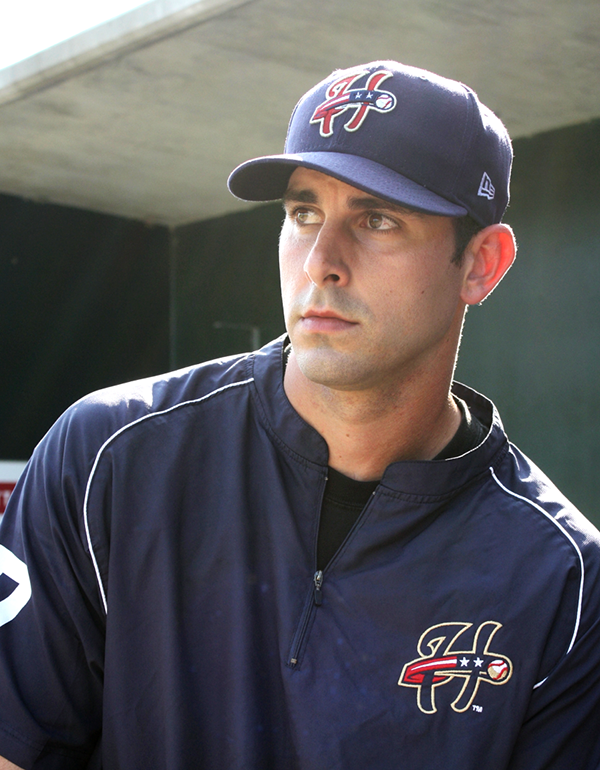
 “Why do you want to make it, Jimmy? Is it for the money, or because it’s the top?” asks Terry Byrom, the Harrisburg Senators announcer and media relations manager.
The question implicitly rejects the possibility that Jimmy doesn’t aspire to play in the Majors. He opens his mouth to respond, but stops to rethink.
I’m at Arooga’s with Senators outfielder and utility man Jimmy Van Ostrand and Terry. The two are talking about life in the Minor Leagues.
Jimmy waxes nostalgic about some of his career highlights. A favorite memory is playing for Team Canada in the 2008 Beijing Olympics. “It was an amazing thing to be a part of,” he says, recalling how strange it felt to be in the presence of so many of the world’s most accomplished athletes; Kobe Bryant responding to his greeting in the cafeteria line by saying, “Hi, Chief,” and eating dinner with Rafael Nadal and his dad.
Van Ostrand, even seated at the stool in front of me, is a brick house. At 6-foot-4 and 210 pounds, he’s large even by professional baseball standards. Genes alone, however, don’t dictate someone’s rise to “The Show,” as the Majors are called informally, a process I hear about soon enough.
Following his graduation at Cal Polytech State University in 2006, he’s been in the Minor Leagues, a seven-year-itch that has included stints in the Houston Astros farm system and, since 2011, the Washington Nationals. He has bounced between the Senators and the Syracuse Chiefs, Double- and Triple-A teams, respectively, for the Nationals.
This means that, for almost half the year, April to August, Jimmy lives and works wherever his parent organization tells him. The rest of the year, he resides in San Luis Obispo, Calif., not far from his alma mater.
The Friday after that first meeting at Arooga’s, I went to the ballpark to shadow Jimmy at the stadium on City Island.
He shows up around 1:30, coming from the Staybridge Suites Hershey-Harrisburg, where he has been sleeping since he last re-joined the Senators earlier this season. He tells me he was playing acoustic guitar in his room earlier this morning.
Before the game, the players spend much of their day in a clubhouse beneath the bleachers. It’s a posh locker room of sorts where the players relax, eat, play cards and poke fun at each other and visiting members of the press.
When I meet up with Jimmy, he’s reviewing tapes of the opposing team’s pitchers with an employee of the Nationals. He then plays a few hands of Pluck at the card table and ridicules other player’s opinions about the previous night’s NBA final. Seniority allows such privileges.
After about an hour, Jimmy heads outside for the batting cages, meeting up with hitting coach Eric Fox, who introduces himself to me as the team’s “chief psychologist.” Fox pitches several buckets of balls from behind the net. Jimmy makes contact with nearly all of them. Few words are spoken during the ritual, which Jimmy repeats before every game.
While Jimmy bats, another player walks up. “Whaddya think?” he asks. I comment that there’s a certain peacefulness to the routine—almost a meditative quality.
He gives me a quizzical look. Then shrugs, “He must be in a good mood.”
“Why do you say that?” I ask.
“There’s a lot of stress that goes along with this job.”
“Because you’re traveling all the time?”
“Hell no. That’s the easy part,” he says, “It’s the pressure to deliver. Let me put it this way: Three out of 10 is great. Two out of 10 is terrible. Two-and-a-half out of 10 is enough to keep you in the game.”
I think about that for a minute. He throws back a handful of sunflower seeds. “Sorry to rain on your Zen parade,” he says, walking away.
* * *
After batting practice, Jimmy hangs around the clubhouse for awhile longer until it’s time for stretches and field practice.
Out on the field, things are starting to pick up. Players, coaches, groundskeepers, scouts and other employees are bustling around. A corporate group that was touring the field is clearing off, and the team spends about an hour on the field warming up.
Then it’s back to playing cards, eating his pre-game meal of salad with chicken and watching the buzz of ESPN for another hour.
Seemingly by pure instinct, Jimmy gets up from watching TV, heads over to his locker and starts getting into his uniform. While he does, a teammate calls out, “Rave in five minutes!”
Sure enough, five minutes later, dance music is blasting from the speakers, and someone is flickering the lights on and off. Jimmy begins taping up his bat.
“Is this a regular occurrence?” I ask Jimmy over the cacophony. He nods. “You’re not a raver?” I inquire.
“Sometimes,” he deadpans, never looking up. As he finishes his task, several teammates are doing a rowdy interpretive dance while the lights flash and the music blares. Jimmy suppresses a smile and heads out to the ballpark.
The stadium is filling up as we step into the dugout. The air is hot and sticky. The Senators will face the New Hampshire Fisher Cats tonight. As the designated hitter, or DH, Jimmy will only bat.
The game starts off poorly for the Senators, who are losing 4-1 by the fifth inning. In that time, Jimmy has hit the ball twice, but never made it safely to first base. In baseball statistical jargon, this means he’s 0-for-2 or simply, no hits.
I think about what I was told about the stress of the job. Each player’s batting average is prominently displayed next to his face on the screen when he’s up to bat—silently screaming whether that player is “excellent,” “terrible,” or “staying in the game.” Jimmy says that you just don’t think about it too much.
* * *
As the game goes on, I can’t help marveling at the sheer quantity of cultural artifacts that converge to create the total experience of one Minor League game. As Terry told me several weeks earlier, “Everyone here knows we’re in the entertainment business.”
He’s right. At times, the crowd seems more excited for the T-shirt cannon than they do about a great play on the field.
In between innings, children play competitive games on the field, ranging from the athletic (catching fly balls in the outfield) to the absurd (dressing up in hot dog and condiment costumes and chasing each other around the bases).
Short clips of popular movies and songs from the past century are played, rapid-fire, throughout the game. Most serve to reference, dramatize or poke fun at something that’s happening on the field.
The experience as a whole is an enormous mash-up of everything that defines mainstream American culture: competition, patriotism, music, cinema and unapologetic commercialism.
While the commercialism is a bit off-putting to someone like me, I couldn’t help but feel there’s something nostalgic, even reassuring, about the experience.
The game is played more-or-less the same as it has been played for more than 100 years; new players are always viewed within the context of the game’s history and legendary players; and cultural clips draw indiscriminately, everything from Gladys Gooding’s original organ music to Kanye West, from “Braveheart” to “Anchorman.”
Together, it creates the sense of a larger narrative that the players and fans alike are all part of. It reassures us that present adds to—rather than replaces—the past.
* * *
In the sixth inning, things start looking up for the Senators, starting with a home run deep into left field by Jimmy (it falls just short of the giant inflatable “Ollie” of Bargain Outlet fame, although Jimmy tells me he’s hit it before). It was Jimmy’s fourth home run this season, and the team rallies around him to celebrate.
The next inning, he hits a single for an RBI, pushing the Senators to a lead that they will hold for a victory. Jimmy is clearly the game’s MVP, and he finishes 2-for-4 at the plate. The word “excellent” comes to mind.
By the game’s end, the sun has gone down and the air has cooled.
The coaches and players briefly celebrate in the dugout, but, without much delay, the players head in to shower. I stay outside to watch fans throw tennis balls onto the field in a post-game competition, which is then followed by fireworks.
It’s a Friday night, and an exciting comeback victory. The team is holding their standing at the top of their league. I imagined the night would be ripe for partying.
But, in a season of 144 games in 154 days, I discovered, it takes more than that. The players trickle out one by one. Jimmy is going to watch the Stanley Cup with a buddy from the other team who had played on the Canadian National team with him back in 2008.
Jimmy is a quality player by anyone’s standard. But, at 28, his odds of being called up to the Majors are increasingly slim.
Nevertheless, Jimmy has made the most out his Minor League years. He makes much more now than he did in his rookie year for the Astros, which, like most starting Minor League contracts, paid low monthly wages, as little as $900 per month.
One of Jimmy’s teammates says that his accountant couldn’t understand how he provided for himself. “I stay with a host family during the playing season, and I stay with my parents in the off season. That’s how,” he shrugs.
As one of the managers put it to me, “By and large, these guys are barely making enough to get by.”
Jimmy now earns a salary more in line with a professional career. “Most people realize it’s not a fair system,” he says. Tight-lipped about this topic, I assume it’s to protect potential conflict in the clubhouse and future contract negotiations.
Whatever happens, Jimmy seems impervious to the stresses of life in the Minor Leagues. He says that, whenever his playing career ends, for whatever reason, he will simply continue his career in sports and athletics. He sees himself as a trainer or coach.
But he doesn’t worry too much about that. The tagline on his twitter page (@Dr_VanOstrand, a Seinfeld allusion) epitomizes what I saw in him that day. “Plan for the future but live in the moment.”
* * *
Jimmy didn’t answer Terry’s question at Arooga’s right away. He thought for a minute. After a few bites of quesadilla, Jimmy explained that he does hope to get called up, but it’s not necessarily just for the money or the status.
“It would mean more for me to make it to the big leagues for the people around me— coaches, family, friends growing up—than for me. I want them to see their efforts and support rewarded,” he says.
“If I don’t make it, that won’t bother me. I’ve had a great career.”