Central PA as Classroom: International students & their hosts find that learning goes both ways.

Screenshot 2014-07-30 22.17.09

Many international students visit central Pennsylvania to learn about America, whether they are a high school exchange student, a college student taking classes, or a college student working an internship with a local business. And we learn from them, too.

One of the most valuable experiences I have had was serving as housing host to Polish graduate students. Over the past 10 years, I have opened my home to five young ladies who were between the ages of 21 and 23. These particular students have traveled extensively throughout Europe and could speak three different languages. It was my duty to make sure they had a ride to and from their jobs and to provide them with a nice home environment during their stay in central Pennsylvania. As the students practiced their English language skills, I shared my way of life with them while being exposed to their traditions.

Although the students have been screened to participate in such international programs, you never know what an individual will be like until they are actually living in your home. But that’s life…meeting new people and learning to appreciate different lifestyles. People often get stuck in their own circles of family and friends. In Europe, it’s very common to let a stranger stay in one’s home. This was a wonderful opportunity for me to expand my horizons, and I am glad that I embraced it.

The young women I hosted valued faith and family. They attended church every Sunday. The students were kind and especially well-mannered. I was amused that, after I asked my first student to take off her shoes when coming into my home, she and her friends would leave all of their shoes at the bottom of the stairs every time they entered the home—I never had to ask again. And every new student who stayed with me followed suit. They were happy to do so without any rumblings. I do not have any children of my own, but these students were a real treat to be a part of our temporary family.

Foreign students are fascinated by American history. Since my boyfriend is a history buff, we always had fun taking the students exploring noteworthy sights in Harrisburg and the surrounding areas. Places like the National Civil War Museum and Gettysburg broadened the students’ knowledge of the area. The students also went on weekend trips to Washington, D.C., Pittsburgh, Baltimore, New York, and they often made the excursions on their own.

On the flip side, they shared stories of their lives and travels. My most recent student and her family vacationed in Trou-aux-Biches, Mauritius, an island located in the Indian Ocean off the coast of Africa. It was exciting to hear about a beach—a place on the other side of the world, that I never imagined visiting myself.

Christmas is a major holiday in Poland. While in Harrisburg, the students contributed their culinary talents to celebrate the holiday by making pierogies from scratch, and bigos (hunters stew), made of sauerkraut and meat, that is a Polish national dish. The meal was a delicious variation from American traditions. In addition, we exchanged gifts and attended Mass on Christmas Eve.

Although they were thin, the students were concerned about gaining weight while living in the United States. They were not accustomed to eating processed foods. Even the local bread was too sweet for their taste buds. Other observations from the kitchen: The students preferred to drink water without ice, they liked dark beer, and frowned upon using plastic sandwich bags when packing their lunches, which were considered to be harmful to the environment.

Ten years ago, a European student could only make an occasional phone call to hear the voices of family abroad. Now, Skype allows face-time with loved ones. It’s instant communication from anywhere. And, thanks to Skype, the Polish students would talk for hours, especially with their boyfriends.

With every new student I hosted, I learned something new. I take pride knowing that I enhanced the lives of these young ladies. I consider myself to be very fortunate to have made these friendships. When you open your heart and your home to someone different, you will be surprised by the rewards.


Become a Host

If you have an interest in sharing your life with an international exchange student, here are several organizations to check out.

Nacel Open Door, Inc.
www.nacelopendoor.org

Pennsylvania Partnerships Abroad, Ltd.
www.ppa-ltd.org

AFS-USA
www.afsusa.org

Continue Reading

Making “The Ask:” A new column seeks to add diverse voices to TheBurg.

Wendy Jackson-Dowe

Wendy Jackson-Dowe

In November 2013, I was having coffee in the downtown location of Little Amps when I was introduced to Lawrance Binda. Well, my mind immediately starting racing and I thought, “Yep, I’m going to ask him!”… so I did.

I knew Lawrance was editor-in-chief of TheBurg, a magazine I really enjoyed reading and looked forward to each month. However, each issue seemed absent of a perspective that, in my opinion, was and is quite necessary to share, particularly in central Pennsylvania. The perspective I’m referring to is that of the progressive and professional black population in our region.

As I have shared with some who cared to know (and perhaps some who didn’t), most of my adult life has been lived outside of Harrisburg in places like Nashville, Chicago and Maryland. You may wonder, “What does this have to do with anything relative to TheBurg?” It is, in fact, the impetus of the “ask” I made of Lawrance—or LB as some call him.

Although Harrisburg is my hometown and my family has deep roots here, I sometimes struggle with the realization that I now live here and am raising my impressionable children in this region. When I left Harrisburg in 1980 to go to Fisk University as an impressionable, eager college freshman, I soon was exposed to—and interacted with—black folk who owned banks, motels and insurance companies; who published national magazines and were transplant surgeons; who owned multiple luxury car dealerships and investment banking firms; who leased their sprawling acreage to railroad companies. This exposure left quite an impression on me, as it would anyone.

So my “ask” of LB was to add a perspective to the magazine that highlights success stories from the greater Harrisburg black community, past and present, as they relate to intellectualism, economic empowerment, fiscal leadership, the sciences, banking, etc. We embody incredible intellectual capital, and, too often, it is omitted, overlooked, slanted or simply spoken about within an insular setting.

As stated in my first article published in the magazine, too often black folk are lauded for our superior athleticism or our exceptional ability to entertain. We are barraged with the negative images of black boys and men in the news. Now, people certainly should be held accountable for their actions. However, I feel these images cannot be the only prominent images of black men, young and old, that my children and members of the greater population believe to be true.

This dynamic also added to my eagerness to make “the ask.”

There is no stopping the “browning of America,” and, if we are to live together, we must have constructive dialogues that work toward the greater good, work in teams that are efficient and productive, hire one another, take direction from each other, provide constructive criticism, successfully apply for business loans, and rely on one another to protect our communities. We must teach our young, award contracts to each other, and promote those who may look a little different to positions of power. We must make a greater effort to get to know each other outside of often-superficial workplace relationships.

You won’t read about a victim mentality in my articles. You will read stories of hard work, stories of a tenacious desire to reach a goal, stories of pride, stories of economic empowerment, stories of a dignified people. My hope is to inspire, to move people to engage one another, to open minds to make considerations where one may not have before. Some may call it bold; I call it common sense.

So, again, I say, thank you to Lawrance Binda who saw value in my “ask” and who provides me a platform to do my part to make a positive difference in my space of the world in central Pennsylvania and beyond.

You can reach Wendy Jackson-Dowe at [email protected].

Continue Reading

A Legacy of Learning: Artist Oliver LaGrone devoted his life to teaching others. A scholarship in his name ensures that his work continues.

Screenshot 2014-07-30 21.24.35Oliver LaGrone, noted poet, sculptor, educator and humanitarian, believed in educating through generosity. He wanted to make education possible and dreams come true.

In 1974, LaGrone inspired members of the Unitarian Church of Harrisburg (UCH) to establish a scholarship in his name. He wanted to help graduates of the Harrisburg School District attend college so they could lead more productive, successful lives.

This past June, that dream came true for one Harrisburg grad, Merced Ramirez, now a sophomore at Messiah College. He was awarded $5,500 as the 2014 recipient of the Oliver LaGrone Scholarship.

“The LaGrone Scholarship helped me stay at Messiah,” he said. “I thought of transferring to another college that offered a full scholarship. But my professors at Messiah helped me work through my financial challenges, and, with the LaGrone Scholarship, I found a way to continue at Messiah.”

LaGrone, a committed Unitarian Universalist, was not a Pennsylvania native. He found his way here in 1970 after accepting a position teaching art education and African-American history at Penn State. He also was artist-in-residence at Penn State Harrisburg and held a similar position with the Hershey Foundation and Boas Center of Learning for the Harrisburg School District.

Several of his sculptures are prominently displayed in the UCH. In fact, proceeds from the sale of his sculpture, “The Dancer,” helped provide initial funding for the scholarship. His sculptures also can be seen in the LaGrone Cultural Arts Center at Penn State Harrisburg.

Dedicated, Driven

Meeting Ramirez at Cornerstone Coffeehouse in Camp Hill, I was introduced to a bright, articulate and witty young man. Graduating in the top 5 percent of his class from Harrisburg SciTech High, mathematics and languages were his favorite subjects.

While in high school, he was a member of the National Honor Society, Youth and Government Club, varsity soccer team and track and field team. He also participated with the Joshua Group, an at-risk youth mentoring organization in Harrisburg. That experience inspired his strong commitment to helping others and serving his community. Dedicated and driven, Ramirez now is majoring in international business with a minor in Chinese.

He does his best to make ends meet. He has a job at UPS this summer and hopes to be a residential advisor during his junior year. After graduation, he plans to work abroad collaborating with professionals from many backgrounds and careers.

When asked how he will give back to his alma mater, Ramirez said he wants to help students who struggle financially, providing secure pathways, allowing them to stay at Messiah and finish their education.

“My message is don’t let hard times destroy the possibility of a great future,” he said. “Don’t let disadvantages set you back. Make the hardest times the best times. Use them to grow and overcome adversity.”

Strong Foundation

In May of 1992, at the age of 84, LaGrone journeyed back to Harrisburg to celebrate the revitalized scholarship. Redefined to suit more diverse needs, the scholarship now may be used for any legitimate cost connected with schooling, such as tuition, books, room and board, transportation and childcare.

Margaret Carrow, chairwoman of the selection panel for the Oliver LaGrone Scholarship program, believes that a strong educational foundation can help people make a difference in the world.

“I grew up in Brooklyn, N.Y., and was fortunate to attend Clark University in Worcester, Mass.,” she said. “By chairing this committee, I am assuring that students have their chance to go to college and make a difference in the communities in which they live.”

The scholarship is given based on motivation to completion of one’s education despite obstacles, as well as financial need and knowledge and skills gained from life.

A unique feature of the scholarship is its mentoring component. A member of the UCH is matched with the scholarship recipient to provide personal support and encouragement throughout his or her education.

“My mentor understands me and the adversity that I have overcome,” said Ramirez, pausing before summarizing what the scholarship is really all about. “This is a great opportunity.”

Continue Reading

That’s Amore! It’s the dog days and guess what? A new gelato shop is set to open.

Screenshot 2014-07-30 21.25.11Hot, right? Maybe you could use a refreshing treat?

Well, we’ve got some good news for you.

A new take on the original ice cream shop will debut this month in the Point Shopping Center just outside Harrisburg. Amore Artisan Gelato & Yogurt is the perfect remedy for those who want to sit and enjoy a frozen treat in an intimate, European-inspired café.

Amore is born from owner Robin Dobson’s early passion for frozen treats. As a girl, she watched her grandmother hand-make ice cream, using ice from a nearby creek.

“My husband and I have this business together, and we are both retired,” she said. “I took this opportunity to pursue my lifelong passion, which is ice cream.”

Amore’s patrons will find that they are in for more than just basic ice cream. Certainly, gelato is delicious, but it’s healthier, too. It clocks in at 8 to 12 percent fat as opposed to 35 for ice cream. It’s “low in air, but high in flavor,” says Robin.

This is because gelato is aged for 24 hours and then brought up to temperature, decreasing the amount of air to 15 to 20 percent. It’s also served at a slightly warmer temperature, and “that means less brain freeze!” she says.

The process of making gelato is more intense than one might think. Robin received her education in gelato making at PreGel, a leading Italian maker of gelato products, where she was able to test several different machines.

In the end, she found what she calls the “Lamborghini of gelato makers,” an import straight from Italy and the ideal machine for crafting perfect gelato. She also made sure to have the proper case for storing it, allowing her to bring the exact type of frozen confection enjoyed in Italy to central Pennsylvania.

In keeping with the Eurocentric theme, the Dobsons worked with local interior designer Carol Gmuender of Gmuender Designs to create the café, which includes blond wood, an intimate “niche” layout, a cozy fireplace and soft, comfortable seats.

“I wanted to break down the loud, bright ice cream shop and make it the perfect place for couples to come after the movies or a nice dinner,” says Robin. “That’s really the crowd we hope to attract.”

The inclusion of free wifi and artistic decor also will appeal to those wanting to work peacefully on their laptops while enjoying a cup of coffee.

In all, the Dobsons will manufacture 100 rotating flavors, with 12 available on any given day. Options will include traditional gelato flavors, as well as such inventions as apple pie biscotti, peanut butter and jelly, lemon basil, Shirley Temple and caramel bacon.

But Amore will serve more than just gelato. The menu also will include frozen yogurt, gelato tacos, cannoli, donato and an assortment of beverages. There also will be specialty options such as gelato cakes and pies, all of which can be requested for takeout and catering services.

After a lifetime of travel, the Dobsons can’t wait to bring the rich and creamy desserts that they’ve enjoyed in Italy to the Harrisburg area. In fact, for their café, they purposely chose a location convenient to both the east and west shores.

“Everywhere I’ve traveled across the country and the world, I’ve sought out gelato,” said Robin. “This is our dream come true.”

Amore Artisan Gelato & Yogurt will open Aug. 20 at 4235 Union Deposit Rd., Harrisburg, in the Point Shopping Center. Hours are daily, 11 a.m. to 10 p.m. More information is at 717-919-0738 or at www.loveamoregelato.com. Amore also can be reached through Twitter, Facebook and Google+.

Continue Reading

Yes, And: Life unfolds at a silly pace at the Harrisburg Improv Theatre.

Screenshot 2014-07-30 21.30.26

HACC student Haad Naqvi of Hummelstown remembers being on his way to visit a professor on campus when a flyer caught his eye.

It was for a class—sans grades and credit points—to learn a comedy form known as improvisation. The place? The new Harrisburg Improv Theatre in Midtown Harrisburg. The instructors? Its resident troupe known as The HIT Squad.

“I was hesitant to participate,” Naqvi recalls. “I actually didn’t have any acting, singing, comedy, performing skills. At the same time, I know these things work better with everyone participating, so I decided that my hesitance should die right away.”

But that “hesitance” took a little while to make its exit. Naqvi had told The HIT Squad members that he would perform only if it were a requirement to take the class. After all, his initial intention was simply to think quicker on his feet, but Naqvi ended up performing, found it valuable and was hooked.

“The experience was fantastic,” he says. “I felt performing completed the experience.”

Intimate, Artsy

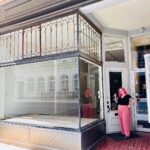
Harrisburg already lays claim to several improv groups that perform around the region, but now the comedy form has a home of its own. Go on over to the Midtown space—a former shoe repair and tailor shop and then an art gallery—now repurposed as a theater by Perry County native Jake Compton and his wife, Somers, a native of Etters. The Harrisburg couple are amazed that their dream of offering a place for improv and other creative endeavors has come true.

About 10 years ago, Jake got hooked on improv and took some classes in New York after inviting himself along when friends wanted to give it a try. He discovered that he loved it, but got busy with other things and put it on the back burner.

“I knew it would cycle back in my life,” Jake says, as he relaxes on one of the cushioned pews in this cozy theater. “We launched classes at MakeSpace and got a full house.”

That evidence of interest was all Jake needed. It fueled his need for a space where creativity and the improv mantra of “yes…and…” (meaning that performers always affirm each other’s contributions) could flourish. At the end of last year, Jake was online and noticed that a building on 3rd Street was available, and, when the price dropped, he and Somers were able to make that dream a reality.

It was perfect—intimate, artsy, filled with potential. Jake wanted a niche space for improv; Somers sought a place where people could rent the storefront building for events like birthday parties and bridal showers, as well as poetry slams. They compromised. It was going to be all of those things.

“We look at this and laugh,” Jake says. “How legitimate we must look to other people.”

Open, Welcoming

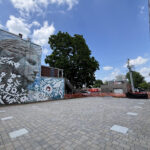
The theater officially opened in June, but not before hitting an unexpected snag. After taking ownership of the building, the Comptons decided to paint over a mural on an outside wall facing a community garden. At the time, they didn’t know that the mural was a commissioned work that had become a cherished part of the neighborhood.

A brief media kerfuffle ensued, and the Comptons suddenly found themselves facing TV news cameras, explaining and apologizing for their oversight. The controversy now seems to have receded, allowing them again to focus on the potential of the theater.

“We’re very excited about what the future holds,” Jake said.

So is Jennie Adams of Hummelstown, a seven-year improv performer/teacher, member of Gamut Theatre’s TMI Improv Troupe and a performer with and co-owner of the all-female No Artificial Sweeteners. She took a class at MakeSpace with Jake last spring and enjoyed it so much that she signed up for Level 2.

“Jake and Somers Compton have been very open and welcoming to the already strong Harrisburg improv community and are open to collaborating with all the existing troupes here,” Adams says. “In fact, No Artificial Sweeteners and The HIT Squad did a joint show that benefited their improv class scholarship program.”

The young improvisers scholarship is for young people ages 17 to 19 who are interested in taking a class but for whom price might be an issue.

“We are hoping it helps to draw in young people who otherwise would not become involved,” Jake says. “I lucked into getting involved with improv when I was 19. I’m excited at the chance to give young people the same opportunity I had.”

On Aug. 15, the Harrisburg Improv Theatre will present a Level 1 class show at 6 p.m. and a Level 2 class show at 7 p.m. Then The HIT Squad will take to the stage at 8 p.m. At 9 p.m., there will be a free mini class and mixer for those who want to try improv.

“If it terrifies you, you should take a class,” Jake says. “It will help you with life.”

The Harrisburg Improv Theater is at 1633 N. 3rd St., Harrisburg. See www.hbgimprov.com for more information on classes and shows.

Continue Reading

To Good Use: 3 years ago, Harrisburg’s main post office closed its doors. Now, a new owner is seeking clarity about what he can and can’t do there.

Screenshot 2014-07-30 21.21.20Adam Meinstein sweeps his arm forward as he speaks of his vision.

A restaurant here. Small-scale manufacturing there. Maybe a rental car office or workshops or a showroom.

We’re standing at 815 Market St., a cavernous building that once was the Keystone branch, Harrisburg’s main postal facility. For decades, millions of letters and parcels passed through, heading into town and out to who-knows-where. It was a noisy place, with the buzz and hum of sorting machines, conveyors and hundreds of employees.

Today, the building is mostly quiet, the silence broken up by an occasional voice or some tools banging. But Meinstein says he’s working hard to fill the building once again with the sound of commerce—people working, people creating, customers being served.

“This is an interesting property,” he said, “We’re sitting in the middle of an industrial zone, but we know there is long-term potential for many uses for the property.”

Meinstein is president of Equilibrium Equities, a suburban Philadelphia investment and development company that bought the facility in 2011 for $600,000, after the U.S. Postal Service wound down 50 years at the site. In addition to the 240,000-square-foot building, 700 parking spaces sit amid an 11-acre property that’s the equivalent of eight city blocks.

After the purchase, Meinstein invested about $1.5 million in improvements that included everything from paving, lights and security cameras outside to removing heavy postal equipment, sealing floors and knocking down walls inside.

The easiest sell was, as one might expect in Harrisburg, the parking. Under the name TransitPark, Meinstein’s company lets spaces on both a short-term and long-term basis at a deep discount to rates charged by Standard Parking, which took over city garages and street parking late last year as part of Harrisburg’s financial recovery plan.

Meinstein now does a lot of business with state and downtown workers who don’t mind walking a few extra blocks, including beneath the Market Street underpass, to save a fair chunk of change. Amtrak riders, downtown residents and short-term visitors represent other groups of customers.

Adam Meinstein

Adam Meinstein

But it’s inside the building where both the opportunities and challenges lie. After the post office closed in 2011, the doors were locked, and the only indication of activity was some new landscaping and a sign that said, “815 Market Street.”

But, says Meinstein, that outward perception was deceptive. Following some improvements and marketing, the building began to find occupants.

Harrisburg-based Exhibit Studios had run out of space at its main facility on Cameron Street, so took some space—and then some more. Restaurant Auction Co. needed a place to stash some equipment, as did Appalachian Brewing Co. Meinstein donated room to store 80 murals that used to line the Mulberry Street Bridge, which is undergoing a complete rehabilitation.

As of this writing, about 80,000 square feet of space was leased, with another 40,000 or so under negotiation, Meinstein said.

Who knew?

“Usually, I like to keep a low profile,” he said.

That, however, began to change in June, when the Papenfuse administration reintroduced a new zoning code that had been moldering on the shelves for four years.

The code rezoned the old post office site from industrial to a new zone called “Downtown Center,” as the city tried to push the boundaries of downtown up Market Street towards Cameron. With the change, industrial uses would not be permitted in the area by right.

“This building went from a single tenant, the U.S. Postal Service, to a living, breathing, mixed-use building, including industrial,” said Meinstein. “The new code takes away industrial use.”

He objected. His building, “grandfathered” in, would be exempt from the restrictions of the new zone as long as the existing uses were unchanged. But he feared negative consequences if a future tenant wanted to propose other industrial uses. The fact that the building was constructed for industrial purposes—with 40 dock doors, 22-foot-high ceilings, a large truck court and massive freight elevators—made that scenario likely, he said.

In fact, he said his building already housed a wide variety of uses, as tenant Exhibit Studios was using it for assembly and fabrication, in addition to storage. Therefore, all these uses should be grandfathered, he insisted.

“We were just trying to make sure that on Wednesday morning, we were allowed to do the same things we were doing on Tuesday night,” he said.

The city disagreed, insisting that the site served primarily as a warehouse.

“We’d have to have a more thorough understanding exactly of what economic activity is going on there, but it’s my understanding that it’s primarily storage or warehousing at this point,” said city Planner/Zoning Officer Geoffrey Knight at a City Council meeting last month.

To try to make changes to the code, Meinstein took a public stance, speaking his piece at several public hearings. He also saw it as an opportune time to let the people of Harrisburg know what had become of their old post office, that he was putting back into productive use an enormous, strategically located building that the federal government no longer wanted.

He received only slight satisfaction. Several City Council members tried, but failed, to pass a narrowly targeted amendment that would have continued to allow a full array of industrial uses at 815 Market by right, including manufacturing, assembly and distribution.

In the end, council agreed only that assembly would be allowed in the new Downtown Center zone—and not by right. The Zoning Hearing Board would have to agree to a special exception for the use.

Still, Meinstein plans to continue trying to change minds by suggesting amendments to the new zoning code during the six-month review period. Otherwise, he’ll operate on the belief that the building’s historic industrial uses—including warehouse, distribution and assembly/fabrication—are grandfathered uses for his building.

“We’re going to continue doing what we’re doing,” he said.

In his view, the city’s stance represents wishful thinking. The administration and council may want to extend downtown to Cameron Street, but there’s currently no demand for new offices or housing there—and may not be for many years, he said. What is there demand for? The industrial uses that his building was designed for.

“It was not a great message for the business community at large that these uses did not just get clearly approved in a highly functional, well-maintained industrial building,” he said.

In fact, 815 Market is one of the few decent structures left in a corridor that once housed thriving industrial concerns as diverse as a brewery, a print shop and the Patriot-News press and distribution facilities. Abandoned buildings and large surface lots now dominate the area between the railroad tracks and Cameron Street.

“Look around here,” he said, gesturing into the distance towards Market Street. “What do you see? There are vacant buildings, distressed properties. That one building has trees growing out of the roof.”

Then he pointed back to his building.

“This property has long-term potential,” he said. “We have a lot of room to do what we need to do, what the city needs to have happen.”


Continue Reading

All That Jazz: A fusion of styles, locales at annual Central PA Jazz Festival.

Screenshot 2014-07-30 21.28.04Sometimes, when life hands you lemons . . . well, you know the rest.

It may be a cliché, but making the best of a bad situation is exactly what the folks at the annual Central PA Friends of Jazz did after funding was reduced for their annual jazz festival.

“We used to hold our entire festival centered around the Harrisburg Hilton and downtown sights in Harrisburg,” explained Steve Rudolph, CPFJ’s executive director. “But, because of some funding cuts, we’ve lost some of the affiliations that made that possible.”

Instead, CPFJ has chosen to reinvent the event and spread it out over a broader geographic area.

“For the past three years, the festival has been in sites all over the place, “said Rudolph. “It’s really helped us to draw in a wider audience.”

CPFJ also recognizes that fans like to listen to their jazz in different type of settings.

“For this festival, we are trying to appeal to a variety of tastes,” said Rudolph. “Some people like the formal concert thing and some people prefer to enjoy music in a more intimate space.”

He also noted that a lot of people like to bring their families out to events such as their annual picnic. “We’ve had the picnic for about 30 years,” he said. “But only in the past two years have we included it as part of the festival schedule.”

Another departure from the original festival model is that now the event features fewer headliners, instead showcasing a cadre of excellent jazz musicians who live locally or in nearby cities.

”The one thing that we can still guarantee on a quality level is that, anytime you come to a Friends of Jazz event, you’re going to hear some of the best jazz musicians alive today,” said Rudolph. “It may not be anyone who you have ever heard of, but, if you love jazz music, you’ll love what we are presenting.”

With that, let’s take a look at what CPFJ has planned for the 34th annual festival.

Thursday, Aug. 7: Jazz Cruise, 5:30-8:30 p.m.

The Central PA Jazz Festival will kick off with a riverboat cruise on the Pride of the Susquehanna, which leaves from City Island in Harrisburg. During the summer months, CPFJ sponsors a weekly Thursday evening series called “Jazzin’ on the Pride,” but, according to Rudolph, “we beef up the money for the band on festival night.” The Dave Stahl Quintet, featuring Stahl and woodwind master Tom Strohman, will provide the entertainment. Food and drink will be available, and there is a $10 admission charge.

Friday, Aug. 8: Jazz Party, 6:30-11:30 p.m.

New for this year’s festival is a jazz party held in three different venues in the 1500 Condominium building at N. 6th and Reily streets in Harrisburg. Two restaurants in the facility, Café 1500 and Crawdaddy’s, will feature live jazz. Crawdaddy’s is scheduled to honor legendary area drummer Sammy Banks with music by pianist Danny Stuber and his trio. In addition, CPFJ will host “Jazz Under the Stars” on the building’s rooftop patio, featuring jazz vocalist Diane Wilson Bedford and Jimmy Wood’s Trio. There is no cover charge for the restaurants, but tickets are $12 for “Jazz Under the Stars.”

Saturday, Aug. 9: Picnic, 2-7 p.m.

The Jazz Picnic, a festival highlight for many, will be held this year on the grounds of Indian Echo Caverns at 368 Middletown Rd. in Hummelstown. Many activities for families will be available, including tours of the caverns and a petting zoo. Continuous music will be provided, including the Larry Marshall Trio at 2 p.m., Central PA Youth Band at 3 p.m., Greg and Tom Strohman at 4 p.m., the Sonia Vrooman Group at 5 p.m. and No Last Call at 6 p.m. Food is available for purchase or picnic-goers can bring their own. Complimentary beverages are included with the ticket, which is $15 for adults and free for children under 12.

Sunday, Aug. 10: Jam, 3:30-6:30 p.m.

A jam session will be held in the afternoon preceding the concert at The Timbers Restaurant at 350 Timber Rd. in Mt. Gretna. Jonathan Ragonese will be coming home from New York to lead the jam session, and all aspiring jazz musicians are welcome to sit in. Everyone is also encouraged to enjoy a meal at the restaurant. Admission to the jam is $5, but free for students, children and musicians who participate.

Sunday, Aug. 10: Concert, 7:30 p.m.

The festival will culminate with a concert featuring two great jazz luminaries—harmonica and vibraphone virtuoso Hendrik Meurkens and legendary bassist Lee Smith. It will be held in cooperation with Gretna Music at the Mt Gretna Playhouse at 200 Pennsylvania Ave. in Mt. Gretna.

Hendrik Meurkens is first on the bill. He will appear with his New York Samba Jazz Quartet, which features Russian pianist Misha Tsiganov and Brazilian musicians Gustavo Amarante on bass and Adriano Santos on drums. Meurkens, who is German born, fell in love with the music of Brazil while living there. He currently resides in New York, where he has recorded 15 CDs for Concord Records.

“Hendrik is a fantastic jazz musician,” said Rudolph. “He is widely considered to be the greatest jazz harmonica player ever.”

The Lee Smith Sextet will close out the festival. The group features Smith on bass, Marc Adler on flute, Tim Thompson on trumpet, Tim Warfield on sax, Joshua Richmond on piano and Justin Faulkner on drums. Perhaps better known as a sideman for jazz greats such as Lionel Hampton, Dizzy Gillespie and Roberta Flack, Smith started focusing on his own compositions and arrangements while working on his latest recording, ” Sittin’ on a Secret.” Now, with a new recording due out in the fall, Smith has had the opportunity to explore a growing repertoire with the members of his sextet.

“When I write, I try to compose in such a way to reach out to as many people as possible and not just the jazz enthusiasts,” he said. “At the concert, people are going to hear some songs that they know and some that they don’t. They should just expect to hear some really good melodies.”

For tickets and to learn more about the festival, visit www.friendsofjazz.org.

Continue Reading

“Quiet Is OK:” An essay from a student writer at Capital Area School for the Arts (CASA).

Grace Beatty

Grace Beatty

Children’s voices pierce the air. The sun burns bright in a crisp blue sky as they play on the blacktop. A boy kicks a ball through the air before sprinting around a painted kickball diamond. Four square games host lines of students, chatting away as they wait their turn. The swings creak, their seats full. Girls braid each other’s hair on the climbing rock, soaking in the warmth it absorbs.

Away from this chaos, one girl sits alone. Underneath a black lamppost, she shrinks into her bumblebee-colored coat, book in hand. Her little eyes dart back and forth, immersed in the story. Two kids walk past, ignored by the girl. This behavior could raise some questions. Is she socially developed? Is she mentally ill? Does she need medication?

Or perhaps it’s normal, a part of her introverted personality.

Introverts have often been categorized as shy, unconfident people, which couldn’t be further from the truth. It is not self-esteem that defines the introvert, but how they obtain and expend energy.

Kate Bartolotta explains this well in her Huffington Post article, “What Is it Really Like to be an Introvert?” She compares an introvert’s energy storage to a cup. Each moment an introvert spends with other people, a little more energy is taken from the cup. Once it’s empty, they need to go spend some alone time to fill it back up.

The opposite is true for those on the other end of the spectrum. Extroverts need to spend time socializing to fill their cups and become drained when solitary. People can usually identify themselves with one type or the other, but some are an equal mix of both, called ambiverts. However, someone cannot be all introvert or extrovert. Carl Jung, the psychologist who popularized “introvert” and “extrovert,” describes such a person as “a man who would be in the lunatic asylum.”

Introverts’ tendency toward being alone depends on the amount of energy they can hold in their cup. Some introverts are able to spend more time socializing, to the point where they may be mistaken for extroverts. But there are others who aren’t as easily motivated by social stimulation, their cups holding a small fraction of energy. These people might want to take solitary trips to restaurants or libraries, or stay at home, in contrast to going out each night and meeting new people.

Such introverts may appear, upon observation, anti-social, even hermitic. Those who prefer more extreme seclusion, or who speak only on occasion, could be labeled mentally ill. But this isn’t new. According to an article published in Psychology Today, the World Health Organization has included “introverted disorder of childhood” in its medical manual, “International Statistical Classification of Diseases and Related Health Problems,” for years. Having their personality catalogued in a book of mental illnesses gives introverts the hint that something is wrong with them.

Susan Cain writes often about Steve Wozniak in her book “Quiet.” Wozniak, a co-founder of Apple, worked often on what he called “The Dream.” His dream was to make a computer that used a screen and a keyboard and was small enough to use at home. He spent his time working on this prototype. According to “Quiet,” each morning he’d show up at work “around 6:30, and… read engineering magazines, study chip manuals, and prepare designs in his head. After work, he’d go home, make a quick spaghetti or TV dinner, then drive back to the office and work late into the night.” He labored alone and loved it, recalling it as “the biggest high ever.”

As a child, Wozniak studied alone, his skill with computers placing him on the low end of the social ladder. But he didn’t mind. He welcomed the solitude as a chance to spend more time messing with circuits and playing with knobs.

He’s not the only example. Bill Gates, another introvert, founded Microsoft and became a billionaire. Rosa Parks, a soft, quiet person, launched the Civil Rights movement with one act of bravery aboard a bus. Even actresses like Audrey Hepburn have described themselves as introverts.

An important part of these famous introverts’ stories would be missing if we only focused on one end of the spectrum. The fact that Wozniak met extrovert Steve Jobs is crucial in explaining the founding of Apple. Had it not been for Jobs, Wozniak would have had a more difficult time bringing his “Dream” to the world. Parks met Martin Luther King Jr., who helped raise awareness for Civil Rights by making groundbreaking speeches to huge crowds. It’s where the idea started—in solitude—that matters.

Just because someone is an introvert doesn’t make him or her better than anyone else. But to direct them from the world turning inside their heads to the party going on outside could rob the world of other great advances. Everyone has been created differently, to act differently, think differently, and express differently than everyone else. It’s what makes them individuals, helping to shape their future.

The future that little girl—curled up with her book in the bumblebee coat—will create.

Continue Reading

Taking Care of Business: 100 years old, the Harrisburg Chamber eyes its next century.

Screenshot 2014-07-30 21.15.31

A hundred years ago, the Harrisburg area was a completely different place.

Streetcars ran the length and breadth of the city; shoppers crowded the streets downtown. The suburbs, as we understand them today, did not exist.

It was in that environment that prominent businessman E.J. Stackpole set the wheels in motion to establish the Harrisburg Regional Chamber & CREDC, which this year celebrates its centennial.

Declaring that the Board of Trade, the city’s previous group for merchants, had outlived its usefulness, he recommended that the entity give way to a new organization possessing “wider powers” and a “broader scope of activity.”

Stackpole seems to have gotten what he wanted.

At its birth in 1914, the Chamber enlisted nearly 200 members, including newspapers, banks, printers, retailers and theaters, which agreed to pay dues set at $25 and up.

Today, the Chamber has about 1,400 members and has greatly expanded its portfolio of services.

“Helping both large and small businesses succeed are always a key part of [what we do],” said David Black, president and CEO.

But the group also provides aid in the form of research, lobbying, education, networking, and advice on reducing business expenditures, to name a few. Collaboration is key to the success of the organization, according to Black.

“We build bridges and coalitions to move things forward,” he said. “That’s both a challenge and a blessing. We have a pretty good reputation when it comes to business issues and getting things done. We help businesses connect with each other and to government at all levels.”

The Early Years

After its founding, the Harrisburg Chamber leased office space in the Kunkel building downtown and named George B. Tripp, head of Harrisburg Light and Power Co., as its first president.

The Chamber faced its share of problems early on. In 1923, a fire destroyed nearly all files and records. Shortly thereafter, it faced the difficult challenge of helping midstate businesses cope with the Great Depression, which brought about economic devastation as well as many new programs, rules and regulations mandated by the Roosevelt administration.

By the 1940s, things were looking up, and the Chamber moved into a new home at 114 Walnut St. in Harrisburg. During this era, it played a major part in persuading the federal government to build a Navy base in Hampden Township, which brought a plethora of jobs to the area.

More projects followed during the next decades. Some of the most notable included 1,200 new parking spaces on City Island, a four-lane highway from Baltimore to Harrisburg through York (I-83), construction of a $12-million, 10,000-foot runway at Olmsted Air Force Base in Middletown, and AMP’s purchase of a 42-acre site near Dauphin County Prison.

In 1968, Gov. Raymond Shafer cut the ribbon to open commercial air service at Olmsted. A Chamber-led plan to locate the Penn State-Harrisburg campus on the grounds of the Air Force base and relocate Fruehauf Trailer Co. nearby was hailed as a successful conversion of a military base to civilian use.

By 1972, the Chamber faced another natural disaster, losing its files once again, this time to Tropical Storm Agnes. While coping with the loss, it moutned citywide clean-up and revival efforts.

The Chamber expanded its scope even further as the years passed and, in 1984, founded the Capital Region Economic Development Corp. (CREDC), which was among the early investors in the Hilton Harrisburg and Towers, erected in 1990.

In the new millennium, major projects included the purchase, remediation and transfer of ownership of the vacant Bethlehem Steel Pipe Mill in Steelton; the founding of Harrisburg University of Science and Technology; the formation of several Keystone Opportunity Zones, Keystone Innovation Zones and Enterprise Zones; the construction of Perry County’s Business Campus One; and the organization’s Business Diversity Initiative, which began in 2004.

Looking Ahead

Black said the future looks bright for the organization and for the area in general.

“Economically, we are a fairly strong region, so there is a fair amount of money that supports our organization,” he said.

Adding to the optimism is the belief that the enormous financial problems facing Harrisburg may be waning. That’s the opinion of Linda Goldstein, vice president and chief operating officer of CREDC, who foresees a better business environment in the city following the Harrisburg Strong Plan.

“Mayor [Linda] Thompson was forced to focus on the city’s financial dilemma. Now that we’re more stable, Mayor [Eric] Papenfuse and City Council can focus on other initiatives that are key to the vitality of the city,” she said.

The Chamber, in fact, played a key role in Harrisburg’s recovery process. Black sat on the state receiver’s Financial Recovery Advisory Committee and now sits on the Harrisburg Strong Task Force, which is drafting rules for the formation of a non-profit group that will administer the city’s infrastructure and economic development funds. In addition, CREDC has provided funds to hire Harrisburg’s new director of economic development.

“We are committed to the long-term health and growth of the city of Harrisburg through involvement in the Strong Plan and the financial support for Harrisburg’s community and economic development director,” said Black.

Jack Sproch, CEO of Appalachian Brewing Company and a long-time Chamber member, said he is very satisfied with the benefits provided by the organization.

“They promote legislation that is favorable to the business and economic development of the area and provide demographics and numbers for those interested in starting a business here,” he said.

CREDC has been instrumental in ABC’s expansion, said Sproch.

“I spent money on accountants and a lot of my time meeting with various economic development people seeking favorable business development loans,” he said. “People assured me that if I located in the Cameron Corridor and the Enterprise Zone, it would be simple. Yet, I was unable to get any kind of state or tax benefits until I contacted CREDC.”

To learn more about the Harrisburg Regional Chamber & CREDC, visit www.HarrisburgRegionalChamber.org or call 717-232-4099.

Continue Reading

Art of the State: A Summertime Ritual

A summertime ritual in Harrisburg, Art of the State has returned to the State Museum, showcasing some of the finest painting, photography, sculpture, craft and work on paper in Pennsylvania.

The juried show features 122 works from 30 counties, culled from more than 1,700 submissions. We’re only able to highlight a fraction of the art here. So, please, motor on over to the museum and check out the exhibit, which runs through Sept. 14, the day of Harrisburg’s annual Gallery Walk.

Screenshot 2014-07-30 22.04.23 Screenshot 2014-07-30 22.04.30 Screenshot 2014-07-30 22.04.41 Screenshot 2014-07-30 22.04.56 Screenshot 2014-07-30 22.05.05 Screenshot 2014-07-30 22.05.14

Continue Reading