A Different Drum: Real-deal drummers have a beat on Dale’s.

Screenshot 2014-11-25 17.16.22There’s a sign hanging over the register at Dale’s Drum Shop that says, “We’d rather make friends than $$.”

It’s a mantra for the surprisingly large and extensive drum retailer tucked away in a residential neighborhood in Colonial Park. With multiple rooms filled wall-to-wall with supplies, it’s enough to make any drummer drool. What makes the shop even more interesting is its history. Founder Dale Wise was the right-hand man of legendary drummer Buddy Rich.

Rejjie Troup is the general manager at Dale’s and has been a part of it pretty much since the beginning. On a recent workday, Troup, who has a raspy voice and a horseshoe mustache, was sitting in the shop’s workroom, a narrow space lined with boxes of drumheads, sticks and countless tools. Joining him was Dale’s sales manager, Dan Grabski, a tall and skinny man with a beard and a few tattoos peeking out of his shirt.

“Basically, Dale came off the road—he was Buddy Rich’s drum tech—and started the store with two other friends of his,” Troup said. “It was down in the basement. You had to duck your head to get down in, but I remember, the first time I went in, I was amazed at how much gear he had fit into that small space.”

The shop opened in 1982, and was originally called BCR, which stood for Bluegrass, Country and Rock n’ Roll. BCR still exists today in Lemoyne, but with different ownership. Wise’s two business partners handled the guitar end of the business, and he had the drums.

Screenshot 2014-11-25 17.16.29Troup remembers Wise tinkering in his limited space, making everything stand out perfectly. He speaks of him with a reverent and respectful tone, but he doesn’t gush. He tells the stories of the shop’s origins with the same humbleness Wise is known for, but he still takes great pride in what they’ve accomplished.

“A lot of times, he’d sneak in at night and maybe move his stuff one or two more inches to pick up space from the other guys that were there,” he said. “They never even knew that he did it, but he knew, just like it is here now, that you have to have product and that’s why people come in.”

The shop drew customers in from near and far. Troup says that he used to make a sometimes 45-minute commute himself.

“If you bought anything else from around here, you were paying full list price,” Troup said. “Dale’s prices were, at that time, roughly 40 percent less than anyone else’s.”

In 1985, the shop moved to its current location, a renovated, two-bedroom blue house just off of Jonestown Road, behind a strip of commercial properties. Grass-lined sidewalks separate the neighboring homes from the quiet street. Most of the traffic is made up of cars going in and out of the small parking lot in front of Dale’s. A large sign in the shape of a cymbal hangs over the door.

The late-night tinkering in the original basement shop continued in the new location, where many late nights were spent renovating the house, preparing displays and getting the shop ready for customers.

“We used to spend evenings here, just like Dale used to in the old place,” Troup said. “Rearranging displays, building displays, just trying to make space for one more piece of gear. We still do it but not to that extent.”

“I remember stories, you guys would work all night, and then be like, ‘Oh, we have to open in an hour and a half!’ and then clean up and sell all day,” Grabski said. “And then you’d have to go back and do it again at night.”

Perhaps the most interesting piece of Dale’s history comes from the equipment itself. While he was on the road with Buddy Rich, Dale had amassed a collection of equipment that once belonged to the drummer.

Buddy Rich was an American jazz drummer and bandleader. Known for his innovative techniques, versatility and precision, he was heralded as one of the greatest drummers ever to have lived.

Much of the shop’s original merchandise had belonged to Rich, though Dale never advertised this fact. It was like selling a guitar that once belonged to Eddie Van Halen, or cleats that belonged to Barry Sanders, and never telling your customers.

“That’s the difference between this shop and any other shop,” Grabski said. “If it was any other shop owner, he would’ve been selling himself, saying ‘You know who I am, look at what I have,’ and Dale is the complete opposite. He wants to cut you a great deal, and it’s about you, not him.”

In keeping with the sign over the counter, customer service is first and foremost at Dale’s Drum Shop. Whether you buy a huge drum kit, a pair of sticks or nothing at all, the staff is glad you came. Grabski says the keys to their success are never being satisfied and always striving to make the shop better. It helps when your staff is made up of real-deal drummers, and better yet, real-deal drummers who are all friends.

“I think that’s what sets us apart from other retailers,” Grabski says. “At night, you’re either gigging, working on your personal equipment, or your staying here and working late. It’s not just reading out of a book and studying it. We’re actually into it and interested in it for our own needs and know it for our customers.”

This small, close-knit team takes pride in the shop they work in, literally day and night. It’s a family affair, and, when you’re at Dale’s, you are a part of it.

“This isn’t just a hobby for us,” Troup said. “This supports a lot of families. We care about the gear we sell, and we care about the people buying it. I think that’s what keeps us getting better.”

Dale’s Drum Shop is located at 4440 Fritchey St., Harrisburg. For more information, call 717-652-2466 or visit www.dalesdrumshop.com.

Continue Reading

Mission Trip: A single night in the century-long life of the Bethesda Mission.

Screenshot 2014-11-25 17.15.48On weekday nights, around 8 p.m., the halls of the Bethesda Mission men’s shelter, at the corner of 6th and Reily, are cleared for cleaning.

The long-term guests do most of the work, according to a schedule of duties pinned up next to a poster for HIV testing. The other men either wait in the chapel, watching TV, or go outside, where they can have a smoke and look out at the view: a parking lot, a grassy field, a luxury residential high-rise.

This routine was underway at Bethesda when I arrived to check in there, on a mild, foggy night in mid-November. On the recommendation of the shelter’s program director, whom I’d interviewed a couple of weeks before, I showed up unannounced and asked for a place to sleep.

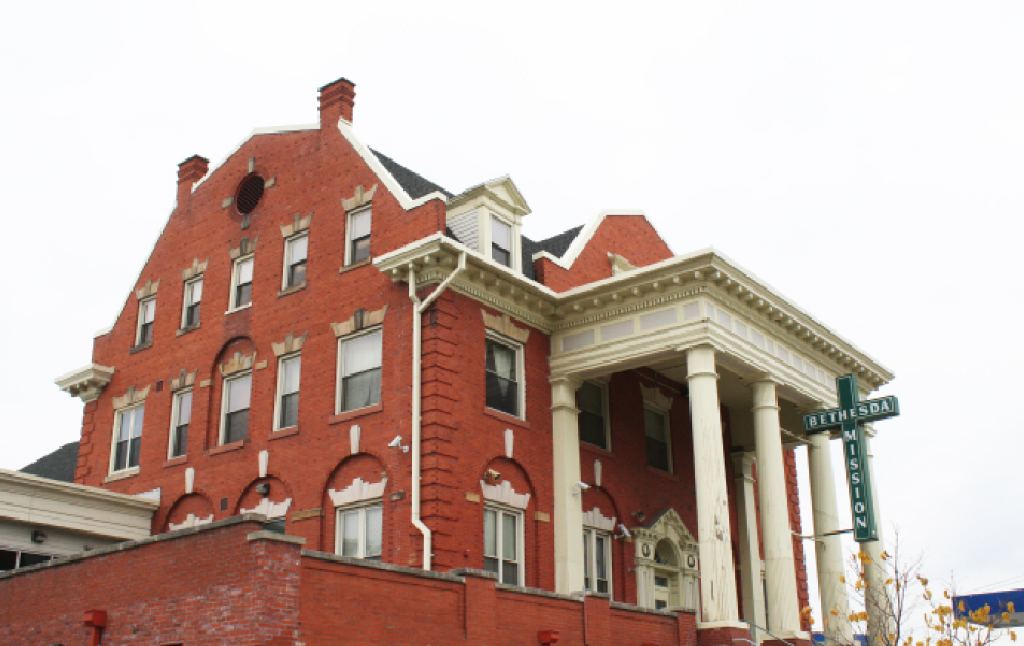
On Dec. 22, the Bethesda Mission marks its 100th anniversary. Most people associate Bethesda, if they know it at all, with the men’s shelter at 611 Reily, a grand brick structure with an iconic green cross hanging out front. The shelter has been at that location since 1934, when Bethesda purchased what had previously been the Railroad YMCA. But, since 1983, the organization has also operated a women’s shelter in Allison Hill, in a former elementary school. And, since 1990, it has run a youth ministry out of an old fire station at 15th and Herr.

This year, the Bethesda Mission has undertaken a campaign to spread awareness of its lesser-known programs, through billboards and radio ads bearing the tagline “Inspire Hope.” A second goal of the campaign, according to Scott Dunwoody, Bethesda’s vice president for business development, is to educate the public about Bethesda’s mission. Traditionally, a homeless shelter was thought of as providing bare essentials—“three hots and a cot,” Dunwoody said. “But now the goal is long-term recovery.”


While the employees at reception figured out how to accommodate me, men streamed out of the chapel into the front hall. A few minutes later, a voice over the speakers, polite but firm, reminded everyone to keep out of the way of the cleaners.

The men at reception didn’t push too hard. They didn’t ask for my name or my information, but they did want to make sure I needed just the one night. Unless you enter Bethesda’s recovery program, New Beginnings, you’re limited to one 10-night stay every four months, and they were puzzled I didn’t want to stay longer. “You miss the bus or something?” one of them asked. They said they could put me up on a mat on the chapel floor. “Now, don’t come back tomorrow saying you want the 10 nights,” one of them added.

The recovery program at the men’s shelter extends a guest’s stay in phases. A guest in the New Beginnings program can stay for four months, but he has to opt in by his fifth night. A second phase, called the Helmsman program, extends the stay another six months. Doug Barger, program director at the men’s shelter, explained Bethesda wants guests to make a considered decision to sign up for recovery—and not just a last-ditch choice because they have nowhere to go. “We make a long-term commitment to them,” he said. “They have to make a long-term commitment to us.”

Barger has been with Bethesda for 13 years. He previously worked at America’s Keswick, a Christian addiction recovery program in Whiting, New Jersey. Like many people who go into recovery work, he overcame his own addiction. “I gave my life to Christ and asked my church to pray for me,” he said. When I asked if his experience helped him understand Bethesda’s guests, he replied, “I speak their language. I know where they’re coming from.” Many of them, he said, don’t believe he ever had an addiction, because they don’t think theirs can be defeated. “But I tell them, ‘It’s very possible. Just make the next right decision.’”

Programs at the women’s shelter operate on a different calendar. Residents must commit to a full year, and their movements are restricted for an initial period, the length of which varies depending on the circumstances that brought them there. As Shelley Brooks, who has been the director there for the past 30 years, explained, “We don’t do emergency shelter. We focus on recovery and homelessness.”

Brooks took me on a tour of the house in late October. Where the men’s shelter feels like a dormitory, the women’s shelter feels like a home—quieter, cozier, more evidently inhabited. We passed a mural, titled “Fruits of the Spirit,” showing a tree bearing fruit of a dozen different varieties. I took note of a banana labeled “patience” and a pineapple labeled “love.” “People become very gentle, very caring for one another, one they find out that they’re safe,” Brooks told me. She recounted the looks on women’s faces at Christmas, when they receive gifts from donors who learned about their specific needs. “They don’t understand that someone took their name, and went out and bought clothes that fit them, and wrapped it—that there are still good people in the world.”

Brooks introduced me to Margarita, the shelter’s house manager, who has worked at Bethesda for 14 years. Margarita, who came through the program herself, recalled her feelings the night she arrived. “It was a release for me,” she said. “They had these raggedy blue chairs. I didn’t care. I said, ‘I got somewhere to lay my head. I got some peace.’”


After being admitted, I entered the chapel, a large room with a high, tapered ceiling. In the center are a hundred upholstered metal chairs, divided into eight rows with an aisle up the middle, and facing a squat white lectern. Behind the lectern is a flat-screen television, mounted on a glass wall. Flanking the television are cream-colored banners, one saying KING OF KINGS, the other LORD OF LORDS. Flanking the banners are poles holding American flags.

I sat in one of the chairs to get my bearings. A young man, perhaps 19 or 20 years old, stood in the corner with a ping-pong paddle, serving a ball to himself off a spot high up on the wall. After a few minutes, I headed to a lounge behind the altar, dimly visible through the glass. Here, perhaps two dozen armchairs were crowded together in front of another television. Several men reclined in them, some with shoeless feet draped over the arms, watching “Thirteen Ghosts.” At one point, someone remarked he’d once walked from Philadelphia to York. At another, someone said the chairs were comfortable. But mostly no one said anything.

I headed back out to the chapel. In the interim, maybe half-a-dozen men had drifted in and taken seats, and the television was now on. Someone flipped the channel to a documentary about Randy Moss. In addition to ping-pong, the chapel is home to a foosball table. While I was eyeing it, a young man walked over and picked up a small cardboard box off a stack of hymnals on a bench nearby. It held a traveler’s toothpaste. He gave it a little shake. “There a foosball in there?” I asked him. “Huh?” he said. He started to walk off, and then he turned around. “You want to play foosball?”

The young man’s name was Preston. It was hard to guess his age. He had short, dark hair, light brown skin and a compact build. He said he grew up in the area; he’d played foosball at his daycare in Allison Hill. He’d been at the shelter for two and a half months, and was enrolled in the New Beginnings program, which he highly recommended. I asked if he knew Barger, and told him I was there on Barger’s advice, to help with a story I was working on for a local magazine. He sounded disappointed, but not fazed. He told me his story in basic outline. He’d developed a drinking problem, and had been in the shelter once before; this time, he wanted his recovery to stick. He hoped someday to go into either counseling, personal training or theater and the arts. Then, after making a winning shot, he shook my hand, said it was nice meeting me, and disappeared.


By this time, the cleaning was finished, and the men starting moving around more freely. In a corner room off the main hallway, I came upon two men in raised swivel chairs, singing Little Anthony and the Imperials’ “Tears on My Pillow.” Their names were Phil and Steve. Phil was white, with a bushy beard and gray hair parted neatly in the middle. He wore a long V-neck T-shirt over his round belly. He sang the lead in a reedy vibrato, baring long white teeth and keeping time with his hands. Steve, on the bass line, was black, bald, wore glasses and carried a toothpick in the corner of his mouth. When they finished the song, Steve wanted to take pictures with his Fujifilm disposable camera: first of me and Phil, then of himself and Phil.

They continued to sing doo-wop songs for the next half hour, usually introduced by Phil: “Blue Moon,” “Under the Boardwalk.” Phil had to grope to come up with each next song, but once he’d started he knew the words. In between songs, they talked about their situations. Steve was from Philadelphia, where he and his brother worked in a barbershop. “Each day, I’d cut hair, take my money, and go buy dope,” he said. He had a plan that was a little hard to follow: the gist of it was he hoped to sell some property he owned in Philly, save up while going through the full program at Bethesda, and eventually buy a home. Phil left and came back with a gray pinstripe suit on a hanger. “Look what God gave me,” he said. His daughters, he added suddenly, would not be coming to visit this weekend after all, because their grandfather had fallen ill. “But that’s just part of God’s timing,” he said.

As the men sang, a small crowd gathered to listen or sing along. Then, all at once, the group dispersed—it was time for roll call and prayer. Men filed into the chapel, filling up the rows, and a man named Israel, one of two who had checked me in, approached the podium. He made reference to the grace of God, soliciting applause. Then his tone became more somber. “Gentlemen,” he said. “If you sign up for the doctor on Tuesday night, then you gotta be here.” The men were rapt; the chapel fell into a guilty schoolroom silence.

Israel moved on. It was Veteran’s Day, and after thanking those who served, he reflected on the private “war” of addiction. “Use the tools you pick up in here out there,” he said. “‘Cause guess what? Nothing’s changed out there.” Then he told the group they could take “late showers”—an opportunity not afforded every night—and that the laundry, which held a stockpile of toiletries, would be open for people who needed them. He waxed briefly on the topic of deodorant. “Use it!” he said. “It’s here for you, man. You know what I mean?” Then he called roll, cracked a joke about the “barbershop quartet” in the hallway, and said a short prayer.

After prayer, the night wound down quickly. Heading back into the hall, I learned that the corner where Phil and Steve were singing was, in fact, Bethesda’s actual barbershop—someone was now sitting on a swivel chair, getting a buzz cut from another guest. For a while, a few men hung around in the chapel, watching the CBS crime drama “Person of Interest.” The episode was a potboiler, built around a gratuitous riff on the Ebola crisis. But the plot was engrossing, and there were murmurs of disappointment when, halfway through, the loudspeakers crackled on to announce it was time for lights out. I went back to collect a mat from the hallway, a thick foam slab encased in a rubber sheet. When I got back, I was alone.


Two of the chapel walls are lined with stained glass windows, all made in an identical abstract pattern: yellow in the center, with green, red and blue along the borders. Though the windows don’t look out on anything, they are lit by fluorescents from behind. Now, with the other lights off, they gave the room a yellow-green glow. I placed my mat on the floor, between the ping-pong and foosball tables.

Also along the chapel walls are quotations from the Bible, and at various points in the evening, I’d read and re-read one from Paul’s letter to the Colossians, intrigued by one line in particular: “You were enemies in your minds because of your evil ways.”

With nothing better to do, I found a Bible on an empty chair and flipped to the relevant passage. The letter to the Colossians, only a few pages long, is a note offering encouragement and some guidance on the faith to a new Christian church in Colossae. At the end of it, Paul notes that he’s writing from prison. “Remember that I am being held by chains,” he says. It’s a curious way to end a letter. For me, it has the effect of making the preceding advice seem less preachy. It’s as if Paul is saying, “I need this stuff as much as you do.” I thought of what Barger said about overcoming his own addiction, and the fact that most of the men working at Bethesda at one time or another went through the program themselves.

Just before 11 p.m., a voice came over the loudspeaker a final time. “All conversations, guys, must come to an end,” it chided gently. “Please respect yourself, your neighbors and this facility. Some of these guys have to get up and go to work in the morning. And some of them have to get up and cook.”


Continue Reading

Scent of Christmas: Roasted chestnuts offer wonderful holiday smells, tastes.

Screenshot 2014-11-25 17.19.52Growing up, I knew Christmas was near by several subtle, yet unmistakable, signs at our house.

Plump and fragrant tangerines appeared for dessert. There were savory blanched almonds that my mother tossed in olive oil and salt, roasted in the oven until golden brown and served as a snack or, for some, with a pre-dinner cocktail.

My father dragged out his bottle of Harvey’s Bristol Cream, a sweet, dark and rich sherry that we drank even before dinner. (That bottle lasted for years.) And then there were chestnuts, a must-have treat for every Christmas holiday. My mother roasted them in the oven for my father, who relished them along with a little sambuca or amaretto for dessert. Even without an “open fire,” the smell of chestnuts roasting at home is just as lovely as on the streets of New York City.

Chestnuts have strong ties to Italy where, in centuries past, they were a staple food of peasants. Chestnut harvesting, which was backbreaking work, also provided a livelihood as the nuts were packaged for exporting to other countries. Chestnut groves still cover the hillsides of Tuscany, and little villages celebrate chestnut harvest every fall. They are no longer considered peasant food, rather a coveted ingredient in many Italian dishes and baked goods.

Preparing chestnuts can be rather time-consuming and hard on the hands. But, after trying chestnuts sold in vacuum packs or in jars, I have decided that the taste doesn’t even come close to buying the fresh nuts when they are in season. No special equipment is needed, although Williams-Sonoma once sold a chestnut-roasting pan for use over a wood fire. I can’t imagine many were sold.

Be picky when you are buying fresh chestnuts. They should be a beautiful, glossy brown, very round and plump. Pass on those that seem to have a crackly space between the outer hard skin and the nut itself, and avoid those that have a dull or dusty appearance.

To roast chestnuts, place the nuts on a flat surface and, with a small, sharp paring knife, cut an “X” into one side. The goal is to cut through the tough outer skin, but not pierce the “fruit.” There is a little disagreement as to which side of the nut should be cut. My mother always cut the flat side, although some recipes advise the rounded side. I think both should work.

Roasting Chestnuts

  • There is no set amount of chestnuts to cook at one time. Buy what you think you can eat and that will fit on your rimmed baking sheet. A metal pan is best.
  • Spread the chestnuts out in a single layer on your baking sheet. There is no need to grease the pan first.
  • Sprinkle the nuts lightly with water before placing in the oven.
  • Roast in a pre-heated, 400-degree oven for 15 to 20 minutes, shaking the pan a few times while roasting.
  • After 15 or 20 minutes, the chestnuts will turn a darker brown and the cuts in the shell will begin to peel back.
  • When the chestnuts are cool enough to handle, peel away both the brown outer shell and the thinner inner membrane.
  • Eat and enjoy.

My family used to eat chestnuts while they were still warm, and their wonderful aroma still permeated the kitchen. But you can freeze them for later use or keep them for a few days in the refrigerator.

Chestnuts can be used in so many ways—tossed with Brussels sprouts or other green vegetables; in your Christmas stuffing; with pasta (especially gnocchi); and even in soup. And, somewhere out there, an Italian grocer can sell you chestnut flour for baking holiday cakes.

Wishing all TheBurg readers a wonderful holiday. Buon Natale!


Chestnuts with Grappa

Here is a traditional Italian way to serve roasted chestnuts at Christmastime. The recipe calls for grappa, a strong and clear after-dinner brandy much like the Greek ouzo. But you could also use regular brandy, amaretto or perhaps even Grand Marnier.

  • Roast 1 pound of chestnuts (see main story).
  • Toss the cooked chestnuts with:

o   4 tablespoons grappa

o   4 tablespoons sugar

o   A tiny pinch of salt

o   1 teaspoon grated orange zest.

  • Serve in a little dessert dish.

Serve the chestnuts with additional spirits on the side and some vanilla gelato. What could be better than a Tuscan treat at Christmastime?

Continue Reading

Sharing the Harvest: It’s easier than ever to donate your surplus venison.

Screenshot 2014-11-25 17.22.10The opportunities to harvest more than one deer in Pennsylvania abound.

Besides an antlered buck allowed on your general license, there are many ways to take an antlerless deer as well. Doe licenses are available in every part of the state; numbers depend on the Wildlife Management Unit you hunt. It’s possible to add another three deer if you are fortunate enough to be drawn for additional licenses.

Then there are harvest permits from the Deer Management Assistance Program (DMAP). DMAP provides an additional means for landowners to manage deer to meet their land-use goals. It also provides additional opportunities to the hunters who participate in the program. Hunters can get up to two DMAP harvest permits per property. The more DMAP properties you hunt, the more deer you may take.

Finally, the Pennsylvania Game Commission has issued 13,000 special antlerless deer harvest permits for use in Disease Management Area 2 this fall, an area in the south-central part of the state, including parts of Bedford, Blair, Huntingdon, Cambria and Fulton counties, where Chronic Wasting Disease has been identified in wild, free-ranging deer. Hunters may purchase an unlimited number of permits until all permits are issued.

Therefore, at the conclusion of all seasons, a hunter in Pennsylvania can add a considerable amount of tasty, healthy meat to their freezer. It also affords the opportunity to help feed those less fortunate in our commonwealth.

The Hunters Sharing the Harvest Program, founded in 1991, coordinates the processing and distribution of donated wild game from hunters and municipal herd reduction sources to hungry people throughout Pennsylvania. You can donate a deer through one of the program’s many participating processors closest to where you hunt or live. An average-sized deer will provide enough highly nutritious, low-cholesterol meat for 200 meals.

To donate, a hunter takes a deer to a participating butcher, who will process the venison into 1-pound bags to be distributed by food banks to local charitable, hunger-relief organizations, such as soup kitchens and food pantries. One deer produces around 40 to 50 pounds of ground venison that can feed more than 30 families.

“The venison we get from the Hunters Sharing the Harvest program is like gold,” says Brad Peterson, director of communications for the Central Pennsylvania Food Bank. “Many people who are struggling with hunger go without that center-of-the-plate protein to try to make their meal dollars stretch. When we get this venison in, we just can’t keep it in our freezers. As fast as we put it in, it goes on our inventory, and it goes right back out. People want this. It is highly desired. It’s a high-protein, low-fat meat that everyone loves.”

Some significant changes in the program for 2014 make it even easier to donate an extra deer. Hunters had been asked to donate $15 when they dropped off their deer at the butchers to cover the cost of processing, but not any more.

“This copay has been dropped for this year,” said John Plowman, executive director for HSH. “Costs of processing are now covered by the program and its many sponsors. Hopefully, this will encourage even more successful hunters to participate.”

Finding a processor to take your deer is easy, as well. The HSH has a toll-free phone number (1-866-HSH-2141) that hunters can call to find a processor, or go to the website (www.sharedeer.org) to find a list of processors by county.

Hunt safely this season. Shoot straight and remember all of the needy families you can help feed in the state.

Continue Reading

Harvest Time: New farm-to-table helps satisfy the midstate’s growing appetite for fresh, local.

Screenshot 2014-11-25 17.18.52Two o’clock is generally pretty quiet in a restaurant.

The big lunch rush is done; staff is busy preparing for dinner. This is not the case at Harvest Seasonal Grill and Wine Bar, a farm-to-table restaurant that opened after much anticipation in the Shoppes at Susquehanna in August.

I walked through the doors expecting the usual mid-afternoon restaurant calm, but was greeted by an energized atmosphere and insanely delicious smells.

The Harrisburg location is the fourth Harvest opened by Philadelphia-based restaurateur Dave Magrogan, whose other restaurants include Dave & Anthony’s Stella Rossi Ristorante, Doc Magrogan’s Oyster House and Kildare’s Irish Pub. When I asked Magrogan why he decided to open a farm-to-table restaurant, I was honestly surprised by his answer.

“Well, before I got into the restaurant business, I used to be a chiropractor,” he said. “So, I learned a lot about health and nutrition and processed foods, and I saw a real blank space for this type of restaurant in the industry. Most farm-to-table restaurants are smaller, but I thought, ‘why can’t there be a healthful chain?’”

So Magrogan opened the first Harvest in Glen Mills in 2010 to great acclaim. All of Magrogan’s other restaurants are in Philadelphia or the surrounding area. So why was Harrisburg a good spot for the next location?

“There were a lot of reasons,” he said, “but the most attractive thing was the proximity to farms and farmers. Also, there are lots of great restaurants in the city of Harrisburg, but not as many as you move outside the city. The opportunity was clear.”

Harvest’s menu changes seasonally, and nearly everything (including dessert!) is 500 calories or fewer, made with locally sourced, fresh ingredients. Items more than 500 calories are marked with a little plus sign, and are, of course, also locally sourced and fresh.

The menu changes seasonally, and I mean the whole menu: the food, desserts and many of the drinks switch up every three months.

“We try to change it as close to the beginning of the new season as possible,” explained Gary Grasela, Harvest Harrisburg’s general manager.

Harvest has partnered with 12 local farms to provide meat, produce, dairy, vegetables, even honey for its menu. The day that I met Grasela, he had just come from a meeting with Keswick Creamery in Cumberland County. It was a cheese meeting.

“Our proximity to these farmers allows us to dial in deeper to the farm-to-table concept,” Grasela explained. “Many of these farmers are willing to deliver. We have so many choices.”

Grasela says that among the most popular entrees on the fall menu are the cedar-roasted Atlantic salmon ($19), coq au vin ($19) and the filet mignon ($31). Another highlight is the local cheese plate.

“It has local, raw, grass-fed, cave-aged cheddar from Lancaster that this guy makes by hand,” Grasela said. “It’s amazing.”

If you’re looking for something on the lighter side, there are some scrumptious-sounding sandwiches and salads, as well as flatbreads and vegetarian dishes. The portobello “cheese steak” caught my eye, which replaces meat with the steak of ‘shrooms ($11), as did the slow-roasted chicken sandwich ($10) and the vegan black kale Caesar salad, featuring a mix of lacinato kale and baby spinach, tossed with pickled red onions and herbed breadcrumbs (small $6, large $9).

As the mother of a 2-year-old who isn’t the most adventurous of eaters (although her favorite food is hummus, which she licks off any vegetable I serve with it), I was excited to see that there is a kid’s menu, which includes staples like spaghetti, mini-cheeseburgers and cheese quesadillas.

“My 8-year-old son loves it!” Magrogan told me excitedly when I asked if Harvest was the kind of place where you could bring a kid. “It’s his favorite of all of our restaurants. And, I mean, we have a pizza restaurant. Like, a really good pizza restaurant.”

So, how’s business?

“Really, really good,” Grasela told me. “We are the busiest restaurant in the company right now. The crowds have been exceeding expectation.”

Looking around Harvest, I saw all sorts: lots of business-y people catching a quick bite, couples, a mom with a toddler, a pair of older ladies (one of whom stopped Grasela on her way out to compliment him on her meal). Grasela said that the demographic is “really hard to pin down.”

“We see tons of couples for dates,” he said. “Large groups, whether it’s a corporate group or a birthday party or something, lots of families on weekends. And, of course, we get lots of shoppers from the stores around us. All of our customers appreciate the options that our menu provides.”

And those options are one of the things that Magrogan is most proud of.

“It’s great for date night or a business dinner, and you can bring the kids after soccer practice,” he said. “I think that we created something that appeals to everyone.”

Harvest Seasonal Grill and Wine Bar is located at the Shoppes at Susquehanna, 2625 Brindle Dr. in Susquehanna Township. More information is at www.harvestseasonalgrill.com or 717-545-4028.

Continue Reading

Voices of the Season: Choral groups portray Christmas in song.

Jason Vodicka

Jason Vodicka

For many people, music is a big part of the holiday.

Fortunately, here in central Pennsylvania, we have several choral groups that will bring new life and a sense of spirituality to a genre often defined by the stale songs one hears in an endless loop at the shopping mall.

First up, the Harrisburg Singers will perform their concert, “Holiday!” in early December at three different venues, presenting a collage of classical and secular Christmas music. The anticipated highlight: three joyous movements from British composer John Rutter’s “Magnificat” (“Song of Mary”) and two choruses from Handel’s “Messiah.”

“The group changes sound and mood throughout,” said Artistic Director Sue Solomon Beckley. “Several of our own members will be featured in solo roles. And you will hear percussion—the timpani (kettle drums) on two songs, in addition to the organ and piano. It’s a mixture of styles that all will enjoy.”

The Harrisburg Singers were founded in 1984 by vocalist Ron Sider.

“He brought together the best soloists in the capital city at that time to create and showcase a professional sounding group,” said Kat Prickett, secretary of the Harrisburg Singers. “Back then, they were semi-professional paid performers.”

For the past two decades, Beckley has led the group of 40 singers. She has an extensive background in music education and is an adjunct professor of voice at Bucknell University.

“We are known as ‘One Voice,’” said Beckley. “The singers work to blend the quality of the sound, as if just one person is singing. Since each voice has a special quality, the blend comes out as a lush sound.”

Closer to the yuletide, the Harrisburg Choral Society will put on its holiday concert, “Christmas Celebration.” The group will spread holiday cheer by performing 20 minutes of Bach’s “Christmas Oratorio,” balanced by 40 minutes of traditional carols.

“The opening chorus of this piece (Bach) is incredibly exhilarating. It captures what Christmas is all about,” explained past president Glenn Murray. “Even if you are not familiar with the music, it is so overt—just hearing the musical content hits you emotionally.”

Founded in 1895, the Harrisburg Choral Society recently welcomed the youngest music director in its long history, Jason Vodicka, who is just 34 years old. He also is the coordinator of music educational programs and an assistant professor of music at Susquehanna University.

Vodicka brings a focus on vocal technique to the group. He is interested in musical style—making Berlioz sound like Berlioz and Bach sound like Bach.

“I put the focus on the text and expressing the music together, as opposed to instrumentalists, to communicate with the audience,” said Vodicka.

He added that he is impressed with the level of talent and hard work that his group possesses.

“They come with expertise, and they are willing to try new methods,” he said.

The admiration appears to flow in both directions.

“He has different ways of warming up our voices and presenting the music,” said veteran soprano Jayne Kopko of Mechanicsburg, who’s been with the group for 12 years. “We are excited to have such a young director.”


The Harrisburg Singers

The Harrisburg Singers will perform their concert “Holiday!” at three different venues:

Friday, Dec. 5, 8 p.m., Faith Presbyterian Church, 1801 Colonial Rd., Harrisburg

Saturday, Dec. 6, 7:30 p.m., Trinity Lutheran Church, 2000 Chestnut St., Camp Hill

Sunday, Dec. 7, 3 p.m., Mechanicsburg Presbyterian Church, 300 E. Simpson St., Mechanicsburg

Tickets are available at the door: $20 adults; $15 seniors; $5 students. More information is at www.harrisburgsingers.org.


Harrisburg Choral Society

The Harrisburg Choral Society will perform its “Christmas Celebration” concert on Dec. 21, 3 p.m., at the Grace Milliman Pollock Performing Arts Center, 340 N. 21st St., Camp Hill.

Tickets are available at the door: $20 adults; $17 seniors; $5 students. More information is at www.harrisburgchoralsociety.org.

Continue Reading

Cookies and Punch: Maybe what Harrisburg needs is less bloviating and more socializing.

Screenshot 2014-11-25 17.14.35It’s been a long year, Harrisburg.

For those of us who live in the city, it’s been a trying one. In fact, as Thomas Paine wrote, “These are the times that try men’s souls.” Women’s, too.

To live in the city at this time requires a thick skin and a strong resolve. It means enduring a barrage of unabashed criticisms, insults and disappointments. There are battles galore, big ones and little ones from inside and out, fights to make Harrisburg better. Every which way are meetings, headlines, announcements, calls to action, warnings, proclamations, declarations, accusations and aspirations.

Not only is there so much to pay attention to, there’s also the need to discern what’s true and what isn’t. That in itself can be a wearisome feat.

When it comes down to it, it’s plumb tiring to be a part of a broken city in the midst of reconstruction.

Of course, it’s the end of the year, and much of the bah-humbug blues are just part of the season. In Harrisburg, though, the circumstances tend to exacerbate the normal trials and tribulations of life.

Yes, it takes strong resolve to persevere in these times.

It also takes cookies and punch.

The theory of cookies and punch is something that struck me a few years ago after a neighborhood holiday party.

Like this year, that year had been a long, exhausting one. The city’s crisis was just cresting and apprehension filled the air. However, that community gathering on a frigid night helped cut the unease we were all feeling.

Everyone brought something. There were homemade cookies, cakes, breads and dips, along with punches and wines shared amongst all of us. The room was filled with engaged residents happy that something festive was organized for them. It wasn’t a meeting obsessed with “Robert’s Rules of Order” or an open mic forum of too much venting about personal frustrations, concerns and desires. It was intended to be a purely social evening, yet there were more productive conversations about our neighborhood and our city than I had witnessed in a long time. Over and over throughout the night, I had fruitful discussions about the state of things.

What I realized is that neighborhood-wide, citywide, we are all sharing the same experience of Harrisburg, and it is only a matter of time until more and more of the gaps that seemingly separate us are bridged.

Where will those bridges come from? I dare say that social gatherings may be the wave of Harrisburg’s change. In the past eight years, I have been to more city and community meetings than I can count. All too often, I walk away from these meetings thinking, “What was that?! I can’t believe I just gave two-and-a-half hours of my time for that. What will even come of it?” And I’m a pretty patient and committed volunteer.

When it comes down to it, though, the most productive exchanges I’ve had have been in front of my house with passersby, with people I bump into at the Broad Street Market, and in spontaneous conversations over cups of coffee or pints of beer.

In these instances, I have learned more about the structure of cities, operations of the city’s administration, the power of the school board, crime in my neighborhood, codes legislation, projects, history and points of view than at any formal meeting I have attended. I have learned who to contact about this and that and how to really get a response from so and so. That night so many years ago, I walked away from the party with new contacts, new ideas and future meetings scheduled to actually get something done. Tangible next steps. Something to count on.

I was a renewed ball of energy and hope.

Fortunately, I have experienced that same sensation many times since then. Away from the formalities and to the essence of communal gathering—that’s when there is an encouragement of the spirit and a rejuvenation of the soul.

As this tiring year ends, let us rethink how we get things done. We should ponder what really encourages people to participate and why so many don’t, leaving the grueling tasks of reconstructing a broken city to too few. We should think about how we communicate and what certain approaches imply about power and order. Ultimately, we must consider how to organize processes that represent the dynamics of our city more fairly and bring more people together.

I say let there be more cookies-and-punch gatherings and see what happens.

May this season be filled with many such endeavors in the city and, with them, a renewed sense of vigor to take us into the new year.

Tara Leo Auchey is creator and editor of today’s the day Harrisburg. www.todaysthedayhbg.com.

Continue Reading

Grown-Up Gifting: A holiday guide for some of the hottest wines & best deals.

Screenshot 2014-11-25 17.18.39When we were kids, we often judged our holiday presents by their shapes.

Scanning the bounty under the tree, we zeroed in on the biggest boxes, believing that they might hold the best gifts.

As adults, we still look for the most promising packages. However, many of us now desire those long, rectangular boxes that just may hold something special for us to drink.

In that spirit, I attended a Chairman’s Selection Tasting last month sponsored by PA Fine Wine and Good Spirits, an event held just in time for the holiday-giving season.

I consider myself very fortunate to be able to preview these wines, see what is in store for us, and share my impressions with you.

During the tasting, we were guided through the different quaffs by Steve Pollack, the chairman, who pointed out nuances and characteristics in each bottle. The five other people at the table made for a good sounding board and lively debate as wine is very subjective.

These wines are here just in time for the holidays, either as gifts for a special someone, or to help with the myriad of celebrations. I hope that my tasting notes will help guide you as you pick out that special bottle or two during this festive month.

Keep sipping, Steve.


White Wine

Terra da Vino Masseria Dei Carmelitani Gavi di Gavi DOCG 2013, code 33699, $12.99: Citrusy, clean-tasting palate-scrubber from the Italian Piedmont. Tasty.

Sterling Vineyards Malvasia Bianca Cellars Club 2013, code 33656, $8.99: Spicy, zingy wine made from an Italian grape that found its way to California.

Michele Chiarlo Moscato D’Asti DOCG Nivole 2013, code 33641, $8.99: Delicious dessert wine with low alcohol and huge clean sweetness from Italy.


Red Wine

J. Hofstatter Pinot Nero DOC Meczan 2012, code 33586, $13.99: Pinot Noir from Italy done in a light elegant style. Burgundian in weight.

Domaine Sainte-Eugenie Corbieres Rouge 2011, code 33638, $8.99: Carignan-dominated easy-drinking wine from southwest France.

Pat Paulsen Vineyards Primitivo 2012, code 33649, $10.99: Subtle Zinfandel wearing its Italian moniker from California.

Asio Otus 2012, code 33692, $11.99: Fruity, easy-drinking French blend from east Italy. Latin name of a long-eared owl.

Gloria Ferrer Merlot Carneros 2009, code 33620, $15.99: Mature, delicious wine says this grape is back. Fruity and elegant.

Domaine la Croix d’Aline Saint-Chinian AOP 2013, code 33671, $11.99: Good solid Rhone blend, mostly Syrah. Fruity and silky.

Vignamaggio Castello di Monna Lisa Chianti Classico Riserva DOCG 2009, code 33606, $24.99: A truly exquisite, classic expression of Sangiovese to drink now.

Rivera Il Falcone Castel Del Monte Riserva 2008, code 33601, $17.99: Beautiful Puglian wine and a chance to drink Nero di Troia, an ancient Italian grape.

Le Gravillas Gigondas Les Dentelles 2012, code 33674, $18.99: Grenache-based quaff with richness and complexity. Lay this one down.

B.R. Cohn Cabernet Sauvignon Olive Hill Estate Vineyards 2010, code 33580, $34.99: Rich, dense Cali Cab that doesn’t come from Napa. Big and dark.

Piccini Brunello di Montalcino Villa al Cortile 2009, code 33581, $29.99: Mature fruit-filled Tuscan classic. Wonderful Sangiovese. Drink now.


Sparkling Wine

Decelle Brut Champagne NV, code 33599, $29.99: Tart, citrusy, bubbly. A genuine bargain.

Alfred Gratien Brut Champagne NV, code 33609, $39.99: A classic wine. Dry, yeasty and clean with all three of the designated grapes.

Herbert Beaufort Brut Champagne Bouzy Grand Cru Carte d’Or NV, code 33675, $32.99: Wonderful, fruit-forward sparkler, mainly Pinot Noir. My pick.

Continue Reading

Musical Notes: Jingle Bell-Less

I know, I know, December is for holiday music. But I must confess, sometimes I need a break from “Jingle Bells” and “White Christmas.”

If you’re like me, you’ll want to brave the snow and chill and see one of these shows. Whether you are looking for upbeat or contemplative music, December has a number of quality offerings.

So, put down the eggnog, tie a scarf around your neck and go see some live music. Besides, they show “A Charlie Brown Christmas” on TV every year, right?


HANK & CUPCAKES, 12/11, 8PM, ABBEY BAR, $7

This husband and wife duo is hard to categorize. New York-based by way of Tel Aviv, the pair’s music is infectious, danceable pop with a punk attitude. But when you see them live, you realize that they are much more than they seem. Using an extensive pedal board, “Hank” creates a wall of sound using only his bass guitar while vocalist “Cupcakes” belts out powerful melodies while adding percussion. Their shows are a live experience that separates them from so many other dance musicians who perform from behind a MacBook.


MATTHEW O’NEILL, 12/12, 7PM, DOWNTOWN LITTLE AMPS, $5 SUGGESTED DONATION

A wild, backwoods rocker, Matthew O’Neill draws comparisons to Neil Young and Creedence Clearwater Revival. With chunky electric guitars and gravelly vocals, his sound is weathered, which is appropriate considering the subject matter. Often tackling the realities of hard living, his music offers a wealth of experienced wisdom. Tinged with indigenous cosmology and an appreciation for America’s vast uninhabited country, O’Neill is enigmatic, existing somewhere between the world and what lies beyond it.


BRIAN DUNNE, 12/19, 7PM, MIDTOWN SCHOLAR, FREE

Brian Dunne is a country singer in the truest sense of the word. His melancholic songs resonate with the heartbroken, but he also has a dose of the big city in his music. A graduate of the Berklee College of Music, he has called New York home since 2011. With a powerful and emotive voice, he connects with those who have experienced love and loss, suggesting wisdom beyond his years.

Mentionables: Jonathon Boogie Long and the Nighthawks, 12/6, Whitaker Center; Tom Yoder, Midtown Scholar, 12/12; Turkuaz, Abbey Bar, 12/19; Camela Widad, HMAC, 12/27

Continue Reading

An Imitation of Life: There’s real Harrisburg; then there’s media Harrisburg.

Screenshot 2014-11-25 17.14.20Lately, I’ve been pondering the nature of reality.

No, I’m not taking a post-graduate philosophy course nor am I suffering through some type of midlife crisis (I did that about 10 years ago).

Rather, I’ve been wondering how people arrive at their conception of reality and how my business (the media) influences it. As usual in my columns, I’m talking mostly about Harrisburg here, though I suppose this theme could apply to many other communities and things.

When I moved here, I found Harrisburg to be a genial, if somewhat neglected, place. It was generally attractive to walk around, had some nice architecture, decent enough places to eat, a pretty Capitol building. It reminded me of some other urban neighborhoods I had lived in: great bones, nascent redevelopment, a smattering of typical inner-city woes.

Other than the city’s burgeoning financial crisis—which really was a unique problem—I didn’t see Harrisburg much differently than other East Coast cities, though it was a good deal smaller.

So, I was pretty shocked to learn that not everyone agreed with my assessment of this mostly pleasant place. In fact, many people disagreed—emphatically. They disagreed often and passionately and without hesitation.

I remember vividly a couple years back, when, in response to a rather innocuous post on TheBurg’s Facebook page about a downtown restaurant, someone wrote that he was surprised I didn’t fear for my safety.

How did this happen? I wondered. How was it that this quaint, if flawed, little city could stir such negative emotions among so many, particularly those who lived in the suburbs?

Now, I understand that Harrisburg isn’t for everyone. It can be a challenging place to live, especially with the sometimes-spotty (though sometimes-good) service delivery and subpar infrastructure. But the level of contempt and fear that I found on message boards or just in casual conversation surprised me.

I suppose there are several reasons for this. First of all, Harrisburg, as I understand it, was once in pretty desperate shape. The 1960s and ‘70s hit all cities hard, and Harrisburg suffered more than most, with severe flooding adding to the usual list of deindustrialization, white flight, rising crime, racism and blight. A couple generations later, this legacy lingers.

Secondly, the city’s government has been badly mismanaged, and that’s had an impact. The worst abuses, though, have only come to light in recent years. It wasn’t too long ago that Steve Reed was touted as one of the best mayors in the country.

And, thirdly, let’s face it: the Harrisburg area can be pretty provincial and racially divided. There are people who seem to relish bashing the city for their own personal reasons, even if they have little firsthand experience of life here.

Mostly, though, I blame my industry, the media. The media didn’t cause this misperception of Harrisburg, but it certainly has fed and done little to correct it.

Sure, the media has to report bad news; that’s part of its job. But another vital part of its job is this: it should reflect reality.

Too often, media presents a fictional version of life in Harrisburg, and perpetuating a fiction is one of the worst things a news organization can do.

You want to know what life is like in Harrisburg? For the most part, it’s pretty dull. Speaking personally, I walk to work, get lunch, walk home, repeat. On weekends, I do some yard work, try to eat at a good restaurant or two, and venture over to Broad Street Market, City Island and a few other places I like.

My life isn’t a lot different from that of your average suburbanite, with a few exceptions. I certainly walk a lot more and have quick, easy access to some of the area’s best cafés, bars, restaurants and entertainment. I also like to run along the river and at Italian Lake. To me, these are the things that make city life special, and they’re why I choose to live here.

Believe it or not, I spend almost no time worrying about crime, thinking about parking meters or dodging bullets from gun-toting state legislators.

But you wouldn’t know that from reading the front page of the Patriot-News or watching the evening news broadcast. Sure, I understand—how do you make a newscast out of a guy strolling over to Yellow Bird Café for a breakfast sandwich?

The constant drumbeat of bad news, though, has consequences, a terrible effect on the well-being of Harrisburg and its people. Taken in total, this coverage creates a fiction—a fanciful representation of life in this city. People who don’t live here then believe that falsehood, accept it as reality, and act on it as if it were true.

Recently, one downtown restaurateur told me that parking rate hikes haven’t much affected his business, but that he gets calls often from customers who worry for their safety. They want an assurance they won’t get mugged walking the 10 feet from their parking spot on the street into his restaurant. Where do you think that irrational fear comes from?

TheBurg tries to be a counterpoint, a magazine more interested in representing life than in sensationalizing it. We think it’s a more responsible approach, but we also believe that should be the mission of any news organization. Don’t lie to your readers—not just in the facts of an individual story, but in the bigger picture that your reporting, editing and design, taken together, create.

Most newsrooms operate on a daily timeframe, pumping out an article or news segment on a tight deadline. Their focus is on a few stories that single day, and they try to make sure that that they’re reasonably accurate. But there’s little recognition of the cumulative effect of so many stories, spanning a long period of time.

Unrelenting bad news, especially when it’s routinely reported breathlessly, can be destructive to a community and, worse yet, present an untrue picture of what life is like. It’s a fiction, and, in the case of Harrisburg, one that is widely believed and has proven to be profoundly harmful.

Lawrance Binda is editor-in-chief of TheBurg.

Continue Reading