Kane: Incinerator Probe Hoped To End Soon

Former Harrisburg Mayor Steve Reed, left, and former Harrisburg Authority board member Fred Clark at a Senate hearing on the incinerator financings in 2012.

Former Harrisburg Mayor Steve Reed, left, and former Harrisburg Authority board member Fred Clark at a Senate hearing on the incinerator financings in 2012.

Pennsylvania Attorney General Kathleen Kane briefly addressed the progress of the probe into Harrisburg’s incinerator financings Tuesday morning, saying her office hoped to bring the case to a conclusion “in the very near future.”

The remarks came at a budget hearing before the Senate appropriations committee in response to a question by Sen. Rob Teplitz, D-Dauphin, whose district includes Harrisburg.

Teplitz brought up the investigation as a prelude to a question about funding for a military and veterans affairs division in Kane’s office.

It was critical to his constituents, Teplitz said, to find out “whether that debacle was the result of criminal activity on the one hand or just bad government or bad lawyering on the other hand.”

In response, Kane said she understood the importance of coming to a conclusion, adding that “dedicated agents” had been working on the investigation “since its inception.”

“All people want is the truth,” she said. “We’re hoping to draw to a conclusion in the very near future. And we understand that no stone will be left unturned.”

Teplitz is also the Democratic chair of the Senate local government committee, which held hearings on the incinerator financings in the fall of 2012.

Those hearings sought to shed light on how a series of borrowings in the mid-2000s related to a retrofit of the city’s trash-burning facility had ballooned to a more than $350 million debt that pushed the capital nearly to bankruptcy.

A host of witnesses testified, including Harrisburg’s first receiver David Unkovic, former Mayor Stephen Reed, future Mayor Eric Papenfuse and a number of past board members from the municipal authority that approved the borrowings.

Continue Reading

TheBurg Podcast, March 13, 2015

Welcome to TheBurg Podcast, a weekly roundup of news in and around Harrisburg.

March 13, 2015: This week, Larry and Paul talk about Gov. Wolf’s proposed state budget and its possible pluses for Harrisburg, the incremental movements in the lawsuits over the city’s gun laws, and the fateful decade when Harrisburg city government went into the hotel business.

Special thanks to Paul Cooley, who wrote our theme. You can listen to Paul’s own podcast, the PRC Show, on SoundCloud or in the iTunes store.

TheBurg Podcast can be downloaded by clicking on the date above or by visiting the iTunes store. You can also access the podcast via its host page, here.

Continue Reading

TheBurg Podcast, March 6, 2015

Welcome to TheBurg Podcast, a weekly roundup of news in and around Harrisburg.

March 6, 2015: This week, Larry and Paul talk about Gov. Wolf’s proposed state budget and its possible pluses for Harrisburg, the incremental movements in the lawsuits over the city’s gun laws, and the fateful decade when Harrisburg city government went into the hotel business.

Special thanks to Paul Cooley, who wrote our theme. You can listen to Paul’s own podcast, the PRC Show, on SoundCloud or in the iTunes store.

TheBurg Podcast can be downloaded by clicking on the date above or by visiting the iTunes store. You can also access the podcast via its host page, here.

Continue Reading

Harrisburg School Property Taxes Eliminated under Wolf Plan

SchoolSpreadsheet

A page from the school funding spreadsheet distributed today by Gov. Tom Wolf’s office. In order, the final three columns represent the total proposed property tax reduction allocation for the 2015-16 school year; the 2012-13 residential real estate tax collected; and the percentage of proposed residential real estate tax reduction for the 2015-16 school year.

Harrisburg residents would see their school property taxes zeroed out if a bold plan proposed today by Gov. Tom Wolf passes the state legislature.

Wolf’s proposed 2016 budget would dramatically change how schools would be funded, as increased income and sales taxes would provide much of the money for public schools. As a result, residential school property taxes in many of the state’s poorer districts would be eliminated, while wealthier districts also would see a reduction.

In Harrisburg, residents would pay no school property tax at all. Even non-resident homeowners would have their taxes reduced under Wolf’s proposed budget.

To pay for his plan, Wolf would raise the state’s income tax to 3.7 percent from 3.07 percent and the sales tax to 6.6 percent from 6 percent. The proposal was a key part of the $29.9 billion spending plan for 2016 that Wolf unveiled today.

“This is quite an exciting day,” said Harrisburg Mayor Eric Papenfuse. “If you take school property taxes to zero for Harrisburg, you’ll see people flocking in to buy properties in the city.”

Papenfuse said he wasn’t sure of the odds of Wolf’s plan being passed, but hoped it would not be summarily rejected by the Republican-controlled legislature.

“He’s building on a Republican House proposal to do something similar,” Papenfuse said.

Wolf’s proposal would not eliminate school property taxes for most suburban jurisdictions, but would substantially lower them.

For instance, the school property tax for Camp Hill residents would fall by about one-third, with a similar decrease for homeowners residing in the Central Dauphin School District.

Historically, property taxes have provided the bulk of school funding in the United States. In recent years, however, some states have begun to look to other ways of funding schools so that the burden is shared more equally among all taxpayers, not just property owners.


Continue Reading

TheBurg Podcast, Feb. 27, 2015

Welcome to TheBurg Podcast, a weekly roundup of news in and around Harrisburg.

Feb. 27, 2015: Larry and Paul try (and mostly fail) to speed through the many topics of a newsy week. Among the topics of discussion: the once-a-year Airing of Greivances before the city’s parking committee, a partial victory for lawyers, guns and money, the rejection of a land sale and the newest edition of TheBurg. And the answer to a piece of Harrisburg trivia. Q: What drives Harrisburg residents to council meetings in droves? Clue: It rhymes with “balsa music.”

Special thanks to Paul Cooley, who wrote our theme. You can find his podcast, the PRC Show, on SoundCloud and in the iTunes store.

TheBurg Podcast can be downloaded by clicking on the date above or by visiting the iTunes store. You can also access the podcast via its host page, here.

Continue Reading

The City’s Interest: In 1993, Harrisburg went into the hotel business. More than two decades later, it’s still living with—and paying for—this legacy.

Screenshot 2015-02-22 11.26.38On Sunday, April 20, 1997, around 3 a.m., a pair of Saint Vincent College students, in town for the College Republican State Convention, were in a room at the Ramada in downtown Harrisburg when they heard a knock on the door.

According to a taped statement given later by one of the students, whom I’ll call Jill, her friend went to open the door when three men suddenly pushed their way into the room. Two of the intruders pinned her friend to the wall. A third put on a mask and started demanding money. Then he approached another student, whom I’ll call Tom, who had been sleeping in one of the beds. Tom “looked up and the guy just came down and just smashed him right across the face,” Jill recalled. “And blood just started coming out everywhere.”

Jill’s statement, which she didn’t give until two years later, wound up as an exhibit in a long-running personal injury lawsuit Tom filed, alleging the hotel bore responsibility for his injuries—a broken nose, a deviated septum and “shock and injuries to his nerves and nervous system.” The suit hinged on Tom’s claim that the hotel had lax security and that the automatic lock on the room’s door had failed.

In its response, filed with the court in May 1998, the hotel’s owners denied the charges. That wasn’t surprising. But the person who signed the document was—Robert Kroboth, the city’s deputy business administrator and chairman of the Capital City Economic Development Corporation.

The city formed Capital City Economic Development Corporation in late 1993 to facilitate an ambitious takeover of what was then the Harrisburg Hotel. The hotel, a 10-story concrete and masonry structure with an underground garage and a swimming pool, sat at the corner of 2nd and Chestnut streets, a block away from city hall. Prior to the opening of the Hilton, in 1990, it had spent several years as the only major hotel downtown. But, in October of that year, about a week before the Hilton’s grand opening, the hotel’s owner, a Florida-based management company, filed for bankruptcy. A year and a half later, the property was seized in foreclosure.

When the city got involved, in 1993, the hotel was on the brink of being shuttered. Rick Staub, who’d been brought in to manage the facility during a period of receivership, recalled it being a “real throwback kind of a place.” The service carts were equipped with shag rakes, which housekeeping staff would drag over the carpet on their way out of the rooms. The restaurant bar had porthole windows through which patrons could see into the swimming pool. The Aetna Life Insurance Company, which had taken control of the hotel in the foreclosure action, planned to close it and put a fence around it. They had gotten as far as an estimate of its carrying cost when then-Mayor Stephen Reed intervened. “Steve Reed caught wind of it,” Staub recalled, “and said, ‘We just can’t have a commercial building like that close downtown.’”

This past January, Harrisburg signed off on a plan to manage a $42 million debt it must pay in increments each year through 2033. The debt stems from a complex transaction from 1998 involving the city’s sale of three downtown office towers to one of its many municipal authorities. In a memo that year, Mayor Reed outlined a plan for spending proceeds from the sale—around $24 million—on all manner of city needs: repaving streets, demolishing blighted structures, buying fire trucks and police cars, planting trees. At the top of the list, at $10 million, was a single expense: “Retirement of Ramada Hotel Bonds.”

At the time the hotel takeover occurred, people understood it was unusual. The Patriot-News linked it to Reed’s other public-finance experiments, like the purchase of the Senators baseball team and the backing of $16.3 million of the Hilton’s mortgage. At the same time, downtown Harrisburg was experiencing a revival that no one wished to see disrupted. Kroboth, in an email, explained that the mayor and council “agreed that it made more economic sense to purchase and renovate the hotel to get it to the point that it could later be sold than the alternative of blighting a half-city block in the midst of the downtown renaissance.” They also wanted to save people’s jobs, as the “vast majority of the hotel’s employees were city residents.”

Reed, for his part, sold the move as essential to the Hilton, whose convention bookings he said would suffer without overflow lodging nearby. (According to Kroboth, Reed also saw a need for a “middle-market hotel” to attract visitors who wouldn’t spring for the Hilton.) Years later, when the risks started to show, he stood by the decision. “I can still say candidly that I do not regret our having intervened to save the hotel and keep it in existence,” he told the Patriot in 1999. “I believe it was the right decision then, and the interests of the city and its central business district demanded that such occur.”

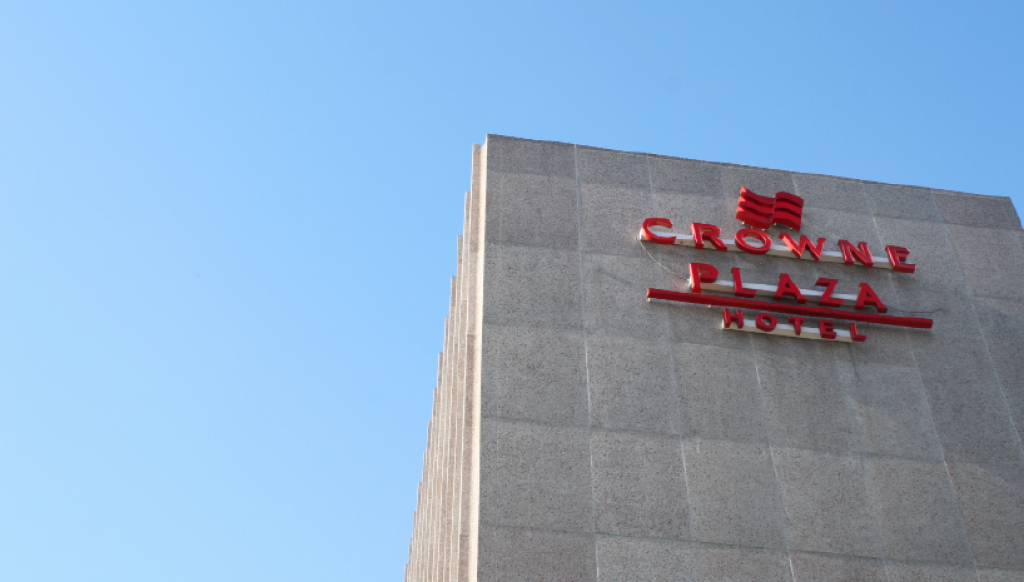
Indeed, after the period of city ownership, the hotel was upgraded and joined the Crowne Plaza chain, under whose flag it operates today. “He succeeded in keeping it open, and you have to give him credit for that,” Staub said. Or, as a more recent advisor to the city put it, “There is a Crowne Plaza and not a hole in the ground.” As far as the health of downtown Harrisburg is concerned, that seems an obvious benefit. What was the cost?

At the time of the 1998 lawsuit, Capital City Economic Development Corporation had a five-member board, most of them, like Kroboth, closely connected to city government. One of them was Richard House, the City Council president. Another was Milt Lopus, a financial advisor to the city. A third was Wilmer Faust, executive director of the Harrisburg Redevelopment Authority.

The board met each month, typically at the hotel itself, and heard reports from Staub, who stayed on as manager. Meetings were “serious, structured and professional,” Kroboth recalled, conducted according to Robert’s Rules of Order, with written minutes and formal agendas. Bruce Foreman, the corporation’s solicitor throughout the ownership period, said members would also review the progress of renovations. “It was a very old hotel and needed upgrades,” he recalled.

The renovations were a key part of the takeover’s financing plan. The hotel was reportedly in terrible shape—in the course of the former owner’s bankruptcy workout, half the rooms had been stripped of valuables. Reed’s plan, which he brought to City Council in July 1993, was to spend several million dollars renovating it, then sell it off when it turned a profit. Patriot articles at the time referred to a “market analysis” supposedly showing the hotel would break even sometime in 1995. But, according to the paper, the city treated the analysis as confidential.

The proposal was controversial. Council delayed an initial vote, after residents and local hotel owners opposed the plan at public hearings. The owner of the Quality Inn on Front Street worried about having to compete with a city-backed enterprise. In August, the CEO of another hotel company told the Patriot the Harrisburg Hotel should be shuttered immediately because of safety problems, including inadequate fire protection. But the city dismissed the concerns. “You’re going to find there are some envious hotel operators that are afraid when this is all done, the Harrisburg Hotel could possibly dip into their clientele and that’s why they’re screaming foul,” Councilman House said.

The city ultimately financed the takeover and renovation with a $10 million borrowing, in the form of bonds issued in early 1994 by the Harrisburg Redevelopment Authority. Out of the proceeds, around $3.5 million were slated for renovations, including $300,000 for a new sprinkler system, $425,000 for asbestos abatement and $597,000 for revamping rooms. Around $2.2 million went towards repaying the city, which had advanced money to HRA to buy the hotel from Aetna and to cover operating expenses while the borrowing was negotiated.

A little more than $4 million went towards costs that were only indirectly related to acquiring and fixing up the hotel. Such costs, which are present in every municipal borrowing, are important—the true price of a public project can’t be measured without them. In the case of the hotel project, the city spent $605,052 on what are called “costs of issuance,” which include things like fees to ratings agencies, financial advisors and lawyers. One of the larger payments was to Eckert Seamans, a local law firm, which received $95,000—$45,000 as bond counsel, $20,000 for organizing Capital City Economic Development Corporation, and $20,000 for the city’s agreement guaranteeing payments on the debt, plus expenses.

These indirect costs can also give a sense of a borrower’s actual assessment of a project’s risks. The confidential market analysis, according to the city, projected the hotel would become profitable in 1995. But the city also borrowed large sums as a kind of insurance in case things turned out differently. For instance, $1.5 million of the 1994 borrowing was what’s known as capitalized interest—money borrowed upfront to cover early debt payments, in this case through May 1996. Another $1.1 million was for “working capital,” to cover operating expenses while the renovations were completed. The city also borrowed $1 million for a reserve fund, to cover some of the debt in case of a shortfall.

Such borrowings are normal in construction projects, which often require a “ramp up” period before they become profitable. But, as a 2012 investigative report on the Harrisburg incinerator debt discussed, they can also result in unnecessary expense. Steven Goldfield, who worked on the audit and later served as an advisor on the city’s financial recovery team, explained why this was so. “If the construction is supposed to be done in one year, why borrow for two years of debt service?” he said. “It’s just more debt.”

As it turned out, when it came to generating enough revenues to make interest payments, the hotel needed all the time it could get. The $3.5 million renovations budget depended on an exemption from a state law requiring public projects to pay contractors the prevailing union wage. When the state deemed the hotel a public project, construction costs on the hotel ballooned. The renovations, which Staub said were originally expected to bring the hotel into the Doubletree chain, were scaled down; the city had to seek a new franchise.

In July 1995, the Patriot reported the hotel would become a Ramada. The article quoted Reed as claiming the hotel had been profitable since the previous April. But, the article also noted, the mayor and hotel officials “refused to disclose financial records for the hotel or discuss occupancy rates.” A year and a half later, in November 1996, the paper reported the hotel was running a deficit of half-a-million dollars. The city blamed the shortfall on the prevailing wage problem, which had prevented two whole floors from being renovated. In Kroboth’s recollection, though occupancy was “good” on the finished floors, the inability to charge Ramada rates on the others made it difficult to meet original projections. (The hotel, according to Staub, rented rooms on those floors at steep discounts to rail and airline employees—$30 per night, compared with the $100 the Hilton was charging.)

To solve the problem, Reed said he would seek another $3 million from City Council to finish the renovations. He brought the proposal to council in December, prompting a reproachful editorial. “That the city would put together a borrowing plan based on a hunch it could get around the law is not evidence of good management,” the Patriot’s editorial board wrote. In a subsequent critique, they urged the controller and council members to pay closer attention to the mayor’s spending. A year later, Reed backed off the plan for the additional borrowing. The extra debt, he told the paper, would have stayed on the books until 2020. Instead, he started looking for a buyer.

When the plans to sell the Ramada were initially reported, in the summer of 1998, Reed pledged the city would recoup its entire investment. The private investor, a company called Monarch, was going to pay $1 million upfront, and then another $500,000 after several millions in renovations were completed. The city would later get a share of net profits, or a share of any proceeds in the event of a sale, sufficient to repay at least the full $10 million.

As part of the 1994 borrowing, however, the city had entered a series of agreements tying up the hotel’s revenues. In June 1998, those agreements were relinquished to clear the way for the sale. This was made easier by the fact that all of the bonds had been sold to a single lender—what was then Phoenix Home Life Mutual Insurance Company. Phoenix signed off on the city’s revised guarantee agreement, releasing the hotel from its ties to the debt. Under the new agreement, the bonds were secured solely by city tax dollars.

The exposure was only temporary. That fall, Reed brought a new real estate proposal to council. The city would sell its downtown office towers in Strawberry Square to the Redevelopment Authority, thereby generating a one-time infusion of $24 million. The money would go to a variety of projects, including paying off the stranded debt from the Ramada hotel. In a memo to City Council, Reed was careful to characterize the new bonds as “self-liquidating,” meaning city taxes would never be used to repay them. In fact, he said, profits left over after operating expenses and debt service would “come to the City’s General Fund in the Year 2016 and beyond.”

In recent years, as 2016 approaches, the 1998 debt has returned to headlines. The problem is the security on one portion of the bonds—rents from Verizon, a tenant in one of the Strawberry Square towers. The company’s lease expires in early 2016, shortly before the first scheduled debt payment. In lieu of rent, the city will be on the hook for the full obligation. In September, the Commonwealth agreed to rent additional office space after Verizon leaves, relieving the city of a portion of the burden. But the city will nonetheless have to budget tax dollars to cover a majority of the debt payments, due each year through 2033.

These bonds, often referred to as the “Verizon tower bonds,” are technically separate from the ones that were used to pay off the hotel debt. Those were secured by rent payments from the Commonwealth, which had a separate lease for Strawberry Square offices through 2025. Still, it’s hard not to see them both as threads in the same elaborate quilt. Throughout 1999, City Council drew on the proceeds from both sets of bonds without distinction, paying for all kinds of “capital projects”: police sedans, fire bureau equipment, a Civil Rights History project, Verbeke St. landscaping. And Reed’s November 1998 memo, outlining a list of proposed uses for the $24 million, didn’t discriminate, either.

Capital City Economic Development Corporation still exists, though it doesn’t appear to have conducted any business for several years. Kroboth, who left the city at the end of 2013, said that to his recollection it never embarked on any other projects. In 2003, it briefly changed its name to HarrisCom, Inc., as part of an abortive enterprise involving the sale of phone lines to city entities. Wilmer Faust, the Redevelopment Authority executive director who was on the corporation board, died in 2005. Milt Lopus, the board member whose firm served as financial advisor to the city on numerous deals, including the original $10 million borrowing in 1994, the 1998 bond issue and the sale of the hotel, died in February of 2014. (Lopus’s former associate, Bruce Barnes, declined to be interviewed.)

Several months after the hotel sale was reported, Monarch and Capital City Economic Development Corporation quietly amended the agreement to reduce the city’s share of proceeds. Officials, confronted by the Patriot in 1999, said the original version was preventing Monarch from receiving financing. But, Reed said, there was still “no question” the city would recover its investment. That September, officials told the paper they’d received the last of a down payment, totaling a little more than $1 million, at least some of which had gone towards hotel expenses.

In 2000, the hotel reopened as a Crowne Plaza after $10 million in renovations. In 2003, however, Monarch defaulted on its loan. A Connecticut hedge fund specializing in distressed assets, after taking over the mortgage, bought the property at sheriff sale for $856. The city lost its investment. The hotel stayed open.


Continue Reading

Playbills and Paying Bills: Artsy types often have to get creative to make a living.

Screenshot 2015-02-22 11.29.13

Ask any artist, actor, writer, musician. It’s not easy being a creative type in a world where “show me the money” is the ongoing mantra and sunless cubicles become day jobbers’ second homes. But one has to get food on the table and, gosh, electricity would be nice.

But how does one avoid punching the clock? Well, some starving artists have worked the system by finding creative outlets by day that support their creative needs at night.

Would you believe donuts?

Yes, even donuts are creative, according to Angela Ruediger of Lemoyne, who began her business, Donut Dolly, as a way to support her theatrical itch. As her siblings toil in the traditional business world, Ruediger sells cinnamon sugar, plain sugar and “naked” mini-donuts—a treat popular west of the Mississippi.

She created Donut Dolly last year after noticing a “donut hole” at craft fairs and festivals, where out-of-towners searched in vain for the mini-donuts they loved. Ruediger now sets up shop at craft shows and festivals where her machine spits out 155-dozen mini-donuts per hour. Her competition? Funnel cakes.

This venture is a way for Ruediger to make some extra “dough” to supplement her 21 years of teaching at HACC’s York campus as an adjunct professor. At night, after papers are graded and the donut machine is tucked away, audiences have delighted in her beautiful operatic voice at Theatre Harrisburg’s summer concerts and in such shows as “Gypsy” and “A Little Night Music.”She also does some Christmas caroling at various spots in the region.

“The question is: ‘How do you feed your need to be creative and still pay the bills?’” she says. “For me, creativity often trumps the money, or I’d be way wealthier.”

Ruediger has been performing on stage for years, as has Stuart Landon of Harrisburg, who first discovered theater in an acting class when he was 8 years old. But it was in his Texas high school, where the arts were highly valued, that Landon sealed the deal on his future.

“We had four theater teachers at one point, led by a marvelous woman named Marilyn Miller,” Landon recalls. “Marilyn, who was fabulously Texan with her long nails and her big blond hair, looked at me one day and said, ‘Stuart, you can make chicken salad outta chicken shit. You need to do theater for a living.'”

Landon took the poultry reference to heart. He went on to attend the University of Oklahoma for musical theater—a school that boasted a head professor who put equal emphasis both on the art and the business of theater.

Landon never forgot what he learned and has combined art and business in the best possible way. By day, Landon wears two hats in two different places. He is the director of community engagement for the Midtown Cinema, responsible for marketing, outreach and programming. He also serves as the marketing and sales operations manager at Open Stage of Harrisburg, is an instructor for its Studio/School and gets to perform at the theater in various musicals and plays produced there. No matter which hat he wears, Landon says that theater performance has taught him collaboration skills, which he then brings to his day jobs.

“I feel that my experiences working on new theater have really shaped me as an artist and as a person and now as a manager,” he says. “There are other collaborative arts, but few involve as many minds as theater, musical theater especially.”

And Steelton resident Marc A. Faubel’s mind can never be confined inside an office. By day, he’s primarily a dad, but Faubel also owns Echo Reality Photography, a creative outlet that mushroomed from his other artistic talents.

Faubel, as they say, gets it honest. While growing up, his parents were involved in community theater, and, as a teen and beyond, he staged-managed shows.

“Growing up immersed in musicals and productions, it was sort of natural to gravitate towards wanting to be an entertainer in some way,” he says. “I, too, chose to go to college for theater/performing. I sing, I act, I write. I’m a Jack of all entertainment trades.”

Those trades include performing magic, being a DJ/general manager for Mad Hatter Production Company, and being a member of the Don’t Break The Streak improv group. That creative effort led to his photography career when a camera gifted to him proved useless to videotape the group’s shows. Instead of being discouraged, he decided to put the camera to good use. His hobby turned into an obsession, and Echo Reality Photography was born.

While it certainly is his business, for Faubel, photographs are art; they are connections and moments meant to be captured in unique and creative ways.

“Capturing those moments and suspending them forever is a very special thing,” he says. “I never realized the importance of a photograph until I had my son, Calvin. I just love the idea and ability to take one instance and preserve its beauty forever.”

You can reach Angela Ruediger at [email protected] and Marc Faubel at www.erfotos.com. 

Continue Reading

A Dress Dream: A seamstress shop has evolved into an eclectic boutique at Leaf of Eve.

Screenshot 2015-02-22 11.28.43As a teenager, Deborah String had a passion for sewing. And, despite her youth, she already had a goal in life—to open a dress shop.

“My business was named when I was a senior in high school,” she said. “I knew what I wanted to do.”

The name she had decided on was Leaf of Eve and, today, her little boutique carries an array of items from clothing to home décor, gifts, food products, jewelry, giftware, accessories and more.

To make her dream happen, String began as an apprentice to an Italian tailor named Francesco Sita. She made good use of those years, soaking in all she could learn. When she felt ready to make custom clothing for others, she began operating a business from her Harrisburg apartment.

People soon learned of String’s talent, primarily through word of mouth, although she did advertise at the VIP, the popular ‘80s club located in Harrisburg’s Strawberry Square.

“The VIP had big screens where they would flash photos and show pictures of the area,” she said. “I paid to have my model’s pictures up there, along with my logo. Everyone dressed up to go to the VIP.”

When String decided to move to a storefront on Enola’s main drag, Leaf of Eve was billed as a tailoring business.

“I started out with 1,000 square feet of sewing space and used half the building as storage,” she said.

About 14 years ago, she decided it was time to put the storage space to better use for retail sales.

“I began with embellished jackets, then started selling the slacks and skirts to go with them,” she said.

Buoyed by the reaction to the retail end of her business, String began to diversify, adding more items and traveling to wholesale clothing shows in New York and the Specialty Food Association’s Fancy Food shows to choose what to carry.

“I’m very eclectic and try to bring a variety of unique items to the area—things people don’t often see,” she said, mentioning stylish handbags from Passion, perfume and body lotion from Ireland-based Inis and a line of clothing from Clara Sunwoo.

String pointed out a colorful, flowing Sunwoo jumpsuit hanging on a mannequin in the corner of the shop.

“Kathy Lee [Gifford] wore that on her show the other week,” she said.

For food items, String rarely looks farther than her home state.

“I try to carry Pennsylvania food products,” she said, singling out Mechanicsburg-based Brittle Bark. “That was one of the first ones I picked up.”

Others products include Pepperelly, a pepper jelly made in Harrisburg, Asher’s chocolates from Souderton, and products from Bumbleberry Farms.

“That’s a women-owned business based in Somerset, and they make a variety of honey creams that are great on so many things, like toast, popcorn and cupcakes,” she explained.

Of course, String still does a steady tailoring business.

“When women come in for tailoring services, they are amazed at the selection of items for sale,” she said.

Chebonne Robison, who relocated to Delaware but often returns to visit, said Leaf of Eve is one of her routine stops.

“She carries different clothing that you can’t find anyplace else,” said Robinson, who recently purchased a raincoat from the shop and two bracelets for friends with February birthdays. “I like her jewelry, and I know if I see something that I think might fit me, Debby will guide me to the right size. So, it’s the personalized service I like, as well. Not many shops are like that.”

Sisters Tania and Abeer Srouji own Eye Candy, a Mechanicsburg-based jewelry and accessories business. They were so impressed with the boutique that they decided to pair up with String to sell their products there.

“I discovered her shop a couple years ago when a friend of mine recommended her seamstress services and was blown away—it was almost like a hidden secret,” said Tania. “When we choose where to sell our items, we try to find retailers that embody the same type of ethics we embrace. She tries to buy local and is very involved with the community.”

She also was impressed with the variety of items offered.

“She has a little bit of everything—items you don’t find at the big box stores,” she said. “That’s what makes her shop so special. She’s an entrepreneur with vision and fills her store with unique, fun stuff.”

String said she stays up to date with current trends by attending trade shows several times a year—which is something she likes.

“I enjoy selecting products that people will like and tailoring clothes that people will feel confident wearing,” she said with a smile. “And when brides come in and leave happy and give me hugs, that just makes me feel good.”

Leaf of Eve is located at 149 N. Enola Dr., Enola. For more information, call 717-732-2564 or visit www.leafofeveonline.com.

Continue Reading

Rescue Mission: For a quarter century, Channels Food Rescue has been fighting the scourge of hunger.

Screenshot 2015-02-22 11.28.30The still room beamed with the glint of stainless steel. Immaculate countertops held endless food possibilities, and huge refrigerators stored the goods and ingredients that would be turned into delicious, nutritious meals.

The staff was getting ready to serve hungry patrons who soon would tuck into what was on the day’s menu. But this isn’t a restaurant or bistro or diner—it’s a rescue.

For 25 years, Channels Food Rescue has been serving the people of Dauphin, York, Perry and Cumberland counties.

“We deliver a multilayered approach to fighting food disparity,” said Vicki DiSylvester, executive director and CEO of the organization, whose motto is “Food Is Love.” “The need in the community is unbelievable.”

One layer in this hunger fight involves preventing waste by rescuing food and delivering it to organizations that can use it. From their N. 6th Street location, Channels’ transportation personnel travel to restaurants, caterers, distributors and grocery stores to rescue food destined for the trash.

DiSylvester stresses that this is not “dumpster diving.” It is food given to Channels in good condition and meets all food safety requirements. Prepared food is accepted, but not once it has left the refrigerator for serving.

At my visit to Channels, I met Dylan Ritter and Tommy Moon. These two amiable, energetic guys had just returned from delivering bakery items, canned good and meats to the Interfaith Shelter and Lourdes House.

Both Ritter and Moon are quite familiar with the agencies that Channels serves, allowing them to deliver items where they can do the most good.

“We try to put things where they need to be,” Ritter said.

Touching Their Heart

The feeding program, Channels Care Café, offers another layer for addressing hunger. The program provides nearly 500 hot, nutritious meals a day, prepared in the impressive kitchen by a mere four-member staff.

This program, said DiSylvester, helps Channels battle food insecurity.

“It’s not only that you are hungry today, you don’t know where your next meal is coming from,” she said.

The food provided for these meals is made possible through collaborations with organizations such as WalMart and The Central PA Food Bank, among others. Distributed meals reach 11 sites, including Boys & Girls Club of Harrisburg’s three locations.

Yvonne Hollins, executive director of Boys & Girls Club, reiterated the Channels motto that “Food Is Love.”

“It truly is, because, when you are feeding an individual, you are touching their heart and soul,” she said.

She said that feeding children is so important because “children can’t produce when hungry.” They have no stamina or energy.

Mark Hawthorne, the Club’s director of operations, concurred.

“Hunger distracts every opportunity of lessons, every opportunity of attention, it distracts [from] whatever the focus is,” he said.

Screenshot 2015-02-22 11.28.23Daniel Davis, sous chef at Channels, knows about distraction.

He grew up in a difficult home environment where hunger and food insecurity were always present. His mother, addicted to heroin, left him home alone for hours at a time. From his personal experience, he says that hunger can make people anxious and aggressive.

“Knowing a meal is guaranteed takes it off your mind,” he said.

Opportunity to Succeed

Channels offers peace of mind through nutritious food, but it also broadens children’s food horizons, exposing them to unfamiliar foods.

Hawthorne recounted how, 12 years ago when the program began, children were skeptical at their first experience with new foods, such as shepherd’s pie. Now, they daily ask the question, “What are we having?”

If what they are having includes vegetables, like in many households, it’s a hard sell. Davis said getting kids to eat vegetables is a continual challenge, but Channels’ Executive Chef Scott Siquenza and Davis devise ways to increase vegetable intake, like shredding carrots in the beefy mac (shhh don’t tell!).

Davis attained his culinary skills through Channels’ Kitchen School, which affords another level of security—opportunity. The Kitchen School trains students in cooking techniques and graduates receive a ServSafe certificate upon completion of the program. Its goal, as stated by DiSylvester, is to give folks “a leg up.”

“Students learn to work hard and take that with them,” Davis said.

The school also stresses professionalism and positive work ethic, skills necessary for any work environment. Davis, whose passion for all of Channels programs is palpable, entered the school from a halfway house after spending time in prison. After graduating, he obtained his sous chef position at Channels.

He said that hunger pressures young people to “make decisions you might not be ready to make” and participate in illicit activities. He feels participation in programs like Channels Care Café and the Kitchen School can help place adults and children on successful paths.

The community can help people succeed through financial donations to Channels, volunteering and participating in one of its two major fundraising events: Cross the Globe or its annual Polo event. A willingness to volunteer as a “high-level leader,” who would be willing to plan and organize events, is especially helpful, DiSylvester said.

I began this story wanting to write about how people are rescuing food from waste. I ended it, however, with a recognition that Channels’ mission is more about feeding people so that they have an opportunity to succeed. In that regard, at Channels, people don’t rescue food; food rescues people.

For more information about Channels Food Rescue or to request a food pickup, call 717-232-1300 or contact Vicki DiSylvester at [email protected].

Continue Reading

A Taste of Romance: In all its forms, amaretto is a hint of love.

Screenshot 2015-02-22 11.31.59Amaretto di Saronno. The name almost sounds like poetry doesn’t it?

Most of us are familiar with the bittersweet amber liqueur of the same name with its rich almond flavor. Today’s amaretto is an infusion that includes the oil of apricot kernels, burnt sugar, fruits and herbs. It is often referred to as the spirit of love and romance, dating all the way back to the 16th century. Legend has it that it was originally made as a gift to a young painter from his beautiful model.

Amaretti cookies, though not made with that famed spirit, have that same bittersweet almond taste. They too are associated with romantic legend. As the story goes, a cardinal from Milan visited the little Italian town of Saronno in the early 18th century. A young couple, who were deeply in love, baked him some biscuits from sugar, egg whites and crushed almonds or apricot kernels. They wrapped the little cookies in tissue paper and presented them as a gift. In thanks, the cardinal is said to have blessed them with wishes for a happy marriage and a long life together.

I love the liqueur and the cookies and use them both in my baking. Amaretto di Saronno Originale liqueur is readily available. It is sold in a beautiful, rippled Murano glass bottle with a square cap.

Amaretti cookies, made by Bellini, can be found at the supermarket (in the “Italian section”). But, if you can, try to find those made by Lazzaroni—perfectly shaped, round biscuits wrapped in pastel tissue paper in packs of two and packed in a distinctive, red tin box. They are sold in specialty stores, Italian markets and online and are worth the trouble to find. The Lazzaroni family claims to be the sole possessor of the original cookie recipe. Authentic amaretti biscuits are crisp on the outside, chewy on the inside and sprinkled with coarse sugar.

I recently baked a chocolate amaretti cake that uses both of these Italian treats. It is called Torta di Cioccolata alle Mandorle and is a specialty of Lombardy, a northern province of Italy near Switzerland. The recipe calls for almonds, amaretti cookies and semi-sweet chocolate rather than flour. It results in a rich, dense confection, perhaps a little like a brownie. I took the cake to a friends’ house for dinner and, paired with creamy gelato, it was a hit.

Spring is coming. Celebrate the season by serving this cake for company or a romantic dinner for two. Good espresso and a little glass of amaretto liqueur on the side would be lovely. Your love affair with amaretto has begun.


Ingredients

  • 6 ounces semi-sweet chocolate (I use Hershey’s but other good quality brands will do. Just don’t use bittersweet.)
  • 1 cup almonds (skin-on almonds are fine)
  • 1 cup crumbled amaretti cookies
  • ½ cup (4 ounces) unsalted butter at room temperature
  • ½ cup sugar
  • 4 eggs
  • 1 or 2 tablespoons Amaretto liqueur
  • Cocoa powder for dusting

Recipe

  • Preheat the oven to 350 degrees.
  • Grease and flour a 9-inch, round cake pan with sides at least 2 inches high. (I used my springform pan and PAM baking spray.)
  • Break the chocolate into small pieces and place in a heatproof bowl. Then place the bowl over a saucepan that has a few inches of simmering water in it. The bottom of the bowl should not touch the water. Heat until softened, stirring occasionally. (This is not a hard step. If you have a double boiler that will work too.) When the chocolate is softened, remove from the simmering water and stir it until smooth and glossy.
  • In a food processor, process the almonds and cookie crumbs until finely ground and transfer to a bowl.
  • Process the butter and sugar until smooth.
  • With the motor running, add the eggs, one at a time, and blend well. Scrape down the sides of the bowl occasionally. Add the Amaretto liqueur.
  • Add the nut mixture and the chocolate to the food processor bowl. Pulse to blend all the ingredients together.
  • Pour batter into the prepared pan. Smooth it out a little with a spatula.
  • Bake until the center is slightly puffed, about 30 minutes. My advice is to check the cake at 20 minutes with a cake tester or bamboo stick as every oven is different. It is done when the tester comes out clean.
  • Remove the cake from the oven and let it cool on a rack for 15 minutes.
  • Remove the cake from the springform pan by releasing the sides onto a plate. If you are using a plain round cake pan, invert it onto the plate. Let the cake cool completely.
  • Just before serving, sift some cocoa powder over the top of the cake. This creates a very pretty effect. Top each serving with gelato, ice cream or sweetened whipped cream.
  • Enjoy
Continue Reading