Derby Day

May 2: Catch the ponies and see the floppy hats at Derby Day 2015, which this year migrates to Linwood Estate in Carlisle. The annual Jump Street fundraiser also features music, food and plenty of mint juleps. For more information, visit jumpstreet.org or the Facebook page: Jump Street’s Derby Day.

Continue Reading

Water Company Flushing City Fire Hydrants

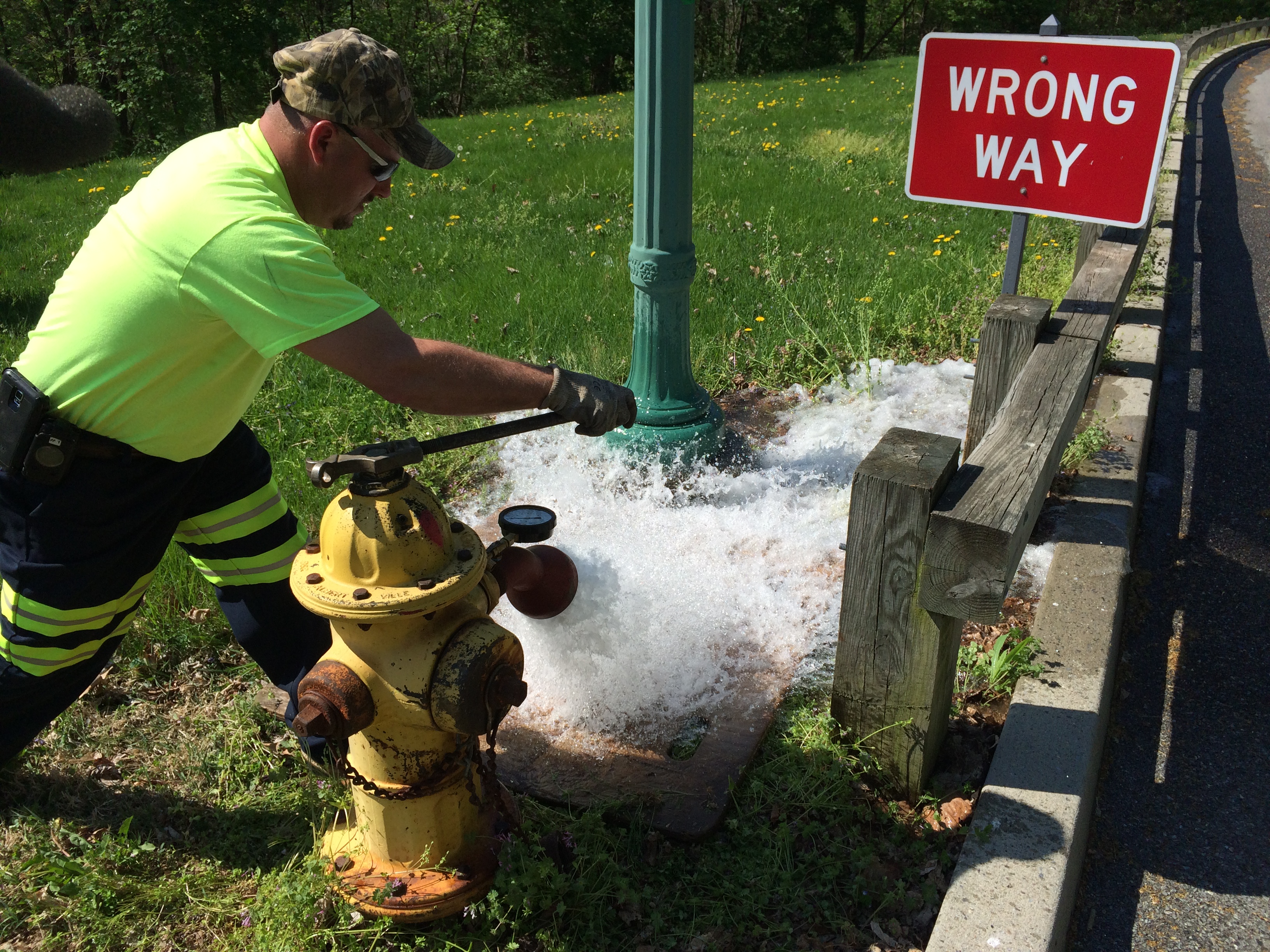
Maynard Gardner, a Capitol Region Water employee, flushes a fire hydrant Monday morning in Reservoir Park.

Maynard Gardner, a Capital Region Water employee, flushes a fire hydrant Monday morning in Reservoir Park.

Harrisburg’s water and sewer authority has begun flushing fire hydrants in the city and in other townships in the authority’s service area, as part of an annual procedure to check water pressure, look for leaks and clear dormant lines of mineral buildup.

Workers will flush all of Capital Region Water’s 1,600 hydrants over a six- to eight-week period, beginning with those closest to the city’s reservoirs and proceeding outward through the system.

The procedure can stir up debris in the pipes, meaning customers may see discolored, brownish-orange water coming from their faucets while the authority flushes hydrants near them.

The discoloration is not harmful and should clear up after affected customers run their faucets for a couple of minutes, an authority spokesman said.

The city flushes the hydrants every year, although it skipped the procedure last year because workers were overextended addressing a billing problem caused by failing batteries in water meters, the spokesman said.

Maynard Gardner, a Capital Region Water employee, demonstrated the flushing procedure Monday morning at a hydrant in Reservoir Park, checking the pressure and taking a sample of the gushing water with a small glass jar.

The water came out clear, but hydrants in areas further from the reservoirs, like Kline Village, tend to be noticeably discolored and can take up to 45 minutes to flush, Gardner said.

The procedure, which improves drinking water quality by clearing lines of stagnant water, also allows the authority to alert firefighters of hydrants that aren’t working properly. The authority covers failing hydrants with orange bags, schedules them for repairs and reports them to emergency dispatchers at Dauphin County.

Continue Reading

TheBurg Podcast, May 1, 2015

Welcome to TheBurg Podcast, a weekly roundup of news in and around Harrisburg.

May 1, 2015: This week, Larry and Paul talk about some hoop dreams on Penn Street, a mystifying exchange over Zumba at City Council, and a surprise reintroduction of tax abatement legislation…right in time for the May 19 primary.

Special thanks to Paul Cooley, who wrote our theme music. You can find his podcast, the PRC Show, on SoundCloud or in the iTunes Store.

TheBurg Podcast can be downloaded by clicking on the date above or by visiting the iTunes store. You can also access the podcast via its host page, here.

Continue Reading

Chasing the Light: In central PA, the spring season has become plein air season.

Screenshot 2015-04-29 00.53.58It’s all about the light.

Capturing sunlight and shadows is the crux of plein air art, which means, in French, “in the open air.”

Plein air painting is about “leaving the four walls of your studio behind” and experiencing the creation of visual arts in a natural setting, according to the website www.artistdaily.com.

It’s not a new idea.

Plein air art goes back centuries but became a true art form in the hands of the French impressionists of the 19th century. Their desire to paint light and its changing, ephemeral qualities, together with the creation of transportable paint tubes and a box easel, gave artists the freedom to create outdoors.

The approach of the impressionists was, at first, considered “outré, even scandalous,” said Carrie Wissler-Thomas, executive director of the Art Association of Harrisburg. “They weren’t doing finished studio pieces and weren’t painting gods and goddesses but a washer woman or people drinking in a café.”

The Joys

Locally, the annual Plein Air Camp Hill Arts Festival, now in its fifth year and to be held later this month, is one example of the popularity of outdoor art.

The festival is increasingly drawing artists from outside the area, such as Delaware resident Jim Rehak, a caricature artist who sometimes works on boardwalks and at outdoor events.

“I love the outside, the solitude,” he said of plein air.

There are, of course, challenges like wind, rain and bugs. But most plein air artists seem to see these as less significant than the joys.

Nowadays, plein air consists not only of painting but also of photography. Jim Whetstone has his own photo business, but has joined the plein air movement.

“A lot of photography is done outdoors anyway,” he said. “Part of the beauty of the Camp Hill Festival is that artists come together to share ideas and creativity.”

Don Uvick is an artistic photographer with a special interest in diner and street photography.

“I like nostalgia and focusing on structures rather than landscapes,” he said, though the latter is much more typical for plein air artists.

It’s up to April Tichenor-Holtzman to inspire younger generations of plein air artists.

An art teacher, she oversees the youth activities of the Camp Hill festival, which include a Youth Paint-Out for kids in preschool to fifth grade; Youth and Young Adult Quick Draws; and a Youth Quick Shoot for budding photographers.

“The competitions, which began five years ago, are fast becoming more regional,” said Tichenor-Holtzman. “All schools in the Capital Area Intermediate Unit can participate.”

Among the special events at the Camp Hill Festival is the Collectors Preview Party on May 29, a catered event with live music. Winners of the juried painter and photographer competitions, as well as student competition winners, will be announced.

Back to Realism

In central Pennsylvania, plein air painting actually dates back quite a bit.

It has been a hallmark of the Seven Lively Artists, a group that has been an integral part of the area’s art community for more than 50 years. Although the Lively Artists’ work encompasses a variety of subjects and styles, they are best known for their plein air passion. In addition, the Art Association of Harrisburg offers classes for drawing and painting outdoors.

“They’re intrepid,” said Wissler-Thomas of the participating artists. “They go in all kinds of weather.”

The Gettysburg Festival, entering its eighth year, includes a component called Plein Air Paintout, which takes place the first day of the three-day June event. And the Harrisburg Symphony Society Showhouse & Gardens, which bridges May and June, includes a robust plein air component.

The region also has an organization devoted to the needs of plein air artists, the Susquehanna Valley Plein Air Painters.

Julie Riker, an active member, is an interior decorator painter, doing faux finishes and murals. But, in between jobs, she loves to paint plein air, sometimes with a group, sometimes alone.

“I took classes at the Art Center and Galleries of Mechanicsburg with Earl Blust (a member of the Seven Lively Artists) and loved it,” Riker said. “I love how the subject makes the colors alive, and I love the challenge of working quickly.”

Indeed, after many years in the wilderness, painting landscapes and other outdoor subjects seems to be back in vogue.

“A lot of artists today want to go back to realism,” said Wissler-Thomas.

 
The Plein Air Camp Hill Arts Festival will be held May 29 to 31. Most festival activities take place at Willow Park, 24th and Market streets. Plein Air headquarters is at Cornerstone Coffeehouse, 2133 Market St. More information is at www.pleinaircamphill.org.

The Susquehanna Valley Plein Air Painters will paint at the Harrisburg Symphony Society Showhouse & Gardens at Lindenwood each weekend from May 23 through June 14. Visit www.harrisburgsymphonyshowhouse.org.

Continue Reading

River Beds: Historic riverfront mansions brought back to life at The Manor on Front Bed and Breakfast.

Screenshot 2015-04-29 00.42.18Michael and Sally Jo Wilson believe the “Mary K” Mansions, along the river in Uptown Harrisburg, were treasures just waiting to be appreciated.

When they decided to attend the auction of the two properties a year ago, they went “just to check it out,” Mike Wilson said. They came home with the keys to their kingdom.

“Most people would advise against making such an impromptu decision,” he said, standing in what is now a newly renovated piece of Harrisburg history.

The couple has spent the past year making the Ledgestone property at 2909 N. Front St., which they have dubbed the Ledgestone building, into a seven-room bed and breakfast as part of their master plan for The Manor on Front Bed and Breakfast. The second building, at 2917, is where the couple lives and where they plan to add more rooms for guests.

As the owner of Integral Construction, Mike had done some work on the century-old mansions in the 1980s, and he admired their historic charm and river views. But, when the couple stepped into their new project a year ago, the road ahead seemed rocky, he said.

The indoor pool in the back of the Ledgestone, protected by glass walls and ceilings, had vines growing from trees through the skylights, stretching towards the dirty water that lingered in the bottom of the pool.

The plaster throughout the entire structure had to be redone because of years of exposure to the elements as rain poured in through the roof and down the staircase, Mike said.

But thanks to good bones, the majority of the structure was safe. Mostly cosmetic work was done to bring the building back to its original glory.

Approaching the front of the bed and breakfast, guests are greeted by a bright red door. Inside, the entryway opens up to a wide staircase. To the right is a living room, where sunlight streams in through original windows and reflects off of the bright white walls. In the back of the room is a raised platform that will be used for music. The Wilsons plan to have a piano added and will host different musicians and artists for each 3rd in The Burg.

“We wanted this place to be something that the entire community can enjoy,” said Sally Jo. “It’s one thing if we had just planned to live here and keep this place to ourselves, but it’s too beautiful for that. It’s something that everyone should see.”

Across the hall from the living room is the dining room, which is attached to a kitchen that features dark stained cabinets and speckled counter tops.

On the first floor is the entryway to the pool, which will be open year-round, as well as a handicap-accessible room. Also on the first floor is a library, where the walls are covered in a rich, dark-colored wood.

“We wanted to showcase the historical significance of this building,” Mike said. “We didn’t change anything we didn’t have to.”

Up the chestnut stairs to the second floor, guests can stay in one of six rooms. Originally all attached, the rooms have been divided to provide privacy, Mike said. Two sets of rooms each share one bathroom, which is ideal for families, Sally Jo added. Throughout the home, there are five full baths and three half baths.

Two of the upstairs bathrooms feature original Pennsylvania tile, which Mike estimates would cost $80,000 to install today. From the front rooms, deep windowsills overlook the Susquehanna River below, and intricate, detailed designs are featured in the plaster, the paneling and the border of some rooms.

A large honeymoon suite in the back of the house has its own bathroom and is set apart from the rest of the rooms, allowing for more privacy.

Even the outside of the structure features unique architecture. The ledgestone walls look like stacked slate, while the sun creates beautiful shadows off of the roof. They couldn’t afford to replicate it if they tried, Mike said.

With an open house planned for May 15 during 3rd in The Burg, the couple plans to start booking rooms now for July. While other details are still being worked out, such as what will be featured on the breakfast menu, the two confess they “love food” and guests can look forward to “more than cereal.”

As the Ledgestone building progresses, the Wilsons plan to start tackling the 2917 property, which will feature four rooms and a check-in office.

“Things are coming along pretty well,” Mike said. “We didn’t have any major snags. Things went pretty well to plan. It’s just a matter of patience.”

The couple’s greatest goal is that the mansions become part of the community again. Until recently, the only life on the property was from the overgrown shrubs and trees that crowded the outside. With all of that gone, Mike said, the buildings are free to boldly greet the community, both those who pass by and those who stop to rest inside.

“It’s important to us that people can enjoy the glory of what these buildings can be,” Mike said. “They won’t be in hiding any longer.”

The Ledgestone building at The Manor on Front Bed and Breakfast, 2909 N. Front St., will be open to the public on May 15 for 3rd in The Burg. As of May 1, guests can book rooms for July. For updates and more information, visit Facebook and search for “The Manor on Front” or call 717-226-2234.

Continue Reading

House of Note: Beauty awaits the discerning eye at Lindenwood.

Screenshot 2015-04-29 00.53.44Close your eyes and imagine this: a master bedroom beyond your wildest dreams staged with a showstopper brass bed, silky shag rugs, linen-covered dressers and walls like purple onyx. Vintage blends with the new, the masculine with the glamorous.

Step outside—a sculpture garden, a flower-shaped birdbath, a 7-foot high red poppy—all combining art and nature.

At Lindenwood, Harrisburg Symphony Society’s Showhouse & Gardens 2015, you can view this transformation of a property dating back to the 1700s. The Symphony Society has been doing the Showhouse every three years, beginning with the Ashcombe house, since 1997. The much-anticipated house tour is a fundraiser to support the activities of the Harrisburg Symphony.

Karen Viscito of Karen Viscito Interiors in Mechanicsburg was in charge of redecorating the second-floor sun porch, along with that magnificent master bedroom, using her imagination to create another reality.

“I imagine my ‘client’ is a well-traveled gentleman who has been collecting items from all corners of the globe,” she says. “This is the space where he surrounds himself with all of his treasures.”

In fact, “treasures” will be everywhere as each outdoor and indoor room comes alive under the care and creativity of more than 30 talented designers using anything from stunning Japanese maples and bubbling water fountains on the outside to unique painting techniques and an antique Steinway piano on the inside.

“Lindenwood is a wonderful historic estate with many mature and natural plantings,” says landscape designer Michael D. Lehman of Mechanicsburg. “A stroll through these gardens will be both inspiring and relaxing.”

Phyllis Mooney, a co-chair for the event, attributes Lehman’s “wonderful vision” of Lindenwood’s outside design spaces for the splendor visitors will first see when they pull up the tree-lined drive.

“Michael Lehman has worked with us to choose the outdoor areas to be re-done and has helped to contact the designers,” Mooney says. “He also designs beautiful metal sculptures that will enhance any outdoor space.”

Fine and decorative artist Julie Riker of Camp Hill chose a charming, third-floor attic space with sloped ceilings and beautiful natural light for her Lindenwood “canvas.” Riker will transform the space into an artist’s studio—a decision that was quite personal yet felt so right.

“I liked that the wood floors in the room were already in very bad shape,” she says. “The plan was to carpet them, but I was able to postpone that until after the showhouse so that I could paint the floors and do some artistic ‘splattering’ suitable for an artistic space.”

Riker’s vision was one of combining the romantic with the rustic. The furnishings are a mix of primitive antiques and pieces she will paint and “age” to appear old and worn. Vintage art supplies and other objects of Riker’s inspiration will form the decorations, and she’ll have her own personal oil paintings on display in the room.

“I plan to, on occasion, do some painting in the room from a still life setup, so visitors may catch me working there,” she adds.

Riker also created a painting of the Lindenwood house and the tree-lined drive, an effort that Caren Schein, another event co-chair, calls “perfect.”

“She captures the mystery of the house at the end of the drive—not quite visible and making us all yearn to follow the drive up to the house and find out what is inside,” Schein says. “The faux painting on the wall of her room has made the room come alive, and I can’t wait to see how she will continue to transform her room into an artist’s studio.”

The Harrisburg Symphony Society Showhouse & Gardens has been called “a labor of love” by those involved. Indeed, it brings together many groups and individuals from the community to help raise funds and awareness for Harrisburg’s own symphony orchestra.

“My favorite parts of this year’s showhouse were working with two amazing co-chairs and our committees for about 1 1/2 years to finally see the work that is being done, then our successful empty house tour,” says Debra Yates, the third event co-chair. “Then seeing the house come alive with the designers, electricians, plumbers and all types of landscapers and master gardeners, who came together towards making the dream a reality.”

Harrisburg Symphony Society Showhouse & Gardens runs May 22 to June 14 at Lindenwood, 210 E. Lisburn Rd., Mechanicsburg. For more information and to purchase tickets, visit www.symphonyshowhouse.org or call 717-612-4970. Tickets are $18 pre-sale and $20 once the Showhouse opens. 

Continue Reading

Back to Its Roots: The world’s best quaffs, a stunning setting for the Harrisburg Wine Festival.

Screenshot 2015-04-29 00.49.21For Harrisburg wine-lovers, this month will be a special one indeed. For the first time since 2006, the Harrisburg Wine Festival is returning to the capital city.

Since the festival started, I’ve attended every year, save one. Personally, I believe it’s our area’s most significant annual wine event and, for fans of the grape, not to be missed.

To get some background on this year’s festival, I spoke with Colleen Jones, expo manager for Journal Multimedia, which is organizing the event on behalf of the Pennsylvania Liquor Control Board.

For years, the festival was held at the Giant Center in Hershey. While the venue had plenty of room, it was more of an atmosphere of a sporting event than a presentation of a beverage that people write poetry about.

It next was held at the Antique Automobile Club of America Museum, which, in my opinion, was cozy and had an interesting vibe. However, I felt it was too cramped for the thirsty crowd.

Colleen told me that, at a planning meeting at the PLCB offices, someone looked out the window across the street to the State Museum of Pennsylvania and wondered about its suitability. After inquiries, the decision was made to have it in this masterpiece of mid-century modern architecture, which, this year, celebrates its golden anniversary.

The festival will be three-tiered this year. The VIP Tasting will start at 5 p.m. and will feature more than 50 wines that are not available to other tasters, such as several super Tuscans, vintage ports and some of the best wines that California has to offer. The Grand Tasting will follow at 6:30 p.m., featuring the variety and quality that attract wine-lovers each year.

This year, for the first time, the Chairman’s Select Seminar will be hosted by the chairman himself, Steve Pollack. The seminar will give folks an opportunity to taste wines that will emerge in stores in a few weeks. Tickets must be bought in advance, and the seminar starts at 5:30 p.m. in the Allegheny Room.

Colleen and I also discussed the food for the festival, as wine and food are natural mates. Honestly, I was a little concerned about who would cater the event. This may sound trite, but long-time festival-goers may remember the switch from the original festival site at the Harrisburg Hilton to the Giant Center. So, I was very glad to hear that the Hilton once again is on board, with the hors d’oeuvres coming from the kitchen of the newly opened Ad Lib Craft Kitchen & Bar.

There is another aspect to this grand event, the on-site silent auction to raise money for the Patient and Family Centered Care program at Penn State Hershey Children’s Hospital. Colleen pointed out that many families arrive at the hospital totally unprepared for an extended stay. So, a portion of every festival ticket sold will go towards benefitting these people in their hour of need.

I hope to see you at the festival. If you spy my nametag, stop by, and we’ll share some wonderful wines.

Keep sipping, Steve.

The Harrisburg Wine Festival takes place May 8 at the State Museum of Pennsylvania, 300 North St., Harrisburg. Tickets start at $75 per person. There will be free parking at the South Street garage, 220 South St., a short walk to the museum. For more information, visit www.harrisburgwinefest.com.

Continue Reading

Love Is the Key: Harrisburg troubadour Josh Krevsky pursues his musical journey.

Screenshot 2015-04-29 00.53.00Josh Krevsky has been singing for as long as he can remember. In fact, some of his earliest memories are singing along with his parents’ records.

“Props to my parents for having an incredible record collection,” the Harrisburg-based singer-songwriter said. “Very eclectic.”

He credits them for laying the foundation for a solid appreciation of music: The Beatles, Fleetwood Mac, Sinatra, Eric Clapton, Bruce Springsteen.

“Then I heard Green Day and R.E.M. and No Doubt,” Krevsky recalled. “And then Nirvana and The Counting Crows, these last two were game changers.”

When he was 15, Krevsky got his first guitar and almost immediately began writing his own music. He didn’t add lyrics at that point, just worked through melodies and chords. He still writes songs in that same order: melody, then lyrics.

“As I played more guitar and put together more melodies, I began to experiment with adding some verses and chorus,” he explained. “Slowly but surely, I started to find a structure from which decent songs were emerging…at least I thought so.”

Krevsky began playing those songs for his friends and family, then at open mic nights, then started booking solo shows.

“The more I wrote, the more I played, and a repertoire soon developed,” he said.

But, like most musicians starting out, Krevsky played a lot of covers in addition to his original tunes, an experience that he retrospectively values.

“When you’re getting started playing live shows, cover songs are part of the deal,” he explained. “When I was learning how to play guitar and sing, covers were the vehicle in helping me eventually find my own style and sound.”

He’s been honing those songwriting skills over the past several years and now is putting the finishing touches on his first solo EP.

“This collection of songs has great meaning to me and chronicles some of the greatest and worst experiences in life thus far,” Krevsky said. “The therapeutic power of that has been profound. Plus, no one else can ever say they wrote those exact same melodies with those exact same lyrics.”

In recent months, he’s shared the results of some of his musical journey at local venues like HMAC Stage on Herr, Midtown Scholar Bookstore and Little Amps, all in Harrisburg, and Battlefield Brew Works in Gettysburg.

“Even if no one else in the world liked a single song I wrote, there’s still something amazing about that accomplishment,” he continued. “The joy and fulfillment that brings me is more than any cover song performance can ever deliver. And it just makes me hungry to write more and more and more.”

When I asked Krevsky what sorts of things inspire his music, he gave me a one-word answer: “Love.”

Then he elaborated.

“I could give you some long, drawn-out answer, but all other answers eventually lead there anyway,” he said. “Whether it’s family, friends, women, work, God…anything. Love is the key to it all.”

You can hear samples of Josh Krevsky’s music on his ReverbNation page, www.reverbnation.com/joshkrevsky. Keep an eye his Facebook page, Josh Krevsky Music, for information on his EP release.


Continue Reading

Vine Vision: As Bucks Valley opens, Mike Pelino completes a journey from goal to glass.

Screenshot 2015-04-29 00.41.47It wasn’t long ago that refugees from the city, tired of what they did each day, wanted to burst out of the daily grind and start a Christmas tree farm in the country. A few years later, those same desk jockeys dreamed of running a bed and breakfast. Now, the fad seems to be starting your own winery.

But what is that like? Is there a gap between the romantic vision of clinking glasses with guests in your own wine cellar and the sober reality of actually creating a winery?

Mike Pelino knows. Early this month, he will open Bucks Valley Winery & Vineyards just outside of Newport. The opening marks an exciting, sometimes excruciating, often exhausting trek that required not just vision, but years of learning, hard work and small, relentless steps forward.

Getting Started

Mike wasn’t exactly raised with a vine clipper in his hand.

He’s a Penn State graduate, holds a degree in electrical engineering and has spent the past 30 years traveling the country and the world installing and repairing MRI scanners. Years ago, he began making wine and brewing beer at home, which is how he got bitten by the winery bug.

“After buying the farm in 2000 and toying with the idea of raising grapes, I finally decided to start a vineyard in 2006,” he said. “Being an engineer is not a bad thing, but it seems that being a vintner is much more fun.”

Mike already had learned a great deal from his hobby, but knew that starting a winery would require much more education. So, he enrolled in several enology (wine-making) courses, learning about subjects such as advanced winemaking, packaging and regulations. He sat in numerous seminars and conducted hundreds of hours of research.

“I went to grape-growing seminars in Maryland and Virginia to learn how to select and prepare a site for grapes,” he said. “Also, I needed to know what kinds of grapes would do well with our winters and rainy, humid summers.”

It took him a year to prepare the soil before he could plant a single vine.

“Adjusting pH, nutrients, biomass and testing for nematodes (ground bugs that eat roots) kept me on my toes,” he said.

Mike found that establishing the trellis system for the vineyard was labor intensive. He installed a tractor-trailer load of posts and ran eight miles of wire.

“After the first planting, I realized how much deer enjoy grape vines, so I enclosed the 10 acres with a six-wire electric fence,” he said.

Eventually, Mike planted seven varieties of grapes.

“Growing the grapes allows me to control the final product,” he said. “There’s a popular saying in the wine industry that ‘wine is made in the vineyard,’ and it couldn’t be more true. It starts with choosing the site, then the root stock selection, and finally installing a trellis system and ensuring proper canopy management.”

A Winery Rises

Mike first met with his builder in April 2013.

“I picked a scenic location on top of a hill next to the vineyard,” he said. “To get to this location, customers would need a new driveway about one-eighth of a mile long.”

Building the drive went smoothly until the last 30 feet where the ground became solid rock.

“One-hundred-twenty holes needed to be dug 10 feet deep,” Mike said. “Then we packed the holes with explosives and, boom, I ended up with 80 truckloads of pulverized rock, which became the base for my parking lot. Getting power service to the winery building from the road required over 1,000 feet of underground wire.”

Construction planning for the winery was long and challenging, but Mike didn’t want to cut corners. The winery is energy efficient with geothermal heat, LED lighting, UV EF windows and high-R-value insulation.

At about the same time, he attended the Eastern Wine Exposition to meet with vendors and obtain more information on the equipment he would need to produce the wine.

“Equipment like stainless steel tanks and large presses needs to be ordered six to nine months in advance,” Mike explained. “Almost all of my equipment is Italian, so the vendor takes orders at the exposition in the winter months, then has it shipped from Europe for delivery in the summer before harvest begins.”

Red Wine, Red Tape

Besides growing grapes, building the winery and buying and setting up his equipment, Mike had to receive permissions from various levels of government.

Winemakers must work with both federal and state agencies, including the Department of Agriculture, the Food and Drug Administration, the Occupational Safety and Health Administration and the Pennsylvania Liquor Control Board (PLCB). They all seemed to have different requirements, so he was never quite sure what to expect.
The Alcohol and Tobacco Tax and Trade Bureau (TTB) is a federal agency that collects an excise tax for each gallon of wine he sells. They also have to approve each type of label that Mike uses before he bottles the wine.

“It took 30 days to receive a password so I could submit my labels for them to review,” he said. “After submitting the labels, it took an additional 20 days for them to be approved. After approval, it took another two weeks to have the actual label printed. This put me behind more than 60 days before I could start bottling wine.”

Gathering all of the information the TTB and PLCB required for his Limited Winery License took hundreds of hours and resulted in a mountain of paperwork. In the end, he was able to get it all completed.

The paperwork, of course, is just a small part of Mike’s challenges. Then there’s the actual growing of grapes and making of wine.

Here’s how Mike described the process for one of his favorite grapes, traminette, which produces an aromatic, spicy off-dry wine with a white pepper finish.

“I choose a site, test and adjust soil and plant vine root stock on a trellis system. Next, I begin pruning vines in February, initiate a spray schedule at bud break, start scouting for harmful insects and disease, position shoots until they reach the top wire, start shoot-thinning and pulling leaves in the fruit zone to allow sun exposure. This develops monoterpenes in the grape and is usually done three times throughout summer. I pick the grape at proper pH levels, press the grapes, ferment slow and cold with proper yeast, age, filter and bottle.”

Clean Finish

Opening a winery is especially tricky because of the nature of wine.

White wines can be consumed about six months after harvest, but dry reds need more time to develop, from 12 to 24 months. So, once you get approval from the TTB and PLCB to make the wine, you’re looking at a six- to 12-month period before you can actually start selling it.

To promote his new business, Mike plans to advertise locally and attend wine festivals. He hopes to be included on two local wine trails, the Susquehanna Heartland Wine Trail and Hershey Harrisburg Wine Country. In addition, Mike will use social media to keep people informed about current and upcoming events.

He also hopes to open a microbrewery at some point in the future. The beer would be brewed in small batches with a wide range of flavors throughout the year.

“Because beer is best fresh, unlike wine which needs to be aged, I could brew and have two different types available each month on tap only,” Mike said.

To top it all off, Mike has a commercial, gas-fired pizza oven so his customers will be able to enjoy pizza and artisan breads with their wine. He is planning to build an outdoor pavilion with a wood-fired pizza oven.

So, if you think starting a winery is easy, you’d better think again. If you think it can be exciting and rewarding, just ask Mike.

Bucks Valley Winery & Vineyards is located at 333 Meadow Grove Rd., Newport, just one mile off the Midway exit of Route 322 West in Perry County. The grand opening is slated for May 2. For further information, call 717-514-6152 or check out their Facebook page: Bucks Valley Winery & Vineyards.
 
Don Helin published his first thriller, “Thy Kingdom Come,” in 2009. His recently published novel, “Devil’s Den,” has been selected as a finalist in the Indie Book Awards. His latest thriller, “Secret Assault,” was published in November. Contact Don on his website, www.donhelin.com.



Continue Reading

A Fish Adventure: The head and eyes weren’t a problem; the scales were.

Screenshot 2015-04-29 00.50.23I have always wanted to learn how to cook a whole fish. I’ve seen them served in restaurants many times, usually with a flashy server fileting at the table. A Harrisburg (and husband) favorite is the salt-encrusted rainbow trout at the Firehouse Restaurant on N. 2nd Street. It is a long-time menu offering there.

I’m always mesmerized by the beautiful magazine photo layouts of whole fish like snapper, branzino or sea bass roasted to perfection and garnished with lemons and fresh herbs.

So I wondered—how hard could it be? I’ve prepared a great variety of dishes in my “cooking career.” But could I get by those sad fish eyes and actually cook a whole fish?

I started with Kepler’s Seafood, my regular seafood and fish vendor at the West Shore Farmers Market. From time to time, I’d seen whole fish in their case, usually red snapper or small porgies. I asked if it was possible to place an advance order for a whole fish that would serve four and was told “yes,” even a branzino if it was available during their weekly trips to Baltimore.

So, I dove right in (thinking of friends who would be up for the adventure) and ordered two whole red snappers about two pounds each. Mr. Kepler assured me that he’d clean and gut them, but advised against removing the scales for a better photographic effect. I did regret that decision. Leaving the scales intact meant that we couldn’t slice across the fish later. It was like a little coat of armor. We had no choice but to filet them.

The big day arrived, and my snappers were waiting for me at the market. I brought them home and let them rest in the refrigerator before I began the prep. When I could put it off no longer, and Megan Davis from TheBurg arrived to photograph the “festivities,” I unwrapped the fish and decided I was just fine with the heads, tails and sad eyes.

I rinsed both fish under cold running water, making sure to open the pockets and flush them well. Then I swaddled them in lots of paper towels and dried them. I decided on a recipe in an old cookbook of mine called “Savoring Italy.” It called for sea bass, but I thought that my snapper would work just as well. I stuffed the fish cavities with lots of fresh herbs and lemon slices and coated the exteriors with good olive oil, fresh lemon juice and sea salt.

Our guests arrived at the appointed time armed with a sharp boning knife and a cold Muscato wine. We were ready for our Mediterranean feast (or disaster?). I put the fish into a pre-heated, 425-degree oven for about 40 minutes. I had prepared green beans dressed with olive oil and seasoned breadcrumbs and roasted, thick, yellow-gold potato slices with rosemary and black olives to go with the fish. They were good choices.

Screenshot 2015-04-29 00.50.32When the fish were golden brown and flaky, we took them from the oven and began the process of fileting, or perhaps a better word would be dissecting. Because the fish were still covered with scales, it was impossible to cut through the flesh. So, our friend Arnie delicately lifted the skin away and pulled pieces of fish from the cavities. It wasn’t easy, and we ended up with chunks of fish rather than filets or slices. But it was wonderful: sweet, moist, not the least bit “fishy.” The dinner was lovely, and our friends reported that the leftovers made great fish tacos the next day.

We all had a new adventure that night and agreed that we should do it again, maybe on the grill on a warm summer night. But the scales must go.

Ingredients

  • 2 whole fish about 2 pounds each, dressed with heads and tails intact and a pocket cut into the fish belly
  • 2 tablespoons chopped Italian parsley
  • 1 tablespoon chopped fresh marjoram or oregano, or other herb of your choice
  • 6 tablespoons good olive oil
  • 2 tablespoons fresh lemon juice
  • Salt and freshly ground pepper to taste (sea salt is nice)
  • 2 lemons sliced


Recipe

  • Rinse the fish under cold running water, making sure to open the pockets and wash them out as well.
  • Dry the fish with paper towels, stuffing some into the pockets.
  • When the fish are completely dry, pour the freshly squeezed lemon juice into the pockets and over the outside of the fish.
  • Chop the parsley and the herbs, place them in a small bowl, and mix with the salt and 4 tablespoons of the olive oil.
  • Place the herb mixture and some of the sliced lemons into each fish pocket.
  • Pour the remaining 2 tablespoons olive oil over the outside of the fish, sprinkle with a little more salt, and top with the remaining lemons.
  • Roast the fish for about 40 minutes in a pre-heated, 425-degree oven. Roast a little longer if needed until the fish flakes and the outside are golden brown. Timing will depend on the thickness of the fish.
  • With a very sharp knife, remove the skin and bones as gently as you can and place the fish on a platter. (We tried to follow an Internet video but this definitely takes some practice.) Garnish with a few sprigs of fresh herbs if you have some left.
  • Open several bottles of white wine, and imagine for a few minutes that you are in a little trattoria along the Mediterranean Sea.
Continue Reading