Tired Teens: Rest assured, adolescents need solid sack time.

Screenshot 2015-06-01 08.34.35Parents often focus on making sure young children get enough sleep, but not as much for teenagers. Frequently, teens and their parents come to see me due to concerns about excessive tiredness. Inadequate sleep is often found to be the cause.

A 2006 poll by the National Sleep Foundation showed that 75 percent of 12th-graders (as opposed to 16 percent of sixth-graders) receive less than eight hours of sleep per night. One of the objectives of “Healthy People 2020,” goals set by the U.S. Department of Health and Human Services, is to increase the percentage of children in ninth through 12th grade who get sufficient sleep. The National Sleep Foundation recommends more than eight hours per night.

Besides your teen telling you that she is tired, other signs that your teen is not getting enough sleep include having trouble waking up in the morning, napping during the day, sleeping in for more than two hours on weekends and frequently drinking caffeinated beverages.

Why is sleep important? An obvious answer to this question is that, when we do not get enough, we are tired. This tiredness, as well as other changes that occur with lack of sleep, can greatly affect the lives of teenagers. Studies have shown teenagers who slept less than the recommended eight hours per night were more likely to be involved in car crashes, have decreased academic performance, report higher levels of depression and stress, have worse control over chronic illnesses such as asthma, and have a higher risk of obesity.

How can we improve our teenagers’ sleep?

Part of the lack of sleep in this age group is related to puberty. During this time, circadian rhythms shift to make teens want to stay awake later in the evenings and sleep in longer in the mornings. This change in sleep schedule is not possible due to early school start times. Often, teens will sleep in longer on weekends, but this shifts their circadian rhythm further and makes it difficult to fall asleep on weekdays and maintain a good sleep schedule.

Improving sleep hygiene is another effective way to get better sleep. Sleep hygiene consists of habits that help sleep. Using a bed only for sleeping, not for eating, reading or other activities, helps to decrease the amount of time it takes to fall asleep. Other behaviors that help improve sleep–but are hard for today’s technology-driven teen–are stopping the use of electronics (cell phones, computers, tablets, televisions, video games, etc.) one to two hours before trying to fall asleep and never using electronics in bed.

Limiting caffeine intake and controlling other medical and psychological conditions will also improve sleep and decrease daytime sleepiness in children.

If you think your child is having trouble sleeping, be sure to discuss this with your pediatrician.

Dr. Brittany Ann Massare is a pediatrician with Penn State Hershey Medical Group.

Continue Reading

May News Digest

Mayor’s Slate Victorious in Council Primary

Three candidates endorsed by Mayor Eric Papenfuse won nominations last month for four-year terms on Harrisburg City Council.

Incumbent Jeffrey Baltimore and challengers Cornelius Johnson and Westburn Majors emerged victorious in the Democratic primary for three council seats. Challenger Destini Hodges tallied the most votes for the lone two-year seat.

No Republicans ran in the primary, meaning the winners of the Democratic primary will be strongly favored in November’s general election.

Moreover, Papenfuse vocally denounced incumbent Brad Koplinski, pleading with residents to vote against him. Koplinski placed fourth, losing to Majors by just 18 votes for the nomination for the final four-year seat.

“This is a big night for Harrisburg, absolutely phenomenal,” said Papenfuse after the final votes were reported. “I’m elated that we’re finally going to get new leadership to move the city forward.”

Primary results were as follows: Johnson, 1,474; Baltimore, 1,429; Majors, 1,257; Koplinski, 1239; Ellis “Rick” Roy, 1,048; Rhonda Mays, 760; Jeremiah Chamberlin, 719; Ron Chapel, 332; Koscina Lowe, 226.

In the race for city treasurer, Tyrell Spradley defeated challenger Brian Ostella by a count of 1,279 to 1,221. Council appointed Spradley last year to fill the unexpired term of former city Treasurer John Campbell, who was arrested on theft charges.

For Harrisburg school board, Jennifer Smallwood, Monica Blackston-Bailey, Matthew Krupp and Melvin Wilson Jr. won nominations for four-year seats. At press time, Daunessy Penn and Lionel Gonzalez were tied for the final four-year slot, each with 1,159 votes. Judd Pittman defeated LaTasha Frye for the nomination for the sole two-year seat.


Tax Abatement Plan Passed

Harrisburg City Council last month narrowly approved a 10-year tax abatement ordinance that many had considered dead.

By a 4-3 vote, council members passed a plan that would provide full tax abatement on residential property improvements and new construction in Harrisburg for 10 years.

“For the first time ever, we have 100-percent tax abatement,” said Mayor Eric Papenfuse. “Before, there wasn’t enough of an abatement (to promote development). This is a stronger, more powerful LERTA.”

Council twice before had failed to pass the administration’s plan for the Local Economic Revitalization Tax Assistance (LERTA) program.

Councilman Brad Koplinski last month introduced his own LERTA plan, a program that would have diminished the tax abatement by 10 percent a year over 10 years. However, a council majority opted instead to re-introduce and pass the administration’s plan, along with certain responsible contracting provisions.
“I was totally shocked,” said Papenfuse. “I didn’t see this coming, but it’s great for the city of Harrisburg.”

The LERTA ordinance now must be approved by Dauphin County and the city school board, which are the other entities in Harrisburg that tax property.
Veno Announces Departure

Gene Veno, the state’s chief recovery officer for the Harrisburg school district, said he would step down at the end of June.

In December 2012, Veno was appointed to help revive the struggling, debt-ridden district. Several months later, he presented a five-year plan that he hoped would lead to a financial and academic revival.

Since then, the district has been in financial surplus, due to a combination of tax increases, school closures, staff layoffs and the discovery of millions of dollars that had been kept off the books. Academically, however, the district’s performance has deteriorated further.

Veno said he was departing to focus more on his consulting and lobbying firm, Gene Veno and Associates.

Last year, Harrisburg Mayor Eric Papenfuse asked the state to remove Veno, claiming he was too focused on financial, not academic, improvement.

As of press time, the state Department of Education had not announced a replacement for Veno.


Comprehensive Plan Team Named

Harrisburg last month awarded a contract to a consulting team for the first update in more than 40 years to its comprehensive plan, a document that will guide development across the city for the next two decades.

The $200,000 contract went to a team led by Bret Peters of the Harrisburg-based Office for Planning and Architecture and that includes designers, planners and engineers from both local and global firms.

Mayor Eric Papenfuse and city planner Geoffrey Knight said the update was long overdue and would help speed the city’s recovery.

Papenfuse described the plan as “the vision of the residents and the business owners and the stakeholders and everyone who has a stake in Harrisburg and its future development.”

The mayor added that he expects the plan to be ready for formal approval in April 2016 and that it will probably result in a revision of the city’s zoning code.

Knight said the plan, when finished, would overhaul an existing comprehensive plan dating back to 1974.

“So we’re in arrears by about 20 years with updating and adopting a new one,” he said.


Moose Lodge Conversion OK’d

The landmark Moose Lodge Temple in Midtown Harrisburg took a step closer to revival and reoccupation last month, as the city’s Zoning Hearing Board approved a plan to renovate it as mixed-use space.

The board unanimously granted a variance to WCI Partners LP for 33 apartments on three upper floors with commercial space on the ground floor. WCI needed the variance because the size of the apartment units, about 500 square feet apiece, is less than the 1,200-square-foot size permitted under the zoning code for the 900-block of N. 3rd Street.

WCI President David Butcher assured the board that the apartments, while small, would have high-end finishes that would appeal to young professionals. He estimated that the units would rent for around $1,000 per month.

WCI is purchasing the four-story building at the corner of N. 3rd and Boas streets for $900,000 from Atlanta-based Mosaica Education, a for-profit charter school company that is in receivership.

The purchase includes several adjacent parcels of land—three dilapidated townhouses and a 40-vehicle parking lot. Butcher said that WCI also plans to renovate the townhouses into apartments and retail space and would landscape the area around the parking lot to make it more attractive.

Harrisburg City Council now must approve WCI’s land use plan. If all goes smoothly, the project should start by the end of summer with completion expected in 12 to 18 months, said Butcher.

For five years, the former Moose Lodge housed the Ronald Brown Charter School. However, the building has been empty since 2005, when the school district’s board of control refused to reauthorize the school’s charter.

The Harrisburg Moose Lodge Temple was built in 1924, designed in the Beaux Arts style by renowned Harrisburg architect Clayton J. Lappley.
 
Disclosure: Alex Hartzler, publisher of TheBurg, is a principal with WCI Partners.
 
 
Changing Hands

Benton St., 634: 8219 Ventures LLC to S. Jawhar, $32,000

Briarcliff Rd., 135: J. & J. Lawrence to A. Sawyer, $215,000

Briggs St., 207: PA Deals LLC to S. & K. Plummer, $90,000

Brookwood St., 2424: G. & M. Tipton to R. Patterson, $70,000

Capital St., 911: K. Dolphin to B. & A. Lentz, $171,000

Chestnut St., 1925: J. Harbilas to J. Munoz Tineo, $45,000

Cumberland St., 1322: D. & D. Oswandel to E. Brinkman, $109,900

Cumberland St., 1416: T. Lewis to Full Harvest Ministries, $80,000

Division St., 609: D. Miller to G. Barone & L. Ambrosino, $90,000

Edgewood Rd., 2309: W. & N. Robinson to M. Cool & J. Smith, $162,000

Emerald St., 405: P. Dobson to G. Venable, $40,000

Fulton St., 1710: Cartus Financial Corp. to W. Fletcher & K. Cropper, $97,872

Green St., 1819: K. Livingston to N. Fickes, $105,000

Green St., 3212: R. Darr to E. Griffin, $55,000

Hale Ave., 426: M. & J. Williams to Gandy Real Estate LLC, $40,000

Kelker St., 500: Hamilton Health Center to Ministerio Nuevo Renacer, $65,000

Logan St., 2446: PA Deals LLC to M. & J. Sather, $104,300

Melrose St., 1029: S. & J. Wydra to W. Hocker, $35,000

North St., 244: E&S Properties LLC to K. Bryner, $161,000

North St., 1719: G. & M. Ramsey to K. Siddal & D. Cook, $35,000

N. 2nd St., 515: M. & B. Habib to Candlelight Properties LLC, $625,000

N. 15th St., 1617: Ajaz Uddin Inc. to T. Sweet, $35,000

N. 16th St., 911: E. & J. High to M. McManus, $82,500

N. Front St., 1525, Unit 404: R. & R. Fried to J. Kelley, $210,000

N. Front St., 1525, Unit 613: J. Wirick to Pact Enterprises LLC, $108,000

Peffer St., 220: R. Scarabello to G. Cudaback & S. Cox, $190,000

Rudy Rd., 1944: V. Kelly to V. & S. Reyes, $66,900

Showers St., 616: J. Forr to S. Clearfield, $112,000

S. 13th St, 1530: M. Watson to W. Okello, $58,000

S. 19th St., 1340: PA Deals LLC to S. Orr, $81,000

S. Front St., 623: D. Sullivan et al to G. Schwab, $117,500

State St., 231, Unit 401: LUX 1 LP to S. Sehar, $164,900

Susquehanna St., 1724: Fannie Mae to B. & E. Burchfield, $35,000

Swatara St., 2101: T. Sweet to R. Gonzalez, $55,000

Swatara St., 2224: H. Romanovicz & W. Shade to L. Ho, $105,000

Wyeth St., 1412: J. Cruz to PA Deals LLC, $82,000

Continue Reading

The Good Intentions of “Yes”: Women’s group combines comedy with cause.

Vicki Fox, photo by Meredith Kaminek

Vicki Fox, photo by Meredith Kaminek

When all-around funny person Jennie Adams, a member of the improvisation group No Artificial Sweeteners, was contacted by Vicki Fox, founder of Women of Intention (WOI), the request seemed simple enough—put on a performance for an upcoming WOI event.

When Adams explained that the group only performs at charitable fundraisers and was not for hire, Fox offered more details that changed Adams’ mind. Her event was to help the C.A.R.E. Program at Allison Hill Community Ministry so that the group could receive much-needed funds. That new bit of information and the now resounding “yes” from Adams sealed the deal.

No Artificial Sweeteners is an all-female, all-volunteer improv group that has put on shows in the past to benefit organizations such as the PA Breast Cancer Coalition, Caitlin’s Smiles and The MakeSpace. WOI is a community of women committed to changing the world. When the two merge, you get an evening of hilarity, connection and support for everyone involved, but particularly for a local after-school program that serves about 30 Allison Hill children, providing them with meals, tutoring and field trips.

“When Vicki called, I couldn’t say no,” Adams recalls. “The match-up was just too perfect.”

Fox couldn’t agree more. She’d been looking to create another entertaining evening for her group of women but, at the same time, wanted to extend her reach to help the local community.

“I believe women are the change agents making this world a more humane planet,” Fox says. “We are the ones who tend and befriend and are mindful of the generations that will follow. In order to be able to give, a trait that women excel in, we have to have something to give. In order to nurture, we need to nurture, replenish, rejuvenate and refresh ourselves. What does that better than laughter?”

Improv comedy, as many know, is an unscripted, seat-of-your-pants art form where the actors create characters, dialogue and story as they go. It’s edgy and scary for the people on stage; it’s refreshing and fun and in-the-moment for audiences. The mantra that improv comedians follow is “Yes, and…”, meaning they accept and go with any scenario they are presented with and, in a sense, jump into the comedic fire with everything they’ve got.

While comedy was not Fox’s objective when she organized WOI in 2006, most of the other descriptions of improv probably apply as to why the group exists in the first place. It was at her 55th birthday party attended by 38 female friends where she asked each to share their intentions. They did so with such passion, Fox recalls, that she sought to continue that intention-sharing experience—thus the name Women of Intention, whose tagline is “Ordinary Women Making an Extraordinary Difference.”

In a way, Fox’s journey headed toward that improv rule of “Yes, and….” Saying “yes” to coming up with the idea of WOI, going with her gut, and creating events where like-minded women—teachers, doctors, activists, artists, entrepreneurs—are nurtured, informed and connected and where they give to each other and to others.

So women making other women laugh for a good cause? Yes, and…it all makes sense.

“No Artificial Sweeteners proved my point of how women find it natural to come together to make the world a better place,” Fox says. “While they perform in different troupes, they feel drawn to gather in supporting each other and donating their time and energy to support causes that improve our community. It will benefit the WOI women because not only will we be having an evening filled with laughter, camaraderie and fun, we will have the joy of knowing we are helping people in our local community.”

The Women of Intention benefit for the C.A.R.E. Program at Allison Hill Community Ministry will take place on Thursday, June 18, 6:30 p.m. to 9:30 p.m., at Passage to India Restaurant, 520 Race St., Harrisburg. For more information and registration, visit www.womenofintention.com.

Continue Reading

Editorial Judgment

Screenshot 2015-04-29 00.39.37Screenshot 2015-04-29 00.38.51

Cornelius Johnson and Westburn Majors, two of the victors in the recent Democratic primary for Harrisburg City Council.

In the Burg Blog, I’ve written previously about my distaste for editorial boards and professional editorial writers.

My dislike has nothing to do with certain individual columnists or newspapers. I just find it confounding and presumptuous that people, sitting in an office building somewhere, can cast judgment on issues that they’ve never covered and really know little about.

They’re not at the meetings; they don’t witness the often-subtle dynamics between the players; they don’t interview anyone; chances are, they rarely even step foot in the places (like Harrisburg city hall) they’re writing about.

How can you have an informed opinion about something in which you have such limited knowledge? Yet, there they are—people whose main job is to have opinions about stuff. How strange.

That thought occurred to me again the other day when PennLive’s editorial board weighed in on Harrisburg’s recently concluded primary election. The rather sloppy editorial seemed to suggest that Harrisburg Mayor Eric Papenfuse, in alliance with businessman Alex Hartzler, unduly influenced the election.

I’m not writing this blog post to defend Papenfuse or Hartzler, who, no wallflowers, are perfectly capable of defending themselves (Hartzler also is publisher of TheBurg). My issue is that the editorial demonstrates scant knowledge of what actually happened in that election and, just as much, with the election process itself.

A mayor, any mayor, has an interest in seeing that his agenda is passed. Mayors do this in numerous ways, including compromise, cajoling, begging, alliance-building, promising, cutting deals, even intimidation. They also often try to get their supporters elected to the legislative body, in this case, City Council.

Over the past year or so, Papenfuse has employed various tactics to pass legislation that he deems important to the future of Harrisburg. At some point, he concluded that several council members, including Wanda Williams and Brad Koplinski, were obstacles to this agenda. Therefore, he went on the offensive, seeking to unseat Koplinski and neutralize the power of Williams, the council president.

When Papenfuse vocally urged Harrisburg residents to reject Koplinski and vote for his preferred candidates (Cornelius Johnson, Jeffrey Baltimore and Westburn Majors), I thought his stance might be too aggressive, that it might turn off voters or even mobilize supporters of the other candidates. But he gambled that, in the end, more residents would be motivated to vote for his slate than vote against it, that he could have out-sized influence in what would be a very low-turnout election. To his credit, he was right.

Papenfuse’s bold support of and campaigning for Johnson and Majors, two men with little name recognition a few months back, almost certainly helped their election. Likewise, his condemnation of the incumbent Koplinski, the candidate with perhaps the greatest name recognition (and recently a candidate for lieutenant governor), almost certainly led to his loss.

As for Hartlzer—I don’t understand why the PennLive editorial mentioned him three times. Yes, he is a member of Harrisburg Capital PAC, but the PAC’s donations were hardly excessive ($5,000 to Johnson and $1,500 to Majors, according to Dauphin County Elections Bureau). The PAC also paid for a poll early in the election cycle (the negative mailings that Koplinski repeatedly warned would result from the poll never materialized).

The sad truth is that, in the United States, elections are financed privately. Any serious Harrisburg council candidate should expect to spend at least $5,000 for campaign signs, literature and mailings. I don’t like it—PennLive evidently doesn’t—but that’s the way it is.

That said: money guarantees nothing. Koplinski received $500 from Vision for PA PAC, $1,000 from IBEW 98 out of Philadelphia and $2,000 from a guy named Alex Shchegol of Staten Island, N.Y., among other contributors. And he still lost, as did other candidates who raised money.

And that brings me to the most important point.

The PennLive editorial, while crediting (or blaming) Papenfuse and Hartzler for the primary results, ignores one of the most important and obvious factors in the election: the candidates themselves. The editorial reads as if a Big Brother-like force selected these candidates to run and then people hypnotically marched to the polls to nominate them.

In fact, Johnson was a superb candidate who ran an energetic, well-organized campaign. He was everywhere: at neighborhood events, at doorsteps, at debates, where he presented himself as caring, hardworking and knowledgeable. He also raised a significant sum of money from sources other than Harrisburg Capital PAC. Voters—particularly “super voters” who vote in every election and were rightly targeted by Johnson—responded to that effort. Did the mayor’s endorsement help? Yes, but Johnson deserves much credit for his own victory.

Destini Hodges, who was not endorsed by Papenfuse, also ran an energetic campaign. Voters similarly responded to her effort, and she won the two-year council seat by a surprisingly large margin.

I was not impressed with the campaigns of the other candidates, even the winners. Incumbent Baltimore, who placed second for three, four-year council seats, did not run a particularly vigorous campaign, but he is well liked and well regarded, and his election was never seriously in doubt. Majors may have benefited most from Papenfuse’s nod, eking out a 19-vote win for the final four-year seat.

As per Koplinski—he depended too much on the perceived power of incumbency and not enough on selling himself again to the voters of Harrisburg. If he had, he might have been able to overcome Papenfuse’s anti-endorsement—or even used it to his advantage. If anyone could fend off, or even turn the tables on Papenfuse, it should have been Koplinski, a two-term councilman whose day job is professional political consultant.

In the end, PennLive seems baffled by Papenfuse, whom the editorial condescendingly describes as a “two-time failed candidate for elected office with no political experience” until two years ago. How could he now have so much power and influence?

I can tell you how: Papenfuse has learned. Over the years, he’s learned how to be successful in politics, how to go from sideline firebrand to skilled tactician who got himself elected and now is helping to elect others. He has a clear idea of what he wants to do and plots a path to achieve it. He also is focused and works harder than other politicians in the city.

You may disagree with Papenfuse’s agenda; I don’t agree with all of it. However, even in disagreement, I can see that he has grown immeasurably as a political practitioner. In that sense, he deserves respect—enthusiastic or grudging, depending on your viewpoint—not sour grapes or condescension.

Harrisburg deserves a fuller accounting and more sophisticated analysis of an important election from its “paper of record.” The vote totals resulted from some combination of the candidates themselves, their campaign strategies, the voters, the low turnout and, yes, the influence of Papenfuse (both pro- and anti-). The backers of the candidates, whether Hartzler, Shchegol, Jimmy Pianka or Dan Miller, also played small roles.

The election, like most elections, was a complex beast, dependent upon many factors that mixed, mingled and overlapped. The superficial, rather lazy, analysis by PennLive shows little understanding of that complexity.


Continue Reading

Turned Out

Sign2

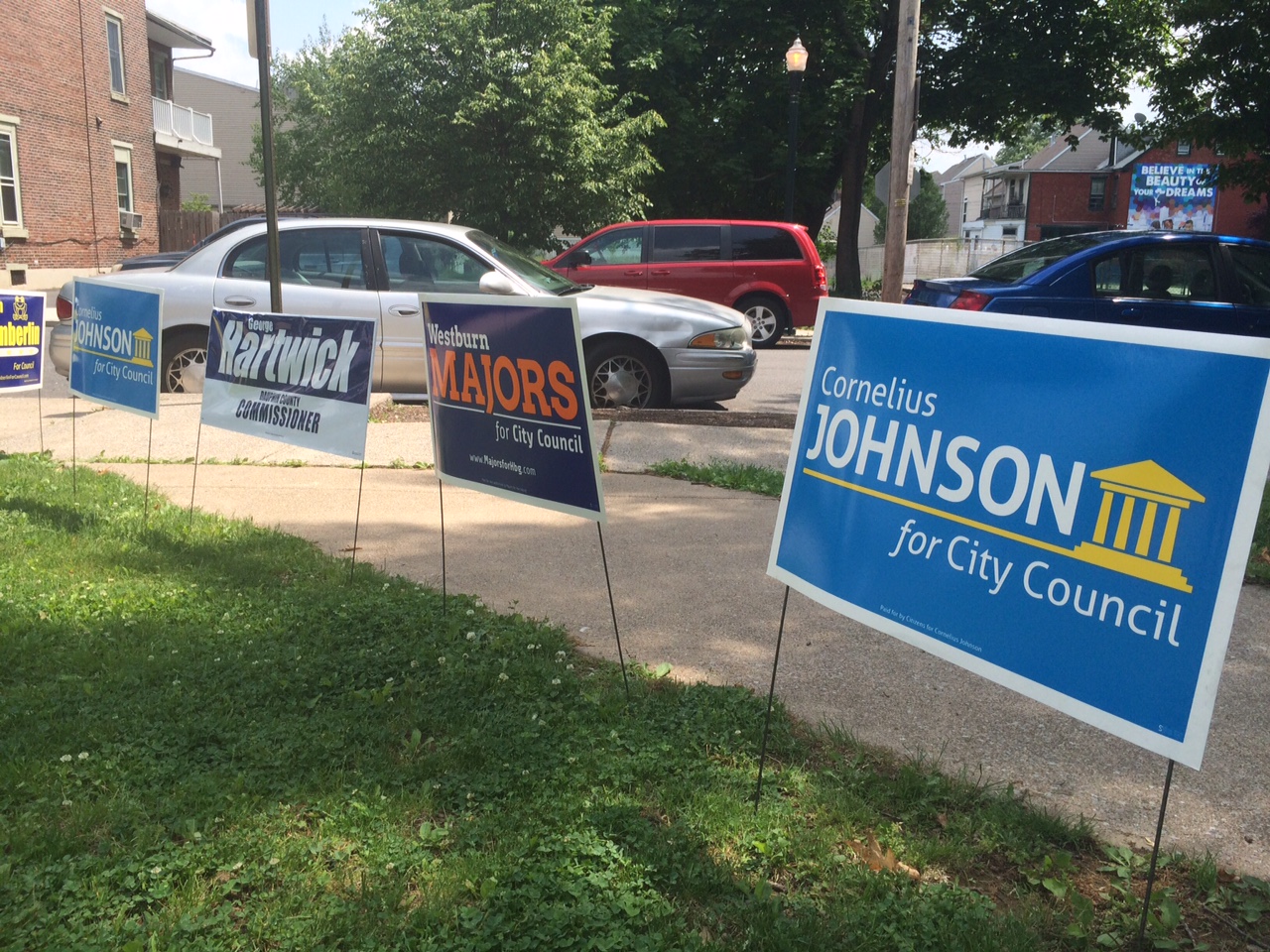
Turnout was sparse yesterday at polling stations throughout Harrisburg, including at the Neighborhood Center in Midtown.

As you may know, there’s an old adage in real estate about what’s most important: location, location, location.

In politics, the corollary might be: turnout, turnout, turnout.

Ideally, elections are supposed to measure the mood of the electorate, but most don’t. In off-year elections, particularly off-year, primary elections, only a small slice of the body politic is measured–the people who bother showing up to vote. As a candidate or a candidate-backer, you need to get your people to the polls. Otherwise, believe me, you will lose.

That point was proven yesterday in the Democratic primary for Harrisburg City Council. Hours before the polls closed, I told my wife that I believed the three council candidates endorsed by Mayor Eric Papenfuse (Cornelius Johnson, Jeffrey Baltimore and Westburn Majors) were likely to win and that incumbent Councilman Brad Koplinski–vocally denounced by Papenfuse–would probably lose his seat.

I’m no political genius, but I saw two trends emerge in the final week or so that convinced me that the mayor would have his way.

First, I assessed which candidates were running the best campaigns. In low-turnout elections, campaigns matter a lot, and no one ran a more organized, professional and energetic campaign than Johnson. For the past two months, Johnson systematically knocked on doors throughout the city, met with residents, and asked for their votes. At debates, he was personable, thoughtful and respectful. He raised money and smartly deployed it building up his name recognition through direct mail. As a result, the 26-year-old Johnson, virtually unknown to swaths of the city before the campaign, was the top vote-getter in the election.

Majors also ran a good campaign, though perhaps without the youthful vigor of Johnson, as did Destini Hodges, the winner of the two-year seat. The rest of the field ran campaigns that ranged from mediocre to practically invisible. Koplinski seemed to make a classic politician’s mistake, depending too much on the power of incumbency. As a result, he placed fourth in a field of eight (nine if you count Koscina Lowe), which is pretty awful for a sitting office-holder, especially one as widely known as Koplinski.

Secondly, I believed that a low turnout election would benefit Papenfuse’s slate. People need a reason to vote for a candidate–and some need a reason to show up to vote at all, particularly in a mid-May primary. Papenfuse provided that motivation and guidance for voters who like him or agree with his pro-business/balanced budget/Reed rollback approach to the office. Meanwhile, anti-Papenfuse sentiment in the city, while it exists, seems rather feeble and unorganized.

I’ll be honest–when Papenfuse announced on TheBurg Podcast a few weeks back that he was publicly supporting Johnson, Baltimore and Majors, I thought that a mayoral endorsement was a risky (if bold) move. I thought the same when he vocally urged residents to vote against Koplinski and when he became ever-more critical of council President Wanda Williams.

Papenfuse, though, has proven himself a savvy tactician. He gambled that, in a low turnout election, he could have outsized influence, perhaps even enough to sway the election–and that the louder and clearer he announced his choices, the better.

He was right, which I realized in something of an epiphany when I sauntered to the polls at around 2 p.m. yesterday and was just the 72nd person in my ward to vote. The turnout was so sparse that the punchy poll-workers actually applauded my arrival.

Assuming the election’s unofficial results hold (Koplinski is down just 18 votes from the final four-year slot), Papenfuse now must ensure that he retains the allegiance of his slate. Former Mayor Steve Reed was famous (perhaps infamous) for running a “Reed team,” only to lose their support as his erstwhile allies, once in office, increasingly recoiled at his dismissive, bullying attitude towards council.

Papenfuse is an ambitious man with a broad agenda. When the new council takes office next year, he will have an opportunity to push through a number of items that, so far, he’s been denied (sustainability officer, anyone?). However, to do so, he needs to keep his support on council in tact.

Johnson and Majors owe Papenfuse some measure of thanks for their wins. However, after an initial period of adjustment, nearly all new council members find their voices, priorities and preferred constituencies. Expect the same here. Come January, the mayor may have more allies on City Council, but he still will have to work hard–and wisely–to retain their support, to line up the votes he needs to pass his legislative agenda.

In the meantime, Papenfuse can take pleasure in knowing that he, again, has out-maneuvered his political foes. Perhaps he and his team understand something that oddly seems to be lost on other local politicians and their backers. Half-measures and wishful thinking don’t win elections. Effort does. Strategy does. Organization does. To win, you must do what needs to be done to turn out your voters.


Continue Reading

Mayor’s Slate Victorious in City Council Primary

Signs

Campaign signs from earlier today outside a polling station.

Mayor Eric Papenfuse wasn’t on the ballot, but he may have emerged the greatest victor in today’s Democratic primary for Harrisburg City Council.

The three candidates endorsed by Papenfuse–incumbent Jeffrey Baltimore and challengers Cornelius Johnson and Westburn Majors–won nominations for four-year terms on council. Challenger Destini Hodges tallied the most votes for the lone two-year seat.

No Republicans ran in the primary, meaning the winners of the Democratic primary will be strongly favored in November’s general election.

Moreover, Papenfuse vocally denounced incumbent Brad Koplinski, pleading with residents to vote against him. Koplinski placed fourth, losing to Majors by just 18 votes for the nomination for the final four-year seat.

“This is a big night for Harrisburg, absolutely phenomenal,” said Papenfuse after the final votes were reported. “I’m elated that we’re finally going to get new leadership to move the city forward.”

He added that he believed the public, with its vote, sent a message that it was “tired of the dysfunction on City Council.” Papenfuse advocated for new blood on council to help move his agenda forward and to replace Councilwoman Wanda Williams as council president.

Primary results were as follows: Johnson, 1,474; Baltimore, 1,429; Majors, 1,257; Koplinski, 1239; Ellis “Rick” Roy, 1,048; Rhonda Mays, 760; Jeremiah Chamberlin, 719; Ron Chapel, 332; Koscina Lowe, 226.

In the race for city treasurer, Tyrell Spradley defeated challenger Brian Ostella by a count of 1,279 to 1,221. Council appointed Spradley last year to fill the unexpired term of former city Treasurer John Campbell, who was arrested on theft charges.

For Harrisburg school board, Jennifer Smallwood, Monica Blackston-Bailey, Matthew Krupp and Melvin Wilson Jr. won nominations for four-year seats. Daunessy Penn and Lionel Gonzalez were tied for the final four-year slot, each with 1,159 votes. Judd Pittman defeated LaTasha Frye for the nomination for the sole two-year seat.


Continue Reading

Harrisburg Zoning Board Approves Moose Lodge Conversion

WCI Partners may be interested in converting the historic Moose Lodge into a mixed use project.

The historic Moose Lodge in Midtown Harrisburg

The landmark Moose Lodge Temple in Midtown Harrisburg took a step closer to revival and reoccupation tonight, as the city’s Zoning Hearing Board approved a plan to renovate it as mixed-use space.

The board unanimously granted a variance to WCI Partners LP for 33 apartments on three upper floors with commercial space on the ground floor. WCI needed the variance because the size of the apartment units, about 500 square feet apiece, is less than the 1,200-square-foot size permitted under the zoning code for the 900-block of N. 3rd Street.

WCI President David Butcher told the board that the apartment sizes needed to be small due to beams that run vertically through the building, limiting design options. He also said the project would not be economically feasible without the apartment density.

Board members seemed skeptical that WCI could not create a floor plan to accommodate larger units. However, they voted in favor of the variance largely because they want to see the building redeveloped, as it has sat empty and increasingly blighted for a decade.

“This case is a case that must recognize the reality of the facts in this neighborhood,” said board member Thomas Leonard. “The reality is that this property has been vacant for 10 years.”

Leonard also cited a lack of community opposition. Several community organizations in Midtown submitted letters supporting the project, and David Morrison, the interim executive director of Historic Harrisburg Association, spoke in favor of it before the board.

Butcher assured the board that the apartments, while small, would have high-end finishes that would appeal to young professionals. He estimated that the units would rent for around $1,000 per month.

WCI is purchasing the four-story building at the corner of N. 3rd and Boas streets for $900,000 from Atlanta-based Mosaica Education, a for-profit charter school company that is in receivership.

The purchase includes several adjacent parcels of land—three dilapidated townhouses and a 40-vehicle parking lot. Butcher said that WCI also plans to renovate the townhouses into apartments and retail space and would landscape the area around the parking lot to make it more attractive.

Harrisburg City Council now must approve WCI’s land use plan. If all goes smoothly, the project should start by the end of summer with completion expected in 12 to 18 months, said Butcher.

For five years, the former Moose Lodge housed the Ronald Brown Charter School. However, the building has been empty since 2005, when the school district’s board of control refused to reauthorize the school’s charter.

The Harrisburg Moose Lodge Temple was built in 1924, designed in the Beaux Arts style by renowned Harrisburg architect Clayton J. Lappley.

Disclosure: Alex Hartzler, publisher of TheBurg, is a principal with WCI Partners.

Continue Reading

TheBurg Podcast, May 15, 2015

Welcome to TheBurg Podcast, a weekly roundup of news in and around Harrisburg.

May 15, 2015: This week, Larry and Paul talk about some surprise reversals over a tax-break policy at City Council, the departure of the school district’s chief recovery officer and the upcoming municipal primary.

Special thanks to Paul Cooley, who wrote our theme music. Check out his podcast, the PRC Show, available on SoundCloud and in the iTunes store.

TheBurg Podcast can be downloaded by clicking on the date above or by visiting the iTunes store. You can also access the podcast via its host page.

Continue Reading

Two City District Justice Seats Up For Grabs in May Primary

A challenge against a sitting judge accused of ethics violations and a five-way race for an open judicial seat are among the races in which Harrisburg residents will cast their votes next Tuesday, May 19, in the municipal primary.

The seats up for election oversee two districts, one encompassing parts of Uptown and North Allison Hill and the other Shipoke, South Allison Hill and Hall Manor.

In the Uptown district, Sonya Baltimore McKnight, a parent engagement specialist at Ben Franklin School, is running against Robert Jennings III, an incumbent who was charged last November by the state Judicial Conduct Board of ethics violations.

The charges, which resulted in Jennings’ suspension with pay while he awaits prosecution, including demanding kickbacks from constables, sitting on citations against him and friends and making sexual remarks to women.

Downtown, a five-way race pits Paul Zozos, the son of a sitting judge in another district, against Bill Cluck, an environmental lawyer, Marva Brown, a social worker, Angel Fox, a casework manager for a state representative and Ausha Green, an employee at the state Department of Education.

The sitting judge in the district, Lavon Postelle, is not running for reelection.

The two Uptown candidates are running on the Democratic ticket, as are all five downtown candidates. Zozos has also cross-filed as a Republican candidate.

Magisterial district judges serve in the minor court system created under the 1968 Pennsylvania Constitution. They hear lower-level cases including traffic violations, landlord-tenant disputes, and civil claims for damages below $12,000.

Their courts also hold original jurisdiction over criminal cases. District judges issue warrants and determine whether to send misdemeanor and felony charges to the county Court of Common Pleas.

Harrisburg currently has five magisterial districts, with judges each serving six-year terms. There are no term limits.

The position comes with an annual salary of $88,000. The city’s district judge offices, funded by the county, have annual budgets this year ranging between $388,000 to $610,000.

A district judgeship has often been a plum prize—and more than once in this city, something of a family business—with candidates occasionally going to great lengths to make a bid for the seat.

In 2002, for example, the state Supreme Court established two new magisterial districts in the city. The next year, one of the freshly created seats attracted a three-way race between Joseph Lahr, Virginia Weaver Zozos and Lavon Postelle.

All three filed as both Democrats and Republicans, and all three mutually attempted to strike each other’s nominations from the ballot. Only Postelle, who currently holds the seat, survived the challenges.

Lahr was at the time the committeeman for the Dauphin County Republicans. He resigned that post the day he filed his nominating papers, but Dauphin County Judge Joseph Kleinfelter ruled that was too late to avoid a conflict.

Zozos, meanwhile, listed a home address in the 1200-block of Hudson Street—even though her family home was in the 600-block of S. 25th St., in a separate district, where her husband, George Zozos, was already a magisterial judge.

Her challengers claimed she didn’t actually live in the district, a requirement for candidacy, offering among other evidence the Hudson Street property’s suspiciously low water bills.

Zozos admitted in court that the sole purpose of buying the other property was to support her judicial campaign. In striking her from the ballot, Judge Kleinfelter called her residency there a “thinly veiled sham.”

Continue Reading

TheBurg Podcast, May 8, 2015

Welcome to TheBurg Podcast, a weekly roundup of news in and around Harrisburg.

May 8, 2015: This week, Larry and Paul talk about potential lawsuits against lawyers involved in the city’s borrowings and the team of architects and designers that will be leading an update to the city’s comprehensive plan. Also, a brief update on those Midtown and Uptown bars whose licenses the city is trying to revoke, and some news about a restaurant opening in Midtown.

Special thanks to Paul Cooley, who wrote our theme music. Check out his podcast, the PRC Show, on SoundCloud or on iTunes. Especially his latest episode about his new roommate!

TheBurg Podcast can be downloaded by clicking on the date above or by visiting the iTunes store. You can also access the podcast via its host page, here.

Continue Reading