More Apartments: Harristown to Add to Downtown Housing Revival

Harristown3rdSt

Harristown plans to renovate this row of buildings (except Walker’s) into high-end apartments and retail.

New apartments continue to spring up in downtown Harrisburg, as Harristown Enterprises plans to add 23 more units near Strawberry Square.

Harristown expects to start this fall on the renovation of a six-story office building at 18-22 S. 3rd St., which also houses El Sol Mexican restaurant, which will continue to operate. The building will feature 15 high-end, one-bedroom apartments, each measuring about 800 square feet.

Directly across the street, Harristown will renovate historic townhouses at 19, 21, 23 and 27 S. 3rd St. Those three-story townhouses will contain eight, one-bedroom and two-bedroom apartments, as well as commercial space on the ground floors.

The building at 21 S. 3rd “may be dedicated” to a new downtown co-working space of about 5,700 square feet, according to Brad Jones, president and CEO of Harristown.

This is the second time recently that Harristown announced it would convert downtown commercial space to apartments. Last month, it received City Council approval to renovate 21,000 square feet of office space and another 6,000 square feet of loft space to 22 apartments above a stretch of shops along N. 3rd and Market streets in Strawberry Square.

“We believe the market for high-end and unique apartments in the downtown is very strong, and we look forward to continuing to grow the downtown residential population,” said Jones.

All of these projects are slated for completion in spring 2016.

Over the past two years, downtown housing has experienced a rapid revival, with numerous office-to-residential conversions. Most recently, WCI Partners completed its Walnut Court Apartments, a 21-unit project at Walnut and Court streets that opened in July and is already mostly leased, according to WCI President David Butcher.

Harristown will partner with Select Capital Commercial Properties for a portion of its most recent project.

HarristownElSol3

This historic office building is slated to be renovated as an apartment building.


Continue Reading

TheBurg Podcast, Aug. 7, 2015

Welcome to TheBurg Podcast, a weekly roundup of news in and around Harrisburg.

Aug. 7, 2015: This week, Larry and Paul talk about a vast records request the legal team defending former Mayor Reed has served on city hall. They also discuss the recent shootings involving off-leash dogs on a Midtown street.

Special thanks to Paul Cooley, who wrote our theme music. Check out his podcast, the PRC Show, on SoundCloud or in the iTunes store.

TheBurg Podcast can be downloaded by clicking on the date above or by visiting the iTunes store. You can also access the podcast via its host page.

Continue Reading

Burg Blog: Gun Shy

Harrisburg police Cpl. Ty Meik (right) speaks with organizer Jay Bowser during a recent meeting at Zeroday Brewing Co.

Harrisburg police Cpl. Ty Meik (right) speaks with organizer Jay Bowser during a meeting at Zeroday Brewing Co.

On Wednesday night, a group of concerned Midtown residents gathered at Zeroday Brewing Co. to discuss what recently has become the talk of the neighborhood—the shooting of two dogs, in just two months, by a fellow neighbor who is a Dauphin County parole officer.

The meeting featured a guest speaker, Cpl. Ty Meik, a Harrisburg canine officer, who, the organizers hoped, would shed some light on the matter, even if he could not discuss specifics (Meik repeatedly said he had no information on an investigation into the parole officer’s actions—or even if one was occurring).

It was interesting to hear Cpl. Meik speak. He clearly was concerned about the incident, as well as the community around him, and urged residents to be both cautious and vigilant.

However, I left the meeting with greater unease than when I arrived. Near the end of the hour-long discussion, the topic evolved from the specific to the general—from the actual case at hand to a broader debate about using deadly force when “feeling” under threat—including when your dog might be under threat.

Among this group of 20 or so, a division emerged between those who felt that firing a gun when sensing a threat was appropriate versus those who did not think so.

I was solidly in the latter category.

At 52 years old, I’m not a young man. I grew up just over the Hudson River from Manhattan when the Bronx was burning and “Escape from New York” seemed less a movie than a prediction. I lived in Washington, D.C., during the crack war and “Murder Capital” years, walking everywhere, even when the city logged more than 500 homicides in just one year.

Yet not once, in all those years, did I feel the need to pull out a gun and start shooting.

Did I feel uncomfortable at times? Absolutely—and not infrequently.

I’ve had groups of young men stare me down menacingly. I’ve had people shove me onto the sidewalk for no reason. I’ve had countless panhandlers aggressively beg for money, even threaten me. I’ve had random people mutter, swear at and even spit at me. I’ve lived on streets where people openly dealt drugs. I’ve had many dogs run at me (most harmlessly).

In other words, I’m no stranger to uncomfortable, even threatening situations, which, unfortunately, are nearly always a part of life in an American city. Yet, somehow, I’ve managed to survive, even prosper, without firing a shot.

Which is why I felt such discomfort when Meik—a solidly built, well-armed man wrapped in a bundle of protection—said that one’s sense of threat was relative, and, if that sense was strong enough, shooting a gun might be justified.

So, I thought to myself, should I have shot a gun when, as a freshman in college, a clearly unstable man punched me in the head as I was walking to the National Mall? Should I have shot a gun when a man followed me down the street and wouldn’t stop harassing me? Should I have shot a gun the one time I was mugged at gunpoint (the robber, clearly a junkie looking for a fix, stole $35 and ran away). Should I have shot a gun when my cousin’s dog bit me so hard in the stomach—and wouldn’t let go—that I needed stitches?

What is the threshold of threat that justifies using deadly force? And could those situations be resolved more peacefully?

I believe that, in each of the many threatening situations I’ve encountered, shooting a gun would have vastly escalated the situation. Someone, today, would be dead. It well might be me.

I have respect for Cpl. Meik and the difficult job he has to do. Having met him, I don’t feel disconcerted that he carries a gun everywhere, including, as he bluntly stated, into his church and his kid’s school. He seems responsible, caring and well trained.

But some people—many people—are not like Cpl. Meik. They are easily threatened and sense great danger when other people see an easily resolvable situation.

This is why I left the meeting so distraught. I have difficulty understanding how one person can feel so threatened by dogs that he pulls out a gun and shoots them twice in two months.

To me, there’s nothing relative about using deadly force. Shooting a gun is the most serious action a person can take, so he’d better be sure there are no alternatives. He should be carrying a gun only if he has the maturity and intelligence—even in the heat of the moment—to distinguish between a solvable problem and a genuine threat to life.

Continue Reading

Reed, Fighting Corruption Charges, Enlists Open Records Law

Attorney Henry E. Hockeimer, Jr., left, and former Mayor Stephen Reed after Reed's arraignment July 14 on corruption charges.

Attorney Henry E. Hockeimer, Jr., left, and former Mayor Stephen Reed after Reed’s arraignment July 14 on corruption charges.

The Philadelphia attorney representing former Harrisburg Mayor Stephen Reed has filed a wide-ranging set of requests for city records, enlisting the state’s right-to-know laws in Reed’s defense against corruption charges, TheBurg has learned.

Henry E. Hockeimer, Jr., of the Philadelphia law firm Ballard Spahr, sent the open-records requests to city hall between July 20 and July 28, a week after Reed was arraigned on racketeering charges stemming from a state grand jury probe.

He asked for a vast array of documents, including Reed’s correspondence with various officials and advisors, minutes and agendas of several years’ worth of meetings, files related to city borrowings and current Mayor Eric Papenfuse’s communications with law enforcement and reporters.

The requests, themselves a matter of public record once submitted, were provided to TheBurg in response to a right-to-know request.

The purpose of the records request is not clear. Under state law, requesters are not required to provide their reasons for seeking records. Hockeimer, reached late on Thursday, had no immediate comment, except to say he had filed an appeal for parts of the requests the city had denied.

But in building their cases, defense attorneys sometimes assert the right to review government records to survey the evidence gathered against their clients and build stories that counter the ones told by prosecutors.

“The state’s investigation is the state’s investigation. It’s not the defendant’s investigation,” said Ion Meyn, a visiting assistant professor at the University of Wisconsin law school and a former faculty member at the Wisconsin Innocence Project. “To rely just on what the state has investigated would be a mistake.”

The state’s initial disclosures about a case “should trigger successive, targeted, and written demands that are reiterated on the record, deepening accountability,” Meyn wrote in 2014, in an article for GPSolo, a publication of the American Bar Association. “A counter-investigation is essential to checking the state’s work.”

Nonetheless, the use of open records requests by defense lawyers does not appear to be widespread in Pennsylvania, according to Erik Arneson, director of the state open records office.

In part, that may be because one of several exemptions in the law, pertaining to records of a criminal investigation, is “broad enough that there’s not much to be gained” from making such requests, Arneson said.

At the same time, records that were deemed public before their connection to any criminal investigation generally remain public after charges are filed, he said.

In Reed’s case, Hockeimer sent a series of four open records requests to Harrisburg city hall, asking for documents in detailed lists that appear to stem from allegations in a grand jury report that was made public July 14.

On the basis of the report, Reed was arraigned that morning on 17 criminal charges encompassing 499 individual counts, including theft, bribery, deceptive business practices, criminal solicitation, evidence tampering and misapplication of entrusted property. Topping the list was a racketeering charge, a first-degree felony.

The report alleged that Reed, the seven-term mayor of Pennsylvania’s capital, used public borrowings to divert fees to pet projects, like acquiring Western-style and other artifacts. It portrayed the former mayor as heedlessly leading the city deeper and deeper into debt in the service of personal interests with little or no public benefit.

Reed, speaking the morning of his arraignment, said he had not been a part of any crime. “I devoted my life to the city of Harrisburg, and I look forward to waging a vigorous fight against these charges,” he said.

In his requests, Hockeimer targeted documents that appear to be related to specific allegations. For example, he asked the city for files related to “the City Council special projects fund created in 2003,” which the state has alleged was created as a bribe to secure council votes for a new borrowing on the Harrisburg incinerator.

In another example, he asked for the personnel file and travel records of Richard Pickles, a former city police captain whom Reed allegedly deputized to collect artifacts on cross-county road trips that were paid for by the city.

Some of the requested records are likely to be voluminous. One list includes a request for “all records including, but not limited to, documents, notes, correspondence and files” related to eight separate years of bond offerings. The closing documents alone for a single bond offering can run to many hundreds of pages.

In the case of some records, it’s not clear on what basis Hockeimer believes them to be in the possession of city government. For instance, he asked for records that current Mayor Eric Papenfuse provided to the Patriot-News, the FBI, the state police and the state attorney general between the fall of 2007 and the present.

Papenfuse did not take office until 2013, though he was briefly a board member of what was formerly the Harrisburg Authority, a governmental entity, before resigning in the fall of 2007. In 2009, during a campaign for city council, he claimed publicly that he had been assisting the FBI’s public corruption unit with an investigation into Reed.

Attorney General Kathleen Kane gave credit to Papenfuse’s persistence when she announced the charges against Reed last month. “Sometimes the squeaky wheel gets the grease, and he wouldn’t let it go,” she said.

Harrisburg solicitor Neil Grover said Thursday that he could not comment on the requests, saying the city was in the midst of a legal review.

The grand jury probe, which was extended by court order to January 2016, is ongoing.

Continue Reading

Pair of Dog Shootings Concerns Midtown Neighbors

The corner of Green and Harris streets in Midtown, where a Dauphin County parole officer shot a neighbor's unleashed dog last Thursday night.

The intersection of Green and Harris streets in Midtown, where a Dauphin County parole officer shot a neighbor’s unleashed dog last Thursday night.

For the second time in two months, a Dauphin County parole officer has shot an unleashed dog on his street in Midtown Harrisburg, prompting concerns from some neighbors over what they say is an unnecessary use of firearms on their residential block.

Bradley G. Smith, of the 1500-block of Green Street, shot and wounded a dog that was off its leash and acting aggressively around 8:30 p.m. Thursday night, near the corner of Green and Harris streets, where Smith was out walking his own dog.

Police, who did not name Smith in an initial description of the incident, said that three individuals had been standing on the corner when they “observed someone walking west with a dog that appeared not to be leashed.”

Sgt. Gabriel Olivera said the individuals called out at least twice for the owner to leash the dog, but both times the request was ignored. One of the individuals on the corner had one dog on a leash, while another had three dogs, all on leashes, he said.

The unleashed dog then charged and, some time after that, he said, “One of these individuals feared for the safety of the adults and the dogs and fired one round striking the dog.”

Smith was involved in a similar incident late on the evening of June 10, when a pit bull leapt from a vehicle as its owner was parking.

The dog ran towards Smith’s dog and “began to bite at it,” Olivera said, at which point Smith, whom Olivera did not name in his description, “feared for the safety of his dog and fired at the dog with his legally owned firearm.”

The pit bull then ran to its home across the street, where it died.

In addition to not initially naming Smith or any other individuals, police did not initially indicate the same individual was involved in both shootings. TheBurg learned about Smith’s involvement in both incidents through interviews with neighbors. Olivera later confirmed his involvement.

Police said they have investigated both incidents and found Smith’s use of a firearm to be justified. “In both incidents the dogs were not on leashes and ran towards him and his dog in aggressive manners,” Olivera said.

Nonetheless, the shootings have upset some neighbors. Jay Bowser, who lives on the block and whose young daughter often plays outside on the street, was disturbed that Smith had chosen to fire a weapon.

“I don’t think it’s acceptable,” he said. “There’s plenty of things you can do to break up two dogs before you shoot.”

Bowser has since organized a town hall-style meeting to discuss the incidents. The event is planned for Wednesday evening at 6 p.m. at Zeroday Brewing Company, a neighborhood brewery.

The city has an ordinance forbidding the discharge of weapons on city streets, but officials have repeatedly said the ordinance does not apply in self-defense cases.

The anti-discharge ordinance is one of several local firearms regulations currently being challenged in county and federal courts. In February, Dauphin County Judge Andrew Dowling preliminarily barred the city from enforcing three of its gun ordinances, though his ruling left the anti-discharge ordinance in place.

Smith is a parole officer with Dauphin County and has owned his Green Street residence since 1990. He did not return voicemails left on his office phone Tuesday and Wednesday.

Continue Reading

Little Amps to Open in Strawberry Square

Little Amps owner Aaron Carlson prepares coffee at the shop's location in downtown Harrisburg.

Little Amps owner Aaron Carlson prepares coffee at the shop’s downtown Harrisburg location on State Street.

Attention state workers–your high-quality caffeine fix is closer than ever as Little Amps Coffee Roasters soon will open in Strawberry Square.

The third location of the Harrisburg-based coffee shop is slated to debut in October in vacant space adjacent to the Chockablock Clock on the first floor, said Brad Jones, president and CEO of Harristown Enterprises, which owns and manages Strawberry Square.

“It’s a very unique Harrisburg brand, and we are excited to be part of that brand,” Jones said.

Little Amps owner Aaron Carlson said he was attracted to Strawberry Square so he can serve office workers who may not venture to his other shops.

“Our other stores tend to attract people who live in the city,” he said. “There are some 9-to-5 coffee-lovers that we think we can attract.”

The new location will be small, a kiosk-style space with a few cafe tables, Carlson said.

Little Amps was founded in October 2011 with a single location at the corner of Green and Muench streets in Olde Uptown in Harrisburg. It later opened a downtown location at the corner of N. 2nd and State streets.


Continue Reading

TheBurg Podcast, July 31, 2015

Welcome to TheBurg Podcast, a weekly roundup of news in and around Harrisburg.

July 31, 2015: A new issue of TheBurg hit newsstands this week, and Larry and Paul mark the occasion by talking about a few stories in it. They discuss the city’s biggest competitor in the downtown parking system, which the state appears to be subsidizing. They also talk about the theme of collective responsibility, both for city housing and at city hall, and some facts about the racketeering charges brought against former Harrisburg Mayor Steve Reed earlier this month.

Special thanks to Paul Cooley, who wrote our theme music. Check out his podcast, the PRC Show, on SoundCloud or in the iTunes store.

TheBurg Podcast can be downloaded by clicking on the date above or by visiting the iTunes store. You can also access the podcast via its host page.

Continue Reading

Parallel Parking: The state has urged Harrisburg to crack down on “rogue” parking operations. Then why is it subsidizing the city’s largest competitor?

Screenshot 2015-07-31 09.50.55In 2011, Adam Meinstein, a Philadelphia-based real estate developer, bought an abandoned post office on the outskirts of downtown Harrisburg.

In many ways, the property was a natural fit for Meinstein’s company, an investment and development firm called Equilibrium Equities. Founded in 1995, the company invests in industrial facilities in the northeast, mostly in Pennsylvania. The old post office, formerly the Keystone branch of the United States Postal Service, was the region’s primary sorting facility for 50 years. Located on Market Street, just east of the Mulberry Street bridge, it sits on an 11-acre parcel in a former industrial zone, adjacent to several parking lots and warehouses.

The property also had two notable features: it bordered an Amtrak station, and it contained an out-of-use parking lot with hundreds of open spaces. These had also caught the eye of the state Department of Transportation, which had been looking for ways to remedy a problem with the Harrisburg train station. Because of the cost of parking downtown, riders would often opt to depart from nearby stations, like Elizabethtown or Mt. Joy, where they could park free of charge. “People make decisions not to come to Harrisburg to take the train because of the cost and other challenges associated with parking,” Toby Fauver, PennDOT’s deputy secretary for multimodal transportation, told me. The agency considered developing the post office lot as a transit center, but when they contacted the postal service, they learned it was already under contract with Meinstein.

In early 2013, Meinstein and PennDOT struck a deal. The agency would sign a five-year lease of the property, and Meinstein in turn would develop and market the lot, under the name Transitpark, as a parking option for Amtrak riders. It wasn’t a typical lease, however. PennDOT would pay Meinstein $285,000 per year, but it wasn’t reserving any spaces. Instead, the lot would be available for public use, and some portion of the proceeds, after paying the lot’s operating costs, would flow back to the agency to “offset” its payments. The state would also pay an initial $300,000 for ticket machines and other upgrades to get the lot up and running. Meinstein, meanwhile, would offer parking at a discount to Amtrak riders, who could park all day for $5 with a validation from machines inside the station. (Without the validation, Transitpark’s rates are slightly more expensive than the city’s, at $7 per day and $40 per month, compared with $6 and $35, respectively, in the neighboring 10th Street lot.)

Around the time the lease was being negotiated, another arm of state government was working out a different sort of parking deal. As part of a complicated bailout of the city’s debt crisis, the state sought to borrow heavily against Harrisburg’s parking system to generate upfront cash. To cover the new debt, prices would be raised, the system would be outsourced to a private operator and the state would enter into a long-term contract to rent spaces. The result was the much-publicized new parking regime, currently halfway through its second year. Standard Parking, a corporation headquartered in Chicago, runs the day-to-day operations in the city’s stead, aggressively enforcing higher meter rates ($3 per hour downtown) with increased fines ($30, up from $14). Money from the system goes to pay bondholders—in 2014, Harrisburg parkers indirectly paid debts totaling nearly $10 million. A portion of it, critically, also goes to the city, which is counting on parking proceeds this year to fund fully 10 percent of its budget.

As part of the agreement, the city had to make a promise. In essence, it pledged to stifle competition from other lots in the downtown zone. Existing private lots could continue to operate, but the city was forbidden from permitting new ones to open—a simple-sounding rule that has led to some tricky deliberations. Take Executive House, an apartment tower at the corner of 2nd and Chestnut. The building has always rented out spaces in its private lot, but lawyers for the city are now researching exactly how many. If they find the landlord has added new rental spaces that aren’t “grandfathered,” it may order them to cut back again. Or consider the small, private lot across the street from McGrath’s on Locust. The lot was “existing” at the time of the city’s agreement—it has offered parking since 1999—but in 2007 it lost a zoning petition to stay open. The owner sued, and the case lingered in the courts unresolved. The city is now ordering it to close.

Recently, the state has seemed particularly keen to see the city make good on its promise by shutting these private lots down. One advisor described them as “rogue operations” that the city must “nip in the bud.” Yet the Transitpark lot, though across the street from a lot in the city system, seems not to concern them. As a matter of scale, this is surprising: the Meinstein lot contains some 750 spaces, while these “rogue operations” total only a few dozen.

In June, at a regional transportation meeting, a PennDOT employee brought up Transitpark, describing it as a way to avoid Harrisburg parking prices and save some money. Wayne Martin, the city engineer, was perplexed. Every dollar spent on that lot was one that could have gone towards the city. “The Commonwealth is competing against itself,” he thought. He went back to city hall and told the mayor.

 …

On the matter of parking, the administration of Mayor Eric Papenfuse has found itself between a rock and a hard place. The city’s agreement was negotiated and signed under his predecessor, Linda Thompson, under terms dictated by the state’s bailout plan. Nonetheless, as the new face of city government, Papenfuse has had to take responsibility for its terms—both by fighting for its benefits and by mitigating its consequences. In December, he announced a partnership with a mobile app that would allow motorists to earn coupons and parking validations by saying it could “change the narrative” on parking. In March, he bargained for four free hours of parking on Saturdays and reduced happy hour rates by pledging a quarter-million dollars in tourism money to cover any lost revenue.

At the same time, he is loath to see the parking system lose a dime, for a simple reason: the city needs the revenue. On July 1, the state coordinator of Harrisburg’s recovery, Fred Reddig, filed a status report with the court overseeing the bailout plan. Among other updates, the report noted that the city was getting far less money from the parking system than expected. By the end of May, the payments to the city were around $650,000 short of what had been budgeted. Revenues were “way, way, way off,” as Papenfuse put it. Yet Reddig’s report seemed mostly to blame the city, noting that City Council had delayed passing an ordinance required to enforce tickets. The city “has a lot to say about how well the parking operations perform, and thus how much of the cash flow it realizes,” the report said. It went on to address “some land owners” who “will attempt to offer parking to the public” in the downtown zone. “It is incumbent that the City act to shut these operations down as soon as practicable in order to maximize revenue.”

How does PennDOT’s lease with Transitpark square with this objective? “One of the long-term threats is the growth of the parking enterprise there,” Papenfuse told me recently. Directly across the street from Transitpark is the 10th Street lot, a part of the city-owned system. “I think they’ve talked about how, if I recall Fred’s words, the city has a role in ensuring compliance with the system and the long-term viability of the system,” he said. “And one has to ask whether or not that PennDOT lease is really in the long-term best interest of the parking system.” The state, he said, “could be working proactively with PennDOT to integrate into the existing system. I don’t know why that’s not happening.”

“Our intent was not to be in competition,” PennDOT’s Fauver told me. He described the investment in Transitpark in terms of a long-term commitment to increase train ridership and tourist travel to the area. The agency is currently completing a $40 million project to upgrade the tracks leading into Harrisburg. The project, along with another recent investment to remove track-level crossings on the rail line, is expected to shave 10 to 12 minutes off the journey between Harrisburg and Philadelphia. “There’s a lot of opportunity to market south central Pennsylvania to the outside, to New York City,” he said. “But we’ve got to be able to provide parking.” He also spoke of long-term plans to improve the station itself, including new elevators from the concourse to the platforms. “We want the city of Harrisburg to have a good station,” he said.

The city is aware of these efforts and, perhaps because of this, has not courted controversy over the lease. Fauver “runs a thousand miles an hour,” Martin, the city engineer, told me. “I don’t think PennDOT intended to hurt the city. In the absence of a plan, they made decisions.” Meinstein, for his part, told me his business had a “fantastic relationship” with Amtrak and PennDOT, and described the development of his property as a form of much-needed help for the station. “We don’t think it’s controversial,” he said. “There were some needs. We didn’t seek this contract—it came to us.” He pointed to the benefit the city already receives from his operation, in the form of a 20-percent tax on his parking revenues.

Yet Transitpark also has real potential to undercut the city’s parking system. Reddig, in an email to city officials, said the Transitpark lease was “entered into primarily to provide parking for those using the train,” but the lot’s own marketing tells a broader story. Last summer, the company promised “Harrisburg’s Best Parking Rates” in advertisements in this magazine. The website currently advertises spaces for “businesses, busy travelers and city visitors.” At the top of the page, in capital letters, is an announcement: “We’re growing!”

Papenfuse has said he would favor “redevelopment of the post office site into something else entirely that would benefit Mr. Meinstein, but wouldn’t be parking.” Meinstein, at least for now, doesn’t seem so inclined. He told me he felt Transitpark helped solve a shortage of parking in the city, and that people were “coming into the city who wouldn’t otherwise come because of the cost.” He also emailed me an excerpt from the city’s parking lease, outlining the “non-compete” area that encompassed the entire downtown. “Very few people are aware of this,” he wrote. In a subsequent phone interview, he clarified. “There shouldn’t be any such thing as a parking monopoly in any city,” he said. “It’s not right.”

This story has been updated with additional information about rates at Transitpark and a neighboring city lot.

Continue Reading

Market Upswing: There’s a new vibe in Midtown as vendors pour into the Broad Street Market.

Screenshot 2015-07-31 09.52.40If someone showed you a time lapse of the city of Harrisburg—what would you see?

The growth of the steel industry; Camp Curtin housing hundreds of thousands of Union soldiers during the Civil War; the 1897 fire at the Capitol; the first Pennsylvania Farm Show; the race riots of 1969; the 1996 collapse of the Walnut Street Bridge; and the addition of Restaurant Row and changes to City Island.

During all of these events, the Broad Street Market, founded in 1860 with the stone building opening in 1863, has stood proud.

Now, thanks to dedicated community leaders, ambitious business owners and improved market management, the Broad Street Market itself is stirring back to life.

Welcoming  to All

When Ashlee Dugan expanded her role from board member to interim marketing manager in 2014, she had a vision of what the market could be.

“Coming in, I knew that it was important to diversify the food options that were at the market and to increase the density of products that we have,” said Dugan, who, late last month, announced she would leave her role to take a job with the state. “So, the first goal was to fill up all the empty spaces with new and already existing businesses so that the customers would have as many options as possible.”

Inspired by markets around the state and across the country, she started making a list of what she felt the Broad Street Market needed. Not only did she think of what would be popular items, but she also focused on creating a place that could fill the needs of a customer’s Saturday grocery list. Then, the outreach and recruiting process began.

Now, the market boasts about a dozen new businesses since Jan. 1, with more on the horizon. With the changes, Dugan stressed that she wanted to maintain the market as welcoming to all.

“With the diversity of the products, I really have tried to keep in mind the price point options. So, for example, we maintained an expanded produce stand, but also increased organic and local options that tend to be more expensive. All of our produce vendors accept SNAP and EBT cards, so we’re hopeful that that range of options and variety of price points are helpful to everyone.”

A Doughnut, a Dream

Dugan’s focus on the market as a community hub reminded one of the new vendors, Eva Burchfield of Evanilla, of the bazaars in her home country of Iraq.

“The bazaar is actually more chaotic,” she laughed. “But sometimes, the [Broad Street Market] vendors talk to each other over the stands, and I always think to myself, ‘This is like the bazaar.’”

Burchield’s favorite treat, doughnuts, weren’t available in the Iraqi bazaar, so she began to make them at home in her kitchen. Five years ago, she moved to the states and began learning the art of baking and pastry-making. After she completed a program at HACC and did a yearlong internship, she decided it was time to start her own business.

“I remember my mom saying ‘What would be the first food you ate if you would ever go to the states?’ and, I said, ‘Uhhh, a doughnut, of course!’”

It was the people of Harrisburg who confirmed that there was a yearning for doughnuts—a statement that encouraged Burchfield to follow her dream of opening a business.

“I wouldn’t trade it for any other place,” she said. “Harrisburg has so much potential and charm, and that’s why we’re so attached to it. It’s so welcoming to new businesses. Customers were telling me we do need this in the city, and that was so encouraging.”

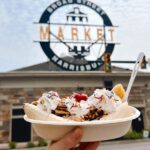
Now, Burchfield offers classic and gourmet doughnuts, as well as doughnuts with a bevy of unique toppings and seasonal flavors. A popular item on the menu, a doughnut sundae, features another Midtown-grown business, Urban Churn. This delightful treat is a scoop of Urban Churn’s unique ice cream on top of an Evanilla doughnut with chocolate sauce and a cherry.

Jess Adams of Mad Dash, an artisan grilled cheese food truck turned market stand, explained that the desire to build your neighbors up instead of tearing them down is one of the reasons she’s so passionate about Harrisburg.

“I think Harrisburg is unique because you have businesses supporting each other,” she said. “It’s not a competition. We all want to succeed and, by working together, we are achieving that.”

Adams started her food truck venture in March 2014 and, a few months later, as things went well, added another truck. After speaking with Dugan and hearing her vision for the market, Adams settled into a permanent space where she could sell during the winter months, as well. She believes her market home is a reflection of the energy and innovation budding in Midtown right now.

“I see the market and Midtown continuing to grow and be a hot spot for people to be. With all the new businesses in the market and surrounding areas, the market will make its mark again,” she explained, giving Zeroday Brewing and the new outdoor film offerings at Midtown Cinema as examples.

The outdoor theater at Midtown Cinema is an effort of the community group Friends of Midtown. Board President Shawn Westhafer, who has partnered on numerous events at the market, agrees that the influx of business is not only cherished by long-standing and new customers, but should also be celebrated due to its economic impact on the community.

“The recent surge of new businesses at the market has provided customers an even more diverse collection of vendors to patronize, making Midtown an even better place to live or visit,” said Westhafer. “It also has the practical effect of increasing income for the market, which can be invested in infrastructure improvements, attracting yet more vendors and customers.”

Westhafer called the recent changes in the neighborhood a “virtuous cycle of improvement,” a description Adams agrees with.

“This area is in the midst of a turnaround and, by bringing in new businesses, creating jobs and ‘cleaning up’ the city, it’s just an overall win for everyone,” she said.
Screenshot 2015-07-31 09.52.15Business with Purpose

Mark Wieder also exemplifies the “everybody wins” mentality.

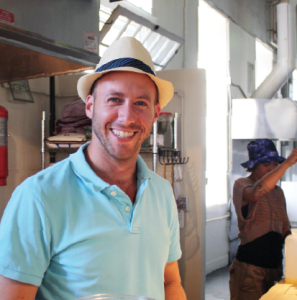
Recently, Wieder opened Popped Culture, another new market stand. The business’s tagline, “Popcorn with a Purpose,” reveals his commitment to serving the community. For every bag sold, one bag is given to a child in need.

An attorney by trade, Wieder took the plunge into popcorn after feeling a lack of meaning in his previous position. What’s unique about Popped Culture is that it operates as a social business, which, according to Wieder, combines business sense and social purpose.

“Nearly 16 million children lack access to food, and this number is growing,” Wieder said. “Instead of providing low-cost products and services specifically geared towards those on a tight budget, Popped Culture is approaching the difficult task of providing goods and services to those who are at risk of poverty in a new way.”

By being at the market, Wieder said that he has the opportunity to start a conversation about what a social business is and how it’s helping the community. He also points back to Dugan and her vision for the market as the driving force behind the recent changes.

“I think Ashlee Dugan did such an amazing job,” he said. “She had a vision for the market and what it can be.”

He’s also impressed with how she quickly recruited vendors for the market.

“A month and a half before I moved into the market, there were only four stalls here,” he said, gesturing around the stone building.  “And, in the last month, there are five new vendors that have moved in. People want to come here.”

Dugan took a commitment to community health as her inspiration.

“My personal inspiration for this comes from a belief in the power of local food and how it can really affect communities and community health,” Dugan explained.

The results have shown themselves in foot traffic and register receipts.

“We have seen quite an increase in traffic, especially Fridays and Saturdays,” she said. “A lot of the vendors are reporting higher sales. For the most part, customer reactions have been positive.”

Dugan now is leaving the market for a position as the PA Preferred coordinator for the state Department of Agriculture.

She said that she’s “honored” to have been offered that position, but admits that her departure is bittersweet.

“It’s not easy to leave the market,” she said. “It’s a place I love.”

Does she have any advice for her successor?

“I would say to come into it with a really collaborative spirit,” she said. “Work with the vendors and the board and the community, and the market will evolve further.”

The Broad Street Market is located at N. 3rd and Verbeke streets in Harrisburg. It is open Thursday and Friday, 7 a.m. to 5 p.m., and Saturday, 7 a.m. to 4 p.m.

Market Newbies

In recent months, numerous new vendors have opened up at the Broad Street Market.


Stone Building

The Harrisburger: Craft hamburgers and fries

Mad Dash: Gourmet grilled cheese sandwiches

Popped Culture: Creatively flavored kettle popcorn

Sugar Whipped: Market location of Lancaster’s popular Sugar Whipped Bakery

Tasty Dishes: Authentic African-Caribbean cuisine


Brick Building

Abrams & Weakley: Market outpost of the popular pet supply store

Elementary Coffee Co.: Fresh-roasted coffee and drinks

Evanilla: Gourmet doughnuts

John B. Kelly Seafood Connection: Fresh-caught and prepared seafood

Kubtini: Homemade pizza and deli items

Radish & Rye Food Hub: Locally sourced and organic produce, dairy and other foods

Soul Burrito: Freshly made, generously stuffed burritos

Continue Reading

Man Up, Layer Up: Guys, slowly back away from that hoodie.

Screenshot 2015-07-31 09.56.12If you’re reading this and are wondering why people in plaid shirts are sprinting past you—don’t worry—coffee shops likely just unleashed the pumpkin spiced latte, not the zombie apocalypse. It’s not even Labor Day, and you see that gourd-infused craft ales already are being poured, football dominates water cooler chit-chat, and every retailer has plastic turkeys staring you in the face.

Fall is almost here.

As much as I will personally savor the last sips of summer along the Susquehanna and be in denial until October, I will look ahead to the crisp air of autumn for style-sake. A few simple swaps will have you ready to conquer the cooler temps.

1. Upgrade at least one hoodie.

Women seem to have a fall uniform: tall boots, tight jeans and scarves. You’ll spot this at any apple orchard, antique barn, or… anywhere, really. Guys can get creative, but most opt for the easy route when it’s chilly—the hoodie.

I still have my college sweatshirt, and, yes, even one from American Eagle (honesty sets you free, I hear). But I’ve also matured my collection to include a cream-and-navy-striped knit hoodie with wooden toggles. And my nickname for four months might as well be “shawl cardigan.” Start with the basic V-neck sweater. I lean towards rich solid colors like indigo, wine or rust.

Save those mustard-stained pullovers for raking leaves and tailgates. If you’re going out for the night or a professional event, hang up the hoodie.

2. Layer up.

Take that sweater and wear a patterned button-down underneath instead of a T-shirt. Crew necks (the rounded ones) tend to suffocate the collars a bit—stick with a V-neck. If you can help it, keep the collar wings tucked in or else you’ll look like Tony Manero. Your shirttails should stay tucked for business and untucked for beers.

Take the same look and throw a suit jacket or blazer over top, and you’ve layered something sweeter than cake. Remember your pocket square and shoe rules (TheBurg, February 2015 and May 2015, respectively), and you will yet again impress the room.

3. Texturize your blazers.

Tweed has returned as king. Well before Under Armour, Scottish gentlemen began wearing tweed around the 1830s as a performance fabric. The “tweel” process to make the fabric allows it to be a breathable, flexible insulator that helped Celtic sportsmen stay warm and dry in the countryside. Folklore has it that a Scottish tailor had too many Glenlivets and the “l” in “tweel” became a “d”—hence tweed.

In today’s world, this is good for, say, the fella that spills his pumpkin-spiced porter on ya at the pub.

Forget the stodgy Harvard professor stereotype. You’ll look even smarter in one of these fine gems. You can find inexpensive vintage tweed blazers with magical leather elbow-patches and buttons at consignment shops or online starting at $20 (ebay user “whiskeyknuckles” has a decent selection). For a quick nip-tuck, you can take it to Top Shelf Menswear’s new Lemoyne store where its tailoring services were expanded—win-win.

Corduroy, our lovable ‘80s fabric, is back with a vengeance. A corduroy blazer on top of a sweater and button down is equally as durable, plush and stylish as tweed. Wear with dark jeans—not cords—or you will look like Professor Jennings. Clue jokes aside, I’ve got one in plum.

Let’s recap your new fall semester syllabus. Upgrade your hoodie, layer your sweaters with button-downs and blazers, and choose rugged texture over fine wool or silk. These simple style cues will take you from freshman on campus to the boss in the boardroom.

If you get hot with all those layers, that’s the point—you can layer down.

Screenshot 2015-07-31 09.56.04I’ve got one more swap for you—your fall drink. Instead of stuffing your gourd with those predictable seasonal brews, try this layered-with-autumn-flavor cocktail I have affectionately named “The Corduroy.”
1 ½ ounces spiced rum
½ ounce cinnamon whiskey
1 ounce apple cider
Squeeze of lemon

Shake over ice, strain, pour over king cube and top with a splash of ginger ale. Garnish with a slice of Granny Smith apple.

Indulge. Stand out.

Our Sharp Press Man, Dave Marcheskie, is a reporter and anchor for abc27 News. If you’d like to ask Dave a question, please email it to [email protected]. He may use it in a future column.
 
This column is sponsored by and the clothes were provided by Top Shelf Menswear. Check out their new location in the State Street Plaza, 829 State St., Unit 1009, Lemoyne, 717-770-2080. www.topshelfmenswear.com.

Continue Reading