Honest Bride: “Wedding Doll” part of this month’s Jewish Film Festival.

Screenshot 2016-04-28 13.21.09The Jewish Film Festival approaches once again.

As usual, there is an incredible lineup of films, including Israeli director Nitzan Giladi’s newest film, “Wedding Doll,” a movie whose protagonist will charm the socks off of you with her honest vibrancy.

Hagit (Moran Rosenblatt) wants to be a bride. There are two reasons you can be sure of this fact. One, the little dolls she makes from the materials at the toilet paper factory always have little, white toilet paper dresses and veils, and, two, because she will tell you.

Hagit wears her heart on her sleeve—and her smile, and her fear. This is something that Omri (Roy Assaf), son of the factory owner, loves about Hagit. They are secret lovers, enjoying their time together when Omri’s father leaves the cutting floor, and they meet out on the cliffs every night when she’s supposed to be in bed.

But Hagit has a mental deficiency and is unable to understand why Omri may not want to tell people about their relationship. There are quite a few things she doesn’t understand, actually, and her overprotective mother (Asi Levi) has sacrificed her entire life to keep her out of harm’s way—an act that prevents both of them from really living life. Hagit desperately wants her independence, a task that proves difficult when she learns that the toilet paper factory soon will be closing, and she will lose her job.

The film vacillates between adorable and vastly uncomfortable, as some of Hagit’s interactions keenly reflect society’s perception of people like her. And though every mother-daughter relationship contains some amount of struggle, Rosenblatt and Levi’s on-screen chemistry really draws out the brutal truth of the situation. What results is an incredibly real and applicable character sketch of a girl with disabilities—and a beautiful one at that.

“Wedding Doll” will make you not only laugh, but also deeply feel Hagit’s sorrow and joy throughout its 82 minutes. It’s definitely a film you shouldn’t miss. It will play this month as part of the Harrisburg Jewish Film Festival at Midtown Cinema.

For more information about the Harrisburg Jewish Film Festival, see the story in this month’s issue or visit www.hbgjff.com.


Midtown Cinema
MAY SPECIAL EVENTS

The Late Shift with Zeroday
“Fight Club”
Saturday, May 7, 10:30 p.m.

Classic Film Series
“Chariots of Fire”
Sunday, May 8, 6 p.m.

Down in Front!
“Samurai Cop”
Friday, May 13, 9:30 p.m.

Jewish Film Festival
May 19-26
Various times, check the schedule

3rd in the Burg $3 Movie
“A League of Their Own”
Friday, May 20, 9:30 p.m.

Faulkner Honda Family Film Series
“Space Jam”
Saturday, May 21, 12 p.m.
Sunday, May 22, 2 p.m.

15th Anniversary Series
“Bend It Like Beckham”
Saturday, May 28, 8 p.m.

Continue Reading

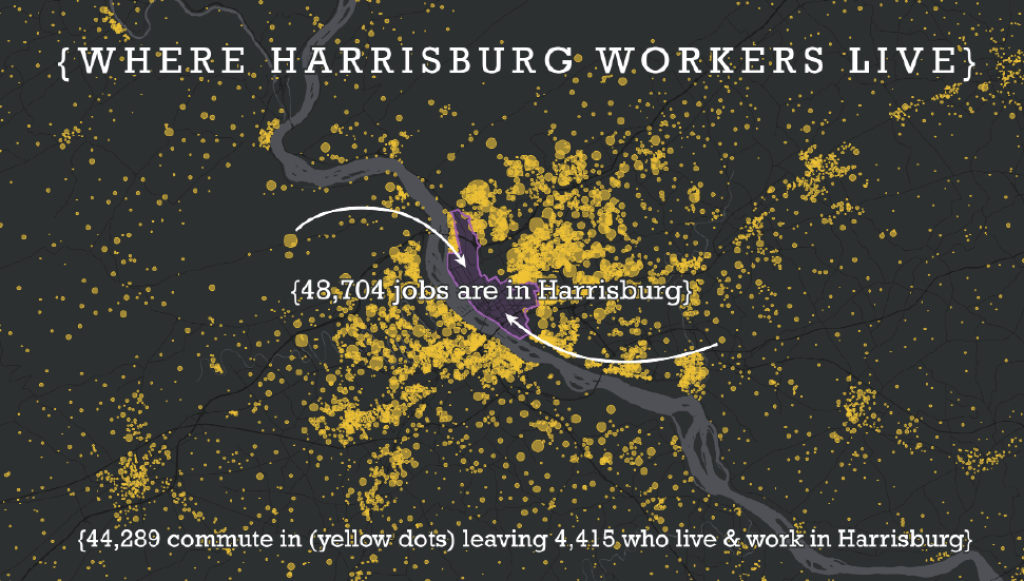
Who Works in Harrisburg? Our mapping project shows where commuters come from—and where they’re going.

Screenshot 2016-04-28 13.01.58Who works in Harrisburg?

Last year, when the city proposed a hike in the local services tax, from $1 to $3 per week, the age-old distinction between the capital’s residents and commuters reared its head.

The tax affects everyone who works in the city, regardless of where they live, with the exception of people below a set poverty threshold. But because an overwhelming number of the city’s workers commute, the local services tax is often branded a “commuter tax”—it’s one of the few means Pennsylvania’s third-class cities have of taxing people who work within their borders, but don’t live there. According to numbers provided by city hall, commuters paying the tax would outnumber residents by a ratio of 5 to 1.

How you view this statistic probably says a lot about how you view the relationship between the city and commuters. To some, it demonstrates how much the city depends on commuters for revenue—not only in the form of taxes, but in the money they spend on lunch at local restaurants and happy hours at local bars. “This mayor needs to keep in mind, all the revenue is coming from commuters,” one young commuter, who worked as a valet at the Hilton Harrisburg, told me in regards to the proposed hike back in December. “I hate to say it, but not much is coming from the residents.”

To others, it demonstrates how deeply people living outside the city depend on it as the region’s economic center and source of jobs.

This month, TheBurg teamed up with Stephen Cline of Urban 3D Modeling to help readers visualize the resident-commuter relationship in the form of an interactive map. Using data from OnTheMap, a U.S. Census Bureau program, Cline divided the city into nine neighborhoods and linked the number of jobs in each to the locations from which workers commute each day to reach them.

When you click on a neighborhood, you’ll see the total number of jobs, along with the distribution of city residents who hold them (in purple) and commuters (in yellow). Each circle on the map corresponds to an individual census block, the smallest unit available in the census data. Each circle’s size is proportionate to the number of workers who live on a given block and work in the selected neighborhood.

OnTheMap combines state employment data with demographic information collected by the federal government. It’s not a perfect representation of actual employment numbers and commuting distances. The source records cover about 95 percent of private sector jobs, plus most civilian federal jobs, but they exclude members of the military, U.S. postal workers and the self-employed. The program also uses “synthetic” data methods to keep workplace and residential information confidential. According to the Census Bureau, the OnTheMap data are “statistically analogous to actual worker counts and locations but not exact.”

For the interactive map, Cline grouped the jobs into nine city neighborhoods, based roughly on the zoning code and generally accepted geographic boundaries. Four of these neighborhoods—Uptown, Midtown, South Harrisburg and Allison Hill/Harrisburg East—are primarily residential, with an assortment of employers sprinkled among their living places. Employers in these areas include the businesses along 3rd and Maclay Streets in Midtown; the PinnacleHealth Polyclinic Campus and the Pennsylvania State System of Higher Education Uptown; Pennsy Supply and Paxton Street’s strip malls and auto dealers in South Harrisburg; and the Derry Street commercial corridor and the public schools in Allison Hill.

Most of the jobs, however, are in the areas we labeled as Downtown, the Capitol Complex and the Industrial Corridor. Our Industrial Corridor is the primarily non-residential district straddling Cameron Street between the Harrisburg Area Community College campus to the north and the Amtrak station to the south. It encompasses a range of employers including Capital Area Transit, HACC, Goodwill, Dayton Parts, K&D Factory Service and Consolidated Scrap Resources. The Capitol Complex captures the almost exclusively public administration jobs of the statehouse and state agencies, while Downtown adds lobbying, banking, and law and advertising firms, along with a high concentration of food and entertainment jobs, to the tally of additional state workers.

For some, the map and the census data may simply give statistical confirmation of something already observed while living or working here. (I’m thinking, for example, of the long lines of cars on 2nd and Forster each weekday between 4 and 5 p.m., waiting to cross over one of the bridges out of town.) But there may also be some surprises. It’s interesting to see the numbers of people who travel long distances to the city for work. I was also surprised to see that, in 2014, some 15,000 Harrisburg residents are estimated to have commuted to a job outside the city (a fact not reflected in the graphic, but available from the OnTheMap tool).

Most people, during their travel to and from work, probably don’t think of the municipal boundaries they’re crossing. But in a distressed city like Harrisburg, the border matters. When an employer creates jobs or relocates them to the city, is it any wonder that officials see dollar signs? Starting last September, the state Department of Human Services began moving its employees from a building just outside the city, on the State Hospital grounds, to the so-called Verizon Tower downtown. The floor-by-floor move-in, which continued through last month, will eventually bring nearly 800 workers to town.

The lease negotiations were led by the city’s state advisors, who, in an April 5 update to the Commonwealth Court, pointed to some of the benefits of the move. Among other things, they said, the new employees “will increase Local Service Tax to City by approximately $42,000 per year.”

Continue Reading

River Saver: Bill Cornell has dedicated his life to the Susquehanna River–and he’s just getting started.

Screenshot 2016-04-28 13.02.50Every morning when Bill Cornell wakes up, he looks out the window of his Wormleysburg home, and it’s there.

Some days, it’s flat and placid; others days it’s windswept and wavy. Nonetheless, the Susquehanna River is always there, just across the road from his front porch.

“Our river is truly a national treasure, something we need to save and protect,” said Cornell, a past president of the Harrisburg Riverboat Society.

Cornell’s river reverence involves more than just words. He is founder and director of the Susquehanna River School, a floating classroom for students of all ages focusing on the history and natural wonders of the Susquehanna, which runs a total of 444 miles between Cooperstown, N.Y., and the Chesapeake Bay.

He also initiated the Save Our Susquehanna, or SOS, campaign, an effort involving like-minded people, businesses and non-profit entities seeking greater protection of the river.

For Cornell’s work with SOS, the Pennsylvania Fish and Boat Commission recently awarded him its first-ever “Resource First Award.”

“Bill was an easy choice for this award,” said John Arway, the Fish and Boat Commission’s executive director. “He’s been a staunch supporter of the bass in the river. ‘Resource First’ is shorthand for our mission. It really means ‘protect, conserve and enhance our community’s resources.’”


It’s Not Enough

Two years ago, Cornell launched an SOS online petition drive to encourage state officials to clean up, save and protect the Susquehanna River.

The effort’s main goal is getting the state Department of Environmental Protection to list the river as an impaired waterway “so that real clean up can begin,” as the SOS website states. It also suggests using funds from a fracking severance tax for cleanup and protection of the river and its tributaries.

“After 20 years, I came to realize (the Susquehanna River School) is not enough,” said Cornell, explaining why he started SOS.

Arway was so impressed with Cornell’s SOS that he initiated a sister branch of the operation through the Fish and Boat Commission last June. The commission’s goal is to raise $50,000 in private donations that it plans to match. So far, $30,000 has been raised, Arway said.

The Fish and Boat Commission’s SOS project has several goals, including identifying possible contamination sites and working with willing farmers and colleges and universities to test soils and reduce nutrient and sediment runoff into the river. This could control nuisance algae blooms that produce low oxygen levels and high pH conditions harmful to young bass.

Another goal is to work with physicians and hospitals throughout the river basin to keep pharmaceutical drugs and other endocrine-disrupting chemicals out of the river because of the harmful effects on fish.

Coincidentally, it was Arway who snapped the notorious photo of a locally caught smallmouth bass bearing a large cancerous tumor in November 2014, an image that went viral. The Susquehanna’s young bass population has been plagued over the last decade by illness and elevated mortality rates due to river contamination, he said.

“The stuff that’s really hurting our rivers now you can’t see,” Cornell observed. “This used to be a bass fishing hot spot. Now it’s catch and release.”


Warming Up

Besides SOS, Cornell may be best known for starting the Susquehanna River School, a river-based environmental classroom that operates during the summer.

“The best way to learn about this is to get out on the river,” Cornell said. “It’s not something that’s taught in our schools.”

In fact, the River School was developed for Harrisburg school students, but now is open to anyone who wants to learn about the river.

“This is the longest river in the eastern United States,” Cornell said. “It has a tremendous history. Archeological digs have uncovered all sorts of artifacts. It proved that Native Americans lived on the shores of our river 10,000 years ago.”

Until now, all of the River School’s 75-minute cruises have taken place aboard the Pride of the Susquehanna riverboat, but that is scheduled to change in June, Cornell said. Earlier this year, the Riverboat Society purchased a sister boat from the Cedar Point Amusement Park in Sandusky, Ohio. Cornell found the 34-foot Sea Ark aluminum launch for sale on eBay.

“This can operate in 13 inches of water,” said Cornell. “It will be used for eco tours because it can go to places that the riverboat can’t.”

He then paused a minute to reflect on this new chapter of river exploration.

“I’m excited as all get-go,” he said. “I’m 63. I’d like to think that, at an age when other people would be consumed with retirement, I’m just warming up.”


To access Bill Cornell’s Save Our Susquehanna petition, visit www.sospennsylvania.org.

For information about the Pennsylvania Fish and Boat Commission’s Save our Susquehanna program, visit www.fishandboat.com/sos.htm.

For information about the Susquehanna River School, call 717-234-6500, visit www.harrisburgriverboat.com/riverschool or email [email protected]. You also may visit the Facebook page: The Susquehanna River School.

Continue Reading

River Dance: There was a time when Harrisburg tripped the barge fantastic.

Screenshot 2016-04-28 13.03.24It’s May, which means that the Harrisburg riverfront again comes alive with walkers, bicyclists and runners, with summer festivals not too far behind.

The waterfront, though, was once a hub of nightlife, as well. A century ago, local entrepreneur George K. Riest launched his first dance boat, testing whether city residents wished to mingle and dance on the river. They did, in large numbers.

What began as a boat equipped with a small dance floor soon expanded to a former coal barge outfitted with a band shell at one end, a nightclub at the other and a dance floor in the middle. A 1940 article in the Harrisburg Sunday Courier reported that the boat, which launched every year on Memorial Day, carried thousands of dancers up and down the Susquehanna during summer months.

According to anecdotes and newspaper archives, the boat was docked at the foot of Locust or Market streets. For a dime, revelers could dance the night away. The dance barge would go up to either Harris or Reily streets, a distance of about a mile, and float back. When the water was low, it instead would moor off of City Island. Smaller boats might drift closer to better hear the music, which would be provided by one of the fashionable orchestras in the area, led by the likes of Dan Gregory, Kay Kyser, Ted Brownagle or Red McCarthy.

Kansas City musician Andy Kirk described the experience of performing on the barge in his 1989 book “Twenty Years on Wheels.”

“On one of our dates, we were afloat,” he wrote. “We played on a barge, Reese’s [sic] Houseboat, on the Susquehanna River. We’d start at 8 o’clock in the evening, move out into midstream, then return at 9:30. We played at the pier before shoving off, and after coming to port while passengers came on and got off.”

Harrisburg danced on the river for several decades. Riest operated the barge until 1934. The USO took it over during World War II and ran a “floating club” at the foot of Locust Street each night, the Courier reported.

Riest, an avid riverman who sponsored the Kipona boat races for 25 years, died in 1940 at the age of 46.

“He was best known as the proprietor of the string of boathouses that remained docked along the riverfront off Locust Street throughout the summer months and for the operation until 1934 of a popular river dance boat,” The Evening News reported in his obituary. “The greater part of his life was spent on the river, and he was one of the originators of recreation on the Susquehanna.”

The boat is remembered fondly, if infrequently. The Dauphin County Historical Society’s records consist of a slim manila folder with five sheets of typing paper, and most memories are anecdotal.

Rabbi Carl Choper first heard about the dance barge from a 100-year-old woman in the course of his work as a chaplain at the Jewish Home of Greater Harrisburg.

“She started telling me about life for young people in the 1920s in Harrisburg,” Choper said.

She told him that the youth of the city would gather in Riverfront Park or at the three local dance halls: the Madrid, the Casino and the Coliseum.

At least one romance was kindled aboard the barge. Ken Frew, a historian at the Historical Society of Dauphin County, said his parents first noticed each other across the dance floor. His father was playing trumpet in the Dan Gregory band, and his mother was out dancing with her girlfriends. Later, they were introduced at one of the dance halls downtown.

Fae Morrison, 88, remembered only photos and her husband’s stories of playing the piano on the dance boat with his band, Al Morrison Music.

“I was a little girl at the time, and I knew there was a boat, but I wasn’t allowed to go. I was too young,” said Morrison, who said she was 10 or 12 at the time the boat was popular. She and Al, whom she describes as “one of Harrisburg’s favorites,” were married in the 1950s.

According to historian Erik Fasick’s recent book “Harrisburg and the Susquehanna River,” the barges also sometimes held events for children, including trips to the beaches on City Island and “kiddie hour dances.”

The early 20th century was a period of growth and development for Harrisburg’s riverfront, and Riest’s business sense served him well. The boat’s popularity coincided with city efforts to improve the steps at the foot of Locust Street and the walkways near the river, the Sunday Courier said.

The Susquehanna is still a focal point of recreation in Harrisburg. These days, however, sports—both individual and professional—hold sway over nightlife, making it difficult to believe that, for decades, an old coal barge carried happy dancers up and down the river.


Continue Reading

Musical Notes: Steamy Spring–It’s time to break a sweat.

In May, the first truly hot days of the year arrive in Harrisburg. When I hit the streets to go to the Broad Street Market during the day, or when I head to a local show at night, I know it’s likely that I’ll break a sweat.

When it comes to music, there are a lot of ways to work up a good sweat. The speedy finger picking and near-shouted vocals of bluegrass conjure up images of hot Appalachian summers. The soulful sound of bluesy chords is reminiscent of the balmy Delta. And sensual and romantic vocals sung over a bass-y beat seem best suited for hot, dark nights. However, know that whichever direction you choose, May in the Burg is a good month to moisten your brow to some excellent music.

COLEBROOK ROAD, 5/7, 8PM, ABBEY BAR, $7/$10: For all of you who think that bluegrass is an old-timey genre, Colebrook Road is out to prove you wrong. While many bluegrass bands rely on old standards to show off their chops, these local boys have made a name for themselves through a combination of incredible musical deftness and a penchant for original composition. Formed here in the midstate, they have taken their talents on the road and garnered praise from some of the leading bluegrass critics and festivals, including winning the 2016 D.C. Bluegrass Union’s Mid Atlantic Bluegrass Band Contest and the 2015 Podunk Bluegrass Festival Band Contest in Hebron, Conn. This month, they take the stage at the Abbey Bar to release their newest recording, “Halfway Between,” joined by featured guests Mountain Ride.

SHAWAN & THE WONTON w/BUZZARD LUCK, 5/14, 8:30PM, RIVER CITY BLUES, FREE: In conversation, Shawan is an unassuming young woman. But, when she starts to sing, her voice drips with a soul that is beyond her years. It doesn’t hurt that she’s backed by an incredibly talented band, inflecting her R&B intonation with jazzy keys and slick saxophone grooves. She’s become something of a local hero, never turning down a show and giving every performance her all. This month, she’ll be joined by York’s equally bluesy Buzzard Luck. The three-piece has mastered the jammy electrical blues that inspired classic rockers such as the Rolling Stones and Led Zep. Combined, both bands are guaranteed to get the crowd moving.

KATE FAUST w/ESKIMO WAV, 5/20, 9PM, STAGE ON HERR, $5: Kate Faust is an electro-backed sensual singer akin to Purity Ring or Niki and the Dove. She discovered her voice while singing in choirs as a student in Catholic school. Now, she sings over polyrhythmic, click-y beats and soft synth pads. Her music is dark but not heavy, romantic but not saccharine. She has a big voice that can be reined in for quieter moments, yet sours when left unrestrained. She hails from Philadelphia and has started to earn the praise of that city’s music critics, including WXPN and Philly’s City Paper. She is touring in support of her new EP “Eros” and will be joined by Eskimo Wav.

Mentionables: Jackson Howard, 5/8, Stage on Herr; Davey O., Suba Tapas Bar, 5/14; Southside Johnny & the Asbury Jukes, 5/20, Whitaker Center; Southern Culture on the Skids, 5/27, Abbey Bar; The April Skies, 5/28, Stage on Herr

Continue Reading

April News Digest

Road Plan Revealed

Harrisburg last month unveiled a plan to make major improvements to 6th, 7th and Division streets.

City Engineer Wayne Martin, along with consultant Craig Bachik, presented the results of a study to improve traffic flow and safety along those three major city arteries, a plan that includes adding traffic circles, building pedestrian bump-outs and increasing green space.

Martin said the plan was designed with pedestrians, bicyclists and motorists in mind, in that order.

The study was funded by a $27,000 grant from the Harrisburg Area Transportation Study, with an $8,000 matching grant from the Pennsylvania Higher Education Assistance Agency (PHEAA). It came about because PennDOT requested a study before the city proceeds with a plan to return N. 2nd Street to two-way traffic from Forster to Division streets, said Martin.

The proposed improvements include constructing a series of roundabouts at busy intersections, including at N. 7th and Division, N. 7th and Reily and on N. 6th Street in back of the Broad Street Market. Division Street would be redesigned as a boulevard, with a strip of green space in the middle of the road.

The proposal was created with input from “major impactors” along those roads, such as PHEAA, D&H Distributing and Vartan Group, said Bachik of New Cumberland-based Navarro & Wright Consulting Engineers. Neighborhood groups were not consulted, but the public will be able to have a say once the plan is presented to City Council this month, he said.

The improvements would cost about $30 million, said Martin, though the work likely would be done in pieces as transportation funding was secured.

Besides easing traffic, the improvements would help beautify the corridors, while boosting pedestrian safety, especially on N. 7th Street near PHEAA, said Martin.


 City Nominates 2 for CRW

City Council last month considered two city residents nominated by the Papenfuse administration to the board of Capital Region Water.

Garvey Presley Jr. and Charla J. Plaines appeared before council April 19 to discuss their qualifications to serve on the five-member board.

A confirmation vote was scheduled for April 27, after press time. If confirmed, Presley would fill one open seat while Plaines would fill a seat currently held by Bill Cluck.

Cluck, an environmental attorney whose five-year term expired in January 2015, urged council to think twice before replacing him, pointing to Capital Region Water’s financial turnaround and investment-grade bond rating under his tenure.

His plea seemed to find favor with some council members, such as Westburn Majors, who served with Cluck on the board before taking office this past January. “I think it would be a complete disservice if we don’t keep him,” Majors said.

Yet Mayor Eric Papenfuse, who is empowered to nominate board members with the advice and consent of council, said it was time to add fresh faces to the board to achieve greater diversity in membership and help with community outreach.

Plaines, a reentry coordinator at the Pennsylvania Commission on Crime and Delinquency, said she felt her skills were suited to making sure diverse voices in the community were more fully engaged in the authority’s decisions.

Presley, an equipment operator at the Derry Township wastewater treatment plant, said he had been interested in environmental work for most of his life and that his employment history made him a “natural fit” for the board.


Recovery Plan Brought to Vote

City Council scheduled a major vote on an updated Harrisburg recovery plan last month, setting the stage for the most comprehensive agreement to date on the mix of tax policies, personnel goals and government reforms needed to stabilize the city’s finances.

The state has asked the city to adopt the 115-page update in time for negotiations with its police and municipal employees unions, whose current labor contracts expire at the end of the calendar year.

An affirmative council vote would mark the first time the body has endorsed a comprehensive recovery plan, as opposed to the piecemeal votes for related legislation while the city was under state receivership in 2013.

The updated plan would count on increased revenue from a local services tax hike affecting residents and commuters and would have the city weigh a home rule charter initiative that could make recent earned income tax hikes permanent.

It would also direct a greater portion of any money recovered in lawsuits over incinerator-related borrowings to paying down the city’s current debt load.

The vote was scheduled for April 27, after press time. But Fred Reddig, the city’s coordinator under Act 47, said he was “optimistic that the plan is going to move forward” and that his team would be able to take it to court for approval.


Demolitions Begin

Harrisburg began razing condemned houses last month, vowing to accelerate the pace of demolitions.

The city is on pace to remove about 30 blighted structures this year, far more than in recent years due to a beefed-up sanitation staff. In past years, demolitions were often delayed as workers were pulled off jobs to assist in trash pickup.

Most demolitions are slated for properties in the Allison Hill and Uptown neighborhoods. In all, Harrisburg has several hundred condemned properties.


March Home Sales

The spring real estate market was off to a solid start in March, as sales ticked up compared to last year.

Regionally, sales totaled 647 units in March, 10 more than in the year-ago period, according to the Greater Harrisburg Association of Realtors (GHAR). The median price was down slightly to $155,000, but average days on the market plummeted to 86 from 106 last year.

Sales rose to 233 units from 202 on a year-over-year basis in Dauphin County. They fell slightly in Cumberland and Perry counties.

The median sales price in Dauphin County fell a bit compared to last March, to $136,000 from $139,000, though rose by about $5,000 per unit in both Cumberland and Perry counties, to $179,950 and $139,950, respectively, said GHAR.


So Noted

Harrisburg last month was awarded a $155,522 federal grant to help reduce crime in the Camp Curtin neighborhood. The Byrne Criminal Justice Innovation Grant will allow the city and several community partners to launch an initiative to lessen crime as part of a larger revitalization effort in the area, according to Tri County Community Action.

Harrisburg Area YMCA has purchased the historic Millers Mutual Group building at Forster and Front streets for $750,000. The Y made the purchase mostly to acquire land for more parking for the East Shore Y next door, but also plans to move its headquarters into the building, according to a joint press release. Millers Mutual stated that it will lease back the building from the Y until it can relocate to larger offices.

Park Harrisburg began booting vehicles last month to better enforce parking penalties on motorists with three or more outstanding warrants. The parking operator long planned to start a booting program, but was delayed until it could develop technology that would allow it to access city parking records, said the company.

Journal Multimedia, a homegrown, Harrisburg-based company that publishes the Central Penn Business Journal, was purchased last month by industry behemoth GateHouse Media, the owner of hundreds of daily, weekly and specialty newspapers. In addition to its flagship publication, Journal Multimedia publishes Central Penn Parent, Lehigh Valley Business and several other titles. It also has related custom publishing and events businesses.


Changing Hands

Briggs St., 225: S. & C. Aichele to B. Brock, $179,500

Brookwood St., 2619: R. Santangelo to B. Sweger, $57,500

Derry St., 1323 & 1325: U. Patel to T. & K. Yameogo, $85,000

Duke St., 2435: J. Smith to F. Zeray, $45,000

Fulton St., 1738: Secretary of Housing & Urban Development & Information Systems Network Corp. to PA Deals LLC, $65,250

Green St., 1925: W. Gonzalez to B. & A. Christensen, $216,500

Green St., 2416: F. Seidlich to J. & P. Manjon, $150,000

Green St., 3113: C. & B. Stone to B. Baker, $159,900

Green St., 3121: J. Meadowa to 8219 Ventures, $70,000

Logan St., 1619: L. Blanton & R. Parr to C. Grim, $89,000

Manada St., 1924: B. Vazquez to P. & T. O’Connell, $36,000

Market St., 1912: Secretary of Housing & Urban Development to Rogue Enterprises, $36,500

N. 2nd St., 2215: V. & J. Books to T. & J. Whye, $229,500

N. 2nd St., 2615: Secretary of Housing & Urban Development to TBF Properties LLC, $75,000

N. 2nd St., 2842: Arthur A. Kusic Real Estate Investments to T. Cook, $60,000

N. 3rd St., 3005: D. Bartolet to G. Dutson, $40,000

N. 4th St., 3015: D. Travitz to F. Gresson, $86,000

N. 5th St., 1738: CNC Realty Group to M. Meads, $85,000

N. 6th St., 3138: M. Naranjo to J. Crossett & M. Hochstetler, $50,000

N. 15th St., 1328: L. Mitchell to A. Rodriguez, $38,000

N. Front St., 805: Millers Capital Insurance Co. to Harrisburg Area YMCA, $750,000

N. Front St., 1013: M. Santalucia to B. Rota, $148,000

N. Front St., 1525, Unit 206: J. Feather to C. Wilson & K. Thompson, $85,000

N. Front St., 1525, Unit 604: Riverview Manor Association LP & Brickbox Enterprises Ltd. To D. Baker, $230,000

Paxton St., 1000: Sutliff Enterprises & K. Damitha to PinnacleHealth System, $3,600,000

Rose St., 933: F. Clark to GKX LLC, $235,000

Showers St., 581: R. Ross to M. Terry, $97,000

Showers St., 624: K. Hood to K. Kearn, $86,000

S. 13th St., 243: E. & A. Martinez to N. Srayi, $32,000

S. 18th St., 1117: Vanderbilt Mortgage & Finance Inc. to J. Frias, $30,535

S. 29th St., 630: P. Over to J. Guzman, $46,600

State St., 124: C. Smith to TKP Investments LLC, $175,000

State St., 1520: Federal National Mortgage Association to A. Moore, $31,000

Susquehanna St., 2136: Secretary of Housing & Urban Development to L. Marrazzo, $31,125

Swatara St., 2142: G. & J. Trump to R. Chowdhury & A. Nasrin, $49,500

Verbeke St., 232: K. Bentzel to Afterkey Property Solutions LLC, $60,000

Wyeth St., 1406: PA Deals LLC to J. & Y. Oskam, $113,900

Harrisburg property sales for March 2016, greater than $30,000. Source: Dauphin County. Data is assumed to be accurate.


Continue Reading

Greens Season: Celebrate spring with some tender veggies.

Screenshot 2016-04-28 13.13.06May is here and, every year, I am happy to leave the damp chill of March and April behind.


There’s no guarantee about weather, of course, but hopefully some warmth has returned, and farmers markets are finally showing signs of seasonal produce. Tender sprigs of homegrown asparagus, sweet green onions, sugar peas and pod peas are sneaking in amid the piles of squash and kale. By this time of year, my husband groans every time he sees another sprig of broccoli on his plate. And I am ready to celebrate spring in my kitchen.

May is a lovely time in Italy with warm, sunny days (especially in the south) and cool nights. There are no sunflowers yet, but bright red poppies dot the Tuscan and Umbrian countrysides. On the culinary side, many dishes focus on the bounty of the young growing season.

Asparagus and artichokes make their way into risottos, soups and pastas. Fresh herbs like rosemary and oregano are beginning to send out green and tender sprouts to be used on savory meats grilled over an open spit. Fennel, with its tender green fronds, flavors fish and salads with its strong taste of licorice. Young spinach leaves are perfect for egg fritattas.

In spring, Italians eagerly anticipate the arrival of fava beans, broad beans that resemble limas. Like asparagus, artichokes and peas, they are used in many recipes. But they require some effort to prepare—first extracting the beans from their pods and then peeling the skin that covers each tender bean. I have never been able to find fresh fava beans, so, for the recipe that follows and others like it, I substitute frozen baby lima beans, which are almost always available—and not like those of your youth!

Be on the lookout for two things for your spring recipes: “homegrown asparagus,” the thin tender spears prized by chefs, and the smallest baby peas you can find. The recipe below is a wonderful mix of spring vegetables mixed with baby arugula. It is spiced up with red pepper flakes and smoked cheese: scamorza, mozzarella or cheddar. (Scamorza is an Italian cow’s milk cheese shaped like provolone but similar to mozzarella.)

Cucina Italiana’s Primizie Verdi
(Green Spring Salad)

Ingredients

  • 5 tablespoons extra virgin olive oil
  • 1/8 teaspoon red pepper flakes
  • 1 1/3 cups tiny frozen lima beans
  • ½ pound green beans trimmed and halved crosswise (use the thinnest beans you can find)
  • 1 ½ cups baby peas (if using frozen, do not thaw)
  • 6 asparagus spears (look for tender thin to medium stalks) cut in quarters
  • 7 cups loosely packed arugula
  • 1 1/3 cups shredded smoked scamorza, smoked mozzarella or smoked cheddar cheese (use the largest holes of a box grater)


Recipe

  • In a small saucepan, combine oil and red pepper flakes. Heat over medium-low heat until the oil is warm and bubbles slightly. Remove from the heat to cool.
  • Bring a large saucepan of salted water to a boil and cook the baby lima beans according to package directions. When cooked, remove the beans from the boiling water with a slotted spoon and transfer to a colander. Rinse under cold water to stop the cooking and keep the limas bright green.
  • Add the green beans to the same water and then add the asparagus and cook 2 minutes more. Drain into a colander and let cool.
  • Place the arugula in a large, wide serving bowl. Add all of the cooked vegetables and ¼ teaspoon salt (sea salt if you have it) and half the shredded cheese.
  • Strain the red pepper oil through a small fine strainer over the salad and toss altogether.
  • Sprinkle with remaining cheese.

This is not your usual salad. The combination of bright green vegetables, smoked cheese and a zing of red pepper can be the centerpiece of a spring dinner. All you need to accompany it is a grilled chicken breast or steak, warm Italian rolls and a light, chilled Pinot Grigio or Orvieto.

These same spring vegetables (minus the arugula) can also be tossed with pasta, additional olive oil and some crushed garlic for a lovely pasta primavera. No cream sauce is needed. Enjoy spring’s bounty, which is so fleeting. Eggplant, tomatoes and zucchini will be here soon!


Continue Reading

Design Space: New Mitrani showroom shares a pattern for living.

Screenshot 2016-04-28 13.04.48Furniture stores may come and go, but not many transform from a large-scale retail operation into an intimate, one-of-kind showroom.


Mitrani at Home did just that, as husband-and-wife team Albert Mitrani and Donna Orbach opened their cozy, upscale furniture showroom in downtown Camp Hill last September, just months after closing their towering furniture retail store and warehouse on Walnut Street in Susquehanna Township.

The couple shut the retail site after 10 years partly because the building was for sale and neither wanted to buy it, Mitrani said. “Personal reasons” also were a factor, he noted.

“We thought we would leave the furniture business when the other store closed,” said Orbach, who’s designed living spaces for countless Mitrani customers. “I thought I would just do detail work after this.”

The move to Camp Hill, she stated, “was accidental.”

It started when Albert Mitrani took up yoga at the Just Plain Yoga Studio in Camp Hill in a building that includes the One Good Woman gift and coffee shop. Mitrani liked the building’s “really good vibe” and that businesses worked in tandem with each other, his wife recalled. It wasn’t long before Mitrani decided that he wanted to join them.


Magical Place

Stop by the new Mitrani showroom, and you’ll find items like vividly hued flat weave rugs and folk-art pottery bowls imported from Turkey. You’ll see living room tables designed from the beautifully rich roots of teakwood trees. There are antiques, artisan jewelry, books and other fine gifts.

“I think it’s a magical place,” said customer Ellen Kramer of Harrisburg. “They make living spaces that are easy and comfortable.”

For a long-time patron like Kramer, items like a one-of-a-kind coffee table from France keep her coming back.

“I fell in love with that coffee table as soon as I saw it, but I really didn’t need it,” she said. “I’d never seen anything like it. It was the sort of thing you’re never going to see again.”

Naturally, she ended up buying it.

Jamie Fulkroad’s favorite Mitrani purchase is a waterfall desk by Keno Bros., the twin-brother designer team known for appearances on PBS’s “Antiques Road Show.”

“The desk looks like one continuous piece of wood. I just love it,” enthused Fulkroad of Susquehanna Township.

Linda McKay was entranced by Mitrani’s four-foot wide “Spaceship” light fixture with tiny glass panels. It now hangs in her home.

“Their stuff is so interesting,” said McKay of Mechanicsburg. “Albert got us a beautiful antique rug from Turkey, too. Once you start shopping there, you can’t stop.”


Amazing Eye

Mitrani, a native of Turkey, regularly travels across the globe as an international salesman for American Leather furniture, which is sold in the Camp Hill showroom. During his travels, Mitrani always keeps an eye open for unusual home items that might captivate showroom customers back home.

“This is a very, very different experience from the retail store,” said Orbach. “We feature great prices and turn over our store inventory in eight weeks so people always can come back and see what’s new. Most furniture stores have become like warehouses. This is a very intimate shopping experience. We try so hard to figure out how people live so we can give them exactly what they want.”

Mitrani deals more with the business’ day-to-day operations, Orbach said, while she focuses more on design aspects. When Kramer and husband Shalom Staub moved into their home as newlyweds seven years ago, they commissioned Orbach and her “eye” for a designer’s walkthrough.

“She has an amazing ability to step back and see things others don’t see,” Kramer said.

McKay recalled how Orbach redecorated her entire house, room by room, over the course of several years.

“We bought a semi-circle couch, and Donna recommended a game table to go with it that was really beautiful,” she said. “I never would have thought of doing that, but it really brought the room together. Then she found great chairs that really complemented our lighting.”

When Fulkroad envisioned a painting of a man, woman and dog hanging in her home, Orbach managed to commission exactly that from an artist in Florida.

“Albert and Donna are wonderful people,” Fulkroad said. “We are very lucky to know them.”

Apparently, the feeling is mutual.

“We genuinely like getting to know people the people who come here,” Orbach said. “We consider them our friends.”

Mitrani at Home is located at 1845 Market St., Camp Hill (entrance on 19th Street). For more information, call 717-526-7930 or visit www.mitraniathome.com.

Continue Reading

Brewed in the Burbs: Business is hopping at Harty Brewing Co.

In recent years, a small community called Walden has taken shape just off the beaten path among the rural roads of Silver Spring Township.

The charming, “New Urban” neighborhood was specially designed by Charter Homes for the convenience of residents, with parks and shops offering everything from apparel to salon services to pet grooming to dining, all within walking distance.

Lauren Ishaq and Michael Harty live in a nearby neighborhood and would often visit the development to dine at the popular eatery, Sophia’s at Walden. When Ishaq learned that an 848-square-foot space was available within a stone’s throw of the restaurant, she set the wheels in motion to fulfill a dream.

Harty smiles as he bustles about, hauling in supplies from Scotzin Brothers and listening to Ishaq tell the simple story that launched the business.

“I fell in love with this space, and Michael was a home brewer and I said, ‘Hey, by the way, we have a meeting with Charter Homes in two weeks.’”

It’s not as if the couple didn’t have enough on their plates already.

In addition to parenting three children (Leah, 9, Jackie, 7, and Jordan, 3), Ishaq was attending school full-time, and Harty (still) works full time as an operations supervisor at Three Mile Island.

Something had to give, so, for Ishaq, it was school, a decision she has yet to regret. The businesswoman said she loves every minute of what she’s doing now, which is tending to front-of-the-house duties, while Harty brings his passion to the back of the house.

“For me, brewing doesn’t feel like work,” he said. “It’s far away from my serious and technical day job.”

It took the couple about a year and a half to go from concept to reality, and they opened their doors to the public in February.

“When you lease a space with Charter Homes, they have to approve your style, so it fits in with the community,” said Ishaq. “I found ideas on Pinterest, took pictures and presented the design team with my ideas.”

The interior fits into the “industrial chic” category, with varnished, reclaimed wood, rustic pendant lighting and a brick back wall that is reminiscent of an old “ghost sign,” emblazoned with the Harty logo done in white paint.

During the planning stages, Ishaq reached out to others in the brewing business like Brandalynn Armstrong, who runs Zeroday Brewing Co. in Harrisburg.

“Getting into the male-dominated industry is overwhelming, so it was easier for her to talk to a female with real-life experience,” said Armstrong. “They make a really good product and are set up to meet both their expectations and those of the community. So, it makes sense that they will be very successful.”

The taproom seats about 30, with bars overlooking floor-to-ceiling windows. The main bar faces away from the street, and that’s where Ishaq dispenses beer, wine and cider to her customers. A chalkboard lists the day’s offerings. During my visit, the roster included an American Pale Ale, an India Pale Ale, an Oatmeal Stout, a New Zealand IPA, Big Hill cider and a variety of wines from the Allegro Winery in York County.

As for food, Ishaq offers just hot dogs and chips, preferring to concentrate on the libations. For customers who prefer something a little more substantial, she has that covered.

“We’re partnering with Sophia’s at Walden,” she said. “The customer places their order, we call it in, and their staff walks it over.”

Owner Sophia Nelms said the arrangement is working out well.

“We’re a BYOB, and they’re getting ready to can their beer, so the customer can bring it here too, which will be nice,” she said. “We want them to be successful, so, between their great beer and our great food, we mix together nicely.”

Harty’s friend Chris Harvey, who also homebrews, said that Harty’s chemical engineering background has served him well in turning out a quality product.

“That really sets the bar on how great a brewer he is. They’ve created a unique, special place, which works well in the community,” said Harvey, adding that the atmosphere promotes socialization, meeting people and making new friends.

The couple said that business has been brisk and outside seating will soon be available. For now, hours are limited to Wednesday and Thursday, 11 a.m. to 4 p.m., Friday, 6 to 11 p.m., and Saturday, 1 to 11 p.m., a schedule that enables them to strike the right balance between work and family.

“People have been so receptive,” said Ishaq. “I really do feel blessed.”

Harty Brewing Co. is located at 146 Walden Way, Mechanicsburg. For more information, visit www.hartybrewco.com or their Facebook page.

Continue Reading

A Healthier Community: We must work together to halt the crisis of prescription drug abuse.

Screenshot 2016-04-28 12.54.55Prescription painkiller overdoses claim 44 lives in the United States every day, according to the Centers for Disease Control and Prevention. Such overdoses top the list of deadliest injuries for Pennsylvanians, even surpassing car accidents, according to the Pennsylvania Medical Society.

Much of this crisis is related to prescription opioid pain relievers (opioids). Medications that fall within this class include hydrocodone (e.g., Vicodin), oxycodone (e.g., OxyContin, Percocet), morphine (e.g., Kadian, Avinza), codeine and related drugs.

While opioids have an important role to play in pain management, dependence, addiction and overdoses are a growing concern throughout the nation and in our communities. Education and prevention are crucial to fighting this epidemic.


Understanding Addiction

According to the CDC, more than 1 in 4 patients with chronic pain experience opioid dependence. Dependence means that you need the drug to function normally and stopping the drug can cause withdrawal symptoms. A person may have a physical dependence on a substance without having an addiction.

Addiction, according to the National Institute on Drug Abuse (NIDA), can include physical dependence and is distinguished by compulsive drug seeking and use despite sometimes devastating consequences. More than 2 million people in the United States are addicted to prescription opiates, according to The World Health Organization. Tolerance to a drug (needing a higher dose to attain the same effect) is usually part of addiction.

Many people do not understand why or how other people become addicted to drugs. Often, it is mistakenly attributed to moral weakness or a lack of willpower. But growing evidence shows that neither is true—addiction is a complex disease that causes significant changes in the brain. Plus, a family history of addiction, mental health issues and other chronic issues can put a person at higher risk.

There’s also growing evidence that drug abuse and addiction that starts with prescription painkillers can lead to illegal drug use. According to NIDA, nearly half of young people who inject heroin reported abusing prescription opioids before starting to use heroin. Some individuals reported taking up heroin because it is cheaper and easier to obtain than prescription opioids.


A Difference Locally

As a community, we must work together to protect lives. Over the past few years, state government, professional groups, physicians and hospitals have been actively engaged in a coordinated response to prevent addiction, better treat those who are opioid dependent and prevent overdose deaths.

These actions are being reflected in changing doctor-patient relationships. You may notice that physicians, dentists and other healthcare providers ask more questions about your pain, recommend alternative medications for pain control, or take other actions to prevent the nonmedical use and abuse of prescription narcotics.

For instance, PinnacleHealth Medical Group is taking steps to help halt the opioid abuse epidemic. These efforts include conducting drug screenings during patient appointments, performing pill counts during appointments to ensure patients are taking drugs as prescribed, permitting only patients with photo identification to pick up prescriptions, and requiring patients to sign a controlled substance agreement if taking an opioid for more than 30 days.

Patient education about steps such as these and why they are being taken is an important part of a successful relationship with your physician and other members of your healthcare team. More importantly, open communication between patients and providers is a cornerstone of medication safety, particularly in preventing opioid abuse. Never hesitate to ask questions or voice a concern.

Patients that are taking opioids are encouraged to talk with their provider about how often they are taking their opioid medication and why they may be taking more than prescribed.


Working Together

Drug addiction is a preventable disease. According to NIDA, prevention programs involving families, schools, communities and the media are effective in reducing drug abuse.

For young people, studies show that their drug taking does decrease when they understand it to be harmful. Therefore, it’s up to all of us to help young people understand the risk of drug abuse through education and outreach.

But drug abuse can affect anyone at any age. Therefore, our obligation for education and frank discussion extends well beyond our youth. Medical professionals, hospitals, teachers, parents, community leaders and others must continue to encourage careful use of prescription painkillers and advocate for prevention of drug abuse in both young people and adults.

Michael A. Young is president and CEO of PinnacleHealth System, one of TheBurg’s community publishers.

Continue Reading