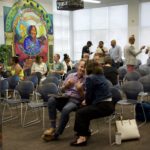
Heart of the Matter: Increasingly, our community is taking heart health seriously.

Screenshot 2017-01-31 08.16.04The heart of a community is its good health.

When we’re healthy together, we can build businesses, learn new things, participate in activities, strengthen our community through volunteerism and so much more. Illness, on the other hand, prevents us from being productive. It impacts our ability to work, volunteer and be engaged.

One of the greatest assets to our collective good health is having a healthy heart. February is National Heart Month, and it’s a great way to bring awareness to our hearts and keeping our hearts healthy. Sadly, heart disease is still the number-one reason both men and women die in the United States.

Coronary artery disease is the most common type of heart disease we face. Many people with the disease feel chest pain and discomfort in the early stages. For other people, the first sign is a heart attack. Long before we get to that stage, there are things we can do to lower our risk for coronary artery disease.

One of the easiest ways to improve your heart health is being aware of how important your heart is to feeling good and living a quality life. If you’re in constant pain or discomfort, odds are you are not going to be active in your community or productive at work. If you have any concerns about your heart or how you’re feeling, always check in with a doctor. Any illness or disease is always better managed when it’s caught early.

Like reducing the risk for many other diseases, the secret to having a healthy heart is no secret: eat a balanced, healthy diet, exercise and make better lifestyle choices. These choices include avoiding tobacco use and secondhand smoke and drinking in moderation (or avoiding alcohol entirely).

If you have already been diagnosed with heart disease, ask your doctor if you need to limit exercise. However, for most people, even those with moderate heart disease, walking is a great form of exercise. It’s easy on the joints and can be as easy or challenging as you wish. Regular moderate exercise has been shown to reduce blood pressure, cholesterol and other risks for heart disease.

Plus, walking is available to everyone in our community. Many organizations, including PinnacleHealth’s West Shore campus, offer walking trails on their premises. In central PA, we have access to City Island, Front Street and beautiful parks that offer enjoyable walks. If you have a dog, he or she would certainly appreciate a stroll to get exercise and also enjoy some mental stimulation.

Walking is also a great way to give back to the community. Throughout the year, many charitable organizations sponsor walks to raise money for their worthy causes. An organized walk is a fun way to stay motivated and get family and friends involved.

Going for a walk is an option no matter what the weather holds. If you have a gym membership, a treadmill is a great way to keep walking. As treadmill technology improves, many are including tools to provide interest and keep you motivated, like screens that simulate beautiful scenery. If you don’t have access to a treadmill, many local malls open early to allow people to go for a walk out of the elements.

Add good food choices to exercise to really help your heart. Fruits, vegetables and whole grains are staples in a healthy diet. As a community, we are starting to do a better job in making healthier options available.

We are lucky to have several farmers markets in our area that offer fresh produce in season, which makes it more affordable. Frozen vegetables and fruits are also nutritious options.

If you’re not sure how to shop or how to prepare healthy food, check with your local grocery store, hospital, community center or food pantry. Many offer healthy shopping tours, free or reduced-cost healthy cooking classes, and instruction on making healthier food choices.

As we celebrate American Heart Month, I encourage you to talk with family, neighbors and friends about improving heart health. Work together for ideas on exercise, better eating and keeping one another motivated. Many free and low-cost activities will be available to commemorate Heart Month, so take advantage of them to jumpstart your pursuit of a healthy heart. Together, we can build better health and create the foundation for a vibrant, productive community.  

Michael A. Young is president and CEO of PinnacleHealth System, one of TheBurg’s community publishers.
Continue Reading

Worth of a Man: Freedom, identity explored in “Father Comes Home.”

Leonard Dozier

Leonard Dozier

How does a man define his own worth?

That is the question at the core of “Father Comes Home from the Wars (Parts 1, 2 & 3),” a play set in the Civil War-era and running this month at Open Stage of Harrisburg.

“Father Comes Home” focuses on Hero, a slave in Texas, who has to choose between staying home with his wife and joining his master and fighting for the South in return for his freedom. The play offers a moving insight into the epic journey of a slave coming to terms with what it means to be free—and if freedom is even desired.

Leonard Dozier, who returns to Open Stage of Harrisburg in the role of Hero, explains why the focal character struggles with the possibility of freedom.

“Being a lifelong slave, slavery is all that is known,” he said. “He equates slavery with value—he is worth something. If he is free, he’s free to do what? Free from value? Freedom is the unknown. Freedom represents no value. Freedom represents losing all sense of one’s self.”

Written by Suzan-Lori Parks, the first African-American woman to receive the Pulitzer Prize for Drama, “Father Comes Home from the Wars (Parts 1, 2, & 3)” is the first three of a nine-play cycle, which begins with the Civil War and ends in modern times.

Dozier is excited by the concept of the show.

“Each of these ‘acts’ represents a totally different thematic concept,” he said. “Each part is really its own play. I think it’s neat—the idea that the audience is watching this ‘miniseries’ in one night and yet it moves fluently, poetically, historically, dramatically.”

The first part of the play, “The Measure of a Man,” focuses on the difficult choice facing Hero. Should he fight for the South and trust that his master will deliver on his promise of freedom or stand his moral ground and stay at home with his wife? The question—and which answer Hero should choose—is discussed, in detail, by Hero and his fellow slaves. Part 1 tackles the personal effects and impossible situation of slavery head-on.

In the second part of the play, “A Battle in the Wilderness,” Hero faces a white, imprisoned Union soldier who is guarded by his master, now a colonel in the Confederate army. The plight of the slave is discussed both by the Colonel and his prisoner, named Smith—and by Smith and Hero. Hero finds himself examining his self-worth, unable to comprehend a life in which he’s free, while Smith works to open his mind to the possibility.

The third part, “The Union of My Confederate Parts,” returns to Texas, where Hero’s wife and Homer, a fellow slave, are harboring three runaway slaves. Hero’s return is preceded by the tale of the last year and a half from the perspective of Odd-See, Hero’s dog. Only Hero is now Ulysses, having changed his name on his journey. With his trek complete, and the Emancipation Proclamation in place, Hero-turned-Ulysses still struggles to imagine a future where he is free.

The themes of the show are timeless.

“I do think, particularly with this political and cultural climate we’re in, we’re very much revisiting the divide this country has known,” said Dozier. “That division magnified against the backdrop of the Civil War will provide real food for thought as to how we can potentially avoid another one.”

At times deeply moving and unexpectedly comedic, “Father Comes Home from the Wars (Parts 1, 2 & 3)” is a play resonant throughout time, tackling issues that have carried through from the Civil War to today.

“If you love a war story, a love story, this is a play to see,” Dozier said. “It really paints an alternative view of history that is provoking and challenging.”

“Father Comes Home” also features Tanisha Hollis, Louis Riley III, Mark Douglas Cuddy, Aaron Bomar, Ciera Spencer, Diane L. Hetes, Caliph White, Ron Chapel and Jedidiah Franklin.

“Father Comes Home” was named the winner of the 2015 Edward M. Kennedy Prize for Drama and was a finalist for the 2015 Pulitzer Prize for Drama.

“Father Comes Home from the Wars (Parts 1, 2 & 3)” runs Feb. 3 to 26 at Open Stage of Harrisburg, 25 N. Court St., Harrisburg. Tickets and information are available at www.openstagehbg.com.

Upcoming Theater Events

Open Stage of Harrisburg

www.openstagehbg.com

“Father Comes Home from the Wars (Parts 1, 2, & 3)”
A new play by Suzan-Lori Parks
Feb. 3 to 26

Studio Workshop at Open Stage
Free evenings of one-act plays
March 8 & 9 at 7:30 p.m.
No reservations required

Sundae Best Variety Show
March 11 & 12 at 7:30 p.m.
At Open Stage of Harrisburg

“The Diary of Anne Frank”
Open Stage’s 18th annual production
At Whitaker Center
Sunday, March 12 at 2 p.m.

Author: Laura Dugan

Continue Reading

Hey, Ms. DJ: Lei Row may roam, but Harrisburg is always home.

Photo by Leon Laing

Photo by Leon Laing

The melodic lyrics of Stevie Wonder’s “Ribbon in the Sky” play in the background of the local eatery where I meet the “urban retro songstress” Leilanda Rowland.

Her natural hair falls around her black-frame glasses. Her easy-going demeanor matches the easy-listening selections playing by chance. The smooth style reminds me of the melodic lyrics and retro inspiration Rowland is known for.

As a singer, Rowland’s urban retro sound has entertained East Coast audiences from The Sugar Bar, a New York City club owned by Motown legends Ashford & Simpson, to the Miami Music Festival. She’s collaborated with artists, producers and songwriters as far away as France.

But the Harrisburg native always finds her way back home.

After she graduated from Bishop McDevitt High School, Rowland studied communications at Millersville University in Lancaster County. She then moved further east to Philadelphia, where she received a master’s degree in higher education administration from Drexel University.

She’s played the career ladder game, working in student affairs at Penn State Harrisburg and admissions at ITT Tech. But, ultimately, she decided pursue her musical passions fulltime. She calls leaving the 9-to-5 grind in 2015 the best thing to happen to her.

“It was scary, but a blessing in disguise,” she said.  

On Her Craft

The career change allowed Rowland to zero in on DJing, singing and songwriting.

Under the moniker Lei Row, she dropped her first mixtape, “Lei Row Presents Euphoria,” in 2010 after she and her fiancé broke up. Her vocals effortlessly ride the beats of the late hip-hop producer J Dilla in “Luvwounds” and “Luvstruction.”  

Four years later, Rowland released the mixtape “Urban Retro Life Volume 1.” This recording, she said, draws from different topics like spirituality and relationships, which are recurring themes. The mid-tempo song, “How I Feel,” addresses expressing feelings in a relationship. Her airy, ethereal voice sings lyrics like, “If you only knew how my heart beats inside.”

In 2012, Rowland coined the nickname DJ worrieL (Lei Row spelled backward) and joined the ranks of the few women in Harrisburg’s DJing scene. She draws inspiration from women DJs like DJ Spinderella of iconic hip-hop duo Salt-N-Pepa and the legendary DJ Cocoa Chanelle.

Undaunted by the male-dominated industry, Rowland focuses more on her craft and less on her gender. She spins hip-hop and rhythm and blues. She’s open to other music genres, as well.

Daisha Hunter, a Harrisburg native and DJ, said the area’s lack of women DJs reflects the situation nationally.

“Hip-hop is a male-dominated culture, so you’ll see that reflected in the elements of hip-hop, DJing being one of them,” she said.

She then added, “There isn’t a shortage of females wanting to DJ.”

Rowland gives props to local male DJs such as Alf Dawg, Godfather and Herbie Hall. She would watch her cousin Alf Dawg spin at Mr. Mike’s Records.

“DJ Alf Dawg took me under his wing,” she said.

A Blessing

The mentorship she’s found in Harrisburg has helped her find success in this market.

She reached a high point DJing when she played to her biggest crowd to date at the city’s 2014 New Year’s Eve celebration. She also opened when rap veteran Slick Rick performed in Harrisburg in 2013. She’s performed all over the city, even at summer community events in Hall Manor.

Harrisburg-based singer and songwriter Dexter Kendrick calls her a visionary.

“We’ve worked together behind the scenes as a sounding board for each other’s creative pursuits,” Kendrick said. “Lei is always excited, creating and willing to lend an ear.”  

She calls Philadelphia, where she used to live, a second stomping ground. She took a six-week course with Scratch DJ Academy in Philly, a school co-developed by Jam Master Jay of Run-D.M.C. She’s a member of Philly’s chapter of The Recording Academy.

When she’s not DJing, singing or writing songs, she drives in Philadelphia for Lyft, a ride-sharing service like Uber.

“It places me in that market,” she said about being in a large urban music scene. “While I’m there, I really make most of my time.”

She drives and performs in Philly and received her advanced education there, but she always makes her way home.

“Being here is a blessing,” she said about living in Harrisburg.

Find Leilanda Rowland’s music on SoundCloud at www.soundcloud.com/leirow.

Author: Leon Laing

Continue Reading

Deliciously Bad: At a Down in Front show, first comes the cringe, then comes the laughter.

Screenshot 2017-01-31 08.22.30Most moviegoers don’t enjoy when other audience members talk loudly during a film. But at Midtown Cinema’s monthly improv show, “Down in Front,” people pay for just that.

At each Down in Front event, performers let loose during a notoriously bad B-movie. The month’s film must fulfill one requirement—it can’t be too self-aware. It must be “earnest” in its awfulness, said Stuart Landon, a core DIF member and director of community engagement at Midtown Cinema.

For instance, in December, for the fourth year in a row, DIF featured the 1964 film “Santa Claus Conquers the Martians.” Before the show, crowlers of Zeroday Brewing Co. beer cracked open to help warm the funny bone as the night’s four performers—Jennie Adams, Matt Golden, Felicia O’Toole and David Ramon Zayas—mingled at the front of the room.

Shortly after 9:30 p.m., Adams gave a short introduction to a sold-out room, the lights dimmed, and the whole cast announced, “Down in front!” as they sat down with their microphones. The roasting of “Santa Claus Conquers the Martians”—chock full of cheesy dialogue, creepy characters, offensive makeup and bad special effects—was underway.

Different Moods

When Landon became Midtown Cinema’s community engagement director, he looked to other arthouse cinemas around the country to see what they were doing to connect with the public.

“It was one of those group efforts back in the day when I first started at the cinema as the manager,” Landon said. “Many of us were big fans of ‘Mystery Science Theater 3000.’”

“Mystery Science Theater 3000” was a quirky 1980s and ‘90s TV series in which a janitor, trapped in a theater, is forced by his mad scientist overlords to watch bad movies. To preserve his sanity, he builds robots to keep him company, and, together, they mock the awful dialogue, sets, acting and everything else.

The first Down in Front show took place in the fall of 2013 with the screening of the cult classic, “Little Shop of Horrors.”

“It was the first piece of programming we did that wasn’t our normal programming,” Landon said, adding that it took about a year before they attracted consistent crowds.

Landon recruited Adams, who was involved in local improv. Within the first year, the two founders and Golden became the core company of DIF. At first, they emulated the three-performer format of “Mystery Science Theater 3000.” Instead of two robots and a man, though, “it was two gays and Jennie,” Landon joked.

Today, they perform with a fourth guest each month, agreeing that an extra person helps to balance different moods.

Throughout DIF’s three-year history, a few “deliciously bad” movies have become yearly staples, like “Santa Claus Conquers the Martians,” “Plan 9 from Outer Space” and “Trolls 2.”

For the rest of the schedule, Landon, Adams and Golden have an ongoing Facebook thread to brainstorm and pick movies a few months in advance, Golden said. The team has learned from experience that the films have to meet a universal standard of bad.

The group showed “The Notebook” a few years ago in honor of Valentine’s Day, even though Adams was reluctant because “people really love that movie.”

On another occasion, they chose “The Creature from the Black Lagoon.” During the show, an audience member, misunderstanding the premise, got angry at the performers for talking over the movie and left.

So, now, we make a statement before each show: ‘We will be talking into microphones and making fun of this. If it is your favorite film, you can leave now and get a refund!’” Golden said.

Collaboration & Community

The improvisers donate their time to each show, but the close-knit nature of the Harrisburg theater community has helped build a diverse roster of regular and enthusiastic performers.

“It’s been nice to pull different improvisers and comedians from different groups around this little community, which is crazy that there’s so much comedy in such a small city,” said Adams, who also is the education director at the Harrisburg Improv Theater.

Generally, they don’t prepare much for each show or watch the films beforehand. In the case of “Santa Claus Conquers the Martians,” though, it was the fourth time Golden and Adams were witnessing the atrocity.

“Oh, I’m dreading it!” Adams said.

Nevertheless, they were able to feed off O’Toole, Ramon Zayas and the audience to come up with new jokes.

O’Toole, a local drag performer and co-creator of the Sundae Best Variety Show, compared DIF to what she does in her living room watching terrible movies with her roommate.

“This honestly doesn’t make me nervous,” she said.

The goal is simple, O’Toole said.

“People have so much stuff going on in their lives,” she said. “If I can give them two hours of a show at Down in Front where they can just forget about that and laugh, yeah, that makes me feel good.”

Down in Front performs monthly at Midtown Cinema, 250 Reily St., Harrisburg. The next show is slated for Feb. 10 at 9:30 p.m. For more information, visit www.midtowncinema.com.

Author: Rebecca Oken

Continue Reading

Beacon of Care: Beacon Clinic marks 2 years of providing health care for greater Harrisburg.

Screenshot 2017-01-31 08.17.59To Maggie of Camp Hill, the Beacon Clinic for Health and Hope in Harrisburg is the sort of place that made her feel “in right place as soon as I opened the door.”

The primary healthcare clinic, located in the rear of St. Paul’s Episcopal Church, offers free services to adults. To qualify, one only needs to be 18 or older with photo ID, said Ruth Stoll, the clinic’s director of development.

Maggie, who asked that her last name not be used, said she first heard about Beacon Clinic on the radio. At the time, she thought she might want to volunteer there after finishing nursing studies at HACC.

Life, however, took a different course.

Maggie has lived in the United States for 13 years, but was forced to return to her native Kenya when her mother fell ill and eventually died. During her travels, she missed two appointments with her doctor in the Harrisburg area. Per office policy, she was dropped as a patient from her doctor’s practice because of the broken appointments.

After she returned to the country, her blood pressure skyrocketed, forcing her to seek treatment at a hospital emergency room. When the emergency room physician advised her to follow through with her family doctor, she realized that she had yet another problem. She no longer had a family doctor.

“Then I remembered this clinic where I wanted to volunteer,” she said. “I called and had an appointment within an hour. Other places I called said I would have to wait a month for an appointment, and I couldn’t wait.”

At first, Maggie felt “uncomfortable” going to Beacon Clinic, she said, because, “All my life, I’ve provided for myself.” But then she told herself, “If they provide services for free, then they must be beautiful people.”

As it turned out, Maggie was right. The staff and volunteers at Beacon made her feel right at home.

“I don’t feel like a patient when I come,” she said. “I feel like I’m visiting someone’s home. I can’t say enough about the staff here. It’s wonderful.”

Given the recent loss of Maggie’s mother, Beacon Clinic also assisted her with grief counseling.

“We’re interested in treating the whole person,” Stoll said.

Hard Work

Beacon Clinic began as an idea in 2011 from Stoll, nurse Paula Green and nurse anesthetist/acupuncture therapist Rosalie Lambeth.

At the time, Stoll was on the board of directors for Hope Within, a community health center in Elizabethtown that offers free primary health care services in Lancaster and Dauphin counties.

The women set things in motion with a task force that included local pastors and other community members.

“We were trying to decide what to do and where,” Stoll said. “We surveyed around the soup kitchen and the Neighborhood Center and the Bethesda Mission. We found that 33 percent of those we surveyed didn’t have health insurance.”

The task force began looking for a suitable, ADA-accessible site to open a free clinic in Harrisburg, but members soon found that most churches didn’t meet ADA regulations or charged rent that was beyond their means. Finally, in 2014, they settled on renting space in St. Paul’s Episcopal Church’s education extension.

This came with more work. The area was in disrepair, and organizers needed money and supplies to make things happen. The clinic’s staff and board of directors spearheaded the renovations.

“It took lots of hard work by everyone here,” Stoll said.

The Foundation for Enhancing Communities and the Wells Foundation provided seed money, and the John Crain Kunkel Foundation helped support renovation of the clinic’s education room.

After much work and preparation, Beacon Clinic opened in March 2015. By December 2016, it had served 346 patients, 190 of those on a continuing basis. Many of the uninsured come with untreated, long-term health issues.

“It’s amazing how many people I see with hypertension,” commented Kay Huber, a certified nurse practitioner.

The clinic continues to run mostly on contributions from churches, businesses and individuals, plus grants. PinnacleHealth has provided $20,000 over two years to pay for patient diagnostic that must be done outside of the clinic, such as blood work and X-rays.

“We’re not here to keep people dependent,” Stoll said. “We’re here to help people help themselves.”

The clinic recently completed renovations on a community education space with funding from the Kunkel Foundation, Stoll said. Administrators hope to begin diabetes classes and a support group early this year, as well as addiction prevention classes for youth. Cooking and nutrition classes also are in the works.

Stoll said she has “learned a lot” by organizing and working in the clinic.

“It’s phenomenal,” she said. “I learned the most about how to appreciate the people who come here, what they’ve gone through, and that they’re still living and hoping and that we can provide concrete care with hope.”

The Beacon Clinic is located at 248 Seneca St., Harrisburg, at the rear of St. Paul’s Episcopal Church, and is open Tuesdays, 3 to 7 p.m., and Thursdays, 10 a.m. to 7 p.m. For information, call 717-775-1111 or visit www.beaconclinicpa.org.

Author: Phyllis Zimmerman

Continue Reading

Your Beer Is Ready: At Ever Grain, a service call means a well-poured pint.

Screenshot 2017-01-31 08.20.06Craft breweries have become masters at repurposing former industrial spaces.

Local beer-lovers, for instance, are now downing IPAs, saisons and stouts inside a former plasma center, an old machine shop and a long-defunct lumber mill (Zeroday Brewing Co., Boneshire Brew Works and the Millworks brewery, respectively).

Since late September, you can add to that list a repair garage, as Ever Grain Brewing Co. opened in what used to be the service bay of the former Sun Motor Cars dealership along the Carlisle Pike, a stretch long identified with all-things auto.

Proprietors Norm Fromm and Larry Dolan are locals who’ve known each other for more than 30 years. Both come from the restaurant industry, are avid craft beer fans and former home brewers. They saw an opportunity for a brewery along the Carlisle Pike “right from the beginning,” they told me.

“I’d been thinking about it for six to seven years,” Fromm said.

Once they made the commitment and found their spot, they had to transform the empty service bay into a functioning brewery. That involved, well, everything: new plumbing, brewing equipment, painting, ceiling and an interior build-out that included a counter bar and a spacious seating area.

Today, if you belly up to the bar, you’ll get a front-row seat to the brewing action. The open corner space to the bar’s right displays the brew house, where the malt is mashed. Brite tanks, which carbonate and finish the beer, are located in the back. The garage doors are still there, and, when they’re open, a nice cross breeze fills the room.

Huge Compliment

As one might expect, opening a brewery is no easy task, so I asked about some of the more notable challenges.

First they had to find a master brewer, since neither owner had the expert skills needed to head up the beer-making operation. So, they hired Bruce Tanner, who had worked at breweries in Arizona and North Carolina, then at Troegs in Hershey. The three got along well and felt they could work together as a team.  

They also needed a good name that wasn’t already claimed.

“We picked the name from the process of elimination from a host of others on a list that we had,” Dolan said. “We had other great names which were denied due to trademark reasons.”

Fromm added that they had no idea that choosing a name would be such a daunting task, adding that naming their individual beers also is a process.

“We can call them anything we want in-house, but we can’t put those names on labels or bottles without a trademark,” he said.

Getting the recipes correct was another challenge, one met by a collaboration between Dolan, Fromm and Tanner.

“Bruce has a lot of experience,” said Fromm. “He sits down and figures out how to make the beers different and better.”

I asked who was lucky enough to be the taste-tester. Both men laughed and raised their hands.

As of last month, Ever Grain had 13 beers on draft, two stouts aging in bourbon barrels and one porter aging in a rum barrel. The brewery offers flights, samples, half pours, full pours, growlers and crowlers. What’s a crowler? It’s an oversized can filled on a tap line, then sealed on demand by a machine.

I asked Dolan and Fromm what they thought about the online comparisons to Troegs. Dolan’s eyes widen.

“I had no idea we were being compared to them,” he said.

“I take that as a huge compliment,” Fromm added. “They make great beer. We know the owners personally, and they’ve been very helpful to us.”

Where We’re Going

At first, Dolan and Fromm wanted to focus completely on beer, so had no intention of offering food. But then landlord Mike Kennedy approached them about a restaurant inside the brewery. They liked the idea, and, thus, Red Sky Café (owned by Chef Wes Stepp) was born. Though a separate entity, the restaurant has an ordering window at the former Sun Motors customer service window, which connects the restaurant to the brewery.  

“We want to encourage families to visit and bring the kids,” said Fromm.

To that end, you may notice the Monkey Pod games at the front, giant-sized floor games of Connect Four, a ping pong table and corn hole. In an effort to give back to the community, beer tender Nina Hamilton (who is also a yoga instructor) offers free community classes, referred to as Ever Flow Yoga, inside the brewery’s open floor space every Sunday and Tuesday morning. Right now, about 25 people attend on a regular basis, but Fromm says there’s plenty of room for more.

Looking down the road, there are a host of things the owners would like to do.

“I’d like to have outdoor seating,” Fromm said.  

In addition, beers change with the season, meaning there’s always something to look forward to.

“New beers are coming in the spring: a new IPA, pale ale, Belgian wit and a Gose,” Dolan said.

Fromm added that they might consider bottling or canning their beer.

“But, for right now, I want to grow into what we’re doing and where we’re going,” he said. “I’m letting the people decide where we will go.”

Ever Grain Brewing Co. is located at 4444 Carlisle Pike, Camp Hill. For more information, call 717-525-8222 or visit www.evergrainbrewing.com.

Author: Cathy Jordan


Continue Reading

Stage of Life: Sharia Benn reflects on her long career in theater—and looks forward to a big challenge ahead.

Screenshot 2017-01-31 08.19.37There’s no down time in Sharia Benn’s schedule.

She has a family and a full-time job, volunteers, serves on community boards and writes plays as a church youth director. She performs in many area theaters and now is helping to launch a new one.

The wonder is not only her energy but her centeredness.

Key to all these activities is the ability to connect with people, something she attributes to an “unusual” childhood.

“I grew up in a mostly white neighborhood and went to a Catholic school that was college preparatory,” said Benn, 50. “I was exposed to a lot of different cultures and religions and appreciate the diversity of my upbringing.”

Her mother and aunt took her to see live theater road shows. She was also exposed at a young age to dance and music, including tap, ballet and jazz. She parlayed these into performing, though not as the so-called “triple threat.”

“People assume I do musical theater,” she said. “I do not. I can sing and I can act and I can move a little, but I don’t do all of them at the same time.”

Her first real experience as a performer took place at the age of 8 or 9 in Baltimore’s Pumpkin Theatre—similar to Gamut’s Popcorn Hat Players—in a production of “The Rackety Packety House.”

Acting came so naturally to Benn that she didn’t realize she had auditioned.

“I had just read a few lines, and they said, ‘Here’s your rehearsal schedule,’” she said, laughing.

Locally, Benn’s appearances have included a number of August Wilson plays at Open Stage of Harrisburg. She had the title role in “Ma Rainey’s Black Bottom,” for which she won the “Best Actress Award” from BroadwayWorld.com’s Central Pennsylvania Awards.

In her day job, she is the director of underwriting initiatives at Penn National Insurance Co. This is a career choice that grew out of a part-time job she had in college.

Why not full-time theater?

Partly, it’s because Benn likes diversity in her life, but there’s a more practical reason.

“Life happens—and limited opportunity,” she said. “During our early years, my husband, son and I were a struggling young family, and theater presented very limited opportunities for me as a young, African-American woman to secure a role or position with stable income, benefits and hours supportive of building a healthy family. I believe that you launch where you land.”

Benn and her husband, William, have been together 35 years. They also have a daughter and a grandson.

To add to her full plate, she now is managing director of Sankofa, a new theater currently forming in Harrisburg in association with Open Stage of Harrisburg. In that role, she will be able to pursue her passion more fully.

“I knew that, some day, I would have the opportunity to do what I love and support my family,” she said. “I have been balancing my full-time job and acting/theater work for over 15 years, and I will continue to balance it with the launch of Sankofa.”

Indeed, it will mean an adjustment, as Benn shifts her time from acting on stage to helping lead a new theater and nurturing the talent of others. But she is nothing if not flexible in making life’s shifts.

In high school, Benn played the mother of the (white) entertainer/producer in “George M,” a play about the Broadway legend George M. Cohan. Recently, Gamut Theatre Director Tom Weaver cast her as Linda Loman opposite Clark Nicholson’s Willy Loman in Arthur Miller’s “Death of a Salesman.”

“There were audience members who couldn’t get past that it was a mixed cast,” Benn admitted. “It seemed for them to change the texture of the play.”

Her own dream is to give more opportunities to actors of color in the area.

“Open Stage continues to do at least one African-American play a season, and there’s a place for that,” she said, “I thank founding Artistic Director Don Alsedek for making the plays authentic.”

But Sankofa, she said, will be an African-American theater company focusing on the African-American experience—the playwrights will be African American, and their works will be directed and produced by African Americans. Leonard Dozier will serve as artistic director for the new theater expected to mount its first play in February 2018.

“But we want the audiences to be inclusive,” Benn said.

Sankofa is a word in a Ghanaian language for a complex thought: “You must reach back to reclaim that which is lost in order to move forward.”

I asked about her first name.

“Fifty-plus years ago, my mom had no idea about Islamic law by the same name, which is a lower-case ‘s,’” she said. “She was being creative with the letters of her name and my dad’s.”

It was only during elementary school that, looking through an encyclopedia, she discovered that her name had Islamic and Hebraic roots and meant “leader of the right path, the path to light and goodness.”

“I’m trying to live up to that meaning,” she said.

Author: Barbara Trainin Blank

Continue Reading

Major Figure: SAM hosts the art of, and a visit from, Philip Pearlstein.

Screenshot 2017-01-31 08.21.16

It’s not every day that an artist the caliber of Philip Pearlstein comes to town.

Yes, he was born and raised in Pennsylvania. But, much like his old friend and fellow Pittsburgher, Andy Warhol, Pearlstein spent much of his working life in New York City.

This month, however, he returns to his native state to open a review of his lifetime of work, “Philip Pearlstein: Seventy Five Years of Painting,” which will show through late May at Harrisburg’s Susquehanna Art Museum.

“Pearlstein is arguably the preeminent figurative realist painter of the 20th century,” said Alice Anne Schwab, SAM’s executive director. “He’s like the Energizer bunny. He just keeps pumping out incredible paintings into the 21st century.”

Best known for his modernist nudes, the 92-year-old has led a revival in realist art that went against an entrenched abstract expressionist trend. His works are now featured in collections of more than 70 American public art museums.

The SAM exhibit, though, won’t only include old works. Just last month, Pearlstein was “literally finishing one of the works to be included in the exhibit,” Schwab said.

Yet there was a time the artist didn’t believe he’d be able to do fine art at all.

“When I started my first year at the Carnegie Institute Department of Art, we were in the middle of the Depression and World War II followed,” Pearlstein said. “I anticipated going into public school teaching, advertising or illustration.”

Some of Pearlstein’s training came from an unexpected place—the military. While in the Training Aids Unit in Camp Blanding, Fla., during World War II, he developed skills in layout, drafting, lettering and printing.

“My whole unit had all been commercial artists, and they were open and friendly,” he said. “I learned a lot.”

Toward the end of the war and post-war in Italy, Pearlstein took up sign painting to fill the Army’s needs. Still later, back in civilian life, he designed catalogues for building products at an architectural firm, among other commercial art projects.

Being a fine artist still seemed remote. So, on the advice of an employer, he went back to school to study art history.

He kept the company of other artists, some of whom, like George Klauber, also became famous. One of Pearlstein’s fellow students at what is now called the Carnegie Institute of Technology was Warhol. The two were roommates before Pearlstein’s marriage in 1950, and Warhol was in his wedding party.

Though friends, they parted company artistically.

“I totally rejected pop art,” Pearlstein said.

American Way

The discovery of a weekly drawing meeting in Manhattan moved Pearlstein in another direction.

In 1954, he was selected to be in an “Emerging Talent” show at Kootz Gallery in New York. A year later, he had a one-man show at the Tanager Gallery and earned his master’s degree in art history from New York University’s Institute of Fine Arts.

Shortly afterward, he received a Fulbright grant for painting in Italy. A few of the landscapes he painted there are included in the SAM exhibit.

Starting as an abstract expressionist, Pearlstein discovered the niche he is best known for in 1962 after a class with live models. He began to paint directly from the model with “Reclining Nude,” followed by such works as “Male and Female Nudes Reclining in the Studio” and “Reclining Nude on the Green Couch.”

“I saw models lying around casually, not in academic poses or in reference to art history,” he said.

Soon, he moved on completely from landscape art.

“It was easier to do models than landscapes,” Pearlstein said. “It all has to do with how you design. My basic training was layout.”

Despite the choice of the human body as subject, the artist insisted he “didn’t care about the human factor at all. It was all compositional. People try to apply psychoanalysis to my painting, but it’s wrong. This is a distinctive American way at looking at nudes, rather than the European way.”

Art and Artist

Because of space limitations, SAM is unable to present a comprehensive exhibit of the artist’s career.

“Rather, it is a survey of his work,” said Schwab.  

Included in the exhibit is a painting Pearlstein did as a teenager. “Merry-Go-Round” won first prize in Scholastic Magazine’s “High School Art Exhibition.”

On Feb. 9, two days prior to the opening of the exhibit, Pearlstein will attend a special fundraising event for the Susquehanna Art Museum. He will speak about his work in the context of the exhibit, to be housed in the main gallery.

The next day, he’ll spend much of the day with high school and college students at the museum. That evening, SAM will host a members’ preview.

The SAM exhibit is unique, Schwab said.

“It is the only one so far to feature work from Pearlstein’s award-winning high-school painting through the current day,” she said. “We’re thrilled to bring his work, as well as the artist, to Harrisburg.”

“Philip Pearlstein: Seventy Five Years of Painting” runs Feb. 11 to May 21 at the Susquehanna Art Museum, 1401 N. 3rd Street, Harrisburg. For more information on the exhibit and the special events, call 717-233-8668 or visit www.sqart.org.

Author: Barbara Trainin Blank


Continue Reading

Ready for Anything: Local roots, lifelong preparation has led Gladys Brown to a top state post.

Screenshot 2017-01-31 08.19.19“Prepare yourself for opportunities.”

That’s the advice Gladys Brown gives to students. It’s also the motto that helped her become Pennsylvania’s highest-ranking female African-American officeholder.

As the chair of the Pennsylvania Utility Commission, she heads a public entity that may affect more Pennsylvanians daily than any other government agency.

Since 2015, when Gov. Tom Wolf appointed her to the post, Brown has led commissioners from both parties. They decide on issues such as energy rates, the safety of pipes that transport natural gas and the regulations for ride-sharing companies like Lyft and Uber. Each commissioner must be appointed by the governor and confirmed by the Senate, a process that brings a mix of perspectives and experiences to the five-member panel.

As a high-profile entity, the commission could find itself in a difficult place. It has a profound effect on consumers and businesses in the commonwealth, but, at the same time, is not immune to the intense partisanship that characterizes government and politics today. Brown’s fellow commissioners, though, say she is uniquely qualified to lead, describing her as a “consensus builder” and a “person of integrity and honesty.”

How did she prepare for this role?

She grew up with five siblings in Middletown and attended Middletown High School. She was always a good student and originally set her sights on becoming a pediatrician. However, after taking an American government class, she found a new interest, and her goals shifted.

“It just clicked,” she said. “I became fascinated by government and politics.”  

She changed her college focus from pre-med to pre-law. She studied political science at the University of Pittsburgh then received her juris doctorate from Pitt’s law school.

After a few short stints at other jobs, Brown began working as a lawyer for the Pennsylvania Senate Democratic leader, advising him on legislative and policy matters. While in the Senate, she built a reputation for reaching out to “the other side,” developing personal relationships with executive branch staffs and Senate Republicans. She worked there until 2013, when she became a commissioner.

But, clearly, more than professional experience makes up Brown’s preparation.

She credits her Sunday school teachers and her church communities with helping to shape her values. She first attended Ebenezer African Methodist Episcopal in Middletown and now attends Bethel AME in Harrisburg, where she is an active member. Her experiences with her churches taught her that, “to whom much is given, much is expected,” she said.

As a leader in the community, she is aware that many look up to her. She often speaks to high school students who have expressed an interest in becoming lawyers through a program with the Minority Bar Committee of the Pennsylvania Bar Association. She believes that she can serve as a mentor and as an example, particularly for “those who might not have had a family member who attended college.”

“I want to open their minds to the opportunities afforded by higher education,” she said.  “I tell them, ‘Prepare yourself for opportunities.’”

Brown recognizes that opportunities also create significant responsibilities, which she takes seriously as PUC chair. Each day, she endeavors to protect consumers while balancing the needs of the companies that serve them. For her, a particular focus has been ensuring consumer safety by replacing aging infrastructure for natural gas, water and electric utilities.

These accomplishments led me to ask if she ever considered running for elective office.

“You are not the first person who has asked that question,” she said, laughing but politely declining to answer.

The future may not be known, but I left our meeting confident that Brown, as always, will prepare thoroughly for whatever lies ahead.

To learn more about the Pennsylvania Utility Commission, visit www.puc.state.pa.us.

Author: Michael McCarthy

Continue Reading

For the City: City Living Workshop provides space, tools to talk about race.

Screenshot 2017-01-31 08.17.09

Illustration by Cambrea Roy.

We seem to live in a time of tension.

One can argue if this is unique to the present day or if it’s always been present.

Regardless, you may have noticed turbulence recently on social media sites for Harrisburg. Shawn Westhafer, president of Friends of Midtown, said that he has.

“I administer the Midtown Harrisburg Facebook group and noticed an increase in use of coded language indicating dissatisfaction with minorities, usually things like ‘renters’ and ‘Section 8,’ “ Westhafer said.

Tara Leo Auchey of today’s the day Harrisburg also has observed this.

“Some of those sort of words are more loaded than people realize,” said Auchey.

To help ease this tension, Auchey, who is white, decided to partner with her friend, Hank Johnson, a pastor at Harrisburg Brethren in Christ Church, and with Friends of Midtown, to host a “City Living” workshop.

“I think that, for all of us, we tend to have these conversations with people we trust or people who are naturally close,” Johnson said. “As people of color, we don’t have a choice to talk about race in America because we’ve been engaging in this for 400 years. Everyone we’ve ever known has to have this conversation at some point. In that sense, we have always been talking about this.”

The first workshop, held in November, was posed as a dynamic conversation to help build better relationships within the city and the diverse people who live here.

The discussion kicked off with definitions of race, racism, anti-racism and white privilege, in addition to other key terms. The intimate group of 20 or so was diverse across origin, age and race and ready to have the conversation.

“A lot of black people are engaging in this because they are on the battle lines,” Johnson said. “One of the easiest signs of white privilege is you can choose not to have these conversations, and you can also choose to not connect with these people.”

Brave Space

Danielle Holt attended to engage with neighbors over what she has witnessed in Harrisburg. She appreciated the conversation, particularly in her position as a young, African-American woman living in Midtown. A large part of her drive—90 percent by her estimation—was the recent presidential election.

Another attendee, Annie Hughes, also mentioned the political and social climate.  

“I haven’t experienced it, but, in the United States, we have a racism problem,” said Hughes, who is white. “It’s baked into society and how we operate.”

Holt echoed the sentiment in my conversation with her.

“I thought Tara did a really good job of seeing both sides of the issues,” she said. “She was really good at being empathetic and pushing towards things that are uncomfortable.”

There certainly were differing opinions, but the participants were brave enough to put them on the table.

“We had some disagreement in that room, too, which is always really exciting and healthy because that’s real in reflecting society when we’re having those kinds of disagreements,” Auchey said.

Change Agents

Johnson told personal stories of his own experiences with bias here in central PA.

Sharing personal stories and building relationships across communities help bridge the gaps that divide us and begin to remove bias based on physical appearance and other factors, he said.

Auchey said that, in her racial justice training, she learned that bias can be difficult to identify by people who don’t experience daily discrimination.

“We’re so culturally, socially, systematically conditioned for our own ease in the world and our own comfort that we don’t think about those daily microaggressions that people of color are feeling,” she said. “If you’re a woman, you might feel it a little bit. If you’re somebody who is LGBTQ, you might understand it a little bit more.”

Hughes said that the workshop helped open her eyes to bias, which often operates unconsciously, and offered tools to help her make change in her community.

“I thought a really powerful and simple suggestion was to ask, ‘What do you mean by that?’” she said. “It calls into question a statement without attacking the person, and it opens the door to a teachable moment. The solution is teachable moments versus combatting.”

Johnson, while encouraging everyone to speak up, explained that he sees the journey to social justice as a “marathon not a sprint.”

“The other things that go against us is we tend to be a very moments-driven culture,” he said. “We remember the word that we didn’t say or the action we didn’t do. It doesn’t matter if I lost these 100 yards when we have to run 26.2 miles.”

Both Auchey and Johnson said that those looking for social justice reform have differing opinions on the timeline for change.

“What is our job as people who are aware?” Auchey asked. “Are we supposed to pick and choose the times we talk, or is it our duty since we are allies to say something anytime? How much are we going to wait for social justice to catch up to people’s oppression?”

Due to the positive feedback after the first discussion, more workshops are planned.  

“Community members really need that occasion to talk openly about community relations and race relations so it’s not something that stays in the shadows,” Hughes said.

Holt agreed with that assessment.

“If we’re dissatisfied with the way we feel the world is going, I think those workshops are important because it brings things to light,” she said. “We’re educating ourselves and being the change we wish to see.”

The organizers plan additional “City Living” workshops. Follow Friends of Midtown on Facebook for news and updates.

Author: Ashleigh Pollart

Continue Reading