Help Hub: Mission Central offers assistance–no questions asked.

Goods are stacked and ready to distribute at Mission Central.

The upcoming holiday season may be a time for helping others, but at Mission Central, that’s a 365-day-a year calling.

In 2016, Mission Central, the mission warehouse of the Susquehanna Conference of the United Methodist Church, distributed more than $7 million in donated resources through 7,243 volunteers, touching an estimated 3.3 million lives.

“There’s no strings attached to what we do,” stated Executive Director Rob Visscher. “There’s no proselytizing.”

Adam Hoover, Mission Central’s director of development, said he received a call recently from a woman who needed help, but wanted to him to know upfront that she wasn’t religious.

“I told her it didn’t matter,” he said.

Toy Time
Bishop Neil Irons founded Mission Central in 2001. He initiated a task force and spent a year developing his concept—a centralized location for donations and distribution of everything from food and clothing to medical supplies and household items.

Originally, Irons planned to construct a new building for Mission Central on a lot near the Susquehanna Conference of the United Methodist Church headquarters outside Mechanicsburg. Things didn’t quite turn out that way, however.

One day, when Irons was driving to the proposed construction site, he was forced to take a different route due to flooding. That’s when he passed an existing warehouse with a “For Lease” sign posted. At 48,000 square feet, the building was twice as large as what Irons was planning to construct, but he stopped anyway.

After some discussion, the building’s owner agreed to sell the warehouse on Pleasant View Drive to Mission Central and tithe 10 percent of the sale price. The tithe covered sale closing costs and a down payment for Mission Central.

Overall, the purchase saved the agency a lot of time because it no longer had to construct a new building for its headquarters. Mission Central opened in July 2002, two years ahead of schedule.

Today, it operates using three points of focus: disaster response, mission outreach and mission education or teaching others “about the economic difficulties and things that we take for granted,” Visscher explained.

“We agreed that what we were called to do was not something that would live strictly within the United Methodist Church,” Irons said. “It would be holding hands with anyone else who had this commitment or desire to help other people.”

Each November, for instance, Mission Central “gears up for the holidays,” Visscher said.

This year, the organization is set on collecting 2,000 toys to distribute to disadvantaged children through local schools and communities, Toys for Tots and other outlets. In fact, toy donations are Mission Central’s greatest need over the holidays, Visscher said. So, the mission is seeking new toys valued between $25 to $50, gift cards or monetary donations.

Last holiday season, Mission Central and Communities in Schools Pennsylvania sponsored an angel tree that provided gifts for K-8 students at Goode Elementary School in the York City School District. This year, the program is being expanded to include McKinley Elementary and Davis Elementary schools in York. Students at Harrisburg High School are being given warm hats and gloves for the season.

Then there are families whose homes were destroyed over the summer by Hurricane Harvey in Texas and Hurricane Irma in Florida, whose needs go far beyond gifts. Mission Central once again helped. In mid-September, agency volunteers assembled some 5,000 hygiene kits valued at $15 each and 5,000 cleaning buckets and supplies valued at $65 each. Those items were shipped to storm victims.

Very Moving
In addition to its own focus, Mission Central works with several partner ministries.

The Computer Ministry refurbishes used computers and equipment to provide assistance and improve efficiency within churches and other organizations of need. The New Digs Ministry recycles household goods throughout central Pennsylvania, helping more than 2,500 families by distributing nearly $1 million of goods annually.

Project C.U.R.E. distributes durable medical equipment like walkers and wheelchairs locally and to more than 130 developing countries. And the Bethesda Mission uses Mission Central’s warehouse as its food distribution center for senior citizens, the homeless, unemployed and undernourished.

Mission Central also has expanded to include 38 independently owned and operated hubs throughout nine U.S. states.

Mission Central gave its hub located at Good Sheppard United Methodist Church in Northfield, N.J., “something it couldn’t do on its own” when Super Storm Sandy hit the Atlantic Coast in 2012, recalled Good Sheppard Pastor Tom Stark.

“When the (storm) forecast started, I started getting calls from Mission Central,” Stark remembered. “When those (supply) trucks rolled in, the biggest trucks you’ve ever seen filled with diapers and heaters and blankets and food, it was incredible to see how people were connected with Mission Central in Mechanicsburg. It was very moving.”

Mission Central is located at 5 Pleasant View Dr., Mechanicsburg. For more information and to volunteer, call 717-766-1533 or visit www.missioncentral.org.
Continue Reading

From Trash to Grass: Allison Hill residents renovate vacant lots with sustainable fixes

Volunteers install fencing at a vacant lot on Evergreen St. on Oct. 28. Photo courtesy of Jay Domenico.

Are new seeds and fence posts the solution to Harrisburg’s illegal dumping problem?

That’s the hunch of a group of homeowners in Allison Hill, who recently rehabbed parcels of vacant land on Hummel Street and Evergreen Street with durable fencing and low-mow grass.

According to project leaders, the improvements were designed to keep trash at bay, and could become a model for how community members address the problem of vacant lots.

Julie Walter, neighborhood revitalization coordinator at the Tri-County Community Action (TCCA), said that the project marks the pilot phase of a community initiative called Reseed and Transform, which is part of TCCA’s comprehensive community plan for Allison Hill.

Walter estimated that there are close to 280 vacant lots within the same half-square-mile as the Hummel Street lots. Many of them languish as overgrown eyesores and crime magnets.

The 13,000-square-foot lot on Hummel Street became haven for illegal trash dumping after houses there were condemned and demolished, Walter said. The parcel on Evergreen St. suffered the same fate on an adjacent block.

TCCA worked with the South Allison Hill Homeowners and Residents Association (SAHHRA) to finance and execute its renovation. TCCA obtained $5,825 in grants from the AARP and donated $1,800 from its own funds. Construction company Michels Corp. donated $4,200 worth of service and materials.

Over the course of two eight-hour workdays on Oct. 13 and 28, more than 15 volunteers cleared the lot of trash and weeds, spread topsoil, planted grass and installed reinforced PVC fencing. The two parcels they transformed represent a total of eight vacant lots.

Now, the finished lots are neat, open spaces with shade trees, full grass coverage and, most importantly, minimal litter. Jeremy “Jay” Domenico, vice president of SAHHRA, said it was designed to stay that way without too much upkeep from residents.

The finished lot on the corner of Hummel and Reese Streets.

The sturdy PVC fencing encircling the lots prevents people from parking and unloading trash, which drastically reduces how much they can dump, Domenico said. Walter added that the low-mow grass reduces the burden of landscaping.

When the grass reaches maturity in the spring, TCCA and SAHHRA will know how effective it is as a maintenance tool. If it proves sustainable, the group will present the findings of the pilot program to Harrisburg officials.

Walter suggested that demolition crews working for the city could plant low-mow grass as they raze houses, which would prevent lots from becoming overgrown with weeds. Both she and Domenico emphasized that vacant land is much more likely to be abused if it appears to be neglected.

SAHHRA has overseen the conversion of vacant lots into community parks before, and Domenico said it helps prevent vandalism.

“When we do community parks, nobody messes it up,” he said.

Domenico personally maintains four parks in Allison Hill by landscaping and picking up trash. He and his wife Jenniene also clear their own street of litter once a week.

Domenico recognizes that the city has limited resources to respond to community problems and thinks that all residents have a role in improving their neighborhoods.

“The city is still recovering financially, and we as citizens could and should do a lot more to help,” Domenico said.

He said that resident-led projects like the one on Hummel Street are a necessary step in the city’s fight against blight.

“This is providing one thing that my neighbors haven’t had in a while – hope,” he said.

Continue Reading

Scant Progress for Harrisburg Schools as State Issues Annual “Report Card”

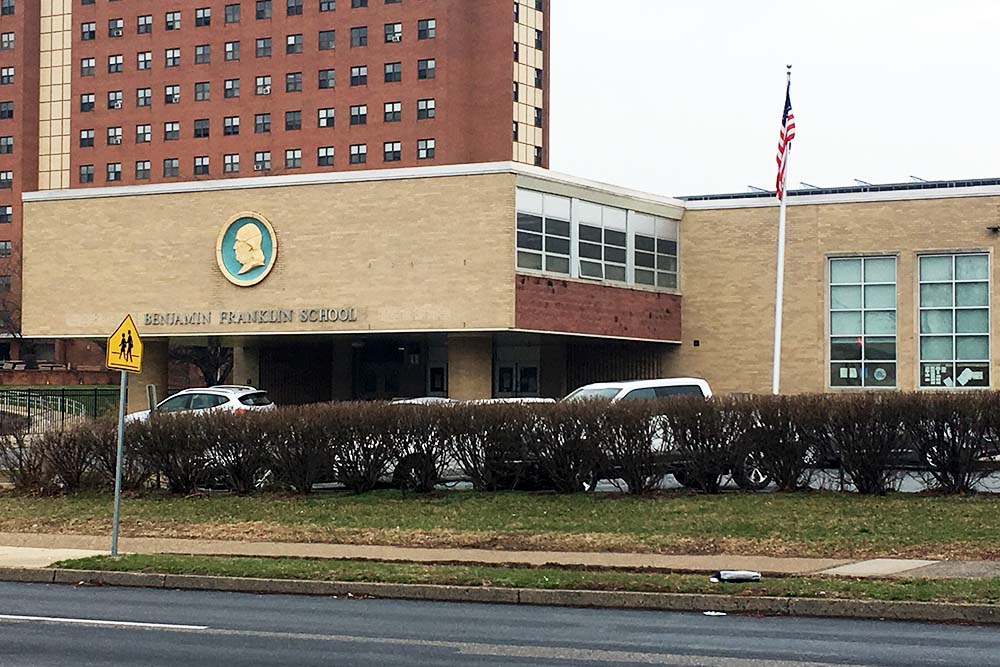
Benjamin Franklin School scored highest among Harrisburg’s elementary schools on an annual state assessment.

Most Harrisburg public schools continued to tread water for the past academic year, once again earning largely poor grades from the state.

District-wise, Harrisburg schools showed little improvement, but they also generally didn’t deteriorate further during the 2016-17 school year compared to recent years, according to the annual “School Performance Profile” released today by the state Department of Education.

“The ‘School Performance Profile’ scores released today provide school-level information to the public related to student achievement and progress,” said Secretary of Education Pedro A. Rivera.

Harrisburg High School attained an academic score of 44 out of 100 total points, identical to the prior year. The SciTech Campus showed more improvement, up to 76.2 points versus 73.2 last year and 61.2 the year before.

To determine academic scores, the state uses a variety of measures, including standardized tests such as the Pennsylvania System of School Assessment (PSSA) and Keystone exams. The scores follow a general academic scoring model with 90 to 100 considered to be excellent and below 60 considered to be deficient.

Other schools in the 6,227-student district scored as follows:

Marshall Math Science Academy: 78.3
Benjamin Franklin School: 60.8
Melrose School: 58.2
Foose School: 53.3
Scott School: 52.7
Marshall Academy: 49.8
Camp Curtin Academy: 45.6
Downey School: 45.5
Rowland Academy: 42.5

The yearly assessment includes a wealth of other data, including graduation rates. In that regard, Harrisburg High School showed a slight improvement, with a graduation rate of 55.8 percent last year, compared to 53.9 percent in 2015-16 and 52.8 percent in 2014-15.

Rivera said that this will be the final time the state uses the current methodology and “report card” grading system to determine school-level academic performance. Next year, the state will transition to what it calls a “Future Ready PA” index, which will use a dashboard approach to present school-level data and will feature a broad range of indicators, such as English language acquisition, career readiness indicators, access to advanced coursework and chronic absenteeism, among others.

Kirsten Keys, the Harrisburg school district’s spokeswoman, declined immediate comment for this story.

Continue Reading

Who’s to Judge? Judicial candidates make their cases at NAACP forum

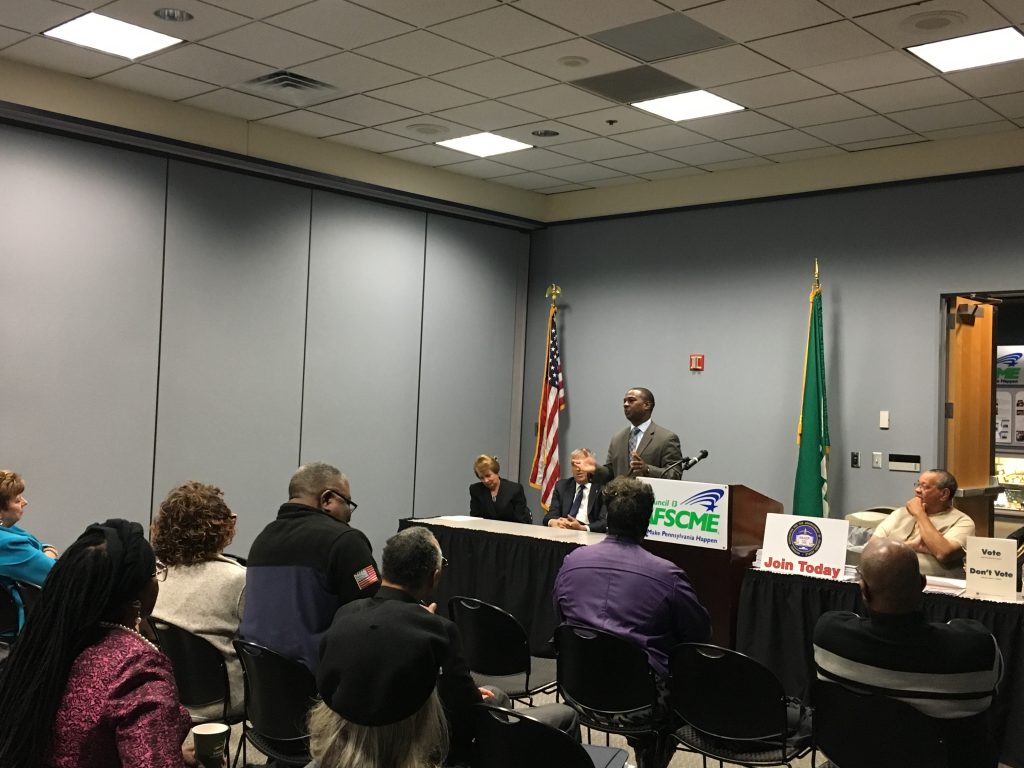
Royce Morris, a contender for a seat on the Court of Common Pleas, speaks at the NAACP candidates forum on Thursday, Oct. 26.

If you’re summoned to traffic court, cited for disorderly conduct, or arrested for murder in Dauphin County in 2018, you may soon get to vote for the judge who will try your case.

Dauphin County voters will go to the polls on Nov. 7 to elect judges for the County Court of Common Pleas and Magisterial District courts. Six judicial candidates made their cases at a forum hosted by the Harrisburg NAACP Thursday evening, which drew more than 75 registered voters to the AFCSME Conference Center on 43rd Street in Swatara Township.

Three of the four candidates running for the Dauphin County Court of Common Pleas – Royce Morris, Ed Marsico, and Lori Serratelli – appeared at Thursday’s forum. They and John McNally, who did not attend the forum, are vying for three six-year seats.

Morris and Marsico each had strong bipartisan support in the May primaries, which positions them well for the general election. Some observers believe the third open seat will be close between Serratelli and McNally, who in May received 16,204 and 16,447 primary votes, respectively.

Speaking on Thursday, Serratelli billed herself as an advocate for families and the working poor. Before Gov. Tom Wolf appointed her to a judicial seat in June 2016, Serratelli worked for 38 years as an attorney with an emphasis in family law. She said she is committed to helping litigants who cannot afford legal representation.

Also present were the two candidates in the only contested Magisterial District Justice (MDJ) race. Hanif Johnson and Claude Phipps are both vying for the seat in District 12-1-05, which covers parts of Allison Hill, Paxtang and Penbrook.

The candidates already faced off in the May primary, and Phipps cross-filed as a Republican after Johnson defeated him for the Democratic nod.

Judicial races may not be crowded this election cycle, but they are critically important, said incumbent MDJ David O’Leary.

MDJs are the first point of contact for many people entering the judicial system. They hand out sentences or fines for misdemeanor crimes, preside over traffic court and set bail after arrests.

They also perform preliminary hearings for criminal cases, which means they decide whether or not a case continues to trial.

The duties and sentencing power of MDJs give them a great deal of discretion, and O’Leary said voters must elect judges who will not abuse it.

“In most cases, I can fine you $1 or $300,” O’Leary said. “Our judicial system places burdens on poor people, and I’m aware of it. You need an MDJ with not just fairness, but compassion.”

An attorney with more 40 years of litigation experience, O’Leary was appointed to his seat in South Allison Hill and downtown Harrisburg by Gov. Tom Wolf last August. He’s also something of an anomaly in the local county courts—one of only three Dauphin County MDJs with a law degree.

Pennsylvania is one of 22 states that allows non-lawyers to preside over minor courts. Across the commonwealth, roughly 75 percent of MDJs are not trained as lawyers, according to the Standard-Speaker (Hazelton, Pa.). Many are retired or former police officers, and others were small business owners or civil servants.

MDJs serve six-year terms and earn an annual salary of $88,290. Candidates must be 21 years old, live in their magisterial district and pass a 400-hour certification course before they can take a judicial seat.

That course is meant to equip candidates with everything they need to know on the bench, but the learning curve can be steep. Hanif Johnson passed his certification test on his first try, but when I asked him how he would use community service as a sentencing tool in his courtroom, he did not know that he was allowed to do so.

In Dauphin County, judicial aspirations often run in the family. MDJ Barbara Pianka holds the seat formerly occupied by her husband, James Pianka. George Zozos and his son, Paul, both currently preside over district courtrooms.

Continue Reading

Weekend Roundup with Sara Bozich

Happy Halloween Weekend – Boo!

Literally no plans except maybe have a baby. And football. And to watch TV with all the lights out tonight because, no, I didn’t buy any Halloween candy.

(OMG I wish I could go to the Symphony this weekend — They’re doing Sgt. Pepper’s Lonely Hearts Club Band!)

What are you doing this weekend?

(more…)

Continue Reading

2-Way 2nd: Council action brings major road change nearer.

Under a city plan, N. 2nd Street, currently three lanes one-way, would be converted to two lanes of two-way traffic in Midtown and Uptown Harrisburg.

Harrisburg is moving closer to making major changes to N. 2nd Street, thanks to a green light from City Council last night.

Council authorized funding for a traffic study and engineering plans to convert N. 2nd Street from one-way to two-way traffic flow. The new pattern would take effect between Division and Forster streets and reduce the current three lanes of traffic to two.

Mayor Eric Papenfuse began advocating for the lane conversion in 2013, during his first mayoral campaign. He believes that rerouting commuter traffic to N. 7th Street and restoring two-way flow to 2nd Street will benefit homeowners and pedestrians near the river.

“We want to give that neighborhood more of a residential feel and make it safer for pedestrians,” Papenfuse told reporters after last night’s council meeting.

According to reporting from TheBurg’s Paul Barker in 2013, the current iteration of 2nd street – three lanes of northbound traffic flanked by two lanes of street parking – came into being during a 1956 transformation of Harrisburg’s major roadways. That year, Harrisburg also converted Front Street into a one-way, three-lane mini-highway, and widened Forster Street to six lanes.

Those road conversions were Harrisburg’s response to a new problem facing American cities in the mid-century: commuter traffic. After World War II, middle- and upper-class whites relocated in droves from cities to suburbs. Their jobs, however, did not necessarily follow, and cities had to accommodate the flood of drivers coming in for the work day.

Many American cities, including Harrisburg, prioritized the new commuter class at the expense of residents and pedestrians. Today, many 2nd Street residents complain about traffic speed and noise.

“People fly down this road,” said Sotirios Ntzanis, owner of Midtown Tavern, located at the corner of Herr and 2nd streets.

He’s optimistic that the lane conversion will slow down traffic and even benefit small businesses.

“Slower traffic could help with exposure, since a lot of businesses along here get missed,” Ntzanis said.

Other residents worry that the conversion will bring more harm than good. Dave Johnson, who lives on the 1700-block of N. 2nd Street, thinks that his street will get more congested as long as Front Street remains one-way.

“It’s going to get backed up,” Johnson said. “We’ve already got three lanes of constant flow.”

Nicolas Conigliano has lived on the 1000-block of N. 2nd Street for six months. He said that traffic there moves quickly and creates noise, but he’s unsure that a two-way flow would help either problem.

“What I’ve noticed on other streets in the city is people go as fast as they want to go,” Conigliano said.

The resolution approved by council last night also said that the final 2nd Street lane configuration might include bike lanes or a two-way, left-turn lane. Project engineers will also consider the possibility of building a bridge above the railroad tracks at Division Street and Industrial Road.

The city has retained the Maryland-based design firm, Wallace Montgomery & Associates, to perform a traffic study, provide preliminary engineering and final designs. Funding for the project comes from a PennDOT grant.

Papenfuse estimated that six to eight months of planning are necessary before any infrastructure changes could be authorized. During that time, he expects to solicit input from residents and business owners in a series of community meetings.

As part of the changes to 2nd Street, the city also wants to make substantial improvements to several other streets to divert outbound traffic to N. 7th Street and to Division Street.

Continue Reading

And Then There Were 7: Green takes council seat.

Ausha Green

Harrisburg City Council is operating at full complement once more, thanks to tonight’s appointment of a new council member.

Council voted unanimously to appoint Ausha Green, a former school board member, to a three-month term. Green will fill the seat formerly held by Destini Hodges, who resigned from council earlier this month to take a job out of state.

Green is running unopposed for a four-year council seat in the Nov. 7 general election. According to Council President Wanda Williams, council decided to appoint her early since she would inevitably join the seven-member body in January.

By appointing Green, council decided to forego the open application and nomination process customarily used to fill vacancies. The last council person appointed by that process was Dave Madsen, who occupies the seat vacated by Jeffrey Baltimore in August.

Continue Reading

Eye in the Sky: Harrisburg police brief council on helicopter patrols.

Tonight, Harrisburg City Council heard from city police about recent helicopter patrols.

A helicopter hovering over the city last week helped law enforcement officers capture weapons, seize drugs and deter shootings, Harrisburg police officials said tonight.

Police also said that residents should expect additional flyovers in the future.

A helicopter patrolling Harrisburg late Wednesday and Thursday last week drew questions and complaints from many residents. In a tweet, Capt. Gabriel Olivera called it a “proactive policing” technique but offered no other details.

Tonight, police appeared at a City Council meeting to defend so-called “Operation Helicopter” as a means of supporting street crimes officers on the ground.

Police Chief Thomas Carter said that the bureau deployed the helicopter after a spate of shootings in the city, many involving juveniles or shots fired into homes. He said that helicopters can help deter crime and assist ground officers tracking down suspects.

Carter told council that the outcome of the helicopter patrol was “very good.” No shots were fired on streets or into residences on either night of the patrol, and the police were able to seize cash, heroin and firearms from criminals, he said.

He conceded that residents complained about the noise and light the helicopter generated, but said that the outcomes of the operation make it worth repeating.

“Citizens deserve to be policed in the best way possible,” Carter said. “We will see more flyovers.”

Only Harrisburg police, the state police and the mayor knew about last week’s operation in advance, since, according to Carter, announcing patrols makes them less effective.

“We didn’t want to show our hand,” he said.

Mayor Eric Papenfuse explained that the patrols were part of an ongoing partnership with the Pennsylvania State Police, which started a three-month collaboration with Harrisburg’s street crimes unit in September. Papenfuse said that residents can expect to see one or two more patrols before the partnership ends next month.

Olivera said that the helicopter bore no extra cost to Harrisburg or the state police. The fuel costs and wages for last week’s patrols were already included in the state police budget, he said. He did not say how often helicopter patrols will take place in the future.

Olivera also insisted that the aircraft was not actively surveilling activity on the ground. Instead, its pilots responded to calls from ground officers and offered them backup as they investigated incidents.

“It was constantly moving in response to calls,” Olivera said.

Residents were surprised and even frightened to see the helicopter roaming the night skies last week.

At tonight’s council meeting, Uptown resident Kim Jones called the patrols “a nightmare.” She said that the spotlights illuminated the inside of her house until midnight, keeping her infant daughter awake.

Even so, she said she’ll tolerate the patrols if they help to keep the city safe – and if the helicopter moves across different neighborhoods.

“They need a better plan,” Jones said about the helicopter’s flight path. “Don’t have it camped out in one spot. Spread it out.”

On the Nextdoor social media site, which creates neighborhood-specific chat rooms, one Uptown resident said the aircraft made her feel “uneasy,” and others complained about the noise and light.

Papenfuse said that the city has heard from many citizens who want greater police presence in their neighborhoods. He claimed that he got 20 such complaints last week alone, but received no negative correspondence about the helicopter patrols.

“I recognize that this might seem bold or dramatic, but I hope people understand it’s to make the streets safer,” Papenfuse said.

Continue Reading

Ideas Offered, Debated as Market Square Plan Moves Forward

The CAT bus station at Market Square.

A local civic group wants to make over congested Market Square, which could lead to substantial changes to one of Harrisburg’s most historic and visible intersections.

Harrisburg Young Professionals is conducting a master plan study for the intersection of Market and 2nd streets. The organization, which has been eyeing a redevelopment project at that location for more than a year, recently tapped Boston-based design firm Sasaki to lead the planning effort.

Sasaki, HYP and Harrisburg-based K&W Engineers last week held a series of stakeholder meetings at the Harrisburg Hilton, which is located on Market Square. Meron Yemane, former president of HYP, estimated that more than 100 people participated in the eight meetings, which were each 45 minutes long.

At the meetings, stakeholders discussed urban spaces in the United States and abroad that Harrisburg could emulate and debated the merits of adding different amenities – such as green spaces or retail outlets—to Market Square.

Yemane said that urban planners from Sasaki will use the input from those meetings to begin drafting a master plan, which HYP hopes will be finished in spring 2018.

From there, HYP will continue to facilitate discussions with stakeholders, Yemane said, and potentially help identify funding for a large-scale project.

Market Square was part of the original, circa-1785 plan for Harrisburg and was the site of the city’s first market area, dismantled in 1889. It currently is dominated by several large structures, including the Hilton, the Penn National Insurance Building and Dauphin County Administration Building. One corner also serves as a hub for CAT buses.

Yemane said that the area’s proximity to the highway, riverfront and retail and dining establishments make it a potential cornerstone of Harrisburg.

“It has the potential to be a postcard image for the city,” said Yemane.

Beyond that, he was hesitant to offer a vision for what the new Market Square could look like. He said the master plan might recommend beautification measures, such as adding more trees and lighting. The plan will also help stakeholders determine whether Market Square is best suited to retail, residential or leisure amenities, or a combination of the three.

According to Sasaki, relocating the bus station is one option. Last year, PennDOT released concepts for the area around the Harrisburg Transportation Center that included a new home for the bus station.

Yemane said that much of the planning effort thus far has been funded privately and that the business community “really stepped up” when HYP decided to bring in Sasaki.

HYP also hired the economic planning company, Landwise, to evaluate the financial feasibility of different projects that could be outlined in the master plan. Yemane said that the firm has helped HYP evaluate federal grant options, though they expect that any major changes to Market Square will require private dollars.

“We recognize the limited resources of the city, but we want to be good stewards of Harrisburg and work with them to identify what’s possible,” Yemane said.

Continue Reading

Don’t Dump Here: Harrisburg concludes city codes meetings.

A Harrisburg resident asks a question during last night’s meeting about city codes and codes enforcement.

Who do you call when a neighbor is dumping trash illegally? And how do you find out if the apartment next door is an unlicensed flop house?

City officials answered these questions and others in a meeting at Hamilton Health Center last night, where residents were invited to ask about the city’s code enforcement process. A similar event was held one night earlier at Camp Curtin YMCA.

Councilman Cornelius Johnson said the purpose of the meetings was to correct public misconceptions about the codes process and gather ideas for amending Harrisburg’s code handbook. Here’s what emerged as common questions throughout the evening:

Illegal dumping
Dumping trash on city streets and vacant lots is a criminal act that requires response from the Harrisburg Police Bureau. But since Harrisburg’s non-emergency police line routes to the Dauphin County dispatch, some residents said they’ve been referred to the codes office instead.

If you see illegal dumping in your neighborhood, Johnson recommends calling Harrisburg’s 311 number during normal business hours. Ask the switchboard officer to direct you to Harrisburg police and log your complaint there.

Blighted properties
Harrisburg has more blighted properties than it can manage. City codes officials can board up properties that are unfit for human habitation, but residents report that squatters break into the sealed homes and establish residence there.

City Codes Administrator David Patton said that his department is fighting blight with a limited budget. The city maintains a list of condemned properties slated for demolition, which currently has more than 250 properties on it, Johnson said. He estimated that the city’s $120,000 demolition budget only allows it to tackle between 17 and 25 properties a year.

Mayor Eric Papenfuse said that the city hopes to significantly increase the demolition budget for the 2018 fiscal year. Raising it to $250,000 from its current $120,000 would allow the city to demolish closer to 30 or 40 properties, he said.

Patton asked residents to remain vigilant in reporting blighted properties. The codes office triages its demolition list and acts first on the properties that pose the greatest public safety risk. If squatters have broken into blighted properties, file a complaint with the codes office so they can seal it again.

Filing a codes complaint
Johnson said that the city clearly needs an electronic system for submitting codes complaints. Right now, residents can download the paperwork to file a complaint online, but must submit the form in hard copy to city hall. Johnson said that creating an electronic submission system is a long-term goal. He also hopes the city can implement a way for citizens to track the status of the complaints they’ve filed.

Finding property owners and rental licenses
If you want to know who owns a property, you can search its address on www.dauphinpropertyinfo.com. Sometimes, however, the owner listed on the deed is a company that no longer exists or an investor who has changed his contact information. If the property is a rental unit, you can try to search the owner’s rental license through the city’s Mercantile Office.

There is more information about codes enforcement on the city’s website.

Continue Reading