HBG Budget: 2018 plan shows growing revenues, no new tax hikes.

Harrisburg Mayor Eric Papenfuse and Budget and Finance Director Bruce Weber tonight presented the proposed 2018 municipal budget to City Council.

Touting healthy cash reserves and rising revenue, Harrisburg’s mayor this evening made his annual budget presentation to City Council, calling for the creation of new salaried positions and millions of dollars in capital investments for 2018.

The budget that Mayor Eric Papenfuse proposed would not raise city tax rates. Instead, it leverages higher revenue from a growing tax base to increase the city’s operating budget from $61 million this year to $65 million in 2018.

Papenfuse said his plan would allow Harrisburg to pay down debt while hiring more city workers and investing in capital improvements. He added that the city’s growing tax revenue this year, which is $2 million more than what was projected in the 2017 budget, shows rising employment, more valuable property stock and increasing incomes.

“The city is showing improving fiscal health, and we’re in a better position than we were a few years ago,” he said.

Papenfuse said that the city expects to balance its budget this year for the fourth consecutive year. It’s on track to meet or exceed all of its revenue projections for 2017, with property, earned income tax and local services tax revenues all greater than expected. The exception is parking and lease revenues as both categories fell roughly $200,000 short of their $1.8 million and $1.2 million projections, respectively.

Expenditures in 2018 would increase in two main categories: personnel and capital projects.

On the personnel front, the city would budget for $32.5 million in salaries compared to $31 million in 2017. That figure, which excludes healthcare costs, would create seven new management positions and two new sanitation positions. The budget would permit the Fire Bureau to make five hires and the Police Bureau to recruit 20 new officers.

The additional personnel funds would also increase salaries for two positions in the law bureau and award raises to sanitation workers represented by the AFSCME union.

Papenfuse also wants the city to spend some of the $20 million in cash that has built up in its general fund. He proposes withdrawing $2 million to make an early debt payment and $6.5 million to spend on capital projects.

The city defines a capital project as any expenditure exceeding $5,000. In 2018, proposed capital projects include $1 million on new radios and patrol cars for police, $700,000 for work on the 15th street police substation and $80,000 for police body cameras. About $450,000 would go towards renovating city playgrounds, and projects to renovate Reservoir Park would receive $285,000 in funding.

The Public Works Department would have a $1.5 million capital project budget, which would fund ADA ramp renovations and allow the city to match grant money for paving projects.

The $6.5 million budget for capital improvements would bring the city’s total general fund for 2018 to $72 million.

Tonight’s presentation was the first step in a weeks-long budgeting process. Council members will have until Dec. 5 to review the mayor’s presentation and submit questions to the city clerk. Public budget hearings will be held on Dec. 12 and 13, and council is expected to approve a budget by Dec. 19.

Council President Wanda Williams and finance committee chair Ben Allatt declined to comment on the presentation on Tuesday night, saying they needed time to review the budget and prepare questions.

Continue Reading

Peace in Our Time: City, Civil War Museum finalize accord over artifacts, rent.

Harrisburg Councilman Ben Allatt speaks to TV reporters following tonight’s legislative session.

Harrisburg’s years-long battle with the National Civil War Museum reached a permanent peace tonight, as City Council approved an agreement that should allow the museum to own its own artifacts and begin paying rent to the city.

Council unanimously OK’d a deal that will sell the city-owned permanent collection to the museum for $5.25 million. The museum now has five years to raise the money to pay for the purchase of the 25,000-plus artifacts.

“I think this is an important step forward,” said Councilman Dave Madsen in announcing his support for the deal.

The agreement ends a longstanding feud between the city and the museum board.

After entering office in 2014, Mayor Eric Papenfuse strongly objected to deals reached under former Mayor Steve Reed that allowed the museum to display the artifacts at no cost and that charged the museum just $1 in yearly rent to use the city-owned building, even as the city remained on the hook for building maintenance and repair.

The new agreement addresses both those issues.

First, the city will sell the artifacts to the museum for $5.25 million. In turn, the city will put $1 million into a reserve fund to pay for capital improvements to the building, which the city will continue to own. The other $4 million will pay for improvements to Reservoir Park, where the museum is located.

Under the deal, the museum has five years to raise the money to purchase the artifacts. If it fails to raise the money within that time, the city would be allowed to sell 20 percent of the museum’s collection.

“I think this is tremendously positive for the city,” said Papenfuse, emphasizing that most of the improvements envisioned as part of the Reservoir Park master plan would be funded from the museum’s purchase of the artifacts.

Papenfuse previously acknowledged that $5.25 million is below the retail value of the artifacts, which were not appraised for purposes of the agreement. But he said that he believed the price was in the best overall interest of both parties.

The agreement also outlines a graduated schedule for the payment of rent.

For the first three years, the museum will pay the city $45,000 per year in rent. The rent then increases incrementally, capping off at $100,000 per year for 10 years starting in 2029.

However, no money will change hands for the first five years, as the cumulative amount over that period almost equals the amount of money that the museum claims it is owed by the city for unreimbursed building maintenance and repair costs dating back to 2009.

Also tonight, council voted 6-1 to hire Maverick Strategies to represent the city in matters before the state legislature. The agreement retains the Harrisburg-based firm for $5,000 a month, for up to 12 months, to lobby the legislature as it tries to retain its extra taxing authority after it leaves Act 47.

The city also wants to make permanent the state’s annual payment to the city for emergency services. That payment currently is $5 million, but must be renewed as part of the state’s annual budget process, which places it in jeopardy each year. This year, for instance, the legislature twice stripped the payment from its proposed budget, only to reinsert it at the last minute.

“This is an important step for us to take,” said Councilman Ben Allatt. “I think this gives us a first foot forward to achieve these objectives.”

Allatt, in fact, has said that the state’s annual payment to Harrisburg should be even greater than $5 million.

Papenfuse said that, if Maverick is successful, there would be no need for a Home Rule charter, an extensive process that would give Harrisburg more leeway to set its own tax rates apart from those allowed in Pennsylvania’s third-class city code.

Councilwoman Shamaine Daniels was the lone vote against the agreement with Maverick.

Continue Reading

Gone to Seed: Blighted Schell building set for demolition.

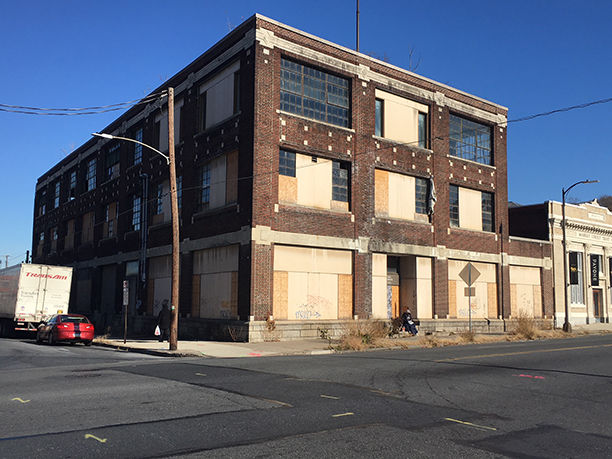
The 101-year-old Schell Seed building in Harrisburg is about to be razed.

Another piece of Harrisburg’s industrial past is set to disappear, as the century-old building at 10th and Market streets will meet the wrecking ball next week.

On Monday, the Pennsylvania Housing Finance Agency (PHFA) plans to begin demolition of the so-called Schell building at 1000 Market St., a long-blighted, vacant industrial structure.

“The building has been deteriorating,” said Brian Hudson, PHFA’s CEO and executive director. “The brick started to deteriorate, and there were health and safety concerns.”

The three-story, 28,000-square-foot building was originally constructed in 1916 as the Standard Baking Co., founded by the Graupner family, whose flagship brewery was located directly across the street. In 1920, it became the Schell Quality Seed Store after Walter S. Schell moved his quickly growing seed distribution and retailing business to that location from farther up Market Street.

The store, which also sold gardening supplies, lasted until 1972, when rains from Tropical Storm Agnes swelled nearby Paxton Creek, flooding the building and destroying the business.

The building later became home to Geiger & Loria court reporting service. After passing through several other owners, Susquehanna Township-based developer Moyer and Williams bought the building in 2007, planning to redevelop it as loft apartments with first-floor retail. PHFA financially backed the project, which never got off the ground, and then bought it out of foreclosure in 2016.

Hudson said that PHFA originally hoped to preserve the building, but that it had deteriorated too much, with trees even sprouting up from the roof. The condition is so bad that it threatens the building next door, an old bank branch now the headquarters of Pavone, an advertising and marketing agency, he said.

Hudson said there is some interest in new construction at the site.

“There are a number of partners interested in developing something on it,” he said.

Hudson declined to name any specific developers or projects but said that it could work as either a residential or office project.

David Morrison, executive director of Historic Harrisburg Association, said several members of the city’s preservationist community had contacted him over the last few days after learning that the building was about to be destroyed.

“It’s always a shame when a building can’t be rescued,” he said. “I wouldn’t say it would be impossible (to save it), but maybe it’s impractical from PHFA’s standpoint.”

The two-block stretch of Market Street between the railroad underpass and Cameron Street was once a thriving industrial and retail corridor. In addition to the brewery and the seed company, it was home to such diverse businesses as the Patriot-News, the city’s central post office, the state’s printing operation and A. Lane used furniture. Today, none survive, and empty buildings and surface parking lots line the corridor.

In 2011, Philadelphia-area developer Adam Meinstein bought the post office site, but that building remains underused. This past June, New York-based Twenty Lake Holdings, a commercial real estate company, purchased the sprawling former Patriot-News site for $644, 286—a fraction its original, 2010 list price of nearly $4 million—but has yet to state its intentions.

About a year ago, PennDOT unveiled concepts for a revitalized Market Street corridor, including the relocation of the city’s main bus depot from Market Square to either the site of the old post office or the Patriot-News building.

Hudson said he hopes that PHFA can assist in that revitalization. To guard against future floods, he envisions a building with parking on the first floor and apartments or offices above.

“We’re going to take a look at what makes the most sense there,” he said. “Our whole issue is to revitalize that area.”

He also said that his agency has the ability to take on projects that other financial institutions avoid.

“We don’t mind being the first ones in,” he said. “We do that all the time.”

Continue Reading

Dauphin County Update: No 2018 tax hike, Chardo poised to become D.A.

Dauphin County courthouse

Dauphin County expects no property tax increase for a 13th consecutive year, but a change will be coming to the county district attorney’s office.

The county made two major announcements today.

First of all, the county unveiled a $241 million preliminary budget that contains no increase in the county portion of the property tax, which will remain unchanged at 6.876 mills.

The county does expect to spend more than it takes in for 2018, but plans to use as much as $12.5 million in reserve funds to make up the shortfall. The county stated that it still expects to have a reserve fund balance of about $25 million by the end of 2018.

Last year, Dauphin County also balanced its budget by dipping into its reserve fund. It estimated that it would spend $12.5 million in reserves, but will only spend about $5.2 million by year-end, according to current county estimates.

The county stated today that it will add one full-time and two part-time deputies in the county coroner’s office in 2018 to deal with the rise in opioid-related deaths. Last year, there were 85 overdose deaths in the county. So far this year, there have been 82, and the coroner expects more than 100 by Dec. 31.

“This board pledged to do all we can to improve the lives of our residents,” said board Chairman Jeff Haste in a statement. “Holding the line on taxes for 13 years and combatting the devastating opioid epidemic are part of that promise.”

The county commissioners are expected to pass the final 2018 budget at their Dec. 13 meeting.

The county also said today it expects First District Attorney Fran Chardo to be named the new district attorney.

Court of Common Pleas judges held a “straw vote” indicating that they would appoint Chardo. The straw vote was taken so that Chardo would be prepared to move into the position when the official vote is taken on Jan. 2.

“The straw vote allows for some level of preparation and transition to head an office that is staffed with 30 attorneys processing an annual case load of more than 7,000 new dockets,” according to President Judge Richard A. Lewis.

The position will become vacant in January as current District Attorney Ed Marsico recently was elected judge to the Court of Common Pleas. Chardo will serve the remainder of Marsico’s term.

Continue Reading

City considers new amenities, pricing for public pools.

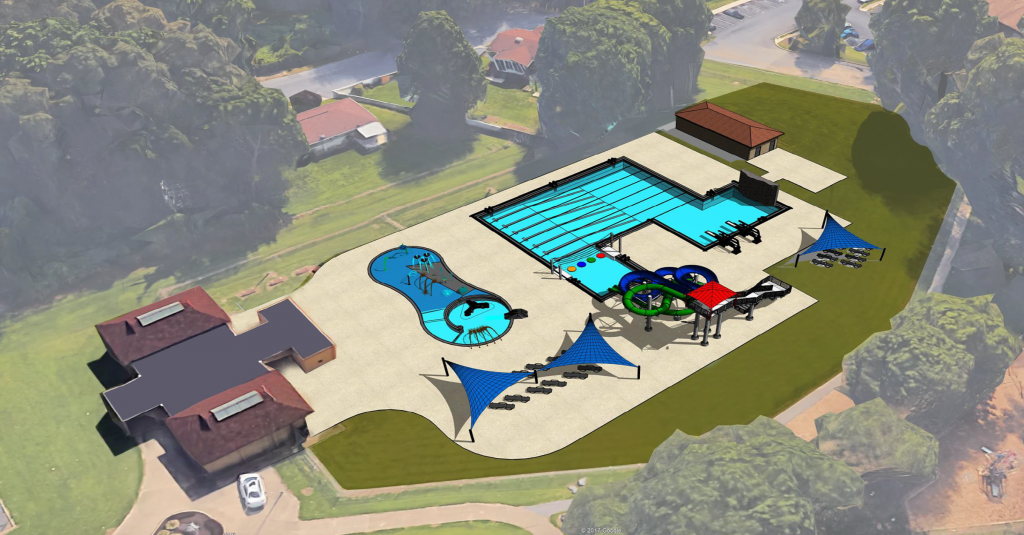
A rendering for the first option for Jackson Lick pool. which would include a six-lane lap pool, shallow swimming area, splash pad, climbing wall, water slide, and crossing activity.

Even as temperatures drop and the holidays draw near, Harrisburg officials have their eyes on the upcoming summer pool season.

Architects last night unveiled proposals for replacing public pools at the Hall Manor and Jackson Lick housing complexes, a process that may begin as early as next fall. The presentation came after a months-long audit of the aging pools, which concluded that both have exceeded their useful lifespans and do not have any salvageable components.

Project managers from Counsilman-Hunsaker, the aquatics consultancy firm that conducted the study, recommend that the city replace both pools entirely and gut-renovate the bathhouses. They also laid out a bevy of new aquatics amenities to include at each facility, as well as tentative budgets for each project.

Modern aquatics facilities favor dynamic amenities and play structures, according to George Deines, a Counsilman-Hunsaker project manager. As a result, all of the options they presented for Hall Manor and Jackson Lick would reduce the overall square footage of the pools to accommodate new features.

“We want a facility that will make people say, ‘Wow, look at that,'” Deines said.

The first option proposed for the Jackson Lick pool laid out a six-lane, 25-foot long competition pool with diving boards, a shallow area for fitness and swim lessons and a spray pad. The facility would also have a water slide, a climbing wall and a “crossing activity” – a monkey-bar-like structure above the water.

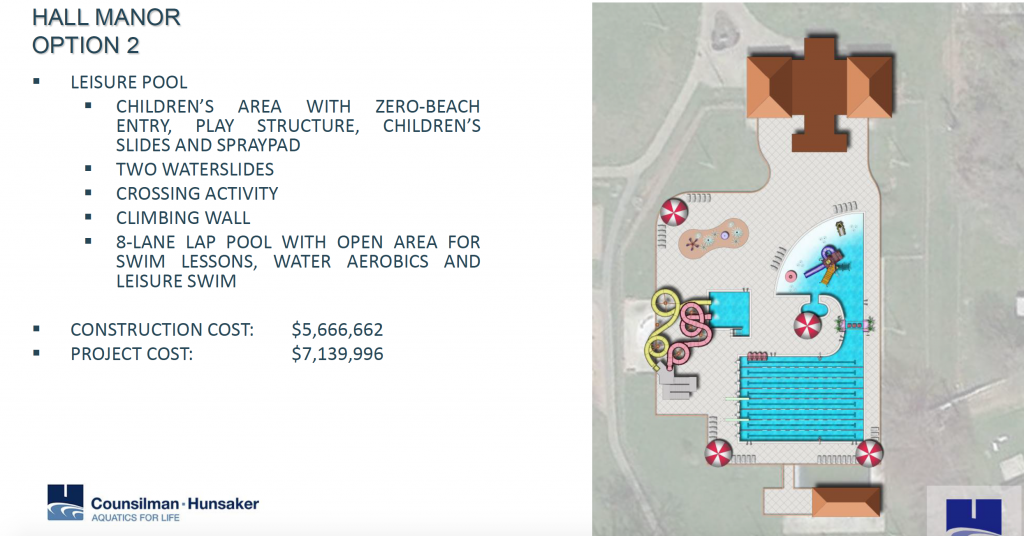
The cost for that project would be close to $5 million. A second, $6.25-million option would create a separate children’s area with a wading pool, play structure, and spray pad, along with an eight-lane competition pool. The pool would feature the same water slide, climbing wall and crossing activity as the first option.

The consultants offered the same options for the Hall Manor pool, but project costs at that facility were slightly higher—$5.6 million for the first option and $7.1 million for the second. The Hall Manor facility would also include a concession stand and outdoor picnic area.

No matter which plans come to fruition, the new city pools will both be compliant with the American Disabilities Act—a federal standard that they currently do not meet.

Before they can break ground or even put the projects out for public bid, the city must secure millions of dollars in funding and decide which pool to tackle first. As Councilman Westburn Majors said, “renovating two pools at once would be a heavy lift for any city.”

To offset construction and maintenance costs, consultants recommended a modest increase to admission prices at each pool. Under the new pricing, daily passes would be $6 for adults and $4 for children and seniors. Season passes would cost $145 for a family, $50 for adults, $45 for children and $30 for seniors. Other possible revenue sources include swim lessons, a summer swim team, and facility rentals for private parties.

Parks and Recreation Director Kevin Sanders said his department will consider the options before them over the next few months. Once they develop firm proposals, they will pursue grant money, private gifts and capital improvement funding to finance the projects.

City officials and Counsilman-Hunsaker both hope the projects can be completed in the off-season. If crews break ground at the end of the swim season in 2018 and work through as much of the winter as they can, it is possible that a new pool would be open for business in the 2019 swimming season, said Deines.

Read on for full project descriptions and renderings from Counsilman-Hunsaker:

Continue Reading

Faced with violent children, Harrisburg teachers say mental health services are lacking.

Elementary school teacher Samara Young addresses members of the school board at their November meeting on Monday.

Teachers from the Harrisburg School District tonight renewed their call for increased mental health services in elementary schools, citing a series of violent student outbursts that they say create a toxic learning environment.

More than 50 members of the Harrisburg Education Association appeared before the school board to support colleagues coping with violent and disruptive students. Teachers spoke about being hit, kicked, slapped and scratched by children, often as they tried to protect other students in their classes.

HEA president Jody Barksdale said that the problem of violent students is most prevalent in elementary schools, and she believes that normal teaching training does not prepare teachers for the mental health needs of their students.

“This is serious behavior and we’re not trained in how to deal with it,” Barksdale said. “The tools we have now are not enough.”

Echoing remarks made by other teachers, Barksdale said that children use violence as a way to cope with trauma.

“This isn’t kids wanting to fight, it’s a cry for help,” Barksdale said.

Johanna Brown, a first-grade teacher at Downey Elementary School, described a student who fears male teachers and will fly into a violent rage at a slight provocation. Brown said she’s been hit and kicked by the student and lifted her pant leg to show board members a large bruise she received last Friday.

“This student needs mental health assistance and counseling I cannot give her,” Brown said. “Other students see her rage every day.”

The district currently contracts with Pressley Ridge, a mental health services provider, to offer counseling in schools. Pressley Ridge also maintains one full-time clinic in Camp Curtin Elementary School. But Barksdale said that firm is overloaded with cases and added that some teachers do not even know the process for referring children for services.

Some teachers were hesitant to assign blame for the problem of violent students, but others called out school district administrators and principals for not taking teacher complaints seriously. In her remarks to the board, Barksdale said that nothing had been done since she furnished more than 100 letters from concerned teachers a year ago.

Barksdale also said that teachers who struggle with violent students have been criticized by principals in front of colleagues and students. This practice emboldens children to disrespect their teachers in classrooms, Barksdale said.

Barksdale also said that teachers have not received sufficient communication from administrators and board members, a claim corroborated by HEA executive member Michelle Rolko. Rolko said that HEA has received 21 grievances in the first three months of the school year, compared to 13 in all of the 2016-17 year. Each grievance represents an allegation of contractual violation by the district.

“We’ve had very little communication, and what we have had does not work,” Rolko said.

She added that some of the grievances came from teachers who claim they were belittled or publically criticized by administrators.

Superintendent Sybil Knight-Burney issued a statement at the end of the meeting, in which she assured teachers that they had the support of the district administration. In remarks after the meeting, she rejected Barksdale’s claim about Pressley Ridge and said that teachers are well informed of the process for referring students for counseling.

Rolko said that 45 teachers had resigned from the school district since the beginning of the year. District spokesperson Kirsten Keys claimed the true number of resignations was lower, but could not offer a firm figure.

Continue Reading

More Residential: HBG Zoning Board OKs apartments for Tracy Mansion, downtown.

Harrisburg’s zoning board tonight approved apartment conversions for this building downtown and at Tracy Mansion in Midtown.

Harrisburg is poised for more apartment conversions, as the city’s Zoning Hearing Board tonight gave the go-ahead to two projects.

The board voted unanimously to permit as many as 18 rental units in Tracy Mansion, which would complete the restoration of the historic Midtown building.

Owner Jack Kay of York-based Susquehanna Real Estate plans between 14 and 18 one-and two-bedroom units in the eastern portion of the century-old building at N. Front and Muench streets, space that has long sat empty.

“All of the existing architectural features will be restored and, if anything, enhanced,” Kay told board members.

Industrialist David Tracy built the 30-room mansion as a private residence in 1918. In 1951, it became an osteopathic hospital and eventually a mental health facility.

Kay bought the building in 2005 with plans to convert it to an office condominium, adding a new, seven-story building in the parking lot next door. He received zoning board approval two years later, but the project died after the recession hit in 2008.

In 2012, Kay sold the western part of the building to Char Magaro, who opened the restaurant, Char’s Tracy Mansion, there.

Kay said that he believes there now is a market in Harrisburg for upscale apartments, which motivated him to seek a special exception for that use. He said that his apartments will be “nice units” with such features as high-end finishes, river views and in-unit washers and dryers.

He said that he hopes to undertake the project next year, but that the timing depends upon securing financing, among other factors. He said that he had not yet determined rental rates, but that they would be competitive with recent projects by Harristown Enterprises and WCI Partners.

Tonight, the zoning board also unanimously granted a variance to Harristown for the conversion of a downtown office building to residential space.

Harristown plans to develop 12 one- and two-bedroom apartments from a worn-out, long-empty office building at the corner of N. 2nd and Cranberry streets. It currently has the building under contract with the seller, Camp Hill-based CJ2 Group.

With Planning Commission and zoning board approvals, Harristown now must have its land use plan approved by Harrisburg City Council before it can begin the project.

Lastly, the zoning board tonight gave Downtown Daily Bread permission to open an emergency shelter over the winter. Starting Dec. 1, the facility on South Street, which operates as a soup kitchen and drop-in shelter, will take in as many as 30 men a night. The shelter will operate through March 31, opening at 7:30 p.m. and closing at 6 a.m.

Continue Reading

TheBurg Podcast, Nov. 17: Raffles and High Rises Edition

Ring in the weekend with TheBurg Podcast!

TheBurg’s editor in chief Larry Binda sits down with city reporter Lizzy Hardison to rehash the past two weeks in Harrisburg news. They recap what the heck happened with that election day raffle, discuss the city’s new comprehensive plan, and imagine a skyline changed by Harrisburg University’s new building project.

A note to our listeners: We are working hard to bring you better audio quality! We’ve acquired new microphones and hope that you’ll see a marked improvement in sound quality in our next episode.

You can listen here on Soundcloud, or download the podcast in iTunes or the iPhone and Android podcast apps.

Read the stories mentioned in this week’s podcast:

Thousands of dollars later, campaign yields no finance report and one unhappy candidate.

It’s Here: Harrisburg’s draft comprehensive plan released

Healthcare & a Hotel: HU plans mixed-use high-rise in downtown Harrisburg

Stream this week’s episode on SoundCloud. You can also download it in iTunes, or on the Apple and Android podcast apps.

Continue Reading

Weekend Roundup with Sara Bozich

Happy Weekend!

Please excuse the abbreviated Weekend Roundup. I have a pretty good reason.

What are you doing this weekend?

(more…)

Continue Reading

2018 Water, Sewer Rates to Rise as CRW Continues Capital Projects

Water and sewer rates in Harrisburg are set to increase more than 7 percent next year, as Capital Region Water passed its 2018 budget last night.

The CRW board unanimously passed the spending plan, which will raise drinking water rates 7.5 percent for all city and suburban customers. Sewer rates will go up by 7.1 percent for city customers and vary for suburban customers, depending on their location.

The 2018 full-service rates for water and sewer service are $9.46 and $6.99 per 1,000 gallons, respectively. Under the new rates, an average customer who uses 4,500 gallons of water per month will pay an additional $5.56.

A few months ago, the board was faced with even higher rate increases, in excess of 10 percent, said board Chairman J. Marc Kurowski. However, CRW was able to scale those back to more reasonable levels, he said.

“Nobody’s excited with having to have rate increases, but we’ve kept them manageable,” Kurowski said last night.

CRW has raised rates for several years running. For 2017, the utility increased drinking water rates by 11.6 percent and sewer rates by 7.9 percent over 2016.

In his presentation last night, David Nowotarski, CRW’s chief financial officer, said the rate increases were needed, in part, to pay for ongoing capital upgrades to water and sewer infrastructure.

For 2018, CRW expects to spend about $8.9 million for water system upgrades and about $33 million for sewer projects. CRW has several major initiatives in place to repair and upgrade the city’s aged water and sewer infrastructure.

“Capital Region Water is continuing on the path of making critical investments to our infrastructure that were ignored for decades,” Kurowski said in a statement today. “We don’t take rate increases lightly, and we’ve made tough decisions to keep the rate increases below original projections, but these long overdue investments in our aging infrastructure will go a long way toward preventing service interruptions and higher costs of system failures.”

This was first board meeting following the departure of former CEO Shannon Gority, who left CRW effective two weeks ago. CRW expects to launch a search for a new chief executive, according to Kurowski.

Continue Reading