Burg Blog: Turn It Out

A polling location on State Street in Harrisburg.

Recently, I received an email from a Derry Township resident with the thesis that county Judge Lori Serratelli lost her race last month because of poor voter turnout in Harrisburg.

The writer further pinned blame on the Dauphin County Democrats, saying the county committee didn’t do enough to get its voters, especially in Harrisburg, to the polls.

Indeed, voter turnout in Harrisburg in the general election last month was abysmal at about 18 percent of registered voters. However, I disputed the notion that the blame lay primarily with the committee’s efforts (or lack thereof), as many other factors played into the low turnout and, thus, Serratelli’s loss by 1,665 votes to John McNally for the last of three judgeships at stake.

Harrisburg’s high levels of transience and poverty are practically a formula for low turnout, a problem exacerbated last month by the lack of passion in the uncontested mayoral and council elections. All the energy, I wrote back to him, was in the primary election back in May. Having said that—if the general election turnout among Democrats had matched the primary’s turnout (still a lousy 23 percent), Serratelli still would have lost by a few hundred votes.

Nonetheless, I consider my e-mailer’s point well taken since, to me, election turnout is the single most important (and often most ignored by pundits) factor in determining who represents us. Does gerrymandering, big money or, now, Russian bots help sway elections? To some extent. But getting voters to the polls is a much more critical factor.

This point was driven home to me on Tuesday night as I watched the special election results roll in from the distant state of Alabama. Before then, I knew almost nothing about voter demographics in Alabama because, well, why would I? But, after a few hours of watching cable news coverage, I could converse pretty intelligently about Mobile versus Baldwin counties, the importance of the so-called black belt and the changing nature of the state’s suburbs.

By the end of the evening, I was most struck by all the blue on the map, which indicated that a majority of voters in a county had voted for the Democrat Doug Jones over the Republican Roy Moore. I wondered: Where the heck did all these blue voters come from, and where had they been hiding all these years?

To me, there it was—proof that plenty of Democratic votes existed in even the reddest of red states. That vote just needed to be mined.

A similar dynamic played out last year, only in reverse. In Pennsylvania, I never imagined that there were enough dormant or persuadable GOP votes to hand the state over to Donald Trump.

In the months before the 2016 general election, I would drive outside of Harrisburg and see long rows of Trump signs, seemingly on every lawn and barn, like some contagion had spread down one rural highway and up the next. I dismissed this, stuck in the conventional wisdom that these probably were not new voters and that, in these sparsely populated areas, there wouldn’t be enough of them to make a difference anyway.

I was wrong and then equally wrong thinking that this state couldn’t possibly flip so abruptly in just four years.

In both the Jones/Moore and Trump/Clinton cases, one could point to the weaknesses of the losing candidates. True enough, though both Moore and Hillary Clinton had large groups of passionate supporters, as well. They both lost very narrowly and may well have won if they had run better campaigns, not assumed victory and continued to dig ever deeper into their pools of persuadable voters.

Indeed, Moore performed quite well in most of white, rural Alabama, with his turnout better than one would expect from a special election in an off-off year. It just wasn’t to the level of the Trump mania that had swept over that demographic last year, a weakening that should have been anticipated.

And that brings me back to Dauphin County.

Long a Republican stronghold, Dauphin County is now majority Democratic (D’s 81,816, R’s 73,825 as of November). Yet Republicans still own the county, occupying every row office (nine of them) and controlling the board of commissioners and the courthouse. Why?

Demographics and socioeconomics certainly are reasons, as Republican voters tend to be older, whiter, wealthier and less transient, which all means higher rates of voting. These factors helped sink Judge Serratelli, a highly regarded jurist who likely lost simply because she had a “D” after her name.

But the county’s Democrats as a whole—the party, the candidates and the voters—are largely to blame.

Yes, the Democratic Party in Dauphin County has structural and demographic issues that are difficult to overcome. However, Democrats also hold a significant registration lead, and the county’s trend towards greater urbanization should increasingly work in their favor.

Put simply, the votes are out there for the Democrats. It’s now up to the party, its activists and its nominees to dig deep and mine every last one—and not just in Harrisburg but countywide. That will take time, money, commitment, leadership and much more organized, professional, energetic and better-run campaigns.

Alabama has shown that a Democrat can be elected under much less favorable circumstances—those votes just need to be fiercely excavated. The question now is: Do Democrats in Dauphin County have it in them?

Lawrance Binda is editor in chief of TheBurg.

Continue Reading

Harrisburg Mayor: City plans to proceed with composting facility plan.

Harrisburg Mayor Eric Papenfuse made a final pitch for a composting facility last night in Susquehanna Township.

Harrisburg intends to move ahead with plans to build a composting facility in Susquehanna Township, even though a number of township residents still don’t want it.

With Harrisburg Mayor Eric Papenfuse in attendance, seven township residents and one state representative appeared before the township board of commissioners on Thursday night to oppose the composting site. No residents at the meeting voiced support for the facility, but the city’s administration believes that it has won enough support in the community to proceed with the project.

“There’s a handful of people from the neighborhood who oppose it, but it’s not overwhelming,” Papenfuse said. “We’ve worked hard to include incorporate public feedback, and there were far fewer people speaking out against it tonight.”

Papenfuse said that the city would apply for a facility permit with the state Department of Environmental Protection in January. If DEP grants the permit, which Papenfuse believes it will, the city will begin to convert the site to a compost facility.

City officials have campaigned to build a composting facility at 1850 Stanley Rd. since the summer. After they were met with fierce opposition from some residents in Susquehanna Township, they agreed to delay the permit application until they had more public support. Over the following months they hosted informational sessions and visits to comparable sites to teach residents about composting.

Some of the concerns raised on Thursday were over the perceived environmental and health harms of a composting facility. Sue Helm, a representative for Pennsylvania’s 104th legislative district, cited those reasons when she said her constituents in Edgemont did not want the facility in their neighborhood.

Papenfuse reminded the crowd that composting leaves and lawn waste – which essentially involves letting the material decompose into the ground – does not carry any risks to humans, soil or water sources.

Some residents claimed that the facility would create odors or mar neighborhood views. Others worried about noise from the machinery and increased traffic from the Public Works Department trucks that transport the waste.

Papenfuse assured residents that the site would be unobtrusive when it opens. Public Works vehicles will use mostly Harrisburg roads to get to the site, and employees will operate the machinery on a limited, set schedule.

State municipal codes require Harrisburg to maintain its own composting facility for leaves and yard waste. The city decided to build the site on land in Susquehanna Township owned by the Harrisburg School District. The Stanley Road property is owned by the school district and will be leased to the city for a nominal fee. According to Papenfuse, the facility cannot be built in a flood plain, which drastically limits the potential sites in Harrisburg city limits.

Continue Reading

Weekend Roundup with Sara Bozich

Happy Weekend!

Please excuse the abbreviated Weekend Roundup. I have a pretty good reason.

What are you doing this weekend?

(more…)

Continue Reading

Citing low manpower, police dial back plans for Allison Hill substation.

A rendering of the police substation on S. 15th Street, which will open in late August 2018 with part-time hours.

The Harrisburg Police Bureau is on track to open a police substation in Allison Hill in late summer 2018, but officials said last night that it will not offer the full-time services they initially proposed.

The bureau first announced plans to open a 24-hour precinct in on S. 15 Street in 2016. Since then, personnel shortages have forced it to delay renovations to the station site and scale back staffing plans.

During last night’s hearing on the 2018 budget, Police Chief Tom Carter and Capt. Derric Moody told City Council that the substation will not operate 24/7 or have civilian staff when it opens in August 2018.

Police may expand operations at the substation as they grow their ranks. The city hopes to hire 20 new officers and a community policing coordinator next year.

“Our goal is to have full service there, but, realistically speaking, we can’t currently achieve that with the manpower we have,” Moody said.

The new plan is to use the substation as a staging area for specialized police units and an outpost for officers responding to calls Allison Hill. The 1,600-square-foot building will include a space for police trainings and community meetings, as well as a squad room, break room, equipment room and locker room with showers.

It will also have an area for a receptionist, though there are currently no plans to hire one. Members of the public will be able to enter the substation for public meetings or interviews with police officers, but will not have access the same administrative services as the Public Safety Headquarters downtown.

“We’re trying to provide a central location for officers,” Moody said.

He added that plans to open the substation came after residents in Allison Hill called for a larger police presence in their neighborhood.

Council member and public safety committee chair Cornelius Johnson was surprised to learn last night that police would not open a precinct as they initially planned.

“It sounds like we’re going to use the building as we have been, it’ll just be prettier,” he said.

Harrisburg police have operated a substation out of a cinder building on S. 15<sup>th</sup> street since the early 2000s. The empty building is not insulated or fully wired with electricity, but currently serves as a rudimentary break room for officers working on Allison Hill.

This year, the bureau decided to demolish the existing structure and install a steel modular building in its place.

“For this footprint, modular is better for speed and cost,” Moody said. “We won’t have much on-site construction.”

The station will be built at a modular construction plant then disassembled and brought to Harrisburg on tractor-trailers.

The city plans to send the modular project out to bid by Feb. 1. The bureau hopes to be at full complement by the time the station opens in August, but still does not want to make a staffing plan based on hypothetical hires.

“We don’t want to overpromise,” said Mayor Eric Papenfuse.

He reaffirmed the city’s plan to vacate the decrepit Public Safety Building on Walnut Street in the next two to five years and said the substation could eventually accommodate full-time staff as employees relocate.

Capt. Gabe Olivera said that the bureau would need to reallocate IT and tactical equipment before it could operate the 15th Street substation as a 24-hour precinct.

It’s also possible that staffing the facility 24-7 would require a renovation. Olivera also said that the building would need to be much larger to accommodate full-time operations, but Papenfuse insisted that the 1,600-square-foot footprint would be sufficient.

The substation construction will be funded by a $700,000 allocation from the city’s general fund and $200,000 in Community Development Block Grant money. This is the third year the police have hoped to use CDBG funds for the substation project. In 2015 and 2016, they had to use CDBG allocations to pay overtime details in Allison Hill.

Editor’s note: This article was corrected on Dec. 14 to clarify the requirements for expanding hours at the substation. The police would not need to invest in more tactical and IT equipment to expand the station hours; they would need to reallocate equipment they already have in their headquarters. 

Continue Reading

No Tax Hike as Dauphin County Finalizes 2018 Budget

The Dauphin County Administration building.

The Dauphin County commissioners today passed a 2018 budget that keeps property taxes steady for a 13th consecutive year.

The three-person board passed a $241 million budget that contains no increase in the county portion of the property tax, which will remain unchanged at 6.876 mills.

The county does expect to spend more than it takes in for 2018, but plans to use as much as $12.5 million in reserve funds to make up the shortfall. The county stated that it still expects to have a reserve fund balance of about $25 million by the end of 2018.

Last year, Dauphin County also balanced its budget by dipping into its reserve fund. It estimated that it would spend $12.5 million in reserves, but will only spend about $5.2 million by year-end, according to current county estimates.

The county stated that it will add funds to the county coroner’s office in 2018 to deal with the rise in opioid-related deaths. Last year, there were 85 overdose deaths in the county, but the coroner expects more than 100 by Dec. 31.

“This board continues to balance the need for conservative budgeting with the corresponding responsibility to provide vital services for our residents,’’ board Chairman Jeff Haste said in a statement. “We also never stop looking for ways to make our limited resources go farther, which is why we are pursuing a lawsuit against opioid manufacturers to force them to help pay for drug treatment and prevention programs.’’

Continue Reading

As Harrisburg finalizes its 2018 budget, officials hear a forecast for Act 47.

Harrisburg City Hall.

Harrisburg is likely to spend another three years in the state’s Act 47 program for financially distressed municipalities, according to a state advisor who oversees the city’s finances.

Marita Kelly, Harrisburg’s Act 47 coordinator for the state department of Community and Economic Development, appeared at tonight’s budget hearing to offer an assessment of the city’s proposed 2018 budget. State law requires Act 47 cities to have their budgets reviewed by state coordinators for compliance with Act 47 provisions.

Praising the city’s “many achievements” since it entered Act 47 in 2011, Kelly said that the current administration has smartly managed the unrestricted fund balance, neighborhood services funds and debt payments. She acknowledged that the small budget surplus and healthy cash reserve balance were due to the augmented taxing authority allowed to cities under Act 47 and believes that the city will not be able to afford to exit the program at the end of next year.

Act 47 grants municipalities exemptions from the state tax code by allowing them to levy higher tax rates. City finance Director Bruce Weber said that $13 million of the city’s $65 million budget comes from taxes levied under Act 47.

“People say Act 47 is like a roach motel – you can get in but you can’t get out,” Weber said.

The city stands to lose that $13 million in revenue if it exits the program next year. It would regain independent financial oversight if it did leave the program, but Councilman Ben Allatt said that lone incentive isn’t enough.

Kelly said that Harrisburg has avoided some of the problems that plague other third-class cities across the state, such as difficulty financing legacy payments – healthcare and benefit payments for current and retired employees.

Weber reported that two of the city’s pension accounts are fully funded, but a third fund for police pensions is causing some concern.

“We only have one that’s slightly in distress,” Weber said. “We are contributing to it every year.”

Kelly will make a formal recommendation for Harrisburg’s Act 47 status in March. The only condition that would enable the city to exit the program would be a change to the third-class city code or a set of special taxing provisions for the city.

Kelly said that she did not expect any legislation to come quickly, but that the state Municipal League was working with legislators to propose changes to benefit third class cities.

City Council recently authorized a 12-month, $60,000 contract with a Harrisburg-based lobbying firm to represent the city in the state Capitol. Mayor Eric Papenfuse said that one objective of the lobbying effort will be to annualize the state’s annual $5 million emergency services payment to the city. He also hopes the firm might help enact legislative change to grant the city more taxing power.

Harrisburg will hold the second day of its annual budget hearing tomorrow night.

Continue Reading

Displaced by storms, students from Puerto Rico, Florida enroll in Harrisburg Schools

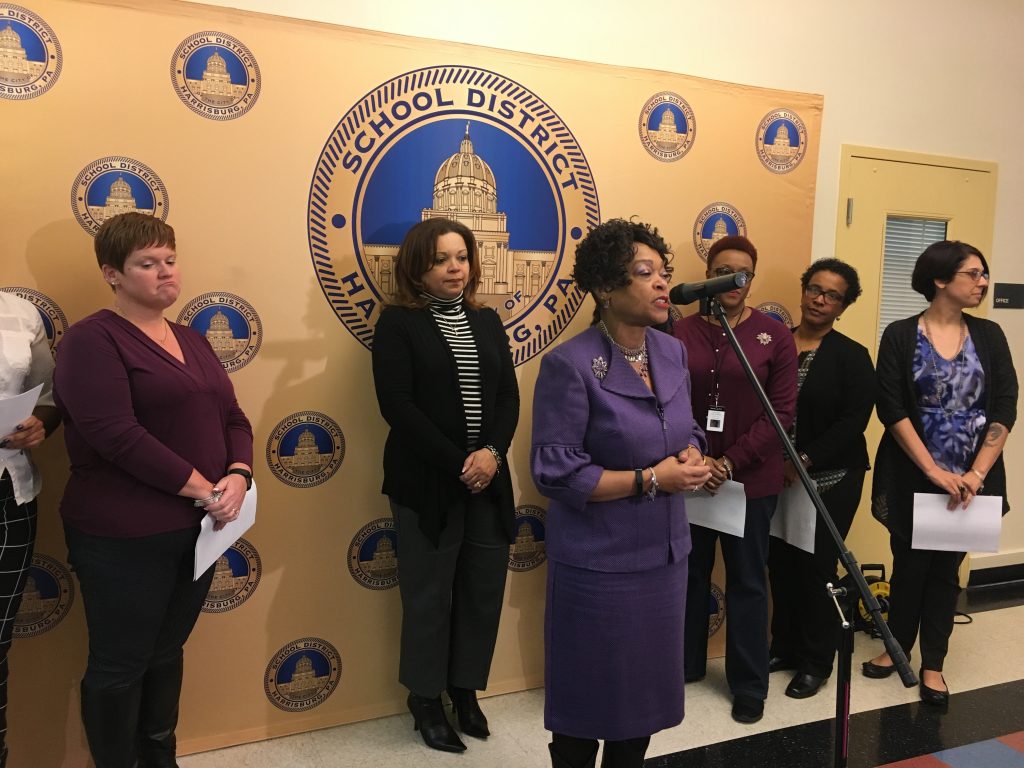
Superintendent Sybil Knight-Burney shared details about the district’s enrollment spike on Tuesday.

The Harrisburg School District is losing teachers and enrolling hundreds of new pupils, but administrators deny any problems accommodating a growing population of under-resourced students.

Since Sept. 25, the school district has enrolled 193 students who were displaced from Puerto Rico, Florida and the U.S. Virgin Islands by Hurricane Maria. Of those students, 113 qualify for ESL programs and 120 are considered homeless.

The new students represent a 3 percent increase to the district’s student population, which was approximately 6,400 in 2015, according to the district website.

The rush of enrollments came as the district struggled to retain teaching staff in the start of the school year. By the end of November, 45 teachers had resigned from the district, according to the Harrisburg Educational Association.

Union reps claimed that the attrition was compounded by a rising number of disruptive and violent students, who teachers say have mental health needs they cannot meet with standard training. Teachers who appeared before the school board on Nov. 20 asked the district for more resources to help troubled students.

District Superintendent Sybil Knight-Burney agreed at that meeting to the formation of a task force to address violence in schools. She could not comment on the status of the task force on Tuesday, but said the district was doing all it could to accommodate children after the “devastating event” of Hurricane Maria.

A coalition of administrators, teachers and social workers appeared with Knight-Burney in a press conference at the district’s Administration Building on Tuesday. They said that the district is working to give each child an uninterrupted education.

Saundra James-Goodrum, a social worker for homeless students, said that new students have received donated hats, gloves, uniforms and school supplies, as well as referrals for mental health and medical services.

“The services they get are no different from other students in the district,” said Monica Chisolm, and ESL social worker.

The new student population has put particular strain on the district’s ESL resources. ESL Supervisor Kathy Ames said that the district began the year with 50 students and two teachers in its ESL program and has hired four long-term substitutes to accommodate the 113 new ESL students.

Ames said that the cost of educating an ESL student is the same as the district’s normal spending-per-pupil, which was $16,709 in 2011. The district does not receive additional state funding to accommodate the new students.

Pennsylvania school districts are required by the McKinney-Veto act to enroll homeless students, including those who move into the district after being displaced from their homes.

In remarks after the meeting, Knight-Burney said that the district is committed to providing a safe environment for displaced students. She said the district is prepared to hire more ESL instructors based on need among staff and students.

Knight-Burney also said that the district is working to replace teachers who have resigned from the district, including those who left after altercations with violent students.

“We constantly post on the website and encourage applicants to apply,” Knight-Burney said.

Since HEA representatives are responsible for organizing the task force, Knight-Burney declined to comment on its objectives or timeline for achieving them. She said that the district is receptive to teacher demands and has planned a lecture about the neurological effects of trauma in January.

Continue Reading

Capital Region Water Set to Start 5 Projects in Harrisburg

Capital Region Water at work installing new pipes on Green Street in Harrisburg last winter.

Capital Region Water will begin a new round of sewer replacement and improvements next week, affecting several neighborhoods in Harrisburg.

Andrew Bliss, community outreach manager, said CRW will stagger the $700,000 project through the end of January. In all, CRW will repair more than 800 feet of aging and broken sewer mains and manholes at five locations.

The individual projects are:

Mid-December to early January
S. 13th Street, between Market Street and Howard Street
New manhole, 18 feet of new sewer pipe

End of December to early January
Cameron and Market streets
Spray on concrete liner, 18-inch sewer pipe

Early January to end of January
Magnolia Street between Cameron and 12th streets
New manhole on Cameron Street, pipe lining

Mid-January to end of January
Derry Street between 13th and 14th Streets
New manhole, 13 feet of pipe, pipe lining

Mid-January to end of January
Fulton and Hamilton streets
New manhole connection

Construction hours will be Monday to Friday, 7 a.m. to 5 p.m.

Potential impacts of the construction include street closures, parking restrictions, construction noise and temporary sewer service interruptions. When the pipe replacement is complete, the road will be temporarily patched until final street restoration is completed in the spring of 2018, Bliss said.

“Every business, office and resident in Harrisburg relies on our sewer system every day,” said CRW board Chairman Marc Kurowski. “These critical repairs will help ensure reliable wastewater service for the next several decades.”

Customers with questions can contact Capital Region Water by phone at 888-510-0606 or by email at [email protected].

Continue Reading

Papenfuse Pitches Composting Facility to City School Board

The site of Harrisburg’s proposed composting facility in Susquehanna Township.

Harrisburg Mayor Eric Papenfuse has renewed a quest to build a city composting facility in Susquehanna Township, but still must return to that municipality for final approval of the project.

Papenfuse appeared tonight before the Harrisburg School Board to present the city’s newest proposal for a composting site on 13 acres of school district property.

Though the proposed site is owned by the school district, it is located in the Edgemont neighborhood of Susquehanna Township, where residents rallied to oppose the project when it was first proposed last spring. Papenfuse and the city’s Public Works Department agreed to limit the scope of the project to placate residents, announcing over the summer that they would not pursue plans to compost food at the facility.

The city now proposes to build a site that composts just leaves and yard waste on five acres of the land. The facility will also serve as an “outdoor learning laboratory” for students in area schools, Papenfuse said, since the land is bound by a covenant saying it must be used for educational purposes.

Papenfuse and members of Public Works presented an informational video, filmed at the site, which explained the composting process and described the proposed facility. The facility would accommodate all of Harrisburg’s leaves and yard waste and produce nutrient-rich topsoil for residents.

School Board Director Percel Eiland said that the school board has always been supportive of the project as long as it pleases Susquehanna Township residents.

“We were pretty much sold the first time we heard this presentation,” he said. “We just want the residents to be satisfied.”

City officials will face a tougher audience later this month, when they make the same presentation to Susquehanna Township residents at a Board of Commissioners meeting. Papenfuse previously told TheBurg that he is optimistic that the scaled-back proposal will get their approval

Continue Reading

Weekend Roundup with Sara Bozich

Happy Weekend!

Please excuse the abbreviated Weekend Roundup. I have a pretty good reason.

What are you doing this weekend?

(more…)

Continue Reading