More Art, Music: H*MAC gets state grant to help complete Midtown facility.

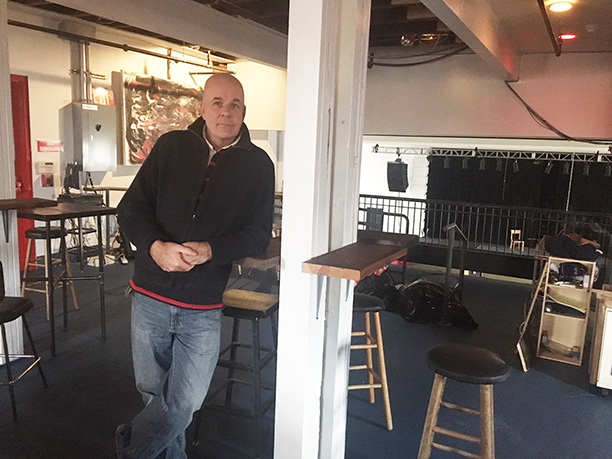
H*MAC partner John Traynor stands on the restored balcony overlooking the Capitol Room.

A major Harrisburg arts venue is the big winner locally in the annual competition for state redevelopment funds.

The House of Music, Arts & Culture (H*MAC) will receive $1 million from the Redevelopment Assistance Capital Program (RACP), a state program that provides grants for the acquisition and construction of projects deemed important for their cultural, economic, civic and historical significance.

John Traynor, a founding partner, said that the money will help H*MAC (formerly known as the Harrisburg Midtown Arts Center) complete the restoration of its building at N. 3rd and Herr streets in Harrisburg.

“I’m very, very pleased,” he said. “This grant is more than a grant to us. It’s a stamp of approval to all the hard work that’s gone into finishing this project.”

A decade ago, Traynor and two partners bought the dilapidated building at 1110 N. 3rd St., formerly the home of the Harrisburg Jewish Community Center and, later, the Harrisburg Police Athletic League.

They initially built out a small performance space and bar on the lower level and opened it as Stage on Herr. They later completed a restaurant and larger bar, the Kitchen at H*MAC, on the main level and then a larger performance space on the upper level now called the Capitol Room.

Traynor said that the RACP grant will allow them to finish restoration of the 10,000-square-foot basement level, turning it into a music school, studio and production facility that he likens to a “School of Rock” concept. It also would permit H*MAC to build a semi-enclosed bar and restaurant area on the roof of the building and complete patio and façade improvements.

“We believe this will be the gem in the crown of Harrisburg, “ he said, adding that this next phase of work would proceed through 2018.

H*MAC received only about one-third of the $3.3 million it applied for, though few projects that are awarded funding receive the full amount. Traynor said that he believed the grant could be leveraged to give him access to additional funds so that the center would be functionally complete.

When H*MAC is finished, Traynor expects to employ more than 80 people, compared to about 30 currently, he said.

In Dauphin County, only two other projects were selected in this round of RACP funding.

Hershey Towne Square received $750,000 for a three-story parking garage. It had requested $2.5 million for the project.

The Salvation Army, Harrisburg Capital City Region, was given $500,000 for its new 39,000-square-foot facility at 29th Street and Rudy Road. It had requested $4.5 million.

“It wasn’t our full request, but we’re very happy to receive this grant,” said Kathy Anderson-Martin, director of resource development.

The grant also may help the Salvation Army leverage other matching funds, she said, raising more money.

Anderson-Martin said her organization has raised about $8 million of a total construction cost of $11 to $12 million. This should allow them to break ground on the facility in the spring or summer of 2018. Already, the site has been cleared and most design work completed, she said.

In all, there were 10 applicants in Dauphin County in this round. The eight applicants denied funding so far are:

  • The City of Harrisburg, $14.3 million for a bridge over the railroad tracks at Division Street
  • Harrisburg City Islanders, $5 million for a new stadium in Lower Swatara Township
  • Harristown Enterprises, $3 million to construct a six-story building at 21 S. 2nd St. in Harrisburg
  • Christian Recovery Aftercare Ministries, $650,000 for renovation of its Uptown Harrisburg building
  • Tri-County Housing Development, $1 million for Hummel Street redevelopment
  • Mulberry Street Properties, $322,311 for Allison Hill revitalization
  • Hawthorne SPE, $5 million for its Progress and Linglestown Traditional Neighborhood District project in Susquehanna Township
  • Whitaker Center, $5.5 million for a major renovation of its building in downtown Harrisburg

In Cumberland County, the Carlisle Family YMCA was the only successful applicant among five total, receiving $1.5 million, half of its request, for an addition to its facility.

Projects denied funding in the initial round sometimes receive funding in a later round or reapply for the following year.

In all, the state funded 149 projects for almost $188 million in this round, compared to requests for 399 projects worth $1.7 billion.


Continue Reading

Weekend Roundup with Sara Bozich

Happy Weekend!

Please excuse the abbreviated Weekend Roundup. I have a pretty good reason.

What are you doing this weekend?

(more…)

Continue Reading

In the Books: Harrisburg Council makes a few tweaks, passes 2018 budget.

Harrisburg City Council tonight as it discussed the 2018 municipal budget.

Harrisburg City Council voted tonight to approve a $72 million budget for 2018, which will hold tax rates steady and allocate millions of dollars to capital improvements in the new year.

The budget that passed 6-1 tonight largely resembles the one proposed by Mayor Eric Papenfuse in late November, though council did decide to withdraw an additional $714,000 from the city’s cash reserves for park and playground improvements. That will bring the city’s total reserve spending in 2018 to $9,234,000, since the original budget proposed withdrawing $2 million for debt services and $6.52 million for capital improvements.

“While we’re investing in public safety, blight and infrastructure, we’re also providing nurturing environments for children so they have spaces to grow and play,” Councilman Cornelius Johnson said. “These are lifelong investments that can benefit the citizens of Harrisburg.”

The additional cash withdrawal will finance a new chutes and ladders playground at Reservoir Park, which the city originally planned to build in 2019. The 2018 budget had also earmarked $250,000 for planting meadows at that park, but council reallocated those funds to the playground project. The Department of Parks and Recreation will also receive $450,000 for renovations at five city playgrounds: Norwood-Holly, Cloverly, Summit Terrace, Penn and Sayford and 4th and Dauphin.

Council also authorized a $10,000 transfer from the city’s Host Fund to the Planning Bureau. Councilwoman Ausha Green motioned to reallocate the money so the bureau can hire an outside consultant to edit the city’s draft comprehensive plan. The allocation passed 7-0.

Councilwoman Shamaine Daniels attempted to strike down proposed salary raises for members of the city’s Law Bureau. Daniels said that the raises should be postponed until council considered a salary ordinance in the new year. Her motion to revert the salaries failed after none of her colleagues moved to second it. Daniels then cast the only vote against the budget.

In addition to salary raises for the Law Bureau employees, the budget will also raise salaries for managers in the Sanitation Department and create new pay grades for sanitation workers represented by the AFSCME union. AFSCME members came to Tuesday’s budget vote to advocate for council to approve the raises and the allocations for new sanitation equipment.

“Knowing that someone acknowledges your work and that you’re doing a good job, it makes you want to go to work a little more,” said sanitation driver Jason Jackson after the vote.

The 2018 budget forecasts $65 million in revenue, up $4 million from this year. Papenfuse attributed that increase to a growing tax base, since revenues from real estate, local services and earned income taxes all exceeded projections this year.

The city will end 2017 with more than $20 million in its cash reserve fund. A $7.2 million withdrawal from that fund will finance capital improvement projects in every department of city government. Some of the line items for those projects include:

  • $700,000 for the Police Bureau to construct a new substation on S. 15th Street, which will open part-time in August 2018.
  • $250,000 for the Codes Bureau to double its in-house demolition capacity.
  • $80,000 for the Police Bureau to purchase body cameras.
  • $30,000 for the IT Bureau to host Harrisburg police video server
  • $1.2 million for the Fire Bureau to replace roofs at three stations.
  • $425,000 for the Public Works department to construct ADA-compliant wheelchair ramps throughout the city.

The 2018 budget anticipates a $1 million fund balance at the end of the new year. It also outlines priority expenses for 2019 and 2020, including $550,000 for an Uptown/Midtown police station and $1.3 million for Reservoir Park redevelopment.

The city will balance those priorities while planning for Harrisburg’s exit from Act 47, which could happen as early as 2019. In a budget hearing last week, however, Marita Kelly, a state overseer, told city officials that Harrisburg will likely need to seek a three-year extension to its Act 47 status.

Council members and administrators have acknowledged that the city cannot afford to give up the special taxing privileges that Act 47 confers.


Continue Reading

All Heat No Fire: Divided Harrisburg school board delays vote on superintendent’s future.

The Harrisburg school board

The former president of the Harrisburg school board sparred tonight with the man who unseated her, alleging that he failed to inform her of a last-minute agenda item.

School board Vice President Danielle Robinson, who served as president until she was ousted in a vote last week, called for the board to table a resolution that would start the process of hiring a new superintendent.

Robinson said that the board failed to follow proper procedure and discuss the resolution in committee. She accused new board President Judd Pittman of adding it to the agenda without telling her.

“This board deserves the respect of not having something slipped in last minute, because you know everything else on this agenda has gone through a committee,” Robinson said.

She claimed that she heard about the resolution on social media before she heard about it from the board.

Pittman said he reached out to Robinson to discuss the matter. She called him a liar and said he never followed through to tell her about it.

The exchange foreshadowed the contentious debate that will likely take place this spring, when the board will consider renewing the contract of current Superintendent Sybil Knight-Burney. Her four-year contract, which carries a $179,208 annual salary, is set to expire in June.

The board can renew Knight-Burney’s contract for another four years or open the position to a competitive hiring process in which she can participate. The state public school code says the board must start the hiring process at least 90 days prior to the day her contract expires, but Harrisburg’s policy requires 150 days.

Robinson also argued that the board should take its time with the resolution for the sake of three members who were sworn in last week. Robinson said that they needed more time to make an informed decision about Knight-Burney’s tenure. Board member Matt Krupp objected.

“It’s unfortunate that this board did not discuss this prior, but I think our members are all well informed and all pay attention enough to vote on this,” Krupp said. “We don’t need to wait.”

The board voted 6-3 in favor of Robinson’s motion, moving the resolution into a committee for discussion. Board members will determine then whether or not to include the item on a future agenda.

The board also tabled a resolution concerning sanitation employees who are represented by the AFSCME union. The resolution would “provide the district with the option” to transfer sanitation workers from the district payroll to the payroll of Aramark, a contractor. AFSCME representative Nichelle Chivis claimed the resolution would violate the collective bargaining law.

“If this goes through, I will file charges,” Chivis said. “The district is attempting to circumvent its responsibilities under the collective bargaining agreement.”

Interim Chief Financial Officer Jim Snell said the item was meant to apply only to AFSCME employees who left the union and sought part-time employment with Aramark.

“I will readily admit that it’s worded very awkwardly, but the intent is the intent,” Snell said.

Board member Percel Eiland motioned to send the resolution back to the Budget, Finance and Facilities Committee to amend the language and avoid a contractual violation. The motion passed 8-1.

Also today: Video surfaces of Superintendent Sybil Knight-Burney speaking at a pro-school voucher rally. 

Continue Reading

To Re-hire or Not? Pro-voucher video surfaces as Harrisburg school board considers Knight-Burney’s future.

Harrisburg School District Superintendent Sybil Knight-Burney speaks at a 2011 pro-voucher rally at the state Capitol, with then-Sen. Jeff Piccola (from a screen shot)

Should the leader of a struggling public school district support a student’s choice to leave it?

That’s one of the questions facing the Harrisburg School Board of Directors and Superintendent Sybil Knight-Burney, who, in 2011, made remarks at the state Capitol supporting a school voucher program. Knight-Burney’s contract with the district is up for renewal in 2018, and the board is meeting tonight to consider her future with the district.

A YouTube clip from 2011 shows Knight-Burney, then the acting superintendent of Harrisburg schools, at a rally in the Capitol Rotunda for Senate Bill 1, a limited-school voucher program. The bill would have allowed low-income students from poor and failing school districts to obtain vouchers to attend private schools. It passed through the Senate but was struck down by the House later that year.

Proponents of school voucher programs say they expand access to private schools and allow low-income students a path out of failing districts. But critics, which include most public school educators and administrators, say they exacerbate problems in under-resourced schools by depriving them of state and federal funds.

At the 2011 rally, Knight-Burney acknowledged that her position on the bill put her at odds with most of the public school community. She addressed a cheering crowd while flanked by school students, lobbyists and legislators, including then-Sen. Jeffrey Piccola, who sponsored the bill.

“This is not about pitting private schools against public schools or saying one is better,” Knight-Burney said. “It’s about providing opportunities of choice for all parents as they seek out educational alternatives… it’s about empowering families to make the best choice for their families.”

Knight-Burney went on to say that the schools have an urgent need to raise student achievement levels. As an educator and a mother, she said, she knows that parents care “more than anyone” about their child’s education.

“Parents and children are consumers of education and should be free to choose the educational product that works best for their child,” she said. “This opportunity should be affordable to all parents no matter what economic level they are categorized in.”

In school choice programs like the one proposed in SB1, a student who is dissatisfied with her public school district can apply to obtain a voucher – essentially a coupon that represents the money that child’s school district would have spent to educate her in public school. The child’s family can then apply the voucher to tuition at another school, including a religious or private school.

The value of the student vouchers is proportional to a school district’s spending-per-pupil. In the Harrisburg school district, that spending is close to $17,000 per student per year. The voucher does not take any local funding out of the district, but does divert the state and federal dollars used to educate the child.

That means that, in Harrisburg schools, almost half of the dollars used to educate a student could leave the district. The school district received 40 percent of its revenue from local sources and 48 percent came from state funding in 2015, according to data from WHYY. Voucher amounts would also be adjusted for the income level of the student’s family.

Knight-Burney was not available for comment on Monday.

Continue Reading

Burg Blog: Turn It Out

A polling location on State Street in Harrisburg.

Recently, I received an email from a Derry Township resident with the thesis that county Judge Lori Serratelli lost her race last month because of poor voter turnout in Harrisburg.

The writer further pinned blame on the Dauphin County Democrats, saying the county committee didn’t do enough to get its voters, especially in Harrisburg, to the polls.

Indeed, voter turnout in Harrisburg in the general election last month was abysmal at about 18 percent of registered voters. However, I disputed the notion that the blame lay primarily with the committee’s efforts (or lack thereof), as many other factors played into the low turnout and, thus, Serratelli’s loss by 1,665 votes to John McNally for the last of three judgeships at stake.

Harrisburg’s high levels of transience and poverty are practically a formula for low turnout, a problem exacerbated last month by the lack of passion in the uncontested mayoral and council elections. All the energy, I wrote back to him, was in the primary election back in May. Having said that—if the general election turnout among Democrats had matched the primary’s turnout (still a lousy 23 percent), Serratelli still would have lost by a few hundred votes.

Nonetheless, I consider my e-mailer’s point well taken since, to me, election turnout is the single most important (and often most ignored by pundits) factor in determining who represents us. Does gerrymandering, big money or, now, Russian bots help sway elections? To some extent. But getting voters to the polls is a much more critical factor.

This point was driven home to me on Tuesday night as I watched the special election results roll in from the distant state of Alabama. Before then, I knew almost nothing about voter demographics in Alabama because, well, why would I? But, after a few hours of watching cable news coverage, I could converse pretty intelligently about Mobile versus Baldwin counties, the importance of the so-called black belt and the changing nature of the state’s suburbs.

By the end of the evening, I was most struck by all the blue on the map, which indicated that a majority of voters in a county had voted for the Democrat Doug Jones over the Republican Roy Moore. I wondered: Where the heck did all these blue voters come from, and where had they been hiding all these years?

To me, there it was—proof that plenty of Democratic votes existed in even the reddest of red states. That vote just needed to be mined.

A similar dynamic played out last year, only in reverse. In Pennsylvania, I never imagined that there were enough dormant or persuadable GOP votes to hand the state over to Donald Trump.

In the months before the 2016 general election, I would drive outside of Harrisburg and see long rows of Trump signs, seemingly on every lawn and barn, like some contagion had spread down one rural highway and up the next. I dismissed this, stuck in the conventional wisdom that these probably were not new voters and that, in these sparsely populated areas, there wouldn’t be enough of them to make a difference anyway.

I was wrong and then equally wrong thinking that this state couldn’t possibly flip so abruptly in just four years.

In both the Jones/Moore and Trump/Clinton cases, one could point to the weaknesses of the losing candidates. True enough, though both Moore and Hillary Clinton had large groups of passionate supporters, as well. They both lost very narrowly and may well have won if they had run better campaigns, not assumed victory and continued to dig ever deeper into their pools of persuadable voters.

Indeed, Moore performed quite well in most of white, rural Alabama, with his turnout better than one would expect from a special election in an off-off year. It just wasn’t to the level of the Trump mania that had swept over that demographic last year, a weakening that should have been anticipated.

And that brings me back to Dauphin County.

Long a Republican stronghold, Dauphin County is now majority Democratic (D’s 81,816, R’s 73,825 as of November). Yet Republicans still own the county, occupying every row office (nine of them) and controlling the board of commissioners and the courthouse. Why?

Demographics and socioeconomics certainly are reasons, as Republican voters tend to be older, whiter, wealthier and less transient, which all means higher rates of voting. These factors helped sink Judge Serratelli, a highly regarded jurist who likely lost simply because she had a “D” after her name.

But the county’s Democrats as a whole—the party, the candidates and the voters—are largely to blame.

Yes, the Democratic Party in Dauphin County has structural and demographic issues that are difficult to overcome. However, Democrats also hold a significant registration lead, and the county’s trend towards greater urbanization should increasingly work in their favor.

Put simply, the votes are out there for the Democrats. It’s now up to the party, its activists and its nominees to dig deep and mine every last one—and not just in Harrisburg but countywide. That will take time, money, commitment, leadership and much more organized, professional, energetic and better-run campaigns.

Alabama has shown that a Democrat can be elected under much less favorable circumstances—those votes just need to be fiercely excavated. The question now is: Do Democrats in Dauphin County have it in them?

Lawrance Binda is editor in chief of TheBurg.

Continue Reading

Harrisburg Mayor: City plans to proceed with composting facility plan.

Harrisburg Mayor Eric Papenfuse made a final pitch for a composting facility last night in Susquehanna Township.

Harrisburg intends to move ahead with plans to build a composting facility in Susquehanna Township, even though a number of township residents still don’t want it.

With Harrisburg Mayor Eric Papenfuse in attendance, seven township residents and one state representative appeared before the township board of commissioners on Thursday night to oppose the composting site. No residents at the meeting voiced support for the facility, but the city’s administration believes that it has won enough support in the community to proceed with the project.

“There’s a handful of people from the neighborhood who oppose it, but it’s not overwhelming,” Papenfuse said. “We’ve worked hard to include incorporate public feedback, and there were far fewer people speaking out against it tonight.”

Papenfuse said that the city would apply for a facility permit with the state Department of Environmental Protection in January. If DEP grants the permit, which Papenfuse believes it will, the city will begin to convert the site to a compost facility.

City officials have campaigned to build a composting facility at 1850 Stanley Rd. since the summer. After they were met with fierce opposition from some residents in Susquehanna Township, they agreed to delay the permit application until they had more public support. Over the following months they hosted informational sessions and visits to comparable sites to teach residents about composting.

Some of the concerns raised on Thursday were over the perceived environmental and health harms of a composting facility. Sue Helm, a representative for Pennsylvania’s 104th legislative district, cited those reasons when she said her constituents in Edgemont did not want the facility in their neighborhood.

Papenfuse reminded the crowd that composting leaves and lawn waste – which essentially involves letting the material decompose into the ground – does not carry any risks to humans, soil or water sources.

Some residents claimed that the facility would create odors or mar neighborhood views. Others worried about noise from the machinery and increased traffic from the Public Works Department trucks that transport the waste.

Papenfuse assured residents that the site would be unobtrusive when it opens. Public Works vehicles will use mostly Harrisburg roads to get to the site, and employees will operate the machinery on a limited, set schedule.

State municipal codes require Harrisburg to maintain its own composting facility for leaves and yard waste. The city decided to build the site on land in Susquehanna Township owned by the Harrisburg School District. The Stanley Road property is owned by the school district and will be leased to the city for a nominal fee. According to Papenfuse, the facility cannot be built in a flood plain, which drastically limits the potential sites in Harrisburg city limits.

Continue Reading

Weekend Roundup with Sara Bozich

Happy Weekend!

Please excuse the abbreviated Weekend Roundup. I have a pretty good reason.

What are you doing this weekend?

(more…)

Continue Reading

Citing low manpower, police dial back plans for Allison Hill substation.

A rendering of the police substation on S. 15th Street, which will open in late August 2018 with part-time hours.

The Harrisburg Police Bureau is on track to open a police substation in Allison Hill in late summer 2018, but officials said last night that it will not offer the full-time services they initially proposed.

The bureau first announced plans to open a 24-hour precinct in on S. 15 Street in 2016. Since then, personnel shortages have forced it to delay renovations to the station site and scale back staffing plans.

During last night’s hearing on the 2018 budget, Police Chief Tom Carter and Capt. Derric Moody told City Council that the substation will not operate 24/7 or have civilian staff when it opens in August 2018.

Police may expand operations at the substation as they grow their ranks. The city hopes to hire 20 new officers and a community policing coordinator next year.

“Our goal is to have full service there, but, realistically speaking, we can’t currently achieve that with the manpower we have,” Moody said.

The new plan is to use the substation as a staging area for specialized police units and an outpost for officers responding to calls Allison Hill. The 1,600-square-foot building will include a space for police trainings and community meetings, as well as a squad room, break room, equipment room and locker room with showers.

It will also have an area for a receptionist, though there are currently no plans to hire one. Members of the public will be able to enter the substation for public meetings or interviews with police officers, but will not have access the same administrative services as the Public Safety Headquarters downtown.

“We’re trying to provide a central location for officers,” Moody said.

He added that plans to open the substation came after residents in Allison Hill called for a larger police presence in their neighborhood.

Council member and public safety committee chair Cornelius Johnson was surprised to learn last night that police would not open a precinct as they initially planned.

“It sounds like we’re going to use the building as we have been, it’ll just be prettier,” he said.

Harrisburg police have operated a substation out of a cinder building on S. 15<sup>th</sup> street since the early 2000s. The empty building is not insulated or fully wired with electricity, but currently serves as a rudimentary break room for officers working on Allison Hill.

This year, the bureau decided to demolish the existing structure and install a steel modular building in its place.

“For this footprint, modular is better for speed and cost,” Moody said. “We won’t have much on-site construction.”

The station will be built at a modular construction plant then disassembled and brought to Harrisburg on tractor-trailers.

The city plans to send the modular project out to bid by Feb. 1. The bureau hopes to be at full complement by the time the station opens in August, but still does not want to make a staffing plan based on hypothetical hires.

“We don’t want to overpromise,” said Mayor Eric Papenfuse.

He reaffirmed the city’s plan to vacate the decrepit Public Safety Building on Walnut Street in the next two to five years and said the substation could eventually accommodate full-time staff as employees relocate.

Capt. Gabe Olivera said that the bureau would need to reallocate IT and tactical equipment before it could operate the 15th Street substation as a 24-hour precinct.

It’s also possible that staffing the facility 24-7 would require a renovation. Olivera also said that the building would need to be much larger to accommodate full-time operations, but Papenfuse insisted that the 1,600-square-foot footprint would be sufficient.

The substation construction will be funded by a $700,000 allocation from the city’s general fund and $200,000 in Community Development Block Grant money. This is the third year the police have hoped to use CDBG funds for the substation project. In 2015 and 2016, they had to use CDBG allocations to pay overtime details in Allison Hill.

Editor’s note: This article was corrected on Dec. 14 to clarify the requirements for expanding hours at the substation. The police would not need to invest in more tactical and IT equipment to expand the station hours; they would need to reallocate equipment they already have in their headquarters. 

Continue Reading

No Tax Hike as Dauphin County Finalizes 2018 Budget

The Dauphin County Administration building.

The Dauphin County commissioners today passed a 2018 budget that keeps property taxes steady for a 13th consecutive year.

The three-person board passed a $241 million budget that contains no increase in the county portion of the property tax, which will remain unchanged at 6.876 mills.

The county does expect to spend more than it takes in for 2018, but plans to use as much as $12.5 million in reserve funds to make up the shortfall. The county stated that it still expects to have a reserve fund balance of about $25 million by the end of 2018.

Last year, Dauphin County also balanced its budget by dipping into its reserve fund. It estimated that it would spend $12.5 million in reserves, but will only spend about $5.2 million by year-end, according to current county estimates.

The county stated that it will add funds to the county coroner’s office in 2018 to deal with the rise in opioid-related deaths. Last year, there were 85 overdose deaths in the county, but the coroner expects more than 100 by Dec. 31.

“This board continues to balance the need for conservative budgeting with the corresponding responsibility to provide vital services for our residents,’’ board Chairman Jeff Haste said in a statement. “We also never stop looking for ways to make our limited resources go farther, which is why we are pursuing a lawsuit against opioid manufacturers to force them to help pay for drug treatment and prevention programs.’’

Continue Reading