It was just another Friday afternoon in May 2016 when Patrick McDonnell arrived at the governor’s suite of offices on the second floor of the state Capitol.
McDonnell was the policy director in the Department of Environmental Protection, and he was in the Capitol to meet with the governor’s policy secretary to discuss departmental issues. Nothing to get excited about—just the type of meeting that takes place all the time around the Capitol complex.
And then the unexpected happened. The meeting location had changed, and McDonnell was ushered into the governor’s inner office. Gov. Tom Wolf gave him stunning news: The DEP secretary had just resigned. How would he like to be the new acting secretary?
It’s not often that a career public servant like McDonnell is thrust into oversight of a department with 2,400 employees and with responsibilities that range from Marcellus Shale drilling to black fly spraying. There had been no warning, and yet there he was, asked to make a life-altering decision. Someone else might have been too stunned to answer or might have stammered through an incoherent response.
Instead, McDonnell calmly answered that he had always been committed to public service and was prepared to help in any role. And, with that, Patrick McDonnell, with startling suddenness and no inkling of what was about to happen, became the acting secretary of DEP.
The truth of the matter, though, is that McDonnell is accustomed to having to think quickly and respond to others without any knowledge of what they are going to say. That’s because of his other life—performing on the stage at the Harrisburg Improv Theatre.
Sanctuary
It’s a Friday night, and a crowd has settled into the pew-like benches in the small theater on N. 3rd Street in Midtown. They are there to watch a series of performances in what has to be one of the most unusual—and challenging—forms of public performing.
Improvisational theater (or “improv”) is the “playing of dramatic scenes without written dialogue or no pre-determined dramatic activity,” according to the Encyclopedia Britannica.
But that definition doesn’t begin to do it justice.
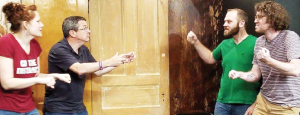
At the Harrisburg Improv Theatre (aka the HIT), the actors—groups of five or six people—enthusiastically enter the stage and ask the audience for one word. That’s it: one word. From that single word, the performers are expected to invent a series of skits that last about half an hour.
And so it was that on this particular Friday night as a group calling themselves the “Hawkwards” entered the stage. Among them was one of the most powerful figures in Harrisburg, Patrick McDonnell. But he didn’t look much like a department secretary. Clad in jeans and a blue T-shirt, he could have been anyone from the neighborhood performing with this group of five men and one woman.
They asked for their word, and someone yelled out, “sanctuary.” And off they went, jumping from skit to skit and, of course, improvising often-hilarious dialogue. That night, a highlight was when McDonnell spontaneously assumed the role of an Irish nun, leaving the audience laughing at his quick wit.
The performances are fast-paced and unpredictable, and then, in what seems like a flash of time, the lights go on as the appreciative audience claps and cheers.
So, what does this have to do with being environmental secretary?
Well, a lot, according to McDonnell. Just like in his improv performances, every day he is confronted by a variety of unexpected developments and unplanned conversations. So improv has been great training for dealing with the unpredictable—like being asked by the governor out of the blue to be the next DEP secretary.
“Improv makes you a better listener,” said theater owner and performer Jake Compton. “It also helps with empathy because you’re taught how to think through another person’s point of view in a way that is honest. Improv also helps you approach life with a sense of fun.”
A Balance
The son of a Philadelphia policeman, McDonnell and his wife Colleen moved to the Harrisburg area 17 years ago and are raising their four children here. They have come to love this area.
“You’re in an urban environment, and 10 minutes later you’re in a park,” he said.
This helps him keep a balance between work and home, urban and rural. He’s found that carving out time to have fun is a big part of that balance.
Besides his devotion to improv, he’s a dedicated movie buff and a fan of sketch comedy shows like “Saturday Night Live” and “Second City.” In fact, when he first addressed the employees of the department, he broke the ice by doing impressions of Yoda, Jack Sparrow and other movie characters.
Of course, running a department like DEP can be serious business. But improv helps him here, too. The experience has, he said, made him a better listener, determined to hear and understand the viewpoints of the staff, legislators, business officials and environmentalists who fill his calendar from early in the morning until late into the evening. And that open approach often leads to getting results that might not have been on the table when discussions began.
McDonnell seems to relish juggling the demands of his family life and running a critical state agency. From his perch on the 16th floor of the Rachel Carson Building, with its spectacular view of Capitol Park, he runs a department responsible for ensuring clean air and clear drinking water, as well as overseeing the state’s mines and drilling and even its nuclear reactors—while having only about two-thirds of the workforce it did 20 years ago.
By all accounts, he’s done it well. The Senate clearly agrees and easily confirmed his nomination earlier this year. And with that, the word “acting” was removed from his title. He’s now the “secretary.”
Except, of course, for Friday nights, when he returns to the Harrisburg Improv Theatre and, once again, is “acting.”
The Harrisburg Improv Theatre is located at 1633 N. 3rd St., Harrisburg. For more information, including classes and shows, visit www.hbgimprov.com.

















 10. Mega-Murals: Let’s kick off the top-10 list on a happy note, with perhaps the most delightful thing to happen in Harrisburg in 2017—the Harrisburg Mural Festival. In September, artists came to town from near and far, and, at the end of 10 days, more than a dozen new murals were sprinkled throughout Midtown and downtown. It was a fun, affirming community event the likes of which I hadn’t experienced here before. Speaking of public art, I’d like to give a quick quack-out to another way-cool project, the Downtown Ducks, which offered a bit of needed whimsy amidst the hard surfaces of Harrisburg’s business district.
 9. To the Limits: Every year, an issue arises that epitomizes the perennial discord and power struggle between Harrisburg’s mayor and City Council. In 2017, there were several, but an effort by council President Wanda Williams to impose mayoral term limits had to be the most overt. Williams recalled the excesses of seven-term Mayor Steve Reed to justify her ordinance, but most people regarded it as a naked swipe at current Mayor Eric Papenfuse. In turn, Papenfuse said he didn’t necessarily oppose term limits for the mayor, but thought they should extend to council, as well. And, months later, that’s where we stand.
 8. Going Up: In November, Harrisburg University offered up an early holiday present when it announced plans to build the city’s tallest building—a 30-story-plus neck-strainer at the corner of S. 3rd and Chestnut streets. The project, currently slated to break ground next year, may include a hotel and conference center, in addition to classrooms and student housing. Downtown saw other development news in 2017, as Harristown Enterprises announced new projects on 2nd Street and continued its transformation of Strawberry Square with the debut of high-quality tenants like Fresa Bistro, Provisions, Freshido and the UPMC Pinnacle medical offices.
 7. What’s the Plan? A single story rarely lasts through an entire calendar year, but the saga of Harrisburg’s comprehensive plan has now extended through 2015, 2016 and 2017. The year began with the city dismissing consultant Bret Peters, as relations between the administration and its hired architect reached a breaking point. In an odd twist, it ended with the Planning Commission adopting Peters’ plan as its final working draft. Because the plan still must pass muster with City Council, I’ve already penciled in this never-ending story as part of my 2018 top-10 list.
 6. Not a Laugh Riot. By springtime, it looked like 2017 might be a difficult year on the streets of Harrisburg, as the capital city got drawn into the nation’s pro- and anti-Trump drama. Following clashes between factions at one protest, Harrisburg police asked council for $65,000 for new protective, or riot, gear. That got the crowds to council chambers, with most speakers opposing the purchase. In October, council tied the funding to the creation of a new, eight-member citizen task force to advise on police issues. However, as of mid-December, council had not passed a resolution authorizing it.
 5. Triple Tragedy: Every year, a few stories in this often-fragile city seem particularly tragic. For instance, the double-murder in November of stepsisters Kaliah Dearing and Natasha Harner was especially horrible and heartbreaking. But arguably no story was more tragic than the triple loss in March of 10-year-old Savannah Dominick, 2-year-old Ashanti Hughes and Harrisburg firefighter Lt. Dennis DeVoe. The girls perished from a house fire in Uptown Harrisburg sparked by a faulty hover board, and DeVoe was killed when his car was T-boned on his way to the fire. Fittingly, the Fire Bureau later retired DeVoe’s badge number and placed his name on the Memorial Wall at the PA National Fire Museum.
 4. Reed Plea: Harrisburg’s “trial of the century” was set to start, with the city’s former seven-term mayor and erstwhile savior, Steve Reed, in the dock facing more than 100 criminal counts. Then, poof, it all ended. Reed suddenly accepted a plea deal on 20 counts of receiving stolen property and, a week later, was sentenced to two years of probation. The conviction was cold comfort for those wanting someone to answer for hanging Harrisburg out to dry, driving it the brink of bankruptcy. Back in 2015, the state had charged Reed with nearly 500 corruption-related counts, but most of those were dismissed because a judge ruled that the statute of limitations for prosecution had expired. Following the sentencing, the state and the city declared that, with the criminal case settled, they now could pursue civil charges against the myriad people responsible for the city’s financial implosion. So far, crickets.
 3. Election Division: High-stakes elections often bring out the worst in a body politic, and so it was once again with Harrisburg’s mayoral contest. The five-candidate primary race was rather quietly (and often poorly) run until about two weeks before the primary election, when a series of debates finally forced the candidates out from behind their Facebook pages. Then it was all division: race, neighborhood, class and anything else that could be used by challengers to try to divide and conquer. In the end, incumbent Papenfuse had the overall best debate performances and won handily. And, with the Democratic nomination determined, the mayoral election seemed to be all but settled, until . . .
 2. Raffle Wreck: In Harrisburg, nothing ever seems resolved. So, candidates lose in the primary, but then often reappear in the general election. This time around, two of the losing primary candidates decided to mount last-minute write-in bids, which seemed rather innocuous and, honestly, pointless, until one of them, Gloria Martin-Roberts, lost control of her campaign. Several supporters decided to mount their own rogue campaign on her behalf, rounding up a bunch of homeless men to distribute flyers supporting the candidate. The men also handed out raffle tickets, which offered a chance to win big prizes just for voting. “Foul!” cried several concerned citizens, who complained to the county elections bureau. A judge, seeing a possible connection between the flyers and the tickets, issued an order to halt the raffle. Over ensuing days, most folks complicit in the strange affair laid the blame on others or denied involvement completely. To quote those New Zealand pop gods, OMC, “How bizarre.”
 1. Up and Up: Several years ago, in my year-end “Top 10” list, I remarked that most news items were surprisingly positive, even though the city itself, broke and under state receivership, was a basket case. This year, I have the opposite assessment. Many of my top news items are rather negative, but, in truth, the city had a very good year overall. The budget is balanced, many new businesses opened, re-development continued, the city’s first bike share launched and home sales were brisk. Back in 2012 and 2013, I never could have imagined such a rapid turnaround and bright future for Harrisburg. But, thankfully, here we are. So, that’s my No. 1 story of the year.