Burg in Focus: Awakening Adventures from GK Visual on Vimeo.
Their friendship got off to a “rocky start.”
A mutual friend introduced Travis Haines to Kyle Stapp, an experienced rock climber, about five years ago.
“I don’t have time to climb rocks,” Haines recalls saying to Stapp at the time.
The two men laugh at the memory because today they not only share a love of rock climbing but are co-owners of the newly opened Susquehannock Climbing and Fitness Center.
Located half-an-hour north of Harrisburg in Liverpool, the business is housed in a former sewing factory known locally as “The Facktory,” just two blocks from routes 11/15 and the Susquehanna River.
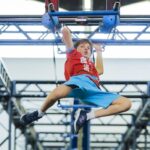
Haines, 29, served in the U.S. Navy, worked as a park ranger at nearby Little Buffalo State Park, and enjoys obstacle course challenges so much that he has applied twice to the popular television show, “American Ninja Warrior.”
Stapp, 33, also served in the military—the Army—followed by six years as a rock climbing supervisor at Perry County’s Longacre Leadership Camp. He’s also a certified single pitch (meaning one pitch or one climb between two points) instructor by the American Mountain Guides Association.
Open since November, Susquehannock Climbing offers rock climbing walls with numerous options, skills and strength training, obstacle course training, instruction in wilderness survival skills and more. Patrons are also welcome to use the facility as an open gym.
All the skills learned indoors, in the controlled environment of Susquehannock Climbing, can be transferred outdoors, to other sports and life experiences, according to Stapp and Haines.
“We truly believe anyone can climb,” Stapp said. “If you’re a total rookie, we welcome you.”
The pair has additional aspirations.
“We want to teach rock climbing as a form of therapy—helping special needs children, those with PTSD such as veterans and recovering addicts,” Haines said.
Above and Beyond
Stapp said he “geeked out” researching what’s called adventure-based therapy.
He pointed to studies that show that climbing stimulates language, balance, spatial body awareness, overall muscle tone, fine and gross motor skills. Additionally, climbing is said to encourage problem-solving, independent thinking and confidence.
Haines said he especially enjoys teaching “newbies” how to climb since it wasn’t long along that he, too, was a beginner.
“I recently had a 242-pound man on the rope—he got the whole way up the wall to the top and that felt good,” Haines said. “I was so proud of him.”
Another source of pride for Haines is the “transformation” he says is underway in Liverpool.
“I feel this building has a lot to do with that,” he said, referencing the rehabilitation of the factory into “The Facktory” by owner Brent Lesperance.
A contractor for 25 years, Lesperance bought the former factory and began rehabbing it in 2004 with his stepbrother.
“We wanted to create a place for kids to go, and it was easier to repurpose the factory instead of starting over from scratch,” he said.
Within the 1900s-era brick-and-stone walls, Lesperance created an indoor basketball court, event and concert venue complete with a stage and sound system, kitchen, space for ping pong tables and other games. A former boxer, Lesperance coached area kids in The Facktory’s boxing ring.
Health issues soon forced him to shut down The Facktory, except for rentals of the space. But he said he was thrilled when Haines and Stapp approached him with a plan to lease part of it for the climbing center.
“They’ve taken it above and beyond what I imagined,” Lesperance said. “It’s inspiring, and I couldn’t be happier.”
Figure It Out
After touring the facility, it was finally time for me to “climb the walls.” I enjoy adventure—running, hiking and biking—however, I’ve always had a fear of heights. I figured if Haines and Stapp could talk me through it, they really could teach anyone to climb.
First, I had to put on my gear—special climbing shoes and a harness—and learn the lingo. Haines would “belay” me, meaning he would stay on the ground, bracing the rope attached to my harness, taking up any slack, so that I stayed safe. I learned how to do the “figure eight retrace,” a secure rope knot.
To climb the wall, my hands and feet would use holds bolted into the wall that felt like rocks. Their size varied, measuring a few inches wide and deep at most. Haines showed me how to start—pointing to a series of holds that mimicked steps where I could begin climbing. I took a deep breath, dug my fingers and toes into the holds and trusted he had my back.
Both Haines and Stapp cheered and encouraged me from below.
“Remember to use your legs—not just your arms so that you’re not relying completely on your upper body strength,” Stapp advised.
As I looked for the brightly colored holds, I realized that rock-climbing involves a good bit of creativity and decision-making. I paused several times, assessing which hands or feet (left or right?) would go where, in order to climb higher. Creating a path was harder than it looked from the ground.
“That’s good, take your time, figure it out,” Haines called up to me.
I tried not to look down, always looking up for more holds. I was inches from the top of the wall when my left hand reached what looked like a larger, more secure hold than most. Boy, was I wrong. As my fingers curled around the hold, expecting a firm grip, the hold shifted slightly and my heart raced. I held on for dear life.
“It’s OK—we didn’t tell you, there are a few ‘spinners’ on the wall,” Stapp called.
I had survived it and was almost at the top. I wasn’t sure if my voice would come out, but I managed to say, “I’m ready to come down.” As Haines let out my rope, I “walked” down the wall. Back on the ground, we high-fived, my heartbeat returned to normal, and I felt a sense of accomplishment.
Stapp explained how, in an outdoor experience, rock-climbing holds aren’t always as secure as they appear, which is why “spinners” simulate the experience on climbing walls. He also said that the placement of the holds is changed every few weeks, so that climbers can experience different routes and challenges. I noted how difficult it was, at certain points, to decide how to climb, to determine which hands and feet would go where—much like solving a puzzle.
Haines and Stapp both nodded in agreement, clearly excited that my first climb had given me this insight.
“Everyone is unique,” Stapp said. “Climbing is a holistic experience. It’s experiential learning at its best.”
Susquehannock Climbing and Fitness Center is located at 101 Chestnut St., Liverpool. For more information, call 570-541-6718 or follow them on Facebook.




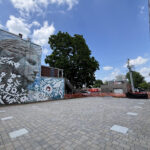




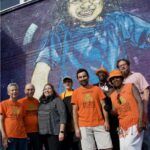
 10. Mega-Murals: Let’s kick off the top-10 list on a happy note, with perhaps the most delightful thing to happen in Harrisburg in 2017—the Harrisburg Mural Festival. In September, artists came to town from near and far, and, at the end of 10 days, more than a dozen new murals were sprinkled throughout Midtown and downtown. It was a fun, affirming community event the likes of which I hadn’t experienced here before. Speaking of public art, I’d like to give a quick quack-out to another way-cool project, the Downtown Ducks, which offered a bit of needed whimsy amidst the hard surfaces of Harrisburg’s business district.
 9. To the Limits: Every year, an issue arises that epitomizes the perennial discord and power struggle between Harrisburg’s mayor and City Council. In 2017, there were several, but an effort by council President Wanda Williams to impose mayoral term limits had to be the most overt. Williams recalled the excesses of seven-term Mayor Steve Reed to justify her ordinance, but most people regarded it as a naked swipe at current Mayor Eric Papenfuse. In turn, Papenfuse said he didn’t necessarily oppose term limits for the mayor, but thought they should extend to council, as well. And, months later, that’s where we stand.
 8. Going Up: In November, Harrisburg University offered up an early holiday present when it announced plans to build the city’s tallest building—a 30-story-plus neck-strainer at the corner of S. 3rd and Chestnut streets. The project, currently slated to break ground next year, may include a hotel and conference center, in addition to classrooms and student housing. Downtown saw other development news in 2017, as Harristown Enterprises announced new projects on 2nd Street and continued its transformation of Strawberry Square with the debut of high-quality tenants like Fresa Bistro, Provisions, Freshido and the UPMC Pinnacle medical offices.
 7. What’s the Plan? A single story rarely lasts through an entire calendar year, but the saga of Harrisburg’s comprehensive plan has now extended through 2015, 2016 and 2017. The year began with the city dismissing consultant Bret Peters, as relations between the administration and its hired architect reached a breaking point. In an odd twist, it ended with the Planning Commission adopting Peters’ plan as its final working draft. Because the plan still must pass muster with City Council, I’ve already penciled in this never-ending story as part of my 2018 top-10 list.
 6. Not a Laugh Riot. By springtime, it looked like 2017 might be a difficult year on the streets of Harrisburg, as the capital city got drawn into the nation’s pro- and anti-Trump drama. Following clashes between factions at one protest, Harrisburg police asked council for $65,000 for new protective, or riot, gear. That got the crowds to council chambers, with most speakers opposing the purchase. In October, council tied the funding to the creation of a new, eight-member citizen task force to advise on police issues. However, as of mid-December, council had not passed a resolution authorizing it.
 5. Triple Tragedy: Every year, a few stories in this often-fragile city seem particularly tragic. For instance, the double-murder in November of stepsisters Kaliah Dearing and Natasha Harner was especially horrible and heartbreaking. But arguably no story was more tragic than the triple loss in March of 10-year-old Savannah Dominick, 2-year-old Ashanti Hughes and Harrisburg firefighter Lt. Dennis DeVoe. The girls perished from a house fire in Uptown Harrisburg sparked by a faulty hover board, and DeVoe was killed when his car was T-boned on his way to the fire. Fittingly, the Fire Bureau later retired DeVoe’s badge number and placed his name on the Memorial Wall at the PA National Fire Museum.
 4. Reed Plea: Harrisburg’s “trial of the century” was set to start, with the city’s former seven-term mayor and erstwhile savior, Steve Reed, in the dock facing more than 100 criminal counts. Then, poof, it all ended. Reed suddenly accepted a plea deal on 20 counts of receiving stolen property and, a week later, was sentenced to two years of probation. The conviction was cold comfort for those wanting someone to answer for hanging Harrisburg out to dry, driving it the brink of bankruptcy. Back in 2015, the state had charged Reed with nearly 500 corruption-related counts, but most of those were dismissed because a judge ruled that the statute of limitations for prosecution had expired. Following the sentencing, the state and the city declared that, with the criminal case settled, they now could pursue civil charges against the myriad people responsible for the city’s financial implosion. So far, crickets.
 3. Election Division: High-stakes elections often bring out the worst in a body politic, and so it was once again with Harrisburg’s mayoral contest. The five-candidate primary race was rather quietly (and often poorly) run until about two weeks before the primary election, when a series of debates finally forced the candidates out from behind their Facebook pages. Then it was all division: race, neighborhood, class and anything else that could be used by challengers to try to divide and conquer. In the end, incumbent Papenfuse had the overall best debate performances and won handily. And, with the Democratic nomination determined, the mayoral election seemed to be all but settled, until . . .
 2. Raffle Wreck: In Harrisburg, nothing ever seems resolved. So, candidates lose in the primary, but then often reappear in the general election. This time around, two of the losing primary candidates decided to mount last-minute write-in bids, which seemed rather innocuous and, honestly, pointless, until one of them, Gloria Martin-Roberts, lost control of her campaign. Several supporters decided to mount their own rogue campaign on her behalf, rounding up a bunch of homeless men to distribute flyers supporting the candidate. The men also handed out raffle tickets, which offered a chance to win big prizes just for voting. “Foul!” cried several concerned citizens, who complained to the county elections bureau. A judge, seeing a possible connection between the flyers and the tickets, issued an order to halt the raffle. Over ensuing days, most folks complicit in the strange affair laid the blame on others or denied involvement completely. To quote those New Zealand pop gods, OMC, “How bizarre.”
 1. Up and Up: Several years ago, in my year-end “Top 10” list, I remarked that most news items were surprisingly positive, even though the city itself, broke and under state receivership, was a basket case. This year, I have the opposite assessment. Many of my top news items are rather negative, but, in truth, the city had a very good year overall. The budget is balanced, many new businesses opened, re-development continued, the city’s first bike share launched and home sales were brisk. Back in 2012 and 2013, I never could have imagined such a rapid turnaround and bright future for Harrisburg. But, thankfully, here we are. So, that’s my No. 1 story of the year.