Comprehensive Jam: Harrisburg spent $200k on a planning project that the Mayor now recommends trashing. What went wrong, and what could the plan mean for the city?

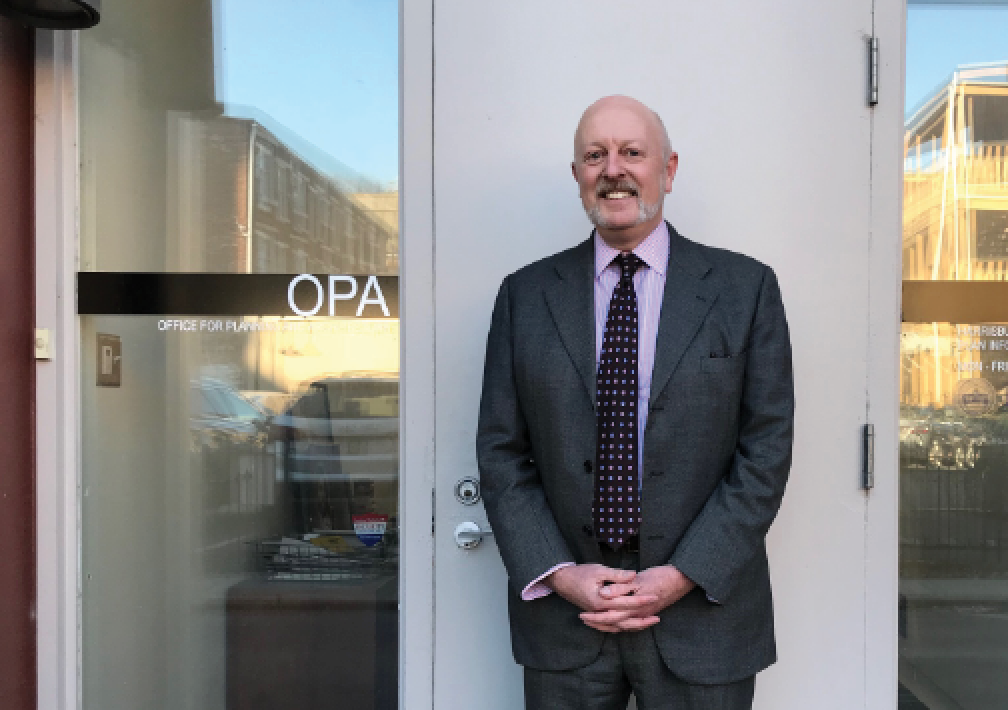
Print may be dead in the news industry, but it lives on in the offices of Bret Peters.

In a small suite of the Office of Planning and Architecture, Peters’ design firm on Willow Street in downtown Harrisburg, every surface is covered in paper: spreadsheets, mockups and “idea slips,” square cards on which Harrisburg residents wrote their desires for the city.

The print detritus shows what was left on the cutting room floor during the 18-month process of drafting a comprehensive plan for Harrisburg. That process recently culminated in the release of a 199-page draft document, which aims to articulate a shared vision of an historically factious and geographically fragmented city. The plan is part audit, offering an inventory of the city’s material and economic resources, and part wish list, enumerating the actions that the city can take to improve its housing stock, traffic patterns, waterways, business development and more.

“It’s an aspirational document,” Peters said on a recent afternoon in the planning room.

He estimated that the cost of implementing the comprehensive plan in full would range in the billions of dollars. But he also claimed that the plan as a whole would pay for itself over time by raising the aggregate value of the city’s real estate market, which would lead to more business development and higher tax revenue.

Many city officials, though, have another opinion of Peters’ draft plan. They regard the plan and the process as so flawed that they vow to fight its approval, much less its implementation.

“Something for the city”

Peters grew up in Lower Allen Township and lives today in Uptown Harrisburg. He founded OPA in 1999 and has taught design and architecture at Penn State and HACC. He also travels nationally for invited speaking engagements. In early November, he delivered a talk at Iowa State University School of Design titled “Corrupt Designs,” where he described “the challenges associated with comprehensive planning in a city well-known for economic and political difficulties,” according to an event listing.

Peters has said that the great potential he sees in Harrisburg led him to prepare a last-minute bid for the comprehensive plan project, which was announced by the city in late 2014. He promised to assemble a team of expert consultants from across the country and was awarded the project in a unanimous vote by a 23-person steering committee.

That vote may have been the first and last harmonious moment in the comprehensive planning process. The next 24 months saw disputes between the city and Peters about Peters’ alleged failure to pay subcontractors and meet deadlines, as well as ideological disagreements about policy proposals within the plan. The acrimony between Peters and city hall has reached such heights that the two parties don’t even agree on Peters’ employment status.

Mayor Eric Papenfuse and city Solicitor Neil Grover insist that Peters was fired after submitting material behind deadline last year. Peters says he assiduously followed the terms of his contract. He claims he suspended the contract in 2016, after city administrators allegedly failed to provide timely feedback on drafts and asked him to change content.

After their communication dissolved in 2016, city administrators and Peters began preparing individual draft plans. In summer 2017, the six-member, volunteer Planning Commission invited both parties to present their material separately. The commission voted unanimously to adopt Peters’ draft. He subsequently published it online at BeHbg.com.

As Peters began promoting the draft in public meetings and soliciting final feedback from residents, members of the city’s administration have been publicly denouncing it.

“The Comprehensive Plan that you are seeing on a website, is not the city’s plan,” Jackie Parker, the city’s director of Community and Economic Development, told members of the Harrisburg Parks Foundation in a Dec. 11 email. “It is a plan written by a consultant who has hijacked the process. It does not include what the public has indicated they would like to see.”

Mayor Papenfuse also claims that Peters “hijacked” the planning process. He said in December that he will recommend that City Council vote to reject the plan.

“[Peters] clearly wanted to impose his vision onto Harrisburg without sufficiently incorporating public input,” Papenfuse charged. “Now you have a fired architect putting forth a plan that the city had nothing to do with.”

The mayor also alleged that Peters undertook the project as a way to extort money from the city.

But people outside of the city administration who have worked with Peters offer a somewhat different account. Tara Leo Auchey led a community outreach effort with Peters for 10 months in 2015. Along with city planning director Geoff Knight, who declined to be interviewed for this story, the team gathered public input data to inform comprehensive plan proposals. Auchey said that Peters was reluctant to undertake the ambitious outreach agenda because of constraints on time and money and because he thought his professional expertise could guide the process. But Auchey said that he was receptive to the data as it came in.

“Bret’s message was that we were all doing something for the city, and I truly believe he came from that place,” she said.

Auchey did threaten to quit the project in October 2015 after a series of her paychecks were delayed. Though she questioned Peters’ management skills, she did not think he pursued the project to extort money from the city, as Papenfuse alleged. Auchey has since been paid for her work in full.

Auchey also emphasized that Peters wasn’t the only professional drafting the plan. A team of international consultants, with specialties from park design to housing policy, helped Peters analyze data and recommend planning strategies. Auchey thinks that Peters’ personality may have invited heightened scrutiny of his leadership abilities.

“Bret pontificates, he’s very highbrow and thinks highly of himself,” Auchey said. “But the biggest fault I see is in editing and time management.”

For his part, Peters insists that OPA upheld its contractual obligations, assiduously managed its resources and acted with good intent towards the city. He believes that officials are trying to discredit his work because they object to some of his
policy proposals.

In the chapter of his plan devoted to housing, Peters does not advocate for homeownership incentive programs, and he discourages the demolition of dilapidated properties. Both of those proposals, which are critical to Peters’ strategy to raise home values and, subsequently, increase tax revenue and business development in the city, are in direct conflict with city initiatives.

Harrisburg’s Department of Community and Economic Development has proposed its own comprehensive housing strategy that it hopes will bring homeownership in the city to 50 percent in the next decade. In December, City Council voted in to double the Code Bureau’s demolition budget
for 2018.

Peters’ comprehensive plan is currently published online for public input, and the Planning Commission will host a public hearing to discuss it on Jan. 10. After that, the commission can ammend the draft and vote to send it to City Council. Council, in turn, will vote to adopt or reject Peters’ draft as the city’s new comprehensive plan. The decision could be vitally important for how Harrisburg develops in the next 20 years.

What is a Comp Plan?

The last time Harrisburg undertook a comprehensive planning effort was in 1974, the same year that the Watergate investigation dominated the American news cycle. The city was recovering from the devastation of Hurricane Agnes, which, according to then-mayor Harold Swenson, dealt the city “a near fatal punch” two years earlier.

Flood waters from Agnes swirled into 6,000 Harrisburg homes and decimated at least 600 small businesses in June 1972. In his history of Harrisburg, “City Contented, City Discontented,” journalist Paul Beers wrote that the storm wrought more than $3 million in damage to city property and caused $5 million in private property loss. By the time the waters receded, landmark buildings and entire neighborhoods had been wiped off the map. Mayor Swenson, along with his seven-member, Republican-controlled City Council, decided to undertake a full update to the city’s master plan, which had last been updated
in 1961.

“The urgency of setting the direction for the future has plainly never been more real,” the 1974 plan begins. “The Harrisburg community is ready and willing to take the necessary hard look of self-reappraisal, to evaluate the future alternatives which face the City, and to determine to proceed by plan on a chosen course of action.”

For all its ambition, the 1974 plan languished after its publication. Some of the objectives of that plan, such as the construction of a bridge on Division Street for pedestrians to access Wildwood Park, are still being considered by the city today. Harrisburg leaders did not commission another update until 2014, the first year of the Papenfuse administration.

In recent years, urban comprehensive plans have shifted from general guides on community objectives to strategic documents that focus on implementation and action, affirmed Tom Daniels, a professor at University of Pennsylvania School of Design. Daniels, who teaches urban comprehensive planning, called comprehensive plans a blueprint of where a city wants to see itself in 20 years, based on professional expertise and public input.

“The clear challenge of a comprehensive plan is how do you set priorities,” Daniels said, noting that planners often have to reconcile competing needs in housing, transportation, land use and economic development.

How they set those priorities depends on what the public wants to see.

“The art of it is blending the more professional planning side with the desires of residents,” he said.

Peters’ team collected public input during a 10-month community engagement campaign in 2015. The effort was led by Auchey and Knight with help from graduate interns at Peters’ firm. Over the course of 10 months, the team held more than 100 meetings with residents and stakeholder groups, gathering input from hundreds of residents across the city. Peters then used that data to determine planning objectives and recommend actions to achieve them.

Peters’ draft document is organized into eight chapters. Each one outlines broad goals, more specific “objectives” and action items to achieve them. In the housing chapter, for example, the objective “stabilize and preserve existing buildings” entails four action items, including the “identification and mapping of problem properties” and “establishment of a troubled buildings initiative.” Each action comes with a detailed list of steps to realize it.

“We have followed an assiduously rational process based on math and fact,” Peters said. He added that, while analyzing the outreach findings, he found that public opinion perfectly aligned with trends and expertise in the professional design community.

In a conversation in early December, Papenfuse criticized Peters’ draft as too prescriptive and ideological. He reiterated the charge that Peters disregarded public input and imposed his own vision for Harrisburg’s future.

“The imperative language of this plan is unlike any other I’ve ever read,” Papenfuse said.

He added that he would have preferred broad objectives with a “panoply” of options for city officials to consider.

According to Daniels, however, the authors of comprehensive plans are supposed to be specific in their recommended objectives and actions.

“One of the things planners are supposed to do with help of the public is weigh alternatives,” Daniels said. “To have just an array of options is a little loose.”

Daniels also said that comprehensive plans should include cogent strategies for economic development and housing. Papenfuse had also objected to those chapters in Peters’ plan, claiming there was an argument over whether they should be included in the project at all.

A House Divided

For all the discord surrounding the contents of Peters’ draft, city administrators agree with him on at least one point: the city needs to rehabilitate dilapidated buildings and hold absentee owners accountable for blight. The problem, however, it that Peters and city hall have radically different ideas for how to do that.

The long-held stance of the city Department of Community and Economic Development is that increasing homeownership in the city will improve neighborhoods. When someone buys a home, they make an economic investment in the property and the neighborhood around it. Conventional wisdom says they will work to maintain both.

Harrisburg’s Department of Community and Economic Development sent Peters its own draft of a comprehensive plan housing strategy in April 2016, which Papenfuse said they completed with help from a subcontractor. That document details the city’s goals to increase resident homeownership in the city to 50 percent within the next 10 years and incentivize the construction of new market-rate homes. Currently, 40 percent of Harrisburg residents are homeowners and 60 percent are renters.

Peters acknowledges that neighborhoods with a higher share of homeowners are safer and better maintained than those dominated by renters. But he also argues that, with a median income of $34,000, Harrisburg’s population cannot sustain widespread homeownership. Even with the help of government subsidies and incentives to finance a house, Peters said, maintaining Harrisburg’s historical housing stock is expensive.

“Many people can’t afford to maintain the asset,” Peters said. “When someone is close to the edge on a payment program, one job loss or medical bill puts them into a foreclosure process in three months. Homeownership isn’t just the purchasing of a house.”

Peters said he didn’t prioritize home ownership in his own housing strategy because Harrisburg’s residents didn’t demand it. Only 14 percent of residents polled during the public outreach period said they wanted more incentives for home ownership. Sixty-five percent said their main housing concern was the rehabilitation of vacant properties. Peters thinks the city can mitigate blight by localizing property ownership, which doesn’t necessarily require owners to occupy their dwellings. In short, he wants Harrisburg residents to have myriad paths to build equity in their neighborhoods.

Peters details some of those paths in a concept he and his team developed in 2015. The concept proposes a “city wide investment area” that would expand property ownership opportunities for people who already live in the city. The resident-owner housing strategy might create favorable financing for a homeowner to buy and manage a neighboring rental property, or a tiered taxing structure where resident-owners would pay different rates than out-of-town landlords. Some of the methods he proposes elsewhere in the housing strategy, such as encouraging collective purchasing of property, also appear in the city’s DCED strategy.

The central goal of Peters’ housing strategy, he said, is to separate houses from the people who live in them. He envisions neighborhoods where rental properties are maintained to the same standard as owner-occupied properties, since the manager of the rental property may live down the street and see it every day. He also wants to incentivize trade education and apprenticeships so that the city has a robust corps of maintenance professionals. Harrisburg’s greatest material asset is its housing stock, he says, and it will become a more lucrative one if it receives proper care.

“The city is functionally a cultural landscape, and we have to treat it like a landscape we value, not a bunch of properties where we can make money off of trades,” he said.

Auchey and Vern McKissick, a local architect who serves on the Planning Commission, confirmed that Peters clashed with city officials on housing strategy proposals. Peters said that disagreements over housing precipitated the breakdown of cordial relations between his firm and the city. Papenfuse maintains that the project devolved after Peters submitted substandard work product and failed to complete the project by deadline.

“Unsalvageable”

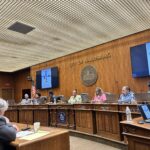
In a public hearing last month on Harrisburg’s 2018 budget, Ausha Green, City Council’s newest member, pressed the city administration on its role in developing the comprehensive plan.

Green serves on the city Planning Commission and supported Peters’  draft over the city’s. She criticized the lack of clearly delineated responsibilities among all the planning entities, but her main concern was how the Planning Commission would incorporate public feedback into Peters’ draft document.

“Once the Planning Commission decides what edits it wants to see, we will do those at your direction in-house,” Papenfuse said.

“You mean what edits the public wants to see,” Green shot back. She then called on the city to withdraw from the process. “I recommend someone from outside do it because some people from the public have the perception that the plan was hijacked by the administration.”

In an interview the next day, Green said that city administrators instructed the Planning Commission to edit and rewrite parts of the comprehensive plan draft in 2016 and 2017. The commission knew that the city Planning Bureau would contribute feedback to the draft materials they received from Peters, but Green said the commission did not think they would be so extensive.

“I didn’t expect the city would have such a hands-on role in the writing of the comprehensive plan,” Green said. “Some people might see them as overstepping their role, but that depends on what they thought their role was.”

Green acknowledged that Harrisburg had not commissioned a comprehensive plan in 40 years, which left scant precedent for how to assign roles and responsibilities. Robert Shoaff, a Midtown resident who is trained as an urban planner, offered a similar theory of the discordant planning process.

“We have 43 years of not doing this, so the residents and city don’t know the right interaction.” Shoaff said. “We have to build this back up.”

Members of the public are invited to comment on the draft plan online and discuss it at a public hearing on Jan. 10. After that, the Planning Commission and City Council will vote on whether or not to adopt the plan. Papenfuse is not sure whether he has veto power, but he has said he does not think the plan will be approved.

“It’s unsalvageable,” he said. “Unfortunately, we’ll have to start over at some point.”

He pointed out that the plan does not include any references to Harrisburg University, which earlier this year announced it will invest more than $100 million in a 36-story building in downtown Harrisburg. He also said that some of Peters’ concepts, such as creating a southern gateway entrance for traffic entering Harrisburg from I-83, have already been considered and rejected by
the city.

Green said she’s heard mixed reviews of the plan from constituents. But after almost two years  of political and personal strife, she wants to let the public guide the planning process to its end.

“We’re going to continue to work through the process and are looking to have as much public input as possible,” Green said. “It’s a community issue at the end of the day.”

To read the draft comprehensive plan, visit behbg.com. A public hearing on the plan is scheduled for Jan. 10.

Continue Reading

Capital Dance: Area ballet students descend, gracefully, on D.C.

As the resident dance company of Whitaker Center, Central Pennsylvania Youth Ballet is accustomed to performing in the state capital.

However, CPYB students had never danced in the premier arts center in the nation’s capital. Until now.

In November, for the first time, 16 students, ages 11 to 18, participated in an hour-long program at the Kennedy Center, a performance that paid tribute to the renowned Russian-born choreographer George Balanchine.

CPYB’s appearance was especially exciting, because it resulted from a Kennedy Center invitation, rather than the school’s request.

When the Kennedy Center decided to pay tribute to Balanchine, the staff reached out to the dance department for recommendations, said Meg Booth, director of dance programming.

“Because of the Kennedy Center’s commitment to local, national and international art of all ages and to education, we thought of Central Pennsylvania Youth Ballet,” said Booth. “It is one of the strongest ballet schools in the country.”

The invitation was a “great compliment” to Marcia Dale Weary, founding artistic director of CPYB, said Alecia Good-Boresow, school principal. “And the performance was a chance to have wider exposure, to perform in front of a not-typical audience.”

In 1955, Dale Weary opened the dance school that eventually became known as Central Pennsylvania Youth Ballet in her hometown of Carlisle after studying in New York.

Since then, thousands of students have benefited from a curriculum focused on building technical strength, stamina and flexibility, and nurturing artistic development. CPYB alumni are principals, soloists and corps de ballet members in the world’s top companies. Other alumni have had long careers in dance-related fields, such as choreography, teaching and arts administration.

Adherence to Balanchine’s choreography is the responsibility of Darla Hoover, associate artistic director of CPYB. She studied with Dale Weary until the age of 15, before moving to New York and enrolling in the School of American Ballet. She then joined the New York City Ballet when Balanchine, co-founder of the company and its artistic director for more than 35 years, was still active.

It was there that Hoover learned a lesson about what’s important to excellent teachers. It was one night when she was dancing Tea in “The Nutcracker,” the first role she performed in the holiday ballet.

“I had a mishap then,” Hoover recalled during the narrative part of the Kennedy Center performance. “Mr. Balanchine used to stand in the wings watching us. One night I dropped my fan by mistake, and it landed all the way across the stage in a place no one could get to. I thought he would fire me, but he didn’t. All he really cared about was that dancers give 200 percent.”

Hoover has a lasting connection to her teacher, as well.

She is a repetiteur for the George Balanchine Trust, which licenses his ballets, protects the trust’s copyrights and trademarks, and continues to uphold the artistic standards of the Balanchine legacy. The trust also organizes the engagement of repetiteurs to teach classes at schools and companies to ensure that the master’s choreography is honored. CPYB is the only school licensed to do Balanchine’s “Nutcracker.”

“We’ve been doing the ballet for close to 45 years,” Hoover said.

An audience of nearly 100 people attended the November performance at the Kennedy Center, in seats set up in front of a carved-out stage. That’s in addition to several parents and friends of the dancers and CPYB staff.

No tickets are required for Millennium Stage performances, which take place 365 days a year and are free. Interested patrons line up and are seated about a half-hour before the 6 p.m. start time.

In addition to segments from “The Nutcracker,” CPYB brought the “Embraceable You” segment of “Who Cares?” (with music by George Gershwin) and the second movement from Western Symphony to the Millennium Stage.

Kensington MacMillen danced Coffee, also known as the Arabian dance, arguably the most sensuous part of “The Nutcracker.”

“Getting to dance at the Kennedy Center was a shock to the system,” said the U.K.-born MacMillen, 16. “It was just such a special gift, especially with knowing how many other people had performed there.”

When she first got on stage, MacMillen said she wasn’t certain what to expect.

“When you are performing in a different place with a new audience, it can be hard to adapt,” she said. “But, at the Kennedy Center, I kind of felt at home, especially with George Balanchine’s choreography and our teachers around us.”

MacMillen enrolled at CPYB as a young child and “from my very first class,” she said, “I immediately fell in love with the school.”

She is now taking six days of classes a week.

“This is what I hope to do with my life,” she said.

For more information on the Central Pennsylvania Youth Ballet, visit www.cpyb.org.


Continue Reading

French Twist: Bon Appetit Crêperie brings a new accent to the Broad Street Market.

Owners Lalla and Shawket Mourtada

A simple food invented on the rocky moors of northwest France has become a culinary favorite all over the world.

The crêpe, a staple of French dining, has been pleasing palettes for centuries. Originally called galettes, which means flat cakes, the thin, little pancakes are served with sweet and savory fillings.

This international delight has now made its debut at the Broad Street Market, with locals jumping on the crêpe train. Open only a few months, Bon Appetit Crêperie has introduced central Pennsylvanians to this French treasure, quickly garnering a faithful following.

Husband and wife team Shawket Mourtada, originally from Liberia, and Lalla Mourtada, from Mali, wanted to own a business that would reflect their love of food and of their culture. Mali, an African nation, is a former French colony, and Lalla grew up speaking French and eating crêpes.

“I would go to France in the summer, and there are crêpes on every corner,” Lalla said. “We decided, why not offer these in Harrisburg?”

Shawket visited Paris this past summer. After his return, the couple decided that owning a crêperie would be an excellent choice.

The Mourtadas left no crêpe unturned as they developed their business and their menu.

“We worked on the recipes for months and would fill up these gallon jugs with different batters we created and mixed up at home,” Shawket said. “We would just try them out to see what worked.”

It turned into a family affair.

“My mother, who is a good cook, came from Boston to help us,” Lalla said.

Both admit it took them awhile to figure out how to make the perfect crêpe.

The equipment can be tricky to use, but, through trial and error, they were able to figure out their recipes. They now own four French-made crêpe makers, which are in full use in the brick building on market days. Their system allows them to make one flat cake and then transfer it the iron beside it to keep it warm. Their stand has glass windows that allow customers to watch the process from beginning to end.

Their crêpe menu is divided into two categories—savory and sweet—and the names that accompany the recipes are as interesting as the recipes themselves.

For instance, the “Sea Master” (a savory crêpe) is stuffed with smoked salmon, capers, scallions and cream cheese. The “Campfire” (a sweet crêpe) has graham crackers, mini-marshmallows and Nutella spread topped with a chocolate drizzle and whipped cream. There are 15 crêpe recipes to choose from. Customers also have the option to “Be the Chef,” which lets them choose their own spread, fruits and toppings.

The Mourtadas get a lot of their vegetables and milk from vendors in the market, so crêpes are both local and fresh. They are considering rotating menu items to reflect the seasons. The two also speak various African dialects between them, as well as Spanish, Portuguese and French, which helps when greeting the market’s increasingly diverse customer base.

Things have moved quickly for the newly minted crêpe-makers.

Next up are some ideas that include weekly posts on Instagram to pick a crêpe from two or three options that will be that week’s special, as well as someday, they hope, expanding to other regional locations.

Shawket and Lalla are trying to improve every day and to educate their customers about their favorite cuisine. Along the way, customers can line up to watch the crêpes being made and, best of all, chomp into the end result.

Bon Appetit Crêperie is located in the brick building of the Broad Street Market, Harrisburg. For more information, visit their Facebook page: Bon Appetit Crêperie.

Continue Reading

Guided by Breath: Meditation and Mindfulness in Harrisburg.

In the past, the stars often guided us. Now, small screens seem to be the constellations that people use to engage with their world.

Despite the rise of the internet, some people practice meditation to help them navigate the 21st century. Their breath has become their guide. And, if you speak to a few practitioners in the Harrisburg area, you begin to hear about ways they keep themselves grounded in awareness while so many distractions spin around them.

Meditation, whether done sitting, walking or otherwise, is consistently used by about 8 percent of Americans, according to the National Center for Health Statistics. Mindfulness, according to physician and veritable guru Jon Kabat-Zinn, is “the awareness that emerges through paying attention on purpose, in the present moment, and nonjudgmentally to the unfolding experience moment by moment.”

In the Harrisburg area, you can find several options to practice meditation and mindfulness.

Andrea Minick Rudolph’s path began when she was 16 years old with “Siddhartha,” Herman Hesse’s 1922 novel about self-discovery.

After reading it, she began to question organized religion and sought new ways of thinking. Ultimately, she adopted Buddhism because it did not require adherence to dogma and it supported the interconnectedness she saw in nature. By 2012, she founded Oryoki Zendo, which has two operating principles: the philosophy of non-dualism (everything is interconnected) and the practice of non-harming.

“We are all connected in ways that are not necessarily definable, but with mindfulness, we are able to practice compassion, loving kindness, joy and equanimity,” she said from her location above Cornerstone Coffeehouse in Camp Hill.

When we realize how much we relate to one another, the chance we might cause harm decreases, while our capacity for compassion increases, she said.

Across the river, Chuck Daley is the facilitator of the Mindfulness Meditation Group (MMG) at the Unitarian Church of Harrisburg. MMG offers Tuesday evening meditation gatherings to help build mindfulness among participants. Daley started meditating in his early 20s, seeking a way to ground himself for college as he transitioned from a more unstructured life.

Meditation, he said, helps him be realistic about life.

“Our heads are filled with ideas about how things should be, and things never are that way, and we’re very unhappy about it and we have to deal with that,” Daley said. “We have to deal with those expectations.”

And not only is mindfulness helpful with expectations, it can help navigate tough feelings, he said.

“I’m a lot happier with myself, and not just when I’m on the cushion [meditating],” he said. “I notice crappy feelings before I try to escape them.”

Research on meditation and mindfulness has confirmed these types of benefits. For example, mindfulness practice has been associated with supporting weight loss, stress reduction and recovery from addiction. In fact, the benefits of mindfulness and meditation for those with addictions have led to Refuge Recovery, a national organization that holds meetings in the Harrisburg, Lancaster and York areas.

Tony Stultz knows well the power of meditation. He is the director of the Blue Mountain Lotus Society (BMLS) and the Center for Mindful Living, founded in 1999. BMLS seeks to offer the benefits of mindfulness, such as self-awareness or solace, to anyone seeking them. His interest in Eastern philosophy started in grade school with Bruce Lee and kung fu movies, as well as the influence of a Japanese aunt. His meditation practice and affiliation with Buddhism grew when the discontents of adolescence required him to find a firmer footing in life.

Stultz’s practices boil down to a straightforward effort to live peacefully, for himself and others.

“The cornerstone [of practicing mindfulness] is that you’ve made an existential choice to move away from suffering by realizing we create experiences with our thoughts,” he said.

Stultz is directly referring to one of the Buddha’s most fundamental messages, but the majority of people attending BMLS aren’t Buddhist.

“Seventy percent of people who come here would not identify as Buddhist,” he said. “But they’re really drawn to the practices. Everything about Buddhism is in mindfulness, and integrating this with one’s existing faith is fine.”


On the Way

Would you like to begin your own journey to meditation and mindfulness? Here are a few resources in the Harrisburg area mentioned in this story.

BMLS
6496 Jonestown Rd.
Harrisburg
www.bmls.org

MMG
1208 Clover Lane
Harrisburg
www.meetup.com/Mindfulness-Meditation-at-Clover-Lane

Oryoki Zendo
2133 Market St.
Camp Hill
www.oryokizendo.com

Refuge Recovery
Community Center of Giant Food
3310 Trindle Rd.
Camp Hill
www.refugerecovery.org

Continue Reading

The Sweet Spot: Chocolatefest celebrates 23 years of confections, connections.

January, for many, seems like a big letdown.

After the highs of the holidays, an icy landscape brings on cabin fever, and, let’s face it, who has ever heard of “summer doldrums?”

Just around the time everything seems so bleak, we are reminded that Keystone Human Service’s Chocolatefest is right around the corner. Suddenly, life begins to take on a brighter sheen, not unlike that of a good bar of chocolate, by the way.

Author and humorist Sandra Boynton once said, “Research tells us that 14 out of 10 individuals like chocolate.”

If that “statistic” brings a knowing smile to your face, imagine having access to a huge smorgasbord chock full of chocolate creations. And what better place to throw a chocolate party than in chocolate town?

This year’s extravaganza will take place on the last weekend of January at the Hershey Lodge. The annual “ChocolateBall” will kick off the event on Friday night with live music, dancing, dinner and auctions. On Saturday, guests can choose to attend the premiere reception or opt for one of two 90-minute sessions beginning at noon and continuing through the afternoon.

The theme chosen for this year’s black-tie gala is “Reach for the Stars,” a reminder that Keystone’s mission is to advocate for those with disabilities to live full, rich, meaningful lives and become valued members of their communities.

Works of Art

This year, some 60 vendors will participate. Confectioners, hoteliers and restaurateurs will offer a wide-range of samples to ensure no one’s sweet tooth goes unsatisfied, and other businesses will do their part to support a worthy cause.

“We are grateful for the partnerships that we have made in order to provide such a great community event,” said Danielle Ruddy, Keystone Human Services development specialist.

Each year, guests’ eyes pop out at the over-the-top cakes created by skilled bakers. The annual baking competition creates quite a stir as retailers, students and professional decorators show off their talents and vie for prizes awarded by a professional panel of judges.

“The cakes are amazing—real works of art,” commented Ann Moffitt, vice president of community development.

Ruddy said that this year’s event will include several new activities.

“Home Depot will be bringing along kits for kids’ workshops, and the Girl Scout STEM Mobile will be onsite where girl’s can earn their STEM Mobile patch,” she said.

The STEM Mobile lab provides students with hands-on opportunities to explore science, technology, engineering and math (STEM). The Hershey Kissmobile will also make an appearance.

Speaking of kisses, a select group of four-legged friends will be in attendance with tails wagging, eager to unleash their charm on willing guests.

“We will have a Susquehanna Service Dogs kissing booth, where guests can get a kiss for a $1 and take their own picture with them,” said Ruddy.

Wineries, breweries and distilleries will join the event for the first time this year, keeping spirits bright by offering a variety of adult libations for tasting and/or purchasing.

Remarkable Job

Chocolatefest depends on the generosity of not only businesses, but also hundreds of volunteers.

Mimi and Bob Goodling have donated their time throughout the years in various ways, from buying a table at the ChocolateBall to traffic control to serving on various boards. The Mechanicsburg couple has witnessed firsthand what a blessing Keystone Human Services can be. The couple’s son has benefited from the services provided by the organization.

“Once I saw how Keystone treated these individuals and how they worked with them, I knew this was an agency I wanted to help,” said Bob, adding that he saw his son flourish after Keystone helped him transition from the state hospital into a productive and happy life. “They do a remarkable job enhancing the human spirit.”

Keystone currently serves 7,500 people and families in central Pennsylvania, even reaching other states and places as far away as India.

Ruddy considers the event a win-win for everyone—from businesses to patrons to the folks who benefit from the thousands of dollars generated to enhance our neighbors’ lives.

“Chocolatefest isn’t just about the massive amounts of desserts that can be consumed,” she said. “It’s about our community businesses coming together to support one another while providing an event that is fun and inclusive, while raising much-needed funds for our programs and services.”


Chocolatefest takes place Jan. 27 and 28 at the Hershey Lodge, Hershey. To learn more, visit www.keystonehumanservices.org or call 717-232-7509. Tickets can also be purchased at the Hershey Lodge, Hotel Hershey, Boscov’s and AMMA JO in Strawberry Square.

Continue Reading

Food Lanes: At the Broad Street Market, new tables, crowned with memories.

Brendan O’Neill, Terry Hanley & Jennie O’Neill

Have you ever felt your heart leap with joy as you bowled a strike or sink as you watched your ball drift into the gutter at Red Crown Bowling?

Many in the area share fond memories of the beloved alley, including siblings Jennie and Brendan O’Neill.

“They’d load us into a van every week and take us over there for bowling gym class,”
said Brendon, with a laugh, recalling his high school years at Bishop McDevitt.

Later, as an adult, he went there about once a week with friends and became acquainted with the Kirkpatrick family, who owned the business, and this is where the story took an unexpected twist.

In March, the Kirkpatricks decided to close after 37 years.

The news was bittersweet. Red Crown has a long history in Harrisburg, and many were sad to see it go. But a neighboring business, looking to expand, met their asking price, and retirement became a reality for one generation and a nest egg for the next.

Brendan shared the news with Jennie and her husband, Terry Hanley, who co-own Knead Pizza at the Broad Street Market. They knew the burger chain, Shake Shack, had a practice of buying up old bowling alley lanes to repurpose into tables, which got their collective wheels turning about doing something similar here.

After some back and forth with the Kirkpatricks, they settled on $1 per square foot for 2,000 square feet of wood from the approaches (the part of the bowling alley where you stand to bowl). They then approached Broad Street Market Manager Beth Taylor about building custom tables, which they would donate part and parcel, tongue and groove.

At the time, the market’s seating was composed of a hodgepodge of plastic tables and chairs, many dating back to the ‘90s. While they had held up admirably, it was an offer Taylor could not refuse.

“It’s such a touching gift,” she said, getting a little emotional. “Jennie, Terry and Brendan donated their time, efforts and money to make this happen for the market.”

Jennie shrugged, smiling.

“We like the opportunity to do projects like this,” she said. “The market needs this. The opportunity came along, and it worked out perfectly.”


Work of Art

The process was far from easy.

While $1 per square foot is quite a deal for wood like this, the catch was that they had to do their own removal. The floorboards were intimidatingly thick, designed to withstand the weight of your average bowling ball.

Jennie, Terry and Brendan had to use a combination of a johni-bar (a giant pry bar, essentially), circular saw and a reciprocating saw to pry up and remove the wood. Brendan estimates that they went through $400 to 500 in circular saw blades alone, thanks to the thickness coupled with countless nails riddled throughout the floor construction.

The excavation process complete, they stored the wood in Jennie and Brendan’s dad’s garage, and Brendan set about the process of cutting and sanding tabletops. Eventually, they ended up with dozens of tables, which were sealed and finished by Oak Park Cabinetry. Extra wood went to Zeroday Brewing Co.’s stand at the market, which used it to create a gleaming bar top.

The finished tables bear a robust, smooth appearance that shows off the layers of hardwood, each table its own distinct work of art. On some, there are subtle gouges in the wood where nails used to be, while contrasting wood inlay characteristic of a bowling alley floor remains visible on others.

Some of the tables are low, four-tops for sitting, while others are four-person high-tops, perfect for leaning against as you wolf down your latest culinary discovery from the market’s many vendors. Jennie estimates that, when refinishing is eventually needed, the tables have at least five good sandings in them.


Second Chapter

On a practical level, Taylor explained that the tables are “not only a way to elevate the aesthetic of the market, but also to maximize seating.”

In fact, the project ended up adding more than 30 seats in the stone building alone, and, in another area, it doubled the number of seats from 12 to 24. The tables are now located throughout the brick and stone buildings, which adds a cohesive warmth throughout the market.

At a deeper level, Taylor stressed that the tables represent much more than just a place to eat for hungry visitors. She described the community of vendors that has blossomed throughout the market.

“The gift of the tables is emblematic of this,” she said. “The fact that Jennie, Brendan and Terry would take so much time and effort—it’s a gift to generations and exemplifies the community spirit that exists in this market.”

Thinking of the long game, Taylor sees rich potential in the gesture.

“If the spirit of the market is inspiring people to contribute and get involved in their community, that’s above and beyond us just providing food for people,” she said, smiling warmly as she gazed across the expanse of tables in the stone building.

Brendan added a kind point of clarification.

“We’re donating them,” he said. “But we’re making our lives better.”

The tables add another chapter to Harrisburg’s modern history. As one business closes its doors, a second chapter begins at the Broad Street Market.

The Broad Street Market is located at N. 3rd and Verbeke streets in Harrisburg.

Continue Reading

Refuge from the Storm: Hurricane survivors have poured into Harrisburg–and their needs are immense.

Lillian Vazquez rode out Hurricane Maria in her mother’s cement house in Puerto Rico, concerned that her own coastal Vega Baja home would not survive the onslaught of wind and rain.

“It was terrible,” she said. “I could see everything flying, you know, the roofs of the houses flying.”

Her mother’s sturdy house shook in the wind as trees fell all around them. Her own home lost its roof.

Lack of water and electricity brought Vazquez to Pennsylvania. Her cousin, Gloria Vazquez Merrick, executive director of the Latino Hispanic American Community Center in Harrisburg (LHACC), invited Vazquez to stay with her.

Like Vazquez, many Puerto Rican families are coming to stay with family on the mainland, and when those families land in Harrisburg, one place they come for help and guidance is LHACC.

“We are the go-to place right now,” said Vazquez Merrick.

An energetic Vazquez Merrick juggles calls about providing families with Christmas gifts, details about Thanksgiving turkey deliveries, and a plethora of other tasks as she talks about LHACC’s increased workload. Since early October, LHACC has served more than 40 newly arrived families in Harrisburg, with more coming daily.

“We anticipated the exodus [from Puerto Rico], because we knew what conditions were,” she said.

Some fathers have sent their families to the states while they handle the cleanup until living conditions improve and schools reopen. Vazquez Merrick said that education is a driving force for people leaving Puerto Rico, as they want their children to get back into a routine as quickly as possible.

“They are afraid that the kids will be left behind from an educational standpoint,” she said.

People come to the center for a variety of needs—food, clothing, housing, transportation, jobs. Warm clothing tops the list because Pennsylvania’s chilly winters seem almost unbearable to folks accustomed to living in a tropical climate.

Recent arrivals share the need for basic necessities, but their needs vary considerably.

“There is no cookie-cutter approach to accommodating their needs,” said Vazquez Merrick.

Some need help getting children into school, finding a doctor, translation services or legal assistance. For example, people have left cars behind and want to transfer the title so that the car can be sold or given to someone else. Transferring that title in Puerto Rico while living in Harrisburg poses logistical problems, and people come to LHACC for assistance with the process.

Vazquez has been volunteering at LHACC since her arrival.

“I am helping my people,” she said. “I feel proud of that.”

Others want to give back, too. One woman, a music teacher, said she doesn’t speak English well but wants to help the center. She’s going to work with the seniors teaching piano, said Vazquez Merrick.

She said that LHACC’s small, dedicated staff of six does a lot of listening.

“Even to refer, you have to understand the whole story,” she said.

Those stories involve tears and showing pictures of their homes before the storm. Some people report nightmares. One little girl panics when it begins to rain. An LHACC supporter has volunteered mental health services for those who survived Maria.

The holidays offer the possibility of a “positive distraction” for displaced families.

“We want to do whatever we can do to help get them through the holidays,” Vazquez Merrick said.

People have offered to “adopt” families and children for Christmas and Three Kings Day (El Dia de los Reyes Magos) on Jan. 6, a special day to the people of Puerto Rico. All families at the center register with Toys for Tots, but Vazquez Merrick said she is concerned that, as families continue to arrive, some children will miss the registration date.

Vazquez Merrick would like to make LHACC a hub for connecting people with services—similar to a model used in New York City—a one-stop shop where people could get registered for school, fill out housing applications, find jobs or connect with a local church food bank. The Harrisburg School District and Christian Churches United HELP Ministries are already on board with the venture, Vazquez Merrick said.

LHACC continues its work helping the all people in the Harrisburg community as it receives those displaced by Maria. Vazquez Merrick said her staff is “stepping up and going above and beyond.”

Those on the receiving end of help show tremendous gratitude, which lifts the spirits of staff and volunteers at the center.

“You give somebody a pair of gloves, and you see how much they appreciate that,” Vazquez Merrick said.

Lending a Hand

LHACC needs a variety of goods, as well as cash donations, to better serve the people displaced from Hurricane Maria. These include:

  • Office supplies, Staples or Amazon gift cards (copier paper, five 2018 desk calendars, one 2-drawer file cabinet with lock, tri-fold presentation board, 3-inch, three-ring binders, tape, large scissors, two staplers, ESL flash cards); medium storage container bins
  • Coffee pot, pots and pans, cupcake and cookie sheets (baking items) and a hand mixer
  • Cleaning supplies/paper towels/trash bags
  • A dolly for moving boxes and heavy items
  • Craft supplies for children and adults in “Sharing Wisdom Program,” or AC Moore/Michael’s gift cards
  • Get It Now Print gift cards (or other print shop in close proximity to 13th and Derry streets)

The Latino Hispanic American Community Center (LHACC) is located at 1301 Derry St., Harrisburg. To donate, call 717-232-8302 or visit www.lhacc.org, where you also can make cash donations.


Continue Reading

The “Acting” Secretary: For Patrick McDonnell, it’s a short road between the Capitol and the HIT.

It was just another Friday afternoon in May 2016 when Patrick McDonnell arrived at the governor’s suite of offices on the second floor of the state Capitol.

McDonnell was the policy director in the Department of Environmental Protection, and he was in the Capitol to meet with the governor’s policy secretary to discuss departmental issues. Nothing to get excited about—just the type of meeting that takes place all the time around the Capitol complex.

And then the unexpected happened. The meeting location had changed, and McDonnell was ushered into the governor’s inner office. Gov. Tom Wolf gave him stunning news: The DEP secretary had just resigned. How would he like to be the new acting secretary?

It’s not often that a career public servant like McDonnell is thrust into oversight of a department with 2,400 employees and with responsibilities that range from Marcellus Shale drilling to black fly spraying. There had been no warning, and yet there he was, asked to make a life-altering decision. Someone else might have been too stunned to answer or might have stammered through an incoherent response.

Instead, McDonnell calmly answered that he had always been committed to public service and was prepared to help in any role. And, with that, Patrick McDonnell, with startling suddenness and no inkling of what was about to happen, became the acting secretary of DEP.

The truth of the matter, though, is that McDonnell is accustomed to having to think quickly and respond to others without any knowledge of what they are going to say. That’s because of his other life—performing on the stage at the Harrisburg Improv Theatre.


Sanctuary

It’s a Friday night, and a crowd has settled into the pew-like benches in the small theater on N. 3rd Street in Midtown. They are there to watch a series of performances in what has to be one of the most unusual—and challenging—forms of public performing.

Improvisational theater (or “improv”) is the “playing of dramatic scenes without written dialogue or no pre-determined dramatic activity,” according to the Encyclopedia Britannica.

But that definition doesn’t begin to do it justice.

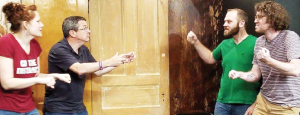
At the Harrisburg Improv Theatre (aka the HIT), the actors—groups of five or six people—enthusiastically enter the stage and ask the audience for one word. That’s it: one word. From that single word, the performers are expected to invent a series of skits that last about half an hour.

And so it was that on this particular Friday night as a group calling themselves the “Hawkwards” entered the stage. Among them was one of the most powerful figures in Harrisburg, Patrick McDonnell. But he didn’t look much like a department secretary. Clad in jeans and a blue T-shirt, he could have been anyone from the neighborhood performing with this group of five men and one woman.

They asked for their word, and someone yelled out, “sanctuary.” And off they went, jumping from skit to skit and, of course, improvising often-hilarious dialogue. That night, a highlight was when McDonnell spontaneously assumed the role of an Irish nun, leaving the audience laughing at his quick wit.

The performances are fast-paced and unpredictable, and then, in what seems like a flash of time, the lights go on as the appreciative audience claps and cheers.

So, what does this have to do with being environmental secretary?

Well, a lot, according to McDonnell. Just like in his improv performances, every day he is confronted by a variety of unexpected developments and unplanned conversations. So improv has been great training for dealing with the unpredictable—like being asked by the governor out of the blue to be the next DEP secretary.

“Improv makes you a better listener,” said theater owner and performer Jake Compton. “It also helps with empathy because you’re taught how to think through another person’s point of view in a way that is honest. Improv also helps you approach life with a sense of fun.”


A Balance

The son of a Philadelphia policeman, McDonnell and his wife Colleen moved to the Harrisburg area 17 years ago and are raising their four children here. They have come to love this area.

“You’re in an urban environment, and 10 minutes later you’re in a park,” he said.

This helps him keep a balance between work and home, urban and rural. He’s found that carving out time to have fun is a big part of that balance.

Besides his devotion to improv, he’s a dedicated movie buff and a fan of sketch comedy shows like “Saturday Night Live” and “Second City.” In fact, when he first addressed the employees of the department, he broke the ice by doing impressions of Yoda, Jack Sparrow and other movie characters.

Of course, running a department like DEP can be serious business. But improv helps him here, too. The experience has, he said, made him a better listener, determined to hear and understand the viewpoints of the staff, legislators, business officials and environmentalists who fill his calendar from early in the morning until late into the evening. And that open approach often leads to getting results that might not have been on the table when discussions began.

McDonnell seems to relish juggling the demands of his family life and running a critical state agency. From his perch on the 16th floor of the Rachel Carson Building, with its spectacular view of Capitol Park, he runs a department responsible for ensuring clean air and clear drinking water, as well as overseeing the state’s mines and drilling and even its nuclear reactors—while having only about two-thirds of the workforce it did 20 years ago.

By all accounts, he’s done it well. The Senate clearly agrees and easily confirmed his nomination earlier this year. And with that, the word “acting” was removed from his title. He’s now the “secretary.”

Except, of course, for Friday nights, when he returns to the Harrisburg Improv Theatre and, once again, is “acting.”

The Harrisburg Improv Theatre is located at 1633 N. 3rd St., Harrisburg. For more information, including classes and shows, visit www.hbgimprov.com.

Continue Reading

Community Corner: Notable January Events

January Community Corner

Penguin Plunge
Jan. 1: Welcome the New Year by getting your feet wet in the Susquehanna River with hundreds of other supporters of the Humane Society of Harrisburg. The 21th annual event begins at 10 a.m. on City Island beach in Harrisburg with the actual plunge at noon. For more information, visit humanesocietyhbg.org.

Photo Display
Jan. 1-27: Visit Wildwood Park’s Olewine Nature Center during regular business hours to view photographs entered in the Friends of Wildwood annual photography contest. Visit wildwoodlake.org for details.

Winter Fun
Jan. 1-28: Whitaker Wonderland offers indoor winter fun for the whole family at Whitaker Center, 222 Market St., Harrisburg. Take laps around the sock skate rink, dive in the snowball pit, and take the cranky cars for a spin. Festive activities are included with Science Center admission. Visit whitakercenter.org.

Comfort Food
Jan. 3-24: Cornerstone Coffeehouse, 2133 Market St., Camp Hill, will warm you up with a selection of comforting cooking classes on Wednesdays from 6 to 9 p.m. The January schedule includes: Heathy and Delicious, Jan. 3; Comforting Soups, Jan. 10; and Mid-Winter Comforts, Jan. 24. For more details, visit thecornerstonecoffeehouse.com.

Benefit Concert
Jan. 5: Enjoy a 7 p.m. trombone tribute concert to Diana Heilner (Ziegler), who was a victim of domestic violence at the hands of her husband early last year. Proceeds from a free-will offering will benefit Pennsylvania Coalition Against Domestic Violence. Find “Twelfth Night of Christmas” on Facebook.

HBG Flea
Jan. 6: Explore the monthly HBG Flea Winter Market from 10 a.m. to 4 p.m. at Strawberry Square, 320 Market St. Shop for local art, handmade gifts and vintage wares. Visit hbgflea.com for vendor information.

2018 Farm Show
Jan. 6-13: Attend the annual PA Farm Show, the largest indoor agriculture show in the nation, at the PA Farm Show Complex and Expo Center, N. Cameron and Maclay streets, Harrisburg. Milk a cow, enjoy a famous Farm Show milkshake or learn first-hand the science and skills used in agriculture. Visit farmshow.state.pa.us.

Book Sales
Jan. 6, 20: Friends of the New Cumberland Public Library, 1 Benjamin Plaza, will hold pre-owned book sales on the first and third Saturdays, 9 a.m. to 3 p.m., in Foundation House, across the shared parking lot from the library. Shop for books, vintage items, jewelry, DVDs, CDs, puzzles, kids’ books, vinyl records and more. Visit cumberlandcountylibraries.org.

Mindfulness Hike
Jan. 7: Go for a guided 3.1-mile walk with yoga instructor Traci Wolfe around Wildwood Park, 10 to 11:30 a.m. The pace will be brisk enough to keep the body warm, with some stops to observe nature and a silent walking session to wrap up. Dress in layers and assume the walk is cancelled if it is raining or snowing. For more details, visit wildwoodlake.org.

Read For Kindergarten
Jan. 8: Fredricksen Library, 100 N. 9th St., Camp Hill, hosts “1000 Books Before Kindergarten” to challenge parents to read to their children to get them ready to read for kindergarten. Stop by the Children’s Desk to register for the program and learn more. Registration begins on January 8 at 12 p.m. Visit fredricksenlibrary.org for details.

Strength Training
Jan. 8-March 15: Penn State Extension offers StrongWomen strength training classes for middle-aged women and men and seniors at Trinity United Methodist Church, New Cumberland, Mondays and Wednesdays, 9:30 to 10:30 a.m., and First Church of God, Carlisle, Mondays and Thursdays, 9:30 to 10:30 a.m. For details, visit extension.psu.edu.

Trolley Talk
Jan. 9: National Railway Historical Society Harrisburg Chapter will host “Hershey Trolley No. 7,” an illustrated talk with Don Rhoads, Jr., and Bob Lawless at Hoss’s Restaurant, 743 Wertzville Rd., Enola. The speaker starts at 7 p.m.; dinner begins as early as 5 p.m. Call 717-439-9744 or email [email protected].

Camera Club
Jan. 9: Harrisburg Camera Club photographer Andrew Hoff will present “Calculated Composition—From Basic to Advanced Concepts” at Giant Community Room, 3300 Trindle Rd., Camp Hill, 7 to 9 p.m. This 70-minute program will focus on concepts of composition and ways to improve compositions in Photoshop. The meeting is free and open to the public. For more details, visit harrisburgcameraclub.org.

Girls who Code
Jan. 9-Feb. 27: Fredricksen Library, 100 N. 9th St., Camp Hill, hosts Girls Who Code, a program for 6th- to 12th-grade girls, who will learn to use computer science to impact their community and join a sisterhood of supportive peers and role models. This is a six-week program that meets Tuesdays at 4 p.m. Registration required. Visit fredricksenlibrary.org.

Foreign Film Friday
Jan. 12, 26: Join Fredricksen Library for “After the Storm,” a film from Japan on Jan. 12, and “Kahaani” from India on Jan. 26. Each film has two showings scheduled for 2 and 7 p.m. Neither film is rated. Visit fredricksenlibrary.org for more details.

Community Weekend
Jan. 13-15: The Antique Automobile Club of America Museum, 161 Museum Dr., Hershey, hosts its annual Community Weekend, with general admission of $7. Guests can enjoy a museum-wide scavenger hunt, an interactive photo stop, a model train display and more. Visit aacamuseum.org.

Music and Civil Rights
Jan. 14: Join East Shore Area Library, 4501 Ethel St., Harrisburg, for a showing of “Let Freedom Sing: How Music Inspired the Civil Rights Movement,” a powerful documentary on the songs and songwriters that were influenced by the Civil Rights movement and music that influenced the actions of others, 1 p.m. Visit dcls.org/adultevents.

Civil Rights History
Jan. 14: Join Betty Garman Robinson at Fredricksen Library, 100 N. 9th St., Camp Hill, as she shares her experiences during the years of the Civil Rights movement, 1:30 p.m. Visit fredricksenlibrary.org for more details.

Crazy for Coloring
Jan. 14, 22: Dauphin County Library System will host “Crazy for Coloring,” two-hour sessions of social, adult coloring at East Shore Area Library on Jan. 14 from 2 to 4 p.m.; and William H. & Marion C. Alexander Family Library on Jan. 22 from 6 to 8 p.m. For more details, visit dcls.org.

MLK Commemoration
Jan. 15: The 28th Annual Carlisle Commemoration of the life and legacy of Rev. Dr. Martin Luther King, Jr., and ceremonial march will begin at 3 p.m. The march will start at First Presbyterian Church of Carlisle, 2 N. Hanover St., and participants are asked to assemble at the church at 2:30 p.m. For more information, contact 717-243-4612.

CapCOG Annual Dinner
Jan. 15: Join the Capital Region Council of Governments at the Central Hotel & Conference Center, Best Western Premier, 800 E. Park Dr., Harrisburg, for its annual dinner, reorganization meeting and presentation of the Perry Albert Award. The reception begins at 5:30 p.m., with dinner starting at 6:30 p.m. For details, visit capitalregioncog.org.

Winter Story Times
Jan. 15-Feb. 23: Join Fredricksen Library, 100 N. 19th St., Camp Hill, in the Pollock Children’s Library for a six-week program for young children that promotes literacy and provides a fun library experience. A variety of days, times and age sessions are available. For complete details, visit fredricksenlibrary.org.

MLK Service Day
Jan. 16: Join the Central Pennsylvania Martin Luther King, Jr., Day of Service to help with service projects and advance King’s dream of opportunity for all. Learn how to get involved at centralpamlkday.org.

King’s Kamp for kids
Jan. 16: Carlisle YWCA, 301 G St., will host a kids’ camp to honor Martin Luther King Jr.’s legacy, from 8:30 a.m. to 3:30 p.m. The camp is open to students in grades 1 to 5 and includes activities centered on the teachings of King. A light breakfast and lunch are included. Space is limited, so register early. Visit ywcacarlisle.org.

MLK Day Breakfast
Jan. 16: Commemorate the life of Martin Luther King, Jr., at the “Access and Opportunity Breakfast”—with presentations on recruiting, retaining and developing a diverse workforce—held at Hilton Harrisburg, 1 N. 2nd St., 9 to 11 a.m. Tickets are $75. Doors open at 8:30 a.m. Visit accessandopportunitybreakfast.info.

Poetry & Storytelling
Jan. 16: Join the World Affairs Council of Harrisburg for a cultural event with international cuisine, guest speakers and student poetry readings on the topic of “Peace at Home and Abroad” at Temple University Harrisburg, 234 Strawberry Square, 6 to 8 p.m. Tickets are $25 for members, $30 for the general public. Visit wacharrisburg.org.

Legislators’ Forum
Jan. 17: Join the Harrisburg Regional Chamber and the West Shore Chamber of Commerce for the 2018 Legislators’ Forum, featuring area members of the state House of Representatives, at the Hilton Harrisburg, 1 N. 2nd St., 8 to 10 a.m. Cost is $70 or $45 for members. Visit harrisburgregionalchamber.org for more details.

Mid-Day Getaway
Jan. 17, 24, 31: Unwind over your lunch break at the McCormick Riverfront Library, 101 Walnut St., Harrisburg. Bring your lunch to the library between 11:30 a.m. and 1:30 p.m. for coloring, card games, board games or low-stress activities. Visit dcls.org for details.

STEM Club
Jan. 18: Students in grades 3 to 6 are invited to New Cumberland Public Library, 1 Benjamin Plaza, after school on the third Thursday of each month, 3:45 to 4:45 p.m., for STEM Club: Science, Technology, Engineering and Math. At January’s meeting, explore Little Bits and program an R2-D2 droid. Visit newcumberlandlibrary.org.

3rd in The Burg
Jan. 19: Enjoy the best of Harrisburg during 3rd in the Burg, the monthly arts and culture event at galleries, restaurants and art spaces throughout downtown and Midtown. Check out all the action at thirdintheburg.org.

Giant PA Map
Jan. 20: Take the family to the East Shore Library, 4501 Ethel St., Harrisburg, at 2 p.m. to learn about our state using a giant map of Pennsylvania. Wear socks so you can play games and walk from Philadelphia to Pittsburgh. The program is best for ages 8 and older, but families with children of all ages are welcome. Registration is limited. Visit dcls.org/specialevents.

Networking Mixer
Jan. 24: Join the West Shore Chamber of Commerce and other local business professionals at the January Networking Mixer, 5 to 7 p.m., at Healthy You Café, 4500 Marketplace Way, Enola. The event is free and open to chamber members. Visit wschamber.org.

Sunni-Shia Talk
Jan. 25: Foreign Policy Association of Harrisburg will host former U.S. ambassador to Oman John B. Craig at the Radisson Hotel Harrisburg, Camp Hill, at 7:30 p.m. Craig will speak on the two major divisions of Islam, Sunni and Shia. A dinner precedes the talk. Visit fpa-harrisburg.org for more information.

2018 Auto Show
Jan. 25-28: Roll into the annual PA Auto Show, an event that features what’s new and exciting in the world of automobiles. The four-day show takes place at the PA Farm Show Complex and Expo Center, N. Cameron and Maclay streets, Harrisburg. Visit autoshowharrisburg.com for more information.

Burns Night
Jan. 27: The Scottish Society of Central Pennsylvania hosts its annual Burns Night Supper at the Radisson Hotel and Convention Center, Camp Hill, beginning with a social hour at 5 p.m. This event celebrates the life, poetry, and music of Robert Burns with a sit-down dinner, entertainment, presentations of Burns poetry, toasts and more. Visit pennscots.org.

Continue Reading

No Excuses, Only Action: A few simple steps will get you moving this year.

It’s January, so everyone must share their perspectives on health/fitness and tell you how/why you must begin to exercise this year.

Why must you/we/us wait until the turn of a calendar year to begin to exercise? It’s silly that we make these “resolutions” to be or do something this year and yet so often fail. But why is that?

Is it because of lack of commitment to the process? Do we fail because we are lazy? Because we simply are not willing to put in the work? Lack of time?

Habits form and are very difficult to break. It is much easier to simply sit than to get up and move, but it shouldn’t be. It should be second nature to move and be active for our overall health and wellness.

So why is this the article you must read? Because it is going to tell it to you straight. You know the health benefits of exercise. You know you should be exercising to improve how you feel. You know that, if you just exercised, you would have less pain and an easier time completing daily tasks. So, that is not where I am going to head with this.

I am going to tell you exactly how to succeed. How to move and feel better. And how to get back to enjoying life again.

Step 1: Understand that it is not going to be easy. You are going to have to put in some work if you wish to make gains. And, yes, starting out will most likely be difficult. But if you will just hang in for six weeks, you will form that new habit. You know, the non-lazy habit of being active versus sitting on the couch watching TV all night. Recognize that your body may hurt a little when you begin a new exercise program. This is normal. That initial soreness will fade if you keep at it. But avoiding exercise until you feel good again does not work. If you have concerns, talk with a qualified health professional to be sure you are starting and working at an appropriate level or to address those injury concerns.

Step 2: Pick something you think you will enjoy and enlist a friend. If you choose an activity you know you will hate, you are sure to stop. But if you pick something you believe you will like, you have a shot. The friend part—misery loves company? No, having someone to help hold you accountable for your workouts will ensure you stay true to the plan this year.

Step 3: Realize that you will need to carve out some time in your schedule for this. I know what you are thinking—I am too busy with work and life. So is everyone who exercises. But they made the conscious decision to make exercise a part of their weekly or daily routine. No excuses anymore—only action!

There you have it—the blueprint for success with exercise this year. I just took away your excuses, objections and rationalizations. The next step is getting going. Here is to actually achieving those health and wellness goals this year.


Dr. Andrew Zang is board certified in orthopedics and a fellow of the American Academy of Orthopedic Physical Therapists.

Continue Reading