Commit to Heart Health: Use American Heart Month to learn about chest pain.

February is American Heart Month. This is a great opportunity to raise awareness about understanding your risk for heart disease. It’s also our chance to emphasize how important it is to everyone at UPMC Pinnacle to help you stay well and achieve your best health.

Heart disease is the leading cause of death for men and women in the United States. Every year, one in four deaths is caused by heart disease.

There are simple ways you can take control of your heart health. Start by making simple lifestyle changes that will help you reduce your risk for heart disease and talk to your doctor for guidance.

One of the most important ways you can protect yourself from disease is to understand chest pain symptoms, what it can mean, and the actions you should take if you or a loved one experiences it. Knowing what to do and acting quickly can save lives.


Get emergency care if you have chest pain
Chest pain can be as serious as a heart attack or as minor as heartburn. But only a medical professional can determine why you are having pain and properly treat you. At UPMC Pinnacle, we take chest pain seriously. Our doctors, nurses and technicians are specialty trained to evaluate and treat patients experiencing chest pain.

Unfortunately, our doctors are seeing a recent and disturbing trend. There is an increase in patients who are going to urgent care locations with chest pain symptoms. Urgent care is for minor ailments and illness. Chest pain warrants immediate emergency attention.

Sometimes, chest pain or discomfort is a symptom of a heart attack, but only a skilled professional can rule out or diagnose one. Heart attacks are serious and need treatment in the ER. Never take a chance if you or someone you love is experiencing chest pain. Other signs and symptoms of a heart attack may include:

  • Shortness of breath
  • Dizziness or light-headedness
  • Nausea or vomiting
  • Unexplained sweatiness or cold sweat
  • Obvious and fast heartbeats
  • Anxiety or a feeling of impending doom
  • Pain or tingling down the left side of the arm, along the jaw or neck


Do not drive yourself to the emergency room
Individuals should never dismiss chest pain or attempt to drive themselves to an ER.

According to our emergency medical services (EMS) team, time is crucial when it comes to the possibility of a heart attack. The best thing to do is call 9-1-1. The longer it takes to get to an ER, the more damage to the tissue of your heart.

When you drive yourself or ask someone else to drive you while you’re having chest pain, you could be underestimating your situation. You not only risk your own health, but you can jeopardize others by getting into a car accident on the way to the medical facility if the pain intensifies. Putting yourself and others at risk unnecessarily is dangerous.


Act quickly to protect your health and life
The American Heart Association encourages use of a new quality measure called “first medical contact to balloon.” That is the amount of time it takes to successfully re-open a blocked artery. (This kind of heart attack is called a STEMI. That’s short for ST-Elevation Myocardial Infarction.)

The goal is to open a blocked artery within 90 minutes of EMS (ambulance) arriving at the patient’s side.

Doctors treat STEMI with “clot-busting” drugs or with intervention in a cardiac catheterization lab. This is also known as angioplasty or stenting. There is a direct relationship between the amount of time a heart artery is blocked, the severity of the heart attack and the odds of survival.


Get care in the right place
Everyone wants relief when facing an acute illness, injury or health annoyance. Yet some of us downplay and ignore signs and symptoms that should be addressed. Getting the right care in the right place can make the difference between a successful or fatal outcome. In the case of chest pain, the emergency room is the place to go for heart attack treatment.


Commit to heart health
Taking care of your heart will improve your overall health and will allow you to enjoy quality time with your loved ones. Start by making a commitment to yourself to talk with your doctor about your risk for heart disease and what you can do to reduce your risk. Celebrate American Heart Month by sharing this commitment with a loved one to support your efforts.

Philip W. Guarneschelli is president and CEO of UPMC Pinnacle, a community publisher for TheBurg.


Continue Reading

Educational Achievement: For 40 years, St. Stephen’s Episcopal School has prized academics, diversity.

Patricia Cameron, Ellen Hartman and her children.

In 1978, Patricia Cameron was given the job of creating a school and serving as its first leader, known as head of school. She had plenty of teaching experience, but had never taken on a task as daunting as this.

“I said to myself, ‘How in the world do you start a school?’” she said recently.

For 40 years, St. Stephen’s Episcopal School has bridged socioeconomic, geographic and racial barriers, and that’s just how Cameron envisioned it. The school, located on Front Street in Harrisburg, not only challenges students academically but also educates them about life in a diverse community.

As St. Stephen’s celebrates its four-decade anniversary, Cameron, now 92 years old, recounted that the school rose out of discussions between St. Stephen’s Episcopal Cathedral and local churches over how best to serve the local area.

“The national church has always been interested in education,” she said.

It took a year of planning to get the school up and running.

St. Stephen’s, which now educates preschool through eighth grade students, began with just 3-, 4- and 5-year-olds. The plan was to add classes above that age range when the 35 original students moved up—and it worked.

The road, of course, wasn’t without a few bumps.

“In the ‘70s, race was a very big issue, and some Southern churches were opening schools, unfortunately, as a flight from desegregation,” Cameron said. “We wanted to be exactly the opposite of that.”

Some of her ideas were met with resistance.

“There was indeed a great deal of pushback,” she said. “There always is a great deal of pushback against change.”

Despite this, enrollment quickly grew out of the original space—the cathedral’s Sunday school rooms and a tiny, windowless, L-shaped office that held just four employees.

Cameron’s husband, an architect, eyed up the cathedral-owned parking garage next door as an expansion option. In 2003, the first students moved into the new space, appropriately called the Cameron Building.

Lockers and classrooms with smart boards now occupy the area where cars once were parked. An atrium joins the exterior wall of the cathedral and the new school. The bright space radiates the aura of a link between past and present.

City as Classroom

The St. Stephen’s of today remains true to Cameron’s original, 1970s vision.

“St. Stephen’s is a true microcosm of the Harrisburg area,” said Ellen Hartman, who began last year as the fifth head of school.

The school’s makeup—40 percent black, 40 percent white and 20 percent representing other races—has remained consistent over its four decades.

“It’s diverse without trying to be,” said Liz Kerr, an alumnus whose son attends the first grade.

When Kerr attended, her classroom was full of kids of different backgrounds, she said. As a child, she didn’t realize the significance of that, but appreciates it today as she makes decisions about her own children’s education.

Susan Watson echoed Kerr’s sentiments.

She attended St. Stephen’s from 1985 to 1992 and, today, her daughter Midori attends third grade. Reflecting back, she said she recognizes that she received an excellent education, an acceptance of people different than herself, and a sense of civic responsibility.

“I want [my daughter] to relive what I remember fondly of my years there,” she said.

Another constant over 40 years: the school’s participation in city life. Students walk to the Dauphin County Library for library time, the YMCA for physical education and the State Museum of Pennsylvania for field trips. During recess, they cross the street to romp in Riverfront Park along the banks of the Susquehanna.

“Students learn how to be woven into the fabric of the city,” Hartman said. “Part of our culture is the city as the classroom, and you clean it up because it’s your classroom, and you give back to the people in it because it’s a part of your world.”

Environmental education, in fact, has always been a hallmark of the school.

Since the early days, students have participated in overnight trips to Pine Grove Furnace State Park and other local state parks. The new building received LEED (Leadership in Energy and Environmental Design) certification, obtaining a silver-rated green building status. The school was environmentally friendly “before it was hip,” Hartman said.

More Like Family

Through its 40 years, a strong bond has developed between students and their school. Former students return regularly to see the building and talk about old times, Hartman said.

“Students don’t leave St. Stephen’s—in a way, they stay,” said Dan Burke, a 30-year veteran teacher. “It’s more like a family than a school.”

Staff returns, as well.

Ruth Graffius began as a parent of a student, taught for 14 years, became head of school for nine years and now teaches kindergarten. This commitment is typical of people involved at St. Stephen’s, she said.

“Our mission really has not changed,” she said. “Overall, we really are the same as we were in 1978.”

Since the beginning, St. Stephen’s Cathedral also has played an integral role in the school.

Students attend chapel weekly, evidenced recently by a plastic dinosaur stashed on the leading of a 19th-century stained-glass window. Parishioners assist in a myriad of ways from making repairs to becoming a “pizza angel”—sponsoring kids who can’t afford pizza on pizza day. Hartman calls the dedicated group of volunteers the “dream team.”

With the help of many and despite the challenges, Cameron created a school that has endured.

“She had the vision, the grit, to make it happen,” said Hartman.

Though the world has changed much over 40 years and the building has been transformed, the foundational mission of St. Stephen’s has remained.

“The key vision [Cameron] had is still being carried out,” Hartman said. “And it was a good one.”

St. Stephen’s Episcopal School is located at 215 N. Front St., Harrisburg. For more information, call 717-238-8590 or visit www.sseschool.org.

Continue Reading

UnCivil Words: Fake news and the partisan press–then, today.

Fake news, hyper-partisan media and the desire of some government officials to curb freedom of the press all seem to be hallmarks of our modern, fractured society. To many people, these problems are the worst they have seen in their lifetimes and have reached a low in our nation’s history.

But historians know better. All they have to do is harken back to the Civil War era. This was not just a matter of North vs. South. The partisan divide between Democrats and Republicans in the North was bitter and deep, even as the nation was struggling for its very existence. Harrisburg was not immune. Debates surrounding slavery and the role of blacks in society drove controversies that make today’s political divide pale in comparison.

A prime example is the Harrisburg Patriot & Union, the forerunner of today’s Patriot-News. The Patriot & Union was a rabidly pro-Democratic newspaper that was read across Pennsylvania, but which was particularly popular in Dauphin, Cumberland and Perry counties. As the unabashed mouthpiece of Pennsylvania conservatives, it was the Fox News of its day.

During the Civil War, the Patriot & Union was published once a week, but it came out three times a week when the General Assembly was in session. According to an article by the late local historian Richard L. Dahlen, the newsstand price was 2 cents and an annual subscription was $5. A typical issue ran four pages.

Its two publishers, Oramel Barrett and Thomas C. MacDowell, were implacably hostile to President Abraham Lincoln, the Republican Party and abolitionists. Their editorials urged a conciliatory attitude toward the Confederacy that would preserve the Union by leaving slavery intact.

In August 1862, the paper even went so far as to undermine the Union war effort. Barrett and MacDowell published and distributed a flyer for a fictitious rally to recruit black soldiers. They were presumably trying to discourage white enlistment by disseminating the false belief that whites would be forced to serve alongside African Americans.

This flyer came out at a critical juncture in the war, when Union casualties were mounting and the Lincoln administration was calling for hundreds of thousands of additional troops. For Secretary of War Edwin Stanton, this blatant threat to the war effort trumped freedom of the press, so he ordered arrests. Barrett, MacDowell and two of their writers were taken into custody.

Before a military commission could be arranged to try the case, the four prisoners agreed not to discourage future enlistments and were released after being held for 16 days. Upon their return to Harrisburg, the four men were greeted by hundreds of cheering supporters.

Unfazed by their imprisonment, Barrett and McDowell took a harsh line toward Lincoln’s Emancipation Proclamation. Their paper called it “an outrage upon the humanity and good sense of the country, to say nothing of its gross unconstitutionality.” Barrett and MacDowell predicted it would lead blacks to “massacre white men, women and children till their hands are smeared and their appetites gutted with blood.”

Like many Democratic newspapers of the era, the Patriot & Union also issued a scathing condemnation of Lincoln’s Gettysburg Address. On Nov. 24, 1863, five days after Lincoln gave his now-legendary speech, the paper wrote, “We pass over the silly remarks of the President; for the credit of the nation we are willing that the veil of oblivion shall be dropped over them and that they shall no more be repeated or thought of.”

The same editorial also blasted Secretary of State William Seward.

“He did not hesitate to re-open the bleeding wound, and proclaim anew the fearful doctrine that we are fighting all these bloody battles, which have drenched our land in gore, to upset the Constitution, emancipate the Negro and bind the white man in the chains of despotism,” it stated.

In a spirit of “better late than never,” the Patriot-News’ editorial board published an official retraction on Nov. 14, 2013, almost 150 years after Lincoln’s speech. The editors began their retraction with echoes of Lincoln.

“Seven score and 10 years ago, the forefathers of this media institution brought forth to its audience a judgment so flawed, so tainted by hubris, so lacking in the perspective history would bring, that it cannot remain unaddressed in our archives,” it said.

Walter Stahr, author of a recent biography of Edwin Stanton, and who spoke at the Midtown Scholar Bookstore in November, said that many newspapers of the Civil War era copied other papers, which tended to “blend” the coverage. By reading the Patriot & Union, Harrisburg-area residents could view material from Democratic newspapers around the country, particularly the influential New York World.

“One could compare it to the practice of re-tweeting today,” Stahr said. “And just as today, that which is re-tweeted is the most extreme.”

Barrett and MacDowell both departed before the war ended. But as Dahlen’s article explained, their successors exaggerated Union military failures and ignored successes, giving the paper’s readers a grossly inaccurate portrayal of the war’s progression. By late 1864, with Union victory almost assured, it had lost credibility with many diehard Democratic readers.

It remains to be seen whether such will be the fate of today’s version of the hyper-partisan press.


Richard L. Dahlen’s article on the
Patriot & Union can be found by searching at https://gardnerlibrary.org.

Continue Reading

The Charm of Sharon: Sometimes, romance is found in unexpected places.

Even its name is charming.

That was my thought upon visiting Sharon, Pa., a quaint town that features the Buhl Mansion Guesthouse and Spa, listed among the “Top 10” romantic inns by iloveinns.com. That was reason enough to visit for a story that would run the month of Valentine’s Day, I reasoned.

Doing research beforehand, I also found out that the mansion, an imposing structure, was listed on the National Register of Historic Places. But otherwise, I knew little else about the tiny city about 75 miles northwest of Pittsburgh.

My first surprise occurred early on when we pulled up to the driveway of the Buhl Mansion, which is located in a residential neighborhood. Until then, I had envisioned a mansion situated in the rural hills of a remote countryside. After I got over the initial shock, I can’t say that I was disappointed. The location turned out to be convenient to downtown shops and other areas of interest.

The handsome, 2½ -story residence, built in the Richardsonian Romanesque style, is crafted of ashlar sandstone and features round arches and several turrets with copper-capped spires. It was built in 1891 for the Buhl family that ran Sharon Iron Works.

Yale-educated Frank H. Buhl left Detroit to assist his father in running the business, which turned out to be a good move on his part. In just one year, the company grew to become Mercer County’s largest employer. Buhl then went on to found the Buhl Steel Co. in 1896, and Frank became known as the “Father of the Industrial Shenango Valley.”

Since Buhl and his wife Julia Forker had no children of their own, the couple used their considerable fortune to help support the children of their community with philanthropic endeavors.

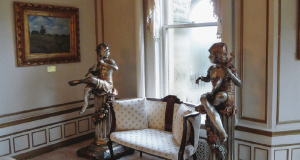
Decades after, when the mansion fell into disrepair, the property caught the eye of Jim and Donna Winner, a local couple with a passion for saving historic landmarks. In 1996, they purchased the structure and restored it to its former splendor with a multi-million-dollar renovation. Today, the inn features 10 guestrooms, a full-service spa and elegant sitting areas among bronze sculptures and many attractive works of art.


Deal of a Lifetime

It’s a short way from Buhl Mansion to the shopping district.

Daffin’s Candies is one popular stop for gifts, chocolate, cards and sundries. The business dates back to 1903, and the 20,000-square-foot store with a mid-century modern flair serves as the flagship location. Daffin’s makes more than 1 million pounds of chocolate annually and sells about 600 variations, including Caramel Pecanettes, followed by Melt-A-Ways and Cordial Cherries in popularity.

Kids, in particular, enjoy its “Chocolate Kingdom,” which includes a 400-pound turtle, a 125-pound chocolate reindeer and a 75-pound chocolate frog.

The mid-century modern theme continues in downtown Sharon with more shops located a short drive from the mansion.

Reyer’s Shoe Store anchors a small downtown shopping center evocative of the 1960s. The sign out front reads, “America’s largest shoe store.” I can’t verify that claim, but I can attest to the fact that they offer a large selection in many different styles and sizes, along with clothing, jewelry and accessories. And when was the last time you saw shoe salespeople roaming the aisles with foot-measuring devices?

This old-fashioned customer service experience continued across the street at a ladies clothing shop called, “The Winner.” The department store reminded me of the days of yore when saleswomen were poised at the ready to make suggestions and offer help. I learned later that Jim and Donna Winner modeled the store after Nordstrom and Saks. It isn’t often you see a grand piano and chandeliers in a department store these days. Men who are kind enough to join their wives on a shopping trip can take advantage of plump, comfy La-Z-Boys, a flat-screen TV and a supply of newspapers and magazines. Why doesn’t every store have one of these?

A short drive away in Clark, Pa., the Winners also own a unique property called “Tara, A Country Inn.” They purchased the 1854 property at auction, calling it the “deal of a lifetime.” The inn opened to the public in 1986, after two years of extensive renovations. It features 27 guest rooms and is chockablock with antiques and “Gone with the Wind” memorabilia.

“Stonewall’s Tavern,” located on the lower level, is a must visit for its cozy ambience alone. With exposed stone, copper-and-wood bar and old, high-backed wood seating, it’s like stepping back in time. Menu items include prime rib, New York strip, chicken Marsala, ribs, scallops and more. Also notable is a Wine Spectator “Award of Excellence” recognizing the establishment for “having one of the most outstanding restaurant wine lists in the world.”


Happy Returns

The Sharon area may not be considered “affluent,” but what it lacks in money it more than makes up for in charm. Much of it can be credited to Jim and Donna Winner’s hard work and dedication to their community.

While researching the couple, I stumbled on an interesting detail that likely afforded them the financial wherewithal to undertake so many projects. It all began with an unfortunate incident involving Jim Winner’s car, which turned up missing one morning. The entrepreneur began thinking of ways to solve the problem, which set the wheels in motion for the creation of “The Club,” the popular anti-theft device that has sold millions of units. Jim was able to make lemonade from lemons. The couple began to buy area landmarks and put their own unique spin on them, while giving back to their community.

Speak to residents of the area, and you’ll get a strong sense of community pride, with people working hard together to create a welcoming environment. For out-of-town visitors, this promises many happy returns.


To learn more about the Sharon, Pa., area, visit www.sharonpa.com. For more about Buhl Mansion, visit www.buhlmansion.com.

Continue Reading

The Poetry of Juelz

Juelz Davenport

When you take in the poetry of Julian Davenport (aka Juelz), you feel yourself immersed in the streets of Harrisburg—the poverty, the richness; the despair, the beauty.

Indeed, many of Juelz’s poems follow an arc from hopelessness to hope. But, fittingly, that describes Juelz himself.

As a young child, Juelz was raised on Vernon Street on Allison Hill, spent some time in Rhode Island, spent some time in prison. More than a decade ago, he began to turn his life around and, since, has become known locally for his verse and for giving back—teaching his craft, giving readings, participating in workshops.

Today, Juelz lives in Carlisle, but still spends much time in the city of his birth. In 2011, he released his first collection of poems, “In My Eyes,” and, last year, his second collection, “In My Eyes II,” from which these selections are taken.

Memories

Memories fade in and out like a shadow.
Shadows of my past come and go in my memory
as I rewind situations back slowly in my memory. I think once I am dead and gone …
there are no more memories except for the ones you can remember of me.
For me: Let my children know my smile could light a room,
and that daddy became a man way too soon.
Shadows of my past seem to be painting the ending of my destiny.
If I pass before my time, what has God expected from me . . . what was I destined to be?

Faded Away

What will they do when I am gone, faded away,
never living for tomorrow. I am only concerned with today,
tomorrow’s never promised, especially to me.
The things that are truth in my life—it gets stressful to see!
I receive so much envy, some days I don’t know why
but some days I wake up wishing I’d die.
What is the purpose? I’ve been asking God that question for years,
instead of an answer I got no response and I received no reply.
Instead he keeps me with the strength that I need to hold on.
Even though at the same time he strengthens the storm . . .
what is it you want—I scream to let it out,
I contemplate in my head,
they won’t be happy
until I’m lying in the gutter,
blood leaking from my head.
Gone and dead not a breath left—I can’t stay!
What will they do when I am gone, faded away?

I Saw the Storm Coming

I saw the storm coming,
but refused to move. I guess I got tired of running.
I guess it was time to stand up.
Sometimes it’s so easy for anyone to give up.
That’s when you think of times when the odds were much greater.
It’s so easy to forget but remembering it is major.
The things we take for granted could be the things that change our life.
If you live negatively with no care,
then be prepared to pay the price.
I saw the storm coming. This time I took my own advice.
I am the leader of these situations
I call life.
I saw the storm coming.
Instead of running, I stood.
I saw the storm coming but I knew I was good!

Tears of April

April, one of 12 spirits.
She cries so blatantly. I wonder if you can hear it!
Man so fearless! The earth lives but he tears it!
April cries and the tears lift
seeds toward sunlight.
Demolition provides paved roads,
so we enjoy Benz Bentley and Range Rove.
April cries so that summer arrives.
So hear the tears thud the roof of your home
and when the sky is painted smoky gray, beams of light refuse to penetrate.
Just know the tears of April paint pictures of what’s to come.
Sun after rain, but above clouds is all the same.

To learn more about Juelz and his poetry, visit www.JuelzPublishing.com and follow him on Instagram at imeurbanpoetry. His collections, “In My Eyes” and “In My Eyes II,” can be purchased at his website.

Article introduction by Lawrance Binda.

Continue Reading

Musical Notes: Feels & Fun–In February, Dig the Love.

Love is in the air, dear readers.

Whether or not you follow Valentine’s Day traditions, I’ve got you covered if you’re looking for a date idea or maybe just something fun to do. If you want to find a great show to entertain your love this month, we have a lot of variety coming your way. The Millennium Music Conference returns for another year. New venues continue to pop up with new acts. Bluegrass makes a big move on the city. Rock n’ roll musicians surprise us with something new. There’s something here for everybody and every occasion. Feel the love around you this month and be sure to listen for it in the music around you, too.

RODDY WALSTON & THE BUSINESS, 2/5, 8PM, THE ABBEY BAR, $15-20
This band is amped up and more than ready to give you the business through their rock n’ roll vibes. J. Roddy Walston & The Business are four guys—Billy C. Gordon on guitar, J. Roddy Walston on piano and guitar, Steve “The Sleeve” Colmus on percussion and Logan Davis on bass—heavily influenced by both old and new rock sounds. In their latest and upcoming releases, the band explores a brighter, poppier sound. Their single “The Wanting” draws inspiration from the new—keeping their sound “D.I.Y. but hi-fi,” says band leader Walston. Departing from their original classic rock-inspired sound, their fourth LP and latest release, “Destroyers of the Soft Life,” is worth a listen if you’re looking for something fresh and new among the community of progressive rock n’ roll artists. “Nostalgia is a cancer,” Walston warns. “Acknowledge that you are in the present.”

JIM HURST, 2/10, 7:30PM, FORT HUNTER CENTENNIAL BARN, $10-22You really don’t want to miss out on this unconventional but amazing venue featuring a true master of his craft. Bluegrass and country music virtuoso Jim Hurst will bring his velvety smooth vocals and incredible guitar skills to the Fort Hunter Centennial Barn for an evening that’s sure to be memorable. For two years in a row, Hurst won the International Bluegrass Music Award for “Instrumental Performer of the Year” on guitar. Starting his solo career in 2010, he has previously played with Holly Dunn’s Rio Band, Claire Lynch, Trisha Yearwood, the Front Porch String Band and Missy Raines, among others. If you want an idea of Hurst’s skills, look up his video for “Long and Lonesome Old Freight Train” and listen for those sweet southern vocals paired with the nimblest fingers plucking away complex melodies on his guitar. Even if you’re not that into bluegrass and country, you’ve got to admire his style.


TIGERS JAW, 2/24, 7PM, H*MAC CAPITOL ROOM, $15-18
There’s a lot of hype about this show, and, since it’s in the Capitol Room, you know it’s going to be a good time. Tigers Jaw is a Scranton-born, indie-rock emo band originally consisting of frontman and vocalist Adam McIlwee, Mike May, Dennis Mishko and Pat Brier. In 2013, the band split apart when the four members announced that they couldn’t continue because of personal reasons. The band then transitioned from being a larger group to a two-piece act with remaining members Ben Walsh on vocals and guitar and Brianna Collins on vocals and keyboards, backed by guest musicians. Since then, Tigers Jaw has opened for co-headliners New Found Glory and Yellowcard during their U.S. tour, as well as working with Basement on tours together. Check out their latest album, “Spin,” for a taste of what these two have going on.


Mentionables:

Deletions & Good in the Dark, Feb. 3, The Underground Bike Shop

Manian Van Hacker, Feb. 10, River City Blues Club

Al Di Meola, Feb. 13, H*MAC Capitol Room

Lucy Isabel, Feb. 16, Little Amps Uptown

The Flat Wheels, Feb. 16, Midtown Scholar Bookstore

The Mellowship Slinky, Feb. 17, Joe K’s Brewhouse

Millennium Music Conference, Feb. 23-24, various venues

Continue Reading

Great Grenache: The grape may not be noble, but its wines command respect.

In the world of wine, only seven grapes earn the title of “noble”: cabernet sauvignon, merlot, syrah, pinot noir, sangiovese, riesling and Chardonnay.

The best wines in the world come from these fruits, with a reputation for unequaled quality and the ability to command high prices. There are, however, grapes that form a second tier that have unique personalities and create wines of distinct flavors and nuance. The red grape known as grenache is one of these. A workhorse in the areas where it thrives, grenache can be blended with other varietals, bottled singly or added in the production of rosé.

In Spain, the grape is known as garnacha and is most likely the source of its origin. The hot, dry growing region suits the fruit well, and it can reach depth and subtlety. When bottled alone, the flavors run from red fruit to milk chocolate with vanilla highlights from the use of oak. Some garnacha is blended with tempranillo to create a newer style of rioja that I think is a definite improvement. For a lighter quaff, seek out Spanish rosés, where the red grapes are fermented off the skins. It’s a delicious version of garnacha.

Interestingly, grenache is an important grape on the island of Sardinia, where it is called cannonau. There, the wine is made so that not all of the sugar is converted to alcohol, giving it a fruitiness that is reminiscent of a zinfandel or Montecucco sangiovese. The local cuisine, based on lamb, cheese and flatbreads, matches this wine perfectly. Definitely worth a try.

Grenache reaches its pinnacle in the southern Rhone Valley of France. The grape is used extensively in the sub-region of Languedoc Roussillon and through all the villages known as Cotes-du-Rhone to its northern terminus in the medieval city of Avignon. The 14th-century seat of the Catholic papacy, Avignon is where the world’s greatest grenache-based wines are made to this day.

A complex quaff with a total of 18 grapes allowed, these grenache blends are wonderful, full-bodied reds that can be enjoyed young or aged to mellow the tannins. They are very much a foil for the rich food of the area with its sauces and heavy beef dishes. The villages of Vacqueyras, Gigondas and Lirac also produce spicy grenache-based quaffs. Here, one should check the bottles carefully looking for the words non-filtre, which is a new and tasty trend for this part of the world.

Keep sipping,
Steve

Continue Reading

Chugging Along: The Station has been on the right track for 60 years.

Burg in Focus: The Station from GK Visual on Vimeo.

I brought my 5-year-old daughter with me when I visited The Station in New Cumberland.

I don’t usually take her to work with me, but a model train store seemed like a place a child would enjoy. I was right.

And, besides, The Station itself is a family affair.

At the door, we were greeted by Julie Payne, daughter of The Station’s late owner, Richard “Dick” Wildman. Julie’s mother, Doris—or, Dee Dee, as everyone calls her—has been running the business with the help of friends and family since his passing a year ago.

Julie and Dee Dee were warm and open, and the store (an old reconstructed train station—more on that later) was bustling with family and customers. Julie’s nieces, Michelle and Nicole Huffer, help out at the store, as well, and Julie’s sister, Tracy Huffer, does all of the accounting and paperwork.

They offered us drinks and snacks, even allowed my daughter to sit and color at the counter with Dee Dee when she got antsy and let her try a new Hershey’s candy that isn’t on the market yet (she still talks about it).

It’s worth noting that I didn’t get special treatment because I was writing a story on the Station. Everyone is treated warmly when they walk through the door, and it’s that welcoming atmosphere that has kept The Station in business for 60 years.

“We know all of our customers really well,” Julie said. “They’re like family.”

The Station exclusively sells hobby trains and accessories, which seems pretty niche, but people that are into hobby trains are into them, and many of them have been coming to The Station for decades.

“There are people who come in here who came here when they were kids, and now they bring their kids here or even their grandkids,” said Julie.

The store itself has a fascinating origin story.

August “Gus” Wildman IV, Julie’s grandfather, was a model railroad enthusiast and began operating a hobby shop out of his home in 1945. By 1955, his business, called Model Hobbies, carried a complete line of structures and accessories, and even manufactured kits for buildings and other structures that hobbyists could rebuild on their own.

In 1957, Gus saw an ad for an original Reading Railroad station in Robesonia, Pa., that was going to be demolished. So, he bought it for a few dollars and, with the help of family and friends, disassembled it on the weekends, brought it to New Cumberland piece by piece, reassembled it in a lot next to his home, and moved his business there. In 1970, Dick came home to help his father run the business and, when Gus passed away in 1978, Dick and Dee Dee took it over.

The building, which is now more than 160 years old, is a labyrinth of sorts, with rooms upon rooms of all sorts of supplies, almost like a time capsule. Even though the shop doesn’t manufacture its own kits anymore, parts and instructions for them are stocked in the back, just in case they’re needed.

Julie and Tracy have worked at The Station in some capacity since they were kids, and after just a few minutes of conversation, it was clear how much the place means to them.

“[I used to work] as a child packing ballast, building paper and barrels for the wholesale business,” Julie said. “I remember hearing my dad hum or sing in the back as I was stocking shelves.”

The Station is truly a special place, and worth a visit even if you aren’t into model trains. It’s cozy and unique, and a welcome change from the big box stores that we tend to visit by default.


The Station is located at 213 9th St., New Cumberland. For more information, call 717-774-7096 and visit their Facebook page.

Continue Reading

How to Heal: At Samara, mothers, fathers learn to become parents.

For Basil Talib, coming to Samara was like meeting “relatives I never knew I had.”

“When you get there, it’s like a holiday,” said Talib, of Harrisburg, who started attending Samara’s intensive parenting sessions in Harrisburg six years ago. “Everyone is so cheerful. They don’t judge you. They’ve been like a family.”

Samara: The Center for Individual and Family Growth is a nonprofit agency in Harrisburg founded in 2008 by Executive Director Pamela Haddad, a former child protective services worker in Lehigh County.

Clients are referred to Samara through the Dauphin County child welfare system, court and probation systems, other non-profit agencies and the community. A separate therapeutic visitation program assists families of children placed outside of the home through the Dauphin County welfare system.

“Our families have experienced a tremendous amount of trauma,” explained Haddad. “We work with parents who have come through foster families or intact families with trauma. Our goal with parents is to form safe, respectful relationships.”

In other words, Samara is a therapeutic base for parents who are having difficulty parenting, as well as their children. Often, it’s a carry-over situation caused by a lack of nurturing in the parents’ own childhoods.

Cathy Bacon was referred to Samara’s therapeutic visitation program in 2015 after her youngest child, then 3, was placed in foster care. She and her son met up in Samara’s homelike setting, where she utilized skills learned in Samara’s intensive parenting program. Bacon said her mother gave her “a work history and love” while she was growing up, but her father wasn’t around.

“Samara helped keep you calm and taught you parenting skills,” Bacon noted.

Bacon’s young son was returned to her home 18 months later, but she continues attending the center’s parenting groups today.

“I like Samara,” she said. “It’s comfortable and friendly.”


Harder Time

Haddad’s extensive field experience includes a stint as a parent educator/project coordinator for Cobys Family Services in Lancaster County from 1996 to 2001. During this time, she conducted a parenting course for community parents, foster parents and court-mandated parents referred by Lancaster County Children and Youth.

“When I was doing child investigations, I never met parents who didn’t love their children, but they didn’t know how to heal their families,” Haddad observed. “In 1996, when I was working in Lancaster County, I wrote a curriculum to help parents walk through their childhood.”

At that time, Haddad developed what would become a pilot program for Samara in collaboration with her mother, Jean Heigel. Heigel, her daughter’s mentor, worked for many years with foster children and at-risk families in Lancaster County, all while researching and writing volumes of curricula and teaching materials in the field.

“I found that lots of kids from foster homes were physically or sexually abused or bounced around 20 times to different homes,” Haddad noted. “If the kids don’t behave, some parents will return them. People who go through the system like that have a much harder time parenting their own children.”

Samara’s intensive parenting sessions includes a nurturing activity in which participants take turns giving each other compliments.

“Some people cry because they never heard nice things said about them before,” Haddad recounted.

Safe Haven

Talib lost his mother when he was 5, leaving him with a “dictator” father “who was never a role model,” he recalled.

He felt even more alone after his sister died early in life of natural causes.

“I grew up rough in Brooklyn,” he said. “I came fresh off the streets into a negative environment.”

He won’t say when or how much time he spent in prison because he doesn’t want to “try to think negative and put dates on it.”

Instead, he focuses on how being in prison renewed his appreciation of life. Becoming a father also caused Talib to reevaluate his priorities.

“When I had my kids, I started to man up,” he said. “I started to understand more about God.”

Today, Talib is a single father of two boys, ages 6 and 7, “doing it by myself.” He’s attended almost every parent session at Samara for the past six years, bringing his boys along for children’s sessions. He’s also a published poet, a literary advocate and a self-described activist, receiving the MLK Drum Major Award, a service award, from President Barack Obama in 2016.

“Samara has been like a safe haven for me,” Talib reflected. “It’s a positive attitude. Not only do I learn there, I teach. I give back because I know what it’s like not to have a mother and father. You can’t spell community without unity.”

Olivia Moore also started attending Samara’s intensive parent classes six years ago after voluntarily reaching out to Dauphin County Children and Youth for help with her son’s truancy issues. Although Samara no longer offered the truancy classes recommended by the county agency, Moore discovered much more there.

“I said, ‘Wow, is there anything else there?’” she said. “I went to the intensive parenting classes and never stopped going. You learn something new every time there.”

In fact, Moore learned so much at Samara that she later pursued leadership training and became a class instructor. Her son, now 19, enrolled in the Job Corps and became a certified auto mechanic.

“Once I took the (Samara) classes, I rebuilt my relationship with my son,” Moore said. “I think it’s about nurturing. Samara is very nurturing. They believe in people. I didn’t have that when I was growing up. My son would have ended up in the judicial system without Samara.”

To learn more about Samara, visit www.samarafamily.org.

Continue Reading

Cry Fowl: It’s duck season in Harrisburg.

In the early years of my marriage, which corresponded to the beginning of my life as a cook, I was drawn to French cooking. It seemed glamorous, I suppose, and very different from the humble Italian food on which I was raised.

Back in the early 1970s, French restaurants were very popular and considered the best places to find “gourmet food” or “haute cuisine.” With Julia Child, the famous French chef, as my guide, I tried my hand at many French favorites including:

  • Coquilles St. Jacques (tiny bay scallops bathed in a rich cream sauce)
  • Sole Meniere (crispy white fish filets cooked with lemon and butter)
  • Onion Soup (served in special crocks and smothered on top with melted Gruyere cheese)
  • Soufflés (puffy savory or sweet concoctions made with whole eggs and beaten egg whites—I tried lemon and cheese.)
  • Cassoulet (hearty casserole of sausages, beans and often duck)
  • Ratatouille (a tasty vegetable stew, not the movie!)
  • Coq a Vin (a slow cooked stew of chicken on the bone with white or red wine, mushrooms and bacon)
  • Quiche Lorraine (egg and bacon pie)
  • Boeuf Bourguignon (beef and red wine stew with carrots and potatoes)
  • Steak au Poivre (strip steak with crushed peppercorns, brandy and cream)

My husband loved snails (or escargot—and still does), but I refrained from trying those at home.

My favorite French food usually involved duck, especially “Duckling a l’Orange,” one of the best-loved dishes of French cuisine. It is duck roasted with butter, oranges and Grand Marnier, the wonderful cognac and orange liqueur.

I have been finding fresh duckling with increasing frequency at my local farmers’ market, both whole birds and breasts. And some of our favorite Harrisburg restaurants are currently offering several delectable duck entrees:

  • Mangia Qui: grilled Moulard duck breast with tawny port cherry sauce and saffron
  • Note Bistro and Wine Bar: pan-seared duck breast with spice butternut squash puree and pecan barley
  • Home 231: pan-seared duck breast with root vegetables and pickled apple

So, I decided it was time to re-visit “duck cooking” in my own kitchen. I searched through my stash of cookbooks and found one of my favorite old recipes: “Roast Duck with Sour Cherries,” a perfect choice to brighten a cold February night. It is from a 1968 version of The New York Times Cookbook and is worth a try (maybe to celebrate Valentine’s Day?). Cooking duck is no harder than roasting a chicken, but you just might find a new love.


Roast Duck with Sour Cherries

Ingredients

  • 1 duck (5-6 pounds)
  • ½ teaspoon salt
  • 1/8 teaspoon black pepper
  • Pinch of thyme (dried)
  • 2 small onions, sliced
  • I medium carrot, sliced
  • 1 can pitted sour cherries (not drained)
  • ½ cup port wine (ruby port is best)
  • 1 teaspoon cornstarch

Directions:

  • Preheat oven to 425 degrees.
  • Season the inside of the duck with salt, pepper and half the onion slices. Remove the giblets if still in the bird.
  • Prick skin with a small knife or fork (this will allow some of the fat to drain from the bird).
  • Place the duck, breast-side up, in a heavy roasting pan and place the remaining sliced onion and carrot around it.
  • Roast for 15 to 20 minutes at this higher heat to brown the duck. Then reduce the heat to 350 degrees.
  • Roast for 1 to 1½ hours or until a meat thermometer inserted into the breast registers 140 degrees (timing will depend on the size on the duck). Remove duck to a warm platter and cover with foil to keep warm.
  • Remove all but 1 tablespoon of fat from the pan. You can use a spoon or pour all the pan juices into a fat-separator measuring cup. The sauce can be made right in the roasting pan or in a little saucepan.
  • Drain the juice from the canned cherries. Add it, along with the port wine, to the pan juices and bring the mixture to a boil.
  • Add the cornstarch, dissolved into a little cold water, and heat until thickened. Finally, add the cherries to the sauce and heat through.

Slice the duck just as you would a roast chicken and serve with the sauce. Duck is so good paired with wild or brown rice and a bright green vegetable like broccoli or broccoli rabe. And while you might be used to drinking white wine with “fowl,” you will find that, because duck is fatty, red wine such as pinot noir, merlot or Barolo are a much better match.

I remain a devotee of Italian cooking. But, every once in a while, I love to wander into the wonderful world of French cooking. Besides, Italians cook duck too!

Continue Reading