Following online outrage and revenue hit, HMAC files chapter 11 bankruptcy as a prelude to sale

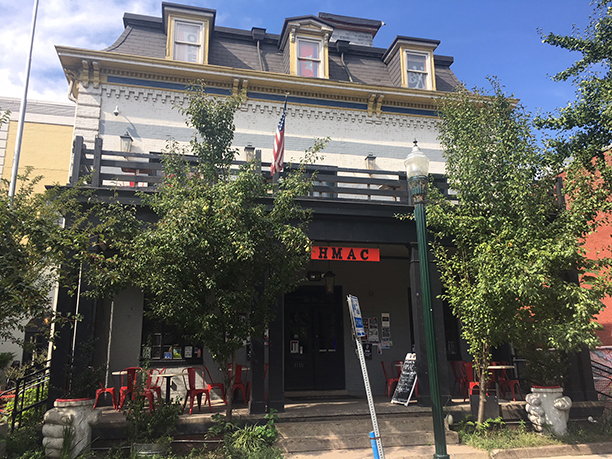
The House of Music, Arts & Culture in Midtown Harrisburg

One month after a sexual assault allegation engulfed the House of Music, Arts & Culture (HMAC) in a social media maelstrom, its owners have filed for bankruptcy and plan to sell their business.

HMAC (formerly the Harrisburg Midtown Arts Center) will continue its normal operations as its owners restructure debt obligations to more than three dozen creditors, said John Traynor, who owns HMAC with his husband, Gary Bartlett, and two other partners.

Their company, Bartlett, Traynor & London LLC, last week filed for Chapter 11 bankruptcy in the U.S. District Court for the Middle District of Pennsylvania. They believe that they have a buyer for the business, according to the filing documents. HMAC listed more than $5 million in total assets, chief among them the sprawling, historic building at 1110 N. 3rd Street.

Traynor hopes to transition to new management and ownership by 2019.

“This allows us to reorganize, take a breath, and work with creditors,” Traynor said. “I think HMAC could use a fresh start, and Chapter 11 will help facilitate that.”

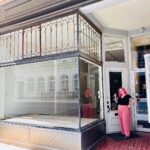
Traynor and his partners have developed HMAC for a decade and, in 2009, opened the first phase, Stage on Herr, a bar and concert venue. In all, they’ve since spent millions of dollars renovating the 34,000-square-foot property, which served as the city’s Jewish Community Center starting in 1924 and later housed Harrisburg’s Police Athletic League.

Today, HMAC comprises three separate performance venues, as well as a full-service bar and kitchen. It hosts shows by local and national performance artists, corporate events, weddings and community gatherings.

According to Traynor, it’s one of the largest privately funded development projects in Midtown Harrisburg.

Crimes and Consequences

Traynor said that that HMAC’s finances were healthy until July, when an HMAC customer claimed that she was drugged inside the bar and later beaten and raped. On social media, she said that HMAC’s staff failed to recognize her as a victim of date rape drugs and left her vulnerable to her attacker when they asked her to leave the bar.

She posted those allegations on HMAC’s public Facebook page on July 28 and deleted them within an hour, Traynor said.

But a screenshot of her post, along with a sensational article from the Philadelphia-based site YC.news, circulated in other online community groups. A conversation in the Midtown Harrisburg Facebook group generated hundreds of comments from people both excoriating and defending HMAC.

The Harrisburg Police Bureau investigated the woman’s assault and quickly debunked her allegations against HMAC. Chief information officer Gabe Olivera told the press that the woman left the bar premises with her attacker, voluntarily, after it closed. The assault occurred later that night in a home in Uptown Harrisburg.

Michael Ray Wright was charged with the woman’s rape on July 30. But Olivera said that HMAC could not have prevented the assault.

“We were totally vindicated by the police,” Traynor said.

He said the claims that the bar mishandled the incident were the work of “disgruntled ex-employees who work for a competing venue.”

The accusation sparked a firestorm nonetheless. Traynor says that the woman’s refuted allegations were “conflated” with other grievances against him and his business.

On Facebook, some community members said that reports of racism, predation and poor working conditions at HMAC long ago led them to boycott the establishment. Traynor denies their claims wholesale.

“I’ve heard them all,” he said. “I’ve heard that I’m a sexual predator, that I drug people, that I cultivate a [bad] culture, but it’s so ridiculous. Some of the people that are maligning me worked for me for seven, eight years. I think they don’t understand the ramifications of what they’re doing. The whole advent of social media and how easy it is to pile on and make false statements is a new phenomenon.”
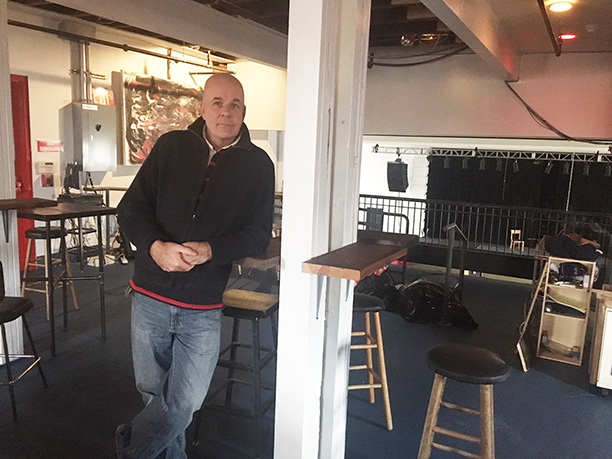
John Traynor, inside HMAC, from December 2017

Traynor admits that Stage on Herr had a freewheeling reputation in its early days but said that HMAC’s management became more professional as the business grew. He claims he didn’t take the social media “bashing” personally.

But he said he won’t forgive the critics who allegedly contacted national booking agents and convinced bands to back out of HMAC gigs.

In all, the firestorm cost HMAC a dozen shows and some $200,000 in revenue, Traynor said.

“We were operating on cash flow, and our cash flow was severely impacted,” Traynor said.

Under Chapter 11, HMAC will be able to rebuild its events calendar and renegotiate debt payment schedules, Traynor said. He said that the company did not have any problems fulfilling its debt obligations until recently.

In the coming weeks, Traynor said, HMAC’s owners will also prepare a case against a dozen people who he claims defamed the business and interfered with its performance contracts.

He said that he and his partners have collected evidence to press charges for tortious interference of contract – the act of intentionally damaging a business agreement and causing financial harm.

Traynor said that the Dauphin County District Attorney’s Office is investigating the claims of interference. That office could not be reached for comment on Wednesday.

He expects that a dozen people could be named in a civil complaint.

“They’ll all pay,” Traynor said. “They can’t do what they did without consequences.”

Not Going Away

It’s unlikely that HMAC’s patrons will notice that the business has filed for bankruptcy.

Filing under Chapter 11 of the federal bankruptcy law grants debtors temporary relief from liabilities while they reorganize their assets. Unlike a Chapter 7 filing, it does not mean that the business will liquidate and close.

“A company doesn’t have to be insolvent to file for bankruptcy,” said Juliet Moringiello, an associate dean and bankruptcy law expert at Widener University Law School. “Chapter 11 was designed as a process for a company with a good business model to pare down its debts and renegotiate contracts.”

According to bankruptcy filings, HMAC has less than $10 million in liabilities. The documents indicate that the company will be able to pay its debts in full once it emerges from restructuring.

Twenty of HMAC’s creditors – including business vendors and utility providers — are unsecured, meaning they wouldn’t be guaranteed money in a liquidation. Peggy Grove Enterprises is the largest unsecured creditor, with $170,000 invested in the project.

The City of Harrisburg is a secured creditor due to its status as a taxing entity, according to city Solicitor Neil Grover. Property records show that HMAC owes $19,000 in local property taxes, including $4,700 to the city of Harrisburg and more than $11,000 to the Harrisburg School District.

Even though a Chapter 11 filing may indicate that a business is in distress, it usually doesn’t hamper its services, Moringiello said. She pointed to America’s airline industry as an example.

“Every legacy airline in America has filed Chapter 11, but as far as passengers are concerned, the planes keep flying,” Moringiello said. “Filing for bankruptcy doesn’t mean a company is going away.”

That’s good news to Jeb Stuart, a lifelong Harrisburg-area resident and preservation advisor to the Historic Harrisburg Association. He said that HMAC’s multi-use spaces have enriched Midtown Harrisburg and preserved an important historic structure.

“It’s very contemporary and animated and innovative,” Stuart said. “To have a space for public assembly with a huge auditorium and stage capabilities, that’s a major contribution to North 3rd Street.”

Traynor said that HMAC will continue its normal program of musical shows, weddings, corporate events and fundraisers through the end of the year. But its owners are also planning new projects.

The project received a $1 million state Redevelopment Assistance Capital Program (RACP) grant in December, which will finance infrastructure improvements. Traynor hoped to use the money to expand the Capitol Ballroom and refurbish the basement to accommodate a music school.

He insists that the grant is the only public money HMAC has received.

Traynor said he wants to see HMAC endure for years to come, which is one reason he wants to find it a new owner, he said. He hopes that the restructuring under Chapter 11 will facilitate a sale.

“What I would hate to see is for this project to close,” Traynor said. “We put a lot of money and sweat equity into it, and now it’s time for a transition.”

The owners’ desire to sell pre-dates the social media firestorm, Traynor said. They’ve been negotiating with national entertainment agencies for the past three months, he said.

HMAC’s assets include more than $5 million in property, $44,000 of inventory and approximately $22,000 in accounts receivable, according to its bankruptcy filings.

Among those assets are HMAC’s liquor license, which it will defend in a Pennsylvania Liquor Control Board hearing later this month.

The PLCB put HMAC under a conditional licensing agreement (CLA) in 2014. It placed additional requirements on HMAC’s license, namely that the owners install soundproofing systems and perform additional security checks every night.

Traynor said that the CLA arose from noise complaints. He is confident that the business will retain its license after the hearing.

He also denied that the PLCB hearing had any influence on the decision to file for bankruptcy.

If the PLCB yanks the license, however, the value of HMAC’s assets would depreciate significantly, Moringeillo said. She thinks it unlikely that the Chapter 11 filing will influence the PLCB’s decision.

Wednesday, Sept. 6: This article was edited to correct the name of a Philadelphia-based news site. It is YC.news, not YC.com.

Continue Reading

Harrisburg playgrounds to open soon after months-long renovations

Mayor Eric Papenfuse was joined by students from the Sylvan Heights Science Charter School today as he cut the ribbon on a new playground at Cloverly Heights Park. The playground features all-new equipment, a rain garden, a pavilion, and a permeable pavement basketball court.

Summer break may be over, but playtime is just beginning in Harrisburg.

Mayor Eric Papenfuse today cut the ribbon on the newly renovated Cloverly Heights Playground, one of four play areas that were recently revamped with new equipment and green infrastructure.

After being closed all summer, playgrounds at Cloverly Heights, Norwood and Holly streets, Penn and Sayford streets and Royal Terrace soon will be open to the public.

Penn and Sayford and Cloverly should be open in about two weeks, the others sometime in October, Papenfuse said.

The four sites have been outfitted with all-new play amenities, and each one has unique features, Papenfuse said.

Three of the sites also have storm water management enhancements thanks to Capital Region Water.

“Our parks are the city’s greatest assets,” Papenfuse said during a sweltering press conference this afternoon, where he was joined by representatives from each of the project partners. “I’m glad we’re bringing all of our playgrounds up to the level that our community would like to see.”

The city will complete renovations at a fifth playground, at 4th and Dauphin Streets, next year.

The citywide playground renovations were part of a $2 million partnership among Harrisburg, Capital Region Water, Impact Harrisburg, the state Department of Conservation and Natural Resources and the state Department of Community and Economic Development.

Today’s ribbon cutting represented the culmination of a project three years in the making. The five playground sites were first targeted for renovations in 2015, but renovations stalled while the city pursued funding and collected public input.

Sheila Dow-Ford, executive director of Impact Harrisburg, said that the project was an obvious pick for a grant from her nonprofit organization, which was founded in 2014 with proceeds from the sale of the Harrisburg incinerator.

“Everyone remembers spending time on a playground,” Dow-Ford said. “My board thinks this project is very high priority, because our children are high priority.”

Students from the neighboring Sylvan Heights Science Charter School also attended the ribbon cutting. They helped showcase the new storm water management amenities at Cloverly Heights, including a basketball court made with permeable pavement. The students poured buckets of water on the asphalt to show how it absorbed liquid.

They also helped plant a rain garden, which will collect rainwater runoff from impervious surfaces.

This story has been updated with additional information about the openings for each playground.

Click to enlarge more pictures from today’s playground ribbon cutting. 

Continue Reading

Harrisburg’s economic director leaving; no plans to fill open position

Jackie Parker, second from left, at the ribbon-cutting for MulDer Square in February.

A senior Harrisburg official is leaving her post to work in the private sector, she confirmed today.

Jackie Parker, who has headed the city’s Department of Community and Economic Development (DCED) since 2014, will report for her last day in city hall on Sept. 14.

Parker told TheBurg she is taking a job with a medical marijuana company.

Parker joined the city administration when Mayor Eric Papenfuse took office in 2014. She previously served as the mayor of Lebanon, Pa., and as deputy secretary of the Pennsylvania Department of Community and Economic Development.

As the city’s DCED director, Parker was the point person for economic development projects, Papenfuse said. She managed employees in the bureaus of housing, planning, business development and parks and recreation.

Papenfuse said today that he does not plan to replace Parker. The mayor announced a city hall hiring freeze in June, but he also hopes to reorganize DCED in the wake of Parker’s departure.

He expects to prepare a reorganization plan ahead of his 2019 budget presentation in November.

“She’s been a wonderful, committed leader for the city,” Papenfuse said. “I think she’s irreplaceable.”

Parker’s duties will be split between other senior administrators in city hall, Papenfuse said. Some of them will be formally redistributed in the department’s restructuring.

The future of Parker’s department will also depend on the city’s fate in Act 47, the state oversight program for financially distressed municipalities. Harrisburg officials are currently deliberating a three-year Act 47 exit plan.

Meanwhile, the state House of Representatives is considering a bill that would allow Harrisburg to leave Act 47 and retain its current taxing authority.

The House will hold a joint public hearing on the bill later this month. But with the city’s financial future in limbo, Papenfuse does not plan to hire a new senior administrator before the end of the year.

“She’s irreplaceable, but this gives us the opportunity to restructure and create new systems,” Papenfuse said. “It will all depend on what happens in the next few months.”

One of Parker’s most significant accomplishments, according to the mayor, was her ability to leverage state agencies as partners in city projects. As an example, he pointed to the ongoing renovation of playgrounds across the city – a $2 million undertaking that was made possible by collaborations with the state Department of Conservation and Natural Resources and the state DCED.

Parker was also instrumental in producing the Reservoir Park master plan, Papenfuse said, which will guide redevelopment in that park over the next decade.

“This is a legacy that will last for a long time,” he said.

Continue Reading

Weekend Roundup with Sara Bozich

Happy Weekend!

It gets a little trite to preface every WR with a recap on the forecast, but HI, IT’S COOLING DOWN. That’s worth celebrating right? Oh what, you don’t want it to rain? I’m cool with it, but that’s because the apex of my weekend plans is FOOTBALL (as in, watching comfortably from my couch — I’m already picking out my sweatshirt).

FOOTBALL IS BACK, FRIENDS. REJOICE.

Hey, also, Big Bottom Brewery in Dillsburg is celebrating its Grand Reopening on Saturday, and you should check that out. It was Al’s Pizza, and then they added the brewery last year, but now they’ve fully renovated into a brewpub, and I’m pretty excited for them. Good people, Steelers fans. What is everything about football with me??? (Yes.)

I hope you’re still with me because there is loads to do that ISN’T football.

What are you doing this weekend?

(more…)

Continue Reading

Harristown plans to purchase Skarlatos building, as law firm relocates to Strawberry Square

The two downtown parcels that make up Harristown’s redevelopment project.

A downtown Harrisburg building project has changed significantly, as a developer now has plans to purchase and renovate the building next door.

Harristown Enterprises expects to close this fall on the purchase of 17 S. Market Sq., currently the home of the SkarlatosZonarich law firm, said Harristown CEO Brad Jones. A full renovation of the century-old, 33,809-square-foot building will follow.

“We’re still evaluating the uses of that building,” Jones said. “We think it’s going to become a mixed-used project.”

Last year, Harristown bought the neighboring building, a small, dilapidated, early 19th-century office and retail building at 21 S. 2nd St., which notably once housed the Coronet restaurant.

It razed that building, with expectations to construct a new office building and attach it internally to the SkarlatosZonarich property. However, according to Jones, the plan changed after continuing discussions with the law firm.

“As we began to talk more, they indicated they were more interested in selling the building,” Jones said.

As a result, SkarlatosZonarich now will sell their Market Square building to Harristown and relocate to the Bowman Tower in Strawberry Square, which is also owned by Harristown.

“We are excited to be a part of a new era of businesses in the Bowman Tower in Strawberry Square—an environment that will enhance the quality of legal services we deliver to our clients as well as the lives of our employees,” said John B. Zonarich, a partner with SkarlatosZonarich.

In January, the firm’s 35 employees will move into about 11,000 square feet of office space, about double their current footprint, following a $1 million renovation, Jones said. After the relocation, Strawberry Square will have an office vacancy rate of only about 5 percent, he said.

Jones said that plans are still in flux for the redevelopment project at Market Square, but he expects a mixed use of residential, office and retail, with residential more likely for 17 S. Market Sq. and office more likely for 21 S. 2nd St.

Last month, the project received a $1 million grant from the state’s Redevelopment Assistance Capital Program.

Jones declined to state the purchase price of 17 S. Market Sq. Harristown bought 21 S. 2nd St. last year for $150,000, but that building was far smaller and in much worse shape than the adjacent building, which SkarlatosZonarich bought in 2004 for almost $1.9 million, according to Dauphin County property records.

Continue Reading

By the Book: Lineup announced for annual Harrisburg Book Festival

Midtown Scholar Bookstore, the site of the annual Harrisburg Book Festival

It may seem unlikely, but Harrisburg has emerged as a key stop for authors on the book promotion and lecture circuit.

That status is punctuated each year by the Harrisburg Book Festival, which will return next month for a sixth year.

“We’re delighted that we’re able to bring this festival to Harrisburg again,” said Alex Brubaker, manager of Midtown Scholar Bookstore, which sponsors the long weekend of book-related events. “Every year, it gets bigger and better.”

The 2018 festival will feature panel discussions, keynote presentations, book signings, story times, arts and crafts and more, Brubaker said.

There will be two ticketed events — the opening keynote with Tayari Jones and the closing keynote with Carol Anderson, he said. Every other event is free and open to the public.

This year’s lineup includes presentations and signings with award-winning authors, including:

  • Grammy-nominated singer/songwriter and poet Mary Lambert
  • New York Times bestselling novelist Tayari Jones
  • National Book Critics winner and New York Times bestselling critic Carol Anderson
  • New York Times bestselling historian Liza Mundy
  • President Barack Obama’s speechwriter David Litt and stenographer Beck Dorey-Stein
  • Caldecott honoree Lauren Castillo
  • Emerging novelists Crystal Hana Kim and Lucy Tan
  • Joe Beddia, whose pizza was named Bon Appetit Magazine’s “Best Pizza in America”

“We’re delighted to feature some of the most internationally renowned authors working today — right here in Harrisburg,” Brubaker said.

The 2018 Harrisburg Book Festival takes place Oct. 11 to 14 at Midtown Scholar Bookstore, 1302 N. 3rd St., Harrisburg. For more information, visit www.hbgbookfest.com.

Continue Reading

Mayor: Judge to delay Harrisburg’s Act 47 deadline until October.

A decision by a Commonwealth Court judge could give Harrisburg until the end of October to adopt an Act 47 exit plan and continue a lobbying campaign in the statehouse, Mayor Eric Papenfuse said on Thursday.

The new deadline would allow city officials more time to negotiate with state lawmakers once they return to the Capitol in September. Harrisburg is asking them to pass a bill that would let the city keep its current taxing authority and make a sustainable exit from the Act 47 state oversight program.

“This clears the stage for the legislature to act,” Papenfuse said. “Hopefully, we’ll get the legislative change we want.”

According to Papenfuse, Commonwealth Court Judge Bonnie Leadbetter indicated at an Aug. 14 conference that she would exempt the city from a statute in Pennsylvania’s Municipalities Financial Recovery Act, which says that a city has 45 days to adopt an Act 47 exit plan drafted by a state-appointed coordinator.

Papenfuse said that city officials did not want to adopt a three-year exit plan until lawmakers could consider House Bill 2557, which is co-sponsored by Rep. Patty Kim, D-Dauphin County, and Rep. Greg Rothman, R-Cumberland County. The House finance, local government and urban affairs committees will hold a joint public hearing on the bill on Sept. 25.

The house returns to session on Sept. 5, and the Senate on Sept. 12. The bill, which Papenfuse announced on July 10, is not yet published in the state’s legislation database.

If the bill passes, Harrisburg will be able to keep its current local services tax (LST) and earned income tax (EIT) rates, which bring in a combined $11.8 million of annual revenue. The Act 47 law has allowed Harrisburg to pass provisional hikes on both taxes. Harrisburg doubled its EIT in 2012 and tripled its LST in 2016.

Otherwise, an Act 47 exit would force Harrisburg to lower its tax rates to their former levels. City officials say they can’t provide basic services if they lose almost $12 million in annual revenue.

Harrisburg’s Act 47 designation expires in September. In March, its coordinator, Marita Kelley, recommended the city stay in Act 47 under a one-time, three-year extension.

In order to secure an extension, however, Harrisburg officials must adopt a state-approved exit plan.

Kelley published the first draft plan on July 9. She had a month to collect public comments and make revisions, but Harrisburg officials faced a September deadline for its final approval.

Residents and city officials excoriated the first draft document, which called for doubling property taxes over three years to offset LST and EIT revenue losses. The second draft deferred the property tax raises for three years, but recommended steep hikes in 2022 if the city does not persuade lawmakers to grant it augmented taxing power.

Members of the Papenfuse administration and City Council agree that Harrisburg can’t balance its books under the current state tax code. They say that Harrisburg deserves special taxing provisions as the state capital city, since it supports large swaths of untaxable land and more than 30,000 commuters a day.

Harrisburg began making that argument to lawmakers in January, when it entered a 12-month, $60,000 lobbying contract with local firm Maverick Strategies. Since then, Papenfuse and his staff have convened dozens of meetings with state legislators.

Their effort soured in June, after Papenfuse clashed with house Speaker Mike Turzai. The next day, Turzai blocked a special provision for Harrisburg from coming up to vote.

The general assembly recessed hours later, forcing Harrisburg to begin the months-long Act 47 exit process. Papenfuse is optimistic that there is enough will in the legislature to pass a bill this fall.

If the legislature fails to act this fall, the mayor hopes that the city can develop an agreeable Act 47 exit plan and continue lobbying into the new year.

As of Friday, Leadbetter had not filed a formal response to Harrisburg’s application for relief. Harrisburg Solicitor Neil Grover, who was present at the Aug. 14 conference, declined to comment on Ledbetter’s decision until it was filed.

Want to learn more about Harrisburg’s financial recovery? Check out TheBurg’s guide to Act 47.

Continue Reading

Dance, Dance, Dance: Fifteen years of forward motion at The Studio.

Photos courtesy of The Studio.

Fifteen years ago, Jennifer Turner Long opened a small dance school in Marysville called The Studio.

It didn’t stay small for long.

After just a year, it had to locate to larger space down the road at the Summerdale Plaza, where it remains today, even as enrollment has grown from that first class of 24 students to 450.

“I have a staff of 15 now, but I still teach,” said Long. “It’s still fun. I love being with the kids.”

Despite such growth, Long said that she strives to maintain an atmosphere of closeness and caring.

“Every year, we grow, and managing that is the challenge,” she said. “It’s so important not to feel like a big place. We know our families here. This is our community.”

Simply put, Long wants The Studio to feel like one big family, an effort not lost on Dave Crozier. With four children, ages 8 to 14, all pursuing dance, Crozier, of Enola, spends “a lot of time” there.

“I view The Studio as more than a dance school,” he said. “They teach grace, manners and humility and maintain a family atmosphere.”

Conveying values like work ethic and kindness are also high on the agenda, Long explained.

“We cultivate our students’ best selves,” she said.


My Calling

When The Studio first opened as a small facility in Marysville, Long went door to door to recruit clients.

Within a year, the business had grown enough to move, but it didn’t expand all at once. Instead, it opened with just one studio in the plaza’s lower level, gradually expanding to four.

“We bootstrapped it,” said Long, who runs the business with husband Kevin, who serves as house photographer and videographer. “We used what we earned and didn’t borrow to build any of this.”

About 30 months into the venture, Long felt confident enough to quit her full-time job in the IT field and devote all of her time to The Studio. In effect, the school served as a daycare for daughter Olivia, now 12, whom the Longs adopted from China.

”I could never get away from dance,” Long said. “It was my calling. It spoke to me.”


One for Us

Dancers at The Studio choose their own path, whether it’s a budding career or just fun.

Recreational dancers are offered combination classes and two significant performance opportunities, while dancers with greater ambitions can pursue specialty paths that include community performance groups, competition teams and professionally staged ballets. Recent public shows include “The Beauty and the Beast” and “Frosty.”

The Studio’s combination classes teach ballet and tap, with jazz beginning at age 7. Specialty genres include ballet technique, pointe, modern and contemporary, jazz intensives and hip-hop. Students’ ages range from 2 years to senior citizens.

Crozier’s daughter Abigail, 12, considers herself an aspiring dancer, while son Shane, 8, has fun doing hip-hop. Amelia, 14, and Olivia, 10, also enjoy studying dance at the school.

Danielle Erdley’s daughter, Elena, 12, takes “pretty much everything,” her mother said, pursuing a full roster that includes ballet, pointe, jazz, tap and contemporary team dance.

“We weren’t there for five minutes when we knew The Studio was the one for us,” recalled Erdley of Mechanicsburg. “Elena connected to Jennifer right away.”

Small wonder that Elena’s little sister, Kathryn, 5, is following suit with ballet and tap lessons.

Ryleigh Prinz, 12, of Perdix, started at The Studio at the tender age of 2 with “Mommy and Me” sessions with mother Desiree. Today, sister Braelyn, 10, joins Ryleigh in a variety of dance activities.

“The Studio is great because it’s flexible,” Desiree said. “My daughters can take as much as they like. Whatever you need, Jen takes care of it.”


Love the Culture

Long believes it’s important to take care of others outside of The Studio. That’s why community service is a vital component of the school’s curriculum.

For example, the school’s Raising the Barre group initiated a costume collection and donation drive last year for Traveling Tutus, an organization that sends costumes to needy children abroad. The group also hosted a “Dancing Through the Storm” party benefiting One America Appeal, a nonprofit that supports natural disaster victims.

In 2015, The Studio joined 1% For Humanity, a worldwide organization fighting extreme poverty and injustice across the globe. Participants pledge to donate at least 1 percent of their income to the cause.

The school also participates each year in the Pennsboro Pumpkin Fest and helps out other worthy causes, including performing at local senior citizens facilities.

“We all really love the culture at The Studio,” Danielle Erdley said. “The kids are all very supportive of each other. It’s just a wonderful community of people.”


The Studio is located at
427 N. Enola Road, Suite A, Enola. For more information, visit www.summerdaledance.com or call 717-614-1942.

Continue Reading

My City Was Gone: How redlining helped segregate, blight Harrisburg.

Growing up on Harrisburg’s 6th Street in the 1930s and ‘40s, Calobe Jackson Jr.’s favorite sandwich was capicola on rye bread. He’d procure the meat, a spicy, cured pork sausage, from Nick’s Italian American store on 6th and Herr—just a block from his family home on Cumberland. The bread came from Strohman’s Jewish Deli, just a block north.

“It was a busy, multi-ethnic neighborhood,” said Jackson, an African-American man who was born in 1930. Though he was a child of the Great Depression, Jackson recalls a neighborhood bustling with small businesses, including Jack’s Hotel, which his father, Calobe Jackson Sr., opened in 1946.

Today, the blocks of 6th Street where Jackson grew up show little of the vibrancy he knew as a boy. Only one neighborhood institution, Jackson House restaurant, still stands. City directories show that businesses started closing in the 1950s, and the number of vacant storefronts and housing units rose steadily through the 1970s and ‘80s. The neighborhood’s proximity to the Capitol Complex and the Broad Street Market likely saved it from the same fate as the northern stretch of 6th Street, where entire blocks languish as patches of grass and concrete.

Ken Frew, a lifelong Harrisburg resident and local historian, grew up hearing stories of 6th Street from his mother. He summarized the changing fortunes of Harrisburg’s longest corridor.

“It was a jumping place,” he said. “Now, it’s been decimated.”

Many factors contributed to divestment in Harrisburg and the flight of wealth to the suburbs after World War II. Among them was a federal effort that segregated neighborhoods in the name of rebuilding the national housing market. Engineered by the federal government and enforced by local realtors, banks and government officials, these policies cut urban neighborhoods off from access to capital, initiating a cycle of divestment and decay that remains visible to this day.

Today, the practice of government agencies denying service to certain neighborhoods is called redlining—a term first coined by community groups in Chicago, referring literally to the red lines that lenders and insurance providers drew around areas they would not service. Redlined neighborhoods—those occupied by African Americans or by integrated, multi-ethnic populations—became unsuitable sites for home loans or business financing. Residents who could afford to leave these areas often did; those who stayed saw once-thriving areas falter around them. According to the National Community Reinvestment Coalition, 74 percent of neighborhoods that were redlined eight decades ago are considered low-to-moderate income today.

The 6th Street corridor from Forster to Maclay streets, which was redlined by appraisers in the 1930s, is a prime example. Jackson’s father was denied a mortgage there in 1945 for Jack’s Hotel, even though he already owned a home and a small business. The neighborhood today has a 33-percent poverty rate, according to census data. Almost half its families make less than $35,000 per year.


Best to Worst

The federal agency that pioneered redlining was the Home Owners Loan Corporation (HOLC), one of the dozens of “alphabet soup” organizations created under President Franklin D. Roosevelt’s New Deal program. When HOLC was founded in 1933, the country was facing unprecedented levels of home foreclosures on top of a paltry homeownership rate. A previous federal campaign, begun almost two decades earlier to promote home buying among the working and middle class, had accomplished little by the time Roosevelt took office. Few families could scrape together the 50-percent down payment required on most homes or commit to the standard five- to seven-year loan repayment schedule.

The nation’s housing crisis worsened during the Great Depression. Many families that owned property could no longer make loan payments, and those that aspired to homeownership now had fewer assets. It was in this climate that the federal government created HOLC, which aimed to stabilize the nation’s housing market by issuing low-interest, long-term loans to homeowners in danger of defaulting. At the same time, the Federal Housing Agency (FHA), another New Deal organization, began granting loans to first-time homebuyers.

The FHA adopted lending guidelines that were explicitly racist. Its appraisal standards included a white-only requirement, and its 1935 “Underwriting Manual” warned that allowing races to mix in neighborhoods led to “instability and a reduction in home value.” But the most infamous relics of racial home policy we have today come from HOLC, which created America’s first formal system for assessing lending risk.

With help from local real estate agents and insurance brokers, HOLC representatives dispersed across the country to rank neighborhoods on a scale of best to worst. Their “City Survey” program produced detailed reports for 239 American cities, along with security maps that assigned each neighborhood a grade on a four-letter scale. Neighborhoods that had high concentrations of African Americans were deemed “hazardous” lending zones and got a “D” rating. On security maps, these neighborhoods were colored red. “Definitely declining” neighborhoods got a “C” grade and were shaded yellow; “static,” B-rate neighborhoods were colored blue, and the “best,” A-grade areas, were colored green. The resulting maps are a striking, visual manifestation of a racist national policy agenda.

Legal historian Richard Rothstein writes in his book, “The Color of Law,” that risk designations had nothing to do with social class or credit-worthiness and everything to do with segregation. A neighborhood with African-American residents, for instance, couldn’t escape redlining “even if it was a solid, middle-class neighborhood of single-family homes.” But they weren’t the only ones who suffered under HOLC’s appraisals. Since the federal government hoped to jumpstart the construction industry with new homebuilding, neighborhoods with old, densely zoned housing also got “hazardous” ratings. Areas with multi-ethnic populations—like the one where Jackson grew up—or large numbers of recent immigrants, particularly European Jews, were also redlined.

Redlining maps have resurfaced in recent years as scholars, urban planners and policy makers place new scrutiny on segregation patterns in American cities. More than 100 HOLC maps, including those for Philadelphia and Pittsburgh, are available in an online database hosted by the University of Richmond. Last year, Bernardo Michael, a professor of history at Messiah College, set out to find one for Harrisburg.

An Old Suspicion

Michael, whose scholarship centers on South Asian history, developed an interest in American social history while leading a civil rights tour for Messiah’s Office of Diversity Affairs. The project made Michael wonder about the more prosaic, lived realities of minority communities in central Pennsylvania. With help from Messiah students, he began plumbing local archives to learn how segregation limited mobility and residential choices for people of color.

“One of the things that became clear to me talking to residents in Harrisburg was that racial segregation was very strong and communities were divided on the grounds of color,” Michael said. “Communities of color lived in anxiety-ridden environments and were anxious about many things—where would they eat as they traveled, what neighborhoods were welcoming and open.”

Michael knew that the nation’s redlining practices must have left an imprint in Harrisburg. Unable to find a HOLC security map for the city, he made an inquiry at the National Archives in College Park, Md. It yielded a scan of a 1930s-era map of Harrisburg, rendered in a patchwork of green, blue, red and yellow.

According to Michael, the map “was confirming an old suspicion.”

“Local authorities and the federal government were heavily involved in setting up structures that limited the movements of communities of color,” he said.

He added that, as a result, people of color “found themselves confined to what we now call the inner city not by choice, but by circumstance.”

One crucial circumstance was the inability of black homebuyers to secure FHA mortgages in highly rated suburban areas. The exclusion of African Americans from the national housing market was a frequent topic of derision in the black press. No digital archives of Harrisburg’s historic black papers exist, but a 1954 wire report from the Pittsburgh Courier illustrates the injustice of “the serious housing problem confronting American Negroes which, in effect, hems them into the least desirable areas of our cities.” Lamenting increased congestion and crime in many cities, the writer contends that “white people seeking to escape such an environment find few obstacles and desert such areas in large numbers, leaving them to those unable to escape: Negroes, Mexicans, Puerto Ricans and the like, who would in equal proportion prefer to move, if they could rent or buy in the new FHA-financed suburban settlements.” The FHA did not reform its racist lending policies until passage of the Fair Housing Act in 1968.

Urban renewal movements that began in the 1970s and intensified in the 2000s did save some redlined neighborhoods from abject ruin. Harrisburg’s downtown business district was redlined in the 1930s, but now boasts restaurants, retail and a growing number of new, upscale apartments. HOLC appraisers warned that Front Street was “definitely declining;” recent years have seen new commercial and residential tenants move into many of its historic mansions. Shipoke, which got a “D” rating from HOLC, today is home to some of Harrisburg’s most expensive, historic properties.

But the same housing policies that devalued cities across the country insulated Harrisburg from meaningful investment for decades. Only two areas in the whole city—Bellevue Park and Riverside, an Uptown neighborhood bordering Susquehanna Township—were considered a lender’s “best” bet for investments. Every other corner of the city was deemed stagnant, declining or outright dangerous territory for those in the mortgage business.

Today, Harrisburg has a 31-percent poverty rate, and some neighborhoods with the highest rates of poverty—Uptown north of Maclay, South Allison Hill and the corner of Harrisburg south of 1-83—were all redlined starting in the 1930s. When the federal government announced, in 2017, a new program to spur development in low-income census tracts, it anointed six tracts in Harrisburg as “qualified opportunity zones.” They align almost perfectly with neighborhoods that were redlined by HOLC.

As many scholars have pointed out, these D-rated areas also became convenient locations for the infrastructure that suburban, white homeowners didn’t want in their own backyards. Harrisburg’s low-income and public housing complexes, including Hall Manor and the Howard Day Homes, sit today in areas that were redlined. The Harrisburg incinerator, once a major emitter of pollutants, found its home in a “hazardous” neighborhood in 1969.

Long, Hard Look

Even though the federal government didn’t have a hand in every home loan that was made in Harrisburg, their segregationist policies shaped the national lending economy. According to Frew and Jackson, the risk assessments in Harrisburg reflect a long-term, local planning agenda that sought to accelerate movement into suburbs.

Take, for instance, HOLC’s redlining of many of Harrisburg’s commercial corridors. In addition to 6th Street, which was a bustling business district, Derry Street and Market Street in Allison Hill were outlined in red on HOLC’s security map, even though Derry Street cuts through desirable neighborhoods shaded in blue. The area between South and Chestnut streets—what is now the downtown business district—is striped red and yellow. These business areas buzzed with grocers, record stores, tailors and laundromats in the 1930s, but they represented a model of commercial retail that was on the decline across America.

Starting in the 1950s, American retail shifted from downtown streets to suburban malls. Harrisburg’s first mall, Kline Village, was built in 1951. As Jackson said, the appraisers drawing Harrisburg’s security map “probably anticipated the fact that people were going to stop shopping downtown.”

Compounding the retail migration to the suburbs was the movement, starting in the 1950s, to reroute major city streets with one-way traffic patterns. Under the pressure of political boss Harvey Taylor, city officials launched an all-out war on traffic congestion. They reduced parking lanes and converted 2nd and Front streets to one-way, multilane thoroughfares. It became easier than ever for drivers to pass through Harrisburg without ever exiting their automobiles.

“The plan was to get people out of the city as quickly as possible,” Jackson said. “When people got off from work, they went out of the city, stopped shopping. When they made Market Street one way, that was the end of downtown. The one-way streets made it difficult for people to maneuver.”

Reading the map as a portend of urban planning trends that came to pass in Harrisburg shows how government policy directly influenced local development, subsidizing suburbs at the expense of city neighborhoods and the people who inhabited them.

Another project looming over Harrisburg at that time was the Capitol Complex expansion. This began in the 1900s with the demolition of the Old Eighth Ward, an African-American and immigrant neighborhood that came to be known as Harrisburg’s “tenderloin” district. The Capitol Complex expansion continued into the 1930s and ‘40s, consuming even more property along Forster and 7th streets.

HOLC redlined those areas, possibly because local leaders had already earmarked them for a state expansion, Frew and Jackson said. It’s just one example of how appraisers with colored pencils helped ensure the planning agendas of Harrisburg’s political class.

“The people who made this had to look far ahead to see what’s going on,” Frew said. “It’s like somebody looked into the future at the city of Harrisburg and came up with these areas because they knew they would have a Capitol expansion, and they knew the downtown area was going to change because of street patterns and malls.”

Today, urban renewal efforts aim to redress some of the deprivations in Harrisburg’s most struggling neighborhoods. City Council doubled Harrisburg’s budget to demolish blighted buildings this year. Vacant storefronts in Allison Hill, Midtown and downtown Harrisburg are finding new lives as brewpubs, retail outlets and restaurants. Some redlined neighborhoods, such as the MulDer Square improvement district in South Allison Hill, are the site of targeted, city-led revitalization efforts.

But there’s work yet to be done. And Michael, the professor, thinks it should start with a long, hard look at Harrisburg’s history. The research project at Messiah called “Spaces of Fear” led to a partnership with Harrisburg University. Their collaborative project, “Digital Harrisburg,” aims to digitize historical census data and create interactive, historical maps of the city. Student researchers also continue to find prime materials, such as racially restrictive covenants, that testify to the history of discriminatory housing in the region. The goal, Michael said, is to create an archival database with policy implications.

“Most of the planning by my generation was clueless about the past,” Michael said. “We are not just going to the past for the past itself, but for how the past informs the present and tells us what we need to do to think about the future. And equality and inclusion are going to play an important role in that.”

Explore more about redlining in Harrisburg and other online historical resources at www.digitalharrisburg.com.

Continue Reading

Forever Young: Moonshine & memories at Dead Lightning Distillery.

Andrea and Eric Montgomery stand before a life-sized image of their son, Skylar

Dead Lightning Distillery, according to its storefront sign, was born on 3-3-2018 in New Cumberland, to proud owners Andrea and Eric Montgomery. Their son, Skylar, was also born on March 3.

It’s not a coincidence. Dead Lightning is a tribute to Skylar, whose life ended tragically in an accidental overdose.

“Three months before he died, we talked about starting a business for him,” said Andrea.

Skylar, a huge Grateful Dead fan, had a penchant for making moonshine—also known as white lightning. Marry the two loves, and you have Dead Lightning.

“He made flavors that tasted so good and found places to make it,” Andrea said.

She wanted to continue that practice in his honor, at “a place where friends could hang out, like his living room.”

“Skylar had a heart of gold,” she said. “He was a welder, super tall and would walk in and light up the room. As a mom, when he died, I was ready to give up. I was married to my best friend, with two children, and I couldn’t give up, but I could keep Skylar’s spirit alive.”

Andrea does that by giving a hug to almost everyone who walks through the doors, encouraging people to sit and enjoy a sample of Skylar’s vodkas.

Skylar’s likeness, in the form of a decal at his actual 6-foot-7 height, greets you with widespread, open arms.

“This picture of Skylar was taken after he won a Go Kart race,” Andrea said. “He had his arms outstretched in victory.”

His original moonshine paddle hangs on the wall over the bar. Don’t be surprised if Andrea encourages you to “shoot the boot” from Skyler’s size 15, Red Wing, steel-toe work boot that sits on a shelf. Tapestries that hung on his bedroom wall now hang from the bar’s ceiling. Street signs that bear his name, or imbed a memory, line the bar’s backroom walls. His surfboard is a cool table top. Since he loved games, ring toss and darts are a popular activity in the bar. And Skylar’s favorite music constantly fills the venue.

“It took him to pass for me to learn the importance of music,” Andrea said. “It’s uplifting.”

If this place sounds like it’s an ode to Skylar, well, that’s exactly what his mother intended. The bar is a union of Skylar’s life and how he lived.

“Skylar was a leader,” Andrea said. “He gave his time and his entire salary to others. He always had canned goods in his car to give to homeless people. And he had all these great sayings—‘Memories over Money,’ ‘Laugh at Yourself,’ ‘Don’t Judge People.’”

Those adages grace the tie-dye label of all 14 Local Legend Flavored Vodkas.

“We only sell the distilled alcohol that we make,” said Andrea.

Like handcrafted, small batch rums. Tall Boy, a 750-ml bottle of vodka distilled nine times at a whopping 100 proof, is a fan favorite. So is their cinnamon whiskey, Liquid Lightning.

“Wasabi is the secret ingredient,” she whispered, revealing that not-so-secret knowledge with a wink and a smile.

The craft distillery—an old bank barn in Lemoyne—was originally bought in 2013 as a place to store her husband Eric’s “toys”—cars, trucks, and motorcycles.

“You can eat off the floor in there now,” said Eric, about the distillery.

Head Distiller Tom Gribb, a welder and Skylar’s best friend, built the copper still. Skylar’s brother, Trevor, also distills. Maddie, his sister, is the family business social media sage. Katrina Carpenter, Skylar’s girlfriend, bartends.

“Originally, we wanted to take things slow,” Andrea said. “We were going to try selling the vodkas in farmers markets. The mayor, Doug Morrow,” an advocate in New Cumberland’s revitalization, “approached us when he heard about Skylar’s story. He invited us to check out this space, the former Coakley’s. I walked in here, looked around and walked out. I knew this was it.”

Renovations to the former Coakley’s Cigar Bar on the walk-able section of Bridge Street happened fast—in about three months.

“Our attitude was to make enough money to pay rent and to have a place for friends to hang out,” she said.

Quickly, change happened again.

“Now, our alcohol is in 14 bars and restaurants, all local places within Camp Hill and Harrisburg,” Andrea said. “It’s about working with the locals. We want to get downtown renovated again. When Coakley’s closed, it hurt the town. We want our good vodka to stay here.”

You’re invited to try a flight, throw back a smoked cinnamon shot, order a cocktail du jour, or even create your own drink. Saturday mornings are all about the bloody Mary bar and bagels. They also sell local PA wines and beers. Simple food items, like soft pretzel logs, steak tacos and tri-colored tortillas with fresh margarita salsa, fill the menu.

“My husband and I make all the food,” Andrea said. “I’ve met so many people because of this place, so many people who’ve been touched by Skylar’s story.”

She pointed to a sign over the bar that reads, “Have a good shitty day.”

“People have bad days,” Andrea said. “But Skylar would want them to have a good bad day.”

I can’t think of a better place to sit and contemplate that contradiction.

Dead Lightning Distillery is located at 311 Bridge St., New Cumberland. For more information, call 717-695-7284 or visit www.deadlightningdistillery.com.

Continue Reading