State & The City: Harrisburg mayor makes case to retain tax rates, exit Act 47.

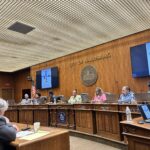
Harrisburg Mayor Eric Papenfuse, flanked by police Commissioner Thomas Carter and fire Chief Brian Enterline, testified today before a joint committee hearing of the state House of Representatives.

Is Harrisburg all that different from other mid-sized cities in Pennsylvania?

Members of the state House of Representatives have eight more session days to say “yes” or “no” by voting on a bill that would let Harrisburg exit Act 47, a state-run oversight program for cash-strapped municipalities.

House bill 2557, which is co-sponsored by state Reps. Greg Rothman and Patty Kim, would let Harrisburg keep the extraordinary taxing privileges it gained under Act 47 and prohibit it from enacting a commuter tax.

The bill would essentially carve out special taxing provisions for the capital city, granting it immunity from the tax limits set out in the Pennsylvania’s Third Class City code.

“Today, you can ensure the future success of the Harrisburg region, if the legislature will continue to work together with the city, our workers, our residents, the business community and state leaders to advance reasonable, common-sense solutions like those offered by HB 2557,” Harrisburg Mayor Eric Papenfuse told a joint hearing of the House finance, local government and urban affairs committees, which convened a hearing on the bill in the state Capitol this morning.

Papenfuse told members that the bill would help restore the city to financial health by allowing it to retain its current local services and earned income taxes, which bring in some $12 million annually.

“House bill 2557 works because it doesn’t ask for anything that the city doesn’t already have,” Papenfuse said.

However, some members were skeptical that Harrisburg deserved unique taxing power.

“When we look at treating one city differently, it brings up concerns, especially since we have had cities leave Act 47 successfully,” said finance committee member Frank Keller, R-Union County.

Some of Keller’s colleagues echoed that sentiment during the two-hour hearing, as they questioned Harrisburg officials about the city’s financial progress since it entered Act 47 in 2010, about $400 million in debt.

The city erased some of that debt by selling the Harrisburg incinerator, leasing its parking assets and transferring control of its water and sewage systems to Capital Region Water. But debt service still siphons off 15 percent of Harrisburg’s revenues every year.

City officials say they can’t balance their budget without the extraordinary taxing power granted by Act 47. Almost half of the city’s land is owned by tax-exempt entities, and some 50,000 commuters enter the city for work each day.

To pay for roads, emergency services and other public goods, the city is forced to squeeze revenue from its 49,000 residents, half of whom live below the poverty line.

That dynamic creates a structural deficit that has plagued Harrisburg for decades, Papenfuse testified this morning.

Given the city’s debt obligations, Rep. William Keller wanted to know why the city’s expenses have grown since Papenfuse took office in 2014.

“We weren’t paying our bills in 2012 and 2013,” Papenfuse said. “When you start paying bills, you increase your spending.”

Papenfuse said he inherited millions of dollars’ worth of unpaid invoices when he started his first term in January 2014. The city’s public works and emergency services departments were also woefully understaffed.

The mayor said the city started filling vacancies when he took office. But as payroll costs grew, bills for outsourced and overtime labor shrank, he said.

Papenfuse was also asked to defend the consecutive years of surpluses that Harrisburg generated under his leadership.

The mayor explained that the city underspent its budget so it could save cash for capital improvements, such as road paving and building repairs.

Harrisburg can’t borrow money to fund those projects because it does not currently have a credit rating, he said.

The city has entered talks with Ambac Insurance Corp., the primary holder of its general obligation debt, about restructuring payments and interest rates. But Papenfuse said those discussions are currently on hold.

“Ambac is looking at the state and wondering if Harrisburg will have long-term financial stability,” Papenfuse said. “We’re essentially stuck in these negotiations until we act on House bill 2557.”

Despite the mayor’s testimony, some lawmakers remained skeptical of Harrisburg’s growing expenses. Rep. Martina White argued that Harrisburg had a higher personnel headcount than larger townships in her Philadelphia-area district.

“I’d urge Harrisburg to take a look around,” White said.

Other committee members encouraged Harrisburg to adopt a Home Rule charter or pursue more PILOT payments from tax-exempt entities. Papenfuse said city officials were exploring both options.

When one lawmaker asked Marita Kelley, Harrisburg’s Act 47 coordinator, if the city’s spending was on the right path, she confirmed that the local officials have taken a “tough approach to manage expenses and keep expenses in check.”

If the legislature does not pass the bill before their session ends next week, Harrisburg must remain in Act 47 under a three-year extension plan. That plan, which will be authored by Kelley and approved by City Council, will likely call for property tax increases beginning in 2020.

Rothman said that property tax increases would drive businesses and homeowners out of the city. He testified that his bill would create a more hospitable environment for economic development while giving taxpayers a break.

In addition to prohibiting a commuter tax, HB 2557 would cut Harrisburg’s local services tax rate by $6 a year, from $156 to $150.

The new LST rate is still far beyond the $52 annual rate allowed under the state tax code. But Rothman’s bill would let Harrisburg keep the $150 rate indefinitely, along with its 2 percent earned income tax (EIT) rate.

Under Rothman’s proposal, Harrisburg would have to submit annual financial reports to the state and undergo a full budget review in five years. The bill also contains a provision to phase out the LST and EIT rates as Harrisburg’s revenue base grows.

Rothman hopes that his bill will encourage more businesses and residents to move into the capital city. As they do, and Harrisburg’s tax revenues increases, any surplus funds will be put into the city’s pension trust.

Once that trust meets 85 percent of its actuarial value, the LST and EIT rates would decrease.

That could take at least 20 years, according estimates provided by Christine Goldbeck, executive director of the House urban affairs committee.

After the hearing, Kim, Rothman’s co-sponsor, said that the bill’s fate was in the hands of House Speaker Mike Turzai. He will decide what legislation comes up for a vote during the House’s eight remaining session days in September and October.

Turzai blocked a similar provision for Harrisburg from coming up for a vote in June. Kim reported today that he has warmed to the idea since then, thanks to pressure from colleagues, city officials and city-funded lobbyists.

If the House approves the bill, it will go on to the Senate, where Kim expects easy passage.

Continue Reading

House bill would prohibit commuter tax, extend current taxing authority for Harrisburg

A state lawmaker has introduced legislation that could be Harrisburg’s ticket out of act 47.

House Bill 2557, sponsored by state Rep. Greg Rothman of the 87th legislative district, would grant Harrisburg the power to levy its current tax rates indefinitely. The city raised its local services tax (LST) and earned income tax (EIT) in 2012 and 2016, respectively, exercising a privilege granted by Act 47, a state-run oversight program for financially distressed municipalities.

Rothman announced the bill in a press release issued late this afternoon.

The tax hikes were meant to be temporary, and would disappear if the city exits Act 47.

But they bring in a combined $12 million for Harrisburg, and local officials say the city can’t function with lower tax rates.

City officials have lobbied state lawmakers for months to allow the city to keep its current taxing authority past 2021, when it must exit Act 47. Rothman’s bill would let it to do just that.

The bill would also prohibit the city from taxing the income of non-resident commuters – a proposal that Harrisburg Mayor Eric Papenfuse floated this summer, amid concern that the city would lose its LST and EIT rates under an Act 47 exit plan.

The mayor’s proposal would have levied a 2 percent income tax on everyone who works in Harrisburg.

Since Harrisburg residents already pay that rate, it would only affect commuters from surrounding municipalities who pay lower taxes to their hometowns. Residents of Susquehanna Township, for instance, who pay a 1 percent income tax, would pay the same amount to the city of Harrisburg.

That proposal wasn’t endorsed by the state Department of Community and Economic Development, which is drafting Harrisburg’s Act 47 exit plan.

Rothman, whose district includes much of Cumberland County, said in a press release that a commuter tax would encourage people to seek jobs outside of the city, thereby limiting economic development in Harrisburg.

“The economy of Harrisburg affects the surrounding suburbs and we should work to ensure that it is healthy for the long term,” said Rothman. “However, we don’t need a commuter tax levied on the workers in Harrisburg and its imposition would be devastating to attracting and maintaining private investment to the city.”

Rothman will testify at a joint public hearing on Act 47 on Tuesday, Sept. 27.

Continue Reading

Former mayoral candidate among 17 seeking seat on Harrisburg City Council

A former city council president and mayoral candidate is one of 17 applicants vying for a seat on Harrisburg City Council.

Gloria Martin-Roberts, who lost last year to incumbent Mayor Eric Papenfuse, has applied to fill a seat formerly held by Cornelius Johnson, who resigned this month to take a new job in Atlanta.

Martin-Roberts served two terms on council, including one as president, before deciding not to seek reelection in 2011. She ran for the 103rd legislative district seat in the state’s House of Representatives in 2012 and lost to state Rep. Patty Kim. Martin-Roberts has also served on Harrisburg’s school board.

She announced her mayoral campaign in November 2016 and received 2,048 votes in the May 2017 Democratic primary. Papenfuse earned 2,663 votes. She also ran a last-minute write-in campaign in the general election.

Martin-Roberts isn’t the only Papenfuse challenger seeking a council seat. Jennie Jenkins, who mounted an unsuccessful mayoral campaign last year, has also submitted an application.

Other hopefuls include Devan Drabik, a former city employee who now works for Visit Hershey-Harrisburg; Airis Smallwood, a musician and daughter of former school board president Jennifer Smallwood; Bill Cluck, an environmental lawyer and local activist who served on the Capital Region Water board when it took over the scandal-plagued Harrisburg Authority; and Joshua Burkholder, a former Democratic congressional candidate who also has previously applied for an open council seat.

Candidates had until noon today to apply for Johnson’s former seat. The Harrisburg city clerk disclosed the full list of applicants this afternoon:

  • Devan Drabik
  • Eric Hicks Sr.
  • Shane Gallagher
  • Chris Yellowdy
  • Danielle L. Bowers
  • Elizabeth P. Hobbs
  • Josiah Yonker
  • Stephen Hickey
  • Damion Scott
  • Joshua F. Barker
  • William J. Cluck
  • Airis Smallwood
  • Gloria Martin-Roberts
  • Lakichia Lee Carrier
  • Joshua Burkholder
  • Jennie Jenkins
  • Aaron N. Holt

City clerk Kirk Petroski said that the city’s Human Resources department will vet all applications starting on Monday. The applicants eligible to serve on council will be invited to an Oct. 3 selection meeting, where each one will be given two minutes to speak before the seven-member body.

Once council members have heard from all applicants, they will nominate candidates to move on to an interview round. A nominee must receive a majority of votes to be appointed to a seat.

The new appointee will chair the Building and Housing Committee and serve through the end of 2019.

Continue Reading

School Beat: Harrisburg police visit city schools to foster positive relations with kids, community.

Harrisburg police today spent time with students at Scott Elementary School as part of the bureau’s community policing program.

It’s back to school season for the Harrisburg Police Bureau.

Under a new partnership with the Harrisburg School District, members of the city’s community policing unit are trying to project a new image of policing and foster positive interactions with Harrisburg’s children.

The Harrisburg police have hosted six events in public schools since the start of the school year in August, according to community policing coordinator Blake Lynch, with more yet to come.

Lynch, a civilian employee, leads the community policing program with Cpl. Josh Hammer, who oversees the unit’s five officers.

They’ve distributed ice cream to more than 3,000 schoolchildren this year, thanks to an in-kind donation from Hershey Creamery. Today, the community policing unit ate lunch with students at Scott Elementary School on Derry Street and gave out ice cream for dessert.

Lynch says it’s one way the department is building positive connections with the city’s youth – a major goal of police Commissioner Thomas Carter.

“We’re doubling down on building connections in the community,” Lynch said. “We want to create more positive interactions with our youngest citizens, which we hope will translate into more connections with parents and our older generations.”

Lynch said that future school programming will have an educational component. He hopes to return to schools so officers can talk to students about gun safety, community service, bullying, drug prevention and other topics.

He would also like to allow parents to participate in school events.

The school partnership dovetails with the city’s other community policing programs, such as the block party barbecues and National Night Out events that the department held over the summer. All of the food, beverages and materials for these free events come as donations from community partners, Lynch said.

“The city hasn’t spent a single dollar on this,” he said.

Though Harrisburg schools will see more police in the coming months, the partnership with the police bureau shouldn’t be confused with a school resource officer (SRO) program, which places full-time uniformed officers in public schools. Harrisburg has not had resource officers since funding for its SRO program evaporated in 2009.

Continue Reading

Harrisburg Police: Crime is down, helicopters are up, and body cameras are on hold until 2019.

Cpl. Josh Hammer demonstrates body camera equipment at a Sept. 2017 press conference. Police officials say that body cameras won’t hit the streets in Harrisburg until 2019.

Aggregate crime rates in Harrisburg are lower than they were at this point last year, according to law enforcement officials.

Capt. Gabriel Olivera credits the slight crime drop to a number of new strategies in the Harrisburg Police Bureau, including a partnership with the Pennsylvania State Police that allows a helicopter to aid Harrisburg police in street crimes missions.

The Harrisburg Police Bureau entered the partnership with PSP last fall under a three-month pilot period. They extended the partnership through 2018, and most recently deployed the helicopter for an hours-long patrol in Uptown Harrisburg on Tuesday night.

The patrols aren’t announced ahead of time, and some Harrisburg residents say they’re weary of the noise, light and perception of surveillance that the aircraft generates.

Olivera acknowledges the public’s concerns but insists that the helicopter is a valuable law enforcement tool.

“One thing we’re tasked with is public safety, and we’re trying to balance that with inconvenience,” Olivera said. “We’re trying to make sure city and citizens are safe by using every tool at our disposal.”

He also dismissed claims that the helicopter was being used for active surveillance. Pilots only aid the Harrisburg police on targeted missions, he said, and don’t rove the sky indiscriminately looking for criminals.

When the helicopter began aiding Harrisburg police last fall, officers said that aerial patrols helped officers apprehend criminals and seize illegal drugs and firearms.

Harrisburg Mayor Eric Papenfuse said recent missions have been similarly effective. Tuesday’s patrol resulted in two guns being pulled from the streets, he said.

Olivera says the helicopter patrols are “one of many” strategies that HPB has deployed in the last year to bring down crime. He declined to say what the other initiatives were.

“I’d would rather not get into details,” Olivera said. “We want to keep criminals guessing.”

He was also hesitant to offer any firm crime statistics, such as rates for property crime versus violent crime, or the magnitude by which crime has dropped since last year.

“Crime is overall lower,” Olivera said. “But I can’t say by how much… We still have a couple months left in this year, and next month things could change.”

The police bureau has encountered one significant setback this year, however, as the deployment of its city-wide police body camera program has been pushed back into 2019.

It’s been one year since police officials held a press conference to announce a body camera pilot program and an intent to equip all officers with the technology in 2018.

The city set aside $80,000 in this year’s budget to purchase equipment and software. Eight officers spent two months trying out prototype equipment, but Olivera said that they didn’t find a single model that suited all the department’s needs.

Before it can purchase any equipment, the department must issue a request for proposal (RFP) to solicit bids from vendors. That process has been slow, Olivera said, since the department is cobbling together its own specifications for recording equipment and software.

“We want to see if we can get everything we want out of the program, [but] it’s taken a lot longer than we thought it would,” Olivera said.

The department has hired a consultant to help it draft an RFP. Once they finalize it, they must send it out to bid and wait 60 days to receive proposals.

Olivera said they entered the consulting contract before Papenfuse enacted a spending freeze, which stopped non-essential spending in all city departments.

Papenfuse said that police are not exempt from the freeze, but he doesn’t expect them to spend any money on cameras until 2019. The freeze could be lifted by then, since Harrisburg will either exit Act 47, the state oversight program for financially distressed municipalities, or adopt a new Act 47 exit plan.

The police are in the process of acquiring three new motorcycles, according to a RFP posted to PennBid, the statewide bidding market place. Papenfuse said that purchase will be covered by a Dauphin County Gaming Grant.

Continue Reading

Harrisburg School District publishes three years of “exemplary” superintendent reviews by mistake.

For the past three years, Harrisburg School Board members have given their superintendent a uniformly perfect report card — or have they?

An administrator admitted today that performance evaluations dating back to 2015, all posted to the district’s website, contained formatting errors that mischaracterized the board’s assessment of Superintendent Sybil Knight-Burney.

Every fall, school board directors evaluate Knight-Burney’s job performance for the past school year. They use a form outlining nine performance standards – including professional leadership, communication, resource management and teamwork — and grade Knight-Burney as exemplary, proficient, needs improvement or unsatisfactory on each one.

Board members each complete their own, individual evaluation for the superintendent. But the district has posted a single evaluation on its website each year since 2016.

The PDF documents had shaded boxes next to the “exemplary” grade on all nine performance categories, and appeared to reflect the consensus of the nine-member board.

Marks on Knight-Burney’s performance reviews indicated “exemplary” job performance by superintendent Sybil Knight-Burney.

But board Secretary Carol Kaufman said today that the documents were never intended to indicate a general ranking for the superintendent. Rather, they were meant to be uploaded as blank template forms to share the board’s ranking methodology, which has been the same for all three years.

The boxes indicating “exemplary” ratings were shaded as the result of a formatting error, Kaufman said.

“They should not look like that at all,” Kaufman said. “That was not the intention. It’s just supposed to be a template so people know what the objectives are.”

However, the “exemplary” evaluations have already been cited in news reports and in social media groups as the board’s official, uniformly favorable evaluation of the superintendent.

Kaufman acknowledged the confusion that the forms could have created. She could not say if the erroneous documents had been viewed by state officials, job seekers or other parties monitoring the district.

An evaluation for the 2017-18 school year, indicating exemplary grades on all nine categories, was uploaded to the district website on Tuesday morning and replaced with a blank form by Wednesday. Kaufman said she switched the documents once another district official brought the error to her attention.

When she learned from a reporter that the 2015-16 and 2016-17 evaluations contained similar errors, she said she would replace them with unmarked forms.

Board Solicitor Samuel Cooper is responsible for providing the evaluation form and giving Kaufman permission to upload them, she said.

He did not respond to requests for comment on this story.

At a board meeting on Monday, Cooper delivered an oral report of Knight-Burney’s 2017-18 evaluation. Three board members rated the superintendent’s overall performance as exemplary, two as proficient, one as needs improvement and two as unsatisfactory.

Kaufman said her record of the vote differed from the tally published by news outlets, including TheBurg: her notes indicate that Knight-Burney got two “needs improvement” grades and one “unsatisfactory.”

Cooper offered similar oral reports in 2016 and 2017. Last year, Knight-Burney received four exemplary ratings, one proficient rating, and two unsatisfactory ratings, according to board meeting minutes. Two board members did not submit evaluations.

In 2016, the superintendent received four exemplary grades, according to meeting minutes. Two members gave her a proficient, and two members said she needed improvement. One new board member was exempt from submitting an evaluation.

The minutes from 2016 also say that the evaluation criteria “and general results” would be posted on the district’s website.

View all of the superintendent evaluations here, including the 2018-2019 review that was replaced with a blank document.

2015-2016 Superintendent Evaluation by Lizzy Hardison on Scribd

2016-2017 Superintendent Evaluation by Lizzy Hardison on Scribd

2017-2018 Superintendent Assessment Report by Lizzy Hardison on Scribd

2017-2018 first evaluation by Lizzy Hardison on Scribd

Continue Reading

Weekend Roundup with Sara Bozich

Happy Weekend!

Kick off the weekend early, and join us this evening at Harvest Seasonal Grill & Wine Bar for some early tastes of this year’s PA National Horse Show! We’ll be revealing the Pink Pony cocktail + treats from Harvest’s kitchen!

Grab a FREE ticket here! 

I tried really hard to get a sitter to have a little wine night tomorrow, but no dice, so it looks like Andy and I will instead break out a few bottles of wine from Tres Bonne Annees past and watch Mad Men (first time, don’t spoil anything).


What are you doing this weekend?

(more…)

Continue Reading

State set to appoint new chief recovery officer for Harrisburg school district

Harrisburg school district administration building

After a year marked by administrative fumbles and tension among board members, the Harrisburg school district soon will get a new state-appointed oversight officer.

The Pennsylvania Department of Education plans to select a new chief recovery officer (CRO) for Harrisburg schools in the next two weeks, according to spokesman Eric Levis. The CRO will oversee the implementation of a new, long-term recovery plan aimed at raising the district’s academic performance and financial health.

The appointment suggests that Harrisburg has, for now, dodged receivership – an arrangement in which a state administrator takes control of the district.

A state-appointed receiver has broader authority than a CRO and assumes many of the powers of the elected school board.

Board directors retain all taxing authority, but the receiver can approve contracts, charter school applications and personnel actions without their input.

Levis said today that receivership “remains an option,” even as PDE appoints a new recovery officer.

The district has been under a financial recovery designation since 2012. State law requires any recovering district to have a CRO, but Harrisburg has operated without one since July, when Audrey Utley retired after three years in the role.

Utley oversaw an overhaul of the district’s five-year recovery plan, which expired in June with 80 percent of its initiatives in place.

State Education Secretary Pedro Rivera is charged with appointing Utley’s replacement. He sought input from state Sen. John DiSanto, Rep. Patty Kim, district Superintendent Sybil Knight-Burney and Harrisburg Mayor Eric Papenfuse while making his decision, Levis said.

When approached by PDE, Papenfuse said he emphasized his belief that the district should be under the control of a receiver.

“Under the power of the law, only a receiver would produce the level of transparency and administrative changes necessary to solve the district’s clear dysfunction,” Papenfuse said. “PDE has chosen to go in another direction, but I do appreciate their seeking my input on behalf of the residents of Harrisburg.”

The district has beat back a steady stream of scandals in the past year, including a grading investigation that led to the reassignment of a high school principal, a hiring mistake that allowed 37 unbudgeted teaching positions to be filled, and criminal charges against an administrator who allegedly embezzled $180,000 from the district.

District administrators drew fresh criticism in August, when they asked 65 teachers that they hired at the wrong salary step to pay back wages.

That request was enough to make Jody Barksdale, president of Harrisburg’s teachers union, consider the merits of receivership – an arrangement she ultimately decided she could not support.

Barksdale has also been critical of the school board this year and once pleaded publicly with board members to act more professionally.

“The way you talk to each other is unacceptable,” Barksdale said at an August meeting. “You guys are the talk of the town, and it makes me embarrassed.”

Friction among board members was on high display this year, as they debated whether to retain or replace Knight-Burney, whose contract expired in June. The nine-member body frequently split on slim margins on decisions related to district personnel.

A vote on Knight-Burney’s new contract devolved into a shouting match between board members at a June meeting, leading President Judd Pittman to issue a public apology the following month.

Three board members have also resigned their seats this year, one amid allegations that he lied about his residence in the city.

This week, the board published its annual superintendent evaluation. Knight-Burney received “exemplary” ratings across nine performance standards, even though three members rated her overall performance “unsatisfactory” or “in need of improvement.”

Knight-Burney will serve in the district for at least three more years. She’ll work closely with the CRO the entire time.

PDE has not disclosed any of the candidates it’s considering for the CRO role. Gene Veno, who served as CRO from 2012 until 2015, inquired about resuming his old position but said he did not receive any response from Rivera.

Kenneth Medina, a former business manager who was demoted and later laid off, also told TheBurg he submitted his name for PDE’s consideration. Medina is currently petitioning the district to get his job in the business office back.

Continue Reading

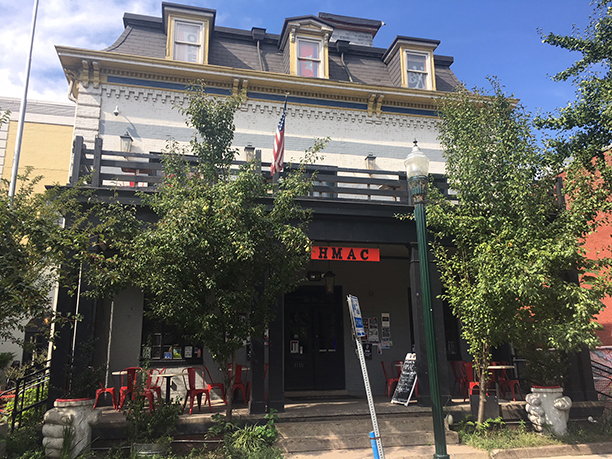
HMAC defends liquor license, business practices in administrative hearing

One month after filing for Chapter 11 bankruptcy, the House of Music Arts and Culture (HMAC) is facing a new challenge: renewing its liquor license.

A hearing held today will help the Pennsylvania Liquor Control Board determine whether or not the midtown Harrisburg bar upheld its end of a conditional licensing agreement (CLA) it entered in 2015.

Among other provisions, the CLA required the bar’s staff to install soundproofing equipment and implement routine security patrols on HMAC’s premises at 1110 N. 3rd St. in Harrisburg.

The terms of a CLA remain attached to a bar’s liquor license until the PLCB decides to expunge them. HMAC last renewed its license in 2017, and it expired in February.

Since 2010, the LCB has cited HMAC 12 times for noise violations. The bar has also been the site of multiple police call outs.

This summer, the bar found itself at the center of a social media firestorm after a woman said she was raped by a man who drugged her on HMAC’s premises.

The police investigated her assault and charged a Harrisburg man with her rape, but their report exonerated HMAC of any responsibility.

HMAC’s owners filed for Chapter 11 bankruptcy one month later, saying they needed to restructure debts as they prepared to sell their business.

Licensing hearings are usually based on concerns stemming from alleged CLA violations. However, the points raised by PLCB attorney Michael Plank today mostly had to do with business practices unrelated to alcohol sales.

Plank spent most of the hearing interrogating HMAC’s money and personnel management.

One witness for PLCB, Mike Banks, said that he was owed $3,000 by HMAC’s managers for services he provided as a sound engineer and open mic host. Banks was eventually compensated, but he said that HMAC’s reputation was “not good” among local entertainment professionals.

“Most of these people have been or are owed money, and most will not work there again,” Banks said.

In remarks to a reporter, HMAC’s lawyer Glenn Parno acknowledged that HMAC had periods of financial distress. But he retracted a claim he made during the hearing that the business was “insolvent,” and said that they could only repay outstanding debts if they retained their liquor license.

Plank also heard testimony from Jody Hoffman, a contractor who is owed $3,000 for work he performed at HMAC in 2016, and from Tessa Bower, a former manager who said she witnessed a pattern of questionable business practices at HMAC in the nine years she worked there.

For example, Bower said that HMAC co-owner John Traynor asked her to not take credit card payments for art sold at HMAC, since the venue could not legally deal art and did not want to keep a paper trail of transactions.

Plank also called three former Harrisburg police officers as witness, all of whom testified about callouts they’d received to the establishment since 2016. One callout resulted in harassment charges against a patron, and another led to the arrest of a performer with an outstanding felony drug warrant. The third did not result in any charges.

Parno objected to each of the reputation testimonies, saying they were irrelevant to the bar’s compliance with its CLA.

Pennsylvania liquor code allows the LCB to consider the reputation of a liquor license applicant when deciding to award a license, as well as the reputation of any stockholders or managers.

But a letter notifying HMAC of today’s hearing did not list its reputation as a factor jeopardizing its license. Parno said that he was not prepared to counter any testimony about the business’s image in the community.

“This is trial by ambush,” Parno said. “This is not fair, and fair notice [of these testimonies] has not been given.”

Hearing examiner Thomas Miller acknowledged that the character and reputation testimonies drew them away from the points in the CLA. But he allowed Plank’s witnesses to testify anyway, saying the LCB could decide how to factor their statements into the license ruling.

Parno called two witnesses who said that HMAC upheld its end of the CLA. Former HMAC manager Justin Leach testified that the bar employed full-time security guards who patrolled the premises during and after the bar’s operating hours, and local architect Bret Peters said that HMAC’s owners went to great lengths to install soundproofing equipment in its performance venues.

Miller adjourned the hearing after more than six hours of testimony. All parties will reconvene at a later date so Traynor and two character witnesses for HMAC can testify.

When the hearing concludes, Miller must compile the findings in a report, which will help PLCB decide to either renew or revoke HMAC’s liquor license.


Continue Reading

Stash, Midtown Dandy teaming up to open downtown Harrisburg shop.

This block of S. 3rd Street in Harrisburg soon will house two vintage clothing retailers.

Two veteran, homegrown retailers are teaming up to open a vintage clothing store in downtown Harrisburg.

Stash Vintage and The Midtown Dandy will operate a joint shop on S. 3rd Street, in the SoMa (South of Market) neighborhood, it was announced today.

“Finding the right space to open our doors was essential to launching our joint venture,” said Andrew Kintzi, owner of The Midtown Dandy. “We’re excited to bring our vision to Harrisburg. SoMa seemed like the ideal spot.”

Kintzi will join Stash Vintage in about 700 square feet of storefront space at 11 S. 3rd St., a building owned by Harristown Enterprises.

The Midtown Dandy, which specializes in secondhand men’s clothing and accessories, has been a regular vendor at the Harrisburg Flea, while Stash has had two previous locations downtown. Both also sell online.

“The new partnership will be a great rebirth for Stash, being that we were initially a collective,” said Anela Bence Selkowitz, owner of Stash Vintage. “And our new location will allow us to create a new voice.”

Brad Jones, CEO of Harristown, said that he expects the store to open later this fall.

“The SoMa neighborhood and its surrounding downtown environment has over 60 newly leased apartments and several wonderful food and beverage establishments,” Jones said. “This new vintage boutique will be a perfect addition to SoMa, which is growing quickly into a destination neighborhood.”

Just yesterday, Jones cuts the ribbon on Harristown’s newest apartment project, The Bogg on Cranberry, which features 12 one- and two-bedroom units at the corner of N. 2nd and Cranberry streets. All the units were pre-leased.

Harristown soon will begin work on renovating two more buildings on the 100-block of Pine Street, adding another 69 apartment units downtown.

Continue Reading