Codes inspectors rule out demolition as repairs begin at Swallow Mansion.

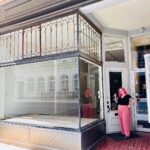
The scene at the Swallow Mansion on Thursday afternoon, where crews were stabilizing an entryway damaged by a partial collapse.

Public safety officials don’t expect to bring a wrecking ball to the historic Swallow Mansion on N. 6th Street, where an entryway partially collapsed on Monday night.

Harrisburg codes administrator Dave Patton said that state preservation laws would likely prevent the demolition of the condemned 19th-century mansion.

Crumbling brick gave way above the property’s Boas Street entrance on Monday, partially exposing the building’s interior on the first and second floors. Patton said that the damage appears to be isolated.

The event spilled brick and wood refuse on to the sidewalk on Boas Street, but was cleared by Thursday afternoon. Crews on-site had also stabilized the doorway with wooden framing.

Patton said the collapse was caused by water infiltration that eroded old brick above the Boas Street entryway. Aside from that area, the mansion is mostly sturdy and salvageable, he said.

“Demolition isn’t something I’d pursue at that property,” he said. “There’s the magnitude of cost, and it would be a huge loss to the area from a historical standpoint.”

The news may come as a relief to adjacent property owners, since Harrisburg’s dense row-home style buildings mean that one collapse can endanger nearby structures.

That’s what happened recently on S. 15th Street, where crews had to demolish five homes in a row after one of them collapsed, Patton said.

The Swallow Mansion sat vacant for decades before it was condemned in 2010. Harrisburg has issued numerous code citations against its owner, Annette Antoun, most recently in October.

Patton said that a person with power of attorney for Antoun, as well as a contractor, visited the property on Wednesday. They obtained a permit to stabilize the collapsed wall from the foundation to its roof on the same day.

In the meantime, Patton expects Antoun’s family to move ahead with repairs.

“This will be a temporary measure, but it will mitigate any public safety threat until [we reach] a final solution,” Patton said.

Civil or criminal misdemeanor charges against Antoun remain an option if she doesn’t tend to the collapse. But according to Patton, Antoun is aged and reportedly incapacitated by a stroke, which complicates the process for pressing charges.

Could it have been prevented?

Patton isn’t just eyeing a permanent solution for the Swallow Mansion – he’s also helping state legislators craft policy that will make it harder for unscrupulous buyers to purchase properties they have no intent of improving.

Reams of research show that blighted, abandoned buildings encourage crime, reduce neighborhood property values and are even associated with depression among nearby residents. Left unchecked, a blighted property can also pose significant public safety risk if it crumbles or catches fire.

That risk is even greater when a building’s demise comes from internal structural failure.

“Nobody can see through the walls and anticipate what’s going to collapse,” Patton said. “It can be solid and suddenly go down, but there’s really no way to tell.”

When a property becomes visibly unsound, the city can issue summary code violation citations to property owners, as it did to Antoun. But it’s easy for property owners to ignore the citations, which have the same legal heft as a parking ticket, Patton said.

Cities also have a narrow ability to pursue civil charges against a property owner. Patton said the Swallow Mansion didn’t meet the criteria for that action.

Now that the mansion has partially collapsed, Harrisburg can press misdemeanor charges if its owners stall their stabilization and clean-up efforts. But, as was the case in the 2015 collapse of a retaining wall at the McFarland Apartments on Mulberry Street, nobody wants to take responsibility for the property damage.

Since Antoun suffered a stroke, her adult sons have reportedly managed her properties in Harrisburg. But the one who reportedly marketed the property to prospective buyers now denies responsibility and ownership.

The Swallow Mansion represents a case in which the owner of a derelict property was local to the city. Just as often, absentee owners live in far-flung locations, Patton said, and buy Harrisburg properties online. They often write off these sales for tax purposes and leave the properties to the elements.

“Municipalities are hobbled by the legislation that’s in place now,” said Patton. “I have owners in Mexico, Indonesia, England, Australia who buy a property for $500 and auction it off. We have to issue new condemnation orders. But before the ink is dry, they’re on the move again.”

Patton is working with a state senator to create greater accountability in real estate transactions. Legislation from Sen. David Argall, R-Berks, would require anyone buying a property at tax sale to take out a bond in the municipality where the property is located.

Adding the bond requirement to the front end of the sale would weed out buyers who aren’t serious about redevelopment, Patton said.

Patton has advocated for a provision that would allow municipalities to waive the bond requirement for nonprofit developers or other vetted parties. But he thinks the bond payment, which would start at $600, is a reasonable price for buyers to pay to show their commitment to a property.

Continue Reading

With new training facility, HU unveils largest e-sports campus in North America

A portion of Harrisburg University’s new e-sports training facility inside Whitaker Center.

Harrisburg University cut the ribbon today on its new e-sports training facility, a practice and competition space that officials say makes HU’s e-sports campus the largest in North America.

The renovated basement space at Whitaker Center in downtown Harrisburg will serve as the official practice home of the HU Storm, the university’s 16-member varsity e-sports team.

It’s the university’s latest investment in its e-sports program, in which student athletes compete in popular video games such as “League of Legends” and “Overwatch.”

The training facility expands the university’s total e-sports campus to more than 175,000 square feet. The campus also includes the Whitaker Center’s two theaters, which can seat more than 700 spectators for live competitions.

The next-largest e-sports facility in North America is in Arlington, Texas, according to Whitaker Center president and CEO Ted Black.

With the competitive gaming industry growing across the globe, university officials and local leaders hope Harrisburg will become the e-sports hub in the northeast.

“With cities like New York, Philadelphia and Washington, D.C., surrounding us, we are a great central location for gamers, fans and e-sports influencers,” said Harrisburg University President Eric Darr.

The HU Storm will use the state-of-the art facility for practice and scrimmage matches. University officials also hope the training space will draw hundreds of spectators and players for large competitions.

Harrisburg University partnered with local companies and e-sports industry leaders to outfit the basement space with cutting-edge equipment. HP Omen contributed 30 gaming computers with 24-inch monitors and graphic cards. Ergonomic gaming chairs will help players stay comfortable and focused.

The focal point of the room is a 17-screen video wall where players can project live-streamed games. The facility is also segmented into competition, practice and teaching spaces.

Chad Smeltz, who moved to Harrisburg from California to lead the university’s e-sports program, said the facility will help his players improve their craft and allow him to attract a strong talent pool.

“Having a space dedicated to practice and learning changes everything,” Smeltz said.

He and Darr are confident that the latest addition to Harrisburg’s e-sports campus will make it a global leader in the billion-dollar e-sports industry.

“We’d stack this facility up against any facility in the world,” Darr said.

Continue Reading

Weekend Roundup with Sara Bozich

Happy Weekend!

It’s looking like a quiet one over here, folks. Steelers game tonight, Market on Saturday, not much in-between.

What are you doing this weekend?

(more…)

Continue Reading

A New North 2nd Street: Residents debate bike lanes, parking and more at public meeting.

Residents discuss how to best use the free space that will be created in the N. 2nd Street two-way traffic conversion, which will reduce the road’s three lanes of traffic to two.

Transportation experts say that a pedestrian who’s struck by a car traveling 40 miles per hour has only a 10 percent chance of survival.

That makes Harrisburg’s N. 2nd Street, where commuter traffic traveling north out of the city clock average speeds of up to 38 miles per hour, a near-certain deathtrap for pedestrians who are involved in a crash.

Speeding vehicles on N. 2nd Street is just one reason that Harrisburg is pursuing a major project to restore much of the three-lane, northbound street to two-way traffic flow. The conversion will also eliminate one of 2nd Street’s traffic lanes north of Forster Street.

Mayor Eric Papenfuse said that he believes that reducing traffic volume and speed on a major road will transform all of Harrisburg. Tonight, more than 100 residents attended a public meeting at St@rtup Harrisburg to learn how it will affect infrastructure and traffic flow across the city.

The $6 million project already has grant funding from Impact Harrisburg and PennDOT. Preliminary plans call for changing traffic flow over a two-mile stretch of 2nd Street north of Forster Street, leaving its three northbound lanes in downtown Harrisburg intact.

As residents learned at the meeting, 2nd Street was originally built as a two-way road. Harrisburg officials converted it to a one-way, three-lane mini-highway in the 1950s to accommodate commuter traffic.

Today, engineers ironing out the technical details of a new, two-way 2nd Street are left with two big questions.

Where will displaced commuter traffic go after the conversion? And, what’s the best use for the extra space that’ll come from eliminating a traffic lane?

Planners and engineers think they know the answer to the first question. They expect much of the evening commuter traffic on 2nd Street to flow north on 3rd Street instead, said Adam Vest, associate engineer at the planning firm Kittelson & Associates.

Other cars will go to 6th and 7th streets.

Overall, engineers expect that 70 percent of traffic between 4 and 5 p.m. on weekdays will be diverted to other roads. About 1,400 cars travel down 2nd Street during rush hour each day.

Outside of those five hours each week, however, the traffic volume on 2nd Street is usually low enough to travel in a single lane northbound lane without much displacement, Vest said.

Mike Hughes, who lives on the 2200 block of N. 2nd Street, wasn’t too worried about displacing commuter traffic.

“Ultimately, commuters are going to have to change routes, but they don’t live here or pay taxes here,” Hughes said.

Like many other residents at tonight’s meeting, Hughes was more concerned about reducing vehicle speeds along 2nd Street.

Traffic study data show that vehicle speeds on N. 2nd Street increase as cars travel north out of the city. Cars approaching Verbeke Street travel an average of 33 miles per hour – already well over the 25-mile per hour speed limit. That speed rises to 35 miles per hour as cars approach Maclay Street and hits 38 miles per hour just south of Schuykill Street.

Over the course of the two-week study, 93 percent of drivers exceeded the 25-mile per hour speed limit, Vest said.

Vehicle crashes are relatively rare on 2nd Street, according to PennDOT data. But an absence of crashes doesn’t guarantee safety for drivers, cyclists or pedestrians.

It also makes the street less comfortable, especially to those who don’t travel by car, Vest said.

“With those speeds, nobody wants to be on 2nd St,” he said. “We’re trying to make a street people want to be on.”

Which brings up the next lingering question: What to do with the lane of traffic that will be eliminated in the two-way conversion.

During an hour-long breakout session tonight, residents debated the merits of bike lanes, angled parking, traffic circles and sidewalk expansions – all options on the table for a two-way 2nd Street.

Trimicka Crump-Joseph runs an after-school theater program for youth at 2nd and Reily streets. She said that vehicle speeds endanger children walking or being dropped off at class.

“I need traffic to slow down because right now, I’m only zoned for 10 children,” Crump-Joseph said. “I could have more, but want it to be safe for kids to walk or get dropped off.”

Crump-Joseph said that replacing the middle traffic lane with a landscaped median would be an unobtrusive, aesthetically pleasing solution.

Steve Brawley, who lives on the 1700-block of N. 2nd Street, feared that the city couldn’t afford to maintain landscaped medians. He and other residents urged the city to use the extra space to create angled parking, which he said would increase the parking capacity along N. 2nd Street.

But that’s not always the case with angled parking, according to Vest, who said the conversion would generate just one or two additional parking spots per block.

What’s more, angled spots are most commonly used in retail zones where there’s high turnover of vehicles, he said.

Residents were split on the question of bike lanes, which could be installed along one or both lanes of two-way traffic.

The consensus among the half-dozen residents who spoke publicly at the end of the meeting was that 2nd Street would be too heavily trafficked to accommodate cyclists. Others supported a single, protected bike lane traveling north, to complement the southbound bike lane on Front Street.

3rd Street resident Chloe Bohm wanted the city to use the conversion project as a chance to address other traffic hazards across the city. Bohm said that delivery trucks frequently stop in traffic lanes on 2nd Street, forcing other drivers to flow around them.

She wanted to know if the city would install loading zones on 2nd Street to accommodate trucks unloading at restaurants and businesses.

Bohm also wanted improved visibility for cars approaching 2nd Street from cross streets. Street parking currently impedes visibility for cars crossing 2nd or turning into its traffic lanes, she said.

City Engineer Wayne Martin said that project managers expected 50 or so residents to attend tonight’s meeting. He and Papenfuse were both pleased with the final turnout, which was more than double that number.

Planners and engineers will use the data collected tonight to inform their traffic plan for 2nd Street. They plan to hold a second public meeting in the spring and solicit input via an online survey before recommendations are finalized.

Continue Reading

Turnout for midterm election strong in Harrisburg, poll workers say.

In the final hours of a drizzly Election Day 2018, officials at polling places across Harrisburg all agreed on one thing.

Voter turnout was far higher than that of the usual midterm election.

In the hour before polls closed at 8 p.m, officials at six polling places in Midtown, Uptown, Allison Hill and South Harrisburg reported preliminary turnout rates ranging from 40 to 80 percent.

Analysts projected historically high turnout for the 2018 midterms, and anecdotal reports from across the country on Tuesday suggest they were right. But strong turnout is significant in Harrisburg, where precincts log some of the lowest turnout rates in Dauphin County.

“It’s been great,” said Wanda Santiago, who has served as election judge for 30 years at the 2nd Ward, 1st precinct poll at First Church of the Brethren on Hummel Street, in Harrisburg’s South Alison Hill neighborhood. “We had 56 voters here at the primary.”

By 7:30 p.m., 240 out of 580 registered voters – almost 40 percent — had signed in at Santiago’s polling place.

Voters in Harrisburg cast ballots in gubernatorial, state legislature and congressional races. Democratic candidates had decisive leads in most races going into the election.

But in the race for Pennsylvania’s newly configured 10th congressional district seat, incumbent Scott Perry found himself in a dead heat for the first time in his 10-year career, thanks to statewide congressional redistricting.

Perry ended his campaign in a statistical tie with Democratic challenger George Scott. Results on Tuesday night gave Perry a small but decisive victory.

Political observers said that redistricting helped energize local voters, but they attributed much of the voter enthusiasm to displeasure with President Donald Trump’s administration.

“This election is a referendum on Trump,” said Jesse Gantt, a school board director in Susquehanna Township. “We’ve seen a lot of energy from political groups and people who feel triggered by Trump, and it helps that redistricting provided an opportunity to pick up a few additional seats.”

Gantt’s assessment came from conversations with thousands of voters he met while canvassing for Democratic candidates in Dauphin and Cumberland counties. More than anything, Gantt said, voters said they wanted civility to return to politics. And they planned to use their midterm votes to send a message to the Trump administration.

He joined a group of more than 60 people at the House of Music, Arts & Culture (HMAC) on Tuesday night, where they watched election returns on CNN and cheered for Democratic victories.

Other voters there agreed that Trump administration policies and rhetoric, rather than newly competitive congressional races, motivated their trip to the polls.

“I don’t usually vote in midterms, but I’ve been so surprised and alarmed by what’s happened since Trump became president,” said Jeremy Brunfield.

His friend, Michael D’Ambrosio, likewise called his vote “a protest of what we’ve been seeing” from Washington, D.C.

Both men said they’ve noticed a larger focus on voter turnout this election, in the form of persistent texts and robocalls and in-person voting reminders from friends and co-workers.

At Harrisburg’s 1st Ward polling station in Shipoke, a longtime election official said the 2018 turnout exceeded that of the 2016 presidential election.

“It’s absolutely, considerably higher than the usual midterm or general election,” said Karen Laconia, a 20-year election judge.

Rich Campbell, an election judge at the 5th Ward polling place on Green and Verbeke streets, attributed the high turnout, in part, to young voters.

“We’ve had millennials in all colors, shapes and sizes in here today,” Campbell said.

At the 11th Ward polling place at 3rd and Kelker streets, poll workers had counted 633 out of roughly 1,200 registered voters by 7 p.m. At the Wesley AME Zion Church in Camp Curtin, almost 500 out of 1,200 eligible voters from the 10th Ward’s 2nd precinct had already cast ballots.

Officials at both locations said with confidence that turnout was higher than in past election cycles.

Continue Reading

Historic mansion in Midtown Harrisburg suffers partial collapse.

The former Curtis Funeral Home at 1000 N. 6th Street on Tuesday afternoon.

A condemned building in Harrisburg’s Old Fox Ridge neighborhood partially collapsed on Monday night, but city officials said there is no immediate threat to public safety.

A brick archway at the former Curtis Funeral Home on N. 6th and Boas streets caved in after months of gradual demise, according to witnesses. The event exposed parts of the building’s interior and spilled rubble on to a sidewalk outside.

The area outside the property was secured with caution tape and sawhorses by Tuesday afternoon. Harrisburg Mayor Eric Papenfuse said there were no reports of injuries.

Papenfuse said that barriers around the property were extended this afternoon,  but the city does not believe there is imminent danger of further collapse.

Codes administrator Dave Patton said that extensive water infiltration appears to have eroded the brick on the collapsed archway. But he believes the damage is isolated, and said the rest of the structure appeared sound during site visits today.

Boas Street resident Ted Hanson, who has been monitoring the property for months, said he wasn’t surprised when the wall finally gave way on Monday night.

“Gravity is gravity,” Hanson said. “And things fall down when they’re not cared for.”

Hanson laid blame for the derelict property with its owner, Annette Antoun, publisher of the Paxton Herald newspaper. Antoun purchased the circa-1896 building from the Historic Harrisburg Association in the late 1990s.

Under former Mayor Steve Reed, the property was flagged as a potential site for an African American history museum. But the neglected building was condemned in 2010, and Antoun was cited for codes violations as recently as October.

Antoun suffered a stroke earlier this year, leaving her family in charge of her affairs.

Her son, Larry Antoun, said that a structural engineer came to his mother’s property in recent weeks to assess water damage inside the building.

But he was not aware of the wall collapse when a Burg reporter contacted him on Tuesday. When he realized the extent of the damage, Antoun insisted he was not responsible for the property’s maintenance.

“I’m not in charge of this,” Antoun said after viewing pictures of wall collapse. “My opinion is an opinion, but don’t quote me as the owner.”

Antoun is correct that his mother remains the legal owner of the building. But multiple sources report that Annette Antoun was incapacitated by her stroke and that her sons have handled her estate.

Matt Long, a property developer who is trying to buy the historic funeral home and its adjacent parcel, said Larry Antoun showed him the property and offered to sell it to him for $300,000.

“When I called Annette’s to [counter]offer, I was referred back to Larry by his other brother,” Long said.

When asked about his role in selling the building, Larry Antoun reiterated that his mother was its owner.

Patton said that one of Antoun’s sons, who has power of attorney for her affairs, is scheduled to visit the property with an engineer tomorrow. Once they determine a plan for securing the building, the city will decide whether or not to press charges for negligence or public nuisance.

“Any codes office has limited authority to fight blight,” Patton said. “But if something extreme occurs we can go the misdemeanor route.”

Long was also not aware of the wall collapse until Tuesday afternoon. He said he’ll have to assess the damage this afternoon, but says he still wants to buy the property if it appears salvageable.

After restoring the foundation and interior load-bearing walls, Long hopes to turn the building into apartments. He expected the renovation to cost $400,000 before the recent collapse.

Long is also in the midst of buying the historic Jackson Hotel property, just doors down from the Curtis Funeral Home.

The property at 1000 N. 6th Street was built in 1896 to house clergy from the nearby Ridge Avenue Methodist Church. Most notable among them was Reverand Silas Swallow, a leader in the Prohibition Party. The so-called Swallow Mansion later became the Curtis Funeral Home, one of many African American-owned businesses on the block, according to Hanson.

Once home to a bustling African American business and entertainment district, much of the 1000 block of N. 6th Street fell into disrepair during the post-War “white flight” to the suburbs.

The block was redlined by lending agencies in the mid-20th century, and two of its buildings have been demolished in the last two decades, including a historic AME church that was gutted by a fire.

Tuesday, Nov. 6: This article was updated to include comments from codes administrator Dave Patton.
Wednesday, Nov. 7: An earlier version of this article incorrectly stated that 1000 N. 6th street was built as a private residence; rather, it was built by a church as a home for its clergy.

Continue Reading

Burg Review: Buckle in for a wild, fun ride at Gamut’s “Pericles”

“Pericles: Prince of Tyre,” a new Gamut production that opened Saturday night, is an emotional rollercoaster that portrays the eponymous prince’s successes and sufferings, yielding a very enjoyable night at the theater.

Audiences should expect to feel nearly as wind-whipped as the characters, whose lives take thrilling and unsuspecting turns, leaving one guessing how it all will end.

Luckily for our hero, Pericles, a miracle is never too far from his reach, as long as he doesn’t become shipwrecked first. The show itself feels as if one is taking a trip to faraway lands, yet contains relatable themes. It is fitting that the time in which the play was written mirrors an emotionally turbulent time of births and deaths in Shakespeare’s own family life.

In the play, directed by Gamut veteran Thomas Weaver, a rather small cast tells one big story spanning many years and different locations. Actor Matt Romain is an expressive, passionate Prince Pericles, and the 11 other cast members switch between garments, personalities and accents as they take on changing roles. As the story unravels, the mesmerizing costume patterns onstage are as enchanting as the characters themselves.

The sound effects and Rachita Nambiar’s innovative choreography are impressive, becoming principal elements in this fresh take on Shakespeare’s tale. From the moment the show begins, the audience is plunged into darkness. The opening lighting and sound sequence stirs up feelings of danger and intrigue, which carry through the entire play. Then, we see scattered suitcases and dazed characters strewn across the stage, reminiscent of one of my favorite television shows, “Lost.”

The sense of sea travel from city to city is flawlessly executed on the intimate stage. Blue tapestries in constant motion embody swelling ocean waves. The audience feels the breeze as the tapestries dance, and as I breathed in, I could almost smell the salty sea air.

Through exciting moments of jousting to scandalous secrets, a bit of kidnapping, and some fantastic dancing, “Pericles: Prince of Tyre” is ultimately a story of love and compassion, one with a lot of heart. Despite its serious moments, which are central to the plot, the production ultimately is a fun escape, and I left the theater feeling lighter than when I arrived.

William Shakespeare’s “Pericles: Prince of Tyre” runs through Nov. 25 at Gamut Theatre, 15 N. 4th St., Harrisburg. For more information and tickets, call 717-238-4111 or visit www.gamuttheatre.org.

Continue Reading

Get Out the Vote: Joe Biden campaigns for congressional hopeful George Scott in Harrisburg.

Joe Biden, center, appeared with Gov. Tom Wolf and Democratic congressional candidate George Scott at the Pennsylvania Farm Show Complex on Sunday afternoon.

Former Vice President Joe Biden stumped for congressional candidate George Scott at the Farm Show Complex in Harrisburg on Sunday, where he and Democratic politicians from across the state tried to drum up voter turnout just two days before the midterm elections.

In a 20-minute speech, the Scranton native cast the race in Pennsylvania’s 10th congressional district as a referendum on national politics, including threats to the Affordable Care Act and the rise of nationalism from the right.

“The character of our nation is on the ballot this Tuesday,” Biden said. “We have to reset the moral compass of this nation, and choose hope over fears, unity over division, and truth over lies.”

Biden says that a Democratic takeover of the House of Representatives will be key to preserving Social Security and Medicare, which he fears will be on the chopping block in the next budget cycle.

Scott is campaigning to unseat Republican incumbent Scott Perry and represent Pennsylvania’s newly redrawn 10th district in Congress.

If he succeeds, he’ll be Harrisburg’s first Democratic member of Congress since 2011, when redistricting efforts by a Republican-controlled legislature took the city out of Rep. Tim Holden’s district and split it between two districts controlled by Republicans.

This year’s race is the first one under Pennsylvania’s new congressional map, which was redrawn this year after the State Supreme Court ruled that the 2011 districts were gerrymandered to favor Republicans.

The new map, which was unveiled in February, has led to more energetic and highly contested races across the state. As many as seven districts across in Pennsylvania could flip, according to political observers.

Pennsylvania’s 10th district is one of them. Perry was reelected by landslide margins in his last three re-election bids, but recent polls put Scott and Perry in a statistical tie.

“At the beginning of this race, few people thought we could win,” Scott said. “That has changed.”

State Rep. Patty Kim, who is up for re-election on Tuesday, also recognized the role of the new map in reenergizing Pennsylvania’s congressional races. She was one of eight Democrats who preceded Biden to the stage during today’s two-hour rally.

Gov. Tom Wolf and his running mate, John Fetterman, who are favored to beat their Republican opponents on Tuesday, also gave remarks before Scott himself took the stage.

A Lutheran minister who completed a 20-year career in the U.S. Army, Scott took a leave from his congregation in East Berlin, Pa., to run for Congress on a staunch Democratic platform.

Scott does not have political experience, but his opponent’s voting record has given him plenty of fodder for the campaign trail.

Perry, who has one of the most conservative voting records in Congress, supports most policy proposals from the Trump administration. He’s voted to repeal the Affordable Care Act, supports building a wall along the U.S.-Mexico border, and opposes federal minimum wage hikes.

Scott has called out Perry’s vote against the ACA on the campaign trail, casting it as a vote to repeal protections for patients with pre-existing conditions. Perry has since come out in support of legislation to preserve the pre-existing conditions mandate.

Polls across Harrisburg open at 7 a.m. on Tuesday and close at 8 p.m. Voters can find their polling places here.

Continue Reading

Shelter from the Storm: New pavilion at Italian Lake Park officially opens

Harrisburg Mayor Eric Papenfuse cut the ribbon today to officially open the new pavilion at Italian Lake Park.

Last summer, inclement weather forced the cancellation of numerous outdoor concerts at Italian Lake.

City officials and local activists expect a better outcome next year, as today they unveiled a new pavilion that shields the park’s stage from the elements.

“This is a tremendous improvement to the value of Italian Lake,” said Jeb Stuart, a board member of the Harrisburg Parks Foundation. “Now, we’ll be able to make more events happen here.”

The foundation was one of several groups to contribute money for the $36,800 project. First National Bank (FNB) donated the bulk, with a $25,000 contribution. The foundation, the city and a group of business people led by activist Mike Trephan filled in the remaining funding gap.

Kennett Square-based Recreation Resource USA built the pavilion, which was completed last month.

The 90-year-old, 9.5-acre manicured park in Uptown Harrisburg has experienced something of a renaissance in recent years.

Several years ago, the ornate fountains were restored, and the community group Friends of Italian Lake introduced several swans into the lake during the warm weather. In 2015, Harrisburg Young Professionals spearheaded a renewed summer concert series, which had been suspended for several years after Harrisburg entered its financial crisis.

At the ribbon-cutting today, Trephan said that the idea for a pavilion took root two years ago after the U.S. Marine Corps Band (“The President’s Own”) had agreed to play at the park, but cancelled after learning there was no shelter on the stage, which is a requirement for them to perform. Therefore, he began to tap into his network of business people to raise money for the project.

“It’s an honor to be part of what the city has done for the last seven years,” he said. “But we know that the city doesn’t have the funds to do everything that it wants to do.”

Community activist Peggy Grove said that Friends of Italian Lake would like to raise another $5,000 to finish the project, which would include an overhead fan, an improved sound system and the refinishing of the concrete stage.

“I’m just so glad that this pavilion has been built,” she said. “Now, people can perform despite the rain.”

Mayor Eric Papenfuse said that the city would like to see additional improvements to the park, such as the rehabilitation of the bench seating and the restoration and reopening of the restrooms.

“This is just the beginning of what we hope will be a greater upgrade of the park,” he said.

Papenfuse also praised the cooperation of so many groups that were part of raising money for the pavilion project.

“What is exciting is that it represents the best of public/private partnerships,” he said.

Continue Reading

Harrisburg accepting applications for Youth Commission

Are you a young person (or know one) who cares about Harrisburg and issues affecting the city’s youth?

Then consider applying for the Harrisburg Youth Commission.

The Youth Commission will advise local government officials on matters relating to city youth and offer recommendations to resolve issues.

To apply, you must be between 11 and 18 years old, a city resident and a current student.

You can find applications and all requirements here, in PDF and Word formats. The deadline is Dec. 14. Best of luck!

Youth Commission App

Youth Commission Application


Continue Reading