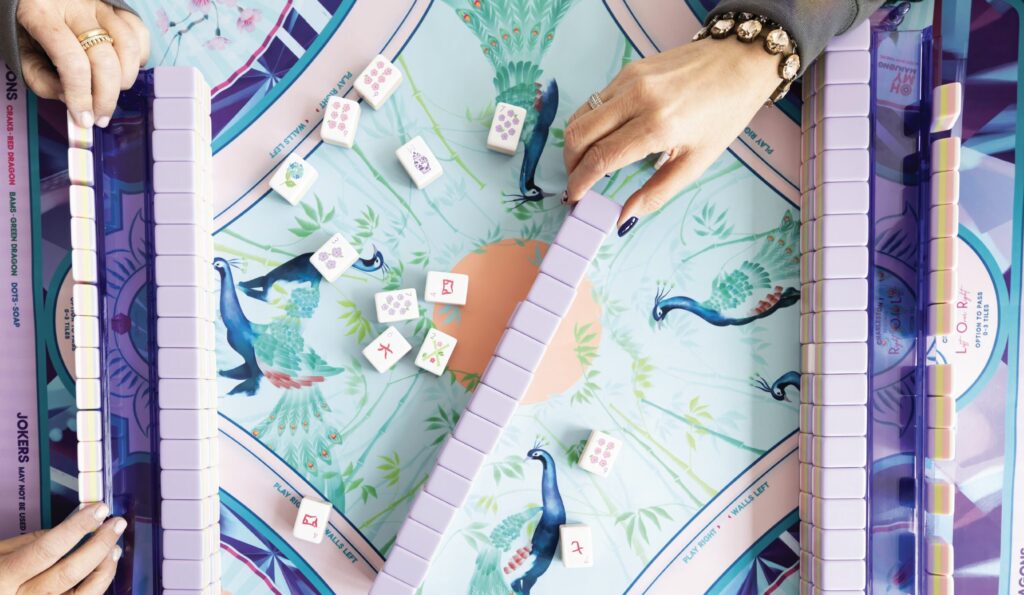
Tile Wild: Competition, camaraderie propel mah jongg to new popularity

“I have mah jongg.”

Susan Wennerstrom is matter of fact about announcing a win.

“It is flower, flower, flower, flower, dragon, dragon, dragon, NEWS”—that’s the North, South, East and West winds—“and dragon, dragon, dragon,” she explained, of her combination of tiles aligned with a National Mah Jongg League official hand.

In NMJL American mah jongg, there are 55 possible hands, compiled by—well, we won’t get into the mah jongg rules. It’s a relatively straightforward tile game of teaming suits and patterns but, as in baseball, there are exceptions to every rule.

And that might explain its surge in popularity. Players say, first, that they enjoy the camaraderie and socializing (thank you, pandemic). But second, they love the intrigue and the mental challenge presented by a game staked on strategy, quick thinking and luck.


Coolest People

Is it rummy? Yes and no. Is it poker? Yes and no.

Mah jongg originated in China. That much we know, but otherwise, it either has origins in royalty, or the military, or ordinary folks playing a table game, substituting cards with tiles.

A staple of Asian, Southern and Jewish gatherings for decades, mah jongg first gained traction in the U.S. in the early 20th century.

Today, it seems to be everywhere. Harrisburg-area players—mostly but not exclusively women—include a foursome at the Camp Hill borough community room on a brisk Tuesday morning. The players, not rookies but still learning, lauded the friendships and connections they were forming.

“For me, it’s the people,” said Mary Soderberg, who was fascinated by mah jongg-playing Chinese women when she lived in the Philippines. “I came here the first time and thought, ‘This is it.’”

Danielle Baumgardner leads the Camp Hill group. She and her husband discovered mah jongg last year. They each played two seats—a great way to learn strategy, she said—and founded the 717 Mahj Circle to teach and play. When they hang a mah jongg flag outside their Camp Hill home, neighbors know that the game is on.

“When you’re playing this game, your mind is nowhere else,” said Baumgardner, a new mom.

Comparisons to rummy come up often, but assiduous rummy players can be kneecapped by mah jongg’s ban on mixing suits within number groupings, said Baumgardner.

“It’s going into the fresh mindset,” said player Robin Jones. “It’s a lot of strategy. For every rule, there’s a caveat. You have to be open-minded to accepting this new way of envisioning the board.”

And, she added, “We’ve met the coolest people.”


Luck & Skill

Mah jongg engages the senses. The clack of the tiles and their cool feel in the hand. The designs as basic as red and black Chinese characters or as ornate as flowers, dragons and bamboo in bright colors. There’s even the satisfaction of saying “bam” and “crak”—mah jongg shorthand for the bamboo and numbered suits—when discarding a tile.

The National Mah Jongg League, founded in 1937 to standardize the rules, is one way to start playing American mah jongg. Every spring, they issue new combinations for reaching mah jongg.

As with other games blending luck and skill, learning strategy takes time.

“That’s a really big moment in your development, when you start thinking defensively,” said Baumgardner.

The game is popular in the South, and Katy Krevsky’s mother was a Florida snowbird who brought the game back to Harrisburg. That was 26 years ago. Krevsky and her childhood friend, Meg Makuch, have been playing ever since.

They launched their teaching and playing group, the Mah Jongg Besties, when they noticed the buzz around mah jongg. They donate the proceeds to Nouri’s Place, the nonprofit striving to create a space that supports socialization and resources for people of all abilities and their families.

“We volunteer for all of the events that they have, whether it’s a golf outing or something happening on World Down Syndrome Day at Ever Grain Brewing, and it felt natural that we would give back in this way and make it really fun,” said Krevsky, mother of a daughter with Down Syndrome. “It’s great for the community and great for individuals who are coming together and forming friendships.”

Social media is positioning mah jongg as a game for all generations and not just retirees, said Makuch.

“It’s becoming cool again, and there’s the aesthetic,” she said over Krevsky’s vibrant pink and purple set, laid out on a Nour coffee shop table. “There’s this beautiful set. It’s like an alternative to book club. It’s just an excuse for women to get together, forming friendships, and there are the benefits for memory and focus. We’ve heard people saying they’re doing this to help fight off Alzheimer’s.”

Added Krevsky, “It’s like a three-hour time of our week when my phone isn’t out, and I just have a break. It’s nice to take a step away and be present in what you’re doing.”

Not that competition doesn’t matter, added Makuch. “It’s fun to win at something. You get the surge of adrenaline if you know you’re about to win and you’re one tile away.”

Oh, and mah jongg? Mahjong? Mahjongg? The Mah Jongg Besties adhere to tradition, said Krevsky, “but honestly, we call it ‘mahj.’” (For the record, the Associated Press Stylebook doesn’t specify, so TheBurg chose the National Mah Jongg League spelling.)

The pair checked off a bucket-list item when they headed to New York last summer, summoning the courage to play in the famous Bryant Park sessions.

“Talk about meeting people,” said Krevsky.

“Before the game started, there was music, a Broadway review,” said Makuch. “We met people from everywhere.”


In Play

When Elizabeth Kaminer lived in San Francisco, she could almost hear the clicking of mah jongg tiles in Amy Tan novels and thought, “I need to learn this game.”

Certified to teach by Oh My Mahjong, Kaminer taught in Florida and New York before continuing on her return to Pennsylvania. On a Monday morning in the classroom studio of Half Moon Handwerks, the Camp Hill quilting shop, she guides her students in discarding, accepting, and “exposing,” or showing, tile groupings to the table.

“9 bam,” a player will say, discarding a 9 tile in the bamboo suit. “North,” the next one says, discarding one of the four winds. Players who might want a discarded tile can ask to pause the play before deciding, but once it’s officially discarded, that tile is out of circulation.

“The nice thing about playing mah jongg versus other games is that you’re not responsible for anybody else’s happiness,” Kaminer said. “If you have a good day, good for you. If you have a bad day, even better, because I may have a chance to beat you.”

Half Moon Handwerks owner Debra Bender opens her sewing classroom to Kaminer’s mah jongg lessons because “quilters and mah jongg sort of go together.”

“I wanted that fellowship, that camaraderie,” she said. “Like Elizabeth said, you’re not responsible for anyone else, but you need that connection. We get so caught up in deadlines and everything else that we don’t take time for ourselves.”

Amid the clacking of tiles, Susan Wennerstrom called mah jongg “a nice way to spend time with other people and do something that’s good for your brain.”

Her tablemate, Bridget Brown, said, “You have to think in multiple directions, and for me, that’s exactly what I need.”

Norine Haertsch played 20 years ago, when she lived in Florida, and got back into the game when she found Kaminer’s classes.

“I get lost in it,” she said. “It’s one game I can enjoy.”

For Kaminer, it “all boils down to community.”

“We just want to be together and have something to do,” she said. “They figured out how good it is for your brain because it’s memory, it’s strategy, and it’s fun and social, unlike COVID, when everybody was sitting at home by themselves.”

Printing the rules of mah jongg would “take up the whole TheBurg magazine,” said Makuch, but Krevsky emphasized that the rules and endless learning are half the fun.

“That’s the challenge,” she said. “It’s the structure. Of course, it’s about getting together with your girlfriends, but there’s something to be said about being involved in a game or a sport or an event or a hobby that excites you to play and that also includes all the rules and just the fun of actually playing, in addition to the fact that I get to see my girlfriends once a week.”

Where to Mah Jongg

Check out the following local groups for lessons and open play:

Mah Jongg Besties, Facebook and Instagram, themahjonggbesties

The Mah Jongg Club PA, themahjonggclubpa.com, Instagram, themahjonggclubpa

The 717 Mahj Circle, Facebook and Instagram, the717mahjcircle


If you like what we do, please support our work. Become a Friend of TheBurg!          

Continue Reading

Beyond the Stage: Live music venues act as an engine for the area’s economy

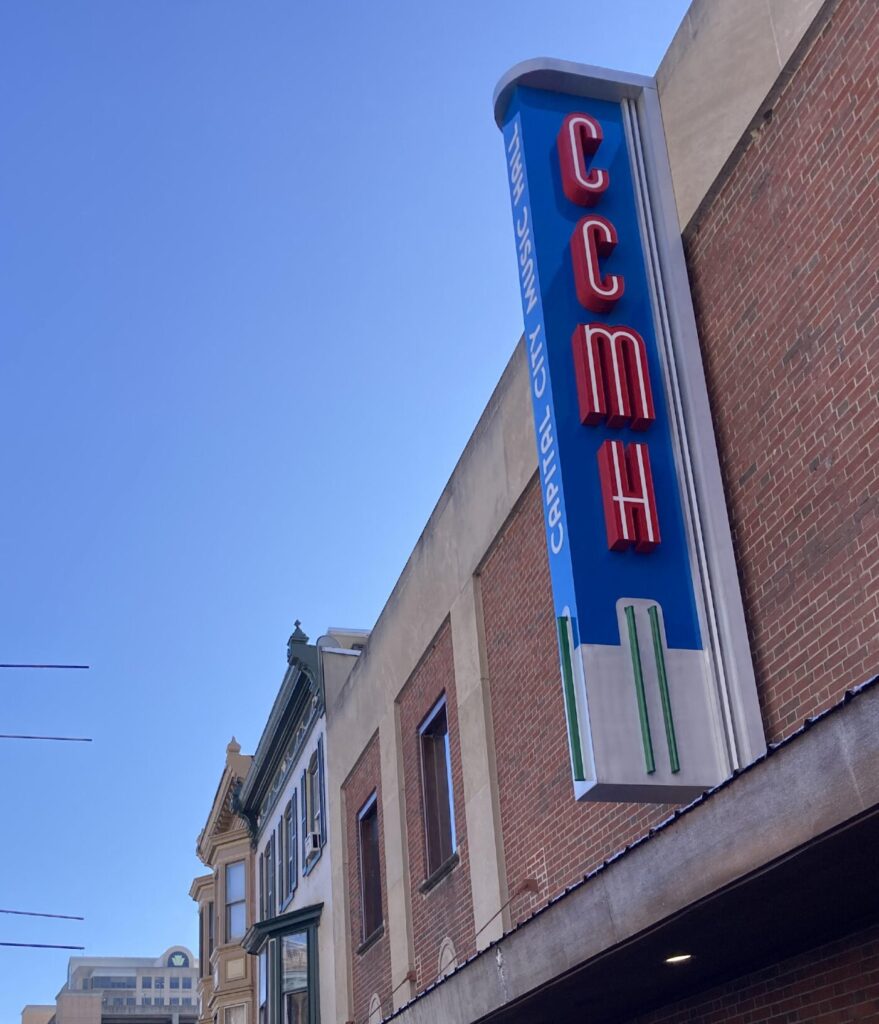
Capital City Music Hall

On an otherwise slow-looking Tuesday in downtown Harrisburg, a group of stagehands darted around inside Capital City Music Hall, laying the groundwork for that night’s big show.

“You have maybe 20 people down here all setting up all together,” explained the venue’s Head of Operations Michael McPhillips. “This is a staff of six loaders, a stage manager, a production manager, three sound guys—and that is just our crew.”

There’s an additional team of more than 26 people on the band’s end unboxing sound and stage equipment, complete with their own DJ decks, light columns, fog machines and video wall.

“In between November and February, you’d see something like this probably twice, three times a month. You get into April, May, June. You’re gonna see this four times a week,” McPhillips said.

The venue’s owner, Justin Browning, (also the owner of downtown’s Nocturnal, Sawyer’s and J.B. Lovedraft’s) opened Capital City in October.

The venue is still figuring out its client demographics, he said. Located on N. 2nd Street, Capital City has the benefit of downtown foot traffic—but he estimated as many as 70% of patrons for the roughly 1,000-person space’s live shows were coming from outside the state.

He listed a few: Maryland and Delaware. Virginia and West Virginia. Ohio. New York. New Jersey. Washington, D.C.

“The goal is definitely to have people come for like a day or two, not just for the show, and leave the next day,” Browning said.

It’s the type of goal that is adding major dollars to Harrisburg’s economy. In fact, long before Capital City Music Hall opened its doors, a national trade group was poring over the local industry’s data.

What the National Independent Venue Association came up with, according to a report released earlier this year, was that Harrisburg’s small, live entertainment venues triggered roughly $14.5 million in “off-site” spending for the region in 2024.

“That’s a pretty large impact on the surrounding area,” said Tyler Davis, venue manager at Harrisburg’s XL Live, which commissioned the report.

It found that people coming into Harrisburg for shows also spent roughly $12.2 million on lodging, $1.3 million on food and drink at restaurants, and an additional $1 million on shopping, transportation and other recreation.

Davis said that the venue asked roughly 50 live entertainment hosts across the region—including JB Lovedraft’s, Harrisburg University’s former Riverfront Concert Series, the Farm Show, the Zembo Shrine and more—to contribute data for the 2024 analysis.

“We all played a part in this,” Davis said.

Overall, it estimated $74.1 million in total economic output.

Tres Hermanos manager Eduardo Ortiz

Behind the Numbers

“A lot of it didn’t surprise me,” said Davis of the report. “Just because I look at a lot of it.”

A pre-show meal nearby. Drinks and snacks during the show. A hotel to crash at afterward. A little breakfast the next morning.

“Maybe get half a tank of gas,” Davis added, “And the next thing you know, they’re spending not just $25 to $30 on a concert ticket.”

While he now manages the venue, Davis has been watching music fans spend their money for years—starting in his first role as the kitchen counter person.

“Ringing in food orders,” he said.

No small feat at XL Live, which was originally, aptly named, Club XL—the venue boasts a dance floor for up to 1,200, one of the largest stages in Harrisburg, a bar and concessions area and an upstairs VIP lounge.

“I only had experience in this industry in that I was in a local band for 10 plus years,” Davis said. “I had never worked out of a music venue. I had never worked at a bar even. I started working here because I just love music.”

Promotions followed—he cooked, worked security, ran security and then became assistant manager before assuming his current role in 2021.

When he looks at XL’s sales on Ticketmaster, he said it’s easy to figure that these out-of-town visitors will be stopping in other places as well. He did some quick math.

In the last two years, XL Live has sold more than 178,000 tickets. Knowing that about 60% of XL’s ticket sales come from outside the county, Davis said, one could estimate about 100,000 of these concertgoers are getting a hotel.

“That’s just my numbers,” he said, noting there’s an 11% lodging tax on top of room rates (6% for state, 5% for county). “That’s not including HMAC’s hotel numbers and JB Lovedraft’s hotel numbers or the Farm Show. It’s not including any of that.”

Matthew Little, sales manager at the Crowne Plaza Harrisburg, confirmed that the area’s music venues and festivals are bringing additional customers the hotel’s way.

“We do see an increase in our room overnight accommodations,” Little said.

Eduardo Ortiz, manager at Tres Hermanos located near XL Live, meanwhile corroborated that the restaurant sees more patrons on show nights.

“Sometimes, it gets packed in here,” he said, to the point where there’s a short wait for a table.

“It’s good for us, and we love meeting new people and having people find out about us,” Ortiz said.

Stock’s on 2nd bar manager, William Derrick also noted that, since Capital City opened last fall, the restaurant has had some busier nights, particularly on nights featuring bigger-name acts.

“If it sells the place out, then you know the whole town is going to be busier as a result,” Derrick said.

Browning said that Capital City has a good relationship with restaurant owners downtown because of this.

“I check in with them pretty regularly when we have larger shows, especially, and they’ve all given us positive feedback,” he said. “When there’s a show here, they see an uptick in their sales.”

Hotels, too.

“Some of the employees there have told us, like they see a rise in room rentals whenever there’s certain shows coming through,” Browning said.

XL Live

Tight Margins

Despite the large economic impact live music has on the region, just 12% of the entertainment venues were operating at a profit, according to the NIVA report—a number that jumped out to Davis.

“You’re seeing both sides,” he said. “You’re seeing the struggle we all go through but also the greatness that comes to the city out of it.”

Davis explained that the association behind the report was founded in March 2020 to support “smaller, self-owned” entertainment venues during COVID-19 pandemic shutdowns, which devastated the industry.

“We weren’t doing live shows,” Davis said. “We have upwards, at any given time, of 40- to 60-plus employees. Everybody was out of a job, right?”

Smaller venues have also struggled in recent years to compete with Live Nation venues, which can offer bands more money. On top of that, running a venue in Harrisburg presents unique operational challenges, Davis added.

Parking can prove difficult (for bands with buses and for customers) in the city and a 10% amusement tax is added to every ticket sale price (5% for the city, 5% for the school district).

“When we do a show, if it costs $50, that means the customer has to pay an extra $5 on their ticket. No matter what,” Davis explained.

He added that while ticket prices—meant to pay the band, production and staffing expenses—have risen, the venue doesn’t necessarily see a profit from this. The only positive revenue that most venues see is from bar sales.

“All that other ticket money is going right to the artist,” he said.

Then there’s competition. The best success for all small venues, Davis said, comes when they coordinate with each other.

“We can do a country show while they’re doing a metal show,” Davis said of a competitor. “Or we can do a hip hop show while they’re doing a country show, and both of us can be successful at the same time.”

Davis said that HMAC, which closed recently, and Capital City have been XL’s two biggest competitors locally, as well as Mickey’s Black Box in Lititz.

On top of that, several bigger Live Nation venues, which can typically offer more money to bands, present tough competition.

Still, Capital City’s McPhillips finds that smaller, independent venues give customers certain benefits you don’t find in larger venues.

“Better proximity to the stage, better visibility. More chance of catching the drumstick,” he listed.

Davis provided another: a more intimate connection with the artists.

“When you go to these big venues, those artists are back in the green room in 0.1 seconds after their sets. Over here, they’ll come down to the barricade, walk across, meet the people, stay, sign autographs, take pictures,” Davis said. “You’re not going to get that at a place that seats 10,000 people.”

Overall, Browning thinks that smaller-scale, live entertainment will be an important part of Harrisburg’s overall revitalization.

“Live entertainment is always going to have a draw, and we need something to draw people here,” he said. “Food costs are high; alcohol costs are high. Drinking is lower than it’s ever been. So, some form of entertainment value is necessary. I think live music is definitely going to be a key.”

XL Live is located at 801 S. 10th St., Harrisburg. For more information, visit www.xlhbg.com.

Capital City Music Hall is located at 234 N. 2nd St., Harrisburg. For more information, visit www.capcitymusichall.com.

If you like what we do, please support our work. Become a Friend of TheBurg!          

Continue Reading

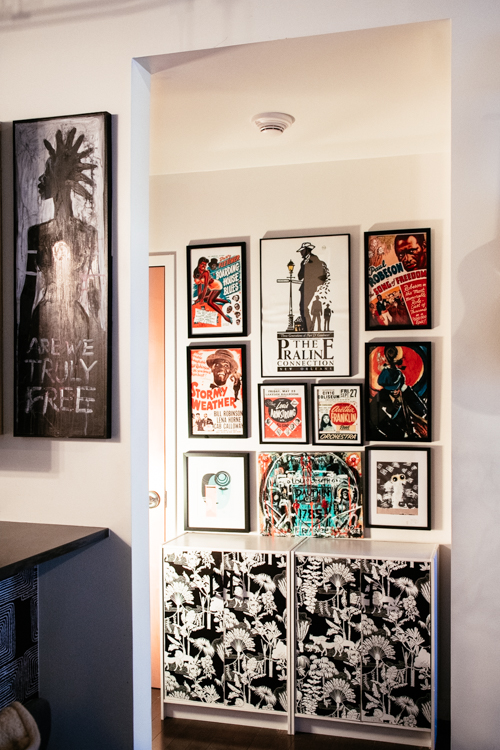
Home Is Where the Art Is: Three Harrisburg artists showcase their most personal galleries of all—their homes—full of whimsy, history and treasure. Step inside.

Carrie Wissler-Thomas

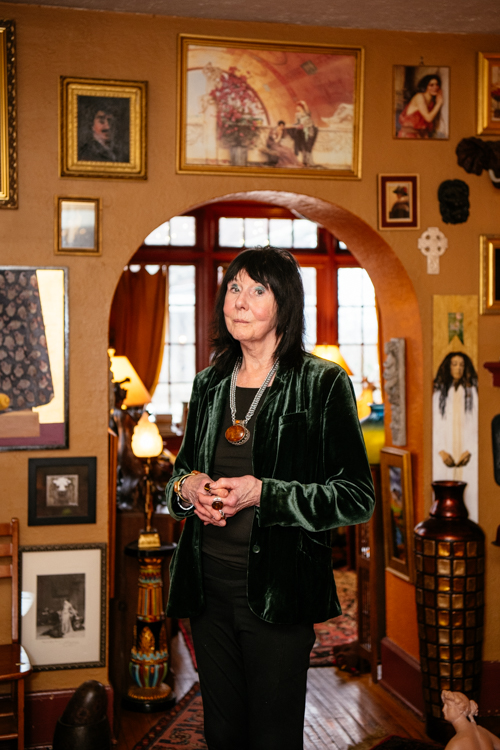
Walking into Carrie Wissler-Thomas’ home is like walking into her mind.

I guess many people’s homes could be described that way, as an expression of who they are. Not all are so unique, as many turn to big box stores for furnishings. But, as you might expect, artists are apt to collect and create one-of-a-kind pieces.

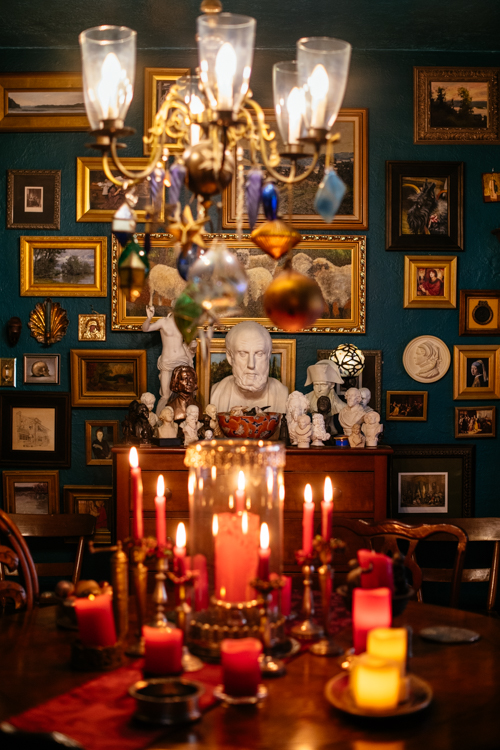
Every recess of space in Wissler-Thomas’ Harrisburg home is filled with art, art, art, history, family memorabilia, more art. She can’t tell you how many works adorn the walls, shelves and every nook and cranny. Taking inventory would be a feat.

However, for Wissler-Thomas, the long-time executive director of the Art Association of Harrisburg, collecting has never just been about amassing a great quantity. Each piece has meaning to her, whether it’s a self-portrait, a framed gift from a friend, a bronze bust from an overseas trip, or her many, many Scottie dog figurines. She’ll gladly tell you the story of each.

Unlike many professions, artists want to be surrounded by their work at home. There’s virtually no line between work and home life. This is especially true for Wissler-Thomas and two other Harrisburg artists, Michelle Green and Charlie Feathers, who all use their homes as studios as well.

Of the three, I’d call Wissler-Thomas “The Collector,” Green “The Heart” and Feathers “The Expressionist.” Welcome to their cribs.

The Collector

In addition to being an art collector, Wissler-Thomas is the family archivist, displaying her grandmother’s tea sets, her family photos, her grandchildren’s old picture books and toys, as well as memorabilia from high on the family tree.

“I read a biography of Sir Richard Burton, who was the explorer,” she said. “One of the photos was of him and his wife sitting in their dining room, and the caption said, ‘A photo of Sir Richard Burton and his wife in their typically cluttered Victorian dining room.’ I said, ‘It looks just like ours!’”

Wissler-Thomas and husband Scott moved into their N. 2nd Street home in 1991. Before hauling in furniture, anything, Wissler-Thomas painted and hung a work inspired by Victorian writer H. Rider Haggard’s book, “She: A History of Adventure,” above the fireplace, setting the centerpiece of their home.

“This is what I’ve always done,” she said. “In our first apartment, we moved the paintings in first, and I hung them and [my husband] said, ‘How can you hang paintings without furniture?’ I said, ‘I know where they should go.’ And they were fine.”

Wissler-Thomas said that first painting, and that late 1800s author, inspired the rest of her home. She’s drawn to the time period during which artists all knew each other, held elaborate parties, and were highly regarded in society.

The family has tried their best to channel the energy of that time with Wissler-Thomas hosting AAH parties in her home, opening it for Historic Harrisburg Association’s Candlelight House Tour and displaying numerous works by other local artists.

And while the house has an extensive showcase of other artists’ work, Wissler-Thomas’ own pieces, landscapes of her travels to Scotland, Spain, France and nude portraits she painted in classes taught by the late Charles “Li” Hidley, take the spotlight.

“The ones that I really love are my portraits. And I don’t take these out. These are our collection,” she said. “I’ll take you up to the studio and that has a huge inventory. I’ve been running the Art Association for 40-some years, so I’m always showcasing other artists’ work, so I don’t get my own work out there that often.”

Her home is her gallery, she said.

As the years ticked by, the collection has grown to the behemoth that it is now. There is something of an order to it. Portraits are in the living room, landscapes in the dining room, and some walls have themes, like the “hero wall,” which includes historical figures and a portrait of close friend, the late Charles Schulz dressed as a Renaissance man. The library in the front of the house is full of books, mostly English history, of which Wissler-Thomas has read every single one.

“Recently, when she brings something home, it’s mostly a matter of finding a place for it, finding a vacant or empty spot,” Scott said.

Scott, a retired IT guy who volunteers as AAH’s bookkeeper, headed up several renovations in the house and is Mr. Fix It. His office on the second floor has slightly less art and more bowling and birding, two of his passions. But the paintings that did make the cut are very meaningful pieces, including several by his wife.

And if you thought that this place—full of precious art, delicate pottery and too many taper candles to count—would make a great place for a bunch of kids and adults to run around hunting Easter eggs, you’d be right. Easter egg hunting, and even other holiday-themed hunts, have become a tradition in the household. The one rule, eggs must not be completely hidden from view.

“Our son hides them, and he’ll hide them in just one room, and it takes hours to find them,” she said, laughing. “Everybody crawls around and looks, and he sometimes puts them on top of paintings. I hate it when they hide things up on the mantel. That head of Laocoön is very unstable. An egg usually ends up on his head and that’s very scary.”

It may look like a gallery, but it doesn’t have the same rules. It’s lived in.

In the back “garden” room that was added onto the house, the couple plays their nightly board game of “Wingspan” and works on puzzles. The dressing room is full of Wissler-Thomas’ clothes, although one visitor once asked what the room with all the “vintage clothing” was for. The children’s bedroom is where her granddaughter slept for some time.

“We love coming home,” Wissler-Thomas said. “There are lots of things that remind me of my family […] there are things that family members have given me, and that Scott and I have collected on our trips and they’re all meaningful. It’s like living in history.”

The Heart

Like Wissler-Thomas, when artist Michelle Green moved into her Midtown apartment, she knew she needed to create some new art for the space.

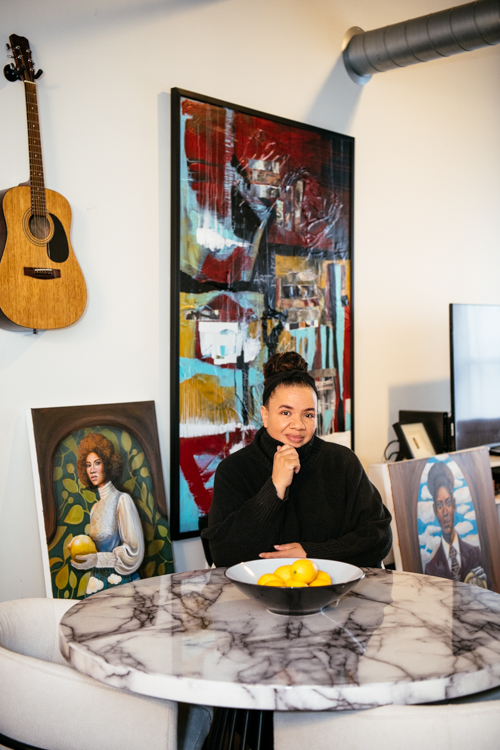
What followed were three paintings for behind the couch, two black-and-whites of beautifully dressed women with afros, one with the word “Black” written above her head, and an abstract with primary colors red, yellow and blue.

“I do surround myself with my art because everywhere I sit in my apartment, whether it’s here or over here, I need to feel inspired,” Green said. “I just feel like, everywhere you look in your house, why aren’t you looking at something that’s enjoyable?”

Much of Green’s work is Afrocentric and Black art, depicting Black women clad in ornate dress. Since she was a child, Green has had a special interest in fashion design. She also specializes in photography and videography.

It wasn’t until she moved to Philadelphia to go to school and work at an art gallery that Green was introduced to Black art, which, she said, “changed the direction” of her craft.

Her newest painting, “Just Dandy,” sat propped against the wall, ready to be delivered to Coda Rouge, a Harrisburg restaurant that displays Black art. The image shows a young woman dressed in a suit inspired by the Harlem Renaissance, holding a clock to represent history and legacy.

Another piece, “Bayou Beauty II,” shows a Creole woman from New Orleans, her dress paying homage to both her French and African ancestry. The woman holds a lemon, referencing the saying, “when life gives you lemons, make lemonade,” symbolizing resilience.

“I love being Black. I love being a Black woman. I love being different; I love that my personality is different. I love being a woman, and that’s what my art represents,” Green said. “I sometimes used to think, ‘I’m getting older, is it too late to…no […] maybe this is the intent, and this is the time to do it.”

Unity, and joining different inspirations, cultures and people groups, is important to Green. In her entryway hangs an interactive painting she’s entitled, “All Who Gather.” Each time a meaningful guest visits her home, Green invites them to fill in a portion of the painting with a paint marker.

“There is so much unity in art if we allow it to be,” she said.

While working on another project, heartbreak struck Green when her mother passed away in 2024.

Art was put on pause.

Emerging from the grief, Green put all her emotion onto a large canvas. The first painting she created after the loss, while still mourning, now hangs on her living room wall.

“I took all that pain, and I threw it into that,” Green said. “I said I need this piece; I need it to be big; I need to see it every single day. It’s called ‘Art Is Life,’ because it saved my life.”

Within the painting, Green incorporated tributes to both classical artists who served as inspiration to her and more modern artists, like the late Andrew Turner, a Philly-based artist who Green said was the first Black artist who she met.

This phase of Green’s art life has been a sort of renaissance for her, as she paints a new path forward and embraces who she is.

“I’m just now, these past couple of years, trying to find myself as an artist,” Green said. “I used to paint for money. I don’t have to paint for money anymore. That’s what’s changed. When you paint for money, your passion and your love is not in your piece.”

Green’s art will be on display, along with work from other local artists, all over 50 years old, at her showcase on May 16 called “Strength, Courage & Wisdom: The Power of the Seasoned Creative.”

Attendees will be able to view many of the paintings currently hung in Green’s home, each holding personal meaning.

And though you’d never know it, Green’s pristine home is also where she creates her art. Her art cart was tucked away beside the couch ready for her next project.

For Michelle, her home is a place of comfort, joy and creativity.

“I love coming home. I love being home. It takes a lot for someone to get me to leave the house.”

Charlie Feathers

The Expressionist

When you enter artist Charlie Feathers’ Midtown townhouse, you’re greeted by several larger-than-life animals. There’s the funky llama covered in yarn and wearing sunglasses. There’s a papier mâché elephant, a tortoise on wheels and a giraffe made of a tossed chair and broom.

Each was sculpted with recycled materials, as most of Feathers’ art is. He pointed to one, explaining that he made it from discarded Planet Fitness paper towels he found while dumpster diving.

“I’ve dug in worse,” he said. “Believe me, that’s nothing.”

Feathers is one-of-a-kind, as is his home.

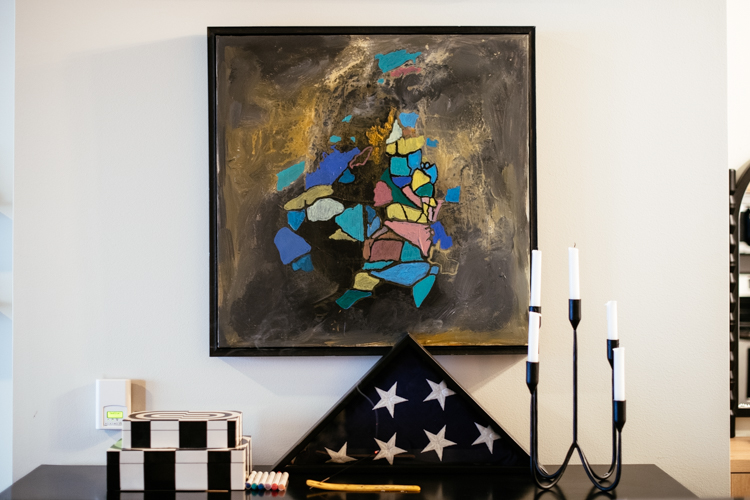
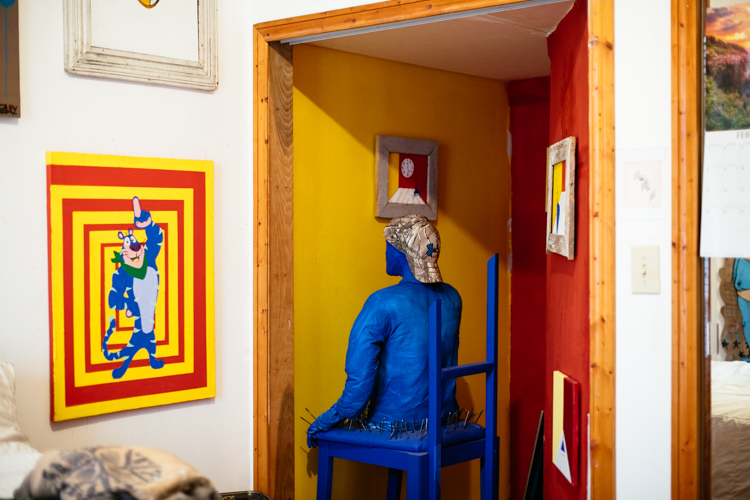
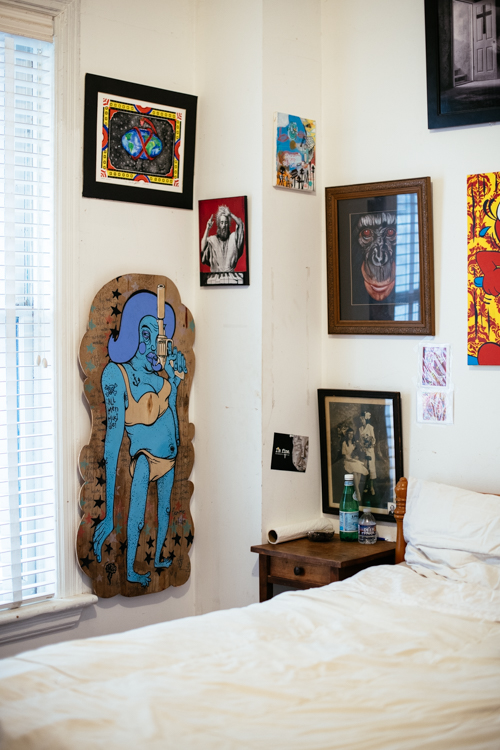
Where Green and Wissler-Thomas’ homes are decorated with paint, wallpaper, aesthetic rugs and furniture, Feathers’ is much more bare bones, gritty. It’d be fitting to describe it as a blank canvas that’s constantly showing off new and evolving work. But that certainly doesn’t mean the home is minimalistic. Every wall, corner and even the floors and closets are art displays.

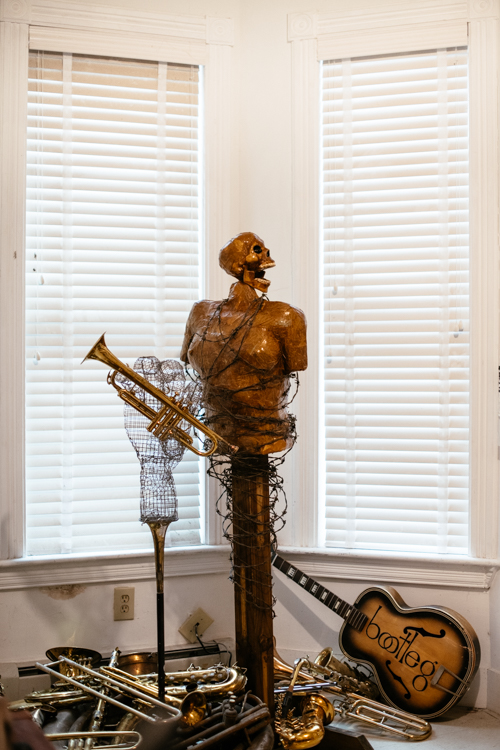
His bedroom closet has been retrofitted into his “blue chair” art display, and on the floor of a nook in his upstairs hallway sits a jumble of donated and found brass instruments.

Feathers tends to work in series. He gets “buzzing” on an idea and won’t stop pulling the thread until he’s satisfied. There’s his rattle head doll series, “black balloon” series, collection of sculpted hands, and many others.

“I seem to run on series,” he said. “Just repetitive, repetitive things until I get it out.”

Feathers found art later in life, in 2012, when he enrolled at HACC in search of a purpose and something to help curb his substance addiction. In school, he found art and was drawn to the “dynamic” group of artists he met.

“This filled a good niche. All previous euphoria was chemicals,” he said. “And then I found a different outlet, which hit like the same sensor, and I was like, wow, this is euphoric.”

Feathers’ work runs the gamut of mediums. He paints, sculpts, quilts and works with metal, fabric, wood, paint, clay and more. His best work is born when he is simply “freestyling” without a plan, he said.

Feathers uses found objects, mostly because it’s the most affordable way to make art, breaking the mold of art requiring costly materials.

“They’re most accessible to me,” he said.

That’s why, if you dissected Feathers’ work, you’d find scrap metal in sculptures, his old hoodie balled inside an animal head wall hanging, a tarp in a painting on canvas and wool sweaters stitched into a quilt.

While some of his work is inspired by random colors, objects or themes, some is also born from his real-life experiences and relationships. One piece depicts “the one that got away.” Another represents the time he found religion as a boy. A literal ball-and-chain piece was made at the end of a relationship. There’s also plenty of references to his artist tags—“Speedee,” a symbol of a guy on a motorcycle, and “Bootleg,” which represents his tendency to pull from other artists’ work and give it his own “lick.”

Much of Feathers’ art also speaks to mental health, an important and personal topic to him. He’s not shy about sharing how art keeps him on track day-to-day and in a healthy head space. For that reason, he’s always creating.

“If I don’t, it’s not a good sign,” he said.

Feathers’ spacious basement is his workshop, and his art-filled home is his sanctuary.

That’s a sentiment that all three of the artists shared. There’s both something comforting and inspiring about being emerged in art—a feeling that maybe only an artist can truly understand.

“It’s a safe place,” Feathers said.

To view Carrie Wissler-Thomas’ work, visit www.wisslerthomas.com.

For Michelle Green’s work, visit her Instagram page @filmzbymichelleg.

To see art by Charlie Feathers, visit his Facebook page.

Photos by Dani Fresh.

If you like what we do, please support our work. Become a Friend of TheBurg!          

Continue Reading

Building People Up: Working with grants, donations and generous volunteers, this nonprofit provides free repairs for homeowners in need

Sue Gebhart and house captains

At the start of March, a group of handy volunteers gathered at Second City Church on a weekday afternoon.

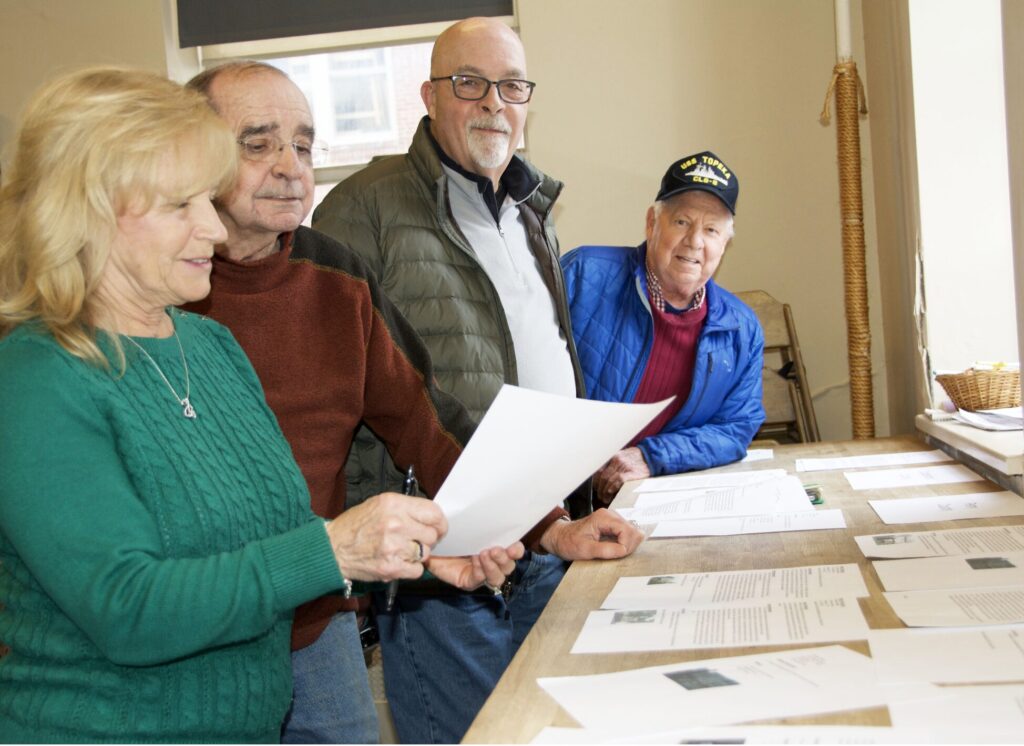
They stood over a row of tables, blanketed by a few dozen project options, eyeing the details of each, eager to choose tasks for Rebuilding Together’s annual “Event Day,” which helps repair houses in Cumberland, Dauphin and Perry counties on the last Saturday in April.

There’s a lot of work to be done and the scope of projects vary. Assignments include repairing soft spots in floors, installing handicap bars, and sealing ill-fitting doors and windows.

The homeowners they’re helping are seniors, veterans, people with disabilities or families with children. They also qualify as low-income. In 2026, this means individuals earning less than $15,960 per year or less than $33,000 for a family of four. Such financial restrictions mean they may struggle to complete home renovations on their own, putting them in a situation that may jeopardize their ultimate wellbeing.

“When a homeowner lacks the financial resources to maintain their home, unhealthy and dangerous situations increase,” explained Sue Gebhart, part-time executive director for Rebuilding Together’s Greater Harrisburg chapter. “No one should have to call an unsafe place home.”

Gebhart, of Mechanicsburg, is the only employee of the nonprofit, which boasts an 11-person board of directors that meets monthly in Harrisburg at Second City Church—the church of the board members who founded the group 31years ago.

Gebhart has worked for Rebuilding Together for roughly two decades, first as program director before assuming her current role. She said the job is special in that it gives her the opportunity to help others, utilizing not just grants and donations but volunteer power.

“We’re supposed to be giving back. We’re supposed to be helping one another,” she said. “That’s pretty much what life’s all about.”

Rebuilding Together volunteer

Leading the Charge

According to Gebhart, Rebuilding Together’s Event Day is its biggest day of the year for projects, putting to work upwards of 150 volunteers.

The keys to the success of the program, she said, are the “house captains”—who take charge organizing their fellow volunteers, as well as preparing a plan of attack for requested repairs.

Bob Brightbill, 55, a building construction technology instructor at Dauphin County Technical School, is one of those house captains. He has been volunteering in the role for the last 25 years.

Last year on Event Day, he led a team that built a 30-foot ramp onto a wheelchair-bound homeowner’s Perry County home, complete with vinyl railings.

The work was done on a cold, windy, rainy day.

“If I was getting paid to work, I’m pretty sure I would have taken the day off,” Brightbill laughed.

Nevertheless, he and around a dozen volunteers from the school—instructors, teachers, students and a bus driver—showed up. Despite the poor weather he said that everybody was happy to pitch in and complete the job, which ultimately took two days.

“It was a beautiful ramp when it was all said and done,” Brightbill said. “It really accented the house. Instead of looking like a handicap ramp that was put on out of necessity, it looked like it was something that was planned and put there—and it was all built by pretty inexperienced volunteers in very harsh conditions.”

Rebuilding Together volunteers

Anyone Can Help

This year, Brightbill will be leading a team to build a set of stairs between the ground and a homeowner’s door for a neighbor located across the street from last year’s ramp.

While he is uniquely qualified for the gig, in that he teaches building construction for a living, Brightbill emphasized that this kind of background is not necessary.

“The necessity to be a house captain is to be organized, to put together your team, and to rely on your team to help you, to help the family improve their situation,” he explained. “Not every house captain that I’ve come across has been extremely skilled in the world of construction. Most of the time, they’re just very willing to put together a team that is very skilled.”

Gebhart added that volunteers working under house captains don’t necessarily have to have building experience—just the ability to be directed.

“The volunteers show up, and they’re advised, ‘OK, this is what we’re going to be doing,’ and they get to it,” Gebhart said.

According to Brightbill, almost any task can be made easy with careful guidance.

“No matter how big the project is, if you break it into small pieces, each of those small pieces is an easy thing to do,” he said.

Executive director Sue Gebhart

Money & Maintenance

House captains come well-prepared to worksites. Before Event Day, each visit their site to evaluate which repairs they can do and scope out how much they’ll cost. They send the prices to Gebhart, who purchases a gift card for the estimated amounts that they can use to buy needed supplies in the days before.

Gebhart said that she applies for grants specific to each project to secure funds, in addition to securing funding through individuals and foundations.

“If we have more grant money, we can do more homes,” she said.

She estimated that Rebuilding Together sees roughly 50 project applications per year. Applying homeowners may be referred by governments, hospitals, schools, insurance companies or local churches. Or sometimes neighbors will find out from neighbors about the program.

In addition to Event Day, the group does projects on a rolling basis for homeowners year-round. It can also help them with emergency situations, if need be. Examples might include burst pipes, broken water heaters, or furnace or air conditioning repairs.

“It can really impact the health and safety of the person,” Gebhart said of such conditions.

Sometimes, repairs also help homeowners with generally unsafe situations—like not being able to access their toilets or to wash dishes in their kitchen sinks or living with moldy carpets.

Gebhart added that aging individuals will often request walk-in shower and grab bar installations.

Other accommodations can make a difference, too. For one elderly homeowner, Gebhart recalled how volunteers completed floor and ceiling repairs, improving lighting in her home in the process.

“She was more excited about the lighting than anything else,” Gebhart said. “Because it’s amazing how when something’s really bright, it just changes the whole atmosphere and your attitude in your home.”

Power of Kindness

Aside from the repairs, Gebhart noted that homeowners also love the camaraderie they experience when the volunteers come to their home.

“We have very caring volunteers,” Gebhart said.

Teresa, a Dauphin County homeowner who received assistance from the organization last year, said that she could attest to this.

“These people made a tremendous difference in my life, and they did it with a smile and laugh,” she said.

A team of volunteers from the Greater Harrisburg Association of Realtors worked on her house in the fall of 2025. She said that she was touched by their kind nature as they replaced window screens, installed smoke detectors, and added a grab bar and no-slip strips in the bathroom for her—all renovations that she emphasized have made her day-to-day life much easier.

“This might not seem like a lot to somebody, but to me, it made a tremendous, tremendous difference,” she said.

In between projects, the volunteers even helped hang Christmas lights on the front of her house.

Which, while it wasn’t necessary, did make her day.

“I remember sitting and watching them and thinking, ‘These are incredible people,’” she said. “I don’t think people realize how much small gestures can impact someone’s life in a grandiose way.”

To volunteer with, donate to, or find more information on Rebuilding Together Harrisburg, visit rtgh.org.

If you like what we do, please support our work. Become a Friend of TheBurg!          

Continue Reading

Wow Factor: Window boxes add color, beauty to Harrisburg

Dave Miller

Across the country, window boxes brimming with fillers, thrillers and spillers are elevating curb appeal—and perhaps even inspiring a little neighborhood jealousy as passersby stop and take notice.

“‘Wow’ was the expression we heard most often,” said founder Sue Schneider, explaining how the WOW Windowboxes business earned its name.

Schneider went from sharing her window boxes with friends and family to serving residential and commercial clients.

Now the concept has arrived in the Harrisburg area, thanks to Dave Miller. The Susquehanna Township resident, who grew up in Pennsylvania before spending years in San Francisco, recently launched the local franchise.

“I had been doing corporate marketing for 20 years and wanted to build something for myself that is more tangible and local,” he said.

Many people assume the service is seasonal, but Miller says that’s not the case.

“The beauty of it is that it’s year-round,” he said.

Each installation includes a discreet irrigation system connected to the homeowner’s outdoor spigot.

He returns quarterly to switch out the plantings. In the spring, he may bring pansies. Summer arrangements vary depending on the house’s sun exposure. For homes with full sun, plantings may include vinca and sweet potato vine, while shaded homes might feature begonias, impatiens, coleus and creeping Jenny.

In the fall, Miller adds seasonal elements like pumpkins, gourds and ornamental kale. During the winter season, he removes the irrigation system and replaces displays with items like faux garland, wreaths, magnolia leaves and fresh greenery.

Miller believes services like this shouldn’t be limited to larger metropolitan areas.

“Big cities have this service, so why not Harrisburg?” he said.


Growth Path

Customers can tailor their installations to their preferences. Some choose to skip a season, while others enjoy year-round displays.

“We send a quarterly email out to keep people in the loop,” Miller said.

Pricing is determined by the foot.

Homeowners can choose the color window boxes they prefer. Standard options include black or white, but customers can choose any color from the Sherwin Williams palette to match their home’s trim.

Several architectural styles are available as well, including standard, English, mission and modern designs. Some customers opt for corbels—ornamental window brackets installed beneath the planters to add support and visual interest.

The boxes themselves are crafted from PVC, which is weather-resistant and mimics the look of painted wood while resisting rot, warping and insect damage.

Amy Tobin remembers the frustration of maintaining her own window boxes.

“It would take forever for the tiny plants to fill in,” she said. “Then we’d go away, and they’d die.”

When Tobin heard about WOW Windowboxes, she liked the fact that the arrangements start with mature plants and account for whether the house is situated in the sun or shade.

She now has the boxes installed at her home and at an event venue and says they frequently attract compliments. Tobin also likes that the company puts the plants on a timer.

“If I need to use the spigot for something else, there’s a lever we use which makes it easy, and it’s also easy to turn off the irrigation system if there’s a cold snap,” she said.

For now, Miller’s goal is to grow the business steadily while helping homeowners enhance the appearance of their properties across central Pennsylvania.

His dream project? To irrigate and plant the window boxes at the Governor’s Mansion each season.

“That would be great and would make quite a difference,” Miller said.

Until then, he hopes to see more window boxes popping up throughout the region.

“We have pride in home ownership here too—not just in the big cities,” he said. “We also have century-old houses here that could benefit from the ‘WOW’ factor and maybe even become the envy of the neighborhood.”


For more information on WOW Windowboxes, visit
www.wowwindowboxes.com.

If you like what we do, please support our work. Become a Friend of TheBurg!          
Continue Reading

A Quiet Close: One realtor has created a specialty serving neurodivergent clients

Let’s face it—the process of buying or selling a home can seem overwhelming at times.

For the neurodivergent, it’s especially daunting.

That’s where the Danielle Winn Team of Berkshire Hathaway HomeServices Homesale Realty comes in. As the local team’s website states, their realtors do business with “Patience. Empathy. Real estate support designed with you in mind.”

Winn, who’s worked in real estate for 23 years, opened her specialized firm in Camp Hill last year. Although the business isn’t limited to serving only special needs individuals, team lead Winn believes it’s important to offer realty services tailored for the neurodivergent.

“We realized this was an underserved population,” she said. “The work we’ve done with them has been very fulfilling.”

Winn and her team understand their concept firsthand. At 46 years old, Winn is just now in the process of being evaluated for high functioning, “masked” autism, noting that women are often diagnosed with such conditions later in life than men because their symptoms may not appear as “noticeable.”

Nearly all her team operates with various forms of neurodivergence, such as autism, attention deficit disorder (ADD) or a combination of factors. Realtor Kiersten Hyman, who lives with ADD, also has a background in social work and teaching children on the autism spectrum.

“I get how stressful this whole (realty) process can be,” Hyman stated. “That’s why I do things differently: clear communication, no pressure, and I’m super patient.”

Realtor Nora Whitman, 42, gets it, too.

“I am late in life diagnosed with ADHD,” she said. “It helps me to understand my clients better.”

So how is the process of buying or selling homes different when working with neurodivergent clients?

“Our approach is intentionally structured, transparent and adaptable because ‘one-size-fits-all’ doesn’t actually fit most people,” Whitman said.

For starters, the firm’s “sensory-friendly” office offers special needs clients “quiet space, private restrooms, elevator access and adjustable lighting/music.” Clients are given flexibility of such meeting options as in-home visits, Zoom or “a location that feels comfortable.” Matters are explained to clients “step by step, with no pressure,” and repeated as many times as needed. The team also welcomes texts or messages 24/7 “unless we’re sleeping.”

For example, Winn recalled when she recently “went over all the closing papers” with a client with a traumatic brain injury.

“I’m able to break down the process as many times as needed,” she said. “We all have the same anxieties. We don’t like loud noises, either. We just can’t rush through things (with clients).”

Amanda Orner, of Lower Paxton Township, is one of Winn’s buyers. Although not neurodivergent herself, Orner and her “unofficially diagnosed” husband, Jeremiah, are parents to Gracie, 15, who lives with “high functioning” autism, and Joe, 13, who has “severe autism.”

Orner first knew Winn as a friend and became her client five years ago when Winn worked for another firm. As it turned out, Winn’s work with the Orners involved a lot more than finding the family a home.

“Our apartment building was threatening to evict us because of the noise my son was making,” Orner said. “He was doing virtual learning at home and would make loud vocalizations and bang on walls whenever he got frustrated.”

Winn, she said, “advocated” for her son.

“She set up a Facebook page for him titled ‘A House for Joe,’” Orner said. “She was so comfortable around Joe.”

Additionally, the family had “bank issues” due to a second party’s actions, but “Danielle got us a lawyer and helped us,” Orner said.

“It took us a long time to find a house, but Danielle was so involved with getting us the best home for my children’s needs,” she added. “She made sure the house and the neighborhood would be good for them.”

If that weren’t enough, Winn and her cousin, Carlisle real estate agent Brittany Jean Lesher, followed through and painted Gracie Orner’s new bedroom her favorite shade of pink.

“Danielle is so great about working with neurodivergent needs,” Amanda Orner said. “She made sure the house would be good for Joe. My kids are so happy here.”

For information about the Danielle Winn Team of Berkshire Hathaway HomeServices Homesale Realty, visit www.realtorsforneurodivergents.com or call 717-761-7900. The firm also is on Facebook and LinkedIn.

If you like what we do, please support our work. Become a Friend of TheBurg!          

Continue Reading

Honey Home: With Beahive, affordable housing is in reach

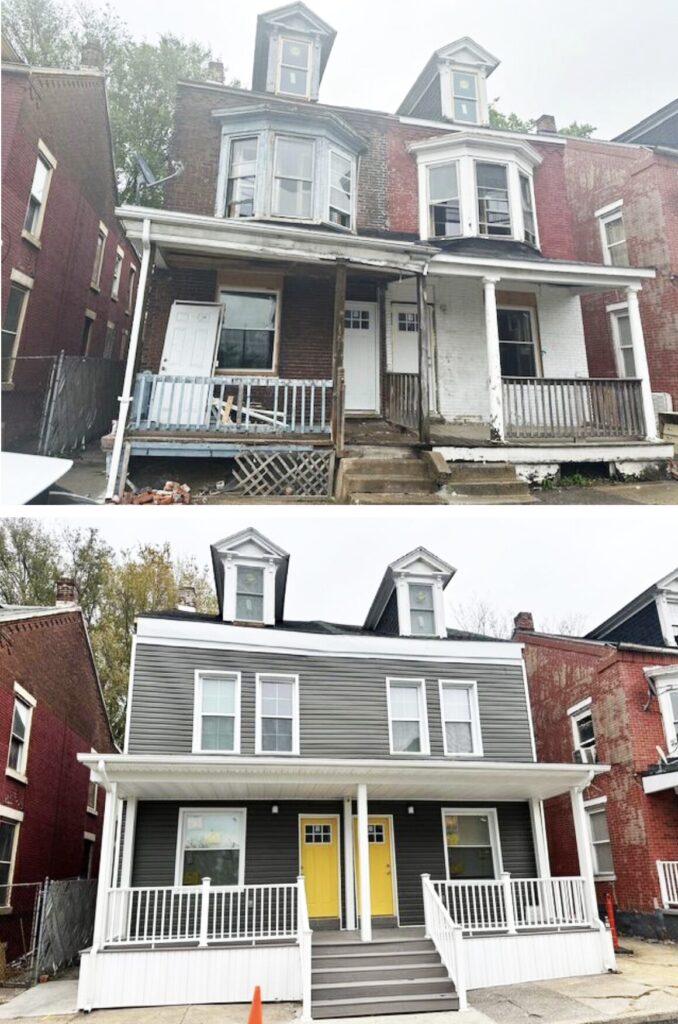
Before and after renovations of a home in Harrisburg

As I walked down Harrisburg’s narrow Summit Street and spied the fresh siding and double yellow doors of the duplex, I knew that Beahive Affordable Housing Outreach was “in the house.”

Beahive rehabs blighted properties and offers them for affordable rent, known as “Hive Creation.”

“The mission is for me is to eventually create affordable housing that people can buy, so they can understand their own equity,” said Samara Scott, founder and executive director.

The seed for this nonprofit, named after Scott’s mother, was planted in 2013 when her family experienced a house fire.

“Someone set fire to the house beside us,” Scott said. “We lived in Uptown Harrisburg, so at 3 a.m., our family is up and our house is on fire. This was my family home too. This is the house that I grew up in and had the opportunity to begin raising my kids in.”

The family of five found themselves in a hotel for six weeks as they navigated finding a new place, but they encountered obstacles.

“I made good money—I had my bachelor’s and master’s in human resources and never cared about credit,” Scott said. “I just paid everything in cash. So, now I go to actually apply for our house, and they’re like ‘Your credit?’ I’m like, ‘I can pay.’ But it didn’t matter.”

Another hit: no insurance.

Eventually, the family found a rent-to-own opportunity. Incredulous at first, they did their research and found this to be a legitimate opportunity, which gave them time to build credit and assume the mortgage for the house they were renting.

“COVID was what flipped a switch,” Scott said. “I looked around my community, and I was like—‘What’s happening here? People need help. There needs to be more affordable housing.’”

So, in 2022, she and her husband used the equity in their house to renovate and sell their first property. They have two other completed and rented units on Summit Street.

Scott took everything she learned from her house fire experience and used that to direct decisions at Beahive Affordable Housing Outreach.

Those who rent from Beahive must go through financial literacy classes to understand the basics of how credit works.  Renters must also have renter’s insurance. Its “Hive Savings” program assists folks with eviction prevention and with security deposits for those needing to find a new place due to eviction, fire or an unsafe living situation. In its four years, Beahive has helped over 58 families.


Purpose & Mission

Beahive’s current renovation project is a large Victorian house on 3rd Street that will serve as rental units. The carriage house will hold Beahive offices and emergency housing.

Scott pointed out that people need emergency housing for many reasons: house fires, moldy rentals and lead contamination.

“We want to make it available to the Red Cross or insurance companies when they remove people due to lead or mold,” Scott said.

Renters who report mold or lead issues to the codes office often find themselves without housing when owners don’t renew their lease due to the complaint.

Beahive’s completed houses have modern, fresh finishes with an open concept. Scott’s husband owns FHS Contractors, which serves as the general contractor for construction. Scott works to find deals on building materials.

“I have an addiction to building material auctions,” Scott said.

Recessed lighting will show up in future homes— she has 20 boxes of them.

The Summit Street duplex was taken down to the studs, and Beahive added half-baths, a laundry/mud room, and closets to the bedrooms. Scott remarked that Beahive’s renovations have had a positive effect on the street.

“We noticed, as we started doing work, a lot of other property owners started doing work,” Scott said.

All of this takes a lot of money, not so much in the purchase of the property, but in the renovation. It cost about $400,000 to renovate the duplex on Summit Street, so the organization relies on grants.

“Dauphin County has been our biggest supporter thus far,” Scott said.

And, just recently, they received a $400,000 grant from the city of Harrisburg. The properties do come with restrictions.

“We have to keep them for 20 years, and they have to remain at 30 AMI,” Scott said.

AMI stands for “Area Median Income,” restricting the rent to no more than 30% of a household income. This percentage is what’s considered sustainable for renters to maintain housing.

Scott said that they keep their overhead as low as possible, and she’s the only paid employee. They pay contractors, of course, but also rely on volunteers, including the hard-working board. Beahive has a relationship with Dirty Dog Hauling, which provided 44 volunteers on MLK Day of Service. That service event even made it onto “ABC World News Tonight with David Muir.”

So, what’s ahead in 2026?

“We want to purchase a property in Cumberland County,” Scott said.

Also on the 2026 docket—becoming a housing counseling agency. Its Shades of Honey Gala, on April 12, provides a fun opportunity for anyone to support the mission.

Scott has taken her life experiences and used them to create and secure housing for those in greatest need.

“I get up every day, and I’m happy,” she said. “Sometimes, it’s really hard, but I know that the work that I’m putting in is for our purpose and mission.”

For more information on Beahive Affordable Housing Outreach, including the Honey Gala, visit www.beahivehousing.org.

If you like what we do, please support our work. Become a Friend of TheBurg!          

Continue Reading

Artful Adaptation: Strong acting grounds “The Stranger.”

Image courtesy of Gaumont.

François Ozon’s “The Stranger,” adapted from the novella by Albert Camus, is a simple film, embellished tastefully by a talented cast of character actors, including two of my favorites, Swann Arlaud and Denis Lavant.

But its heart lies in the unaffected yet nuanced performance of its lead, Benjamin Voisin as Meursault, a young, successful businessman without ambition or direction, defined only by his good looks, his class and his existential absurdism, which gradually reveals itself after the death of his mother.

The gorgeous black-and-white photography from cinematographer Manuel Decosse works on several different levels for Ozon’s adaptation of Camus’ novella. The subconscious feeling that black-and-white evokes—that you ought to take what you’re watching a little more seriously—encouraged me to dig more attentively into the onscreen Meursault’s philosophy. It also captures the diverse, sun-drenched and overheated Algiers of the 1930s in an austere lack of color, reducing issues of colonialism and race to shades of exposure on skin and class to costume design and makeup, forcing the viewer to engage with its characters on a more grounded level.

As my first exposure to Camus’ story, I’m thankful that I knew as little about the original as I did going in. And, if you’re the same way with film, I’d encourage you to stop reading here and just come and see the movie when it opens at Midtown in April.

As far as I can tell, as someone who has explored Camus only through summaries and cultural osmosis, “The Stranger” seems to be an incredibly faithful big-screen adaptation of the original novella and varies in only two significant ways that I could detect.

First, some non-linear editing gives us a glimpse into Meursault’s imprisonment and unaffected emotional state before either of the two main plot points occur, which helped clue me in early to the emotional identity of Meursault, before the film even covers his mother’s funeral.

Secondly, in the story’s next central development, Meursault spontaneously shoots and kills an Arab, who remains unnamed in the original novella. Ozon chooses to name the man in an especially poignant, extratextual scene towards the end of the film, which could seem like a footnote of sorts. In his quite rigid adaptation of the original story, this comes across as a decision rooted in intentionality.

I hold the opinion that a successful adaptation of a pre-existing piece of art stays true to the soul of the original while offering a valuable perspective or spin on the original that only the adapter could offer. And, after experiencing “The Stranger,” first through Ozon and then through Camus and Sartre by proxy, I believe the film to be exactly what I look for from an adaptation—and a great film independent of its source material.

“The Stranger” opens at Midtown in April.

Midtown Cinema is located at 250 Reily St., Harrisburg. For more information, visit www.midtowncinema.com. Gabriel Brown serves as assistant manager at Midtown Cinema. 


April Events
at Midtown Cinema

Down in Front!
Comedy Riffing
“Bride of the Monster” (1955)
Friday, April 10 at 9:30ish

3rd in the Burg Movie Night
“The Royal Tenenbaums” (2001)
Friday, April 17 at 9:30 p.m.

25FOR25 Series
25 films celebrating 25 years of great film at Midtown Cinema

“Amélie” (2001)
Sunday, April 19 at noon

“Magnolia” (2002)
Sunday, Apr 26 at 5 p.m.

Late Night Frights
“Possession” (1981)
Friday, April 24


If you like what we do, please support our work.

Continue Reading

Thoughtful Planning: Preparation is key for a smooth remodel

Image courtesy of Excel Remodeling

Spring often brings a renewed focus on the home.

As days grow longer and families spend more time together, many homeowners begin to notice what isn’t quite working in their space. A kitchen that feels cramped during meal prep, a bathroom that no longer meets daily needs, or rooms that don’t flow the way modern life demands can all prompt the same question: Is it time to remodel?

A successful remodel starts long before construction begins. In fact, thoughtful planning is often what separates a smooth, rewarding experience from one that feels stressful or rushed.

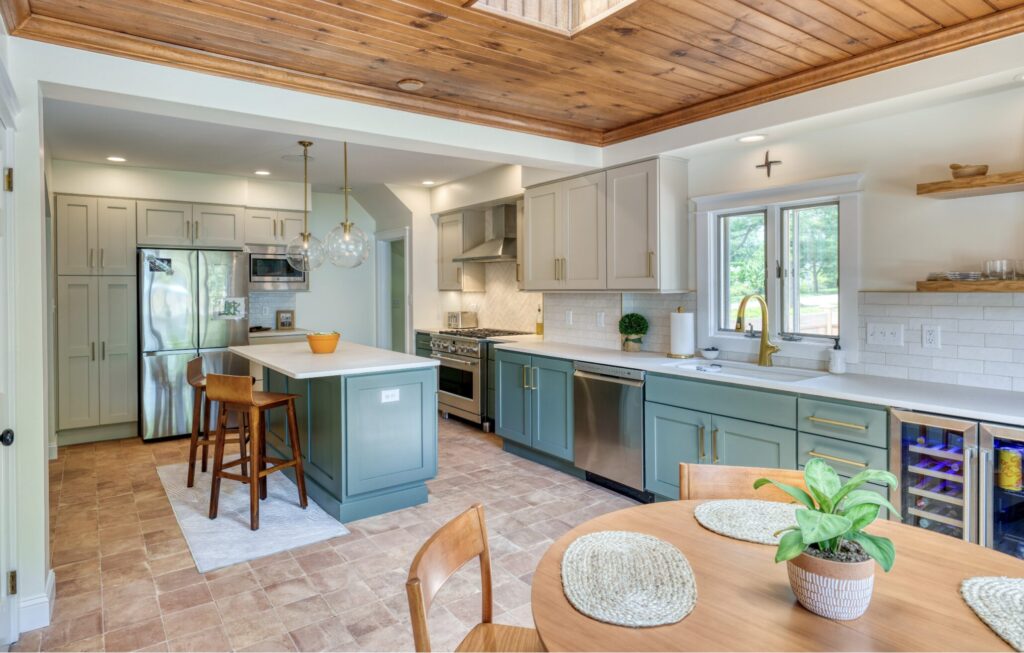
One of the most important early considerations is function. While design trends change, the way a home needs to work for its occupants is far more personal. Kitchens, for example, are no longer just places to cook. They are gathering spaces, homework stations and hubs for everyday life. Bathrooms, especially primary baths, have evolved into spaces that support comfort, efficiency and long-term use. Understanding how a space is used daily helps guide decisions that will continue to feel right years down the road.

Another key factor is pre-construction planning. Many homeowners are surprised to learn how much happens before a single wall is opened. Finalizing layouts, selecting materials, confirming measurements, and coordinating timelines all take place well in advance. This preparation helps reduce delays, avoids costly changes during construction, and creates a more predictable experience overall.

Material selection also plays a significant role in long-term satisfaction. Visiting a showroom or working closely with a designer allows homeowners to compare options side by side and understand how different finishes, fixtures and surfaces will perform over time. Making these decisions early keeps the project moving and ensures the final space feels cohesive and intentional.

It’s also important to recognize that quality remodeling takes time. While it can be tempting to look for the fastest solution, a well-planned project accounts for design development, product lead times and skilled craftsmanship. Allowing the process to unfold thoughtfully often results in better outcomes, fewer surprises and a finished space that truly enhances daily living.

Finally, homeowners benefit from working with professionals who emphasize clear communication and a defined process. Knowing what to expect at each stage—from initial conversations through final walkthrough—can make the entire experience feel more manageable and far less intimidating.

As spring inspires homeowners to reimagine their spaces, the most successful remodels are those rooted in planning, function and intention. When a project is designed around how people truly live, the result is not just a more beautiful home, but one that supports everyday life in meaningful ways.

Jim Mirando is president and design team member of Excel Remodeling, 570 S. 3rd St., Lemoyne. For more information, visitwww.excelremodeling.com or call 717-774-4490.

If you like what we do, please support our work. Become a Friend of TheBurg!          

Continue Reading

Willful Conduct: Planning for a worst-case scenario may be the best gift to your family

Illustration by Aron Rook

“I’ve thought about it a lot, but I haven’t really taken any action,” said Dustin Bishop about creating a will.

He and his wife Amber are my neighbors, and they have two children, ages 15 and 11. The Bishops aren’t alone in procrastination in making financial and custodial arrangements in the event of their passing.

“The number one reason that I hear is the fear that, once they put something into place, that somehow they are going to die,” said attorney Jenni Chavis, owner of Chavis Law Firm, LLC, as we chatted in her Union Deposit office. However, she reassured me that no one has ever keeled over after creating and signing a will with her.

Not to make light of the situation, but the much bigger concern is what may come if an untimely death occurs and the family doesn’t have a will.

“Having to go to court when someone doesn’t have a power of attorney is exponentially more expensive than actually getting power of attorney document in place or fighting over an estate when there is no will,” Chavis said.

For busy families, thinking about what will happen in the future is easy to push to the side. At the West Shore Farmers Market, I talked with three moms out with their children.

“I just keep thinking it’s down the line,” said Maria Mansell. “I don’t have to worry about it yet.”

Her friend, Sophia Topper, turned to the group and said, “I actually was talking about it yesterday to you, about getting one.”

Folks often decide to follow through because they’ve heard of a bad experience that someone has had.

“More often than not, I see people coming in because they had some sort of wake-up call in their life—whether it was a friend who passed, who didn’t have a will, or a parent who left things a mess,” said Jessica Fisher Greene, member partner at Walters & Galloway, PLLC in Mechanicsburg.

Fisher Greene, a former Dauphin County prosecutor, turned her sights to elder law because she saw a need.

“I was getting phone calls from families who were in the thick of things as a result of not having anything in place. It was just horrific,” she said. “So many people were coming in and just crying and trying to grieve and trying to deal with things is the worst.”


Future Freedom

So, what is a will?

“A will is a document that you would create while you are able, so you have capacity, the ability to understand it, and it will allow you to let people know what you’re wishing when you’ve passed away,” Fisher Greene said.

This includes financial wishes but also property wishes. It’s best to not let who’s going to get mom’s wedding ring or dad’s snowblower up to the family to determine.

“Whatever your stuff is, you have to plan for it—whether it’s your sweatshirt or your Pittsburgh Steeler paraphernalia,” Chavis said. “You have to plan for it so that there is no conflict or chaos.”

Chavis added that people can be very reasonable before the life changing event but, “I always say that weddings and funerals bring out the worst in people.”

It is hard to think about our families turning angry and bitter over some dishes or an old car, but both Chavis and Fisher Greene assure me that often happens. Perhaps more important than preventing conflict is the freedom that it provides.

“It’s a gift, a grieving that you’re giving them,” Chavis said. “So, when my parents passed away, they had their plans in place, so I was freed to grieve the loss of my parents versus, ‘We got to run to the courthouse, or we got to get this document signed.’”

When my husband and I began estate planning, the biggest concern on my mind was the custody of the children. The thought of having someone else raise them was a painful one, but the thought of someone raising them, who I didn’t want, was worse. We wanted to pick those people.

“You start thinking about, ‘What are my values?’” Chavis said. “I’m going to start thinking of the people in our lives who fit those values.”

Many parents assume that godparents legally have guardianship, but that is not the case. Also, guardianship doesn’t have to go to a family member, but could go to a friend who knows your children.

When our children reached school age, my husband and I decided to have a friend act as guardian, so that the kids could remain in the same school and keep some continuity in their lives.

Picking an executor who will carry out the will is another important decision to make.

“It’s definitely someone you know who is responsible and going to respond to things,” Fisher Greene said. “They are going to open the mail; they’re going to pay the bills on time—someone you trust to follow through with things.”

The cost of creating a will can prevent people from taking the first step, and at about a $1,000 price tag, that’s understandable. According to Fisher Greene, it’s OK to shop around and ask how much it’s going to cost. People make assumptions about after-death property rights, so despite the cost, it’s best to consult a lawyer about these complicated topics.

It’s common to put off creating a will. What may help is knowing that the will is for the people left behind, and it will also give you peace of mind. Maybe most telling is what Chavis said most families say after completing the process.

“Everyone says, ‘I feel relieved.’”

To contact Jenni Chavis at Chavis Law Firm, LLC, visit www.chavislawfirm.com or call 717-884-8533.

To contact Jessica Fisher Greene at Walters & Galloway, PLLC, visit www.waltersgalloway.com or call 717-697-4700.

If you like what we do, please support our work. Become a Friend of TheBurg!          

Continue Reading