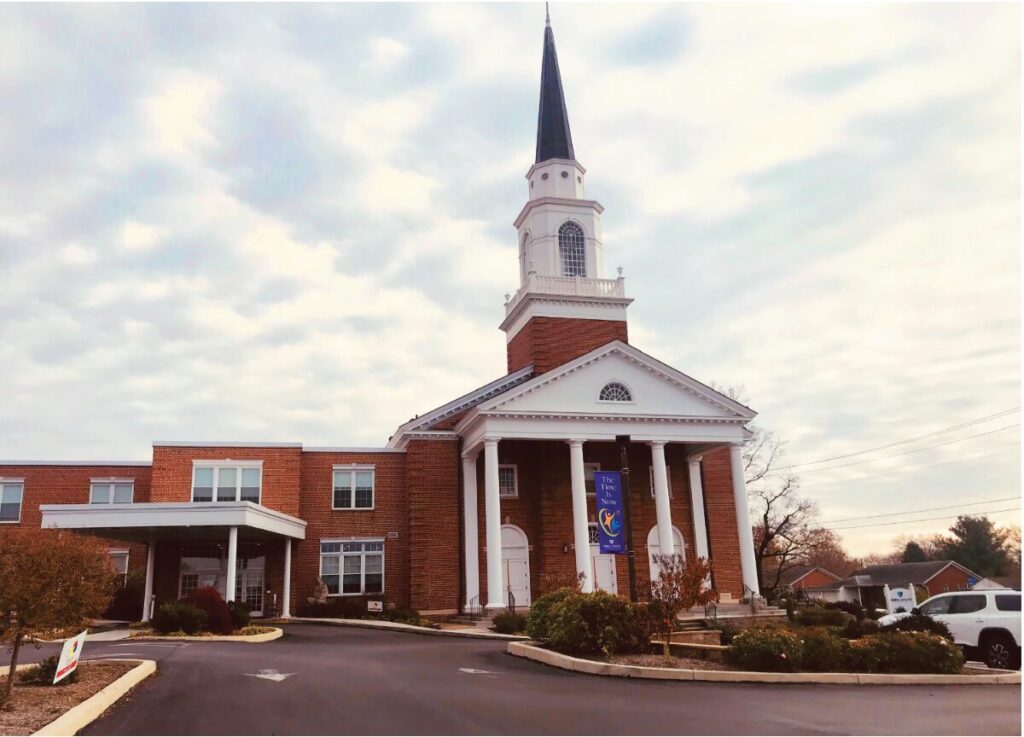
Trinity Lutheran Church
Tatiana is very proud of her Russian culture.
She is part of the Buryat ethnic group, an indigenous group in south Siberia. When we sat down to talk, she told me all about Russia’s Lake Baikal, the largest freshwater lake on earth, as well as the Buryat language, food, dress and religion.
But despite all the rich culture and beauty, life for her, and many others from her region, wasn’t always easy, and she couldn’t find special educational support that her son required. So, she and her family moved to the United States, and she now resides in Camp Hill.
Tatiana explained all of this in English—a language that only a year and a half ago she didn’t know at all.
“I’m trying,” she said. “It’s so hard. I speak English with my kids because the kids learn so fast. I remember my first time in the bank. I didn’t understand anything.”
The foreign-born population in the U.S. grew last year more than it had in any one year in the previous two decades, according to the Pew Research Center. The foreign-born population in 2023 stood at 47.8 million people, about 14.3% of the population, and continued to grow this year.
In the Harrisburg area, this growth can be seen by the uptick in the need for English language classes, and organizations and community groups have stepped up to meet the need.
“I do think that the need is growing and continuing to grow,” said Katie Martin-Momose, ESL volunteer coordinator at Catholic Charities Immigration and Refugee Services of Harrisburg. “I personally have seen an increase, and I think it’s reflected just in the number of classes that we’re offering now at our program.”
Catholic Charities, along with its refugee resettlement services, offers English as a Second Language (ESL) classes. This year, Martin-Momose said that they added four extra classes to their existing three to accommodate the growing need.
But as part of her role, Martin-Momose also helps other community groups organize their own ESL programs, providing resources and training because, the more options for English learners the better.
One of the area’s newest programs is led by Trinity Lutheran Church in Camp Hill, which launched this past spring and just finished up its second session in November.
Tatiana was one of over 100 students, representing around 26 countries, to attend the program.
“Step by step, my English I see is improving,” she said.
Important Resource
The English program is a first for Trinity Lutheran Church, which hasn’t historically offered a lot of community-based programs, said Liz Frey, a pastor at the church. And getting it off the ground wasn’t easy either. Some people in the church doubted whether it would work and if they’d have enough volunteers.
When the first volunteer recruitment event rolled around, church leaders were shocked by the attendance.
“The room was jam-packed with people who wanted to be involved in this ministry,” Frey said. “I wept. I was so overwhelmed by what I perceived to be doubts on the outset to see that there were actually people who wanted to do this.”
Church member Laura Butcher, the program director, has been the main force behind the program’s existence. Having worked with refugees on a volunteer basis before, she recognized the need for language learning.
“I’ve seen how ELL [English Language Learners] classes really seem to be the most important resource for helping them [refugees] get launched in the community,” Butcher said. “There are not nearly enough of them. The need far surpasses the number of free programs available.”
Trinity offers six class levels, 1a through 3b, for free to students, as well as childcare. In Level 1, students learn things like days of the week, weather phrases and pronouns, and, in Level 2, terms around health, driving and paying bills. In Level 3, students learn to talk about more specific and technical things like jobs, the educational system and resume writing. Everything they learn is practical and useful for navigating life in America.
Trinity bases this programming from ESL education books by local author Tone Hess.
Hess, a native of Norway, worked cross-culturally for 20 years before moving to Harrisburg and teaching ESL locally. Based on her experience, she was inspired to write books that would be easy to use for those who may not have an English teaching background and are affordable for volunteer programs.
The books include stories of local immigrants she’s worked with so that people can identify with them. They are also heavily focused on teaching life skills and practical, local application.
“For instance, if you’re going to learn about shopping, you first have to learn the names of food items and the names for grocery stores and the different stores that are available in our community,” she said.
Another program attendee, Roguel, who came from Haiti, said that, before learning English, he couldn’t understand his employer and co-workers without a translator. He didn’t like that. He wanted to be able to understand and converse for himself on the job. Now, he never misses a class.
“Now, I have the capacity to keep a conversation with some people,” he said. “Everything that I need [at work] I can ask them without a problem.”
Challenge & Support
Learning English is not easy—many of the students could attest to that. Newcomers to the country often face barriers to learning the language, and often other needs take priority over language. Things like job schedules, parenting and transportation can act as barriers to education.
New Cumberland resident Celina, a Mexico native, has lived in the U.S. for almost 20 years, but just recently restarted English classes to work on her pronunciation. Soon after she first immigrated and began learning the language, she had a baby, and her focus turned to him. Now, her English has improved significantly.
Yuliia, of Ukraine, who came to this country to escape the war back home, has four children and works more than one job to provide for them, while also fitting in English classes. It’s been extremely difficult for her, and she regularly questions whether she should stay, but she’s sticking it out for her family.
Many students miss the families and homes they left behind but came and stayed in the U.S. with the hope that life could be better for them and their families.
In Trinity’s English classes, many people are in similar situations. They’re making their way in a new country and learning a new language together. There’s a sense of camaraderie.
“We talk about our cultures, and it’s amazing,” Tatiana said. “We meet people of other countries, and they all support us.”
Lisa Carricato, a retired schoolteacher, volunteers at the program, providing educational support to the ESL instructors. She prepares fun, educational games like “Jeopardy” to add to the learning experience.
“What we are trying to do is make this fun so they can have a more fun social connection,” Carricato said.
In one lesson, they had students craft a menu of food from their home.
“We learned a lot of things,” she said. “In one culture, they have cookies and tea as their appetizer.”
They also showed students a short film called “Homesick,” which featured a young woman and her challenging experience immigrating to the U.S., but also her growth and eventual success establishing herself here.
“It was amazing how emotional they are and how huge this step is for them to be here,” Carricato said. “It’s a relief for them to share what they’re going through and see that other people are going through the same thing.”
Carricato’s own family heritage includes immigration, as her grandmother came to the U.S. from Ukraine as a child. She recalled often hearing the stories of what it was like for her, but volunteering at Trinity has let her see those kinds of stories firsthand.
“I think the program is one of the most worthwhile things I’ve done,” she said.
And while program leaders originally questioned the volunteer support they would have for the classes, Trinity’s program now has a waiting list of volunteers.
“They just find us now, these incredibly talented people from the community,” Butcher said. “It’s just provided an awesome opportunity for the church to put into action what we talk about on Sundays.”
Trinity Lutheran Church is located at 2000 Chestnut St., Camp Hill. For more information about their English language classes, visit www.trinitycamphill.org.
If you like what we do, please support our work. Become a Friend of TheBurg!








 Several Harrisburg area nonprofits believe that every child, no matter their family’s financial situation, deserves something special under the Christmas tree.