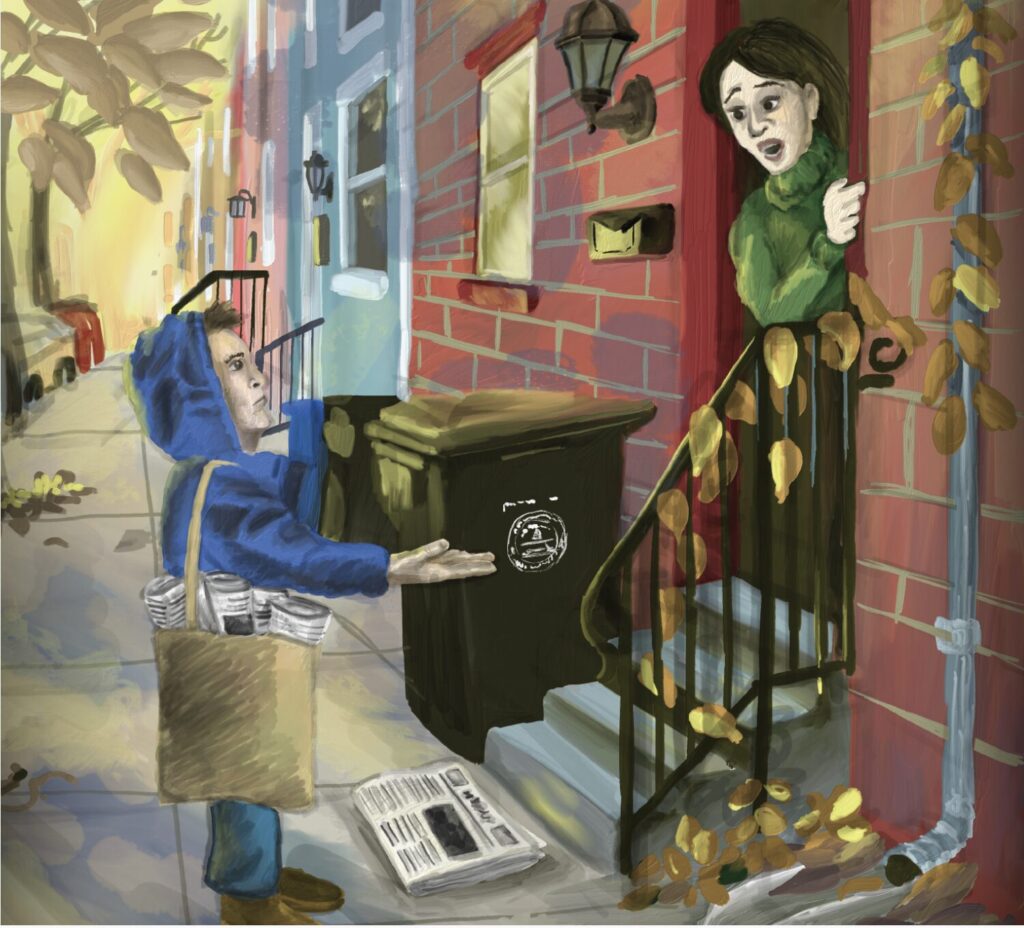
Illustration by Rich Hauck.
When I was a kid, I had a paper route, like many boys did back then.
Each day, I delivered the local newspaper to about 35 houses on surrounding blocks then, each Friday, knocked on their doors to “collect.”
Knowing I was coming, most of my customers had the money—90 cents a week—at the ready. Of course, I always hoped for a nice tip, which, in those days, meant a quarter or two. I made most of my money from those two-bit tips.
I’ll never forget this one old guy who, each week, dribbled the exact change—three quarters, a dime and a nickel—into my outstretched hand, always with the phrase, “I think it’s all there.”
No tip at all. Thanks for nothing, grandpa.
I mention this because, recently, I stumbled upon a rather heated discussion on one of our local social media sites. The subject: paying for local news.
The original poster didn’t think people should be charged—that local news should be freely available as a type of public service. He railed against the paywalls that news organizations increasingly have put up for access.
On the other hand, one commenter defended the practice, saying that news outlets need to charge to survive. Like any business, they have to make money, and a subscription fee is necessary so that journalists can get paid to do their jobs.
In the thread, a couple of people mentioned TheBurg as a quality local news source that doesn’t charge for access. Indeed, we give it all away for free.
But, for news organizations, the right business model is not an easy decision and is not a one-size-fits-all affair. This is especially true in the internet age, when making a passable income providing news is tougher than ever.
Historically, most news companies have charged for their product, just like your grocer charges for bananas or your service station charges for gas. News has been an equally consumable good, thus my weekly collections as a 12-year-old proto-capitalist.
That said: some papers, even back then, didn’t charge. My 1970s-era suburban hometown had two separate “free weeklies,” which were wrapped in plastic and tossed onto front lawns from passing cars. One was a decent product, with a smattering of local news. The other wasn’t. It was an “advertiser,” printing verbatim press releases and other junk filler in between ads for cars, shoes and snow shovels.
So, yes, local news long has had different business models.
This is something that Joel Berg has grappled with recently.
In 2020, Berg, the former editor of the Central Penn Business Journal, founded BizNewsPA, a local business news website supplemented by a popular daily email newsletter.
For the first four years, he went the free route, building up a readership then trying to attract advertisers who would pay for access to his audience. He had some success—enough to continue the one-man operation, but not enough for full-time employment, as he had to supplement his income with freelance work.
“It’s sustainable as a side hustle, but I want to make it the main thing,” he told me recently.
Among his issues: a lack of dedicated sales staff and a lack of space in his newsletter for ads, without junking up the product.
“I’m having my best year ever for ads, but there’s a ceiling,” he said.
Therefore, he conducted a survey of his 2,400 or so email subscribers to see if they valued his newsletter enough to pay for it. About half said they would.
So, starting last month, he began charging $5 a month—or a discounted $50 a year—for access to his full daily newsletter, while launching a second, bare-bones version for free.
Berg realizes he’s running an experiment, but believes he needs to charge to survive.
“The question is—how do I keep it going as best as I can?” he said.
Indeed, that question is at the heart of the news business today, as the internet, especially social media, has blown apart old business models that long supported the community good known as local journalism.
At TheBurg, we’ve cobbled together a hybrid model that melds paid advertising with donation-based revenue. Therefore, we’ve been able to continue offering everything for free, though, to be honest, it hasn’t been easy and has limited our ability to grow our tiny staff.
So, returning to my earlier point, I’m not going to criticize an outlet that chooses differently. Each news organization has to weigh free vs. paid, just as they always have, in order to sustain a viable business. In turn, readers need to judge for themselves whether they believe the product offered is worth the price charged.
For instance, is $50 a year the right amount to pay for Berg’s BizNewsPA? Is it too much? Is it a huge bargain?
Writing this column, I realized that $50 is almost exactly what my cheapskate customer paid me some 50 years ago for a year’s worth of newspaper delivery. In other words, the price hasn’t changed at all, which speaks volumes about the impoverished state of local news today.
And that doesn’t even include the 25-cent tip I always hoped for.
Lawrance Binda is publisher and editor of TheBurg.
If you’d like to support our journalism, please visit our website and join our membership program, Friends of TheBurg.
If you like what we do, please support our work. Become a Friend of TheBurg!