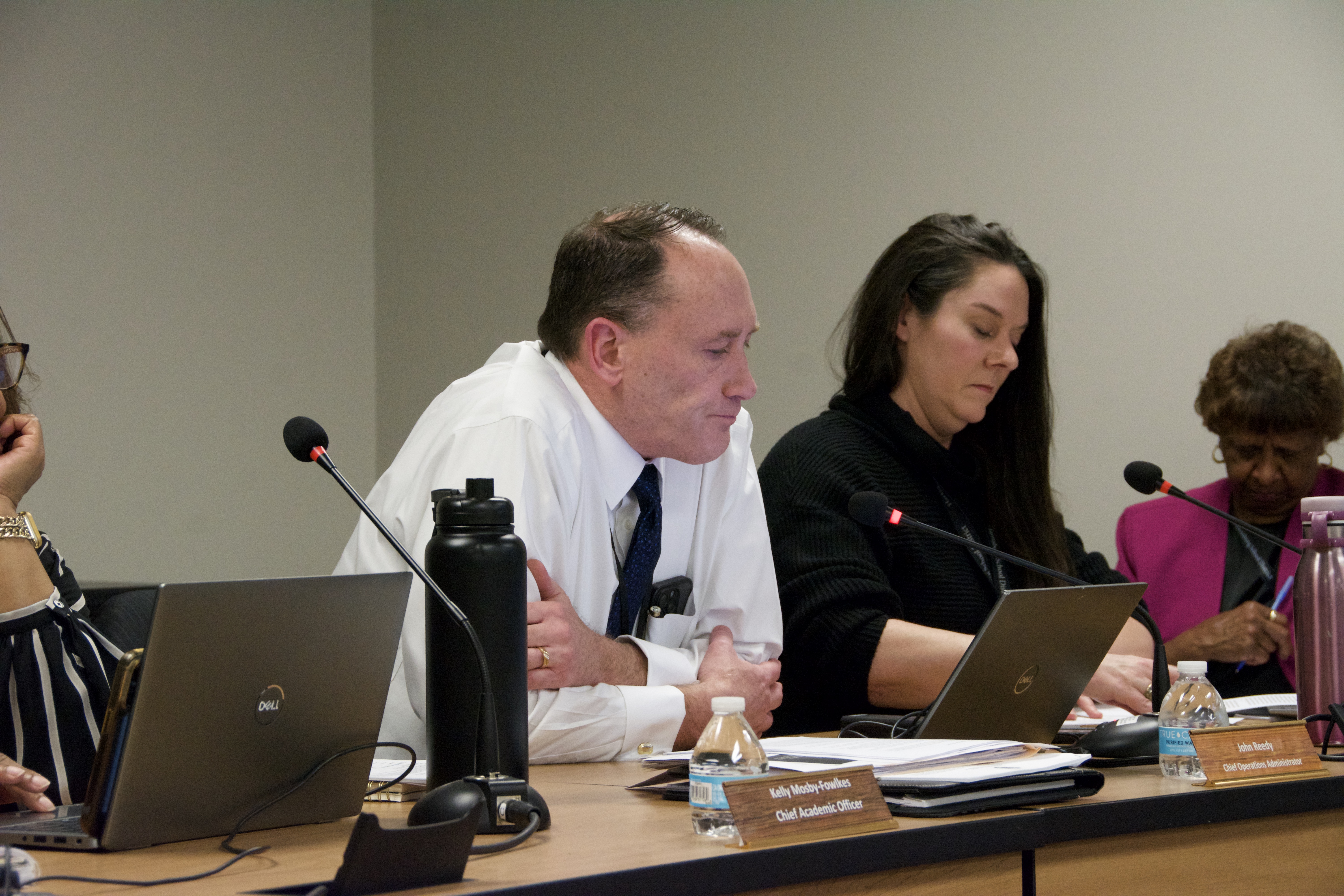
Chief Operations Administrator John Reedy speaks on William Penn demolition options
Harrisburg school officials discussed demolition contractor search options for William Penn at a meeting Tuesday night, after voting to demolish the building last month.
The 250,000 square-foot, 100-year-old, neoclassical building could be torn down as soon as this summer. It was last used as a technical school 15 years ago and has sat vacant, deteriorating, since.
Most board members voiced interest in hiring a demo contractor using a cooperative purchasing system, which would speed the process.
The other option, public bidding, would push the demolition back to late 2026.
Chief Operations Administrator John Reedy explained to the board that the cooperative purchasing program the district has used over the last few years, Keystone Purchasing Network (KPN), “saves a tremendous amount of time” and has produced “high-quality work at a reasonable cost.”
It also allows the district to maintain control over the contractors used, he said.
“Our expectation would be that they are a local company that could get the job done in a timely manner,” Reedy explained.
In an informal 6-2-1 straw poll vote, with board member Brian Carter voting for neither option, the board asked the district to pursue the cooperative purchasing path, over public bid.
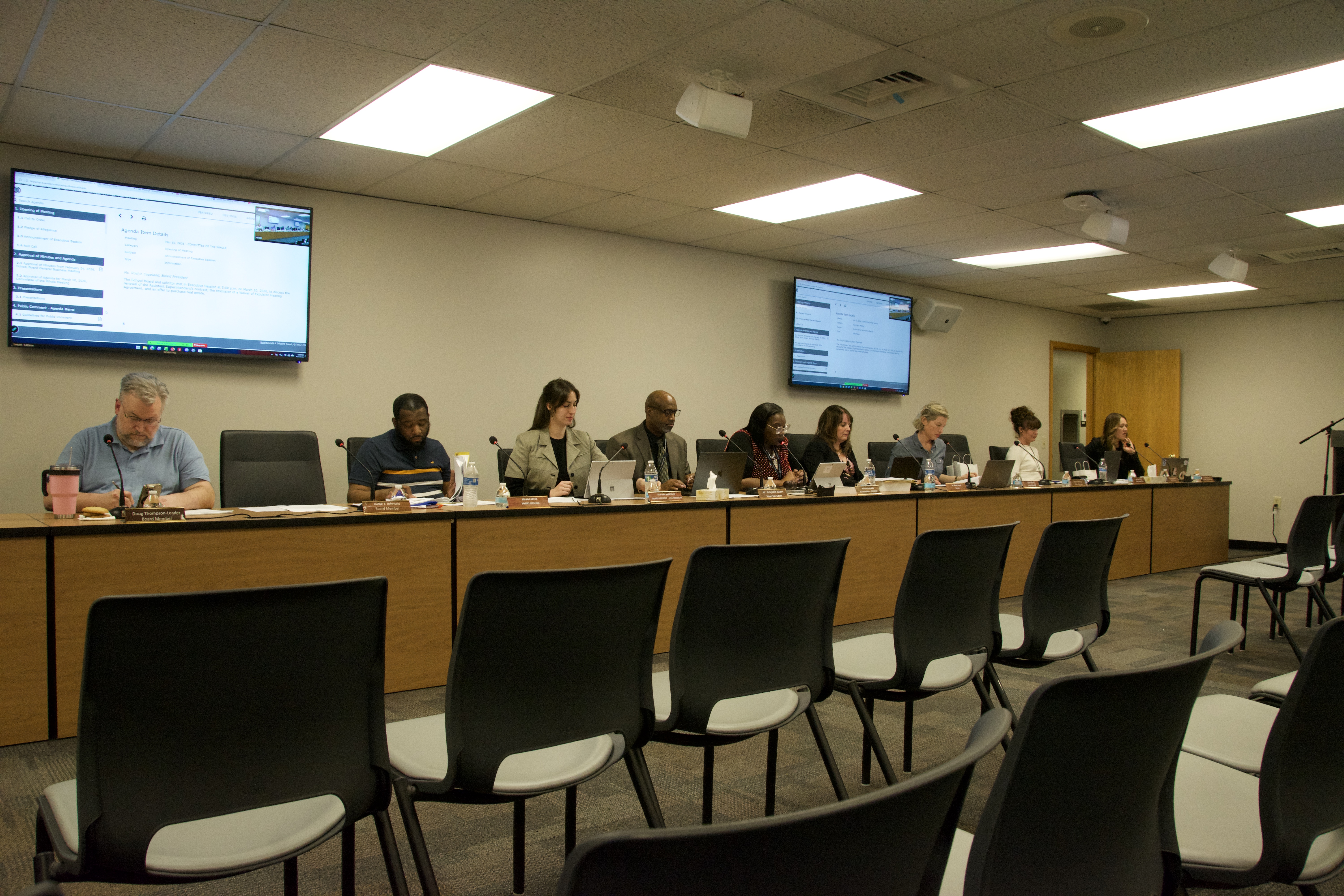
The Harrisburg School Board
No interest in one-year LERTA extension
The board indicated Tuesday night it has no interest in joining Harrisburg and Dauphin County in a one-year city tax abatement program extension.
“No one can say definitively if the program is positive or negative for the district,” explained Chief Financial Officer Marcia Stokes of the Local Economic Revitalization Tax Assistance Program (LERTA) program.
The program incentivizes development and property improvements in Harrisburg.
First implemented in 2015, it offers a 100%, 10-year tax abatement to developers for residential renovations and construction. Under LERTA, commercial and mixed-use projects are also eligible for 50% to 100% abatement.
In a straw poll vote, six out of nine board members said they would rather use 2026 to negotiate LERTA with the city and rejoin the program if it can be adjusted to better benefit the district moving forward. Only one member indicated interest in the one-year extension.
Stokes said 55 of the 73 properties the district has forgiven taxes on through the LERTA program are residential. She expressed concerns that the program may therefore be bringing more children to the district without additional tax dollars. She added that the district cannot determine whether developers would have pursued projects without the abatement in place.
“It is a big decision for the board to make, especially when you consider our position and our amended recovery plan, along with our declining assessed values that are taxable,” Stokes said, indicating that the district’s decision on LERTA will impact it financially at least 10 years into the future.
The district solicitor sent a letter to the city that it does not wish to extend the program and has since been contacted by developers to reconsider, according to board president Rosyln Copeland.
She also expressed concern that the district solicitor had said that the district’s heavy reliance on state aid might be disproportionately hurt by tax abatement programs.
She cautioned the board that pursuing a one-year extension today would impact the amount of money the district collects from projects built this year for the next decade.
Stokes said that while the city, county and school district have historically been involved in LERTA — the other two are able to continue participating in the program without the district.
“We could do nothing, and they could move forward,” she said.
At the end of 2025, the district declined to renew the program by issuing a one-year extension after city officials failed to respond in a timely manner to its requests for program changes, it said.
Stokes said the district asked to negotiate changes to LERTA that would make the program more beneficial to the district in December, but received no response.
In December, City Council defunded the position of Jason Graves, the city’s then-director of business development and its LERTA administrator.
Graves had said previously that Harrisburg was working on new LERTA legislation with the Harrisburg School District and, in the meantime, recommended extending the current LERTA program for another year.
The city approved this extension in December, and Dauphin County approved it in February. The district however, never extended the program, letting its involvement lapse at the end of 2025.
Stokes said that most people’s greatest property tax burden comes from the district, so the city would be incentivized to negotiate with the district to create a more favorable program moving forward. This would involve district Superintendent Benjamin Henry, Stokes, and the district’s solicitor working with the city LERTA administrator and county commissioners to redesign the program.
“What’s the difference on how much we lose out on taxes versus the city and the county?” board Vice President Autumn Anderson asked. Stokes said it was substantially more.
“It wasn’t a benefit to the district. It really pretty much brought construction into the city, which then benefitted the city, but didn’t benefit the district at all,” said board member Danielle Robinson.
Meanwhile, Anderson clarified that the program was an economic development tool.
“The school district is essentially subsidizing development,” she said, questioning whether LERTA brings more people to the city or helps to “ignite or spark” future investments in a city that struggles with closing businesses and blighted buildings.
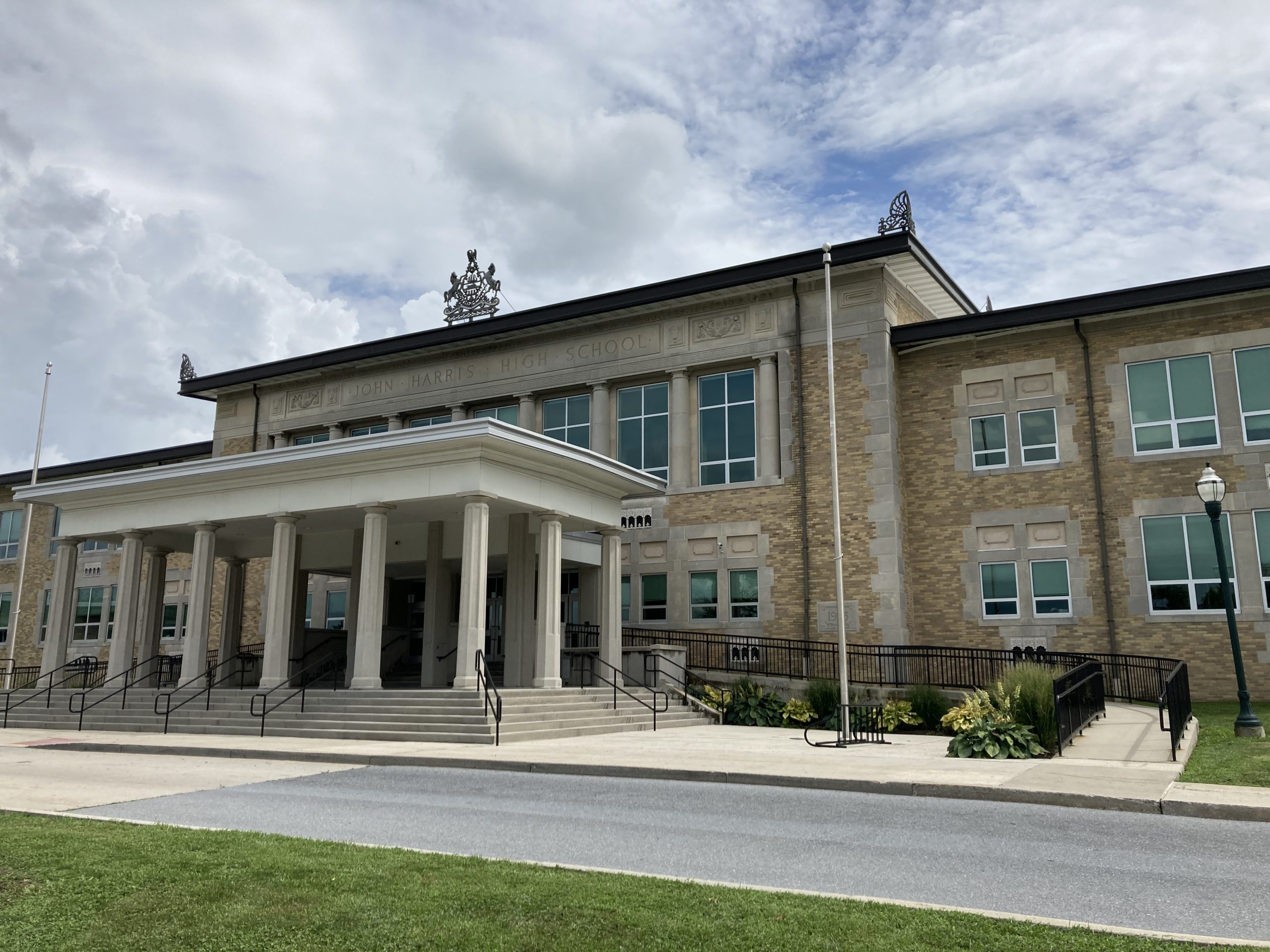
Harrisburg High School’s John Harris Campus.
More details wanted on potential high school program
The board tabled talk of a contract with a consultant that would help lay the groundwork for a multi-year plan to create a potential new flagship program for John Harris High School, after lengthy discussion.
“We’re not going to move this forward until we get some more information from our administrative team,” said Copeland.
The district asked for more details on plans to use a consultant to create a new business-related career and technical education program (CTE) at John Harris that would begin in the 2026-2027 school year. The idea was first proposed in spring 2025.
While the consulting contract would cost $10,000 or less, in line with the program, the district would also spend $25,700 to outfit a wing of John Harris.
The area—currently a midsize office and a small classroom—would have a wall removed and be redesigned to be “more of a collaborative space,” according to the superintendent.
“We have kids be able to walk right out of algebra one and into a CTE class,” Henry explained, noting he thinks such a program could improve attendance and that he wants it to be highly visible to the high school’s students.
If you like what we do, please support our work. Become a Friend of TheBurg!