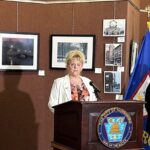
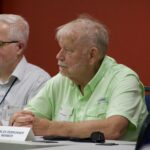
From left: Dauphin County commissioners George Hartwick, Justin Douglas and Mike Pries at Wednesday’s commissioners meeting.
Dauphin County approved its 2026 budget on Monday that includes a property tax increase for the second year in a row.
By a 2-1 vote, the county commissioners passed a $221.9 million general fund budget, which includes a 9.75% property tax hike. The tax increase is lower than the 15% hike initially included in the county’s proposed budget, which was introduced last month.
The spending plan marks a $172,671 decrease from 2025’s budget of $222 million. It includes no new full-time positions, a 2.95% cost-of-living-adjustment for union employees and a $2 million vacancy adjustment.
Commissioner Mike Pries was the sole “no” vote on the budget Wednesday. He told TheBurg this was due to the tax increase.
“We were told there’d be no tax increase for the foreseeable future,” he said.
Last year, the county increased its property taxes for the first time in roughly two decades with a 21.8% hike. Commissioner George Hartwick had said at the time that the county hoped not to raise taxes again in the following year.
At the meeting, Budget and Finance Director Chris Davis said that county departments originally asked for $232 million for next year. This would have required a tax hike of more than 25% to close, he said.
Hartwick said that he, Chief Clerk Eric Hagarty, and Davis then met with every county department, scrutinized each request, and evaluated the county’s needs versus the county’s wants. The final budget was a result of department negotiations, spending reductions, debt restructuring, vacancy adjustments, and the strategic use of one-time funds, Hartwick said.
“The revised budget reduces the overall cost of county government in 2026 compared to 2025, despite continued inflationary pressures and rising healthcare costs,” Davis told the commissioners.
Hartwick noted that the board also reduced the commissioner’s budget by 11%.
“What deserves emphasis is not just where this budget landed, but how far it moved,” he said.
Commission Chairman Justin Douglas also applauded the reductions that led to “a single-digit increase” in property taxes.
“This is a balanced budget. It cuts costs, it protects jobs, it protects a cost of living increase,” Douglas said.
“It’s not perfect, but it’s something that I think we’re proud of,” he added.
The county projects to end 2026 with a general fund balance of $13.9 million.
Even with the double-digit tax hike for 2025, Hartwick said that the county is projected to have just 24 days of cash on hand at the end of 2025, which is “well below recommended levels.”
At Wednesday’s meeting, Hartwick said that 50 of Pennsylvania’s 67 counties are facing significant fiscal stress and that many are preparing for substantial tax increases.
The commissioner, who has served since 2004, also defended the board’s “deliberate decision” not to raise property taxes between 2007 and 2025.
“Had revenue merely kept pace with inflation, the county would have collected $202 million more since 2007. Had it kept pace with average salary growth, that gap would have exceeded $336 million,” he said. Pries and Douglas were elected in 2010 and 2023, respectively.
Hartwick noted that the cost of delivering county services, human services, corrections, public safety, elections in the courts has consistently exceeded inflation due to rising demand and unfunded mandates.
“We will continue to work tirelessly to reshape what local government looks like in a post pandemic environment, especially as state and federal partnerships continue to do less and require local governments to do more,” Hartwick said.
If you like what we do, please support our work. Become a Friend of TheBurg!