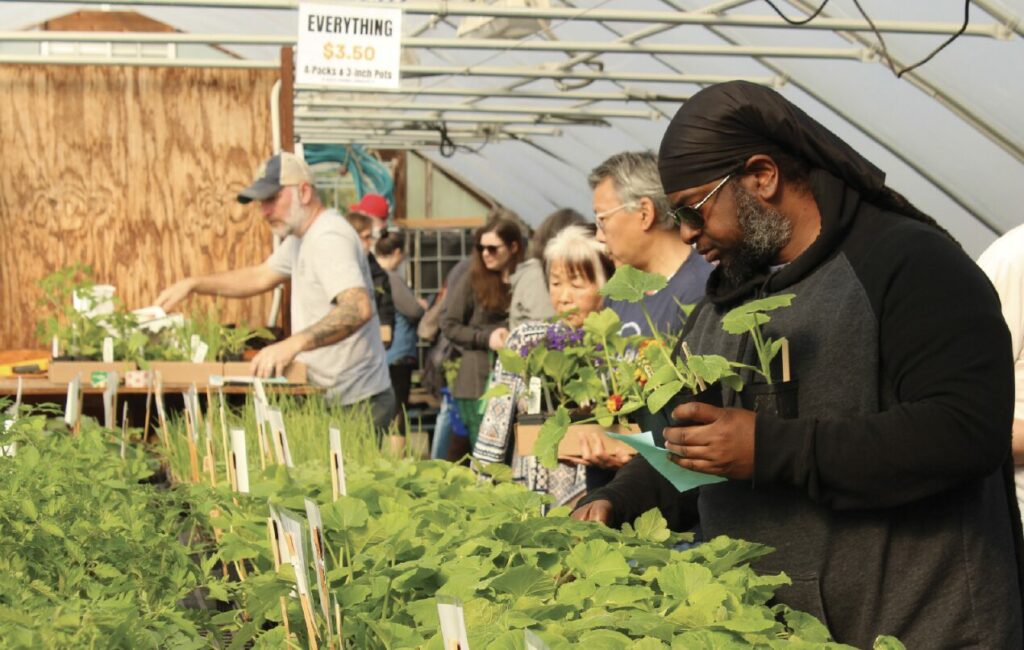
Annual plant sale
Plants, animals and people come together at Horn Farm.
Thanks to a group of passionate citizens, a 186-acre farm in Hellam Township is producing education and community instead of gearshifts and exhaust systems.
In the early 2000s, Harley-Davidson attempted to build a plant on a piece of property owned by York County. The Horn Farm’s rolling hills, natural habitats and 19th-century farmhouse border a tributary of the Susquehanna River, which feeds into the Chesapeake Bay.
Concerned citizens cherished its history and environmental importance. They feared that commercial development would forever negatively impact the property and those around it. County leaders listened, and the Horn Farm Center for Agricultural Education was born.
“We love to bring people here, get them connected to the land, and have a positive experience,” said Alexis Campbell, executive director. “It’s an incredible feat. You do not hear many stories about people saving open spaces.”
The center is marking its 20th year in 2024. Its first seeds were planted in the 102-plot community garden. Campbell said that founders created the garden to illustrate the land’s value to the community. Over time, relationships began to grow alongside various crops. Many gardeners return every season, with some driving a considerable distance to care for their plants.
Once the plants are harvested, Horn Farm gives growers an opportunity to learn how to use them through classes held in its commercial kitchen. The kitchen, known as a summer kitchen because it’s adjacent to the farmhouse, was rehabilitated by volunteers in 2015. The Horn Farm Center uses the space and the 19th-century squirrel tail oven it contains for bread-baking, vegetable preparation, butchering, herbal medicine-making and other workshops.
Lauren Hayman discovered Horn Farm Center in 2008 when she enrolled in a new gardener training program.
The class came with the expected small garden at the farm, seeds, seedlings and an instructor who gave hands-on lessons through a season of vegetable gardening. It also came with an unexpected community, sense of wonder and a new understanding and appreciation for all the natural systems that work in cooperation with each other. Hayman grew alongside her plants, and now serves as chairperson of the organization’s board of directors.
Horn Farm holds events year-round, and fall events, including foraging walks, ecology lessons and cooking classes, are especially popular, as are farm tours.
“In the 16 years I’ve spent coming back to the Horn Farm Center, the magical connections with other people and the natural world have not lessened,” Hayman said. “Each experience there opens my mind and deepens my connection with the world around me.”
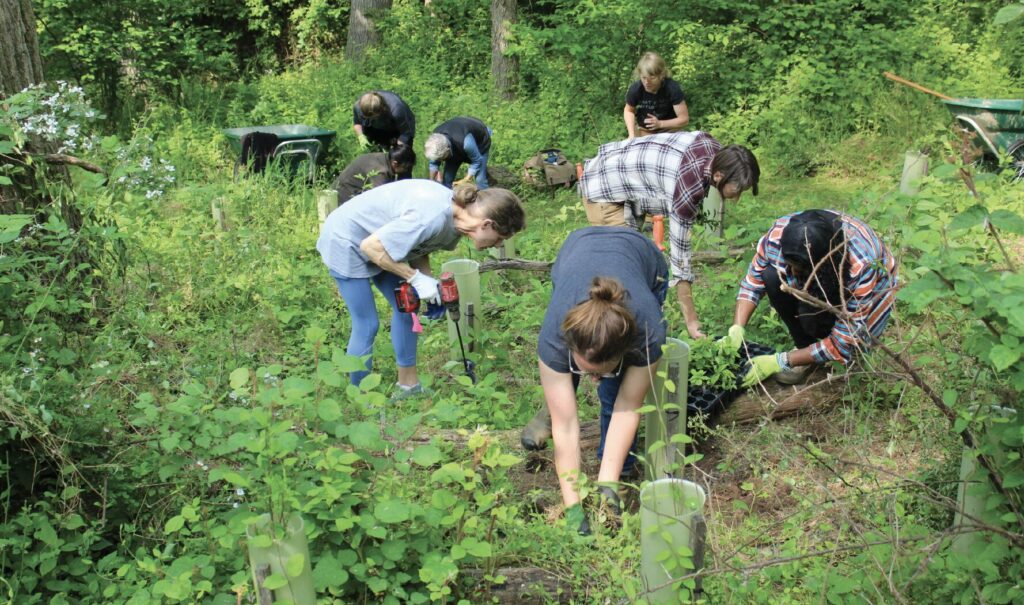
Ecological gardener training program
Positive Impact
Campbell is excited that the center’s staff and volunteers not only appreciate what the nonprofit organization is, but what it can become.
In 2016, York County and Horn Farm entered into a 99-year lease. The center also received a conservation easement that perpetually protects the land from development. With the future looking bright, leaders switched from survival mode to growth.
Several acres of trees were planted along the Kreutz Creek to prevent sediment from flowing into the water and, eventually, the Chesapeake Bay. Most tree species can protect land and waterways, but Horn Farm leaders had a bigger vision for their purpose.
“We are working to manage the trees in a way that is productive and useful for education,” Campbell said.
The plan is far from finalized, but Campbell trusts that Horn Farm Center members will help it come to fruition. Some trees produce fruits and nuts, while other wood-bearing trees, such as the willow, can be cut down and used for basket weaving. Campbell hopes that, in 2025, those materials will be used in a basket-weaving course taught on-site.
Higher upstream, erosion flushes land downstream. Horn Farm recently received a grant that will allow it to build wetlands to prevent the destruction. When complete, the space will also serve as a lesson for visitors who have similar waterways on their property.
“It will be an opportunity for us to educate the public about ecology and ways they can intervene and make a positive impact on their land,” Campbell said.
Erosion can be prevented, but the Horn Farm community knows all too well that Mother Nature can threaten the center in more swift and unpredictable ways.
In 2021, lightning struck the farmhouse. Fire burned from the roof to the second floor. Horn Farm saw an opportunity amidst the devastation. They focused on preserving and restoring the historic structure while giving people more space to meet and learn from each other. Once complete, the first floor will house a large classroom, and the kitchen and second floor will be the site of the organization’s administration center
“It’s been a long recovery process,” Campbell said. “I didn’t realize how challenging it would be to rebuild an 1800s building.”
Those desiring to appreciate the land but not participate in classes or the community garden are welcome to roam the grounds, Campbell said. The area is rustic, but future plans call for a public space with directional and educational science.
For all those plans to come to fruition, the Horn Farm Center needs dedicated volunteers and donors who can advance the legacy of its founders. Corporate and private donations, public grants and class fees help fund operations. The center also benefits from a trust established by the Horn Family.
Twenty years in, Campbell is excited to see how the land and those who enjoy it grow together in the future.
“I love seeing that a-ha moment when people learn something,” Campbell said.
The Horn Farm Center for Agricultural Education is located at 4945 Horn Rd., York. For more information, visit www.hornfarmcenter.org.
If you like what we do, please support our work. Become a Friend of TheBurg!