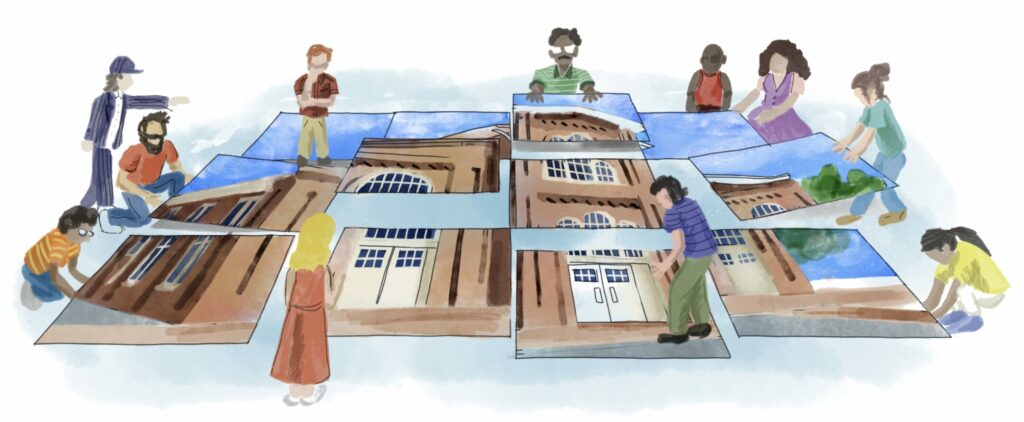
Illustration by Rich Hauck.
If all goes right, the Broad Street Market’s long-awaited temporary building will be open for business this month.
Can I get a big “Alleluia?”
Indeed, it’s been a long, tough slog getting to this point, some 10 months after an early-morning fire ripped through the market’s brick building, displacing about two-dozen vendors.
Regrettably, many vendors are not returning, but the ones that are will inject some badly needed meat, cheese and produce into the food desert that is Harrisburg.
As you may know, there’s been a lot of ink spilled on complaining/blaming/arguing over the many glitches and delays getting the temporary market open—and we’ve spilled some of that ink ourselves.
But, at least for now, as we celebrate the building’s opening, I’d like to take a different track. Sometimes, good comes out of bad, and, as it turns out, even the Broad Street Market tragedy has had bright spots that should be acknowledged.
First of all, I’d like to raise a Zeroday double IPA to all the folks who volunteered their time and talents to get the tent up and running. Without them, believe it or not, we’d still be waiting. The credit list is long.
Let’s start with the trades—Carpenters Local 431, Iron Workers Local 404, the McClure Company. They all worked long hours, for free, to build out the temporary market’s interior, install the metal roof and donate plumbing services, respectively.
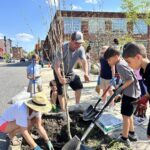
Secondly, Harrisburg residents, organizations and companies stepped up in a big way. In fact, the community mobilization and involvement may be the best thing to come from this disaster.
It began with a land donation by Millworks owner Josh Kesler. Then came big-money contributions from the likes of PSECU, F&M Trust and the William Penn Social Association, as well as smaller donations from hundreds of residents.
Midtown Property Management offered free management and maintenance services, and Hornung’s LED Lighting donated over $15,000 in new, high-efficiency LED Lighting for the stone building. TheBurg also wanted to help. So, we forgave the market’s past-due balance and, going forward, are donating ad space.
The fire—and its fallout—also led to changes to the market’s board of directors, which had been criticized in the past for being opaque and non-responsive. Following a resident and vendor revolt, a large part of the board changed hands, newly peopled with members who care passionately about the Broad Street Market and its role as a vital food resource and community hub.
Suddenly, a board that often had trouble filling seats and getting a quorum brimmed with new energy and ideas. And those ideas didn’t just come from board members. Wisely, the board opened up its meetings to the public, which offered engagement, oversight and input.
In the meantime, in February, the embattled executive director resigned his post, which gave the market board an opportunity to rethink that position. When hired, the new day-to-day administrator will focus less on time-consuming, mundane tasks like billing and collections (now the realm of Midtown Property Management) and more on making sure the market functions well on a day-to-day basis.
To plug the gap, three board members have been splitting up hours and tasks, acting as de facto market managers and, according to several vendors, doing a solid job. Obviously, this isn’t sustainable long-term, but these volunteers deserve credit for donating tons of their time to the market until a permanent manager is hired.
The board also is launching a badly needed refresh of the market’s website. Here’s hoping that, unlike in the past, the new website is kept up-to-date, with timely, accurate and reliable information.
Having said all this, I don’t want to sound overly sanguine or sugarcoat what’s happened.
There’s no way it should have taken the city 10 months to set up a temporary home for displaced vendors, many of whom got tired of waiting and left. In addition, as I write this, no work has yet begun on the charred, partially roofless brick building, which has sat exposed to the elements for nearly a year.
However, as the temporary market opens, the Harrisburg community has much to be proud of.
Residents and a handful of organizations and companies rose up to fill in gaps, provide leadership, offer direction and donate money, time and services. To the extent they could, community members took charge and pushed the market project forward. Without question, this is the bright silver lining to an otherwise bleak chapter in Harrisburg history.
Lawrance Binda is publisher/editor of TheBurg.
Illustration by Rich Hauck.
If you like what we do, please support our work. Become a Friend of TheBurg!