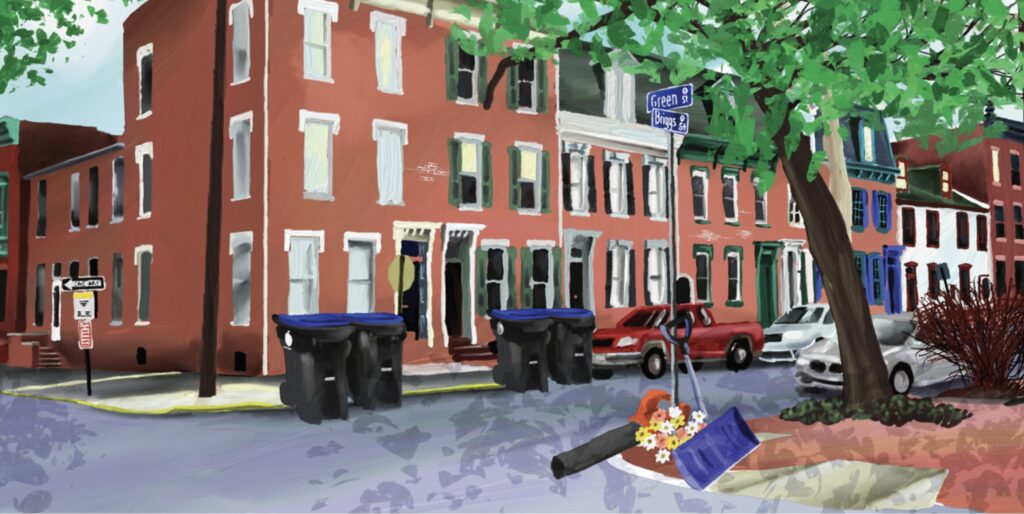
Illustration by Rich Hauck
Everyone on my block has a Joel story. Mine dates to the very day I moved into my house on Briggs Street.
It was springtime 2017, and on that very first night, a fire broke out on my block. Around midnight, emergency sirens screamed out, and a fleet of fire trucks jammed onto the small side street. For a few frightening moments, I watched helplessly as flames shot out the back of my neighbor’s row house.
The fire bureau, thankfully, quickly doused the blaze, and, finally, at maybe 3 a.m., I fell back asleep—but that wouldn’t last long.
As dawn broke, a loud grinding sound jolted me awake, and I quickly realized that some (insert profanity here) guy was mowing grass at 6 a.m., just hours after the fire had awakened the entire neighborhood.
And that’s how I met Joel.
Joel Turley, I soon learned, was the self-styled “Mayor of Briggs Street.” He lived in a small, first-floor unit of a row house carved up into apartments, and had been there, a neighbor once told me, since “the dawn of time.”
My mother would have called Joel a “character,” a description that nearly everyone on the block—perhaps including Joel himself—would endorse.
If you left for work at 8 a.m., Joel would be outside, strolling up and down the block, picking up random pieces of litter. If you came home at 5 p.m., he’d still be around, greeting you with a “Hiya, young man,” then leaving you with a firm “God bless.”
At almost any time, you might hear a whirrr approaching, and you knew what that was. Armed with a leaf blower that may have been surgically attached, Joel was inching up Briggs Street, making sure his block stayed clean.
Joel was the eyes and the ears and the heart and the soul and the blessing and the bane of Briggs Street.
If you bumped into Joel, he might regale you with his analysis of the neighborhood: who was weeding, who was planting flowers, who was cleaning up, who was practicing (or not) proper snow removal. For a few bucks, he’d gladly take on some of those tasks, the go-to guy if you needed your sidewalk shoveled or your brick walk weeded.
Trash day was a particular concern.
When I moved into the neighborhood, I couldn’t understand why the entire block’s garbage was at curbside two days early. Did some collective spell cause all my neighbors to put their trash out on Sunday for a Tuesday pickup?
It took me a while to realize the common denominator was . . . Joel, who dragged every can to the curb fully 48 hours early. Like everything else he did, he didn’t ask for permission—as mayor of the block, he just did it. He was going to help you, whether you wanted it or not.
In my own petty way, I rebelled against this trashcan tyranny, refusing to roll my cans out from the backyard until the night before. However, I soon learned the hard way who really was in charge on Briggs Street.
One evening, I placed my can out front, but then realized I had one more bag to toss. When I went back outside, my can was—gone, vanished. In the cold dark, I wandered down the street, bag in hand, searching for my missing bin, finally finding it encircled by a group of other city-issued receptacles.
Without my knowledge, Joel had shanghaied my garbage can. Upping his trash game, he had begun consolidating every can on the street into two large clusters, situated half-a-block down from my house. Then, after pickup, he rolled the large plastic bins back to everyone’s house, with a deafening rumble, at around 6 in the morning. The next time I saw him, I asked him why.
“Gotta help out the guys,” he said, referring to the city’s sanitation workers. “They work hard, you know?”
And that was Joel. He wanted to help people—and often did. He put canned goods in his window boxes or in bags outside his building, so that needy folks might take them. At one point, he grew tired of the growing pile of garbage dumped in one of the many parking lots abandoned, post-pandemic, by state workers. Unlike most everyone else in the neighborhood (including me), he took it upon himself to clean up the mess.
Last summer, I ran into Joel and his sister, who was visiting from out of state. Joel told her that I ran TheBurg, and she said that I should write a story about her brother—the “Mayor of Briggs Street,” she proudly stated.
And so I have. I don’t know if this is what she had in mind, and almost certainly she didn’t intend it to be a remembrance, as Joel died suddenly in late February.
But it might resonate with those of us who live—or have lived—in Harrisburg’s Capitol district over the last three or four decades. Joel was a quirky, friendly guy who spent much of his life walking up and down Briggs Street, trusty leaf blower in hand, rumbling trashcans in his wake.
You may have appreciated his assertive good deeds, or maybe not. Regardless, his heart, I believe, was in the right place, a person who cared deeply about and was uncommonly committed to the street he lived on.
Lawrance Binda is publisher and editor of TheBurg.
If you like what we do, please support our work. Become a Friend of TheBurg!