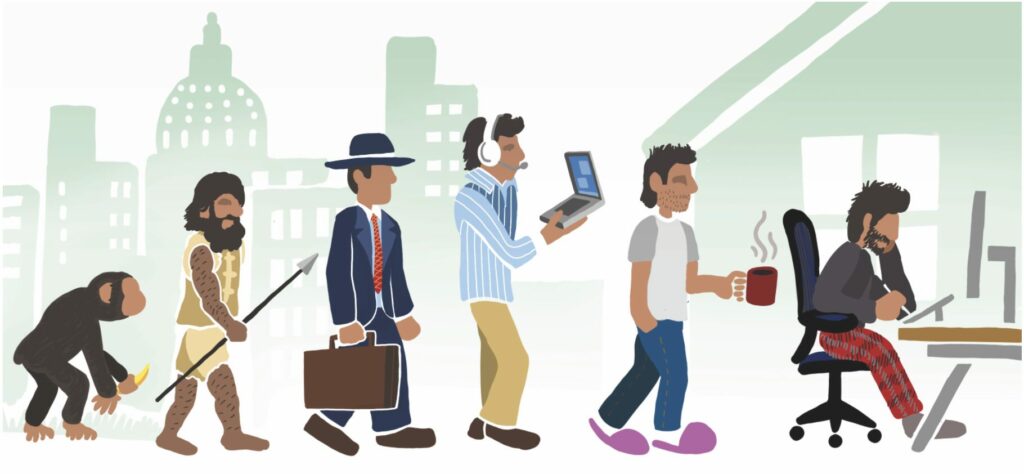
Illustration by Rich Hauck
Harrisburg is at an inflection point.
For the past six or so decades, Harrisburg has been primarily a government town, its economy driven by the commonwealth’s ever-growing workforce.
Those days are over.
For a few years, we could fool ourselves into thinking that the daily fire hose of state workers, sprayed up Forster and down State Street, headed for the Capitol Complex, would resume someday.
It was just a matter of time, we thought, before our region’s huge white-color workforce would see the value of trading in their pajamas for khakis and return to the office—or be forced to.
Once again, they’d be walking our streets, eating at our restaurants, drinking at our bars, browsing our shops.
It’s time to give up such thinking. Four-plus years after the pandemic hit, upending our lives, we’ve reached the maximum level of “return.”
My back-of-the-envelope estimate puts the number of commuters into Harrisburg—both government and other office workers—somewhere between one-third and one-half of pre-pandemic levels.
Therefore, it’s time to begin thinking about what comes now. What’s next for Harrisburg after “government town?”
Now, this isn’t the first time that Harrisburg has had to remake itself.
Following the Civil War, the city grew rapidly from small market town to dense urban center. Then, after World War II and the collapse of the steel industry and railroads, its economy—its very identity—became inseparable from the only major thing left, the state government.
Not that everything was great—far from it.
The city had developed around heavy industry and the blue-collar workforce that needed to live within walking distance of its factories, rail yards, bars and stores. The new labor force didn’t, commuting in vehicles on freshly paved highways from spanking new houses in the suburbs, driving its population, disposable income and tax base out of the city every day.
Still, as some people have said to me over the years, what would Harrisburg be without all the state workers here?
Well, now we get the chance to find out, as Harrisburg enters a new phase in its 300-year-old history.
This phase won’t be about industry and, increasingly, won’t be about state bureaucrats either. So, then, what will it be?
My best guess is that, given enough time, we’ll see a more mixed economy, less dependent on a single employer or industry and more heterogeneous, based upon a growing residential population, small businesses and visitors.
I once wrote that Harrisburg’s fate lies in its core strength as a small, walkable, densely built city located along a magnificent river, close to larger metros. I said that, to exploit these advantages, it must “learn to do small city well.” I continue to believe that.
Perhaps, over time, Harrisburg will head in this direction by default, as other options (e.g. attracting industry or major employers) seem unlikely. However, city stakeholders can take steps to inspire and advance this future.
First of all, Harrisburg needs to right-size its major roads, which are too big, fast, ugly, noisy and dangerous. The city’s tight street grid was destroyed in the 1950s to accommodate the daily inflow and outflow of state workers. Those days are over. So, Harrisburg and PennDOT need to slim down streets, eliminate lanes and reduce speeds. The two-way 2nd Street project should serve as an excellent example of how urban life can be greatly improved through road reform. Let’s extend that approach throughout the city.
Secondly, Harrisburg needs to encourage housing construction and renovation, offering incentives and knocking down barriers. I like city officials’ emphasis on affordable housing, but it shouldn’t stop there. Harrisburg has thousands of vacant lots and empty buildings, offering vast opportunities for housing of all types. The city can accommodate many more people, as it remains about 40% below its peak, 1950s-era population. A thriving city is a vibrant one.
Thirdly, small business and arts and culture should be prioritized as engines of the local economy. Sure, it would be great if a Chick-fil-A, Costco or Trader Joe’s would settle within our borders, and props to anyone who can make that happen. However, I consider this unlikely, given the unyielding requirements of these national companies. So, I think that the city should spend its scarce economic development resources focused on rebuilding street-level retail and other small-scale enterprise. I also believe the city would be better served with 50 solid, independently owned shops, art spaces and eateries than with a corporate behemoth or two.
Transitions are typically hard—and painful—and, certainly, this one will be too. Moving ahead will take planning, money and hard work. For some 60 years, Harrisburg, for better or worse, has been “government town.” It’s now moving on to something else, a new phase in its long history. That future can be random, unplanned and uncharted. Or we can grab the wheel and steer it ourselves.
Lawrance Binda is publisher and editor of TheBurg.
If you like what we do, please support our work. Become a Friend of TheBurg!