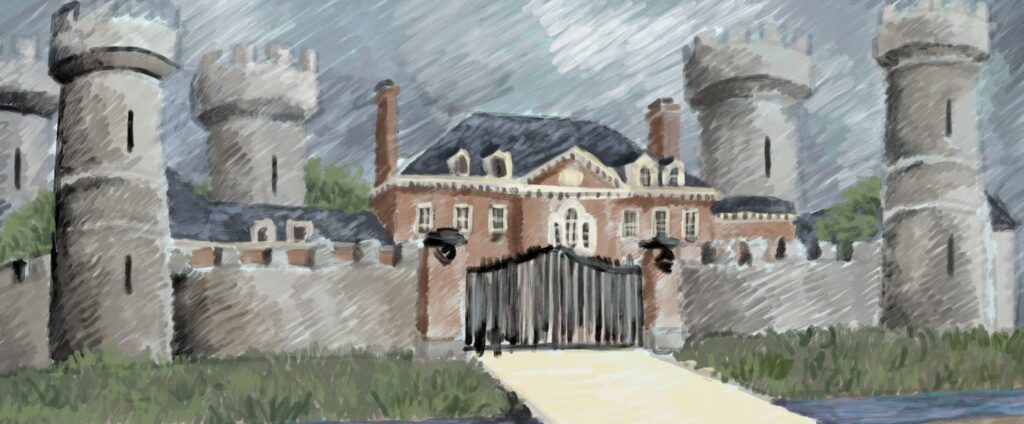
Illustration by Rich Hauck
Like most Americans, I stared in horror and disbelief as a string of terrorist attacks unfurled on live TV on Sept. 11, 2001.
Unlike most Americans, I had genuine reason to fear for my personal safety. My house was a block from the U.S. Capitol, one of the closest private buildings to the Capitol complex in Washington, D.C.
On that morning, I sat in my living room stunned, not sure what to do. Friends and family called, urging me to flee my house. I didn’t, only to learn later that United Airlines Flight 93, which crashed into a field in Somerset County, Pa., was likely headed in my direction. If not for the brave passengers and crew aboard that flight, I might not be here today.
I mention this now not to rehash the events of that terrible day, but to explain what came next.
Before 9/11, I lived in a very special neighborhood. My house was less than a block from the Supreme Court, the Library of Congress, the Folger Shakespeare Library. These monumental buildings, grand lawns and lovely gardens made up the content and context of my neighborhood. It was a uniquely beautiful and extraordinary place to call home.
After 9/11, a gloom fell over my neighborhood. Streets closed. Ugly concrete barriers lined the blocks; bollards went up everywhere. There were chain-link fences and makeshift gates and security checkpoints and police who stopped and questioned me when I tried to walk down my own street.
A few years later, the U.S. Capitol police proposed installing a pop-up barrier directly in front of my house. That was the final straw. I decided to sell, later using some of the proceeds to move to Harrisburg and start TheBurg.
At the time, I simply couldn’t understand how ravaging my neighborhood made the Capitol any safer. It would not have prevented a 9-11-type attack, which used airplanes as weapons. In my view, any security gain was marginal, but at great cost to the taxpayer and to the surrounding community. Years later, I felt my opinion vindicated when all those measures failed to prevent the worst attack on the Capitol in U.S. history—the ground assault of Jan. 6, 2021.
Recently, I had a flashback to that time. In the wake of the horrendous arson attack on the PA Governor’s Residence, I feared that similar things might happen in Harrisburg. The state closed off an adjacent alley; stately old trees along Front Street were felled; the sidewalk was blocked; an unsightly fence was quickly erected.
Yes, I understand that greater security may be needed around the residence. For three years, I lived nearby and often walked down Geiger Street, the alley adjacent to the south side of the mansion grounds. From there, last April, an attacker climbed the fence, ran up to the building, smashed a window and firebombed the dining room.
I wasn’t surprised that the attack originated from that spot. Walking by almost daily, I often thought about how exposed this area was—isolated, eerily quiet, pitch-dark at night. I rarely saw any personnel on the grounds there, save the occasional gardener.
So, yes, I believe that the Governor’s Residence needs better protection, especially from the dark, quiet, backside of the property. And, unfortunately, we live in an age with toxic politics, toxic partisan media and toxic social media, which together can pollute minds, feed delusions and trigger someone inclined to violence.
But I also believe that additional safety can be had without turning Front and Maclay streets into an ugly, scattered mess of metal fencing, tree stumps and concrete barriers. Fortunately, the Governor’s Office assured me last month that these unsightly elements are temporary as the state improves security measures, including constructing an “anti-climb fence.”
“In the end, the Residence and surrounding grounds will look much as neighbors remember,” stated the governor’s press office, in response to my questions.
I also would advocate for additional human resources. Would I want a job sitting in a guardhouse all night long? I would not, but more eyes and ears may be the best way to thwart a future attack, with the least negative impact on the residence and on the surrounding natural and built environment.
Indeed, Harrisburg—and Pennsylvania—deserves a well-considered, well-designed security and architectural plan that respects the city, the riverside setting and the building’s own history, stature and aesthetics. I’m confident that, with thought, care, expertise and skill, the commonwealth can achieve a balance between security, functionality and design. In the end, opportunity could arise from calamity, with the building’s security, livability and eminence all enhanced.
Two dozen years have passed since the horrible day of Sept. 11, 2001. Unfortunately, the political climate today may be even more volatile, especially domestically. Ultimately, the best way to improve security is not with stronger fences but with stronger people—with politicians, pundits and ordinary Americans collectively deciding that we’ve had enough, that we must work together to rediscover respect and lower the temperature of our civic discourse.
Lawrance Binda is publisher/editor of TheBurg.
If you like what we do, please support our work. Become a Friend of TheBurg!