CCCW at the Harrisburg Regional Chamber & CREDC’s Catalyst Awards
When the Cumberland County Commission for Women (CCCW) accepted a major regional award, Chair Brianda Freistat stepped up to the mic to share a powerful observation.
“When women hold the microphone, the room leans in,” Freistat said in her acceptance speech. “When women lead policy conversations, the agenda changes.”
That shift is already underway in Cumberland County, thanks to this group of 25 women bringing long-overlooked issues affecting women into the light.
The commission’s mission is simple: to make the county a better place for women and girls. The group works in partnership with County Commissioner Kelly Neiderer and includes professionals from across the county, from New Cumberland to Boiling Springs to Newville, representing a wide variety of ages, backgrounds and life experiences.
The organization was established in 1999 but only recently transformed into an active force for change. Lately, the commission has focused on recruiting community members and setting strategic, attainable goals.
“We used to have less than 15 spots,” said Freistat, a lobbyist and consultant from New Cumberland who has chaired the group for the past 1½ years. “Now, we’re up to 25, and we have a waitlist to get in.”
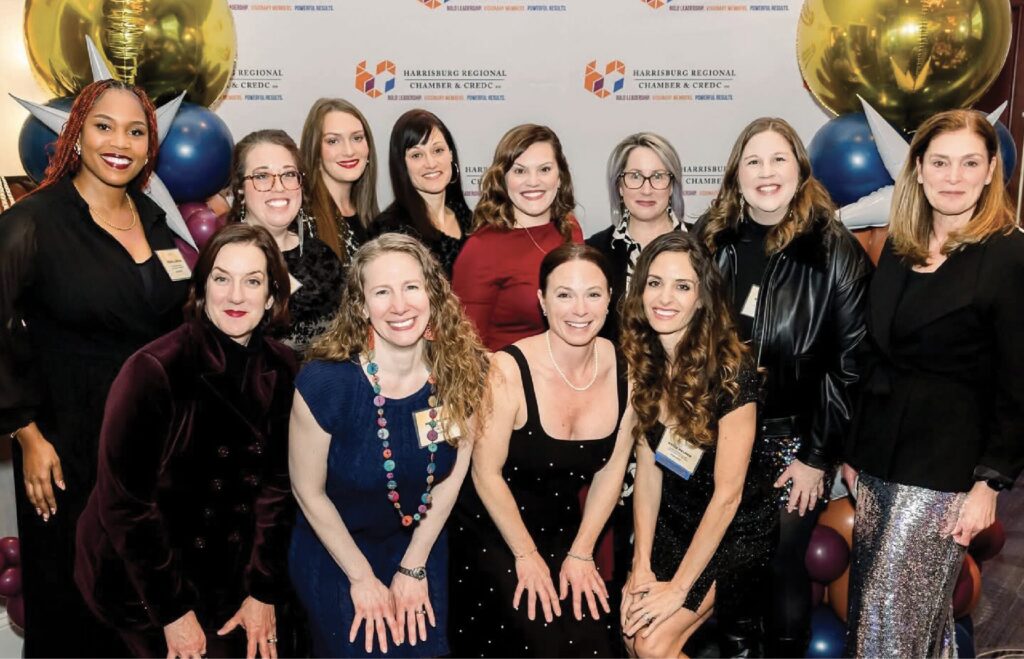
That waitlist is a testament to CCCW’s growing visibility, which reached new heights when the group was honored as “Government Leader of the Year” at the Harrisburg Regional Chamber & CREDC’s annual Catalyst Awards in December.
“We were honored and humbled, to be quite honest,” said Freistat. “We are all volunteers. We do this in our evenings and when we can throughout our workdays. For an organization like CREDC to realize community happens when people step up outside of their day to day, that’s humbling.”
The recognition came as the commission was wrapping up a major initiative addressing the county’s childcare crisis.
Cumberland County is the fastest-growing county in Pennsylvania, but, while it has added necessities like grocery stores and hospitals, it hasn’t added nearly enough childcare providers to serve the increasing number of working families. The shortage affects the whole family unit, but the burden often falls disproportionately on women.
“They’re the ones who leave the workforce,” said Vice Chair Becca Zelner. “They’re the ones who have to find different childcare when daycare is closed, when the child is sick. At the doctor’s appointment, who takes them? Mom.”
The group hosted two town halls on childcare—the first to identify the crisis and the second to explore how the business community can help address it. Recently, they released a comprehensive report proposing a private-public partnership model to increase childcare capacity across the county. Working with CREDC, the local chamber and York County’s ECHO (Every Child Has Opportunities), the report lays out how businesses can begin working with the community to address the gap.
Showing Up
While the childcare crisis brought CCCW into the spotlight, it’s far from their only issue. The commission addresses a variety of challenges women face in different circumstances and stages of their lives.
“The goal is really to advocate on issues that are important to us and are therefore important to other women in Cumberland County,” Freistat said.
Throughout the year, the commission hosts events that address these various issues. Recent initiatives have included healthcare and wellness fairs focusing on women-specific health needs. At their latest fair, vendors specializing in women’s health sparked conversations about topics often overlooked in traditional healthcare settings, including perimenopause, which is “wildly understudied and undertreated,” according to Freistat.
“Women have different health needs and require different health specialties,” she said.
The commission is also exploring programs around financial literacy for women, recognizing that money management is another topic that often isn’t discussed as openly as it should be.
Beyond healthcare, the commission has tackled housing issues, connecting women with resources on affordable housing and shelter programs. They’ve addressed navigating complex county systems, such as filing for divorce and understanding available support services.
The commission also shows up intentionally at community events, from domestic violence vigils to breast cancer walks to a “Healing through the Arts” event. Women approach CCCW’s table to share their stories and gratitude, and some join the group.
“It’s our simple presence [at events] and them knowing what we do that had an impact on them,” said Tiesha Laryea, CCCW’s communications chair. “That’s why I think this work is important.”
Looking Ahead
The commission has a range of events and initiatives in the works.
For International Women’s Day on March 8, CCCW will collect menstrual products from locations across the county and create care packages.
“If you can imagine for a second, your family is on hard times, maybe you’re 12 or 13 in school, and you’re too embarrassed to go to the nurse or afraid to ask for support,” Freistat said. “We don’t even want her to have to make that choice.”
This summer, the commission will host a roundtable discussion on running for local office, designed to demystify the process and encourage more women to pursue local government positions. The event will feature women currently serving in positions such as state representative, mayor, township supervisor and school board member.
“Women are typically asked to run. Men just say, ‘I am running,’” Freistat said. “It’s one of those outdated patterns. We want to flip that script.”
The conversation will address concerns women often have to consider that men may not, such as childcare logistics and balancing family responsibilities with campaign commitments.
“We want to do the basics of ‘how do I get into government,’ from the moment of filing a petition to what type of staff you need,” Laryea said. “A lot of people who want to run don’t understand the process.”
The goal is to show women that many local positions are more attainable than they realize. And, as Freistat reminded the room at the Catalyst Awards, when women hold the microphone, people lean in. The conversation shifts, the agenda changes. In Cumberland County, that change is becoming a reality.
“Representation reinforces possibility,” said Laryea. “When women lift other women up, it signals, ‘there’s room for you here, too.’”
And judging by that waitlist, more women are ready to pull up a chair.
For more information on the Cumberland County Commission for Women, visit www.cumberlandcountypa.gov/57/Commission-for-Women. Also, follow CCCW on Facebook and LinkedIn for updates on upcoming initiatives.
If you like what we do, please support our work. Become a Friend of TheBurg!