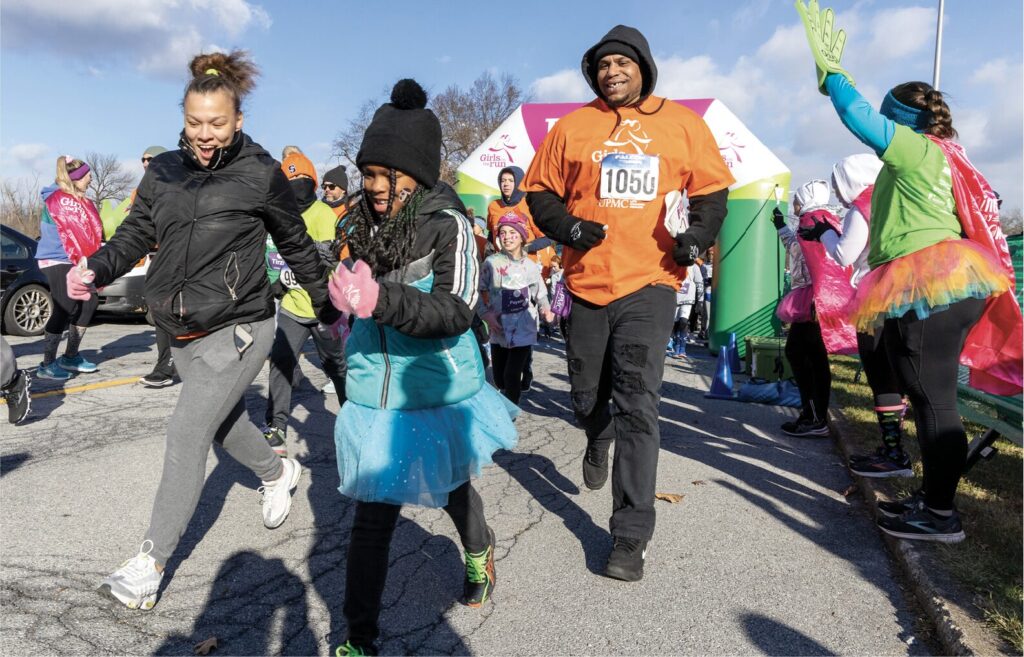
Girls on the Run. Photos courtesy of Girls on the Run.
When my 9-year-old daughter signed up for Girls on the Run a decade ago, she wasn’t a runner. Or a walker, really.
But she laced her pink sneakers and started with a strong stride around the perimeter of Shenk Park anyway. When she became red-faced, she slowed her pace, lagging 50 yards behind. By the time all the other girls finished the race, my little cherub was walking, and not quickly.
We cheered for her anyway—even as the boys’ race started. She wasn’t *too* embarrassed about placing last. She finished what she started, saying she felt “accomplished.” She said, “I proved to myself I could do it.”
Girls on the Run is one of several local programs dedicated specifically to impacting young girls. GOTR Mid State PA Executive Director Gillian Byerly believes in the connection between a strong support system and breaking out from the pressurized, barrier-laden “girl box.”
“We envision a world where every girl can boldly pursue her dreams,” she said. “Our after-school programs inspire girls to be joyful, healthy, confident, resilient and connected with their communities.”
The evidence-based program provides a judgment-free environment for trying new things. GOTR volunteer coaches guide girls through the curriculum, packed with skill-building games, activities, projects and discussions to cultivate skills like building relationships, working in teams and impacting their communities.
Although the program takes its name from a run around the park, Byerly cites a “connection between physical and emotional health, moving bodies in a powerful way to regulate emotions.” Embedded into GOTR is imparting an emotional vocabulary, teaching girls to recognize emotions, to feel negative emotions without reacting, and to develop empathy.
“We target girls specifically because they have different challenges and mature differently,” Byerly said, citing a significant youth mental health crisis. “Girls drop out in larger numbers than boys. One in three consider suicide, and two-thirds feel negative effects from competition.”
A national program in its 10th year, built on a strong volunteer network that invests in approximately 2,500 girls annually, GOTR works with girls in grades 3 to 8, with a structured curriculum focusing on five “Heart and Sole” aspects: social, spirit, brain, body and heart. Girls and LGBTQ+ kids from all races, backgrounds and socioeconomic levels are welcome. There is an adaptive curriculum for girls with disabilities.
“With encouragement from friends and a robust mentor network outside the home to cultivate healthy relationships, there’s a team of girls behind them,” Byerly said. “It makes this program beneficial in so many ways.”
Who I Needed
If running isn’t your girl’s thing, other programs offer character development opportunities through different types of mentorships.
With roots in Harrisburg, Young Women’s Empowerment Academy is a nationwide mentorship nonprofit founded in 2017, offering girls aged 8 to 25 from diverse backgrounds mentorship, leadership development and life skills.
Its mission: “Be Who I Needed When I Was Younger.”
Founder Lisa Lickers-Ricks was once that younger woman—a teen mom who needed guidance. She observed women struggling with challenges related to self-esteem, societal expectations, emotional challenges, navigating personal relationships, and overall stress from feeling like “not enough.” Seeing this need inspired her to create a support system where women could feel empowered to succeed, despite their circumstances.
Through YWEA’s leadership workshops, mental health awareness sessions, community service projects, personal development seminars, entrepreneurship training and the occasional fashion show, each activity is designed to build essential life skills.
“Our leadership workshops help the girls take ownership of their lives, while mental health sessions provide them with coping mechanisms for anxiety and stress,” Lickers-Ricks said. “The community service projects instill a sense of purpose, and our entrepreneurship training encourages them to think creatively about their future.”
Ripple Effect
Also in Harrisburg, Whitaker Center has two evolving programs to connect girls with real-world computer science applications.
Their Women in STEAM committee supplies both the Girls in STEAM program (grades 3 to 8) and Girls Who Code program (grades 6 to 12) with professional mentors who encourage girls to explore STEAM careers as possibilities. Both programs counter cultural and societal gender stereotypes that previously limited career ambitions, resulting in underrepresentation in STEAM fields.
Girls in STEAM’s Education & Science Center Manager Kristin James said the programs “create safe spaces for discussion and encouragement to empower young girls to change their mindset, overcome challenges and thrive.”
The Women in STEAM program offers a range of topics to expose girls to various STEAM opportunities. Guest speakers from local partnerships like Capital Blue Cross, Hersheypark and Harrisburg University provide girls with powerful networking connections. And inviting NASA astronauts through the AstraFemina organization shows girls that women can succeed in male-dominated fields.
Providing girls with STEAM education, showing them what’s possible “can help drive workforce development for future generations,” James said. “We can help shape the goals and aspirations of the next generation and grow the region’s quality of life and economic vitality.”
Coding is just one career path in the vast and ever-shifting field of computer science. Girls Who Code’s Innovation Educator Josh Meek points to the foundation of their curriculum of computational thinking, requiring planning, problem-solving and curiosity. Attendees engage in curated lessons of various scope and difficulty, peer mentorship and friendship-building with others who enjoy solving puzzles and exploring technology. And they learn about computer science careers other than coding, ranging from cybersecurity to 3D art and design.
For nearly three decades, this writer has held a steady 9-to-5 in computer science occupations: technical writer, functional business analyst, data analyst, project manager/integrator, software tester, hardware evaluator. Girls, I’m living proof you can have a career in computer science aside from coding. Computational thinking and problem-solving will get you far.
I wonder how far I might have gotten with mentoring programs.
Lickers-Ricks summed up these enriching local mentoring programs best.
“It’s about creating a ripple effect—inspiring young women to become leaders, innovators, advocates for positive change, and change-makers who will give back to the community,” she said.
For more information about Girls on the Run, visit www.girlsontherun.org.
To find out more about the Young Women’s Empowerment Academy, visit www.yweacademy.com.
To learn more about Whitaker Center’s programming, visit www.whitakercenter.org.
If you like what we do, please support our work. Become a Friend of TheBurg!








 As a parent of a special needs child, life is different for us.



 It may be 142 years old, but the Wednesday Club for the Performing Arts is as energetic as ever.