Tag Archives: State Museum of Pennsylvania

Total Eclipse of the Heartland: Prepare now to view the Great American Eclipse

 On Aug. 21, one of Mother Nature’s most glorious spectacles will grace the skies of the mainland United States: a total solar eclipse.

The moon will completely block the sun in a roughly 70-mile-wide corridor that runs east-southeast from Oregon’s Pacific coast, cutting right through Wyoming, Nebraska and Missouri, and all the way across the continent to South Carolina.

People inside this narrow path will be dazzled by the unforgettable spectacle of a pitch-black hole in the sky—where the sun is supposed to be—surrounded by the diaphanous whitish glow of the solar atmosphere (the corona). There’s no other sight like this in the world.

 Having seen five total solar eclipses myself, I cannot stress enough that it’s absolutely worth your time and effort to do whatever you can to get inside the path of totality at the time of what’s being called the Great American Eclipse. To paraphrase Mark Twain, the difference between a total solar eclipse and a 99.99-percent partial solar eclipse is like the difference between a lightning bolt and a lightning bug.

 But if you remain in the Harrisburg area, you can still enjoy watching a partial solar eclipse unfold over the course of 2 hours and 42 minutes. But make sure you take the proper precautions to view the eclipse safely.

 The time of when the eclipse begins and ends depends on your exact location. But if you’re in or near Harrisburg, the moon will begin to move across the sun’s disk at 1:17 p.m. The maximum blockage of the sun will occur at 2:41 p.m., when the moon will cover 77 percent of the sun’s disk. And the eclipse will end at 3:59 p.m.

Although 77 percent sounds like a lot of sun blockage, you probably won’t notice any darkening of the sky, though you might notice slightly cooling temperatures.

 Looking directly at the sun for just a few seconds, even when the partial eclipse is at maximum, can cause permanent damage to your eyesight if you don’t use the proper protection. And whatever you do, do not look at the sun directly for even a brief moment through a telescope or binoculars unless a special filter is mounted on the front end of the instrument.

 Fortunately, there are inexpensive methods for observing the partial eclipse safely.

You can order eclipse glasses online, and many public libraries are giving them away for free. These glasses block out almost all of the sun’s light, so you can stare safely at the sun for hours. But do not use eclipse glasses with a telescope or binoculars; they are for your naked eyes only.

 Another way to view the partial eclipse is to project the image of the sun by punching a small hole in a sheet of paper and letting the eclipsed sun’s light pass through the hole onto another sheet of paper. Alternatively, if you stand near a tree, its leaves will act as natural pinhole cameras, projecting dozens or hundreds of images of the partially eclipsed sun on the ground or pavement.

 If you plan to use a telescope or binoculars, make sure to securely install a special solar filter on the front end of the viewing instrument. The least expensive option is Baader AstroSolar Safety Film, which has the texture of aluminum foil. You can tape the film over the front of the telescope or over both lenses of binoculars.

 If you travel into the path of totality, it’s perfectly safe to remove the filter and view the eclipse with your naked eyes or with binoculars once the sun is completely blocked at totality. In fact, if you use a filter during totality, you’ll see nothing at all. If you’re near the center of the narrow path, totality will last two to two-and-two-thirds minutes, depending on your location.

 Obviously, there won’t be anything to see if your sky is cloudy at eclipse time. In general, the western United States has the best weather prospects. But no matter where you go, I recommend checking the weather forecast the night before the eclipse and be prepared to drive to an alternate location with better prospects for clear skies at eclipse time. With tens of millions of eclipse chasers from all over the world expected to be in the path of totality, expect heavy traffic.

 If you’re interested in photographing the eclipse, my advice is to use the time between now and the eclipse to practice photographing the sun at the local time of the eclipse. Numerous websites, such as MrEclipse.com and Eclipse-Chasers.com, offer practical tips. But if you’re in the path of totality, spend almost all of your time actually looking at the eclipse. Don’t waste this precious time fiddling with camera equipment.

 The Aug. 21 eclipse will be the first to touch the U.S. mainland since 1979. And it’s the first coast-to-coast eclipse since 1918. The path of totality crosses 14 states (although just tiny portions of Montana and Iowa) and five state capitals. And amazingly, it’s the first solar eclipse in which totality can be seen exclusively from the United States since our Founding Fathers declared independence in 1776.

 A typical location on Earth gets one total solar eclipse every 375 years on average. The last total eclipse to pass over Harrisburg was in 1478—before Columbus’s first voyage to America. The next won’t take place until 2144—when nobody reading this article will still be alive.

 If you miss the Aug. 21 eclipse, you’ll have another shot on April 8, 2024. A total solar eclipse will cross the United States from Texas to Maine, and the narrow path of totality will pass over the very northwestern part of Pennsylvania, in and around Erie.

The State Museum of Pennsylvania’s planetarium will run shows about the eclipse from Aug. 9 to 20.

Raised in Hershey, Robert Naeye was editor-in-chief of Sky & Telescope magazine from 2008 to 2014.

Continue Reading

June News Digest

Dog Park Proposed

Terriers and hounds soon may displace groundhogs and squirrels from a block of long-empty land in Midtown, as plans are afoot for Harrisburg’s first public dog park.

The community group Friends of Midtown is raising about $18,000 to cover two years of expenses for the off-leash park, which would be created on a grassy, three-quarter-acre expanse at N. 7th and Granite streets.

“We have the enthusiastic support of the city, the planning bureau,” said Annie Hughes, who is spearheading the effort for Friends of Midtown with her husband Andy. “Everybody’s all in, essentially.”

The Vartan Group owns the lot and has agreed to a two-year commitment, Hughes said. Friends of Midtown should hear soon on the fate of a grant application from PPL Electric and also is soliciting funds from individuals. It hopes to have the park, which would be free and open to the public, ready by spring 2018.

Plans call for a fence to ring the lot, which would be divided into two areas—one for large dogs and the other for small dogs. Dog waste bags would be available on site, and signs would be posted with the rules of the park.

The desire for a dog park in Harrisburg has come up repeatedly in recent years. Two years ago, it was the fifth most-popular suggestion among 1,200 ideas for inclusion in the city’s comprehensive plan, Hughes said.

She added that the dog park would be temporary, serving as a pilot for the city, which may use data collected from this effort to build a permanent park.


Jackson Hotel Mural

A new mural will celebrate Harrisburg’s African-American history, adorning the side of a building that once hosted such luminaries as Louis Armstrong and Pearl Bailey.

Sprocket Mural Works announced the project last month for the former Jackson Hotel and Rooming House on the 1000-block of N. 6th Street, a building that, decades ago, catered primarily to a black clientele refused service in the city’s major, segregated hotels.

“It will be an African-American historic mural, playing off the history itself,” said Sprocket co-founder Jeff Copus.

The Jackson Hotel painting is one of 10 murals that will be created during the Harrisburg Mural Festival, which Sprocket is organizing for the first 10 days of September.

Copus last month told the Harrisburg Architectural Review Board (HARB) that the mural will feature people who stayed at the hotel, possibly including entertainers like Armstrong, Bailey, Cab Callaway and Ella Fitzgerald. It may also incorporate images of important Harrisburg figures such as Ephraim Slaughter, an escaped slave who fought in the Civil War and later settled in the city.

In August, Sprocket will seek public input for the mural design, Copus said.

Sprocket is commissioning artist Cesar Viveros to paint the mural. Locally, Viveros is best known as the artist-in-residence who helped design and lead the creation of the Mulberry Street Bridge murals. 


Stop the Drop

A small change to trashcan lids may cut the amount of litter on Harrisburg streets.

That’s the idea behind “Stop the Drop,” a campaign to turn home trashcans into, essentially, public trashcans.

The new lids are bright orange with a hole in the center that residents can attach to their trashcans, replacing their existing, solid lids. Pedestrians then can put litter into the can through the hole, rather than toss it in the street, said Julie Walter, neighborhood revitalization manager at Tri County Community Action, a part of the grassroots coalition Clean and Green Harrisburg.

A successful, three-month pilot run on 6th and Market streets convinced the coalition to roll out the lids citywide, Walter said.

“[We were] excited that people were actually using the lids,” she said about the trial run. “When we would go check them out, there would be coffee cups and chip bags in the cans. You can tell that there was actually a need.”

Later this month, residents citywide will be able to volunteer to swap their lids out with the new lids. These new lids work well with rowhome residents who place their trashcans at the front of their houses, she said. 


King Mansion Sells

Harrisburg’s iconic Horace King Mansion sold last month, purchased by an engineering firm that plans to relocate there.

K & W Engineers, under the holding company name 2201 NFS LLC, purchased the building at 2201 N. Front St., along with several adjacent parcels, for $1.8 million from a group called 2201 Partnership, which had owned it since 2003.

The 10-person engineering and consulting firm expects to leave its current offices in Swatara Township and move into the building once renovations are completed this fall. To that end, CREDC provided a $325,000 Enterprise Zone Loan for improvements to the second floor.

The building also houses the marketing firm Sacunas, which moved into the first floor late last year.


Home Sales Up Again

Area home sales continued a years-long climb, as unit sales rose 4.4 percent in May, according to the Greater Harrisburg Association of Realtors.

GHAR said that May sales totaled 948 units versus 908 houses in the year-ago period. The median price dipped to $170,000 compared to $174,900 in May 2016.

Dauphin County sales were strong, with 355 units sold versus 297 in the year prior, with the median price unchanged at $155,000. In Cumberland County, 310 houses sold compared to 326 in May 2016, with the median price falling to $190,125 versus $193,950, said GHAR.

In Perry County, 43 houses sold versus 30 in the year prior, and the median price fell to $127,000 against $151,500 in May 2016, said GHAR.

GHAR covers Dauphin, Cumberland and Perry counties and parts of York, Lebanon and Juniata counties.


So Noted

Andrew Guth of Harrisburg took first place in the category of “Work on Paper” at the 2017 “Art of the State,” a juried exhibit held each year at the State Museum of PA to honor the commonwealth’s best artwork. Guth is a Millworks and Burg artist, contributing the cover art for our May issue. You can see his winning entry, “Where We Used to Go When Everything Was Wrong (I Watched the Lilies Grow Until They Got Old),” with the rest of the exhibit, which runs through Sept. 10 at the State Museum.

Anna Rose Bakery & Coffee Shop opened last month at Walnut and N. 2nd streets in Harrisburg, featuring doughnuts, cupcakes, cookies and espresso drinks. The business, owned by Ron Kamionka, is located in the rear portion of the former Molly Brannigans Irish Pub, which closed almost three years ago. 

Excelon Corp. is making plans to shutter Three Mile Island in 2019 absent policy reforms by the state legislature to make nuclear power more competitive. TMI employs 675 workers, most of whom would lose their jobs if the facility closed.

Freshido, a fast-casual restaurant specializing in Asian cuisine, is expected to land this fall in Strawberry Square, at the corner of N. 3rd and Market streets. The 50-seat eatery will occupy the 2,200-square-foot storefront long vacated by Plum Sport.

Harrisburg Downtown Improvement District launched “Discover the Ducks Downtown,” an outdoor art and beautification exhibit for the summer. Along with HDID, Harrisburg-based Sprocket Mural Works commissioned artists to paint 15 fiberglass ducks, which now can be seen throughout the downtown.

Harrisburg Hoopla, a field day of track-and-field activities, raised $5,500 last month for local nonprofits. Fourteen groups with 101 participants competed for select organizations in this first-ever charitable event, sponsored by Emerging Philanthropists Program, a partnership of TFEC and HYP.

Hershey Harrisburg Regional Visitor’s Bureau last month received a Bronze Anvil Award of Commendation from the Public Relations Society of America. The award was for “Tourism in Your Town,” a series of advertorials that appeared in TheBurg throughout 2016.

PFM Asset Management signed a lease last month for 63,133 square feet of space in an office building at 213 Market St. in Harrisburg. By year-end, the firm plans to relocate its 150 employees from 100 Market St., where it has been for the past 20 years, according to commercial real estate firm CBRE Group, which represented the company.

Rite Aid has opened in Strawberry Square in downtown Harrisburg. The new, 14,000-square-foot store moved from cramped quarters across Market Street after a yearlong build-out.


Changing Hands

Adrian St., 2418: G. Brown to R. Ivey, $30,000

Balm St., 60: Kusic Financial Services LLC to OJK Enterprises, $32,000

Bellevue Rd., 1921: CNC Realty Group LLC to J. Romelfanger, $55,000

Berryhill St., 2202: PA Deals LLC to R. Narinesingh, $62,500

Berryhill St., 2316: D. & Y. Jiang to D. & L. Nguyen, $30,000

Boas St., 1925: P. Long to Resistance Properties LLC, $38,000

Camp St., 521: G. & S. Gallagher to K. Moralez, $30,000

Conoy St., 123: Secretary of Housing & Urban Development & Information Systems Network Corp. to E. Fultz, $73,000

Elliot St., 1080, Lot 2: R. & C. Berger to A. Gerges, $250,000

Fox Ridge Ct., 307: B. Miler to C. Hoover, $121,500

Green St., 1007: R. Nicoli to J. & C. Nunley, $110,000

Green St., 1915: J. & K. Johnston to S. Williams, $207,900

Green St., 1930: A. Miller to I. Bailey, $205,000

Green St., 2013: L. Binda to M. Didone, $214,000

Green St., 2137: Deutsche Bank National Trust Co. Trustee to N. Morrison, $32,694

Green St., 2321: J. Yoder to Willowscott Investment LLC, $37,500

Hale Ave., 447: K. & L. Torres to D. Norris, $62,000

Hamilton St., 242: J. & J. Collins to P. Christensen, $150,309

Harris St., 207: MTGLQ Investors LP & Selene Finance LP to K. Clark, $117,900

Harris St., 344: MidAtlantic IRA LLC Phillip Sachs IRA to M. & A. Gilbert, $108,500

Herr St., 269: G. Thall to M. Berlin, $115,000

Hoffman St., 3221: W. Wood to N. Consagra & L. Umberger, $109,900

Holly St., 2006: W. Thompson III to SCC Ward Inc., 32,000

Kelker St., 427: Secretary of Housing & Urban Development & Information Systems & Networks Corp. to I. Jordan, $32,500

Kensington St., 2110 & 2116: Donald L. Pong Trust to M. & A. Robinson, $59,000

Lewis St., 237: J. Toro to M. Horgan & Innovative Devices Inc.., $43,500

Locust St., 202: AMTO LLC to Sturges Property Management LLC, $300,000

Luce St., 2320: EAD Associates LLC to S. Ginder, $38,000

Muench St., 278: Secretary of Housing & Urban Development & Information Systems & Network Corp. to H. & C. Foley, $44,06

N. 2nd St., 1522: J. Cantarell & A. Meck to K. Reiter, $164,000

N. 2nd St., 2323: LSFP Master Participation Trust to M. Horgan & CR Services Inc., 63,900

N. 2nd St., 2528: A. & C. Broadus to E. Pine & S. Ransome, $145,000

N. 4th St., 3119: R. & C. Steele to T. Gottshall, $123,500

N. 4th St., 3213: A. Semancik to G. Erdman & S. Ukodie, $120,000

N. 4th St., 3227: Central Penn Properties to T. Barnes, $142,000

N. 5th St., 2515: 2013 M&M Real Estate Fund LLC to T. & V. Williams, $129,900

N. 5th St., 2600: PA Deals LLC to S. & S. Aiken, $69,900

N. 7th St., 2714: M. Owens to L. Owens, $45,158

N. 14th St., 1206, 1314 N. 15th St. & 603 Benton St.: Kirsch & Burns LLC to Equity Trust Co. Custodian John Spencer IRA, $165,000

N. 15th St., 1340: MidAtlantic IRA LLC James Yeager IRA to Z. Yap, $39,000

N. 16th St., 1216: R. Urrutia to W. Jones, $110,000

N. 17th St., 1102: C. & N. Finnell to J. Martinez & T. Kobayashi, $33,500

N. Front St., 1525, Unit 605: A. Lenda to C. Carter, $173,500

Peffer St., 219: N. Braun to D. Wendt & S. Shultz, $122,000

Peffer St., 317: 1515 Associates to D. Berhe, $75,000

Penn St., 1605: R. Daniels to L, D. & R. Olenowski, $87,500

Reel St., 2416 & 2418: 24 Reel Street LLC to American Rental Home LLC, $52,000

Rudy Rd., 2454: J. & S. Merlina to J. Howard, $57,500

Sassafras St., 269 & 1112 Susquehanna St.: R. & J. Ruth to Major League Properties LLC, $60,000

Showers St., 605: H. Madsen to J. Moore, $163,900

South St., 122: Tang Liu Realty LLC to FA Realty LLC, $126,000

S. 2nd St., 316: WK Rentals to Diamond Real Estate Solutions LLC, $32,000

S. 13th St., 1456, 1460 & 1466: Davden Property Investments Inc. to 4880 East Prospect LLC, $66,000.

S. 16th St., 947: R. Splawn to L. Jackson, $30,000

S. 24th St., 623: K. & D. Brown to S. Jordan, $72,200

Swatara St., 2055: G. Barlow to S. Thomas, $34,500

Swatara St., 2413: J. Garisto to PI Capital LLC, $85,801

Verbeke St., 300: Kidder Wilkes LP to Silverstone Enterprises LLC, $215,000

Watson St., 2815: R. & A. Gates & C. Windham to LJ Realty Trust, $59,800

Harrisburg property sales for May 2017, greater than $30,000. Source: Dauphin County. Data is assumed to be accurate.

Author: Lawrance Binda 

Continue Reading

Golden State: Raise a glass as State Museum celebrates 50 years of “Art of the State.”

Photograph; “Miranda” by Nicole Dube

As the summer heat descends upon Harrisburg, many midstaters pack up their suitcases and sunscreen and head for the surf, sand and sea.

Fortunately, for those who are staycationing it by the Susquehanna this steamy season, a free voyage awaits in the shadow of our own Capitol, at the State Museum.

As Marcel Proust once said, “The real voyage of discovery consists not in seeing new landscapes, but in having new eyes.”

On display through early September, right here in our own backyard, your eyes can be opened as you take in 130 original paintings, sculptures, photographs and three-dimensional crafts from 119 Pennsylvania artists.

This is the landmark 50th year of the annual “Art of the State” exhibit, proving that life begins at 50.

More than 20 artists in the exhibit hail from Dauphin and Cumberland counties, including TheBurg’s own Aron Rook, the magazine’s former chief illustrator, and a first-time entrant in “Art of the State.”

Her piece, entitled “Gold Bond, Because Silver Linings Don’t Mean Sh*t,” is wood-burn, acrylic and gold leaf on an antique wood panel. The piece reflects both “strength and vulnerability,” Rook explained, with two mirroring figures who have placed their hearts where their heads are.

“They are deteriorating, they have become disconnected,” she said. “Yet, in all their decay, they are surrounded by golden light.”

Another local artist who dazzles is Nicole Dube, a Carlisle-based photographer whose picture of “Miranda” depicts a pensive young teen.

“That kind of melancholy—you don’t expect a 14-year-old to have such deep thoughts, such a burden on her shoulders,” Dube said. “You rarely see that kind of weightiness.”

Harrisburg’s award-winning street photographer Karen Commings’ entry is a full-color photograph of a bicyclist zipping down 2nd Street in Harrisburg in the pouring rain, the green of the streetlights glowing in the gray mist.

“I always appreciate the beauty of Harrisburg and seeing it wet,” said Commings, a long-time member of the Harrisburg Camera Club. “I just hope people will appreciate the beauty of the street, and I hope it makes them happy to look at it,”


New Excitement

Harrisburg-based artist Jeff Wiles had an impressive three pieces accepted into the exhibit this year.

“Regardless of the style of photography, it’s always my hope that I establish an emotional connection with the viewer,” Wiles said. “A good image will hold the eye, prompt interpretation and be memorable.”

Dube admits that her favorite piece in the exhibit is Wiles’ photograph entitled “Four Worlds,” which shows four Milton Hershey School students on a bus, each so close in proximity, yet so far apart in spirit.

State Museum Director Beth Hager said the show is an “interesting mix, juxtaposed against each other.” With different judges, and featuring everything from rocking chairs and jewelry to pottery and portraits, the show changes dramatically from year to year.

This show features a first-time award from the docents, she noted, which is triggering new excitement.

“Pennsylvania has a rich artist tradition,” Hager said. “Historically, Pennsylvania has been a mecca for artists.”

She pointed out that “Art of the State” is among the longest-running shows in the nation, if not the longest.

“It just draws you in,” she said. “It’s amazing what comes in every year.”

This year’s exhibit attracted nearly 2,200 entries from 845 artists. It’s co-presented by the State Museum and Jump Street, with WITF and Higher Information Group as sponsors.

Hager noted that, thanks to a newly negotiated reciprocal agreement, members of the State Museum and the Susquehanna Art Museum now can receive free admission to both destinations through Sept. 17.


A Conversation

For the 50th year exhibit, some works are indeed “state-of-the-art.” Others are timeless.

Rook said that, for a work of art to be brilliant, it must be “a most genuine expression, one where sincerity cuts through all the veils. Perhaps it deconstructs and reconstructs beliefs.”

To be a great photographer, “You have to understand your equipment and be willing to experiment and practice, practice, practice,” Commings said.

Keeping up with software and the capricious weather is a constant challenge, she added.

For Dube, the challenge is light.

“Photography is light,” she said. “That’s the hardest thing always.”

From the creative side, Dube said she always looks for a beautiful subject and, more importantly, a subject that resonates.

“A photograph will be empty unless there is some kind of narrative,” she said. “The narrative can be hidden or overt.”

Commings does a lot of street photography, particularly in the rain.

“In candid situations, sometimes it’s the unusual, sometimes it’s the ordinary, shown in an unusual way,” she said. “Nothing is off limits. Once I take it, I know how I want it to look, how I want to process it.”

During the exhibit, the museum plans to offer three “Conversations with the Artists,” programs, where two artists at a time will join together to talk and answer questions.

“We look to start a conversation about art,” Hager said.

On July 7, Pennsylvania First Lady Frances Wolf and Harrisburg’s own Andrew Guth lead the tour. Guth received a first-place award in the category of “Work on Paper.”

And despite what your art teachers may have told you, “There are no right or wrong interpretations. We all see art through the filter of our unique set of personal life experiences,” Wiles said.

With so many works featured, you won’t connect with every selection in the show. But that’s OK.

“A tour through any ‘Art of the State’ exhibit will make you aware of the depth and variety of talent our state possesses,” Wiles said.

That’s worth staying home for.

“Art of the State” runs through Sept. 10 at the State Museum of Pennsylvania, N. 3rd and North streets, Harrisburg. For more information, visit www.statemuseumpa.org.

Author: Diane McNaughton 

Continue Reading

Sense of Place: An historian reflects on American identity during this patriotic season.

Screenshot 2016-06-23 14.45.39American history, says Brent Glass, is “a resource for understanding our own times and our own lives.” Its study is patriotic, even when it unearths injustice and the fight against oppression.


You might remember Glass. From 1987 to 2002, he was executive director of the Pennsylvania Museum and Historical Commission, helping win PA Keystone funding to maintain historic sites. He left Harrisburg for Washington to become director of the Smithsonian’s National Museum of American History, managing a two-year overhaul before retiring in 2011.

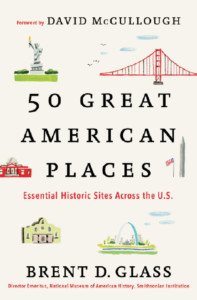
So, when you hear that Glass has written “50 Great American Places: Essential Historic Sites across the U.S.,” with a foreword by no less than his friend David McCullough, you have to figure he knows his stuff.

Glass often returns to Harrisburg to visit family, and on a recent trip, he shared the thinking behind his new book, published by Simon & Schuster Paperbacks. There’s no magic in the list, and it’s certainly not definitive, he said. Presented chronologically, the sites encapsulate the themes of freedom, war, innovation, diversity and land and landscape.

“American identity is defined, I think, by those five things,” Glass said. “Other countries may have those same five things, but not in that unique configuration.”

Hence, the Alamo is followed by the upstate New York birthplace of the women’s movement. The tragic Indian Wars sites of Little Big Horn and Wounded Knee precede “The Bridge and The Statue”—you know the ones—in New York City.

“It’s an introduction to American history, and it’s also an appeal to public memory, that we need to remember and value these places because of how they reflect our traditions and values and ideals,” Glass said.


Overcoming Barriers

The book’s first listing, the National Mall in Washington, D.C., is the only site presented non-chronologically.

As a kid, Glass visited the monument-dotted span he now calls “America’s front porch.” As National Museum of American History director, he stepped onto that porch almost daily. Under his watch, the museum underwent renovations reflecting new thinking in use of public space.

Under those renovations, the preserved fragments of the original Star Spangled Banner got a new gallery, and a replica of the massive 30-by-42-foot original, “meant to be seen at a great distance,” is sometimes unfurled for visitors to hold while singing the National Anthem.

It is, said Glass, “a patriotic moment,” but he added that patriotism means different things to different people. Profiling essential sites doesn’t mean glossing over the dark patches in American history. Someone once asked him, “What’s so great about Wounded Knee?” where U.S. cavalry soldiers massacred 300 Native Americans in 1890.

“What is great about it is that it’s essential to know about Wounded Knee if we’re going to understand how American history involves overcoming barriers,” he said. “And to be a democracy and to really be patriotic, we have to acknowledge the fact that there is some tragedy in our history, and we recognize it, and at least in this country, we talk about it and we acknowledge it. We don’t try to bury it.”

Similarly, from his Smithsonian tenure, Glass cities the counter from the Greensboro, N.C., Woolworth’s, where, in 1960, sit-in participants re-enacted their defiance against segregation. A schoolchild on a museum tour once asked Glass, “Did this really happen?”

“He couldn’t fathom it, that we had laws and customs enforcing segregation,” he recalled. “That was something I was proud of, that we could make history accessible, not only through our collection, which is the best in the world, but using the museum as a stage for providing the content.”


What-Ifs

Asked his definition of patriotism, Harrisburg political consultant Charlie Gerow said that America needs citizens who “know a little bit more about history and a little bit more about civics.” The history buff, who hadn’t yet read Glass’ book but looked forward to picking up a copy, quoted 19th-century U.S. Senator Carl Schurz: “My Country! When right, keep it right; when wrong, set it right!”

But a warts-and-all view of history must be put in context, said Gerow, CEO of Harrisburg-based Quantum Communications. Any discussion of the World War II internment of Japanese-Americans should be paired with the “vicious, malicious, unprovoked attack on the American people by the imperial Japanese government,” he said.

“This is the most exceptional country in the history of the world, built on very high ideals,” he said. “Because we are human beings, we sometimes fall short of those ideals, and, when we do, it’s important to reflect on how it happened and what we need to do to correct it, but that’s not an indictment of the country or its system of government.”

Glass does, indeed, feature consecutive chapters on the Pearl Harbor attack and Minidoka Camp in Idaho, where 120,000 forcibly relocated Japanese-Americans built a community and erected an honor roll of internees who performed military service “even while family and friends were held captive in the high desert of Idaho.”

Pennsylvania appears often in Glass’ book. Gettysburg, the Liberty Bell and the forks of the Ohio River at Pittsburgh’s Point get their own chapters. Other Keystone State sites and people make cameo appearances. Gifford Pinchot butts heads with fellow conservationist John Muir. In charming but tumultuous New Castle, Del., freewheeling descendants of Dutch settlers rebel against control by the conservative Quaker government of William Penn’s Pennsylvania.

By selecting still-standing sites, Glass paid tribute to historic preservationists, including President Dwight Eisenhower, advocate for protection of the Gettysburg battlefield.

“The past is not inevitable,” Glass said. “It is not inevitable that we have these places. People made decisions to save some of these structures. And people made decisions that gave these places their historic meaning. When you go to Gettysburg, you really can appreciate how history is contingent on so many individual decisions and so many what-ifs.”

Even Harrisburg, which receives one mention as the end goal for Robert E. Lee’s Army of Northern Virginia, has scored telling victories with the City Beautiful movement and preservation of its unique riverfront, said Glass.

“You can’t go wrong if you have access to that scene,” he said.

Harrisburg also embodies a theme of the book—that history is in our midst and easily accessible. Glass believes it’s time to stop complaining about the excess of nontaxable state properties in the city and, instead, market their tourism value, especially the Capitol, Forum building and State Museum.

“All those buildings were built at a time when they paid artists to decorate them,” he said. “I would put the Harrisburg Capitol as one of the best, not only for the Capitol building but the whole complex.”

Public disinvestment in heritage sites “is very shortsighted,” Glass said, but the passion that historical assets generate is heartening. Investments in visible history “have such a tremendous effect on the morale of people, to know they are connected to a bigger story.”

“You can’t measure that,” Glass said. “There aren’t a lot of metrics to say, ‘What’s the return on that investment?’ But I’m really convinced that we’re enriched by preserving history and knowing the history and telling that story to the next generation and getting them engaged in it.”

“50 Great American Places: Essential Historic Sites across the U.S.” by Brent Glass is available in bookstores and online.

Save

Continue Reading

The Lounge Next Door: Romance, rooftop are part of the expanded 704 Lounge.

Screenshot 2015-06-01 08.29.36At Harrisburg’s 704 Lounge, a stunning, upscale addition is ready for its close-up.

Several years ago, owners Brett Johnson and Russ Harr bought the circa-1881 townhouse next door to their original bar, both located across the street from the state Capitol complex. They then began a series of renovations that removed part of the wall that divided the two properties, adding a new kitchen and second-floor bar area.

Like that, the new Cielo Lounge was born (in Italian, cielo means sky or heavens).

In the beautiful addition, guests can sit comfortably and admire the work of local and national artists along with a colorful collection of Depression-era glass gleaming in the built-in display case. The space has a partially enclosed nook perfect for private conversations. A Chihuly-inspired, hand-blown chandelier takes center stage in the original foyer, which has a clean, modern feel with Victorian-era details about the room.

“Anything from 1881, we kept,” said Harr of the historic townhouse.

The property has been lovingly restored to show off its best assets. Prominently featured in the foyer is the original fireplace, gorgeous stained-glass windows and a winding staircase, which the wait staff uses to access the new, second-floor bar servicing the Cielo Lounge.

Johnson meticulously designed the Cielo Lounge with Brazilian Koa wood floors, wall coverings from Germany, rosewood mahogany tables and sparkling light fixtures by Yale. 2D artwork by Orna Amrani is hung as a focal point along the main wall.

Gold, bronze and silver accents provide a romantic and relaxed atmosphere in the sunken bar lounge. Step up through the sliding glass doors and the glowing rooftop invites you to admire the Pennsylvania State Museum and Capitol building. The rooftop also has one of the best views for fireworks in the city.

“You don’t even have to bend your neck,” said Johnson of the view.

The Cielo Lounge has a state-of-the-art sound system and is equipped to host business meetings and events. Though the space just opened, there are already two weddings booked, as well as several social and charity events.

The lounge also functions as a dance floor on Fridays and Saturdays with different themes like salsa and swing nights led by dance instructors.

704 Lounge offer a tapas menu and a new drink list with specialty cocktails, some with edible flowers. Speakeasy nights feature old-fashioned concoctions sourced from a 1920s drink recipe book found by Johnson. On Sundays, you can make your own bloody Mary from your choice of three kinds of tomato juice, a house mix and all manner of garnishes. Wait staff takes drink orders from both the lounge and rooftop.

The renovations have been a labor of love for Johnson and Harr. They explained that some of the inspiration for designing the Cielo Lounge came from places they’ve visited like Upstairs at the Kimberly atop the Kimberly Hotel in Manhattan. Johnson couldn’t recall a place in Los Angeles that could quite match what they’ve achieved at 704 Lounge.

“Everything is designed,” said Johnson, a long-time professional in the field. “From the wall coverings and silks to original art, it’s all hand done.”

Johnson worked as a designer and project consultant in L.A. when he met Harr, who had moved from Pennsylvania in 1990. Harr found success managing artists for events such as the Oscars, which he continues to do. In 2010, they relocated to Harrisburg and created Bar 704, the original name for the business before two expansions.

“I never thought I’d come back,” said Harr of the return to his home state.

The affordability of the area has allowed them to do what they love and do it with style. In the five years that they’ve been open, 704 Lounge has become known for its annual Night of Glamour, which celebrates the Oscars during its live broadcast. Along with a red carpet, awards are offered for the best-dressed man, woman and couple of the evening.

Neither Johnson nor Harr would have guessed they’d one day own a bar, but their love of people and art led them to where they are now.

“We are very proud,” Johnson said of their establishment. “It’s an ‘everybody’ bar.”

704 Lounge is located at 704 N. 3rd St., Harrisburg. For more information, visit www.704pa.com or call 717-234-4226.

Continue Reading

Back to Its Roots: The world’s best quaffs, a stunning setting for the Harrisburg Wine Festival.

Screenshot 2015-04-29 00.49.21For Harrisburg wine-lovers, this month will be a special one indeed. For the first time since 2006, the Harrisburg Wine Festival is returning to the capital city.

Since the festival started, I’ve attended every year, save one. Personally, I believe it’s our area’s most significant annual wine event and, for fans of the grape, not to be missed.

To get some background on this year’s festival, I spoke with Colleen Jones, expo manager for Journal Multimedia, which is organizing the event on behalf of the Pennsylvania Liquor Control Board.

For years, the festival was held at the Giant Center in Hershey. While the venue had plenty of room, it was more of an atmosphere of a sporting event than a presentation of a beverage that people write poetry about.

It next was held at the Antique Automobile Club of America Museum, which, in my opinion, was cozy and had an interesting vibe. However, I felt it was too cramped for the thirsty crowd.

Colleen told me that, at a planning meeting at the PLCB offices, someone looked out the window across the street to the State Museum of Pennsylvania and wondered about its suitability. After inquiries, the decision was made to have it in this masterpiece of mid-century modern architecture, which, this year, celebrates its golden anniversary.

The festival will be three-tiered this year. The VIP Tasting will start at 5 p.m. and will feature more than 50 wines that are not available to other tasters, such as several super Tuscans, vintage ports and some of the best wines that California has to offer. The Grand Tasting will follow at 6:30 p.m., featuring the variety and quality that attract wine-lovers each year.

This year, for the first time, the Chairman’s Select Seminar will be hosted by the chairman himself, Steve Pollack. The seminar will give folks an opportunity to taste wines that will emerge in stores in a few weeks. Tickets must be bought in advance, and the seminar starts at 5:30 p.m. in the Allegheny Room.

Colleen and I also discussed the food for the festival, as wine and food are natural mates. Honestly, I was a little concerned about who would cater the event. This may sound trite, but long-time festival-goers may remember the switch from the original festival site at the Harrisburg Hilton to the Giant Center. So, I was very glad to hear that the Hilton once again is on board, with the hors d’oeuvres coming from the kitchen of the newly opened Ad Lib Craft Kitchen & Bar.

There is another aspect to this grand event, the on-site silent auction to raise money for the Patient and Family Centered Care program at Penn State Hershey Children’s Hospital. Colleen pointed out that many families arrive at the hospital totally unprepared for an extended stay. So, a portion of every festival ticket sold will go towards benefitting these people in their hour of need.

I hope to see you at the festival. If you spy my nametag, stop by, and we’ll share some wonderful wines.

Keep sipping, Steve.

The Harrisburg Wine Festival takes place May 8 at the State Museum of Pennsylvania, 300 North St., Harrisburg. Tickets start at $75 per person. There will be free parking at the South Street garage, 220 South St., a short walk to the museum. For more information, visit www.harrisburgwinefest.com.

Continue Reading