Tag Archives: State Museum of Pennsylvania

Art in the Burg: Our fine arts columnist takes a stroll up Verbeke Street during 3rd in the Burg.

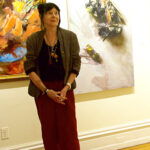
Works by Ann Benton Yeager adorn the wall of “The Gallery” at The Millworks.

Usually in an art column, one starts with the art and its impact felt by those who view it. This time around, it is important to discuss three components that go into making an art event work.

The first is an “A” for atmosphere. Is the stage set to provide the tone the artists want to convey? For last Friday’s 3rd in the Burg, we narrowed that stage to Verbeke Street, nicely tucked between the two art blockbusters currently in Harrisburg (“Picasso: A Life in Print” at Susquehanna Art Museum and “Art of the State” at The State Museum of Pennsylvania, both reviewed previously).

Tara Chickey is the art director of the Millworks, presiding over a beehive of activity in this art enclave on Verbeke, just across from the Broad Street Market. We got the inside buzz for the new show that opened Friday night and runs through Sept. 15, including the lineup of artists that will be featured for the citywide Gallery Walk on Sept. 8. The Millworks has been a natural home for local artists creating their own nest within the larger art community. Tara knows that, to keep the colony productive, there has to be a sense of cross-pollination. Think of the artists as vital to the sociality of the hive.

Ann Benton Yeager’s “Modern Art” on the main floor, studio 103, revealed her “cold wax and oil” painting. The finished product is “cool” to say the least, but it is the process that makes it so unique. Yeager will demonstrate her art for Gallery Walk. Next, onto the Millworks’ first-floor Market Place, a room filled with treasures for art lovers of all flavors. From candles to leather goods, textiles to trinkets of an artistic bent, jewelry and clothing, all touchable and tempting, provide visual stimulation to those who enter.

We next traveled upstairs to Studio 319, a shared space with a trio of artists who refer to themselves as “the three-ring circus.” This includes Tina Berrier, who spoke to the stories behind her colorful and quirky portraits of people and animals. A personal favorite was a cocky chicken named Clyde smoking a cigarette (pictured). Colonel Sanders would frown upon that activity as this character proved to be a “Kentucky Clyde Chicken.” Fellow painter Judy Kelly gave us the lowdown on their place in Millworks history, as the trio has been part of the creative hive since its inception. Mary Gelenser, with her fiber art, rounds out this group of friends.

Sharing studio 323 is none other than Caleb Smith and Tara Chickey, the Millworks studio’s resident married couple. And TheBurg’s own creative director, Megan Caruso, adds her “Quiet Clay” vessels to the charm, elegant in their clean lines. In the back half of 323 was Maddie, gallery assistant to artist P.D. Murray, whose paintings were drenched in rich colors with wildly imaginative subjects. The hive atmosphere carried over into the restaurant and bar, a hub of after-work gatherings with weekend wishes already starting to come true, enhanced by the clink of glassware and gab. In a glamorous and gregarious way—that’s atmosphere.

We next ventured up the street, to No. 258, also known as “Vivi on Verbeke.” Here, Vivian Sterste and Jeb Boyd had a welcoming stage set up outdoors and in, with a bench and chairs and the most comfortable divan. Perfect pottery by Vivi and painterly photographs by Jeb added just the right amount of pop that also snapped and crackled. Again, the relationships they make with 3rd in the Burgers create a lasting bond. In promoting that mindset, an outsized community painting (pictured) waits inside for visitors to add their own creative marks.

Just up the street at 214 Verbeke, La Cultura makes networking a nuance not to be outdone by any other organization. Elyse Irvis, owner and operator of this unique establishment, subscribes to her mission statement of, “For the culture…franchising the disenfranchised.” Her plan allows local businesses and artists to rent space within the premises for special events and art exhibits, limited only by the imagination. Coming up on Sept. 21 is a self-care workshop from entrepreneur April Ashe. Her line, “UnBottled Expressionz,” combines bath salts and beauty, proving that, if you are relaxed in spirit, you beauty shines through. The artist on hand was Dillon Mitchell, CEO of Art Only LMG, and his line of artistic products, including tees and paintings.

All told, 3rd in the Burg took a leisurely three hours in our tour of art on Verbeke Street. That brings me to the “T.” Time flew in the best sort of way. What we experienced in our investment of that ever-fleeting intangible commodity is something you cannot measure in quantifiable terms. Our night at all three venues was enlightened by rich cultural exchanges, atmospheres completely individual. The hive at Millworks in all its layers of “Art.Food.Brewery” and the venturous vibe at Vivi on Verbeke, completed by culturally committed La Cultura, all add up to “Atmosphere,” “Relationships” and “Time,” immeasurable gifts to be relished. So when the hourglass flips for the next 3rd in the Burg, may I suggest pursuing moments worth remembering?

The next 3rd in the Burg will be held on Friday, Sept. 20, through downtown and Midtown Harrisburg. For more information, visit https://thirdintheburg.org/.

Continue Reading

The Week that Was: A summary of news and features around Harrisburg

Harrisburg school district Receiver Janet Samuels speaks to the press.

The weekend is upon us once again, but it can’t start until we sum up another heavy workweek of news around Harrisburg.

“Art of the State” opened at the State Museum of Pennsylvania, giving our art reviewer a chance to check out the annual juried exhibit dedicated to PA artists. Also, find out who won the awards.

Bethesda Mission received Harrisburg City Council approval for its proposal to demolish the historic Shamrock Fire Station and build a new addition to its community center on Herr Street. Click here for the details.

Capital Region Water unveiled its plan to begin imposing a stormwater fee for system upgrades and greening initiatives. CRW officials stressed its necessity, but not everyone was happy about it. For all the details, click here and here.

D&H Distributing is making a major commitment to help out our region’s children. Find out what this company, one of our area’s largest yet little known, is up to. Click here for the details.

Harrisburg swore in nine new police officers and gave commendations for bravery to both officers and civilians. Separately, a city hall ceremony honored Capt. Gabriel Olivera, a long-time officer who is retiring from the force.

Harrisburg School District again offered a bounty of news, as the district’s new court-appointed receiver cleaned house of the old administration, including the embattled superintendent, and announced that she would bring in a new team. Our editor added his own commentary.

Harrisburg University has attracted students from all over the world to attend its annual AI Bootcamp. Click here for the details.

July 4 Food Truck Festival and Fireworks will return for another year on Thursday. We have all the patriotic details from the mayor’s announcement.

Keyzus was our featured musician for the week as we wrapped up our series in honor of African American Music Appreciation Month.

Lt. Gov. John Fetterman opened the pool at his Fort Indiantown Gap mansion to groups and organizations, and Harrisburg schoolchildren were the first ones to make use of it.

Rockhill Trolley Museum is a nice day trip to view (and ride in) historic trolleys from around central PA, says our writer.

Rock climbing has become a popular sport in recent years, and there are numerous walls to scale around the Harrisburg area. Click here to read our feature story.

Sara Bozich punches your ticket for a fun weekend with her weekly roundup of things to do around the Harrisburg area.

TheBurg distributed our July issue to more than 500 locations in seven counties around central PA and posted all the content to our website. This month, we have a focus on pets, in addition to our usual wealth of community news and features.

U.S. Environmental Protection Agency has awarded Harrisburg a $300,000 grant to help clean up old, polluted industrial sites known as brownfields. Click here for the details.

Do you receive TheBurg Daily, our daily digest of news and events? If not, subscribe here!

Continue Reading

Art Debut: Annual “Art of the State,” a feast for the eyes, the emotions; winners announced

The State Museum of Pennsylvania houses many collections, but none quite as diverse and rich as this one.

On Sunday, the museum unveiled this year’s “Art of the State” with an opening reception and awards ceremony, marking an exceptional 52nd edition of the annual juried contest and exhibit.

The exhibit honored some of the best artists from across the commonwealth, with artists both seasoned and emerging joining forces to create a tour de force.

Applications for this juried show started shortly after the new year. Entrants numbered 2,170, and, in the end, 110 works of art from 103 artists across 35 counties were selected. Cash prizes were awarded for painting, works on paper, photography and digital arts and sculpture and craft.

As the State Museum’s curator of fine arts, Amy Hammond, along with Carol Buck, curator of installations, took great care in presenting this latest edition of “Art of the State.”

By purposeful design, Hammond’s presentation replicates that of an upscale gallery, elevating what could be an unwieldy task in highlighting 110 works of diverse media. In this massive undertaking, many hands worked together—from collecting and cataloging to the final finish as the last piece is hung.

The power of art is such that it can transform a mere viewer to a full-in participant. There is art that speaks in a whisper, art that leaves us thunderstruck, and art that bowls us over with a feather.

In no particular order, the following are 10 “snapshots” from the 2019 class of “Art of the State”:

James Evangelista’s “The Law’s Must Change” (pictured top) is a close-up a child’s face peering through a wire fence. No work is more charged politically or fraught emotionally as one imagines a child separated from their family and freedom. This photo speaks a thousand words without uttering a sound.

“Zen Teraglyph” is a color photograph by John Meza that depicts a series of crop circles dusted by new fallen snow echoing down the centuries with man’s fascination of mysteries manifested from beyond the natural realm.

The perfection achieved in Bill Snyder’s night skyscape, “Mars Milky Way and Seneca Rocks, almost makes one think it was staged that way. Along with Mars’ amber glow is sprinkling stardust from the Milky Way, making a serendipitous moment captured on film.

Michael Munchel’s “Salon de Musica” is a photographic study of a haunted habitué no longer present. His depiction details a salon of spirits only in showing an ambiance of abandonment. The photo features a neon pink piano as its primary focus. A diffused use of color, tinting and light only heightens the melancholy mood.

At face value, Donna Barlup’s whimsical watercolor painting captures its title perfectly, a girl sitting astride her father’s shoulders gives her the “Best Seat in the House” (pictured). Perhaps they are at a country fair, but the painting shares its deeper meaning—that special bond between daughter and father. Barlup achieves an artistic nonchalance as only a master watercolorist could attain.

The world would look a lot different to us if we only saw it in black and white. If color is king, then Chuck Olson’s “The Meeting Place” delivers the goods. But more than that, the title carries additional import as the oil painting converges head-on at the intersection of abstraction and color.

Michelle Thomas’s acrylic work on canvas, “Route 29 South, Late Autumn,” captures a stretch of road in northeastern Pennsylvania that could just as easily be an unknown destination in our imagination. Brilliantly inserting the viewer behind the wheel creates an eerie sense of entering a dreamscape. What lies around the bend is entirely up to you.

“Embrace the View” is Paul Sirofchuck’s gift to sculpture and craft at its finest. This thought-provoking, imagination-invoking combination of solid cherry, wenge, brushed aluminum and polished mirror standing 7 feet tall, is a statement piece of its own accord. If beauty is truth, then this is as honest as it gets.

Qay San’s “Emergence of the Grid” demonstrates pottery’s testament to time immemorial in its tonal and textural tribute to what looks like could be a Mayan artifact that speaks to lost civilizations. A time when life was lived completely off the grid.

Sandra Moore’s “Fat Egg II” takes Native Okeewemee red clay from North Carolina to create a vessel that defies description. The artist states, “Hot clay dictates the moment when the painting of line and direction of smoke is embedded into the burnished layers of the clay resulting in translucent planes of line and smoke.” The piece tells the story of each of those moments.

More than ever, “Art of the State” exemplifies the vast richness of art and artists distributing a common wealth to all who visit.

“Art of the State” runs through Sept. 8 at the State Museum of Pennsylvania, 300 North St., Harrisburg. It close coincides with the Art Association of Harrisburg’s citywide Gallery Walk.


And the Winners Are:

The State Museum of Pennsylvania today announced the winners of 2019 “Art of the State” juried competition. Awards are $500 for first place, $300 for second place and $200 for third place. 

Photography
1st Sanh Tran, “Untitled, No. 1 (Country Mouse)”
2nd Lisa Bennett, “Constructed Lights 5095-45”
3rd James Evangelista, “The Laws Must Change”
Honorable Mention: Irene VanBuskirk, “Divided Attention”
Honorable Mention: Kyle Yates, “Indiana Theater” 

Painting
1st Denny Bond, “DIY”
2nd Debbie Baer, “Hostile Takeover”
3rd Robert Arnosky, “Wish I Was There”
Honorable Mention: Paige Tibbe, “Mike” 

Work on Paper
1st Geoffrey Beadle, “Samuel Illuminated”
2nd Cassaundra Flor, “Aeolian Cityscape”
3rd Lauren Scavo-Fulk, “Building and Tree”
Honorable Mention: Terri Fridkin, “Freeriding”
Honorable Mention: Linda Aragon, “Maria” 

Craft
1st Amy LeFever, “Untitled”
2nd Paul Sirofchuck, “Embrace The View”
3rd Sue Reno, “In Dreams I Slept in a Cabin”
Honorable Mention: E. Douglas Wunder, “Scramble”
Honorable Mention: Janine Wang, “Snug Stones” 

Sculpture
1st Diane Pepe, “Installation: Selective Processes of Memory”
2nd Brian Glaze, “WPA”
3rd Jennifer Rubin Garey, “Transformation”
Honorable Mention: Tyler Stanton, “Tree House Credenza” 

The State Museum Purchase Award
Cassaundra Flor: “Aeolian Cityscape”
Sanh Tran: “Untitled, No. 1 (Country Mouse)” 

William D. Davis Memorial Award for Drawing
Richard Huck, “Assault”

Art Docents Choice Award
Paul Sirofchuck, “Embrace The View”

Continue Reading

Look–Up in the Sky: Naylor Observatory allows those close by to see very far away.

If you contemplate the outer reaches of the universe, what celestial phenomena would you like to see?

A meteor shower? A comet that only appears once a lifetime? How about the terrain of the moon or Mars?

Fortunately, you don’t have to drive far from Harrisburg to get your heavenly fix.

The Naylor Observatory lies just outside of Lewisberry in York County, a short hop across the river though far enough away from the lights of the city and highway to offer a good look at the sky—on a clear night, that is.

The Astronomical Society of Harrisburg (ASH) holds regular viewing events there. Provided the evening’s conditions are right, you’ll be able to observe the night sky through several telescopes and share knowledge with the amateur astronomers at ASH.

The club holds regular viewings for the general public, which can draw a few hundred people. Visitors experience a distinctive ambience both in the sky and on the ground. Dotted along the observatory’s steep driveway is a series of red lights to gently guide your eyes.

“Red light best allows our eyes to transition to night vision, because the rods in our eyes don’t respond to red light,” said ASH member Courtland Barnabei.

Also red-lit on the observatory’s grounds are the compact outbuildings, four of which contain either retractable or removable roofs. These buildings have no heat or air conditioning, surrounding the telescopes with a stable ambient temperature. Inside, the telescopes are permanently mounted to underground piers.

“Wind is a huge factor for telescopes because air currents can distort images,” said ASH Secretary James Davis. “The mounting stabilizes them.”

You can bring your own telescope or use one belonging to ASH, but you don’t necessarily need one.

“The best observing is looking straight up,” said Chip Templin, ASH president. “Your eyes are looking out through various layers of atmosphere. But looking straight up cuts through the fewest number of layers.”

Using the club’s telescopes is an ASH membership perk.

“Most people make the mistake of buying a telescope, but then only use it a handful of times because it’s cumbersome to use or hard to set up,” said Barnabei. “You can use a free online star chart and binoculars instead.”

Some hobbyists even build their own rudimentary telescopes. You would think that a telescope is full of complicated mechanisms, but it’s actually mostly hollow, comprised of just two mirrors and a focuser eyepiece encased in a fiberglass cylinder. Light enters, bounces between the mirrors and through the lens to magnify faraway objects. Depending on the magnification power, some telescopes can see farther than others.

“The sky in Harrisburg doesn’t get dark enough to use certain telescopes,” Templin said.

The more sophisticated telescopes can automatically point to different objects in the sky simply by typing the object into a navigator controller. Davis routinely teaches classes on how to use telescopes, and he shared the secret for taking clear, detailed pictures of the moon. Press the lens of any camera to the telescope eyepiece, guide it to the moon, then click.

If you’d like to locate other celestial objects, ASH members recommend a number of good reference materials, accessible both at the observatory and online.

The “Observer’s Handbook” is like a celestial almanac, with different editions available for different regions. If you’re looking for a visual representation where you can cross-reference date, time of day and coordinate positions, try the “Skygazer’s Almanac.” If you want to be able to recognize what you’re observing when you locate something through the eyepiece, consult “The Messier Catalogue,” a set of 110 celestial objects catalogued by French astronomer Charles Messier.

Some celestial events are predictable or cyclical, so observers have plenty of advance notice to plan a proper star party, which is like a nighttime tailgate party for a heavenly happening. Cloudynights.com provides an online crowd-sourcing forum for sky-gazers. Having a worldwide reach allows hobbyists to leverage pictures, information and logistics of star parties worldwide.

If you’re looking for Pennsylvania’s utmost star party, Templin recommended Cherry Springs State Park, a dark sky park located a few hours north in Potter County, 2,300 feet in elevation.

ASH members often build vacations around premiere observing locations. In the United States, the southwestern desert and parts of Hawaii have the best conditions because of their sparse populations and lack of industry. Internationally, the best place to observe is the mountains of Chile. Also, “the Australian outback is dark, and it has some of the largest telescopes in the world,” said Davis.

ASH facilitates events and classes with local schools, educational centers, the State Museum planetarium and HACC. Regular offerings include 101-level astronomy, identifying constellations, cosmology and telescope how-to.

For ASH members, observing celestial bodies is a lifelong pursuit.

“With new information coming in every day, it’s impossible to learn everything,” said Doug Grove, ASH vice president. “Visitors can leverage the knowledge of the members who have been observing as long as we have.”

Indeed, astronomy is attractive because it’s a “learning hobby,” said Barnabei.

“The benefit of Naylor is that the membership facilitates the learning process,” Barnabei said. “You can come to our observatory with questions, and you’re certain to find a member who once asked themselves that exact same question.”

The Naylor Observatory is located at 670 Observatory Dr., Lewisberry. For more information about the Astronomical Society of Harrisburg, including classes and viewings, visit www.astrohbg.org.

Continue Reading

Gown then Town: Harrisburg ranked among best cities for recent college grads.

Erin Templeton, Tyler Eaglowski, Liz Barrentes and Dove Reinford gather inside Capital Joe, one of Harrisburg’s many meeting places for young people.

Seth Robbins’ bags were packed before he even hit his Lock Haven University graduation stage in 2015. Afterwards, he drove himself out to Indianapolis, Ind.

In the fall of 2017, he finally landed a job in the field he spent four years studying, right in his hometown of Harrisburg.

According to Realtor.com, a popular real estate website run by the National Association of Realtors, more college grads like Robbins should be flocking to Harrisburg.

Recently, Realtor.com ran a story titled, “Give It a College Try: 10 Best Cities for New Grads to Live, Work Play,” and Harrisburg ranked an impressive fourth in the nation. Their team examined job opportunities, wage growth, housing affordability, social clubs and more in the 100 largest metropolitan areas in the country to help determine the best places for college grads.

The Capitol complex is a rich source of jobs for recent college graduates.

Though Harrisburg might not be your typical college town, it features many aspects that attract young people upon graduation, according to Realtor.com. The article specifically mentions running groups and Wildwood Park, and there is no shortage of activities–from 2nd Street’s bars and clubs to the State Museum and City Island.

In fact, only large college towns, like Madison, Wisc., and Austin, Texas, outranked Harrisburg on the list, while Pennsylvania’s capital city beat out other popular post-college cities, such as Nashville, Pittsburgh and Denver, which ranked sixth, seventh and ninth, respectively.

Pricey destinations, like Washington, D.C., New York, Boston and Seattle, which attract many graduates, didn’t make the top-10 list.

But there’s more to Harrisburg than just its nightlife. There’s also a growing job market, which contributed significantly to its high ranking. According to Realtor.com, with a 3.5-percent unemployment rate, students can find many types of jobs here, especially in government, politics and lobbying.

“I think Harrisburg in general is a great place to live, work and play,” said Derek Whitesel, executive director of Harrisburg Young Professionals (HYP). “There are a lot of jobs for those that are coming out of college. You can make a decent starting salary and have a decent cost of living.”

The job market might pull students in and nightlife will keep them entertained, but Harrisburg’s biggest draw, according to the site, is affordability.

Katherine Bosak, an undergraduate at Temple University, said that she plans to move to Harrisburg once she graduates because of its affordable housing. Currently, she pays $945 a month for her off-campus studio apartment in Philadelphia.

According to Realtor.com, the median home price in Harrisburg is $129,500. The average rent price is $900, $500 less than the state average, according to Zillow, another real estate-focused website.

“Compared to Philadelphia, [Harrisburg] is way more affordable,” Bosak said. “There is still nightlife and there are still things to do here, but it’s on a smaller and more affordable scale.”

After two years, Robbins is still in love with Harrisburg. When he’s not working as an associate residential mortgage loan officer at Fulton Bank, he works with Whitesel and other members of HYP to help highlight and improve the city.

“There is no other place better on the East Coast, and I’m not just saying that because I live here,” Robbins said. “You can go to a bigger city where there is more stuff to do, but you can’t make as big of an impact.”

To read the full realtor.com story, visit https://www.realtor.com/news/trends/best-places-for-new-college-grads-to-find-a-job-mate-and-affordable-home/.

Continue Reading

Silver Is Golden: HBG Jewish Film Festival celebrates 25 years in many languages, on many themes.

In “Working Woman,” one of the offerings of this year’s Edward S. Finkelstein Harrisburg Jewish Film Festival, Orna, a mother of three, returns to the workplace to help support her family when her husband’s new restaurant is struggling. She gets a job with Benny, a former army superior who is now a successful real estate developer.

Under his mentorship, the talented Orna rapidly rises through the ranks. But there’s a price of success—trying to balance work and home demands. Even more insidious is the escalating sexual harassment from her boss.

Released in 2018, the Israeli film might have been ripped from today’s headlines. But Director Michal Aviad said that a woman whom she met more than a decade ago, who was similarly harassed, inspired her.

“Most of the time, the harassment was a constant unspoken threat. This woman was dependent on the job and believed she could handle it,” said Aviad. “Orna wants the job, and needs it. Benny doesn’t appear to Orna or to us as a plain villain. He’s generous and appreciates her work. It is confusing, but reality is full of complex villains.”

“The Last Suit,” a 2017 Argentinian film written and directed by Pablo Solarz, sets a very different tone.

At 88, Abraham Bursztein seems to be at the mercy of his grown children. They’ve sold his Buenos Aires residence, prepared his move to a retirement home, and disagree about how to handle his fading health. But Abraham, a curmudgeonly Holocaust survivor who made a successful life in a foreign land, has his own ideas. He empties his bank account, buys a one-way ticket to Poland, and sets out to fulfill a promise made 70 years earlier—to find the man who restored him to life after the horrors of the war.

“But I was not interested in an unfolding a series of events,” Solarz said. “I wanted people to feel the same as the characters—to feel the importance of telling one’s story to ‘die in peace.’”

Along the way, in a comic, yet poignant, late-in-life road movie, Abraham experiences the kindness of strangers. Viewers are unlikely to emerge dry-eyed at the movie’s end.

“This year’s slate [of films] is quite eclectic, and we hope that our increasingly diverse audience is well met, with pictures that highlight World War II and the Holocaust, the #MeToo movement, LGBT issues, the Israeli/Palestinian divide, and even the 2017 World Baseball Classic,” said Julie Sherman, executive director of the film festival.

“The Tobacconist,” a German drama by Nikolaus Leytner based on the best-selling novel, is a coming-of-age story of innocent, 17-year-old Franz, who arrives in Vienna shortly before Hitler’s annexation of Austria. As apprentice to Otto, a tobacconist, Franz becomes enamored of regular customer Sigmund Freud, whom he consults about his infatuation with unattainable goddess Anezka.

“The Tobacconist” is the subject of the annual “Book Club Film and Breakfast” event.

Several films explore facets of Israeli life.

In the comedy-drama, “The Unorthodox,” (by Eliran Malka), a Sephardic printer who has grown tired of feeling like a second-class citizen in an Ashkenazi-dominated country takes on the establishment in quintessential underdog fashion.

“Inside the Mossad,” a documentary by Duki Dror, explores the inner workings, achievements and moral dilemmas of the foreign intelligence organization.

One of the two LGBT-themed Israeli feature films is “Family in Transition,” about a long-married man who comes out as transgendered.

From Mexico comes “Leona,” directed by Isaac Cherem. Ariela, a young Jewish woman in Mexico City, is in no hurry to marry, yet she falls in love with a man guaranteed to meet with her family’s disapproval—in a close-knit community with one of the world’s lowest rates of assimilation.

Cherem will conduct a Q&A about his directorial-debut movie.

Films also come from many European countries, Canada and even South Korea.

Closing the festival is “If You’re Not in the Obit, Eat Breakfast,” an American documentary by Danny Gold, which explores the secret to living into your 90s—and loving every minute of it. Writer-comedian Carl Reiner tracks down fellow nonagenarians—and a few others over 100—who are living happy, rewarding lives in their twilight years. Among them are comic actors Betty White and Dick Van Dyke.

Most films will be shown at the Midtown Cinema, though the festival will open at the PA State Museum and close at the Harrisburg Jewish Community Center.

“One secret to our success of the film festival is our relationship with Midtown Cinema and its members,” said Sherman. “It is expanding our audience, and a lot of these people are true cinephiles—just incredibly open to new and different film experiences.”

With its silver anniversary, the festival can claim success on many levels.

“Twenty-five years is a real milestone for the film festival,” Sherman said. “It’s been a great opportunity to consider—and be proud of—how we’ve grown, and to imagine what we can do going forward. It’s a very exciting time.”

The Edward S. Finkelstein Harrisburg Jewish Film Festival opens May 5 at the PA State Museum, 300 North St., Harrisburg. It continues May 10 to 16 at Midtown Cinema, 250 Reily St., Harrisburg. It concludes on May 16 at the Harrisburg Jewish Community Center, 3301 N. Front St., Harrisburg.


Screening times, film trailers, special events and other details can be found at
www.hbgjff.com.

Continue Reading

Artist in Focus: Andrew Guth

Do you own a Guth?

If you’ve been around Harrisburg awhile, you just might.

Artist Andrew Sedgwick Guth has been creating art in the capital city for more than a decade, formerly as part of the North Gallery and Mantis Collective and, now, as an independent artist with a studio in the Millworks in Harrisburg.

His painting and printmaking is eclectic in media and theme. One day, he might employ mixed media to create figurative art with a deeply personal message. On another, he’ll turn to abstraction. Then he’ll create whimsical representations of taco trucks, bears or parking meters. You just never know.

One thing you will know is that Guth’s art will be of high quality. His work has been shown regionally and nationally, and he has curated more than 125 exhibits throughout his career. His art has been showcased in such prestigious places as the Andy Warhol Museum in Pittsburgh, the French Embassy in Washington, D.C., and the State Museum of Pennsylvania in Harrisburg, where, in 2017, his work on paper took a first-place award in the annual, juried “Art of the State” exhibition.

On this page, we include a small sample of Guth’s work. To see more, visit www.andrewsedgwickguth.com or, even, better stop by his studio in the Millworks.

Continue Reading

February News Digest

Delay in School Board Appointment

It may be months before Harrisburg residents learn who will be the newest member of the district’s school board, as a court hearing in the matter isn’t slated to take place until late April.

Court of Common Pleas Judge John McNally has scheduled an April 23 court date to hear a citizen’s group response to a petition supporting Ralph Rodriguez, a city resident who wants to fill the vacant seat.

The group known as Concerned about the Children of Harrisburg (CATCH) responded to the petition filed on Jan. 24 on behalf of Rodriguez. As part of its response, CATCH asked the court to appoint its own preferred candidate, Cornelius Chachere.

This petition response appears to have triggered a series of events that will take several months to resolve.

The parties now have until mid-March to finish their discovery processes, followed by the April 23 court hearing.

Jayne Buchwach, a member of CATCH, said that her group opted to respond to Rodriguez’s petition, as opposed to filing an original petition in support of Chachere, after they saw that Rodriguez’s supporters had filed first.

“The response states our objections,” she said. “It also tells the court—this is who we think should be on it.”

The response touts Chachere’s qualifications and, like an original petition would, asks the court to appoint him.

To add further complexity to this issue, former school board Director James Thompson also has filed a petition with the court for the seat. Technically, this makes four candidates for the seat: Rodriguez, Chachere, Thompson and Marva Brown. In their petition, Rodriguez’s supporters mention that appointing Brown also would be acceptable to them.

The board seat became empty following the Dec. 16 death of school board Director Melvin Wilson. The remaining board members, split between Rodriguez and Chachere, failed to muster a majority of five votes to replace Wilson within a 30-day time period, throwing the matter to the court.

Buchwach said that she wasn’t concerned about having only eight members on the board for an extended period.

“The board is contentious,” she said. “So, having eight there or nine there—it really doesn’t matter.”

Meanwhile, five of the nine school board seats will be up this election year. CATCH has vowed to put up its own slate of candidates for the board seats.


Fetterman Starts Listening Tour

A packed room and dozens of speakers greeted Lt. Gov. John Fetterman in Harrisburg last month, as he kicked off a statewide listening tour on the proposed legalization of recreational marijuana.

Some 300 people filed into the auditorium of the Harrisburg Jewish Community Center for the first of 67 such events, as Fetterman began to wind his way through every county in the commonwealth.

For about two hours, Fetterman listened patiently and respectfully as speaker after speaker rose either in support of or in opposition to the proposal, often sharing with him emotional stories from their lives.

One young man named Darryl said that he was arrested and jailed for possession of marijuana and possession of drug paraphernalia and now can’t find a full-time job because of those convictions.

“That’s why I’m struggling so badly, because of a stupid possession charge,” he said. “It’s time to end this.”

To that end, a few speakers recommended not only legalization but expungement of criminal records for those previously convicted.

Les Stark, executive director of Reading-based Keystone Cannabis Coalition, a pro-legalization advocacy group, said that, in Pennsylvania, about 25,000 people a year are arrested for marijuana possession.

“How many lives have been ruined in Harrisburg alone?” he asked. “Over the next 10 years, will we ruin the lives of 250,000 more Pennsylvania citizens?”

Several speakers identified themselves as users of medical marijuana, which is legal, and testified to the effectiveness of cannabis for treating their conditions.

While most attendees spoke in favor of legalization, some did not.

Several speakers said they feared that legalizing recreational marijuana would lead to greater threats to public safety—from the potential of more car accidents to the possible greater use of harsher drugs.

“My main concern is that I have a grandchild turning 16,” said one man. “My concern is that I believe recreational marijuana is a mind-controlling substance. I’m afraid for her to be driving out on the highway when some other driver’s mind is being controlled by marijuana.”

Other speakers accused the state of wanting to legalize recreational marijuana as a revenue-raising tool.

“I’m not against medical marijuana, but I am against use of recreational marijuana,” said one man. “I believe the administration just wants to create a new revenue source to tax and spend.”

Throughout the lengthy event, Fetterman said little from his seat on the stage, listening attentively as people spoke their minds.

At one point, he asked would-be speakers to allow a woman, who was holding an infant, to move to the front of the long line. The woman, who said she drove in from Hummelstown, offered a moving story about surviving AIDS then, relatively late in life, giving birth to her baby.

“Medical cannabis helped me survive by the skin of my teeth,” she said. “It can’t be denied to others.”


Illegal Guns Seized

Harrisburg police have seized hundreds of firearms over the past few years, following a department-wide push to take illegal guns off of city streets.

At a press conference last month, police lined three long tables with handguns, rifles and shotguns, which they said was a small sample of the 646 illegal weapons confiscated from 2016-18.

Capt. Gabriel Olivera said that, in 2016, city police Commissioner Thomas Carter instructed officers to focus on the epidemic of illegal weapons in the city.

“All these guns were seized mostly without officers engaging these individuals with gunfire,” Olivera said. “Our officers have shown great restraint.”

According to Olivera, 196 guns were seized in 2016, 252 in 2017, and 198 in 2018. The far majority of these weapons have been handguns.

Carter said that, even before 2016, his officers routinely seized illegal firearms. But he wanted them to be more mindful of illegally owned guns, most of which have been stolen, as they patrolled and made arrests.

“I work with these amazing men and women on a day-in and day-out basis, and I know their capabilities,” he said, referring to his officers. “It’s something the entire agency bought into.”

Olivera mentioned that, for 2018, Harrisburg had about a 10-percent drop in “Part 1” offenses, which include the most serious crimes like murder, robbery and aggravated assault, compared to 2017. He also cited a 5- to 6-percent reduction in “Part 2” crimes, such as simple assault, disorderly conduct and most drug possession offenses, which are generally considered to be less serious.

“I can’t tell you that the number of guns has reduced the homicide rate,” Carter said. “But I can tell you that it has reduced violent crime.”

Olivera said that, after police seize a stolen gun, officers try to determine the rightful owner, so it can be returned. If no owner is identified, the gun eventually is destroyed, he said.


ICA Board Complete

A Harrisburg resident and former media executive has secured the final seat on Harrisburg’s new financial oversight board.

David Schankweiler, former publisher of the Central Penn Business Journal, was appointed to the five-member Intergovernmental Cooperation Authority (ICA) by state Senate Pro Tempore Joe Scarnati.

Schankweiler joins UPMC Pinnacle executive Tina Nixon, nonprofit professional Audry Carter, attorney Kathy Speaker-MacNett, and property developer Ralph Vartan on the newly created ICA, which will oversee Harrisburg’s finances for five years.

Until 2016, Schankweiler was the CEO and owner of Journal Multimedia, which published the Central Penn Business Journal and other publications. Since his retirement from the publishing industry, he has served on numerous nonprofit boards.

The board met for the first time last month for an organizational meeting.


New Police Gear

Harrisburg police last month showed off a pile of new protective gear, equipment it purchased with a grant from UPMC Pinnacle.

At a press conference, the city’s police bureau shared samples of new vests, helmets and steel plates, part of about 120 pieces of protective gear that will help protect officers from lethal, high-caliber weapons, according to police Commissioner Thomas Carter.

In total, UPMC Pinnacle donated more than $40,000 for the equipment purchase. That figure includes about $20,000 raised last June from the “3.2 to Protect the Blue” race, which was organized by UPMC Pinnacle emergency room nurses, with the UPMC Pinnacle Foundation donating much of the remainder.

“I had no idea of the dedication and love that these people showed our officers,” said Carter, flanked by UPMC nurses and Harrisburg police officers.

The new gear includes 60 helmets, 40 “body armor level 3 ballistic” protective vests with steel plates and 20 additional steel plates. The vendor, Royersford, Pa.-based Body Armor Megastore, contributed another 10 armor body vest sets.

Carter said that the need for the equipment arose last year following the death of U.S. Deputy Marshal Christopher Hill during a raid on a house in Allison Hill. The bureau realized that its helmets and vests were not adequate to protect against today’s powerful firearms, he said.

Deputy Police Chief Deric Moody said that his officers will not wear the equipment regularly, but will keep it nearby in case it’s needed.

After the press conference, Mayor Eric Papenfuse stressed that the equipment was not the full body armor “riot gear” that the bureau requested in 2017 after high-profile clashes throughout the city between “anti-Sharia” protestors and “antifa” counter-protestors. That gear was already purchased following a $68,000 allocation from City Council, he said.


Teachers Protest Pay

A sea of teachers dressed in red and carried homemade signs at a Harrisburg school board meeting last month, protesting what they perceive as unfair pay.

Hundreds of teachers flanked the standing-room-only gymnasium and wore “Red for Ed,” demanding to know why the school board denied a grievance settlement that would have raised the pay of veteran teachers.

In response, the district claimed that the pay raises would be prohibitively expensive for the struggling district, saying, in a prepared statement that “the settlement costs would run into the millions of dollars because of its continuing impact on salary costs in the district.”

At the heart of this fight is a set of intersecting problems: the Harrisburg school district’s budget issues, complaints of low pay and high teacher turnover rate. Veteran teachers demand that their pay reflect the time they’ve invested in Harrisburg schools, but the district asserts that veteran teachers are already being paid competitive wages.

“The more veteran the teacher is at Harrisburg, the more competitively they are paid under the negotiated salary schedule,” the statement read. “The board also believes that if the [Harrisburg Education] association was so concerned about the turnover problem in the district, it would have recommended that this be addressed in our ongoing labor contract negotiations where the teachers have refused to make a salary proposal after 14 months of negotiations.”

“We haven’t refused anything,” Barksdale responded. “We have to settle this before we agree on anything.”

The events culminating in the protest began in August when the Harrisburg Education Association filed a grievance against the board, claiming that veteran teachers were underpaid.

In it, they stated that the district had hired new teachers at rates higher than veteran teachers with equivalent experience, violating their contract. In January, the union reached a verbal agreement to raise the salaries of some of the lowest paid veteran teachers, but the board voted down that contract.


2019 Arts Awards Announced

Theatre Harrisburg has announced the recipients of the 2019 Awards for Distinguished Service to the Arts in the Capital Region (“Arts Awards”).

Ronnie Waters, a jazz musician, arranger, composer and educator, will receive the “Award to an Individual,” and The State Museum of Pennsylvania will receive the “Award to an Organization, Company or Group.”

The awards will be presented on Sunday, June 2, in a theatrical gala at Whitaker Center in downtown Harrisburg. The event is open to the public, and proceeds benefit Theatre Harrisburg.

For more information about the awards, including banquet reservations, visit www.theatreharrisbug.com/artsawards.


Mural Fest Returns

The Harrisburg Mural Festival is returning for another round, as Sprocket Mural Works last month announced a 2019 festival.

Co-organizer Megan Caruso said that Sprocket will oversee the creation of 10 murals over 10 days, from Aug. 30 to Sept. 8. The purpose, she said, is to add density to Harrisburg’s existing “mural trail,” which runs mostly along 3rd Street in downtown and Midtown.

“We want Harrisburg to be a mural-dense city,” she said. “So, they have to be concentrated.”

Sprocket also plans to mount a mural in Allison Hill, Caruso said. The organization created 18 murals during its first mural festival, which was held in 2017.
 

Lobbying Contract on Hold

Maverick Strategies will need to wait until mid-month to find out if its lobbying contract with Harrisburg will be renewed.

City Council was expected to vote on a one-year, $60,000 contract with the city-based lobbying shop last month, but pulled the resolution at the start of a council legislative session.

Earlier, council had asked Maverick for detailed billing statements for their prior contract, which ended Dec. 31. That information was received just before February’s legislative session, and council needed time to review the bills, said President Wanda Williams.

“We need clarification on these invoices,” Williams said. “City Council has additional questions they want to ask.”

Williams said that they’ll request that Maverick appear at the next council work session, which is slated for March 5, with a contract vote likely at the following legislative session on March 12.

So Noted

Brooks R. Foland of Marshall Dennehey Warner Coleman and Goggin has been named president of the Dauphin County Bar Association for 2019. The rest of the 2019 executive committee includes Lisa M. Benzie of Navitsky, Olson & Wisneski LLP; Paula J. McDermott of Post & Shell P.C.; Scott B. Cooper of Schmidt Kramer Harrisburg; and Thomas P. Gacki of Eckert Seamans.

D&H Distributing plans to move its headquarters from Harrisburg to Lower Paxton Township later this year, it was announced last month. The century-old company will relocate from the 2500-block of N. 7th Street to a 50-acre campus near I-81.

Harrisburg University has named former professional player Alex Chu to coach its “League of Legends” e-sports team. Chu joined Giuseppe Gramano and Chad Smeltz to round out the e-sports coaching staff at the university.

Joyce Davis has left her position as Harrisburg’s communications director to take a post as the new opinion editor at PennLive. At press time, her replacement in the city had not been named.

National Association of Collegiate Esports last month announced that it had selected Harrisburg for its 2019 annual conference. The July 17-19 convention will attract 300 to 400 attendees, with most events taking place at Harrisburg University and Whitaker Center.

Wildheart Ministries is seeking skilled artists to do small art installations for its third annual Summer Project in Allison Hill, June 9 to Aug. 3. For more information, contact Serena Viera at [email protected].


Changing Hands

Berryhill St., 2156: M. & J. Rider to V. Marsico, $42,500

Bigelow Dr., 37: BSR Rental Trust to L. Pate, $67,500

Briggs St., 2018: D. Patterson to Cohen Altman Properties LLC, $40,000

Brookwood St., 2202: D. McCahan to Z. Hess, $80,000

Calder St., 517: R. Godshall to PA Deals LLC, $80,000

Crescent St., 332: Dynaspek Holdings to K. Stoute, $55,000

Croyden Rd., 2963: M. Thomas to D. Jamison, $49,900

Emerald Ct., 2450: S. Manly & J. Ebenezer to J. Gilliam, $80,000

Emerald St., 235: R. Valentine & C. Frater to R. Liddick, $35,000

Green St., 1022: Dilks Properaties of Harrisburg LLC to S. & J. Toole, $100,000

Green St., 1605: C. Frater to Fratelli Property Investments LLC, $110,000

Green St., 1609: C. Frater to Fratelli Property Investments LLC, $110,000

Green St., 2035: G. Neff & City Limits Realty to Heinly Homes LLC & W. Hoover, $55,000

Green St., 2037: WCI Partners LP to D. Ranson, $219,000

Green St., 3224: Wilmington Savings Fund Society FSB & Selene Finance LP to C. Wise, $51,500

Greenwood St., 2516: W. & C. Davenport to R9 Holdings LLC, $33,000

Hoffman St., 3010: Innovative Devices Inc. to R. Wiley, $122,000

Hummel St., 250: Y. Martinus to M. Fragoso, $150,000

Kensington St., 2135: A. Segin to L. Scott, $61,000

Lenox St., 2011: R. Volcy to N. Burrell, $162,000

Logan St., 2303: M. Arnold to S. & S. Stridiron, $30,000

North St., 251: Peleton Investments to Trip Aces 251 LLC, $135,000

N. 2nd St., 719: J&S Estate LLC to Hasan Properties LLC, $265,000

N. 2nd St., 1937: M. Horgan to B. & A. Klinger, $201,000

N. 2nd St., 2449: L. Lee to J. Reed & M. DePhilip, $120,000

N. 2nd St., 2739: S. Staub & E. Adler to K. Werner & D. Neyman, $242,000

N. 2nd St., 2953: PI Capital LLC to V. Edwards, $272,000

N. 3rd St., 1931 & 1933: C. Frater & R. Valentine to GMG Harrisburg A LLC, $350,000

N. 4th St., 1729: J. & E. Lonon to C. & E. Little, $142,000

N. 4th St., 1924: Equity Trust Co. Custodian Julie Burns IRA to C. Williams, $117,500

N. 4th St., 2030: I. Alderton to B. Russ, $87,000

N. 4th St., 2448: A. Barber to S. Lewis, $84,000

N. 6th St., 1002: A. Antoun to N&R Group LLC, $31,000

N. 6th St., 2933: C. Wise to J. Ryan, $134,900

N. 6th St., 3105: M&T Bank to K. Kissam, $52,000

N. 18th St., 59, 61& 63: MSP Associates Inc. to Shutter Real Estate LLC, $85,000

N. Front St., 1525, Unit 314: D. Forney to A. Winch, $90,000

Paxton St., 1626: S. Reed to D. & B. Chisolm, $55,000

Penn St., 1933: D. Ranson to J. Hunter, $149,900

Race St., 600: D. Korlewitz to K. Douglas, $135,000

Randolph St., 1416: A. Campbell to N. Tran, $74,000

Reel St., 2742: L. Polite to W. Edgerton, $58,900

S. 13th St., 401: N. & A. James to C., A., F. & S. Weaver, $59,000

S. 17th St., 1112: Wells Fargo National Association to HT Properties LLC, $35,920

S. 18th St., 1039: Secretary of Housing and Urban Development to T. Bilbo & J. Seay, $42,200

S. 19th St., 1141: Z. Robinson to PA Deals LLC, $42,000

S. 20th St., 512: GKT Enterprises LLC to Equity Trust Co., $34,000

S. 25th St., 448: J. & J. Nuhfer to K. & M. Stone, $100,000

S. 26th St., 737: S. Wedemeyer to W. Quezada, $33,000

S. 27th St., 728: E. Patterson to H. Alcantara, $33,621

S. Front St., 577: M. Kuhns to E. Stover, $138,000

State St., 1816: M. Ochoa to H. Plaza, $50,000

State St., 1900 , 1902 & 1904: D. Kapp & W. Cupp to Cassiano Properties LLC, $175,000

Wiconisco St., 523: N. McCoy & M. Gordon to Equity Trust Co., $42,000

Wiconisco St., 623: V. Rivas to L. Cruz & I. Perez, $55,000

Wyeth St., 1405: J. & M. Reis to L. Stamm, $115,000

Harrisburg property sales for January 2019, greater than $30,000. Source: Dauphin County. Data is assumed to be accurate.


Continue Reading

A Medal, A Mystery: A century-old keepsake finds its way back home.

Arlene Waters contemplated giving her father’s World War I medal to her children, but then she had a second thought.

“What do boys do with medals that were their grandfather’s?” she asked herself, wondering what to do with it.

Before she made a decision, she decided to find out about the medal, since she knew little about it.

The medal referenced the Harrisburg Chamber of Commerce, so she picked up the phone and gave that organization a call. It also was a mystery to them.

“We were questioning whether it was actually from our organization,” said Kara Luzik Canale, vice president of Chamber operations.

The words imprinted on the back, though, left no doubt.

“Presented to Martin Luther Kauffman by the Harrisburg Chamber of Commerce in grateful recognition of service in the World War. 1917-1919.”

Walters, of Lewisberry, had kept the medal since her father’s death in 1958. From a handmade, dovetailed, vine-decorated box, she showed off some of her father’s other treasures: an Indian Head nickel with a dough boy (a name given to American infantrymen in World War I) carved into it, dog tags and a New Testament that had traveled to France.

“He didn’t speak about it [the war] often,” she said, describing her father as a patriotic man who cried whenever “Taps” was played.

But she recounted that he did describe one of his battle experiences.

“He laid in the furrows of a plowed field and could hear the bullets fired in the field,” she said.

Eventually, Walters reached a decision. She felt it was best to return the medal to the Chamber.

“She said it was obviously very important to her father,” Luzik Canale said. “She was very clear that she didn’t want this to disappear. She wanted it to be in a place where it was honored.”

While the Chamber wasn’t familiar with the medal, CEO and President Dave Black wasn’t surprised that it existed.

“[The Chamber] was intricately involved with all things community,” he said. “When someone went off to war, everyone was aware of it.”

Interestingly, the U.S. Chamber of Commerce was formed in 1914, just at the beginning of World War I. In fact, the Harrisburg Board of Trade, founded in 1884, was instrumental in the U.S. Chamber’s creation, joining the new group and then becoming the Harrisburg Chamber of Commerce, Black said.

“It made about a 100-year journey out of our office and back into it,” Luzik Canale said.

But questions remained. How did these medals come about, how did they get awarded, and what building graced their front?

A call to Robert Hill, military and industrial history curator at the State Museum of Pennsylvania, shed light on these uncertainties.

Hill, too, was unfamiliar with these medals until just a few months prior, when a fellow curator gave him one. Then he discovered that they were awarded to honor and commemorate those who had served in the war.

“At the end of a conflict, there is a celebratory mood,” Hill said. “People wanted to celebrate the soldiers.”

Along with the medal came a registration card. The reverse of that document instructed former soldiers to return it.

“By filling in the other side of this card, you will be aiding materially in the task of compiling the history of Harrisburg’s part in the World War,” the card said.

According to the document, the names would be “placed in the pylons of the State Street Memorial Bridge,” something that Hill said never actually happened.

This particular card was for Ross Anderson Hickok, a field artillery private. He was one of the 3,000 Harrisburg residents who served in World War I.

As for the building on the face of the bronze medal, according to Hill, it’s the old state Capitol building, which burned in 1897.

With the mystery mostly solved, the medal now resides at the Harrisburg Regional Chamber. Black said that he warmly welcomes back all historical items associated with the Chamber.

“Help recreate our history,” he said.


The Harrisburg Regional Chamber & CREDC is located at 3211 N. Front St., Harrisburg. For more information on the Chamber, visit www.harrisburgregionalchamber.org.


To learn more about Pennsylvanians who served during World War I, visit the State Museum, 300 North St., Harrisburg, which features the exhibit, “Dressed for Service: Pennsylvanians in the Great War,” through May 5. For more information, visit www.statemuseumpa.org.

Continue Reading

A Deep Dig: Excavation reveals pieces of a long history at Fort Hunter.

A 4,000-year-old prehistoric, full-grooved axe excavated from below the 18th-century level.

Harrisburg-area locals may know Fort Hunter from its many Victorian-themed events each year. But its history goes deeper than that—deep enough to dig for it.

Kurt Carr, senior curator of archeology at the State Museum of Pennsylvania, has held an excavation on the grounds of Fort Hunter annually since 2006. Artifacts unearthed by his enthusiastic team of professionals and volunteers help piece together past events and people, sometimes even answering big-picture questions about societal trends.

“We’re looking for an unbiased description of the past,” Carr said, “We ask questions and base hypotheses founded on our research.”

This year, his team dug on the side of the mansion’s summer kitchen, through the muddy path meandering through the garden. They sliced through layers of soil 3 inches at a time to form a grid 5-feet squared. When they reached the layer that used to be topsoil from the time period they were researching, they scraped sediment and brushed away loose dirt to find items hidden beneath.

“You have to Bob-Ross it,” said Kim Sebestyen, State Museum curator of archeology, referring to the PBS icon who gently painted happy little trees.

The curator leaves the objects in place because the position and context of the object is just as important as the found object itself. Then they control how deeply to dig.

“We take elevations on tops and bottoms of every layer and every feature and changes to soil caused by human activity,” said David Burke, another curator of archeology at the State Museum.

For this particular excavation, the team dug for artifacts from the French and Indian War and compared their findings to other forts from that time period situated around Pennsylvania: Fort Loudoun in Franklin County, Fort Augusta in Northumberland County and Fort Le Boeuf in Erie County.

“We see how Fort Hunter fits into that pattern,” Carr said.

His team’s partial list of artifacts is mostly metal- and rock-based: a cannonball, musket balls, musket lock, chunk of iron, crucible pieces, metals for blacksmithing and gun-smithing, flint, spear points, grinding stones, Indian pottery and dishware.

Over the years, the range of artifacts has incorporated various phases of settlement and use in and around Fort Hunter: Native American, military and agricultural.

“Hunter-gatherer tribes were indigenous to this area,” Carr said. “The different tribes put their unique tribal designs on their pottery.”

The evolution of Native American cookware found onsite correspond to what seeds the tribes ate at the time, the grinding of the seeds against the pottery, and how long they had to boil the seeds.

Unearthed bones from a later period indicate that some former residents were wealthy enough to own pets and that they had a barnyard. Infrastructure-wise, the team also found a gristmill, blockhouse, a walkway and a bake oven that soldiers used.

Lab manager Calli Holmes washed, catalogued, inventoried and bagged everything the team found.

“Single artifacts don’t mean much,” Holmes said. “Context is everything in archaeology. We take elevations and site surveys. It’s how we can understand what we find.”

Artifacts are related by function and time period—except when they’re not.

“Some things have mixed context due to human intervention,” said State Museum Curator Elizabeth Wagner. “When the builders dug foundations, they dumped dirt and trash. We also found a sewer pipe.”

In part of the grid, Burke brushed past the French and Indian War sediment layer to dig into the prehistoric layer. Knowing what to look for requires a trained eye.

“Shapes and colors, pieces larger than a thumb,” Burke said. “We look for sharp edges that can indicate part of a tool or piece used to cut or shape something else.”

The most remarkable artifact found at Fort Hunter was a rare button from a Navy uniform. This was exciting for the team because they could “connect the artifacts to the people who once used them and tell a good story,” said State Museum Curator Janet Johnson.

“One of [former landowner] McAllister’s sons was a Navy officer, and the rare button was awarded from a specific skirmish involving a Mediterranean ship,” she said.

Rachel Shin, a junior at Cumberland Valley High School, volunteered at the excavation site during afternoons after being released early from class.

“This is good hands-on experience,” said Shin, who had helped find nails, washers and pottery.

Things that seem to be missing are also significant, Carr said.

“A hospital and a stockade appear in historical records, but the team has not found evidence yet,” he said.

Undiscovered artifacts give the team goals for future excavations.

Through archeological excavations, we can “connect to the past and the people who lived here,” Johnson said. “We’re painting a picture, a visual depiction, of these people.”


Fort Hunter Mansion & Park is located at 5300 N. Front St., Harrisburg. For more information, visit www.forthunter.org. The State Museum of Pennsylvania is located at 300 North St., Harrisburg. For more information, visit www.statemuseumpa.org.

Continue Reading