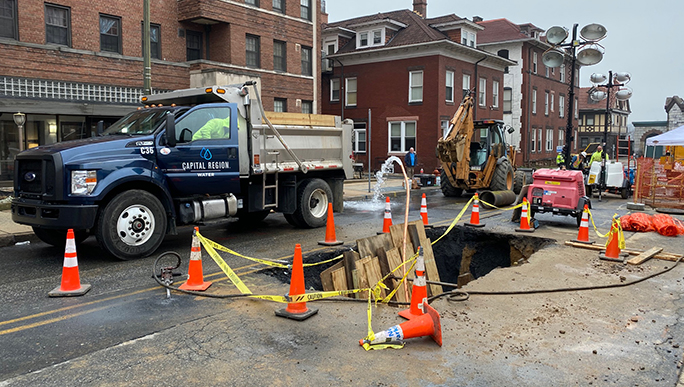
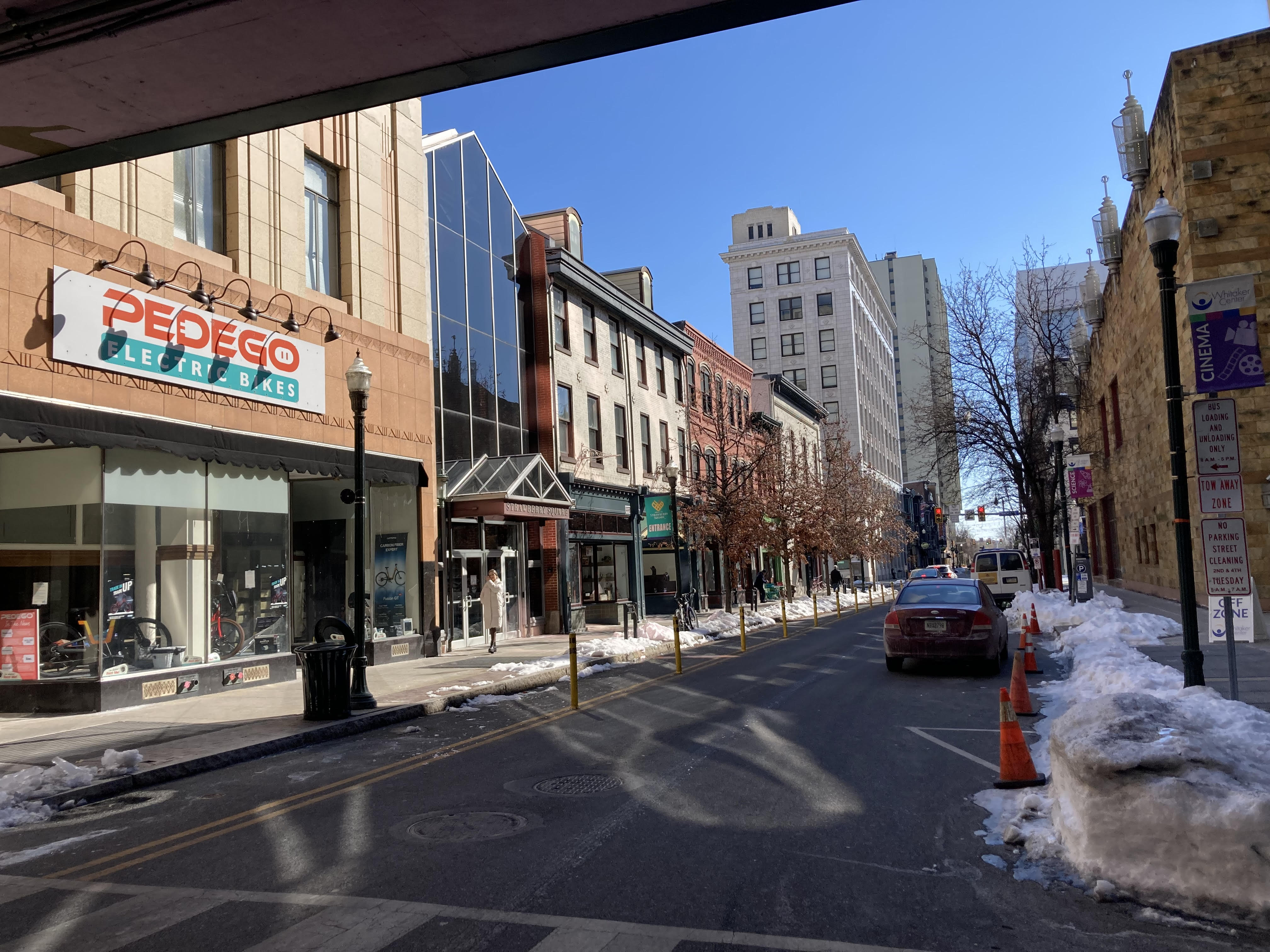
A stretch of downtown Harrisburg on N. 3rd Street
A group of state and local leaders is looking to Harrisburg residents, business owners, workers and visitors for help with a revitalization plan for downtown Harrisburg.
The Capital Region Economic Development Corporation (CREDC) and Harrisburg are asking stakeholders to complete an online survey in order to best understand people’s “perception” of the city’s struggling downtown.
The survey asks participants to weigh in on their view of the area’s restaurants, businesses, overall appearance and availability of activities, among other things.
Harrisburg spokesperson Mischelle Moyer explained that the survey is the “first step” in a broader engagement process that will guide policy decisions, economic development priorities and public-private partnerships as a downtown revitalization plan moves forward.
“Engagement ensures that our strategy reflects the lived experience of residents and the practical realities of business owners,” Moyer said. “It also builds shared ownership. When the community helps shape the vision, the community is more invested in its success.”
Several entities, including CREDC, the city, area legislators and the state, are combining forces to fund and draft a revitalization plan for downtown Harrisburg. In addition, Gov. Josh Shapiro said earlier this month he had state dollars “available” for the project if a comprehensive vision could be established.
Ryan Unger, president & CEO of the Harrisburg Regional Chamber and CREDC, noted that CREDC’s role in the process will be to bring together all groups collaborating on the effort.
After gathering data from the survey, which was developed by Pennsylvania Downtown Center, the revitalization team hopes to identify early opportunities for revitalization and identify areas for further research.
“We want to produce a short-term action plan within the very near future,” Unger said. “At the same time, we know that we need a longer-term vision and revitalization plan, and that’s also a part of our work as we go forward.”
Unger said the survey is an initial step in the planning process and that it’s important to gather the public’s input.
“You need a starting point to try to understand where people think of the downtown, but also what they would like to see,” he said.
If you ask local business stakeholders, possible areas for improvement include more daytime activities for tourists and fewer abandoned or vacant buildings. That’s according to Little Amps Business Development lead Mia Song, who formerly managed the coffee shop’s downtown State Street location.
She noted that the COVID-19 pandemic had a detrimental impact on the downtown’s business corridor.
She also said that when the state House is in session, Little Amps, just down the street from the Capitol, sees a high number of customers coming in the door, but that business can be pretty slow otherwise—especially in the winter.
“We need help from the state,” she said. “I hope that the state incentivizes people to come into the city.”
Song added another perception issue: safety during the city’s festivals. There have been several safety incidents in recent years, such as a woman driving through barriers and injuring several at Kipona Festival this past year. In 2024, the city’s Fourth of July fireworks show was cut short due to several people carrying guns.
“I know people who don’t live in the city too are deterred to come here,” Song said.
Meanwhile, Trik Sadi, owner of the downtown crepe shop Au Bon Lieu Bistro, theorized that more activities downtown during the day, like these festivals, might help bring in people to support businesses like his.
Right now, he said, foot traffic downtown is so low that he must work another job to cover his expenses. Many former customers, who are state workers, are now working from home, he said, and the high cost of parking is a big issue for other customers.
”The downtown now is very, very, very tough,” said Sadi.
Pat Davis, who owns Hornung’s True Value on N. 2nd Street, agrees that downtown parking is a major barrier for customers. When her customers get parking tickets, she worries they might not return.
She thinks that 15-minute free parking on downtown streets would make a world of difference for business owners like herself.
“That would change the whole scenario,” Davis said.
According to Unger, the survey will be available to the public for at least a week, maybe more, depending on the number of responses logged at that time. Additional outreach and engagement with downtown businesses will follow, he said.
“I think there’s definitely a lot of thoughts–a lot of desire to help improve downtown Harrisburg,” he said.
To learn more about or participate in the survey, visit HBGsurvey.com. The primary focus area of the survey on downtown Harrisburg is from Front to 7th streets and Mulberry to Forster streets.
If you like what we do, please support our work. Become a Friend of TheBurg!