Tag Archives: Mayor Eric Papenfuse

TheBurg Podcast, Oct. 30, 2015

Welcome to TheBurg Podcast, a weekly roundup of news in and around Harrisburg.

Oct. 30, 2015: This week, Larry and Paul nurse a trick-or-treating hangover by talking about the ongoing negotiations between Mayor Papenfuse and the tourism bureau and another court ruling on the lawsuits over the city’s gun laws. Plus, a call for help from Harrisburg police on an unsolved murder, a new Burg issue and the city’s first distillery since Prohibition (we think).

Special thanks to Paul Cooley, who wrote our theme music. Check out his podcast, the PRC Show, on SoundCloud or in the iTunes store.

TheBurg Podcast can be downloaded by clicking on the date above or by visiting the iTunes store. You can also access the podcast via its host page.

Continue Reading

TheBurg Podcast, Oct. 23, 2015

Welcome to TheBurg Podcast, a weekly roundup of news in and around Harrisburg.

Oct. 23, 2015: This week, Larry and Paul talk about complaints and revelations at the recent meetings on Harrisburg’s parking system. Then they discuss Mayor Papenfuse’s beef with the local tourism bureau, which reached boiling point this week. Also, a quick update on the Reed defense team battling the city over the release of records, and a test-ride in the new Front Street bike lane.

Special thanks to Paul Cooley, who wrote our theme music. Check out his podcast, the PRC Show, on SoundCloud or in the iTunes store.

TheBurg Podcast can be downloaded by clicking on the date above or by visiting the iTunes store. You can also access the podcast via its host page.

Continue Reading

Mayor on Leaves: Bag ‘Em, Don’t Blow ‘Em, Please

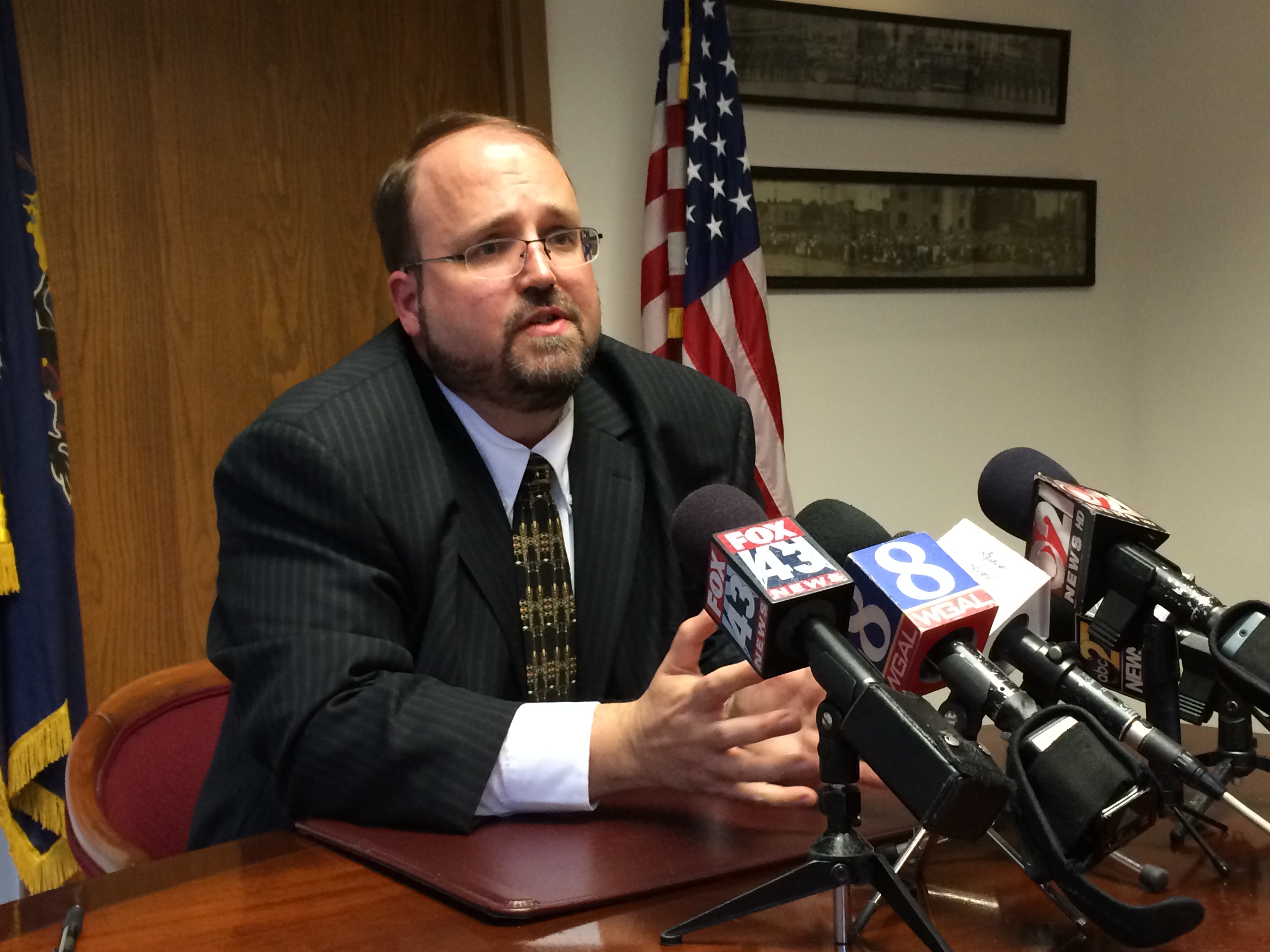
Mayor Eric Papenfuse.

Mayor Eric Papenfuse.

As fall advances, the city is once again asking residents to collect leaves in compostable bags, not rake or blow them into the street, to help its sanitation efforts in the midst of a department overhaul, city officials said Thursday morning.

Mayor Eric Papenfuse, speaking to reporters on the heels of inconsistent reports about this year’s leaf policy, some of which centered on frustrated residents, said the city would not punish residents who didn’t bag leaves, but was simply asking for help as it works to refine its leaf collection procedure for next year.

Bagging leaves is the “best way to help public works do their job,” Papenfuse said, but no one would be cited or fined for not doing so. “If they can’t do it, they can’t do it, and the city’s going to pick up the leaves as it’s always picked up the leaves.”

By placing leaves in compostable bags, residents will ensure the leaves don’t get mixed with litter, which can force the city to pay to dispose of it at the incinerator rather than drop it off at a composting site in Swatara Township.

Residents should place bagged leaves curbside the night before scheduled street cleaning, and not on trash collection days, Papenfuse said. The city’s street cleaning schedule is posted on signs throughout the city and is also available online.

The city has several thousand compostable paper bags residents can pick up for free at the public works center, at 1820 Paxton St., weekdays between 7:30 a.m. and 4 p.m. The mayor said he will also be asking City Council to appropriate around $6,000 for purchasing more bags.

The request to bag leaves is one of a number of changes this year to Harrisburg’s sanitation services. As part of a department overhaul, the city has replaced trash and recycling cans, worked to upgrade an aging sanitation fleet, and fought to bring businesses back from their accounts with private haulers to paying for city service.

Those efforts extend to leaf collection, which the city hopes to improve by next year with the purchase of a specialized leaf-collection vehicle and the creation of its own composting site, Papenfuse said.

The mayor made reference to the various changes in explaining the timing of the announcement on leaves, saying that the city didn’t want to make the request too early for fear it would get lost amid other sanitation news.

For more information about the sanitation overhaul, or to speak with city officials about the changes, residents can attend tonight’s final “Talkin’ Trash and Trees” meeting at the public works center at 6:30 p.m.

Free leaf collection bags will be available at the meeting, the mayor said.

Continue Reading

The Cost of Recovery: As Harrisburg’s recovery plan turns 2, how close is the city to financial stability?

Cost of RecoveryWhat will it take for Harrisburg to exit Act 47, Pennsylvania’s program for cash-strapped municipalities?

Don’t ask the citizens of Farrell. Located in the Shenango Valley, along the Ohio border, the city entered the program in 1987 and hasn’t left. In 2013, the Farrell City Council approved an amended version of the consulting plan guiding its recovery, which said it was “in a position to move out of the Act 47 program over the next four to five years.” Residents had heard that before—in 2006, consultants had said the city was poised to exit within a few years, too. But this time was different. Within a year of the update, state lawmakers adopted a five-year deadline for all municipalities in the program. “We’re stuck now,” Michael Ceci, the Farrell city manager, said recently. “The most recent amendment is it.”

Farrell’s fortunes, like those of many other Pennsylvania towns and cities, rose and fell with the U.S. steel industry. In 1992, the Sharon Steel Corp., a major local employer, filed for bankruptcy. By 2010, the city’s population had fallen to just above 5,000, from a height of more than 15,000 in the 1920s. A key benefit of Act 47, in this context, has been the ability to levy an additional four-tenths of a percent of income tax on non-residents—primarily people coming from Ohio to work in the remaining factories. According to Ceci, the hike, which provides a quarter-million dollars of Farrell’s $3 million budget, has been the program’s only meaningful advantage. “I get no other benefit,” he said. Yet, under the new deadlines, the city must eliminate this hike by 2018. Future budgets will have to be balanced through some combination of cuts and higher taxes on people who live there.

Two years ago, a state court approved Harrisburg’s own blueprint for financial recovery, branded the Harrisburg Strong Plan. The plan cautiously promised four years of balanced budgets, but a few weeks shy of the anniversary, Mayor Eric Papenfuse, who took office in 2014, announced it wasn’t working. Speaking in an annual “State of the City” address downtown, he swaddled this claim in some impressive rhetoric, comparing the need to amend the plan with the need for a Bill of Rights to amend the Constitution at the country’s founding. But Harrisburg’s plan, like Farrell’s, was already no stranger to revision. The Strong Plan updated a 2012 plan, itself modeled on plans from 2011, which in turn had replaced an emergency plan from 2010, a few months before the city entered Act 47.

Every city has its own circumstances, but financial trouble ultimately comes from the same two quarters: growing expenses and sluggish or declining revenue. When Harrisburg first sent up its distress flare, the worst problems were on the expense side. Though the Strong Plan has its detractors, there’s no question it addressed many of these woes. Most famously, it paid off hundreds of millions owed on the city incinerator, but it also targeted other, smaller obligations. (Among these were ballooning overtime costs for city firefighters; in his speech, Papenfuse noted these had dropped from $2.8 million two years ago to below $900,000.) This year, like last year, the city plans to underspend its budget. Halfway through its second year under the plan, Harrisburg appears to have expenses under control.

At the same time, cutting expenses isn’t the only key to recovery. As Papenfuse also said, the city is “starving for capacity,” with a workforce that has shrunk from 667 a decade ago to 369 today. The problem now is on the revenue side. The Strong Plan provided for two primary sources of new money—a higher income tax on residents and proceeds from more expensive parking downtown. But for months, city officials have been warning that the money isn’t coming in as expected. The balanced budget now threatens to fall apart in 2016.

Is the Strong Plan working? The first part of the plan, captioned “Guiding Principles,” concluded with a “cautionary comment”: no matter how comprehensive the plan was, it couldn’t replace the “dedicated and diligent services by public officials and other civic leaders.” But cities like Farrell offer their own cautionary tale. No matter how dedicated the public officials, they can only tax so much and cut so far. Most recently, Farrell decided to jettison its library, handing its management over to an area non-profit. “This city has done absolutely everything it can in terms of cuts,” Ceci said. At the same time, he fears what will happen as the city shifts the tax burden from commuters to residents. Why would anyone move to town?

Nobody likes it when money is tight, but one benefit of being in recovery is that it can force citizens to think about what level of government they’re willing to pay for. Harrisburg’s leadership, in the form of the recovery plan and, more recently, in Papenfuse, has drawn conclusions about what services to provide. They include filling in more potholes, tearing down more blighted properties, and hiring more police and public works employees. At the same time, Papenfuse has stirred the pot by saying the plan doesn’t quite cover their costs. He has already aired an initial suggestion on how to make up the difference—an extra $2-per-week tax on people who work in Harrisburg, and a plan to get more businesses to switch trash accounts from private haulers to the city. But the true price of closing the gap, and who should pay it, are questions we should expect to revisit in the months to come.

Continue Reading

Home Remedy

Harrisburg Mayor Eric Papenfuse.

Harrisburg Mayor Eric Papenfuse.

The new HBO miniseries “Show Me A Hero,” David Simon’s take on a desegregation battle that roiled the city of Yonkers, N.Y., in the late ‘80s and early ‘90s, is full of scenes that squeeze high drama out of the most tedious of municipal exercises. Roll call votes are cast before crowds of screaming protestors. A councilman, running to unseat the incumbent mayor, asks to use a city hall photocopier and is told stonily—faint hearts, plug your ears—it’s “gonna be a while.” In the fourth episode, the city manager hands a brown paper package to the outgoing mayor, Nick Wasicsko. Inside is neither money nor drugs but, rather, a framed copy of a recent amendment to the Yonkers charter. “You really fucking shouldn’t have,” Wasicsko says, as he tears the package open. The city manager, not to be out-cussed, replies, “Because of you, this place won’t be half as fucked up as it is now.”

Is there anything more boring than a local government charter? The things local governments do are often viscerally affecting—raising taxes, hiring and firing cops, bulldozing churches or, in Yonkers’ case, erecting public housing in middle-class neighborhoods. But charters concern what local governments are—whether they’re run by a manager or mayor, how many councilors oversee them, what day the budget is due. Even profanity can make them only so stimulating. The piece of the Yonkers charter that scored an HBO cameo eliminated the position of city manager and extended the mayor’s term from two to four years. Who fucking cares?

This week, at an annual “State of the City” address, Harrisburg Mayor Eric Papenfuse did his best to spice up his own charter initiative. The proposal has to do with home rule, the designation for a local government that opts to replace the state’s cookie-cutter municipal code with a charter of its own crafting. To date, Pennsylvania has 72 such “home rule” municipalities, including large cities like Pittsburgh, Philadelphia and Allentown as well as Harrisburg-sized cities like Lancaster, York and Wilkes-Barre. A municipality seeking home rule must first elect a commission to study its form of government. State law is poetic about this commission’s duties; among other things, it is to determine whether the local government can be “made more clearly responsible or accountable to the people.” It should also ensure the “widest possible public information and discussion” about its work, though it has some latitude in deciding how to do that. The commission for Carlisle, whose voters approved a home rule charter just this past May, published a monthly newsletter.

Papenfuse gave his address in a ballroom at the Hilton hotel downtown to an audience largely composed of local business owners. How they reacted to his speech depended, in part, on how accustomed they were to his taste for citing American history. He opened with a story about a James Earl Jones speech on the U.S. Constitution and went on to describe a “prize-winning” essay he wrote in graduate school on the Anti-Federalists and the path to the Bill of Rights. One’s reaction also depended on one’s comfort with Papenfuse’s tendency to lob grenades. At one point, discussing businesses that don’t use the city’s sanitation services, he noted he was “sorry to say” they included the event’s host, the Harrisburg Regional Chamber. (“It’s up to my landlord,” Dave Black, the chamber president, told Papenfuse on the ballroom floor after the speech. “Not really, though,” Papenfuse replied.)

The Constitution reference set Papenfuse up for his speech’s central analogy. Like the country’s founding document, he said, the state’s financial recovery plan for Harrisburg—stay with me—was imperfect as originally passed, and needed to be amended. “I say to you this morning: now is the time for we the people to work in unison to amend the Harrisburg Strong Plan,” the mayor said. Specifically, he called for three adjustments. The first was to raise the so-called local services tax, a flat tax on employees making more than $12,000 per year, from $1 to $3 per week. The second, more vaguely, was to “continue to invest in and improve” sanitation services. The third was to shift the city to home rule.

At base, all three proposals are about money. The so-called Strong Plan contains several hundred pages of initiatives for improving Harrisburg government, yet the mayor’s objections centered on only two problems: income taxes and parking revenues. The original plan’s projections were off, Papenfuse said, and the city now expects to fall $6 million short of the hoped-for revenues in 2016. The local services tax would obviously address this—according to the mayor, the proposed hike would rake in an extra $4 million per year. Less obviously, expanding sanitation is about money, too. City trash bills, Papenfuse said, are the one source of revenues that are “out-performing expectations”; adding accounts will allow the city to hire more workers, who can in turn provide “much-needed neighborhood services” like filling potholes and trimming trees. (He also suggested the sanitation fund could provide low-interest loans to other parts of city government, though here he drifted into dangerous territory. The city is currently facing a lawsuit claiming its trash rates are excessively high, allegedly to help fund unrelated government functions.)

What about home rule? Papenfuse discussed the prospect only briefly in his speech, describing it as “Harrisburg’s only real way out” of the state’s program for financially distressed municipalities. Short of specific proposals, how a new charter might provide that exit is not exactly clear. David Greene, assistant director and legal counsel to the Pennsylvania Local Government Commission, said a home rule charter can provide the “broadest quantum of powers to the municipality” of any form of local government, including greater freedom to define and increase the local tax base. Under the state distress program, Harrisburg was permitted to increase the income tax on residents to 2 percent; a home rule charter could make the authority for that increase permanent, or potentially authorize further increases. There are, however, limits to such home-rule powers, including limits on the taxes imposed on nonresidents, which might pose a problem for the mayor’s proposed tripling of the local services tax once Harrisburg leaves state oversight.

If home rule appeals to Harrisburg, it may be for reasons of principle as much as for reasons of practicality. Papenfuse, introducing the concept in his speech, said it would “transfer basic authority back from the state” to the city. In the wake of financial disaster and aggressive state intervention, there is something romantic in the concept of Harrisburg voters going back to the drawing board to design a government structure that may better suit them. The city of Nanticoke, in Luzerne County, became a home rule city in 2013, and left the state distress program earlier this year. At the top of their new charter is a brief preamble: “The citizens of Nanticoke City,” it begins, “have the privilege, right and responsibility to participate in all aspects of City government and have come together with a desire and willingness to improve their government through the enactment of this charter.” It concludes with a pledge by “We, the people of Nanticoke City” to uphold its laws. Papenfuse is not the first to look at local government and think of the U.S. Constitution. You can see why someone might want a framed copy.


Continue Reading

Our Collective Legacy: We all share some responsibility for Harrisburg’s past; we all should embrace responsibility for a better future.

Harrisburg is back in the national news again.

The 499 criminal counts against former Mayor Stephen Reed earned mention on the pages of the Wall Street Journal, the Washington Post and even national TV. This is just a short while after our city’s brush with bankruptcy from the incinerator debacle that brought infamy and ridicule. Depending on your perspective, the criminal charges against Reed are unnecessary grave-digging into a sordid political past or (for a seemingly growing number of people) a sense of justice finally delivered. Nearly all agree that the news represents something less than our community’s finest hour.

Similar news will likely continue for quite some time. The attorney general promised additional indictments stemming from a Reed-led “criminal enterprise” that spent millions of dollars of fees derived from municipal bond financings to purchase artifacts for museums. While some of those city-owned artifacts have already been sold off at steep losses, many more are either on public display (in the National Civil War Museum, for one) or in various storage spots around the city, including, allegedly and until recently, Reed’s personal home. Regardless of the ultimate resolution and disposition of these artifacts and the wisdom or utility of a Civil War museum, it is quite clear that city residents remain responsible for paying back the bonds that made their purchase possible.

The former “mayor for life,” who served from January 1982 until January 2010, maintains his innocence and vows to fight to clear his name. The eventual trial, perhaps together with a number of others involving those who helped to facilitate the bond fee boondoggle, promises to divert our attention from things that need to be done today to things that were done years in the past. Questions about who received what money for what work on what financings will no doubt be asked and (hopefully) answered. But the questions about what needs to be done to move our city forward unfortunately will not.

Current Mayor Eric Papenfuse rightly points out that many of the things some complain about today, including high parking and trash collection rates, as well as neglected infrastructure, are due in part to the millions in bond fees that went to build museums and buy artifacts rather than to the basic building blocks for our city. Papenfuse, in turn, deserves credit for his focus on the decidedly non-sexy items of potholes, vacant buildings, trash pick-up and safe streets, all the while under-spending on shrunken city budgets. His “more with less” approach is certainly a welcome contrast to actions detailed in the attorney general’s criminal presentment.

Papenfuse also called upon the board of the Civil War Museum to close and return the artifacts on display, saying the museum serves as a “monument to corruption.” All indications are that the board has no such intention, setting up additional acrimony and potential litigation from both sides. Regardless of your view on the merits of a Civil War museum, everyone should encourage the mayor and board to not waste yet more civic energy and resources. There should be a realization that, while none of the current parties created the situation, it is their responsibility to try to resolve it, amicably, for the benefit of the city residents who made the museum possible. The mayor and board, at minimum, should pledge to resolve the issue via negotiation and cooperation, not the court system.

For his part, Reed continues to deny any ownership of the city financial problems, claiming that a contractor’s failure to perform needed upgrades to the city-owned incinerator is to blame. The heart of the legal presentment against him, however, is whether or not Reed had the right to use fees from those financings for purposes other than those stated in the bonds. Vampire-hunting kits and buffalo heads make for easy ridicule. However, the real question is, would it make any difference if the mayor had used the funds to purchase items of a less ridiculous nature?

No doubt, the law needs to answer how it is that municipal bonds are allowed to include fees that can be used for such things. Presumably, bond buyers would be less interested in buying municipal bonds if they knew that part of the proceeds would help to build a Civil War or a Wild West museum in a small Pennsylvania city that had relatively little to do with either.

But, even if that’s true, I would caution the wider community to not use this as an opportunity for easy finger pointing, since collectively we do not escape the blame unscathed. All of us need to face difficult questions of exactly how this happened on our watch and, in some sense, take ownership, even if the main protagonists will not.

What responsibility do we all bear for this civic debacle? We, the citizens of Harrisburg, with tacit endorsement from the media and the communities around us, elected Mayor Reed a remarkable seven times over 24 years. To say that he did nothing right and that we are all merely innocent bystanders is to hide from the truth. We liked him for the good feelings he gave us and the seemingly good deeds he did.

At his best, Reed gave us a collective belief and confidence, however chimerical in retrospect it may have been, that the city was heading in the right direction. Somewhere along the line, though, things began to turn, and that collective belief and confidence began to erode. Whether it was due to his overconfidence from past successes or something more pathological in nature, Reed increasingly focused on amassing artifacts for ill-conceived museum projects that would ultimately overshadow the positives. As his longtime advisor Randy King told him, according to the grand jury report, “You’ve got to stop this, you’ve got to cut it out, it’s just going to kill your career.” Indeed it did—and nearly the city, too. But few of us noticed at the time, let alone helped King make his point.

The truth is, there was no one around to make him stop. Those close to him enabled him or benefited financially from him or both. To a person, this inner circle still doesn’t own the problem. Not their fault, they say. They were just doing what they were told.

For the most part, most of us, like them, were content to see the mayor take care of Harrisburg, so that we could go on with our lives, devoid of the responsibilities of ownership of our capital city.  While in office, Reed may have sucked all the oxygen out of the room, so to speak, but that easy vacuum allowed many of us to avoid the hard work of real civic engagement and sustainable growth and development.

More than the artifacts, the misguided museums or the alleged criminal misconduct, that might be the saddest legacy of the Reed era—that many in the region weren’t left with any real connection or feelings of responsibility toward Harrisburg. While things were going well, he was the hero; when they went wrong, the pariah. “Let the city fail,” they say. “They elected him, and we are safe out here in the suburbs.” “The city is someone else’s problem, not ours.” If this ordeal accomplishes anything, it’s hopefully showing how wrong that kind of thinking is and that it must begin to change.

For the city to truly move forward from this, we all have to acknowledge and take responsibility for what happened to make certain that it doesn’t happen again. And by that, I don’t simply mean the alleged criminal misconduct, as important as that is. More broadly, I mean we can never allow a single person or organization or entity to hold the reins of the city while ignoring our civic duties to question, engage and, most importantly, do the hard work it takes for a community to be strong—whether that means picking up trash or fixing up a building or getting involved in city life and doing more than the bare minimum that is required. Maybe it just means acknowledging that the health of Harrisburg matters to the health of our region. Maybe it just means giving a damn.

The first step is admitting. The next step is doing. This is our collective penance, and, despite whatever Reed did, it’s the legacy that we can still leave behind.

J. Alex Hartzler is publisher of TheBurg.

Continue Reading

August News Digest

Reed Arrested, Arraigned
 
Seven-term Harrisburg Mayor Stephen Reed was arrested and arraigned last month on 17 criminal charges ranging from bribery to running a criminal organization.

In all, the state charged Reed with 499 criminal counts covering actions related to the Harrisburg Parking Authority and the Harrisburg School District, as well as city government.

The counts cover alleged actions for many well-known Reed-era projects, such as the incinerator retrofit, the effort to acquire museum artifacts, the Senators baseball team and Harrisburg University.

Debt accumulated under Reed eventually resulted in a financial crisis that led the state to appoint a receiver for the city, as well as a failed attempt by City Council to declare municipal bankruptcy.

Dauphin County District Justice William C. Wenner set bail at $150,000 unsecured, meaning that Reed did not actually have to post bond. He ordered Reed to surrender his passport and restrict travel to the confines of Pennsylvania.

After the arraignment, Reed and his attorney, Henry E. Hockeimer Jr. of the Philadelphia-based firm Ballard Spahr, made statements defending the 28-year mayor. Reed blamed the criminal charges on “misperceptions and politics,” while Hockeimer said Reed “carried out his role [as mayor] with dedication and integrity.”

Afterwards, Pennsylvania Attorney General Kathleen Kane publicly released the grand jury presentment, which detailed the evidence behind the charges. The presentment alleged that thousands of “artifacts” and “curiosities” purchased with public funds were found in Reed’s home and storage areas; that Reed diverted money from city borrowings for other purposes; and that he used city employees for personal reasons.

Market Report Released
 
The Broad Street Market Task Force last month released a long-anticipated report on how to improve the condition, management and overall operations of the historic Midtown market.

Chairwoman Jackie Parker told Harrisburg City Council that the market’s two buildings are in decent condition, but that they will require “large capital investments” over the next decade.

More immediately, the report strongly recommended changing the market’s management structure.

Currently, the Broad Street Market Corp. operates the market, with the Historic Harrisburg Association as its sole shareholder. The task force advised separating from HHA and transitioning to a nonprofit entity, which then could better pursue grants and other funding.

“It would be a newly established nonprofit that is dedicated to full-time fundraising for the market,” said Harrisburg Mayor Eric Papenfuse, who announced the 10-member task force early last year as one of his first acts as mayor.

That transition could take the better part of two years, said Parker, who also is director of the city’s Department of Community and Economic Development.

Under the new structure, the market’s two buildings would remain owned by the city, but ongoing repair and maintenance would shift to the nonprofit, which would be overseen by a board of directors composed of volunteers from the community and market stakeholders.

The report recommended a number of other operational improvements, including free WiFi, greater recycling efforts, extended hours, greater diversity of food options, a marketing budget and better litter management.

Separately, Joshua Kesler last month was named president of the Broad Street Market Corp. board, replacing Jonathan Bowser, who resigned in June. Kesler is owner of The Millworks restaurant and art studios across the street from the market.

Campbell Pleads Guilty
 
Former Harrisburg Treasurer John Campbell last month pleaded guilty to charges that he stole money from several Harrisburg-based non-profit organizations.

Campbell said he was guilty of two counts of unlawful taking, a felony, and one count of Charitable Act fraud, a misdemeanor. He also promised to make full restitution for the thefts, which total almost $30,000.

Campbell was accused of taking money from several groups, including Historic Harrisburg Association, the Stonewall Democrats and Lighten Up Harrisburg. He was not charged with theft relating to his position as city treasurer.

If Campbell makes restitution by his Sept. 15 sentencing, Dauphin County Deputy District Attorney Joel Hogentogler said he would agree to a sentence of probation.

 
Anti-Blight Bills Passed

Harrisburg City Council last month approved two bills meant to battle the continuing problem of blight in the city.

The bills, passed unanimously, create a registry of foreclosed properties and increase fines on real estate investors and speculators for code violations.

Under the first ordinance, banks will pay a $200 annual fee for each property on the registry. The properties then must be kept properly maintained and secured.

Under the second, the city will levy higher fines on “corporate owners” of properties cited for code violations than it does on residential owners.

The higher fines are justified because it costs the city money to track down the investors and speculators, who often live out of the area and are difficult to identify and contact because they hide behind corporate entities, said Mayor Eric Papenfuse.

Food Truck Rules Updated

Food trucks in Harrisburg must locate at least 100 feet from brick-and-mortar restaurants under an ordinance passed last month by the City Council.

Council unanimously approved an ordinance update that requires food trucks and other mobile food vendors from setting up within 100 feet of existing restaurants, 15 feet from building entrances and 15 feet from a fire hydrant.

The ordinance update was urged by several downtown restaurants, which have complained that food trucks set up near them during high-volume times, such as during lunch and on weekend nights, and negatively affect their business. They also have complained about grease and litter.

The mobile vendors also must cease selling by 2:30 a.m. and move from the area by 2:45 a.m.

The ordinance does not apply to food trucks that congregate during special events, such as the monthly Food Truck Feast held during 3rd in the Burg.
 
 
HUD Funds Distributed

Harrisburg last month finalized the recipients of its annual dispersal of federal housing money.

The city received $3.1 million from three U.S. Department of Housing and Urban Development programs, most through HUD’s Community Development Block Grant program.

The city’s housing rehabilitation program received $451,806, the largest allocation, and the city police department received $250,000, which it plans to use to boost manpower in Harrisburg’s most troubled neighborhoods. The city’s demolition program got $111,114.

Other recipients included:
Fair Housing Council, $130,000
Tri County HDC, $100,000
Camp Curtin YMCA, $80,000
Christian Recovery Aftercare Ministry, $75,000
Habitat for Humanity, $70,000
Boys & Girls Club of Harrisburg, $60,000
Latino Hispanic American Community Center, $59,982
Heinz-Menaker Senior Center, $50,000
Mid Penn Legal Services, $30,000
Christian Love Ministries, $29,000
Codes Enforcement, $10,000

The city’s Emergency Solutions Grant Program received $164,603, and the Homeowner Improvement Program got $295,765.

More than $1 million will not go directly to recipients. Grant administration received $482,624, while debt service ate up $638,000. The latter item covers this year’s installment of repayment of a $3.8 million federal loan that Harrisburg backed for the failed (since revived) Capitol View Commerce Center.

Recovery Officer Appointed

Audrey Utley was appointed last month as the new chief recovery officer for the Harrisburg School District.

State Board of Education Secretary Pedro Rivera appointed Utley after a search committee recommended her. She recently retired as superintendent of the Steelton-Highspire school district and served a short, three-month stint as acting superintendent of the Harrisburg district in 2010.

Utley will continue the effort of trying to improve the financial and academic condition of the Harrisburg district, an effort begun by Utley’s predecessor, Gene Veno, who served in the post about two years before resigning in June.

Under Veno’s recovery plan, the district’s precarious financial situation stabilized, but the academic performance deteriorated further, according to state performance measures released last year.

2 Projects Get Green Light

More apartments are coming to Harrisburg, as the City Council last month approved land development plans for two substantial projects.

First, council unanimously approved Harristown Enterprise’s plan to convert 21,000 square feet of office space and another 6,000 square feet of loft space to six two-bedroom and 16 one-bedroom apartments above a stretch of shops along N. 3rd and Market streets in Strawberry Square.

If all goes according to plan, work on the project would begin this fall with completion slated for spring 2016, said Brad Jones, president and CEO of Harristown Enterprises, which owns Strawberry Square.

Council then OK’d a plan by WCI Partners to transform the former Harrisburg Moose Lodge Temple at N. 3rd and Boas streets into 33 one-bedroom apartments, with commercial space on the ground floor. WCI also plans to renovate three boarded-up townhouses on the property.

WCI President Dave Butcher said the project should begin in early autumn with completion expected next summer.

Transit Consolidation Urged

A state official last month urged the Harrisburg City Council to consider regional consolidation of mass transit services.

Area governments could save an estimated $2.3 million a year, mostly through reduced administrative staff, if they chose to consolidate into a single entity, said Toby Fauver, deputy secretary for multimodal transportation for the state Department of Transportation.

Fauver cited the potential savings as he briefed council on Phase 2 of the South-Central Regional Transit Consolidation Study, which recommends consolidation for most transit systems in south-central Pennsylvania.

If they decide to merge transit operations, the participating counties and municipalities would need to appoint representatives to a transition board that would decide such issues as structure, governance and operations. The consolidation would cost about $4.7 million to achieve, but the state would absorb that cost, Fauver said.

 
Changing Hands

Boas St., 106: K. Miller to A. Nascone, $130,000

Boas St., 314: B. Ostella to W. James, $99,900

Briggs St., 241: M. Simmons to C. Jeffers, $113,500

Calder St., 504: P. Maruszewski to H. Nguyen, $109,900

Catherine St., 1620: R. & M. Caplan to M. & V. Keyes, $31,000

Chestnut St., 2137: P. Bowman to G. Bierbaum & W. Alford, $184,900

Cumberland St., 117: J. & C. Kuntz to Cardinal Investments LLC, $81,900

Derry St., 2422: N. Foose to D. Brently, $61,900

Green St., 1910: WCI Partners LP to C. Reinhold & K. Hurst, $193,900

Green St., 3011: R. Snyder to M. Palermo Jr., $180,000

Herr St., 415: A. Antoun to J. Foreman, $54,900

Herr St., 1424: M. & A. Foreman to Bethesda Mission of Harrisburg, $275,00

Kelker St., 235: S. Woomer to D. Robinson & J. Vu, $99,900

Kensington St., 2408: PA Deals LLC to F. Frattarole, $63,500

Manada St., 1905: PA Deals LLC to G. & J. Modi, $96,000

North St., 1718; 2418 Jefferson St.; 2228 N. 4th St.; 350 Harris St.; 352 Harris St.; 1813 Boas St. & 1833 Forster St.: R. Shokes Jr. & Shokes Enterprises to JDP 2014 LP, $497,000

N. 2nd St., 405, Unit 2 & Unit 4: Belco Community Credit Union to Vinculum Inc., $410,000

N. 2nd St., 1100: L. & A. Morato to S. & J. Toole, $45,000

N. 2nd St., 2537: J. & M. McCarthy to N. Banting, $72,100

N. 2nd St., 2821: D. & M. Anderson to J. & L. Witmer, $96,000

N. 2nd St., 2904: J. Reitz & Webster Bank NA to F. & B. Pinto, $285,750

N. 2nd St., 2926: J. & Y. Garner to M. & S. Bennington, $282,000

N. 2nd St., 3118: A. Barlup to P. & M. Rowan, $152,000

N. 3rd St., 1720: F. Phillipy to A. & A. Campoverde, $90,000

N. 4th St., 1625: GWD Capitol Heights LP to J. Wolfe & K. Hunt, $103,300

N. Front St., 1525, Unit 103: K. Blum to A. McKenna, $214,900

N. Front St., 2401: E. & D. Black to J.A. Hartzler, $215,000

N. Front St., 2501: Harrisburg Builders Exchange to Poole Anderson Construction LLC, $415,000

Rudy Rd., 2401: C. Butler to B. Royster, $119,900

S. 18th St., 946: W. & D. Shalan to Darna Investments LLC, $140,000

S. 21st St., 971: Lee Estates LLC to T. Le, $100,000

S. 29th St., 520: E. Cohen & Goodrich Assoc. to Goodrich Assoc., $125,000

S. Front St., 607: S. Farr to T. Edinger, $130,000

S. Front St., 711: Z. & J. Goodling to P. Moore, $180,000

State St., 1801: MAT Properties Inc. to Transcend Church, $99,000

Taylor Blvd., 52: PA Deals LLC to V. & S. Vdov, $56,900

Woodlawn St., 2359: Meier Norton FLP to Meier Supply Co., $406,800

Wyeth St., 1404: A. Weikert to F. Frattarole, $103,900

Wyeth St., 1412: PA Deals LLC to F. Frattarole, $103,900

Harrisburg property sales for June 2015, greater than $30,000. Source: Dauphin County. Data is assumed to be accurate.


Continue Reading

As Harrisburg Parking Fines Back Up, A Budget Falls Out of Balance

Mayor Eric Papenfuse, holding scissors, at a ribbon-cutting for Pango mobile parking app last year. (File photo.)

Mayor Eric Papenfuse, holding scissors, at a ribbon-cutting for Pango mobile parking app last year. (File photo.)

Last January, as Harrisburg made its final budget tallies for 2014, Mayor Eric Papenfuse pointed proudly to a major achievement of his first year—a budget so tightly managed that the city, so recently on the brink of bankruptcy, had paid nearly all its bills and still had $5 million in the bank to spare.

He achieved the surplus by spending millions less than authorized in the budget, a feat he is on track to repeat this year, with the latest projections showing the city is on target to spend $57.5 million out of a budgeted $59.5 million.

The same projections, however, show that a balanced budget may elude him. The reason, as reported in a court filing this week by the state coordinator of the city’s recovery, can be summed up in one word: parking.

Revenue from parking is down by an estimated $1.4 million, wrote Fred Reddig, the city’s coordinator under the state program for distressed municipalities, in a July 1 report to the Commonwealth Court judge overseeing the recovery process.

In particular, revenue from tickets is down due to a backlog in the courts. As of early May, there were around 20,000 unpaid tickets outstanding, Reddig wrote. Each month produces about 1,400 new delinquent tickets, but in the same period the sole district justice appointed to process them can only move through 250.

The result has been a steep departure from projected revenues that has in turn cut off the flow of money to the city, which is entitled to receive certain payments from the parking system under a 40-year lease signed in late 2013.

Over the year, the city is supposed to receive $2.5 million in these so-called “waterfall” payments, but it has so far only received a few hundred thousand dollars. In short, the parking revenues are “way, way, way off,” Papenfuse said.

And the consequence for city finances is that Harrisburg is now poised to end the year with a deficit of around $1 million, despite the continued penny-pinching.

“The budget is over-performing in all other areas, in terms of controlling expenses,” Papenfuse said. “The deficit is entirely due to shortfalls in parking.”

A remaining question is the cause of the ticket backlog, a point over which the mayor’s office and the state coordinator sharply diverge.

Reddig, in his report, pins the slowdown partly on the city’s own failure to pass a required parking ordinance in 2014, the year to which three-fourths of the backlogged tickets can be attributed.

Papenfuse dismisses this explanation, however, saying the ordinances have nothing to do with this year’s projected revenues. Instead, he points to the inadequate court processing and says he would like more help from the state.

“The city is doing everything in its power,” he said.

Nonetheless, both the mayor and the coordinator agree that the city is still on the track towards recovery. The city is current on its debt payments, Reddig wrote, and “would be able to weather an operating deficit of $1 million this year.”

Aside from the decline in parking revenues, “we’re feeling pretty good,” Papenfuse said. And the city should eventually get the money it’s owed. The question is when.

Continue Reading

Mayor, PennDOT: No Meeting on Front Street Trees

One of four trees slated for removal. A freshly installed pedestrian ramp is visible in the background.

One of four trees slated for removal. A freshly installed pedestrian ramp is visible in the background.

Four trees in the way of planned pedestrian ramps on Front Street are not as old as previously thought and should come down without further public discussion, city officials said this week.

The trees, located in Riverfront Park at the intersections with Radnor and Emerald streets, are slated for removal as part of a PennDOT resurfacing project currently underway between Forster and Division.

A state historic preservation office urged the city and PennDOT last week to hold a public meeting to discuss the removal, noting the trees were in a historic district and possibly planted as part of the early-20th-century City Beautiful movement.

Doug McLearen, of the Pennsylvania Historical and Museum Commission, wrote on June 23 that his office “strongly suggests that PennDOT solicit and consider stakeholder comments and provide an open public meeting to discuss the project and its potential to affect historic resources.”

TheBurg previously reported that three of the trees were likely American elms dating to 1919, while a fourth was a Chinese elm or maple from the post-Depression era, relying on information from PennDOT project findings.

But Erik Josephson, who was hired this year as the city’s arborist, said at least three of the trees were actually Zelkovas planted between 40 and 50 years ago to replace elms that were likely wiped out by Dutch elm disease in the 1960s.

Harrisburg Mayor Eric Papenfuse said Tuesday that in lieu of a meeting about the removal, the city would be holding a public meeting Aug. 24 to solicit input on a multi-year replanting plan.

“PennDOT has indicated to the city that there will be no public meeting before the trees are taken down,” Papenfuse wrote in a message. “The city agrees that a better use of time and energies would be to create a positive, community-supported tree replanting plan for Front Street and Riverfront Park.”

Greg Penny, a spokesman for PennDOT District 8, confirmed Wednesday there would be no public meeting and that his agency planned to go forward with removal, which he said was not only necessary for the installation of wheelchair-accessible ramps but also to improve sight lines for people crossing the street.

Penny also said the pink “X” marks visible on some trees along the road had not been painted by PennDOT, but rather appeared to be a “stunt of some sort.” “It’s just an assumption on my part, but I think it was done to cause some alarm,” he said.

Jean Cutler, a former historic preservationist at the Pennsylvania Historical and Museum Commission and one of a group of citizens concerned about the tree removal, petitioned PennDOT again on Wednesday to hold a meeting.

“Their loss will mean a great change to the sense of place they help to create along Front Street,” Cutler wrote of the trees. “Harrisburg has lost many of its important resources over the last number of years and healthy trees should not be among them.”

Continue Reading

Court Strikes Down Pro-Gun Law, Saving City Some Fees

Harrisburg Mayor Eric Papenfuse, left, and City Solicitor Neil Grover spoke about the Commonwealth Court ruling Thursday afternoon.

Harrisburg Mayor Eric Papenfuse, left, and City Solicitor Neil Grover spoke about the Commonwealth Court ruling Thursday afternoon.

Harrisburg officials claimed a partial victory in the battle over its gun laws Thursday, after a state court struck down a law that emboldened gun-rights groups to sue Pennsylvania municipalities over their firearms regulations.

The Commonwealth Court, in an almost unanimous opinion, ruled the law violated constitutional requirements that a bill must have a single subject and must not depart from its original purpose in the course of being passed into law.

In its opinion, written by Judge Robert Simpson, the court rejected the argument that the provisions of the bill fit within the single subject of “amending the crime code,” saying such a subject was overly broad.

It agreed with the law’s challengers—three state senators, two state representatives and the cities of Philadelphia, Lancaster and Pittsburgh—that the bill was altered beyond its original purpose when the firearms provisions were added.

City officials celebrated Thursday’s ruling, though with the lawsuits still pending, they could not say precisely how decisive a victory it was.

“We know it helps us,” Harrisburg city solicitor Neil Grover said Thursday. “We just have to identify exactly how.”

The law aided gun-rights groups and their members by granting them automatic standing to sue municipalities, relieving them of the difficult legal task of demonstrating local ordinances had harmed them.

It also allowed them to recoup legal and other costs if they prevailed, leading attorneys like Justin McShane, whose firm is one of the two suing Harrisburg, to threaten the city with tens of thousands of dollars in damages.

Harrisburg Mayor Eric Papenfuse referred to those threats on Thursday, saying one consequence of the ruling is that the city will not have to make such payments.

“Attorney McShane was rather vocal about trying to bankrupt the city through his enormous legal bills,” he said. “I am pleased to say we will not have to pay them.”

Harrisburg has been defending its gun laws against two separate lawsuits since January, spending upwards of $65,000 so far, with mixed results.

A county judge has barred the city from enforcing three of its ordinances, while a federal judge, siding with the city, has voided a $21,000 default that was awarded to one of the plaintiffs.

The state law, Act 192 of 2014, began as a two-page bill about the theft of metals including copper and aluminum, but later was amended to incorporate almost verbatim the provisions on challenging local gun laws from a separate, stalled bill.

Kim Stolfer, whose group Firearms Owners Against Crime helped craft the law and is one of the groups suing Harrisburg, described Thursday’s ruling as “one of the worst examples of tortured logic I’ve ever seen.”

He said the ruling dodged the question of the legality of local gun ordinances, and pointed to a partial dissent by Judge Patricia McCullough arguing the majority left legislators in the dark as to how to amend the crimes code.

Papenfuse, for his part, claimed the opinion sent the right message to legislators. “Hopefully, the result of this will be, in the future, the public will be protected from lawmaking in that sort of last-minute, hidden-from-view style,” he said.

Stolfer, however, disagreed, saying the bill had been well-publicized when it was being considered and the legislature had “overwhelmingly” voted to pass it. “The people of Pennsylvania wanted this,” he said.

Continue Reading