
Tag Archives: Mayor Eric Papenfuse

In Trash Bill Suit, City Sees Source of Sanitation Woes

A trash hauler on the tipping floor of the Harrisburg incinerator. (File photo.)

A trash hauler tips waste at the Harrisburg incinerator. (File photo.)

When a south Harrisburg apartment complex filed a lawsuit against the city last week, it hoped to challenge what it called an “unconscionable” new city bill for trash pickup, one it says would more than triple what it pays a private hauler to provide the same services.

But the city says the suit, filed by Harrisburg Park Apartments, an affordable-housing complex in the 1400-block of S. 15th St., instead demonstrates one of the reasons officials are overhauling sanitation in the first place: private haulers are dodging city dumping rules.

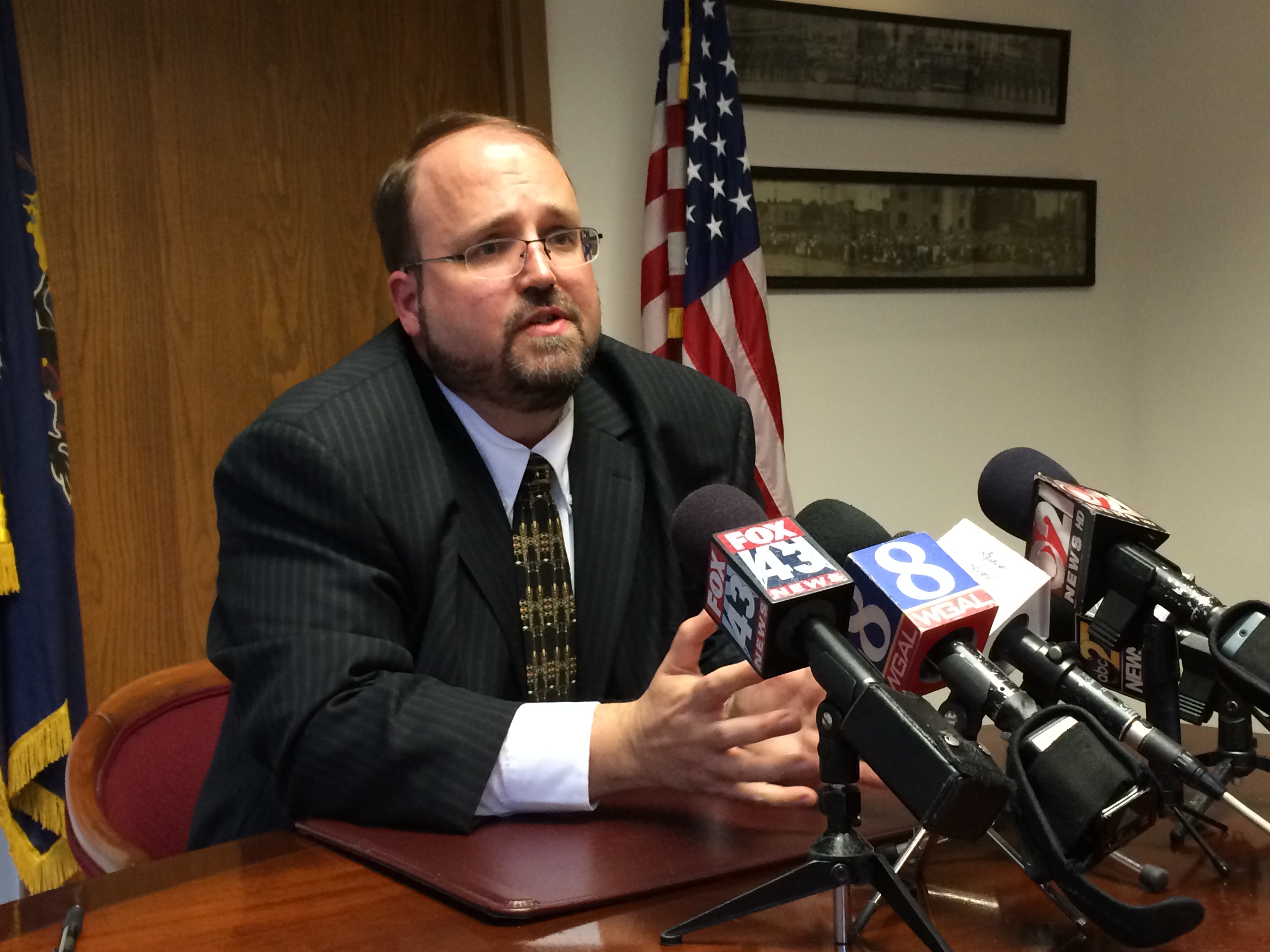
An invoice attached to the complaint, from the complex’s private hauler Republic Services, strongly suggests the company is evading the $190-per-ton charge to dump trash at the city incinerator, Mayor Eric Papenfuse told reporters Tuesday.

“If you look closely at the lawsuit, they put forth a bunch of assertions and facts which would tend to support our contention,” Papenfuse said. “It’s direct proof of the fact…that they’re not paying the city rate. They’re paying the county rate.”

The Harrisburg incinerator charges vastly different rates for municipal waste based on where it originates—$190 per ton to dump waste from Harrisburg, as opposed to $80 per ton for waste originating anywhere else in Dauphin County.

The incinerator does not specifically monitor where the trash is from, depending instead on an honor system in which haulers themselves declare the point of origin.

“We rely upon the haulers to be honest and forthright,” said Katie Sandoe, a spokesperson for the Lancaster County Solid Waste Management Authority, which bought the incinerator in 2013. Sandoe said the authority also reviews historical totals for disparities, which it has not detected.

Robert Hasemeier, a consulting engineer who worked on a recent audit of city sanitation services, estimated there were 6,000 to 8,000 tons of city trash that were declared each year as having originated elsewhere.

Presented with these numbers, Sandoe said the authority has “not seen the type of disparity that’s being described,” though she did say she was referring to recent disparities, rather than the historic shortfalls the city claims it has been facing.

According to the suit, Republic Services charges the apartment complex $2,200 per month to pick up trash twice per week from its five, six-cubic-yard dumpsters.

The weight of the trash would vary considerably depending on what sort of materials are in it and how full the dumpsters are, and without a breakdown of tonnage in the invoice, it’s uncertain how many tons Republic is transporting to the incinerator from the complex each month.

But assuming the dumpsters are only half full, and using an industry estimate of 200 pounds per cubic yard of household trash, the monthly total would be around 12 tons of garbage.

The cost of dumping that amount of garbage alone, and excluding personnel and other costs, would be $2,304 if the company were properly declaring its origin.

A customer service representative at Republic Services referred questions to Andy Warntz, an area sales manager, who could not be reached Tuesday.

Harrisburg Park says its complaint was prompted by a February letter notifying local businesses that the city would be taking over all waste collection and recycling within its boundaries this year.

The letter noted that several properties previously relied on private haulers for such services, but that the city was compelled to reclaim those accounts to meet “trash volume requirements” agreed to in the course of the incinerator sale.

The city must deliver 35,000 tons to the incinerator each year or else pay to cover the shortfall, providing extra incentive to recover lost city accounts, especially if the audit has correctly estimated the amount of trash being improperly declared.

“We are confident the city’s waste disposal and collection services will meet or exceed the services provided by private haulers and potentially save your business money,” said the letter, which was signed by the mayor and public works director.

According to the lawsuit, however, a new bill based on existing city rates would more than triple Harrisburg Park’s current trash costs, bringing them from Republic’s $2,200 per month to nearly $7,500.

The strongly-worded complaint blasts the city’s takeover, calling its rates “facially unconscionable,” “unreasonable and absurd” and “usury.”

It claims the city takeover, if not prevented by the court, would either force the owner to charge higher rent from tenants or go bankrupt and close the property, thereby reducing the stock of affordable housing available to low-income families.

Jordan Cunningham, a partner at the law firm Cunningham, Chernicoff and Warshawsky, which is representing Harrisburg Park in the complaint, could not be reached Tuesday. Ralph Salvia, another attorney at the firm, declined to comment, saying only that the complaint had to be re-filed to remedy a procedural error.

Papenfuse, for his part, said he has arranged to meet with Harrisburg Park’s attorneys to explain the city’s position. In the meantime, he offered his own opinion of the lawsuit, which he says is not the first one that has been threatened over the sanitation takeover.

“There is no merit to their case at all,” he said.
Continue Reading

TheBurg Podcast, April 17, 2015

Welcome to TheBurg Podcast, a weekly roundup of news in and around Harrisburg.

April 17, 2015: In a special extended edition of the podcast this week, Larry and Paul speak with their guest, Harrisburg Mayor Eric Papenfuse, about myriad issues from his first year-and-change in office. They discuss public safety, schools, mayoral power and Papenfuse’s political history and future ambitions – and also get the mayor’s endorsements for the 10-way City Council race this year. “Being mayor is a tough job,” he tells them. It “requires standing up for what’s right, pushing when you need to push, and trying to bring things into the public light when they need to be brought in.”

Special thanks to Paul Cooley, who wrote our theme music. You can listen to his podcast, the PRC Show, on SoundCloud or in the iTunes Store.

TheBurg Podcast can be downloaded by clicking on the date above or by visiting the iTunes store. You can also access the podcast via its host page, here.

Continue Reading

TheBurg Podcast, April 10, 2015

Welcome to TheBurg Podcast, a weekly roundup of news in and around Harrisburg.

April 15, 2015: This week, Larry and Paul give a brief update on two historic houses that may be spared demolition. Then, they turn to the more troublesome topic, on their minds because of a recent notable arrest, of crime, the community and the police.

Special thanks to Paul Cooley, who wrote our theme. You can listen to his podcast, the PRC Show, on SoundCloud or in the iTunes Store.

TheBurg Podcast can be downloaded by clicking on the date above or by visiting the iTunes store. You can also access the podcast via its host page, here.

Continue Reading

Parking Play: The mayor’s quarter-million-dollar bet on downtown parking.

Mayor Eric Papenfuse, holding scissors, at a ribbon-cutting for Pango mobile parking app last year.

Mayor Eric Papenfuse, holding scissors, at a ribbon-cutting for the Pango mobile parking app last year.

Harrisburg motorists are about to be part of Mayor Eric Papenfuse’s grand parking gamble.

The wager? That reduced happy hour prices and free parking on Saturdays will draw more parkers downtown, offsetting the damage to local businesses from a rate hike that began last year.

The stakes? About $285,000 in public money.

That’s the amount the city will pledge, pending a City Council vote Wednesday night, to make up for lost revenues in the event reduced prices don’t attract more drivers.

“We’re going to experiment with a theory we have…which says that basically, if we lower rates, then maybe more people will come to park,” Papenfuse said. “And we certainly believe that that will hopefully be the case.”

The money for the experiment will be allocated from a city account holding unspent county hotel tax dollars from 2014. Hotel taxes, which come from a countywide 5-percent levy on overnight lodging, are split between the county, the city and the tourism bureau for the purpose of promoting regional tourism.

If council agrees to the allocation, happy hour parking prices, from 5 p.m. to 7 p.m. on weekdays, will be lowered from $3 to $2 per hour beginning April 1.

Additionally, drivers will be able to get four free hours of parking on Saturdays by using the promotional code “LUVHBG” on a mobile parking app, beginning April 4.

The city will sponsor the free hours for drivers using the Pango app, which allows people to purchase and renew parking remotely by phone for a small fee.

For drivers using the “LUVHBG” code, which can also be entered as the number 588424, Pango will waive the fee as well as validate the four hours of parking, making the hours “truly free,” Papenfuse said.

Papenfuse discussed the proposal at a press conference Wednesday morning in city hall, where he described the changes as a response to customer complaints about increased rates and longer hours.

“Why are we doing this? Because we have listened,” Papenfuse said.

Trimont Real Estate Advisors, the parking system’s new manager under a long-term lease signed in 2013, also announced several initiatives on Wednesday to improve customer experience and attract more parkers.

One is a “rebranding” of parking officers as “ambassadors,” under a program that Standard Parking, the parking operator under the lease, has employed in other cities.

The “ambassadors” will be specially trained with knowledge of city events and locations, will wear “Ask Me” buttons to encourage the public to approach them, and will carry city maps and other informational material for handing out to visitors.

The operators also plan to implement a five-minute grace period before officers will ticket a car whose time has expired. The grace period is currently being tested and should take effect in the next two weeks, said John Gass, a director at Trimont.

A third program is a lunchtime discount program at the River Street garage, where weekday drivers will be able to pay $3 for up to two hours of parking, as long as they enter the garage after 11:30 a.m. and leave by 1:30 p.m.

On weekends, the program will allow drivers to pay $3 for up to four hours of parking, as long as they enter after 11 a.m. and leave by 3 p.m.

The lunchtime pricing reflects a steep discount on usual rates, which at the River Street garage are normally $8 for two hours and $12 for four hours.

The program is planned to take effect by May, pending the installation of new automated exits and entrances.

The initiatives, which are the first of several to be implemented in the coming years, should help show the parking system is “responsive to public comments,” Gass said.

Harrisburg leased its parking system in late 2013 as part of a state-sponsored plan to pull city finances from the brink of bankruptcy.

The system saw worse-than-expected returns its first year, in part because a long winter led to delays in installing new meters. The fourth quarter saw a shortfall in projected revenues of about $750,000, according to unaudited 2014 financials.

The approved 2015 budget projects $22.5 million in total revenues, with a tiny surplus, around $75,000, left over after all expenses.

Partly for that reason, the city had to put up money to guarantee that any rate changes would not hurt revenues. Nonetheless, Papenfuse said Wednesday he was confident the lower rates would attract enough drivers to cover the city’s wager.

The $285,000 figure represents the city’s “total exposure,” he said, reflecting how much revenue the system would lose if the lower rates attracted no new drivers.

Gass agreed. “We think we have very conservative assumptions at this point,” he said. “The $285,000 is truly a worst-case number.”

Continue Reading

Judge Suspends City Gun Laws

Attorney and plaintiff Justin McShane.

Attorney and plaintiff Justin McShane.

A Dauphin County judge has ordered Harrisburg to stop enforcing three of its gun-control ordinances, while leaving two others in force.

Judge Andrew H. Dowling, in a 12-page opinion Wednesday morning, found that the three ordinances—prohibiting gun possession in a park, by a minor and in a mayor-declared state of emergency—violate the state’s Uniform Firearms Act, which preempts certain local government ordinances regulating firearms.

The act forbids municipalities from regulating the “lawful ownership, possession, transfer or transportation” of guns and ammunition for purposes that are not considered illegal under state law.

Two other city ordinances, requiring owners to report the loss or theft of guns and prohibiting the discharge of guns within city limits, do not overstep the bounds of state regulations and can therefore remain on the books, Dowling wrote.

The order partly granted and partly denied a request for a preliminary injunction by the plaintiffs in the case, the gun-rights organization U.S. Law Shield and two of its members. Under a preliminary injunction, which is an extraordinary measure issued prior to a final determination, a judge finds that plaintiffs have a right to relief from a present harm and that they will be ultimately likely to prevail.

Dowling’s order is the latest development in one of two lawsuits filed against the city this year, after the passage last fall of a state law granting standing to membership groups to sue municipalities over their gun-control ordinances.

Under pressure, a number of cities and towns repealed their ordinances, but several others, including Harrisburg, decided to fight back.

U.S. Law Shield, whose mission, according to its website, is “preserving 2nd Amendment rights for all legal gun owners in our country and ensuring legal representation” for its members, filed its complaint against the city on Jan. 13.

Another group, Firearm Owners Against Crime, filed a complaint Jan. 16. That suit, which raised a question regarding owners’ rights under the U.S. Constitution, was removed to a federal court last week.

Both suits were brought on behalf of the groups as well as certain of their members, some of whom are Harrisburg residents and some who are not.

Harrisburg also argued that Act 192, last year’s state law amending the Firearms Code, was unconstitutional. Dowling declined to rule on this issue, saying constitutional questions are the purview of the Commonwealth Court.

The city had additionally asked Dowling to stay the proceedings until a decision was reached in a complaint filed by three other Pennsylvania cities—Philadelphia, Lancaster and Pittsburgh—challenging the law’s constitutionality.

Dowling declined to do so, however, saying the “timing and effect” of a Commonwealth Court decision was “uncertain.” The state preemption clause, and not the constitutionality of Act 192, was at issue in the present case, he added.

On Wednesday afternoon, attorneys with the McShane Firm, the law firm representing U.S. Law Shield, celebrated the ruling at a press conference at the firm’s Susquehanna Twp. offices.

Justin McShane, an attorney as well as a U.S. Law Shield member and individual plaintiff in the suit, called the ruling a “great victory” and urged Harrisburg officials to stop spending money on a “dead loser” of a lawsuit.

McShane said his firm’s legal fees, which Act 192 would oblige the city to repay, are “approaching six figures.” Harrisburg Mayor Eric Papenfuse should “simply wake up” and “stop being Don Quixote,” he added.

Papenfuse, reached Wednesday afternoon, declined to give detailed comments on Dowling’s opinion, saying he had been preoccupied with a long meeting about parking enforcement and had not yet had time to review it thoroughly.

He did say, however, that he believed Act 192 would be found unconstitutional, and added he was “disappointed” in Dowling’s decision not to stay the proceedings until the Commonwealth Court had a chance to rule on the law.

Other aspects of the ruling, such as the leaving in place of the reporting and discharge ordinances, he said he found “encouraging,” however.

Asked about the state’s preemption clause, Papenfuse referred to separate laws and rulings empowering the city to place “reasonable regulations” on gun use as well as to take actions “protecting the public health and safety.”

McShane, however, described the ordinances as ineffective “feel-good laws” that had no meaningful impact on the use of firearms by criminals.

Dowling expressed a similar view in his ruling, arguing that, while Harrisburg’s laws date back decades, it “would be difficult to argue with any degree of conviction that gun violence within the City of Harrisburg has decreased during that time.”

Dowling then suggested that the city might more effectively use community policing to fight gun violence and that such violence has societal causes that Harrisburg may not be able to combat.

“Instead, gun violence is associated with a confluence of many risk factors including mental health, decline in parenting and values, violence depicted in movies and other sociocultural factors,” he wrote.

To read Judge Dowling’s order, click: Judge Dowling Ruling, Feb. 25, 2015.

This story has been updated with an additional information explaining that the judge’s ruling is a preliminary injunction and not a final determination, as well as an additional quote from Mayor Papenfuse.

Continue Reading

Harrisburg Mayor OKs State’s Verizon Workout, Reluctantly

On Tuesday night, Harrisburg City Council voted 6-0 in favor of an agreement with Assured Guaranty Municipal Corp., the bond insurer familiarly known as AGM, to help the city avoid default on a $41.6 million debt that starts coming due in 2016.

The settlement represents a last, critical piece in a complex negotiation to resolve the debt in a way that would keep Harrisburg’s finances stable, a year and a half after the city adopted a state-sponsored plan to avert bankruptcy.

Council’s vote, however, passed the settlement to Mayor Eric Papenfuse, who on Friday had a message for the folks who brokered it: he’ll sign, but he isn’t happy.

In a 770-word open letter to Fred Reddig, Harrisburg’s coordinator under the state oversight program for distressed municipalities, Papenfuse critiqued what he saw as the deal’s numerous flaws, saying Reddig’s team had put “enormous pressure” on him to sign the documents before he had time to review them thoroughly.

The mayor attacked the city’s share of the proceeds from the deal, saying they ranged from  “anemic” to “disappointing.” He accused the coordinator of having failed to consider the city’s best interest, and blasted an energy contract that wasn’t publicly bid. And he claimed he’d been threatened with the loss of $5 million in annual state funding if he didn’t sign off on the deal.

Several of the involved parties did not return calls on Friday. But a few who did stuck up for the arrangement. Steven Goldfield, a financial advisor to Reddig, said the state Department of General Services, whose 17-year downtown lease is a key piece of the transaction, “bent over backwards” to make things work for the city.

And Brad Jones, the CEO of Harristown Development Corporation, the manager of the downtown properties involved, said he and his colleagues “really feel like we’ve been thrown under the bus.”

Under the arrangement, Harristown had assumed the risk of a new loan and had waived its customary management fee, Jones said. The deal was difficult, he added, but “we did the best we could.”

The deal is the culmination of two years of negotiations to resolve an outstanding debt burden from a city-backed borrowing in 1998.

That year, the city sold three office towers in Strawberry Square to the Harrisburg Redevelopment Authority, at the same time guaranteeing around $24 million in bonds the authority issued to finance the purchase.

Some of the bonds were secured by rent payments from the Commonwealth, which is under contract to lease office space in two of the towers through 2025.

But about $7 million of the original debt was secured by the rent in a separate tower, whose primary tenant, Verizon, was set to depart in 2016.

Under the terms of the original debt issue, the only security for the bonds beyond tenant payments was city tax revenues, meaning that the empty office building would leave Harrisburg on the hook for the full principal and interest on the original debt, for a total of $41.6 million.

In September, the state Department of General Services agreed to pick up where Verizon lets off, with a 17-year lease that will pay off a portion of the city’s obligation each year, for a total of around $11 million through 2033.

As a condition of that lease, however, the Commonwealth required renovation of all three buildings, which Harristown agreed to undertake by way of a $16 million retrofit, financed with a guaranteed energy savings contract with Siemens.

In turn, the lender for the retrofit, First National Bank, required the settlement agreement with AGM that council voted for Tuesday, which would provide some assurance that the Strawberry Square assets wouldn’t get tied up in litigation in the event of a city default.

The mayor’s complaint about the no-bid contract was a reference to Siemens, which Jones acknowledged was awarded the contract without a bid. But, Jones added, Harristown was not a government entity and was not required to seek bids.

Additionally, Jones said, Harristown chose Siemens because the company had already done no-fee work auditing the energy consumption of the Strawberry Square facility, which he described as having high maintenance costs and being badly in need of upgrades.

The mayor ultimately signed the agreement around noon on Friday, he said. But in his released statement, and again at a press conference in the afternoon, he explained he did so “not because I think it is a good enough deal for the residents of Harrisburg, but because I feel the consequences could be worse.”

Reached by phone Friday, City Councilman Ben Allatt, the budget and finance committee chair, said he sympathized with the mayor’s remarks, describing the ultimate arrangement as “the lesser of two evils.”

Allatt pointed to some of the expected benefits of the state lease, including the parking and restaurant revenues that should be realized from the addition of around 900 workers to the downtown scene.

He also expressed frustration over feeling that many negotiations have been “forced on the city” in the course of the state’s intervention, saying Papenfuse “is always right to push back” on contracts that may not be the best deal for the city.

“Are we really getting the best deal? At the end of the day, it’s hard to say,” Allatt said. But, he added of the coordinator’s team, “I don’t think they were negotiating in bad faith for the city. I think there was no easy scenario.”

Continue Reading

Truth in Spending: As a candidate, Harrisburg Mayor Eric Papenfuse outlined a broad vision for a Harrisburg renaissance. But the legacy of his first year may be something more prosaic: fiscal responsibility.

Screenshot 2015-01-27 23.44.26Two nights before Christmas, Eric Papenfuse, the Midtown businessman who was elected mayor in November 2013, was sitting in council chambers in city hall. Outside, in the atrium, was the 26-foot artificial holiday tree which, in a characteristic coaxing of largesse from area corporations, he had gotten donated from Giant Food Stores. While council members amended one of his proposed bills, the mayor spun a pen rotisserie-style between his fingers.

The bill proposed a policy, known as tax abatement, which attempts to incentivize development by providing tax breaks for improvements on certain properties. Ultimately, council amended it so extensively that the administration asked it to be withdrawn. (A subsequent effort to revive it last month was rejected by a split council.) As a result a major administration initiative, and one that Papenfuse announced his support for during his mayoral campaign, wound up on an indefinite backburner.

After the meeting, Papenfuse expressed his disappointment about the failure of the bill. But then he pivoted to a positive note—council had passed his 2015 budget without substantive disagreement, aside from a few quibbles over the salaries of his front-office staff.

A balanced budget, as political achievements go, is not particularly exciting (even if governments at every level seem to struggle to pull it off). Yet, given Harrisburg’s circumstances at the start of his tenure, it might be the most enduring legacy of Papenfuse’s inaugural year.

Tightening the Belt

The state’s recovery plan for Harrisburg, which was called the Harrisburg Strong Plan, included a promise—carefully hedged—of basic financial stability. The city, the plan said, would get a balanced budget in 2013, plus the “expectation” of future balanced budgets through 2016. For each of those years, the city could be “comfortable” that its revenues would cover “required operating expenses.”

There was a reason for the hedging. Four months later, City Council approved a 2014 budget that contained a $4 million “plug”—an accounting trick to conceal the fact that the budget included several expenses the city could not technically afford. Making up a little less than half of the total were savings expected from a new labor agreement with the firefighters union, which the city did eventually secure under Papenfuse in February. Most of the rest was attached to vacant positions, meaning that the city could keep a balanced budget simply by not hiring. But there was an additional challenge. The city was carrying about $4.5 million in unpaid bills over from 2013 into the new year.

Early in the year, Papenfuse met with his finance director, Bruce Weber, as well as the new controller, Charles DeBrunner, about a spending strategy. According to DeBrunner, he looked over the mayor’s wish list and told him, “You’re going to be a miserable mayor in 2014. We’re not doing any of this stuff.” They agreed on a tightened-belt approach: not only would they enact a hiring freeze, but they would also urge city departments to spend less than they were authorized to spend.

During an interview last month, Papenfuse presented a chart showing the results of that directive. In each of four spending categories, the city had significantly underspent its approved budget: $36.8 million on personnel, out of an approved $38.9 million; $1.6 million on supplies, out of an approved $2.6 million; and so on. (Some of the savings, Weber said, resulted from the use of lease financing for certain equipment, so that expenses were spread over several years.) As a result, the city had more than covered the plug, managing to pay down all but a few hundred thousand in 2013 payables while still having an end-of-year fund balance of $5.3 million.

Screenshot 2015-01-27 23.45.05“In my wildest dreams I never thought I’d see a fund balance like this,” DeBrunner told me. “The mayor’s had a terrific year. I’m really pleased with him. And controllers don’t get pleased.”

Nonetheless, in Papenfuse’s view, the city’s cash balance is still less than it ought to be. At the suggestion that the city could afford to cut taxes, he replied, “Let’s not get ahead of ourselves.”

“You should never run a business or a municipality to the point where you have to just stop paying people,” he went on. “The problem with Harrisburg is that, in the past, they just stopped paying the bills. And we now have enough of a cushion to be ensured to be able to pay our bills on time. But that’s it. And that cushion’s not going to be duplicated in the coming year.”

Weber, noting that $5 million represents about one month of city expenses, said that a city with a budget like Harrisburg’s should really maintain a balance of around $15 million. (A best practices document from the Government Finance Officers Association, approved by the organization in 2009, recommends that governments generally maintain a minimum unrestricted fund balance of two months’ worth of operating expenses.) But the surplus does leave him confident that, in 2015, the city will be able to pay its bills on time—and to do so, in contrast with the Harrisburg of the not-too-distant past, without borrowing any money.

Settling Debts

The Strong Plan settled Harrisburg’s historic debt tied to the city incinerator. But it left unresolved a substantial obligation, related to a downtown real estate deal from the late 1990s, which threatened to topple city finances only a few years later.

The debt is associated with the so-called Verizon building, a tower in Strawberry Square where the telecommunications company rents office space. In 1998, the Harrisburg Redevelopment Authority issued $23.6 million in revenue bonds to purchase Strawberry Square land and facilities from the city. The city, as part of the deal, guaranteed $6.9 million of these bonds. But the debt payments, which were supposed to be secured by tenant rents, would not begin until 2016—the same year the lease with Verizon is set to expire. Furthermore, the bonds were capital appreciation bonds, meaning that the full principal has been accruing interest since the bonds were originally issued, so that the debt load currently exceeds $20 million. (By the time the debt schedule concludes, in 2033, $41.6 million will have been paid back on the original $6.9 million borrowing.)

In September, the state Department of General Services agreed to a 17-year lease in the building beginning in 2016, relieving the city of part of the burden. DGS’s rent, however, will not be sufficient to cover all of the debt payments, and the city and its advisors are currently negotiating how the remainder will be paid.

The obligation weighs heavily on Papenfuse. When I arrived for our interview, a leather-bound book of documents from the Verizon-building debt issue was on his desk. “We feel we can meet the obligation,” he said. “It’s just such a horribly bitter pill for the city to have to swallow.” He called the debt the “worst of all of the Reed transactions,” referring to former Mayor Stephen Reed, under whose watch the borrowing occurred. “It’s preposterous. It should never have been recommended,” Papenfuse said. Yet, the debt was approved by a City Council vote; the city had pledged its credit, and though the mayor was reviewing the related documents, he felt that the city would likely have no choice but to pay it.

Last March, the city exited receivership, the period of direct state oversight that produced the Strong Plan. But it remains in Act 47, the state program for distressed municipalities, through which it continues to receive guidance from many of the same advisors who helped craft the plan.
One of those advisors is Steven Goldfield, who has been working closely towards a settlement on the debt related to the Verizon building. In a recent interview, Goldfield said it was his “mantra” that the city “would not have ascending debt service” under the Strong Plan. To achieve this, however, may require some postponement of some of the early payments the city owes under its guarantee. Under the proposed settlement, details of which were still being negotiated at press time, Assured Guaranty Municipal, which insured the original bonds, would advance some portion of the payments to bondholders and be paid back by the city with interest at a later date.

Screenshot 2015-01-27 23.48.48Even with a settlement, the city’s borrowing ability will be deeply constrained. In accordance with his mantra, Goldfield’s target is to limit annual debt service to 10 percent of the city’s revenues. According to a chart of projected debt payments under the proposed settlement, provided by the mayor’s office, a conservative estimate has city debts hitting the 10-percent-of-revenues mark through 2032—and that’s without any new borrowing. (Debt payments currently exceed the 10-percent cap and are projected to do so through 2022.) In other words, as Papenfuse put it, the city has “basically maxed out” its credit for the next 17 years.

A Fiscal Conservative

Given the city’s financial condition, a mayor with any ambitions for projects beyond the bare essentials—like spending on safer streets, for instance, or road repair—has two options: increase revenues or get somebody else to fund them. This context may help make sense of some of the mayor’s recent battles. When Papenfuse took up the issue of student safety, for instance, he supported the idea of police officers in city schools—he just wanted the district to pay for them. (The district, so far, has declined.) Likewise, he sees the debate over tax abatement as a debate about the best way to expand the city’s tax base over the long term.

Understanding these constraints also helps to form a picture of Papenfuse’s politics. He is in many ways an urban progressive, supporting same-sex marriage, standing by the city’s gun control ordinances, demanding better educational results from city schools and promoting city living. But he is also a fiscal conservative, who prioritizes paying the city’s bills on time over, say, filling a vacant position, even one he believes the city needs. Among his department heads, he said, he sought to instill a new ethos: “Just because it’s in the budget doesn’t mean you have to spend it.”

“I think that this particular time and this particular moment in the city’s history required a level of fiscal conservatism,” Papenfuse told me. He claimed to have operated under even more conservative estimates than the city’s state advisors, who projected higher revenues than Papenfuse was willing to believe. “Believe it or not,” he said, “we are more fiscally conservative than the Commonwealth of Pennsylvania.”

Continue Reading

After First Year, Taking Stock of Harrisburg’s Recovery

Harrisburg Mayor Eric Papenfuse. (File photo.)

Harrisburg Mayor Eric Papenfuse. (File photo.)

On the campaign trail in 2013, soon-to-be-mayor Eric Papenfuse spoke approvingly of the state’s financial recovery plan for Harrisburg, saying it offered a “brief window of opportunity” to bring the city back from the brink of bankruptcy.

Now, Papenfuse and other city officials are sizing up the recovery plan once again, as they look back on the city’s first year under his administration and weigh the financial challenges and successes since the plan was implemented.

The year saw Harrisburg’s departure from receivership, the period of direct state intervention in city finances, although the city remains in Act 47, Pennsylvania’s program for state oversight of financially distressed municipalities.

For the most part, officials said, the year exceeded expectations, with the city receiving most of its anticipated revenues, maintaining a balanced budget through the close of the year and getting current on its bills faster than was predicted.

They also pointed to a substantial year-end fund balance and a likely settlement of an outstanding debt obligation as evidence of the city’s improving fiscal health.

At the same time, they remained cautious about the city’s finances in the coming year, as evidenced in part by the $4.5 million tax and revenue anticipation note, or TRAN, they plan to submit for City Council’s consideration Tuesday evening.

The TRAN, a form of short-term borrowing that municipalities often issue to cover lean revenue periods, would allow the city to pay its bills in the event of a cash shortfall in the months before property and other taxes start to roll in.

Steven Goldfield, a financial advisor who helped craft the city’s recovery plan and continues to work closely with the city’s coordinator under Act 47, said the TRAN was a positive step for Harrisburg, since it meant the city was accessing the capital markets for the second year in a row after its debt crisis.

In addition, three lenders bid this year on the city’s request for a TRAN, securing a better offer for the city than last year, when only Metro Bank bid.

Last year’s $2 million TRAN cost the city a $10,000 commitment fee and a $5,000 legal fee. Under this year’s offer, from Mid Penn Bank, the city will pay a $1,500 legal fee and no commitment fee, said Bruce Weber, the city’s finance director.

The city ultimately didn’t draw upon last year’s TRAN. Both Papenfuse and Weber said in an interview last week that they did not expect the city to draw upon this year’s TRAN, either, largely because of its sizable fund balance going into 2015.

That year-end fund balance, which Weber said totaled $5.3 million, is another measure of the city’s improved financial condition, they said, as well as being a pleasant surprise to city officials.

“In my wildest dreams I never thought I’d see a fund balance like this,” said City Controller Charles DeBrunner, who took office in January.

DeBrunner, who served briefly as budget director under Mayor Harold Swenson in the 1970s, ran for his current post with the encouragement of Dan Miller, his predecessor and a former councilman whom Papenfuse defeated in a bid for mayor.

DeBrunner praised Papenfuse for his management of the city’s 2014 budget, saying the mayor helped achieve the large fund balance in part by having almost every city department spend less than it was actually authorized to spend.

The city also managed to pay down nearly all of the $4 million in outstanding 2013 payables that it carried forward into 2014, far exceeding DeBrunner’s expectations.

Papenfuse “had a terrific year,” DeBrunner said. “I’m really pleased with him. And controllers don’t get pleased.”

Officials were also hopeful about a settlement to a significant outstanding debt obligation, which City Council will consider for the first time at Tuesday night’s legislative session, the first of the year.

The settlement, to be introduced as Resolution 7 of 2015, will be with bond insurer Assured Guaranty Municipal, or AGM, over debt obligations related to the so-called Verizon tower, a downtown office building.

In 1998, the Harrisburg Redevelopment Authority issued $23.6 million in revenue bonds to purchase land and facilities from the city in Strawberry Square. The city guaranteed $7 million of these bonds, which were to be secured by rent payments from tenants and were to start coming due in 2016.

However, the building’s primary tenant, Verizon, later decided not to renew its lease, which expires in 2016, potentially leaving the city on the hook for a total of $41.6 million of debt payments through November of 2033.

The so-called Verizon Tower in downtown Harrisburg, which the telecommunications company plans to vacate in early 2016.

The so-called Verizon Tower in downtown Harrisburg, which the telecommunications company plans to vacate in early 2016.

In September, the state Department of General Services agreed to lease office space beginning in 2016, relieving the city of part of the burden. The DGS payments, however, will not be sufficient to cover all of the debt, leaving the city with mounting debt service that could threaten its financial stability.

Full details of the proposed settlement with AGM will not be made public until Tuesday’s council hearing. But Goldfield, in a partial preview of the deal last week, said that it would involve AGM advancing payments to bondholders on the city’s behalf without declaring the city in default of its obligations.

Effectively, AGM will authorize the city to borrow up to $400,000 per year for six to eight years to put towards debt service on the bonds, with the city later paying back any required advances with interest.

Goldfield would not disclose the interest rate, although a note in the relevant section of the state’s recovery plan from August 2013 indicated the receiver’s team was at the time negotiating towards a rate of 6.02 percent.

Goldfield said it was his “mantra” in the city’s debt negotiations that Harrisburg would not have ascending debt service. His goal, he said, was to keep annual debt payments at around 10 percent of the city’s budgeted expenditures.

The city’s current annual debt service exceeds this percentage, although a chart of projected payments, which Papenfuse showed TheBurg, indicates that under the proposed settlement with AGM, the city’s debt service will reach 10 percent of expenditures in the next few years and remain there through 2032.

Repaying the Verizon tower debt is a “horribly bitter pill to swallow,” said Papenfuse, who was reviewing documents from the original 1998 bond issue prior to the interview with TheBurg.

He said he was “personally reviewing every document” to see if the city could get out of its obligation. But he added that, in his current analysis, Harrisburg was “stuck with this horrible Reed deal,” referring to former Mayor Stephen Reed, under whose watch the borrowing occurred.

Because of that borrowing, Papenfuse said, the city had “basically maxed out” its credit through 2032 and would not be doing any elective borrowing under his tenure or possibly even the next mayor’s.

Nonetheless, he was proud of the city’s progress in his first year, which he said represented an extensive effort by him and his staff to cut costs and spend responsibly. “To me it’s pretty extraordinary what we’ve been able to do,” he said.

This article has been updated to correct the title of Bruce Weber, who is the city’s finance director.

Continue Reading

TheBurg Podcast: Year-in-Review Edition

Welcome to TheBurg Podcast, a weekly roundup of news in and around Harrisburg.

Dec. 31, 2014: Larry and Paul look back at the year that was. From parking and crime to street planning and fiscal sanity, they discuss stories ranging from the overplayed to the overlooked.

Special thanks to Paul Cooley, who wrote our theme music and whose own podcast, the PRC Show, is available on SoundCloud and in the iTunes store.

TheBurg Podcast can be downloaded by clicking on the date above or by visiting the iTunes store. You can also access the podcast via its host page, here.

Continue Reading

TheBurg Podcast, Dec. 19, 2014

Welcome to TheBurg Podcast, a weekly roundup of news in and around Harrisburg.

Dec. 19, 2014: This week, Larry and Paul discuss the second city budget hearing, the possibility of a land sale near the DeHart Reservoir, the hidden power of the zoning hearing board and, as usual, other media.

Theme music by Paul Cooley of the PRC Show.

Note: If the podcast doesn’t play when you click the link above, you can access it by visiting our host page, theburgnews.libsyn.com.

Continue Reading