Tag Archives: Kathy Anderson-Martin

Midwest Food Bank PA launches community wellness challenge to support mission

Kathy Anderson Martin, executive director of Midwest Food Bank PA, along with other officials and Giving Wellness program organizers, in the state Capitol.

A local nonprofit will offer the community a chance to play an active role in addressing food insecurity.

Midwest Food Bank PA in Middletown launched its Giving Wellness initiative on Wednesday, which allows companies and community groups to access wellness resources in exchange for support for the food bank.

“At Midwest Food Bank we wanted to create a new path to wellness for all, not just the people we are helping that are struggling with food insufficiency,” said Kathy Anderson-Martin, executive director of Midwest Food Bank, at a press conference in the state Capitol on Wednesday. “We have built a health and wellness program to help people build healthier habits at home and in the workplace.”

For each participant, a donation will go toward the food bank to provide weekend food bags for 11 children.

Through the program, groups can pay for eight weeks of access to a personalized app with nutritional guides, workout videos and wellness support. Resources are provided by Harrisburg-area-based Precision Training Concepts and health coach Amber Peterson. The program functions as a competition, where participants earn points for completing health challenges.

According to Anderson-Martin, Midwest Food Bank is one of the first food banks to offer a wellness challenge.

As part of a pilot group of participants, local organizations CommunityAid and Strategic Consulting Partners have been challenging each other for the past several weeks.

“We thought this was a great opportunity in response to the work we are doing to really walk the talk,” said Monica Gould, founder and president of Strategic Consulting Partners. “Our team has really had so much fun.”

Midwest Food Bank is slated to distribute $24 million in food this year to 200 nonprofits, providing food for 332,000 people who are struggling with food insecurity.

For more information or to sign up for the Giving Wellness program, visit their website.


If you like what we do, please support our work. Become a Friend of TheBurg! 


Continue Reading

In Pictures: Photographer documents quarantine, donates funds to Salvation Army of Harrisburg

Roger Baumgarten of Roger That Photography presents check to Salvation Army Director of Resource Development Kathy Anderson-Martin.

Stuck in quarantine for so long, the last thing many of us thought about was getting dressed up to be photographed. We may have thrown on a nice shirt for a Zoom meeting, but pants? Maybe not.

This morning, Roger Baumgarten presented a $10,327 check to the Salvation Army of Harrisburg Capital City Region for doing just that, photographing people.

Since March, Baumgarten of Mechanicsburg-based Roger That Photography has traveled around the region taking free photos of families on their front steps. Sales from downloads and print purchases went directly to his fundraiser for Salvation Army.

“My choice to do this for Salvation Army came when I saw what they were doing for the COVID crisis,” Baumgarten said. “It was a very easy call to say, ‘I’ll do it!’”

Over the course of around three months, he photographed 422 families in four counties. Some people dressed up for the occasion, pulling out the dresses and slacks that had gone unused for so long. Others truly documented the time, wearing pajamas and holding rolls of toilet paper.

One family’s front step photo.

When Baumgarten embarked on his project, he thought he would cover his own neighborhood and possibly a few others, but quickly started receiving calls from all over the area. He estimated that he’d raise a few thousand dollars, but was blown away by the generosity of the donors towards the Salvation Army fundraiser.

“Salvation Army has done more in 12 weeks than they did in the previous year; it is just so incredible,” he said. “My part was the easy part.”

The photographer got the idea from a friend who introduced him to #TheFrontStepsProject, an initiative started by two Massachusetts photographers. Lacking paying work, photographers wanted a productive way to occupy their time by giving back to their communities. Nationwide, the project has garnered an estimated $2 million for charity.

Kathy Anderson-Martin, director of resource development for the local Salvation Army,  explained how much Baumgarten’s work meant to the organization.

“Our level of services has increased, so this is huge,” she said. “This was a sacrifice.”

The Salvation Army has experienced a rise in demand for emergency food distribution during the pandemic and, with children and youth programs now starting back up, the need is great. Anderson-Martin said there have been around 1,200 families receiving food who never needed to before.

“I was grateful to be in a position to help,” Baumgarten said. “It also got me out of the house, which was good.”

Roger That Photography is based in the Mechanicsburg area. For more information, visit his website. Salvation Army is located at 506 S. 29th St., Harrisburg. To learn more about their work, visit their website.


Continue Reading

Hunger Pains: Innovative solutions, charitable donations meet unprecedented need for food–for now.

Cereal, peanut butter, pasta, sauce and other essential household staples are inside the brown cardboard emergency food boxes.

But it’s innovative “outside-the-box” thinking and “extremely generous” acts of charity that are powering and placing the ingredients inside.

“The innovation that is happening—we are leveraging all opportunities, and it takes a lot of infrastructure to meet an immense challenge,” said Joe Arthur, executive director of the Central Pennsylvania Food Bank. “But we want folks to feel confident that, if they need help, the food is going to be there for them.”

The “immense challenge” Arthur’s talking about is the sudden, unprecedented spike in families who need help putting food on their tables amid the COVID-19 pandemic’s simultaneous economic crisis.

Every day, the food bank is packing and shipping 5,000 boxes of food throughout central Pennsylvania—enough to fill four tractor-trailers. In March and April, the food bank distributed 4 million additional pounds of household staples, compared to the same two months in 2019—that’s 45 percent more food.

Serving a 27-county area, the food bank supplies a network of soup kitchens and food pantries with boxes of shelf-stable boxed and canned goods that normally find their way into the hands of 135,000 central Pennsylvanians. But, under our “new normal,” the need has escalated to 175,000 residents.

Supply chain issues and higher prices for shelf-stable foods are compounding the situation. However, Arthur said fresh foods are actually readily available and being distributed to those in need—albeit due to the drop off in demand from restaurants and schools.

“Right now, because of our produce contacts, we’re positioned to acquire an immense amount of produce from the surplus coming into the port of Philadelphia, as part of a produce co-op that we and 24 other food banks across the mid-Atlantic pulled together,” Arthur said. “It’s become a significant operation over the last two years.”

Thanks to the infrastructure in place, this co-op—the Mid-Atlantic Regional Co-op (MARC)—is creating tens of thousands of family-sized boxes containing produce that doesn’t require heavy refrigeration, such as potatoes, carrots, cabbage and onions.

The MARC is managed by Feeding Pennsylvania, the state association overseeing nine food banks, including central Pennsylvania’s.

In the first month of ramped-up COVID-19 operations, the MARC supplied nearly 100 truckloads of produce boxes to 18 regional food banks, including in this region, according to Corinne Foster of Feeding Pennsylvania.

The brand new U.S. Department of Agriculture’s Farmers to Families Food Box Program will begin distributing boxes of fresh produce, dairy products and cooked meats in late May and early June. Program contracts are being established with farmers. One of the first local growers to sign up is Lancaster Farm Fresh, a co-op of Lancaster County growers.

“Looking forward, we’re expecting this to be a long period of high food insecurity, and, as the federal household stimulus and relief dollars are depleted, we’re expecting an increase in the number of people we serve,” Arthur said, calling April’s unemployment figures “devastating.”

The food bank’s typical annual operating budget is $16 million, underwriting the distribution of 50 to 60 million pounds of food.

“We’re adding probably 10 million pounds of food on top of that… and that’s just to get through June,” said Arthur. “We are about $2 million above normal expenditures due to the crisis response… and we are using some of our own reserves saved over the years. This crisis is that big.”

Arthur is thankful for “extremely generous donors” such as Giant Foods, PNC Foundation, Highmark Health and Capital BlueCross.

Sizeable corporate donations coming into the overarching Feeding Pennsylvania include those from Pennsylvania Skill and PSECU. Additionally, PA Pork donated 90,000 pounds of pork products.


Record Number

Statewide, the number of Pennsylvanians served by food banks has increased by about 65 percent. Foster wasn’t able to provide exact figures or answers about how the organization will continue to keep pace with the demand for food.

“We are getting several donations from partners, plus grants, and we’re working with government agencies to get relief funds,” Foster said. “However, this won’t be enough to cover additional costs. We need to urgently remind supporters this is an ongoing pandemic, and we need their help with financial donations. Our food banks need help now more than ever.”

Two of the region’s largest nonprofit funders—the Foundation for Enhancing Communities and United Way of the Capital Region—partnered to establish a COVID-19 Community Response Fund to help curb hunger, with donations culled from the Hershey Company, Highmark Health and private donors.

One of the Harrisburg-area distribution points for those life-sustaining, 25-pound brown boxes is the Salvation Army Harrisburg Capital City Region. Social-distancing, drive-through procedures are in place.

“We are seeing a record number of new folks, who have never used our services before—more and more folks who have lost employment, as well as small business owners, from all walks of life,” said Kathy Anderson-Martin of the Salvation Army.

In the first four weeks of crisis operations, the Salvation Army distributed food equivalent to 130,835 meals. To put it in perspective, that’s the amount of food they distributed under typical circumstances over six months, last year.

The numbers demonstrate the growing need. Food distributed over the first seven weeks amounted to 188,000 meals—equivalent to 10 months’ worth of food, last year.

Between 60 and 65 percent of the 1,700 households being served have never needed the faith-based charity’s food box program before.

There are positive signs of hope and charity. “Rescue food” gleaned from restaurants, grocery stores and other sources have nearly doubled from the amount normally collected, said Anderson-Martin. Over the course of a typical year, the organization rescues more than 100,000 pounds of food.

Recipients are “very appreciative, very grateful,” she said. “The thing that bothers me greatly is seeing people who want to work but can’t—that’s tough.”

Aside from nourishing food, another item being distributed nourishes the soul.

“Our mission addresses body, mind and spirit,” said Anderson-Martin. “We offer everyone a Bible, and these days, nine out of 10 people are saying ‘yes.’ We’ve distributed over 2,000 Bibles—English, Spanish and children’s Bibles. Some people call back and thank us for that, more so than the food.”

To contact The Salvation Army Harrisburg Capital City Region to see if you’re eligible for food distribution, call 717-233-6755. For more information, or to make a donation, visit pa.salvationarmy.org/harrisburg-pa. 

Anyone within the Central Pennsylvania Food Bank’s 27-county coverage area can locate feeding programs by calling the nonprofit’s helpline at 877-999-5964. To donate or volunteer, visit centralpafoodbank.org.

To learn more about the COVID-19 Community Response Fund or to make a donation, visit tfec.org/covid19.

Continue Reading

Satisfying the Hunger: Area food banks and organizations respond to “staggering” spikes in need

Bags and boxes of food await at the Salvation Army Harrisburg drive-through pickup.

The face of a little boy is captured in Kathy Anderson-Martin’s memory. His eyes followed her, as she put milk on the table—the table holding grocery items his family was about to receive—and he started licking his lips.

“I heard the mom telling him they would have it when they got home,” said Anderson-Martin of the Salvation Army Harrisburg Capital City Region.

This is the faith-based charity’s fifth week of crisis operations, which began on March 16, and the needs continue to escalate.

“We are seeing a record number of new folks who have never used our services before—more and more folks who have lost employment, as well as small business owners, from all walks of life,” said Anderson-Martin.

The numbers demonstrate the need.

In the first four weeks of crisis operations, the Salvation Army distributed food equivalent to 130,835 meals. To put it in perspective, that’s the amount of food they distributed under typical circumstances over six months last year.

More than 1,000 households—1,087 to be exact—received boxes of food during the past four weeks, and 66 percent of those households had never received food from the Salvation Army before. Prior to the COVID-19 pandemic, the organization provided food equivalent to 5,400 meals per week. That’s increased six or sevenfold to 32,000 meals per week, or 80 households per day.

Normally, the Salvation Army provides a daily hot breakfast, access to their food pantry via a “choice shopping model,” youth programs with meals, and more. With COVID-19 safety regulations in place, plus a spike in needs, the organization is providing hot breakfasts only on Wednesday mornings from 9 to 10 a.m. from their 29th Street location, along with distribution of food via a drive-through six days of the week, by appointment. Boxes are designed to help families put food on the table for about a week.

“We need to strike a balance between serving people and protecting our staff, so everything is highly organized and designed to eliminate crowds,” said Anderson-Martin. “Families line up in their cars, and we bring their orders out to a table. Families retrieve the food once we go back in.”

She described it as a “triage process,” by which families make an initial call, go through a brief questionnaire with staff members working remotely from their homes, then receive an appointment time for food distribution.

Not all families have cars. Anderson-Martin noted some families arrive on foot or via bus, carrying the 25-pound boxes and additional grocery bags home.

“We’re making the food orders a little more generous than usual so that people don’t have to come back as frequently,” she said.

What does a typical family receive? A core box of kitchen staples is supplied by a partner, the Central Pennsylvania Food Bank. The Salvation Army adds fresh produce, bread, milk, eggs and meat. The charity is serving a larger footprint than normal, absorbing residents of additional zip codes beyond their standard coverage area, due to smaller food banks’ closure or reduced capacity.

“The volume going out is crazy, but the community has been incredibly supportive,” said Anderson-Martin. “We have a fairly robust food rescue program that’s continued and increased [during COVID-19]—retail outlets such as grocery stores and restaurants that are providing more.”

Fresh food donations arrive from 10 different retailers, five days a week, totaling more than 100,000 pounds of rescued food in a typical year.

The Salvation Army’s standard annual budget is $3.4 million, which fuels 11 programs that serve 23,000 individuals.

But it’s obvious 2020 will be anything but a typical year.

“Financial contributions are the best way people can help, from the individual who sends $25 to those who’ve sent much more. We’ve had a terrific response, but honestly, we need that,” Anderson-Martin said. “We can’t accept food donations or volunteers, unlike normal circumstances.”


All the Tools

On a larger scale, the Central Pennsylvania Food Bank’s mission is to reduce hunger across 27 counties by supplying more than 1,000 agencies and programs with food, including Harrisburg’s chapter of the Salvation Army.

“My age is 56, so I’ve been around a while,” said Joe Arthur, executive director of the Central Pennsylvania Food Bank. “The closest thing [to this pandemic] is when I landed here 12 years ago, working through the financial crisis and great recession…. That took a fair number of months to develop… but this time it’s so immediate and so pervasive—it’s touching so many households.”

That immediacy is clear in the comparisons—Arthur calls it “staggering.”

Overall, the food bank’s distributions have spiked by 25 percent. They supply a network of soup kitchens and food pantries that normally serve 135,000 central Pennsylvanians—but the need has ballooned to 175,000 residents. In the past four weeks, they distributed almost 6.5 million pounds of food—that’s 2 million pounds above normal. They are packing and shipping 5,000 boxes of food every day—enough to fill four tractor-trailers.

What’s inside each standard brown cardboard box that eventually finds its way into a family’s hands?

Arthur said the ingredients—pantry staples—are intended to sustain a small family of four or five members, “to help them get by.” Boxes contain pasta and sauce, cereal, a quart of shelf stable milk, granola or cereal bars, peanut butter and snack foods, along with canned vegetables, soup, chili and tomatoes. They also distribute fresh food—produce and dairy products—to partners that have the ability to distribute it, such as the Salvation Army or Mechanicsburg’s New Hope Ministries.

One of the biggest issues facing the Central Pennsylvania Food Bank is a breakdown in the supply chain, especially for shelf-stable, boxed food and canned goods.

“You can’t buy what’s not available,” Arthur said. “The continued over-buying in grocery stores is stretching the supply lines.”

He said the nonprofit has already placed food orders stretching through June 30 to meet needs.

“The good news is, in the world of fresh produce, dairy, milk and eggs, we’re able to source in abundance every day,” he said. “Unfortunately, dairy farmers are in worse crisis now than they’ve seen over past five years, so there’s a lot of milk available—and we’re moving that at record levels.”

The organization has been “blessed” by a flood of donations, Arthur said, including substantial corporate gifts:

  • In March, the Giant Co. donated $250,000 to four hunger relief organizations including the Central Pennsylvania Food Bank.
  • On April 15, Giant announced it was donating an additional $250,000 to 18 local hunger relief organizations including the Central Pennsylvania Food Bank, Harrisburg’s Downtown Daily Bread, Mechanicsburg’s New Hope Ministries, Carlisle’s Project Share, Perry County Food Bank, Lebanon County Christian Ministries, York County Food Bank and Lancaster’s Water Street Rescue Mission.
  • The food bank received a $100,000 grant from the PNC Foundation on April 14.
  • Sizable gifts to the Central Pennsylvania Food Bank by several health insurance companies have included those by Highmark Health and Capital BlueCross, Arthur said.

“General donors by the hundreds are coming to our website to make donations too—and we’ve been incredibly inspired by that,” Arthur noted.

The nonprofit is also accepting volunteers via their website.

An additional financial shot in the arm, available to the region’s food banks and shelters, was announced on April 15. Two of the region’s largest nonprofit funders—The Foundation for Enhancing Communities and United Way of the Capital Region—partnered to establish a COVID-19 Community Response Fund. They launched the initiative with an initial $118,000 in donations culled from the Hershey Co., Highmark Health, TFEC and private donors.

At the Central Pennsylvania Food Bank, the typical annual operating budget is $16 million, which allows for the distribution of 50 to 60 million pounds of food.

“We’re adding probably 10 million pounds of food on top of that, most of which has to be purchased—and that’s just to get through June,” said Arthur.

He noted that the financial effects will easily be felt through 2020—and possibly beyond.

“On the expense side of this crisis response, we think this will go on for months,” Arthur said. “We are about $2 million above normal expenditures due to the crisis response through the end of the fiscal year at the end of June. And we are using some of our own reserves saved over the years—this crisis is that big. We’re using all the tools in our toolbox.”

To contact the Salvation Army Harrisburg Capital City Region and see if you’re eligible for food distribution, call 717-233-6755. For more information, or to make a donation, see pa.salvationarmy.org/harrisburg-pa. 

Anyone within the Central Pennsylvania Food Bank’s 27-county coverage area can locate feeding programs by calling the nonprofit’s helpline at 877-999-5964. To donate or volunteer, see centralpafoodbank.org.

To learn more about the COVID-19 Community Response Fund or to make a donation, see tfec.org/covid19. Nonprofit organizations based in Cumberland, Dauphin, Franklin, Lebanon, Perry and Northern York Counties are invited to apply for assistance through the fund at tfec.org/covid19resources


Continue Reading

On the March: With a new facility, the Salvation Army expands in size and services.

This past Thanksgiving, the Salvation Army had 60 turkeys delivered, adding to their already large collection of birds to be distributed for the holidays.
Around 600 boxes were packed with the November feast’s staple items—stuffing, corn and mashed potatoes—enough for 300 local families in need.

Their spacious warehouse area and large gym made filling boxes and storing supplies easy. However, the prior year, they wouldn’t have been able to accept those extra 60 turkeys.

“This is a place you’re not going to find anywhere else in Pennsylvania,” said Kathy Anderson-Martin, director of resource development, showing a visitor around the new home of the Salvation Army Harrisburg Capital City Region.

Their old facility in Midtown was just that—old—or, for a better choice of words, well loved. For more than 60 years, the Green Street building was known in the community as the place to go for a hot meal, grocery shopping or job assistance, but the organization was outgrowing it. It was time to move on.

In September, the Salvation Army moved to its newly built center on the 500-block of S. 29th Street—a building that could’ve swallowed up the last one. From the closing of the first space to the opening of the second, there was only a weeklong gap.

“They really haven’t skipped a beat in services,” added Anne Deeter Gallaher, advisory board vice-chair.

The Salvation Army Capital City Region serves more than 25,000 breakfasts each year, assists with over 115,000 food pantry meals and, through its self-sufficiency program, helps around 1,000 households.

The new building houses an updated kitchen for the breakfast program, a food pantry, a family services wing with private offices for case management, a chapel and classrooms for youth programs.

The food pantry is one of the most exciting features for Anderson-Martin, who sees it as a more dignifying experience than it previously was for shoppers.

“People can shop for what they can use and need,” she said. “We want them to have better food. We don’t give out anything we wouldn’t eat ourselves.”

Most of the food comes from the Central Pennsylvania Food Bank or is rescued from stores like Costco. Anderson-Martin explained the Salvation Army’s commitment to having 75 percent of their food be fresh.

With their large, glass-door refrigerators and rows of shelves, shoppers can peruse the aisles for items that fit their needs and their tastes. Occasionally, the organization holds cooking demonstrations, as well.

“People are empowered to come in and choose,” Deeter Gallaher said.

Besides regular services, they’ve added an arts and science classroom for STEM activities and a nutrition education kitchen with eight teaching stations. In the kitchen, families, as well as children and adult groups, can learn how to cook healthy meals by a registered dietician.

Jenny Gallagher Blom, director of programs and operations, remembers the first few days of the new programs opening.

“There was this buzz in the air,” she said. “It was so nice to finally see all of this happening here. This is all worth it.”

Salvation Army now has the capacity to host youth programs in its own building, which includes a playground, instead of alternative places such as schools. There are music, performing arts, church programs and Thrive 506, an after-school program for kindergarten through sixth-grade students. They’ve also partnered with 3 Star, a basketball mentorship program, to host practices and games in their new gym.

Capital Area Head Start also has classrooms for their students there.

The project totaled $12 million, funded through many local donors, corporations and foundations, as well as public grants through Community First Fund, Impact Harrisburg, Dauphin County and the PA Redevelopment Assistance Capital Program (RACP).

With a space this big, numerous staff and volunteers are required to keep it running smoothly. Denise Shade is one volunteer who has been involved for four years.

The huge building, she admitted, took some getting used to, but she’s in awe of how much nicer it is. For her, the Salvation Army has always felt like home.

“I was always very fortunate growing up,” she said. “I come here and see people who are totally different than me, and I see how the Army helps them.”

That’s exactly why Anderson-Martin worked so hard on the building project for a decade—because the Salvation Army impacts so many people.

She pointed to a small mound of change on her desk and recalled the story of a man who came in to receive help around the holidays. He was stopping by on his way to the bank. After the Salvation Army provided him services, he dropped a pile of change on the desk in front of him. He said this was the money he was going to deposit, but he wanted to donate it instead.

Anderson-Martin keeps those coins on her desk to remember that story and why her work matters.

The Salvation Army Harrisburg Capital City Region is located at 506 S. 29th St., Harrisburg. For more information, visit www.pa.salvationarmy.org/harrisburg-pa/

Continue Reading

Salvation Army breaks ground on new $12 million regional headquarters

Local officials and local children grabbed shovels to officially break ground on the Salvation Army’s new regional headquarters.

After a 10-year planning period and a $12 million fundraising drive, the Salvation Army of Harrisburg broke ground Monday on a new regional headquarters, joined by 150 community members, a brass band and elected officials from the local to the federal level.

The 39,000-square-foot facility will house the Salvation Army’s education and human services programs, which reach more than 18,000 adults and children in Dauphin, Perry and Cumberland counties.

“After 132 years of service in Harrisburg, the Salvation Army is writing a new chapter in its book of doing the most good,” said Richard Jordan II, director of the project’s capital campaign. “This project will have an unprecedented, life-changing impact on the community.”

Jordan was one of a dozen stakeholders who spoke at the groundbreaking ceremony on a rainy morning, held under a tent at the construction site on 506 S. 29th St.

The Salvation Army of Harrisburg has maintained a headquarters at 1122 Green St. in Midtown Harrisburg since 1954. Officials began toying with the idea of an expansion 10 years ago, as demand for their services grew, according to Harrisburg corps officer John Griner.

They paid $1.25 million for the seven-acre site, situated at the corner of Rudy Road and S. 29th Street near Kline Village. They razed two dilapidated buildings to make room for new construction.

A three-year fundraising campaign followed, during which time more than 100 donors contributed to the $12 million project.

The bulk of the project’s funding came from a $10 million New Market Tax Credit awarded through the nonprofit lender Community First Fund. The Salvation Army is also eligible for up to $500,000 in construction reimbursements through a state-funded Redevelopment Assistance Capital Program (RACP) grant.

The nonprofit Impact Harrisburg granted the project $500,000 in 2016, and Dauphin County contributed a $100,000 gaming grant this year.

Construction plans call for a full-service kitchen, gymnasium, playgrounds and classroom and meeting space. The facility will also house staff offices and a worship center.

Building will continue for 10 to 12 months, and the Salvation Army staff hopes to move out of its Green Street headquarters by September 2019, said Kathy Anderson-Martin, director of resource development at The Salvation Army.

The new headquarters will be command central for all of the Salvation Army’s family services programs, adult self-sufficiency and spiritual ministries. It will also house educational programs for children, including after-school and summer camps and two pre-K classrooms.

More than 2,800 of the Salvation Army’s 18,000 clients are children, according to advisory board chair Jeffrey Piccola.

Mayor Eric Papenfuse, who also spoke at this morning’s ceremony, said that the city is committed to working with the Salvation Army to find an “adaptive reuse” for its current Midtown space. The main building is listed for sale at $560,000.

Papenfuse thanked the Salvation Army for keeping its headquarters in the city and for repurposing a blighted stretch of 29th Street in the process.

“Among this sea of blighted and abandoned buildings, you saw something that will completely transform one of our neighborhoods,” Papenfuse said. “We’re extremely excited that you’re going to be part of the activity that we’re seeing in each and every corner of this city.”

Continue Reading

More Art, Music: H*MAC gets state grant to help complete Midtown facility.

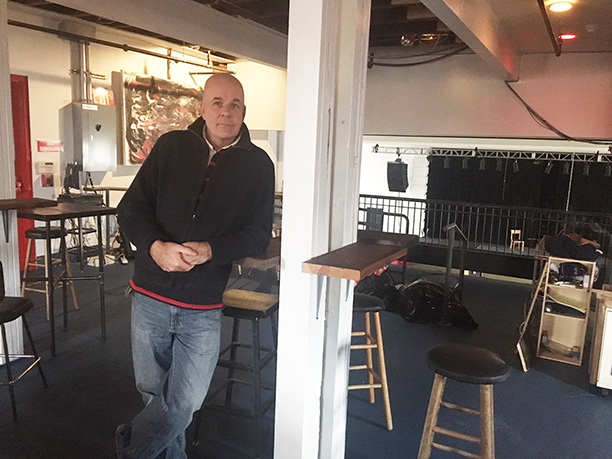
H*MAC partner John Traynor stands on the restored balcony overlooking the Capitol Room.

A major Harrisburg arts venue is the big winner locally in the annual competition for state redevelopment funds.

The House of Music, Arts & Culture (H*MAC) will receive $1 million from the Redevelopment Assistance Capital Program (RACP), a state program that provides grants for the acquisition and construction of projects deemed important for their cultural, economic, civic and historical significance.

John Traynor, a founding partner, said that the money will help H*MAC (formerly known as the Harrisburg Midtown Arts Center) complete the restoration of its building at N. 3rd and Herr streets in Harrisburg.

“I’m very, very pleased,” he said. “This grant is more than a grant to us. It’s a stamp of approval to all the hard work that’s gone into finishing this project.”

A decade ago, Traynor and two partners bought the dilapidated building at 1110 N. 3rd St., formerly the home of the Harrisburg Jewish Community Center and, later, the Harrisburg Police Athletic League.

They initially built out a small performance space and bar on the lower level and opened it as Stage on Herr. They later completed a restaurant and larger bar, the Kitchen at H*MAC, on the main level and then a larger performance space on the upper level now called the Capitol Room.

Traynor said that the RACP grant will allow them to finish restoration of the 10,000-square-foot basement level, turning it into a music school, studio and production facility that he likens to a “School of Rock” concept. It also would permit H*MAC to build a semi-enclosed bar and restaurant area on the roof of the building and complete patio and façade improvements.

“We believe this will be the gem in the crown of Harrisburg, “ he said, adding that this next phase of work would proceed through 2018.

H*MAC received only about one-third of the $3.3 million it applied for, though few projects that are awarded funding receive the full amount. Traynor said that he believed the grant could be leveraged to give him access to additional funds so that the center would be functionally complete.

When H*MAC is finished, Traynor expects to employ more than 80 people, compared to about 30 currently, he said.

In Dauphin County, only two other projects were selected in this round of RACP funding.

Hershey Towne Square received $750,000 for a three-story parking garage. It had requested $2.5 million for the project.

The Salvation Army, Harrisburg Capital City Region, was given $500,000 for its new 39,000-square-foot facility at 29th Street and Rudy Road. It had requested $4.5 million.

“It wasn’t our full request, but we’re very happy to receive this grant,” said Kathy Anderson-Martin, director of resource development.

The grant also may help the Salvation Army leverage other matching funds, she said, raising more money.

Anderson-Martin said her organization has raised about $8 million of a total construction cost of $11 to $12 million. This should allow them to break ground on the facility in the spring or summer of 2018. Already, the site has been cleared and most design work completed, she said.

In all, there were 10 applicants in Dauphin County in this round. The eight applicants denied funding so far are:

  • The City of Harrisburg, $14.3 million for a bridge over the railroad tracks at Division Street
  • Harrisburg City Islanders, $5 million for a new stadium in Lower Swatara Township
  • Harristown Enterprises, $3 million to construct a six-story building at 21 S. 2nd St. in Harrisburg
  • Christian Recovery Aftercare Ministries, $650,000 for renovation of its Uptown Harrisburg building
  • Tri-County Housing Development, $1 million for Hummel Street redevelopment
  • Mulberry Street Properties, $322,311 for Allison Hill revitalization
  • Hawthorne SPE, $5 million for its Progress and Linglestown Traditional Neighborhood District project in Susquehanna Township
  • Whitaker Center, $5.5 million for a major renovation of its building in downtown Harrisburg

In Cumberland County, the Carlisle Family YMCA was the only successful applicant among five total, receiving $1.5 million, half of its request, for an addition to its facility.

Projects denied funding in the initial round sometimes receive funding in a later round or reapply for the following year.

In all, the state funded 149 projects for almost $188 million in this round, compared to requests for 399 projects worth $1.7 billion.

Continue Reading

Waiting Game: Contributions withheld from nonprofits, schools in state budget impasse

The Pennsylvania state budget impasse is preventing millions of dollars in corporate contributions from getting to nonprofit groups and schools.

Kathy Anderson-Martin wants the state to pass a budget.

Since the summer, Anderson-Martin, director of philanthropy at the Salvation Army of Harrisburg, has watched weeks turn into months as the state legislature delays approving a budget for the 2017-18 fiscal year, which officially began on July 1.

Lawmakers have already adopted a spending plan but can’t agree on a revenue package. Until they reach consensus, millions of dollars in tax-deductible corporate donations are on hold, too.

That’s because the budget impasse has stalled approvals for the Education Improvement Tax Credit program, which qualifies businesses for tax credits if they donate to scholarship organizations, educational improvement organizations or pre-K scholarship funds.

Local schools and nonprofits, including the Salvation Army, say that the delayed approvals have paralyzed their planning for future programs and scholarships.

“We can’t receive almost $200,000 in gifts because that program is on hold,” said Anderson-Martin.

According to Anderson-Martin, the Salvation Army of Harrisburg uses EITC dollars to fund its summer youth enrichment program. Last year, the program served 400 children, 130 of whom were in their care all day, every day, for nine weeks while their parents worked, she said.

David Smith, communications director at the state Department of Community and Economic Development, said that the EITC allocations will be approved as part of the state’s final budget agreement.

If partisan gridlock delays that agreement any longer, Anderson-Martin says the Salvation Army might have to scale down its summer plans.

“We can’t wait until January to decide what we’re going to do in June,” she said. “We have to start planning how many kids we’ll serve this summer, and, if that money isn’t there, we have to serve fewer children.”

EITC dollars also fund scholarships to private and religious schools across the commonwealth. The Joshua Group, a nonprofit in Allison Hill, relies on EITC funding to provide low-income Harrisburg students with scholarships to local private schools.

Joshua Group director Kirk Hallett criticized lawmakers for using the EITC program as a “political toy,” and said that the delay could limit Joshua Group’s ability to serve more students.

“The immediate impact is fear,” Hallett said. “This is very frustrating to us, that all this politics ends up affecting our kids.”

Mary Anne Bedhar, principal at Bishop McDevitt High School in Harrisburg, said that “everything is on hold” in the school’s scholarship office until the EITC funds are approved.

If the budget impasse continues through the end of the calendar year, it’s possible that businesses will withdraw their applications for tax credits, thereby reducing the total amount of EITC distributions. Bedhar and Hallett said that’s what happened in 2015, the last time the state endured a long-term budget impasse.

Bedhar reported that Bishop McDevitt lost $200,000 in donations that year, the result of fewer businesses applying for tax credits. She said that the school hasn’t fully recovered from the loss.

The Joshua Group lost about $100,000 in scholarships as a result of the 2015 budget impasse, according to Hallett. He and his staff were able to maintain their operations by approaching private donors, but they weren’t able to take on any new students during that period, he said.

Smith said that businesses withdraw EITC applications every year and declined to draw a connection between application withdrawals and the last budget impasse.

Even so, the program has been perennially popular among businesses. Smith said that the DCED expects to maximize the program allocation this year, just as it did last year when the program budget was $125 million.

The EITC program was signed into law in 2001 by former Gov. Tom Ridge. Companies can apply to give a maximum of $750,000 to an eligible educational organization and receive a tax credit equaling 75 percent of their contribution or 90 percent if they pledge contributions for two years.

Democrats and Republicans have supported expansions to EITC since its inception, according to reporting from PennLive. This May, the House voted 166-26 to pass a $100-million-dollar expansion to the EITC program and a similar program called the Opportunity Scholarship Tax Credit.

Critics of EITC say that it promotes school choice, and fear it could lay the groundwork for a school voucher program by directing more students out of public schools.

Hallett, however, doesn’t see the scholarships funded by EITC dollars as a public-versus-private school matter. His organization views education as an anti-poverty program, and he says that jeopardizing its funding will only harm vulnerable students.

“The bottom line is it affected the poor once again,” Hallett said, referring to loss of EITC funding in 2015. “This is me talking on Allison Hill, but, sometimes, I just don’t know what the guys on Capitol Hill don’t get.”

State lawmakers will return to Harrisburg today for a week of negotiations and closed door meetings, according to the AP.

Continue Reading

Keep on Strutting: For Shoe Strut, 2,000 new pairs—and counting.

While many adults probably remember their back-to-school shopping as an anticipated adventure, some area children go without.

In fact, some youngsters may even avoid going to school because they’re ashamed to be seen in worn or unstylish shoes. That’s where Shoe Strut comes in.

On Sept. 22, Salvation Army Harrisburg will sponsor its 6th annual Shoe Strut, a charitable luncheon and footwear fashion show.

But, really, this isn’t about shoes for you. Shoe Strut’s main purpose is providing footwear for needy children. The Salvation Army, in partnership with Boscov’s, provides one pair of shoes on behalf of each Shoe Strut attendee. Additionally, 100 percent of the event’s silent auction proceeds directly benefit the children.

Last year’s Shoe Strut garnered some $65,000 that funded 500 $30 Boscov’s shoe vouchers, with remaining funds put toward other charitable Salvation Army programs. By distributing vouchers instead of actual footwear, delighted youngsters get to shop for shoes of their own choice at Boscov’s, which sells the goods at a discount, according to Kathy Anderson-Martin, Salvation Army Harrisburg’s director of philanthropy.

Not bad for something that started over a pizza.

The genesis of Shoe Strut took place on an otherwise ordinary day in 2012 as the Salvation Army Harrisburg’s women advisory board shared a pizza in the facility’s community room. Between bites, Claudia Williams and friend Lisa Benzie brainstormed fundraising ideas.

“Then Claudia asked, ‘How about shoes?’” Anderson-Martin recalled. “Some of the kids in our youth programs didn’t have a decent pair of shoes, and some of them didn’t go to school because of that.”

That was all it took to set things in motion for the first Shoe Strut, which netted $20,000 in proceeds and attracted 250 attendees. Since then, the event has continued to grow. In 2016, a crowd of 500 flocked to the sold-out show.

Although this year’s tickets were “technically” sold out months ago, organizers said some tickets likely will become available closer to the date of the event.

Since its inception, Shoe Strut has helped to provide more than 2,000 pairs of shoes to young people selected from Salvation Army Harrisburg programs. Most recipients are in late elementary school, middle school or high school. Surplus funds have gone toward Salvation Army Harrisburg summer programs for at-risk youth, meals and basic needs assistance, self-sufficiency programs and even a new freezer for the Salvation Army facility in Midtown.

“It’s helped to fund a lot of things that otherwise wouldn’t have happened,” said Cindy Minnich, Salvation Army Harrisburg’s special events and communications coordinator.

Not surprisingly, Salvation Army Harrisburg has received numerous letters from parents, grandparents and others who are grateful for what their child received from Shoe Strut, and it’s a lot more than just shoes.

“We wish to thank you so very much for the book bag and shoes for our son,” said one letter. “They allowed him to go to school with what he needs, so he can maintain his 4.0 GPA!”

Another letter read, “The shoes and uniforms are a huge blessing! My grandchildren were so excited and eager to start school. It would have been a struggle for me alone. I know I speak for others as well when I say thank you for being there for our community.”

In retrospect, Minnich and Anderson-Martin are proud of all that has sparked from an initial lunchtime brainstorm.

“All in all, this is a pretty amazing story of what a group of woman can accomplish when eating pizza in a basement and sharing good ideas,” Minnich said.

Salvation Army Harrisburg’s 6th annual Shoe Strut takes place Sept. 22 at the Radisson Hotel Harrisburg, 1150 Camp Hill Bypass, Camp Hill. For more information, visit www.shoestrut.com or www.pa.salvationarmy.org/harrisburg-pa.

Author: Phyllis Zimmerman

Continue Reading

Army Maneuver: The Salvation Army has major plans to move and expand, but first it must raise the funds.

Screenshot 2016-09-28 10.55.10The corner of Rudy Road and 29th Street looks rather ragged.

With boarded buildings, forgotten vehicles and trash, it seems to be a place of great, if unrealized, potential. However, there’s hope for this corner of Harrisburg as the Salvation Army has big plans for it.

Recently, the Salvation Army, Harrisburg Capital City Region, began a capital campaign to create an “Oasis of Hope” with a new, 43,000-square-foot building and a 7-acre campus.

The proposed campus, the Salvation Army Service and Worship Center, would give the organization something it lacks at its current Midtown facility on Green Street—the ability to consolidate in one place—whether that’s serving 2,500 area youth, offering breakfast for 100 five days a week or assisting more than 20,000 people a year.

Currently, the Salvation Army uses 20 off-site locations just to run its youth programs. Kathy Anderson-Martin, director of resource development, said that, while the Salvation Army is grateful for access to churches and schools to house its programs, it “limits impact, and it’s hard to take your programs on the road.”

“We spend a lot of time coordinating logistics that wouldn’t be necessary in another space,” added Melissa Snyder, family services administrator.

The summer program, for instance, is located in a church that requires that all of the materials for 150 students be packed away each Friday—so that the space is useable for the church on Sunday—then unpacked again to start the week.

“For us, we will be much more efficient so our staff can be with clients and the people we serve,” said Jenny Gallagher-Blom, director of operations.

The lack of storage, absence of a loading dock, and presence of a small, gated parking lot prevent delivery of large donations of food. Many deliveries end up on the sidewalk for employees to transfer into the building themselves.

This lack of space is especially glaring for the Salvation Army’s annual Christmas gift distribution, when about 10,000 gifts are collected and stored in various areas of the building. They must be moved again if the space is needed for another purpose. Eventually, the gifts are shuttled to the 19th Street Armory, as the current facility lacks sufficient room to hold the event.


Where We Should Be

Besides physical space, the location is another impediment in reaching the community they serve. In recent years, the Midtown neighborhood where they’ve been located for many decades has changed.

“We’re not where we’re supposed to be,” said Anderson-Martin. “We should be near where the most people need us.”

The new location, she said, will better meet the needs of the community and allow for ease of access with a bus route on the property and proximity to local schools. Leaving the Green Street location will impact some local clients, but many of them already travel to get there.

Community leaders have been consulted about the planned move. Debra Cruel, spokesperson for the 29th Street Neighborhood Preservation Committee, said her group communicated the need for a community gathering space and green space.

The project, she said, meets these goals with a multipurpose center for events and acres of concrete transformed into basketball courts, a playground and a nature trail.

“Just as I believe the model for any community transformation, all of the stakeholders should have a voice in what’s happening,” Cruel said. “As far as neighborhood preservation is concerned, we feel very much a part of the entire venture.”


Holistic Solution

The new location also will have plenty of room for such needs as refrigeration, dry goods storage, a loading dock, a gymnasium and suites to house an education wing, nutrition education and family services.

With all of its programs under one roof, the Salvation Army can provide a holistic solution. Children can come to a youth program while their parents attend a nutrition class or self-sufficiency program.

“Increasingly, we are getting beyond that you come in for a bag of food every so often,” said Anderson-Martin. “We want to help you get to the point of self-sufficiency.”

Independence is important to the Salvation Army, as is good stewardship. Its commitment to responsible stewardship will not allow it to incur debt for any project. Instead, it will rely on donations and grants to fund the $9 million venture. Reserve funds allowed for the purchase of the land in May 2015. Demolition of the three structures on the property will begin this fall, but it will need to raise the remaining $5 million needed.

“The timeline [for completion] depends on the money,” said Anderson-Martin.

In partnership with the community, the Salvation Army hopes that, rather than rooms full of storage boxes, it will have rooms full of youth. Rather than a gymnasium used as a food pantry, the gymnasium will be brimming with ball players. And, instead of moving deliveries from curb to cupboard, pallet by pallet, they can spend their time building relationships with neighbors in need.

To learn more about the Salvation Army, Harrisburg Capital City Region, including how to donate to the capital campaign, visit www.pa.salvationarmy.org/harrisburg-pa.

Author: Susan Ryder


Continue Reading