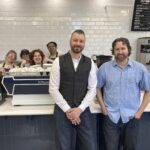
Boutiques and department stores brought shoppers to downtown Harrisburg in droves through the 1960s. This undated photo from the Dauphin County Historical Society shows a bustling scene outside Bowman’s Department Store on Market Street, which is now part of Strawberry Square.
It was close to 3:30 p.m. on a gray Monday afternoon when I found Moe Rammouni ringing up customers at Pal’s Apparel, his high-end streetwear boutique in downtown Harrisburg.
His clientele—two local guys, Rammouni said, who probably found Pal’s on Facebook or Instagram—came in seeking tracksuits and puffy parkas. It was Rammouni’s first sale of the day.
“Business is great now, but there’ve been some growing pains,” Rammouni said. “And there still are. You gotta have a lot of patience to do this.”
Rammouni has been in his storefront at 306 N. 2nd St.for just over a year. But he can already tell you what more seasoned merchants have been saying for decades: retail isa tough business. E-commerce has created a market where prices are low, consumer information abounds, and free, two-day shipping reigns supreme. Those conditions have devastated national chain retailers. In the past year alone, legacy brands like Sears and Bon-Ton have closed stores and liquidated inventory. Suburban malls are going dark as a result.
If not even the biggest brands can compete with online retail giants, where does that leave mom-and-pop shops?
These independent merchants have historically congregated in American cities, where dense populations and compact storefronts offered a symbiotic shopping experience. But the migration of people and businesses to the suburbs have decimated urban retail centers across the country. Harrisburg is no exception. The downtown boutiques, grocers and department stores that once animated the city’s streets are long gone. Their storefronts found second lives as offices and eateries, if they’ve been filled at all.
“To my left and my right, there’s vacant, commercial class-A space that could be turned into something magnificent,” said Rammouni. “I’d love to see more retail on 2nd Street.”
Even as they watch big-name competitors fold, merchants in Harrisburg think it’s a good time to start a small business. They say that the hardships rocking national chains highlight the power of independent retailers, which can offer superior expertise and customer service.
But if current businesses are going to flourish, their owners say, Harrisburg needs to fill its vacant storefronts.
“Don’t get me wrong—I love Harrisburg,” said Anela Bence Selkowitz, one of the city’s newest storefront retailers. “But there’s nowhere to shop.”
Bence recently opened Stash Vintage, a clothing and accessories store, in a shared storefront at 11 S. 3rd St. She’s near the restaurants El Sol and Bricco in the downtown SoMa neighborhood.
“I’d like to see three or four more boutiques on this block,” she said. “If this neighborhood was a destination where people could spend a whole afternoon, it would be a much better situation for us.”
Landlords agree that independent businesses have the best shot at success when they’re part of a dense network of stores. The good news is that Harrisburg’s commercial corridors are emerging from a long period of stagnation. Strawberry Square, the downtown mall that subsumed some of Harrisburg’s old storefronts in the 1970s, had a 40-percent vacancy rate just five years ago, according to Harristown CEO Brad Jones. It’s now at 5 percent.
“There’s been a lot of momentum, but retail is still a very tough sector for us, as it is for everyone else,” Jones said. “I don’t think we’ll ever get back to the way it was… But we are growing our density, and every year, it’s getting better.”
Rise and Fall
If you set out to do your Christmas shopping in Harrisburg in 1950, you wouldn’t have to travel far from 3rd and Market streets. Like most cities, Harrisburg’s central business district boasted everything from small specialty shops to multi-level department stores. Whether you wanted a custom hat, a tailored suit, a new armoire or the latest records, you could buy it in a downtown storefront.
Ken Frew, a librarian for the Dauphin County Historical Society, grew up on Derry Street, where he could pay 5 cents to take the bus to shop in downtown. “You could find anything you wanted down there, and you didn’t need a car to get it,” he said. “You had big anchor stores, sure, but you also had lots of other shops really keeping the place together.”
As a historian who has lived his whole life in Harrisburg, Frew has watched the city’s downtown evolve for decades. Its first major change came in the 1940s, he said, when customers started to favor their personal vehicles over public transportation. The shift carved the first cavities into Harrisburg’s downtown streetscape, as property owners began razing buildings to pave surface parking lots.
But the rise of the personal automobile dealt an even deadlier blow to cities. It facilitated movement to suburban communities, where residents could retreat after a day’s work in a downtown office. Segregationist housing policies and discriminatory lending practices accelerated the exodus. Urban planners played their part, too. Starting in the 1950s, cities including Harrisburg began to reroute major city streets with one-way traffic patterns. Under the guidance of Mayor Nolan Ziegler, Harrisburg officials reduced parking lanes and converted 2nd and Front streets to one-way, multilane mini- highways in 1956. “We are interested only if proper ingress and egress is assured,” Ziegler said at the time.
Ziegler and his engineering team got what they wanted. Following the 2nd and Front street conversions, it became easier than ever for commuters to zoom through Harrisburg as they came and went from work. The city’s small businesses became an unintended casualty.
“The one-way streets made it difficult to maneuver, and it was the end of downtown,” Frew said. “When people got off work, they went out of the city and stopped shopping. My dad was always grousing that it slowed business.”
Harrisburg’s population was close to 90,000 in 1950; by 1980, it had dipped to 53,000. As white, middle-class customers flocked to the suburbs, retailers followed suit. Harrisburg got its first suburban-style shopping center in 1951, when Kline Plaza opened on S. 25th Street. That, according to Frew, was “the first sign that retail was starting to plummet” downtown. The Harrisburg East Mall followed in in 1969. Some local business owners, like the men’s clothing retailer Allan Stuart, tried their luck opening satellite branches in suburban malls. But most found that their storefront model didn’t translate to the new setting. Others couldn’t match the prices of their chain competitors.
The erosion of the downtown merchant base was gradual, according to Stuart’s son, Jeb Stuart. But by his account, “the bottom fell out of downtown by the 1970s.”
Jeb Stuart recently curated an exhibit for the Historic Harrisburg Association that chronicles downtown retail during the city’s “urban golden age,” from 1918 to 1960. Walking through the exhibit, it becomes clear how much of the city’s retail space has been ceded to other industries. When retailers started to evacuate downtown Harrisburg in the 1950s, developers snatched up vacant storefronts and adapted them to other uses. Today, the Market Street property that once housed S.S. Kresge’s Co, a discount retailer, has become Whitaker Center. SciTech High School now occupies the space once held by G.C Murphy department store.
Many downtown retail spaces were acquired by Harristown Development, which the city created in the 1970s to spearhead urban revitalization projects. Chief among them was the development, in 1978, of Strawberry Square, a downtown mall with 1.4 million square feet of mixed-use office and retail space. Jeb Stuart worked as a leasing agent in Strawberry Square in the 1980s. He and his business partner tried to court national chains to fill first-floor retail spaces. When that didn’t pan out, they focused their efforts on small, mom-and-pop shops that catered to the downtown workforce.
“It was a challenge,” Stuart said. “But there will always be a downtown worker population in Harrisburg, so there will always be a need for some form of retail. But what you need now is retail that’s convenient, that fills a need or that offers a niche—because cool things can become destinations in themselves.”
Support System
The same malls that killed downtown retail in the 1960s and ‘70s are today facing a sea change of their own, thanks to the ascendency of e-commerce.
But does the newest disruption in retail represent a potential resurgence for urban storefronts?
“We all think we’re poised for a comeback,” said Isaac Mishkin, owner of The Plum, a women’s clothing boutique. “I see it inching forward. People are getting smarter and spending more time analyzing what people buy.”
Mishkin, who’s run The Plum from the same brick storefront on Locust Street for 50 years, is one of the lone legacy retailers in Harrisburg. To survive today, he believes that storefront merchants have to offer one thing that e-commerce companies can’t—attentive, experience-driven customer service.
“I learned how to sell the old-fashioned way,” Mishkin said. “We know how to dress customers when they come in. It’s not like department stores today where nobody waits on you.”
As accessories designer Amma Johnson put it, a customer’s most valuable commodity today isn’t money—it’s time. One reason customers have flocked to online retailers is because they can peruse goods and complete a transaction in minutes, eliminating the onerous task of driving to a mall to shop. To compete with that convenience, storefront retailers have to make a customer’s visit worth their while, she said. At her Amma Jo showroom in Strawberry Square, that means offering a pleasant shopping experience that puts the customer first. She’s also branched out into events, hosting networking happy hours and, more recently, a women’s empowerment and entrepreneurship panel. Johnson said that these events do generate sales. But she also sees them as an extension of her brand — the larger, more nebulous “feeling,” Johnson said, that people associate with her name and product. And that feeling can’t be conjured with pixels alone. She pointed out that even online companies are experimenting with brick and mortar retail models.
“A good brand is a good feeling,” Johnson said. “And even as powerful as a brand like Amazon is, they’re doing things like pop-up stores because it’s very hard to build a brand exclusively online.”
Andrew Kintzi, who run the men’s vintage store Midtown Dandy in a storefront he shares with Bence on 3rd Street, echoed what Johnson, Mishkin and other merchants said about running a storefront today.
“In terms of competing with other businesses, it comes down to the customer’s experience,” Kintzi said. “It’s being able to walk in the door, be greeted, trying something on and feeling materials. I want you to come in here, find something you love, and remember buying it here.”
Bence has a different take than her business partner. As she sees it, a good landlord can make or break a
retailer. And she says they’re hard to find in Harrisburg. She and Kintzi tried to set up shop on 3rd Street north of Forster, but were stymied by a paltry inventory of storefronts. Landlords wanted to charge exorbitant rents for sub-par spaces, she said, and wouldn’t accommodate requests to enhance them.
“You need a good deal with a good landlord who will work with you,” Bence said. “Landlords are really awful around here. They want way too much for empty shells.”
She contrasted that with her experience leasing from Harristown, which painted walls and constructed a small build-out in their storefront on S. 3rd Street. They’ll also include Stash and Midtown Dandy in their advertising and promotional materials.
“There’s a support system here, so it doesn’t feel like we’re just being thrown into a space,” Bence said. “It feels more like a partnership with the people who own the building.”
The final thing that retailers say they need is increased density in the downtown retail district. Johnson said that she chose her storefront in Strawberry Square because it offered the best chance to gain organic foot traffic—passersby who might not seek out her store on their own, but encounter her brand while going about their daily business. More than 6,000 people walk through the shopping center each day to shop, eat, work or attend events, according to Jones, making it one of the busiest commercial corridors in the city.
But the workforce population disappears on the weekend, creating wild variations in the pace of customers throughout the week. Retailers say the same is true elsewhere in the city. Chantal Eloundou, who opened Nyianga, a boutique selling African crafts and fabrics on N. 3rd Street, said business is best on days when the Broad Street Market is open, since it draws people down 3rd Street from state office buildings downtown. But the rest of the week can be a challenge.
“More retail would draw in more customers,” she said. “So, I say, the more the better.”
Critical Mass
Building a bigger retail landscape in Harrisburg would do more than just create a shopping destination.
Even though the industry can be precarious, experts say that locally owned businesses remain an essential part of any city’s community and economic development strategy. Besides creating jobs and building wealth for entrepreneurs, a diverse array of shops affords consumers more choice and competitive prices. It also drives tourism. Visitors who have enough reason to shop, eat and pass time in a city just might decide to move in.
“Having businesses, whether it’s retail or restaurants or services, really is a key component in making a thriving city where people want to live and shop and do business,” said Ken Hammaker, vice president at the Community First Fund, which loans to entrepreneurs in low-income communities across the state. “You need that component just as much as you need clean, affordable housing and good quality schools.”
Nobody understands that dynamic better than Harrisburg Mayor Eric Papenfuse, who touted his experience as a storefront business owner in both of his mayoral campaigns. Papenfuse and his wife, Catherine Lawrence, opened the Midtown Scholar Bookstore in 2003. In 2009, they moved the store to its current location at Verbeke and N. 3rd streets, into what used to be a movie theater and then a department store.
According to Lawrence, many of the nearby storefronts were underutilized when they moved in.
She and her husband convinced some recalcitrant property owners to sell them their neighboring buildings. County property records show their acquisitions began in 2008, the same year they purchased the two parcels that house the current Midtown Scholar, and continued through November 2013, the same month that Papenfuse won his first term as mayor.
Since he took office, these property holdings have opened Papenfuse to criticism that he prioritizes projects on 3rd Street to his own benefit. He said that it was always part of a greater strategy to build a community-oriented commercial corridor.
“We came in 15 years ago as young retailers interested in generating more foot traffic on this corridor,” Papenfuse said. “We looked at the market, at Midtown Cinema, and saw the potential for more of a critical mass more than just a single anchor store.”
Lawrence and Papenfuse are sympathetic to the challenges facing local retailers today. They know it takes a long time to build a customer base, develop a marketing strategy, and finance an inventory. Speaking as a city official, Papenfuse said that Harrisburg must provide the public services—smooth roads, inviting streets and a public safety presence—that enhance the city’s built environment and encourage tourism. It can also provide practical resources, such as business development programs, through the office of Community and Economic Development.
But speaking as a business owner, he said much of the responsibility for building a retail corridor lies with landlords and merchants who have a shared, community-oriented vision. Like Bence, he reserved special criticism for local landlords, who he says have been historically disinterested in maintaining their properties and identifying good tenants.
According to leaders in Lancaster, good landlords have made all the difference in their downtown business district, which has added more than 100 shops, restaurants and entertainment venues in the past half-decade.
“Historically, we’ve been fortunate that we’ve had a great number of local investors and property owners that are responsible for the fact that we still have this core area of retail downtown,” said Marshall Snively, president of the Lancaster City Alliance, a nonprofit community and economic development group. “They were patient at a time when other cities were leasing to anyone that would lease and very intentional in making sure it was lively retail that would add to the character of the city.”
It’s no coincidence that the evaporation of retail in Harrisburg coincided with the depths of its financial distress, a condition that began brewing in the 1970s and intensified through the 2000s. Today, local officials say that Harrisburg’s long-term recovery depends on whether or not the city can increase its population. But turning daytime workers into full-time, taxpaying residents will take more than new housing and better roads.
The urban theorist Jane Jacobs famously said that the hallmark of a healthy city is the “sidewalk ballet” of people darting between work, errands, meals and entertainment in a humming urban core. Plenty of people in Harrisburg participate in this “ballet” during the week, when almost 50,000 commuters flood the city. But boutiques, bars and restaurants, cultural and entertainment spaces convince them to stick around after hours. And it’s the coexistence of all these elements— apartments, workplaces, businesses and public spaces— that distinguish an urban ecosystem from a suburban office park or housing development. As Hammaker put it, all of these elements are all connected, and no one sector will flourish as long as the others falter.
And that includes retail. At a macro level, the realities of the industry may seem bleak. Dying malls and empty big-box stores have left unsightly cement husks in America’s suburbs. Amazon is colonizing private spaces with smart speaker robots as its CEO controls an ever-growing share of the world’s wealth. But locally, small retail businesses remain an integral component of vibrant, self-reliant cities. They create jobs, animate streets and offer a shopping experience that’s more than just transactional. One need only visit Stuart’s exhibit at the Historic Harrisburg Association to be reminded that retail is an indelible part of Harrisburg’s past. If the city is going to thrive, the same will have to be true in the future.







 There’s always something new at The Plum, the venerable women’s clothing shop in downtown Harrisburg.