Tag Archives: harrisburg

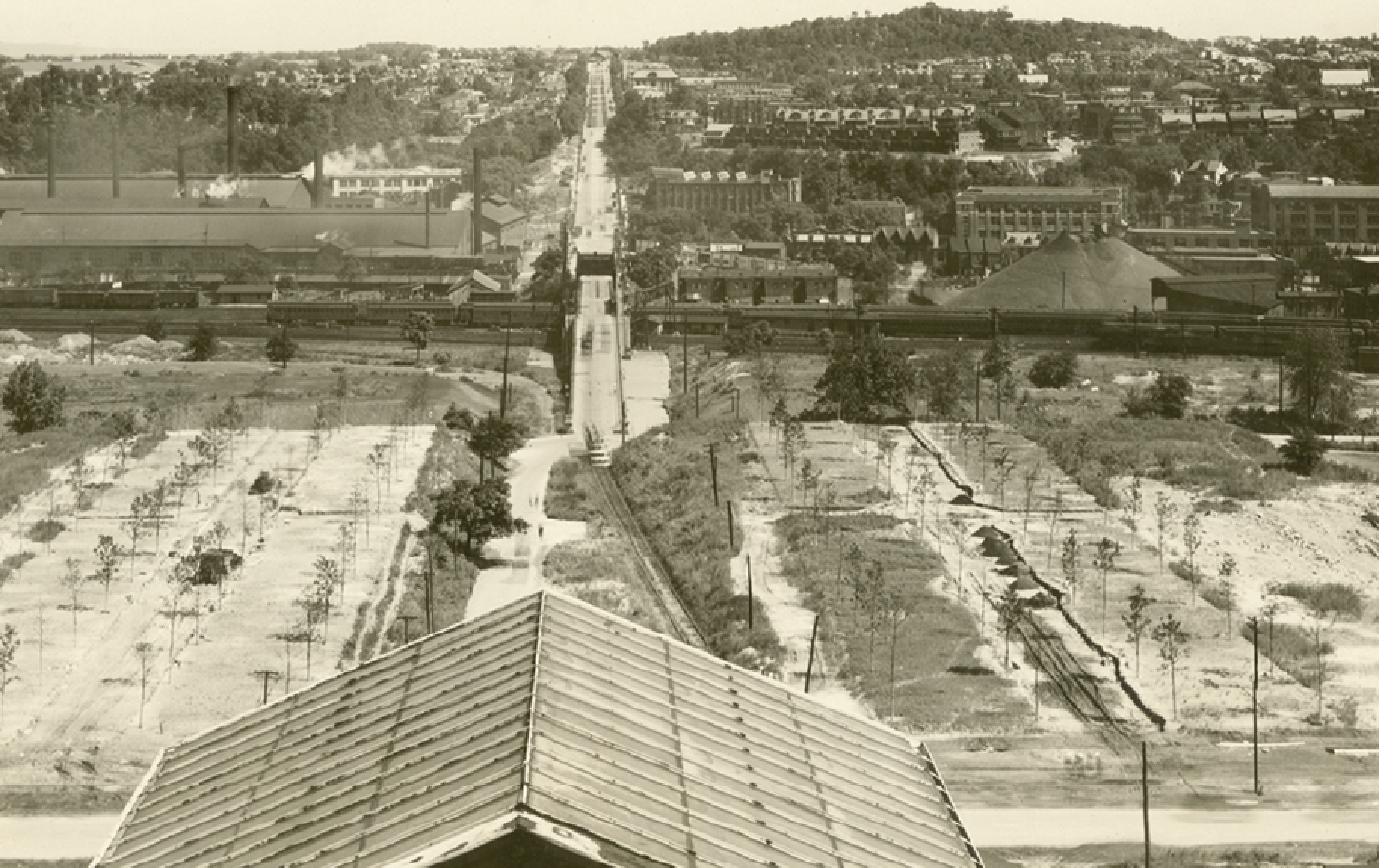
Widgets, Not Words: Before becoming a government town, Harrisburg was an industrial powerhouse.

Screenshot 2013-11-29 10.16.58

The rise of Harrisburg as an industrial city is linked to its rise as a transportation hub in the earliest years of the 19th century.

After the completion of the Camelback Bridge over the Susquehanna in 1820 and the state canal system, smaller forges, furnaces and foundries began locating in the city. The railroad revolution of the 1840s increased the ability to move raw materials, and larger industries began to locate in the city. In 1850, the Porter Furnace, the first anthracite furnace in the city, was built. In 1852, the Harrisburg Cotton Manufacturing Co. began, followed by the Central Iron Works a year later. The Hickok Eagle Works began printing ruled paper in the 1850s, and the Harrisburg Car Co. produced railroad cars.

The Civil War saw Harrisburg’s industries producing material, mainly iron, for the war effort, including the Lochiel Rolling Mill, Paxton Rolling Mills (1866) and, in 1867, the Pennsylvania Steel Works, located just south of town. By the 1880s, steel and railroads had grown into massive industries in Harrisburg, but other, smaller industries were still present to meet the demands of a growing population.

Throughout much of the 20th century, the steel and iron industries dominated Harrisburg’s landscape, and their owners and financiers contributed to the “City Beautiful” improvements within the city. The Great Depression took its toll on smaller industries, but the steel, railroads and large construction projects helped to lessen the burden somewhat.

In the early 1940s, Harrisburg, like other American cities, had ramped-up production for World War II. By 1950, Harrisburg was just shy of 90,000 people—its largest population to date. As the 1950s wore on, both the railroads and steel mills began to decline across America, and many of Harrisburg’s factories closed down in the 1960s and ‘70s.

Though many of the earlier industries are gone, Harrisburg’s steel heritage is still evident in the works at Steelton, now ArcelorMittal, and Harsco, which evolved from the Harrisburg Steel Corp. to become a global industrial services company, now based in Camp Hill.

Jason Wilson is an historian for the Capitol Preservation Committee.

Continue Reading

Off the Chain: Harrisburg leads state in banning dog tethering.

Screenshot 2013-11-29 10.22.01

Harrisburg may not be on the leading edge of too many trends, but it can be proud of this: It is the first city in Pennsylvania to ban round-the-clock dog chaining.

In other words, dog owners can be cited—and lose their pets—if they tether them for extended period of time.

The goal of the ordinance, signed by Mayor Linda Thompson in May, is to alleviate the suffering of animals and boost the quality of life in the community.

“I wanted to have the strongest possible law,” said the bill’s author, City Councilman Brad Koplinski. “It’s another tool to prevent people from not taking care of their dog in extreme ways.”

Life isn’t pretty at the end of a chain. The abuse is no different than beating or starving an animal. It subjects dogs to extreme temperatures, rain and snow and eliminates socialization critical to their psychological health.

Chained dogs are far less likely to get veterinary care and far more likely to attack a passerby who innocently crosses their turf.

Not to mention that shackling a dog to a stake or porch rail can be—and has proved—fatal.

That doesn’t mean residents can’t put dogs on an appropriate tether for a potty break. Under the language, a dog may be tethered for the time it takes to “perform a task.”

“It gives animal control officers a lot of leeway,” said Koplinski. “This isn’t an effort to go after every instance of someone leaving their dog out for an hour, but to go after owners for whom leaving a dog outside is a form of neglect.”

The bill also restricts tethering during periods of inclement weather, including extreme heat (over 90 degrees) and cold (below 32 degrees) and forbids the use of choke collars and thick chains—which are not only cruel, but often the sign of dog-fighting operations, say animal welfare advocates.

In approving the ordinance, Harrisburg did what state lawmakers have failed to do and only a handful of municipalities (in York County) have done in less restrictive ways. Hazleton also bans dog chaining but allows an 8-hour window.

Animal lovers who have lobbied without success for a state law to ban dog chaining rejoiced at the news.

“Tethering is a huge problem,” said Zella Anderson, president of the Central Pennsylvania Animal Alliance, whose volunteers often respond to calls of animals in distress.

Anderson said the ordinance gives law enforcement a tool to remove dogs from an inhumane situation before it becomes life threatening. Tragically, between the time the council heard testimony on the bill and its final passage, a dog tied to a porch was found hanged.

Sarah Speed, state director for the Humane Society of the United States, says multiple chained dogs are often an indication of a dog-fighting ring, and such an ordinance gives humane law enforcement officers a right to enter the property.

Harrisburg animal control officer Fred Lemke said he has issued one citation since the ordinance took effect, a charge that carries a $350 fine and the possibility of losing your dog.  

But he said he also is handing out copies of the ordinance in neighborhoods so residents understand the rules about proper dog-keeping. So far, Lemke said, he hasn’t had to return to houses where he has warned the owners about the new ordinance.

Already, Harrisburg is a model for other municipalities considering similar laws. Doylestown and Erie are considering following suit.

Supporters hope state lawmakers are watching.

Koplinski—who is running for lieutenant governor on a pro-dog platform (among other issues)—and Anderson say a decade of work in the Capitol has so far been for naught.

“Perhaps we can put pressure on the statehouse,” he said. There are bills banning around-the-clock tethering in both the House (HB 41) and Senate (SB 522), but neither has advanced beyond committee.

More than 100 communities in 30 different states have passed laws to regulate the tethering of animals.

Anderson said unchaining dogs benefits the dog and the community. People can rest easy without barking dogs and the potential health risks from unvaccinated animals that may be prone to biting. And, of course, the dog is healthier and happier.

Anderson said the Harrisburg law will help prevent more cases like Peanut, the senior pit bull that spent more than a decade on a chain. Volunteers knew about Peanut’s plight for years, but his owner skirted cruelty charges by complying with the bare minimum required under the law: a crude shelter and access to food and water.

“He was one of many tragic stories, chained outside living a life of hell,” said Anderson. “The laws in Pennsylvania are extremely lax.”

It wasn’t until Peanut developed multiple tumors—a clear indication it had not received veterinary care—that volunteers were able to get him removed from the house.

Unlike the tales of many chained dogs, Peanut’s story has a happy ending.

Thanks to fund-raising by CPAA, he got the surgery he needed and is now enjoying life—and a comfy spot on the sofa—with the family that opened their hearts and home to him.

Continue Reading

Smell Ya Later! We bid adieu to the Harrisburg incinerator–40 years, many breakdowns, a botched upgrade, dubious financings and a near-city bankruptcy later.

Screenshot 2013-11-29 10.14.23

Later this month, about a week before Christmas, Harrisburg should complete its sale of the facility that the journalist Paul Beers once called the “infernal furnace.”

The Lancaster County Solid Waste Management Authority (LCSWMA) will pony up somewhere between $126 and $132 million for it, helping the facility shed the $350 million or so in debt it accumulated over the years. The purchase will also, it’s hoped, help ditch the adjectives—“troubled,” “ill-fated,” “botched,” not to mention “infernal”—that have historically preceded its name.

In the meantime, though, those adjectives will continue to amuse employees like Guy Lefever, who started working at the incinerator in 2009 and has always known it as a functional facility.

“People come up here, and they’re blown away,” he told me one morning in late September. “They’re thinking it’s just gonna be a run-down building, and trash laying all over the place. And it’s not.”

We were standing a few dozen yards from an ash heap, where the scorched remains of solid waste from households in Pennsylvania and New Jersey arrive fresh from the burners all day. A couple of ravens scavenged for surviving morsels. The land around the incinerator is close to capacity, so a pair of trucks spends most days at this heap, loading ash onto haulers that will take it elsewhere.

Lefever, a solidly built man in a clean, blue dress shirt, with a doughy lower jaw like Bill Murray’s, starts many sentences with, “So basically,” in the manner of someone whose job often involves translating technical terms. “So basically,” he said, as we watched the vehicles work amid a thin cloud of ash, “the truck comes up, dumps it out, they spread it out, stockpile it, and then load these trucks to go out to the different landfills.”

According to Lefever, “troubled” is not the only misnomer attached to his place of work. The incinerator is also not technically an incinerator. Covanta Energy, its operator, prefers the term “EfW,” for “Energy-from-Waste,” although the amount of stock you put into this distinction probably says something about your industry. The Harrisburg incinerator achieves the “E” in “EfW” by using the heat from its burners to produce steam, which, in turn, powers a turbine, producing electricity. Nonetheless, some environmentalists have condemned incineration as a wasteful and hazardous method of dealing with trash.

Reconciling the claims of energy companies and their watchdogs can be an exercise in futility. Covanta’s website refers to EfW electricity as “clean, renewable energy,” relying on a definition of “renewable” as “derived from natural processes that are replenished constantly.” But a fact sheet from GAIA, the Global Alliance for Incinerator Alternatives, contests this pretty much absolutely. “Municipal waste,” GAIA says, “is non-renewable, consisting of discarded materials such as paper, plastic and glass that are derived from finite natural resources such as forests that are being depleted at unsustainable rates.”

Tours of the incinerator start in a squat, brick outbuilding, where a colorful graphic mounted on the wall of a conference room provides an overview of the facility’s moving parts. We stood in front of the graphic for about 40 minutes while I tried to picture the combustion process Lefever was describing within the abstract boundaries of a line drawing. Then we put on hard hats and safety vests and headed for the entrance.

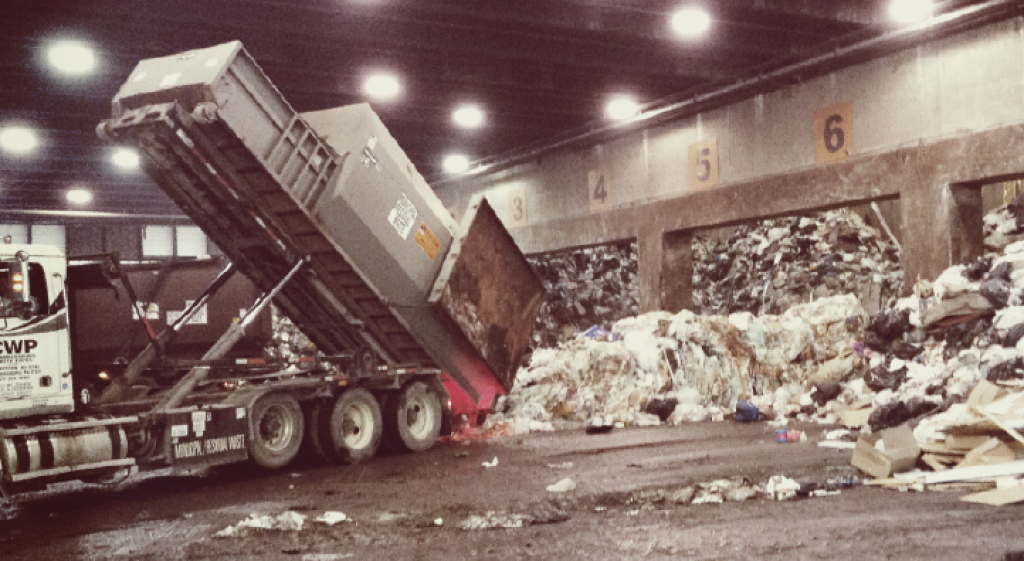
People like Lefever often refer to “feeding” the incinerator, and the first stage in the long meal occurs on what’s known as the tipping floor, where garbage trucks pull up one at a time and “tip” their cargo out onto a cement bay. As we approached, a short line of trucks curled back from the entrance, waiting their turn. Inside, the floor was loud with the grumble of diesel engines and the warning peals of heavy machinery going in reverse. It smelled like wet garbage, but not in an oppressive way. “It gets better over the winter,” Lefever said. We watched as a large hauler backed up and tipped its load. As it drove forward, a block of dripping waste slid out, in the exact shape of its container. Then it settled, its edges melting away, until it was just another pile of trash.

The price the haulers pay to deposit their waste is known as a tipping fee, and it’s the primary source of income for the facility. It’s also the subject of a fair amount of controversy. Different municipalities are charged different rates, for reasons having to do both with volumes of trash and other, more political considerations. Historically, Dauphin County’s fees have been drastically lower than the city’s; last summer, the city’s fee was $200 per ton, while the county’s was $77. Under the terms of the sale to LCSWMA, the fees will gradually become more equitable over the next couple of decades, until both the city and county are paying $115. But, in the short term, the city’s fee will remain much higher.

Preserving the disparity is one of the less savory requirements of the state-appointed receiver’s recovery plan for the city. Higher fees mean more revenue for LCSWMA, which, in turn, translates to a higher sale price for the facility. The receiver’s team viewed the higher sale price as critical, because the proceeds will help pay down the incinerator debt, but many residents are still unhappy about it.

In addition to paying more to dump, the city will also be contractually obliged to deliver 35,000 tons of waste to the incinerator each year. Many residents aren’t particularly happy about this, either. But if trash is the facility’s food, then the burners, like teenagers, need to be constantly eating. If there isn’t sufficient trash to keep the fires burning, they must be restarted with gas, at cost to the owners. The demand for trash is so great, in fact, that Lefever must occasionally bid for waste from outside municipalities. (In the olden days, he said, some incinerators may have even accepted trash for free, because “they were making a god-awful amount on their electric side.”)

From the tipping floor, we headed to the control room, where a shift supervisor named Troy was watching a set of big-screen monitors. “So if this was MTV Cribs, you remember that show?” Lefever said. “Well, this is where the magic happens.”

From this station, Troy could keep an eye on temperature levels, burn rate, flame height, steam output and just about everything that happens to the trash once it enters the burners. Some screens showed color-coded blueprints of the equipment, spotted with lines of data, and some provided live camera feeds from inside the facility. On one feed, lead-colored ash trundled along on a conveyor belt. On others, unbelievably, you could watch the garbage actually burning. Tiny fisheye lenses, cooled by constant air streams, provided the images: ghostly orange-and-black blurs, smoldering at temperatures as high as 2,000 degrees.

Troy, like Lefever, spoke in industrial shorthand. (“So here’s your pit, crane operator feeds grapples in here, trash goes down the chute, and here you got feed rams that are pushing your fuel off, you know…”) They talked about “wet stuff,” meaning moist, slow-burning trash, which produces dark spots in the flames on the video feed. Whoever is manning the control room must monitor the amount of wet stuff in each burner, in order to ensure a well-paced, thorough burn. “If your fuel would be a consistently steady fuel,” Troy said, “you wouldn’t have to do much. But trash is trash. One load comes in, it’s all paper, and the next load comes in, and it’s restaurant waste. You got a constant different waste stream.”

From the control room, we headed out to observe the crane operator, who spends the day plucking up trash from the tipping floor and feeding it to the burner.

He was sitting inside a glass box, manipulating an enormous grappling claw. Essentially, his job is to manipulate a smelly, 70-foot tall teddy picker. He dropped the claw, closed it around a massive clump of trash, and then hoisted it to one of the chutes and let it spill. Occasionally, rather than empty his claw into a chute, he’ll unload it on one of his stockpiles along the edges of the floor. The stockpiles keep the tipping floor clear for incoming trucks, but they also allow for the mixing of wet and dry waste to achieve a more consistent burn.

We passed back along a catwalk between the boilers and stepped outside. Lefever pointed out the baghouses: big, funnel-shaped filters that strip particulates from emissions en route to the smokestack. The effectiveness of these filters is something environmentalists also question, although the state Department of Environmental Protection, which monitors the facility’s emissions, has issued few violations, and the ones it has have been minor. “Really, you don’t see anything coming out of the stack,” he said. “It’s all being captured.”

I looked up. The stack seemed to be emitting nothing more than little white wisps of cloud.

The things that have troubled the incinerator in recent years have afflicted it almost from the beginning. In September 1966, City Council approved a project that, at the time, was projected to cost $4.5 million. By the time the facility came online, five years later, that cost had nearly tripled. After repeated breakdowns, it nearly tripled again.

Then, as now, the incinerator became a measure of the office of the mayor: both the scale of its ambitions and its command of city finances. Paul Beers, surveying the facility’s early history in several columns for the Patriot, recalled that Mayor Al Straub called it “the Rolls-Royce of incinerators” in 1969. But his successor, Harold Swenson, condemned it as “a facility that far exceeds our needs and our ability to pay.”

And then, as now, the trouble came mostly from two quarters: the difficulty of securing a sufficient waste stream and the need for its technology, never quite ready for prime time, to comply with environmental regulations. Beers reported that, in order to pay for itself, the incinerator needed to run at 85 percent of its capacity. It routinely ran at 60 percent. Neighboring municipalities, Beers wrote, could not be cajoled into committing to the city’s project.

In addition, the incinerator was continually plagued with mechanical problems. In 1978, it caught fire. In 1979, there was a cave-in, the aftermath of which, Beers wrote, “epitomized all the comedy and tragedy” of the facility. Its manager, Jack Karper, “hurriedly rescued the garbage reserve so there would be trash to feed the flames and make steam…Explained a jubilant Karper, ‘Thank God we saved the garbage. It represents dollars.’”

In 1984, after years of regulatory violations—mostly over where the city was storing waste after burning it—Mayor Stephen Reed corralled the operation under a newly minted “Department of Incineration and Steam Generation.” Some improvements were made, including the addition of a new steam line, but the compliance issues persisted. In 1985, an inspection revealed the city was burning a greater-than-allowable quantity of sewer sludge. In 1988, a succession of tests on the smokestack discovered emissions violations, and ash repeatedly escaped the site and landed on private property. Eventually, the city reached a consent agreement with the state Department of Environmental Resources and completed major capital repairs in 1990 and 1991.

In 1993, Reed engineered a sale of the facility to the Harrisburg Authority. The deal ushered in what you might charitably call an era of creative financing. The “sale,” to an authority of the city’s own making, drew revenues to the city of around $27 million, and, at the same time, saddled the incinerator with an additional $34 million in debt—the acquisition price, plus $7 million in bonds for capital improvements. In other words, the incinerator acquired substantial debt that had nothing to do with expanding its operations, ensuring its regulatory compliance or improving its equipment. The pattern would be repeated throughout the 1990s, until the debt load had climbed to nearly $100 million.

2003 was something of a watershed year. Dauphin County had pledged its waste stream to the incinerator, promising revenues that might have been sufficient to pay its bills, except that the federal Clean Air Act threatened to sharply limit the facility’s capacity. The city faced a choice. It either could shut down the operation, assuming its debt, or it could borrow once more to retrofit the incinerator and increase its capacity, with the hopes of generating enough revenue to cover the cost. The city opted for the retrofit.

City officials, for several years prior, had been eyeing a potential contractor that could upgrade the facility at the lowest possible price. The contractor, Barlow Projects, had installed a burner in Perham, Minn., using “churn-and-burn” technology that used forced air to circulate the waste, rather than moving grates, which were constantly breaking down in the Harrisburg facility. The Perham installation’s capacity was 50 to 100 tons per day—far short of the 800 tons the city required. Nonetheless, Barlow concluded it could complete the retrofit. The upgraded incinerator, in Barlow’s projection, would produce a cash surplus of $57 million by 2028.

Barlow, though, did not complete the project on time or on budget, and ultimately the firm was fired. The company’s projections of a cash surplus relied on dubious assumptions about electricity prices and interest rates, not to mention its own construction costs. A forensic audit, commissioned by the Harrisburg Authority and completed in 2012, pointedly questioned why Barlow was even allowed to submit a financial analysis of its own project—which, furthermore, was not subject to a public bid. The decision “to allow Barlow to certify the feasibility of its technical approach, to estimate the project’s cost and purported financial benefit, and then to obtain the contracts to actually conduct the work, appears questionable at best,” the audit says. “There are no indications that the City, the Authority or their advisors identified the conflict or potential problems.”

But the city, the authority and its advisors, following the pattern set by the 1993 sale, were far past the point of measuring debt against any future capacity to pay. Like the incinerator, which fed new trash to old trash to produce electricity, they were issuing new debt to pay for old debt. By the time Covanta was hired to finish the project, the facility’s debt totaled $280 million. The authority could no longer service it, and the city, which had promised to pay in its place, was on the hook.

The trick of municipal finance—in a sense, the trick of finance generally—is how to make something out of nothing. A city wants to build an incinerator, but it has no money. What should it do?

If the city were like me, and followed the advice of my old boss (“stay out of debt, kid”), it would sock away a little bit of each year’s revenues until it had enough for an incinerator. The problem with this method is that it would lead to the building of exactly zero incinerators.

An alternative is to borrow now and pay the bill later. The favored tool of municipal borrowing is the bond issue. A bond is a promise to pay, and in the case of a capital project like an incinerator, it comes with a certain built-in elegance: the promise sows the seeds of its own fulfillment. The debt builds the thing that earns the revenue to pay the debt. Between the tipping fees and the electricity sales, the incinerator should be able to pay all of its workers and still have enough left over to pay back what’s been borrowed. The city comes away owing nothing, and, in the meantime, careers have been made, families supported, kids sent to college, and everyone has avoided being drowned in garbage.

The term for debt that can be paid back with user rates is “self-liquidating.” When a local government classifies debt as self-liquidating, it’s essentially reassuring taxpayers that their taxes will never be raised to cover the debt, because the project will pay for itself. It’s important for governments to make this classification, because state law imposes strict limits on how much a municipality can borrow, based on its revenues. Self-liquidating debt doesn’t count against the limit, which frees up the municipality to borrow for other projects.

In Pennsylvania, the entity charged with watching the taxpayers’ back in the municipal borrowing process is the Department of Community and Economic Development (DCED). When a local government wants to issue new debt, it must submit a five-page statement to DCED tallying its various outstanding obligations. The third page of this statement, known as an 8110(b) certificate, requires the government unit to sign off on a one-sentence pledge that says, in essence, that any debt that was classified as self-liquidating in the past is still self-liquidating. A government that gives this assurance is said to have filed a “clean” 8110(b).

On Oct. 4, 2012, the Pennsylvania Senate held the first of two hearings to try to determine what, exactly, had gone wrong in Harrisburg. In a period lasting just under 20 years, the debt load on an incinerator that the city had bought for $27 million had ballooned to nearly $350 million. Huge portions of the borrowings were used to refinance prior debt and generate “working capital,” to cover the costs of operation. A remarkably small portion of the debt went towards actual improvements on the facility, which should have been an indication the project had ceased to pay for itself. Yet each time it borrowed, the city filed a clean 8110(b).

One question for the legislators was how the city was permitted to keep classifying the incinerator debt as self-liquidating. Steve Goldfield, a financial advisor to the state-appointed receiver who contributed to the forensic audit, raised this question during the hearing. In addition, he asked, if the debt didn’t go towards improvements, what was it spent on?

Goldfield’s testimony lasted two hours. After Goldfield, the senators listened to representatives from DCED, to former board members of the Harrisburg Authority, to former Mayor Reed, and to a handful of lawyers and financial advisors, among others. Most of those involved at the time of the borrowings came supplied with reasons why they weren’t to blame. DCED was desperately short-staffed and could rarely give more than a cursory review to the assurances made by local officials. Local officials relied on the advice of professionals, not being qualified themselves to assess technical projects. The professionals, for the most part, fobbed off culpability onto other professionals.

Goldfield, in his testimony, was careful to point out the many factors outside the city’s control. Revenues for an incinerator project were particularly volatile: there was the unpredictability of electricity prices, the unreliable flow of trash, the need to comply with environmental regulations. But Goldfield also described the disturbing pattern that emerged with each new bond issue. Harrisburg wasn’t just borrowing to fix the incinerator; it was using the construction project as a back door to extra debt above its limit.

Each time the Harrisburg Authority issued new debt, it sought guarantees from Harrisburg and from Dauphin County, and in most instances, the guarantees were provided. There’s nothing irregular about guarantees in and of themselves. Municipal bonds, like any other form of debt, have interest rates tied to the amount of risk the bondholder assumes in purchasing them. To reduce the amount of risk, and therefore the interest rate, the borrowing entity can seek a guarantee from a municipality, which pledges to pay bondholders in the event of default.

But the city and the county also charged the authority fees for those guarantees, in the several millions of dollars. In his testimony, Goldfield was quick to note the suspect nature of these charges, especially as applied by the city. In 23 years of working in municipal finance, he said, he had only seen one other instance of a municipality charging its own authority a fee for a bond guarantee.

In addition, there was something peculiar about the way the fee amount was calculated. “The guarantee fee, through serendipity or something else, matched the structural deficit in the city’s budget,” Goldfield said. In short, each time the authority issued new debt, the city sliced off a piece exactly large enough to fill a hole in the general fund.

It has occasionally been said that, under receiver William Lynch’s plan, various creditors and professionals will receive what they’re owed, while the city’s taxpayers receive nothing. Particularly in regards to the incinerator, this interpretation has some intuitive appeal. The facility, the thinking goes, was built with Harrisburg-taxpayer-backed borrowing, but now it will be sold to enrich the coffers of some other municipality.

The problem with this argument is that it skips over everything that taxpayers received under Reed. Tax revenues were insufficient to cover the budget, yet, for years, tax rates stayed low. This was true, in fact, for rates across the board, including water and sewer rates and fees for using public parks. Part of the reason there’s been so much grumbling lately is that prices that ought to have gone up gradually each year are now playing dramatic catch-up.

It’s one thing to be cheated and lied to, of course. The state attorney general has announced an investigation of whether any of Harrisburg’s officials or their advisors cheated or lied, and the receiver’s plan includes a hope for some civil claims from the professionals who escorted the city down a financial hole. But the borrowed money didn’t all just go to a few suits in city hall. Might some part of the deal reflect Harrisburg’s payment for two decades of willful ignorance?

A very small portion of the incinerator’s revenues has nothing to do with burners or electricity. It comes, instead, from scrap metal recovered from the waste. The ash, leaving the boilers on a conveyor belt, passes beneath a big, spinning magnet that sucks metal up from the stream and whisks it onto a mound of salvaged scrap.

Towards the end of my tour, Lefever led me up a ramp, to a point from which I could peer into a large cement box. The magnet, like a giant spool, revolved at the leisurely pace of a paddlewheel. Bed springs, chicken wire, coffee cans and oil pans piled up below, effaced to an identical smoky blue-gray.

We climbed some stairs to the room where the turbine, a dull nest of pipes and dials, sits underneath a high ceiling. It was about as large as a mid-sized Winnebago. I was struck, again, with a sense of disbelief: how could such an extraordinary amount of debt be saddling a facility that was, in physical scope, so comprehensible?

Outside, we pulled out our earplugs and shed our safety jackets and hats. On the perimeter of the facility are a couple of capped landfills. They used to be more of an eyesore (“I think people were calling it ‘Mount Ashmore,’” Lefever said), so they seeded them with temporary grass covers. Now they look like ancient burial mounds—hills too square-shaped to be naturally occurring.

We walked to the active part of the landfill. Between the boilers and the ash heap is a span of city garages and, beside them, a lot that amounts to a graveyard for retired city vehicles. We passed some garbage trucks, still in use, and an outmoded fire truck, long abandoned. At the end of a gravel road, a truck was depositing a load of new ash, water-soaked for cooling purposes, and spreading it out to dry. It will remain there a while, picked at by scavengers. Then haulers will come and take it away, and it will cease to be Harrisburg’s concern.


Continue Reading

A Sweet Tradition: At Matangos Candies, one family has served up handmade delights for 67 years.

Screenshot 2013-11-29 10.19.42

On a recent fall trip into Harrisburg, Lewisburg resident Robert Powell stopped in to Matangos Candies to pick up some sweets for his 92-year-old mother. Shop owner Peter Matangos greeted him by name, asked him how his health was and shared a few laughs with his long-time customer.

“Whenever I come to Harrisburg, I stop in here,” says Powell.

What keeps bringing him back? The family-style rapport he has built with the sweet shop and the handcrafted dark chocolates for which his mother says there is no acceptable comparison.

“They keep mama satisfied with candy,” says Powell, who explains that his mother loves that Matangos uses all-natural ingredients. As Peter packaged an assorted box of dark chocolates, he said, “We hook mama up.”

This is business as usual at the 67-year-old candy shop, where Peter, his mother and previous generations have built a strong sense of community and share the joy that homemade candy brings to the taste buds and the soul.

Their sweet history begins with Peter’s Greek grandfather Christoforos “Pop” Matangos, who, in 1941, immigrated to New York from Turkey, where he had learned his delicious craft and created his signature Venetian Mints that are to this day one of Matangos’ best sellers. After serving many years in the Merchant Marines, he moved to Allentown to start a candy shop and soda fountain, which only survived a brief time during the Great Depression. His failed business forced him to move to Scranton, where he worked for Davis Candy, and later to Harrisburg, laboring in the candy kitchen of the long-gone, legendary Pomeroy’s department store.

In 1947, Christoforos opened Matangos Candies out of his home at S. 15th and Catherine streets in the Allison Hill neighborhood of the city. During the late 1950s through the early 1970s, his family helped develop his business into a thriving enterprise, which quickly became a local favorite.

When Christoforos died in 1977 at the age of 84, Peter, his parents and siblings picked up where he left off. Today, Peter is nearly a one-man show, making the candy, running and cleaning the shop, handling marketing and advertising, keeping financial records, answering the phone and greeting customers with his infectious smile and endearing “Hey! How ya’ doin’?”

Helen, Peter’s 81-year-old mother, with whom he lives in Susquehanna Township, also works at Matangos, most often doing the chocolate dipping.

For the 53-year-old candy maker, the magic happens downstairs in the kitchen, where his grandfather dreamt up his homemade recipes for many years, passed down his techniques and recipes, and told Peter, “Don’t change anything I’ve done, and you’ll be in business for years.” With strong admiration for his grandfather, Peter listened and has helped to round out the family tradition, staying true to “Pop” and their long-time customers.

Back in Time

Walking into Matangos is like taking a trip back in time. With obvious admiration and respect for his grandfather, Peter hasn’t changed a thing. Matangos still offers Christoforos’ signature Venetian mints and ivory (or white) dipped chocolates, something that he was the first in the country to make. The candy shop boasts a wide variety of treats using its patriarch’s exact recipes, which include Wilbur Chocolate (Christoforos’ favorite) and do not contain artificial ingredients. Only the fruit creams contain food coloring to differentiate between the flavors.

“There is no junk in our candy. A 3-year-old could read our ingredients,” Peter quips, and explains that he has had numerous salesmen come to the shop trying to sell him Vanillin (imitation vanilla), which he has always refused.

Peter has even kept his grandfather’s old candy cases, which house Christoforos’ antique stenciled candy signs, and he continues to use all of his grandfather’s chocolate-making equipment, which he swears by. “I have never replaced any equipment,” he says.

This is the magic of Matangos. Peter and Helen have kept family traditions alive, housing antique artifacts at their shop; providing hometown, family-oriented customer service; insisting on using the best ingredients; and only serving the freshest, tastiest candies. While many chains offer cheaper treats at nearly every grocery store in driving distance, Peter says that Matangos boasts freshly made chocolates, which, at any given point in time, have sat in his vintage candy cases for no more than four to six weeks. When you buy a box of chocolate at a large retail store, there is no telling just how old the candy is.

Special Visit

Upon entering Matangos, the aroma of chocolate welcomes you for a special visit, and then, slipping a luscious chocolate into your mouth, you realize why this shop is a well-loved gem in the city. Velvety chocolate caramels melt in your mouth, without the unpleasant side effect of getting the confection stuck in your teeth.

The Figaro, a delightful, three-layered hazelnut chocolate candy, adds a rich, unique flair to Matangos’ offerings. Chocolate-covered toffees offer a quick trip to heaven, with a bold, yet smooth, buttery flavor. And, the Venetian mints—which come in milk, dark and ivory chocolate assortments—elicit audible signs of enjoyment and a nostalgic appreciation for the thoughtfully crafted candy, concocted many years ago. These are a few of the treats that keep customers coming back for more and that influence Peter’s cheerful disposition, loving gratitude and respect for his grandfather’s craft—one that has become his own.

With the holiday season underway, Peter says he will sometimes work 12 to 14-hour days, but the love of candy making keeps him going, without feeling the exhaustion that long workdays can create.

Each year, one of Matangos’ busiest holiday seasons is Christmas—during which time Peter and Helen crank out seasonal favorites like chocolate Santas, classic barley sugar toy lollipops, chocolate straws and red and green Jordan almonds. Easter also proves to be an industrious holiday, when Matangos fulfills orders for chocolate peanut butter eggs and chocolate bunnies, among other favorites. Valentine’s is another big day for the candy shop, which produces close to 500 pounds of chocolate-covered strawberries leading up to the sweet holiday. Matangos offers candy for same-day purchase out of the candy cases, as well as through special orders, in which Peter says he “chocolate-covers anything.”

Handcrafting candy for 35 years, Peter can’t imagine doing anything else. When his grandfather taught him how to make candy during his childhood, he was captivated.

“I knew when I was about 14 that this is what I wanted to do,” he says. “I love it; I can’t help it. I don’t dread coming to work every day. I have never had an angry person in here. I have the sweetest job in Harrisburg.”

Matangos Candies
1501 Catherine St., Harrisburg
717-234-0882
https://www.matangoscandies.com
Hours: Monday to Friday, 9 a.m. to 5 p.m. 

Harrisburg small business articles are proudly sponsored by Select Capital Commercial Properties Inc.

Continue Reading

Bah, Harrisburg! It’s time to celebrate, not Scrooge, your city.

Screenshot 2013-11-29 10.13.55

It’s that time of year again—the end of it. It’s a time to reflect, wrap up and peer ahead.

Looking over 2013 in the city of Harrisburg is no easy task, though.

In fact, it’s downright daunting. It was tiresome enough to go through it in real time—the tome-like plans, the endless public hearings, the continual chatter of truth and rumor in every nook and cranny of the city. Not to mention the constant burden of dissatisfying public services and the overgrowth of weeds, trash and strife.

Many of us may wonder, “What’s the point of exhausting oneself with the thought of going through it again?”

It’s enough to make us say, “Bah humbug!”

Humbug. We hear this word and use it profusely during this time of year, but its actual meaning is not commonly known or even considered. We just say it. Humbug.

It means deceit. Humbug is something devised as a fraud to mislead. Ebenezer Scrooge thought Christmas was humbug. Prior to coming face to face with his ghosts, he thought the yuletide season to be an overly sentimental occasion drenched in falseness and pretense.

Of course, as we all know, his mind was changed. Easier said than done in real life, most especially here in Harrisburg.

There’s lots of humbug around here right now. Humbug is being thrown around loosely and easily.

Some people think the outcome of the mayoral election is humbug.

Some people think the receiver’s recovery plan is humbug.

Some people believe the whole city is humbug.

While that attitude can be accused of being overly sour and peevish, there is indeed humbug in the city that we can all agree on.

It’s humbug that the city has been devastated by years of fiscal mismanagement and defective governance. It’s humbug that the capital city is physically crumbling and breaking. It’s humbug that this small city along the river is deficient in pride and unity. It’s humbug that the region scoffs at us. Humbug.

But, enough humbug already. Where are the ghosts to guide us to realization of other perspectives? Harrisburg has plenty of those—ghosts, that is. If we follow them, will our minds be changed so, like Scrooge, we end up shouting happily at the tops of our lungs in supreme celebration of a second chance given?

Absolutely. But how so? What has to be done?

We have to be engaged, get creative, be bold and find courage to do what needs to be done. There’s no more time for anything else. We’re at a crossroads, and, despite what the most pessimistic among us may say, we do have say in the direction this city goes.

The future of the city is ours for the taking.

Nothing is business as usual anymore. To say it is—or to attempt to make decisions like things are done now as they’ve been done before—is humbug. The next phase of Harrisburg’s prosperity is greatly contingent on the people who live, work and visit here and the decisions they make to pay attention, participate and promote.

With the implementation of the recovery plan, the playing field has been set. If all goes as planned, the massive debt will be eliminated, the city’s budget will be balanced, the incinerator will be gone, the parking system will be leased and generating revenue. Water and sewer operations have already been transferred to the experts, and, with a new administration about to take the reigns of City Hall, there’s new organization on the horizon.

As 2014 is about to commence, now is the time to generate community solutions and decisions that make sense and have lasting power to make Harrisburg prosperous.

The ideas are out there, topics of fruitful and merry conversations. There are suggestions on how to establish a smooth-running government to give us the semblance of competence we’re missing. There are recommendations for ways to strategically approach fixing the infrastructure and strengthening the fabric of community. There is support for smartly spending money for vital and necessary projects. There are volunteers, nonprofits and businesses standing ready to fill the gaps.

The city’s recovery will only succeed if we make it happen together.

There’s much being developed as cheerful and optimistic souls in the city discuss ways to make Harrisburg’s future comprehensively better. Naturally, some minds will not be dramatically changed by such ideas. There will be people who will not see the virtue of the offered proposals.

So be it.

However, one thing should be conceded—the efforts aren’t humbug. Someone may not like certain suggestions for various reasons, but, as long as the ideas come without deceit or pretense, they should be heard. They are ideas, specters of possibility. Creations of the situation we’re in. The fact of the matter is that Harrisburg must be handled smartly, positively, broadly and innovatively. And almost anything and everything should be a possibility.

It’s precisely that type of approach that will bring Harrisburg the gifts of fiscal stability, responsible and competent leadership and an influx of healthy businesses and residents.

Harrisburg has potential, incredible potential. This little capital city along the river. Humbug will ruin us. So let’s leave it behind as we move forward into the new year.

Tara Leo Auchey is creator and editor of todays the day Harrisburg. www.todaysthedayhbg.com

Continue Reading

Harrisburg’s Chance: A cursed city no more?

Screenshot 2013-11-29 10.13.29

“I knew I’d be arrested if I spent another night in Harrisburg. Cursed city!”

Jack Kerouac made that observation after a rough evening, much of it spent walking along the banks of the Susquehanna River with a hobo, while passing through our little city.

Indeed, it often seems that Harrisburg is cursed, at least since the late 1940s when Kerouac made the cross-country trip that resulted in the famous beat generation novel, “On the Road.” In the post-war period, the city has experienced almost unrelenting bad news ranging from de-industrialization to repeated floods to depopulation to profoundly irresponsible governance to near bankruptcy. And that’s the short list.

Harrisburg, though, now has the chance—the chance—to start anew, to move in a fresh direction. In January, the city will have new leadership and will begin to seriously implement the Harrisburg Strong financial recovery plan. In a city’s history, such opportunities for radical change don’t come about often.

No doubt, Mayor-elect Eric Papenfuse will face tremendous pressure on big issues once he takes the oath of office in January. He will need to assemble and deploy competent managers and staff; get up to speed on how best to handle the large, entrenched bureaucracy; ensure that critical services are delivered without interruption; and carry out many elements of the complicated Strong plan, among other overwhelming issues.

There are, though, numerous small things that Papenfuse could do immediately, with little effort, which would go a long way towards starting out right. Seeing to these would indicate a new day in Harrisburg, a clear break from the often-toxic, disruptive, high-handed Reed/Thompson approach to governing, which too often isolated the mayor and turned potential allies into enemies.

Court and respect City Council. Even in Harrisburg’s strong-mayor form of government, council members wield substantial power. It’s hard to get anything meaningful done without their support. So, meet with them, listen to them, involve them early in important matters and show that you respect them and their concerns. Also, as I’ve said before, don’t just send your underlings to council meetings. Go yourself, listen attentively and make yourself available as needed. Thompson’s original sin as mayor was immediately going to the mat with council over her first budget, which set off four years of often-pointless combat.

Follow the rules: Time and again, Reed and Thompson stumbled by not following proper rules and procedures. Reed knew the rules but habitually chose to ignore or go around them for the sake of expediency or to avoid checks on his power. Thompson often didn’t seem to understand processes or their importance, such as when she bypassed mandated principles when launching a redraft of the city’s comprehensive plan. Not following established rules is an unforced, avoidable error, one that will be exposed and has nothing but downside.

Be gracious and humble: In his acceptance speech as mayor-elect, Papenfuse said, “I’m a stronger and humbler man than the one who started this race.” I hope that’s so, as humility has been in short supply in the mayor’s office for a long time. Here are few ways to show the public that an attitude adjustment has arrived in city hall. First, get rid of Thompson’s wasteful security detail, car and driver. Second, don’t refer to yourself in the third person. Third, ditch other trappings of the office that have built up over time, such as the ridiculous “mayor’s tent” at festivals. The mayor of Harrisburg is a local public servant of 49,500 people, not a head of state, not a dictator and not chosen by God. There must be daily understanding and acceptance that the mayor serves the people, not the other way around.

Make the past public: Papenfuse spent years as an outspoken critic of Reed’s financing schemes and as an advocate for good government. Therefore, I trust that he will make good on his vow to release documents that may be relevant to how Harrisburg tumbled into the financial abyss. I’m not one who likes to pick at old wounds, but city residents, who pay each day for past wrongs, deserve as full an accounting as possible.

Expect criticism and don’t take it personally: As mayor of Harrisburg, you will be criticized constantly. You must accept that criticism comes with the office and take it in stride, even with good humor, even when you think it’s unfair. My best advice: ignore it entirely and move forward with your job. Do not let it distract you. If you believe press criticism is egregious, follow procedures to meet with editors and reporters. Do not call reporters to scream at them or refuse to meet with them because you feel they’ve “disrespected the office of the mayor,” both of which have happened to us.

Lastly, Papenfuse must always keep in mind his primary job—to provide a core set of services to residents who are paying for them through taxes and fees. The mayor is an administrator elected (hired) to head up the citizens’ collective that we call municipal government, which pools money to purchase things like police, fire and sanitation services. Somewhere during the past 30 years, the mayoralty morphed into something else, a strange mix of power-obsessed CEO, celebrity and monarch. To regain our bearings as a city, the mayor must return to his traditional role as a manager charged with delivering critical services to the 11.4 square miles that we call Harrisburg.

Papenfuse could begin to make these remedies immediately, from his first day in office. They won’t cost a dime and could well set the right tone within the government and with residents for years to come. Doing these things may help separate Harrisburg from its long-held reputation as “cursed city.”

Lawrance Binda is editor-in-chief of TheBurg.

Continue Reading

November News Digest

Papenfuse Elected Harrisburg Mayor

Democrat Eric Papenfuse last month assumed the mantle of mayor-elect of Harrisburg, besting Republican candidate Dan Miller and write-in candidate Aaron Johnson.

Papenfuse won the race with 3,618 votes versus 2,333 for Miller and 1,213 for Johnson. Various others received another 121 write-in votes, including eight for former independent candidate Nevin Mindlin, who was tossed off the ballot after a successful petition challenge. Four votes went to Lewis Butts Jr., who campaigned as a write-in after losing the Democratic primary.

“The real victory will lie in the years ahead when our streets are clean, when our homes are safe, when our young professionals rush to get back to Harrisburg, rather than flee from it,” said Papenfuse, who, in his acceptance speech, encouraged his supporters at Midtown Scholar Bookstore to be humble and seek reconciliation with his opponents in the election.

“The true victory will lie in the days, the months, the years ahead when Pennsylvanians are once again proud of their capital,” he said. “When the people of Harrisburg once again cherish their homes, and when the rest of the nation connects Harrisburg with culture, prosperity and renaissance and not bankruptcy, despair and defeat.”

Running unopposed, Democrats Shamaine Daniels and Ben Allatt earned four-year terms on Harrisburg City Council, while sitting councilwomen Wanda Williams and Eugenia Smith were re-elected. Charles DeBrunner was elected in an uncontested race for city controller.

Papenfuse, DeBrunner and council members will be sworn in on Jan. 6.

For Harrisburg school board, Democrats Danielle Robinson, Patricia Whitehead Myers, James Thompson and Kenneth Mickens earned four-year terms. Monica Blackston-Bailey, LaTasha Frye and Adara Jackson each won two-year seats on the school board.

In Dauphin County races, Bill Tully outpolled Democrat Anne Gingrich Cornick for Court of Common Pleas judge, and incumbent Republican Stephen Farina won his contest for prothonotary against Democrat Kelly Summerford.


Parking Deal Passed

The Harrisburg City Council last month approved one of the most important parts of the city’s financial recovery plan, the long-term lease of its valuable parking assets.

The council authorized the city to enter into an agreement with the Pennsylvania Economic Development Financing Agency (PEDFA) and another with the Pennsylvania Department of General Services. They, in turn, will contract with a group known as Harrisburg First to run and enforce the city’s on-street parking system.

The council also authorized the transfer of city-owned off-street parking to the Harrisburg Parking Authority, which is entering into its own agreements so that Harrisburg First can operate the HPA’s parking garages and surface lots.

These steps are necessary as the city fulfills the requirements of Harrisburg Strong, the financial recovery plan designed to free the city of about $600 million in debt, solve its long-term structural deficit and provide pools of funds for infrastructure and economic development.


Water/Sewer Rates Going Up

Water and sewer rates for city residents are about to go up significantly, according to the Harrisburg Authority’s proposed budget for 2014.

The budget, which had not been officially adopted as of press time, projects an average increase of around $325 per customer per year. That amounts to a nearly 50 percent hike to current rates, which average around $687 annually.

Shannon Williams, the executive director of the Harrisburg Authority, explained that the increased rates are necessary to pay for long-overdue investments in infrastructure. Harrisburg’s aging water and sewer system has not been adequately maintained for years, and it now requires expensive repairs, Williams said.

“No one likes to pay more for utility services—including me. But the reality is that there were more than 40 sinkholes identified in Harrisburg in 2013. Just one of them—the famous 4th Street sinkhole—cost almost $1 million to repair. We cannot continue to punt on these decisions,” she said.

The rate increase comes on the heels of several weeks of customer concerns about expensive utility bills. Last month, City Councilwoman Sandra Reid devoted most of a public works committee meeting to water and sewer charges after she received a bill in the mail totaling several hundred dollars.

That total did not reflect a rate increase, however, but was the result of nearly 18 months of inaccurate bills, which Reid had been receiving because of problems with the city’s meter system. Batteries in the devices that transmit meter readings to the city’s electronic database have been expiring at unexpected rates, requiring the city to estimate water usage for properties across the city. Those estimates, which tended to be lower than customers’ actual usage, led to months of undercharging for Reid and several other residents.

In her announcement of the proposed 2014 budget, Williams tied the meter-battery problem to the infrastructure problem, saying both reflected the consequences of city officials deferring necessary investments onto future generations.

“If an investment had been made years ago to keep up with technology and replace those defective batteries, customers would not have had to rely on water usage estimates month after month,” Williams said. “It’s time to make the necessary investments in our future.”


Capitol View Sells

The unfinished Capitol View Commerce Center was sold last month in a bankruptcy proceeding to an out-of-area warehouse, distribution and storage company.

Watsontown, Pa.-based Moran Industries bought the 215,000-square–foot structure at N. Cameron and Herr streets in Harrisburg, including almost nine acres of land, for about $250,000.

Moran plans to finish the building next year then use about half the space for its own offices and rent out the other half, according to the company.

The building has sat as an incomplete shell since 2008, when unpaid workers walked off the job. Two years ago, Capitol View developer David R. Dodd pled guilty to federal charges of money laundering and misuse of government funds in connection with the project.


Trash Privatization Debated

Harrisburg last month announced it has selected Republic Services to be its new trash hauler, sparking another squabble between the administration and City Council.

Chief Operating Officer Robert Philbin told council that a three-person team had chosen the country’s second-largest waste hauler to collect and dispose of trash. He said the city would save about $900,000 a year by privatizing waste collection, which currently is done by the city’s Department of Public Works.

The administration had announced in March that it intended to issue an RFP to privatize trash service. Several firms then submitted bids, and the administration eventually selected Republic.

Council members, however, seemed surprised that the decision to privatize had been made definitively and that a hauler had been chosen. They also charged that they had been left out of the process.

The council’s Public Works Committee then held several hearings on the issue, focused on such issues as trash fees, workers’ jobs and the fact that equipment would have to be picked up in York each day. The proposed contract with Republic remained unresolved at press time.


Funds for Greenbelt Restoration

The Capital Area Greenbelt is a step closer to a significant improvement after the Harrisburg City Council last month agreed to dedicate $10,000 for a major fix.

Members of the Capital Area Greenbelt Association appealed to the council to transfer funds dedicated for environmental projects to help remediate and protect the Paxtang Parkway section near Penbrook from further damage caused by storm water erosion.

Originally, the association requested $20,000. However, Jim Warner, CEO of the Lancaster County Solid Waste Management Authority, who attended the council meeting, said LCSWMA would split the cost, kicking in $10,000. This month, LCSWMA is expected to close on its purchase of the city incinerator.

The city’s portion of the funds will be derived from the “host fee” that Harrisburg receives as the site of an incinerator that accepts trash from outside municipalities.

In addition to the $20,000, the association has received $25,000 from the Kline Foundation, enabling it to qualify for a $300,000 state grant to cover the extensive work on that portion of the Greenbelt, said Scott Shepler, an association volunteer.


New Antiques/Collectibles Shop

The good news keeps coming for Cameron Street, as a new crafts and re-sale co-op has opened near Paxton Street.

Crafty Antiques and Collectibles debuted in late October, featuring everything from antique furniture to old toys to holiday items.

Owners Kathy Clark and Rosemary Hibala rent out space in the 2,400-square-foot shop to a variety of vendors who showcase and sell their items. Though the long-time friends just opened their store, they hope soon to double its size by expanding next door.

“We decided to go into business because we work so well together,” said Clark.

The shop at 712 S. Cameron St. is open Tuesday to Friday, 10 a.m. to 7 p.m. and Saturday and Sunday, 9 a.m. to 4 p.m.

Recently, several new businesses have announced plans to occupy space nearby on Cameron Street. Business partners Richard Hefelfinger and Phil Dobson plan to open a blues club and restaurant across the street at 819 S. Cameron St., while Dobson says he will remake 1119 S. Cameron St. into an entertainment and events space.

Crafty Antiques and Collectibles can be reached at 717-547-6032 or [email protected].


Receivership Extension Expected

The state last month requested an extension of Harrisburg’s receivership for another two years.

C. Alan Walker, secretary of the Department of Community and Economic Development, filed a petition in Commonwealth Court asking for the extension, which would run through December 2015. Most elements of the Harrisburg Strong financial recovery plan should be implemented by then.

Separately, Commonwealth Court last month gave receiver William Lynch the authority to sign documents related to the Harrisburg Strong plan on behalf of city Controller Dan Miller.

Judge Bonnie Brigance Leadbetter made the ruling after Miller had not signed off on contracts for key parts of the plan, including for the sale of the city incinerator and the long-term lease of the parking system. Both deals are expected to close this month.


Betsy’s Bakery Arrives Downtown

Betsy’s Bakery last month opened its second shop, serving its gluten-free baked goods from a prime location downtown.

Owners Betsy and Shannon Peffley began offering breads, sweets and sandwiches from a storefront right across the street from the state Capitol last occupied by Downtown Café.

Betsy said they decided to open in Harrisburg because so many of their customers from the first location in Camp Hill live on the East Shore. She added that there’s a growing demand for gluten-free products.

“We are 100 percent gluten-free,” she said. “Our customers with celiac disease or who have gluten-free needs appreciate that so they won’t get sick.”

In addition to baked goods and sandwiches made with Boar’s Head meats, the bakery soon will offer soups and paninis, said Betsy.

“We never expected our business to take off like it has,” she said. “We knew there was a need, but didn’t know it’d be so great.”

Betsy’s Bakery is located at 240 N. 3rd St., Harrisburg. Hours are Monday to Friday, 7 a.m. to 4 p.m. The shop can be reached at 717-236-9901 or at https://betsysbakery.com.  The original shop is at 115 St. John’s Church Rd., Camp Hill.


Changing Hands

Adrian St., 2453: W. Breeze to S. McKune, $58,500

Berryhill St., 2259: PA Deals LLC to J. Vergis, $65,000

Boas St., 122: D. & J. Mowery to J. Sadlock, $115,900

Boas St., 1937: S. Lopez et al to EB & ZEE LLC, $66,500

Briggs St., 233: A. & P. Cowell to T. Harris, $117,000

Cumberland St., 1416: PNL Penn Properties LP to T. Lewis, $35,000

Green St., 3030: E. & K. Peck to J. Luck Jr. & K. Kyper, $220,000

Herr St., 260: D. Leaman to S. Bruder & M. Richards, $165,500

Maclay St., 425: D. & J. Boyle to D. Perez, $31,738

Market St., 1249, 1253, 1255 & 3 S. 13th St.: Hill Café Partners to Hill Café 1249 LP, $500,278

Market St., 1859: M. & D. Nichols to Z. Reeves, $105,900

N. 4th St., 1324: L. Jones & J. Lambright to P. Little, $96,000

N. 4th St., 2030: B. Lerew to I. Alderton, $82,000

N. 6th St., 1500: 1500 SPE LP to A. Gulotta, $558,158

N. Front St., 2601: Radnor Realty to J.A. Hartzler, $200,000

Pennwood Rd., 3135: PA Deals LLC to T. Smith, $118,000

S. 20th St., 1208: T. Nguyen & T. Pham to M. Nguyen, $112,005

S. 26th St., 638: N. Reohr to J. Zimmerman, $69,900

Rudy Rd., 2145: J. Holmes & BAC Tax Services Corp. to M. & K. DeRosa, $162,900

Rumson Dr., 2920: A. & M. Tscherneff to W. Quezada & M. Cedeno, $34,000

Rumson Dr., 2983: PI Capitol LLC to C. Shenk, $64,900

Rumson Dr., 2991: Trusted Source Capital LLC to PA Deals LLC, $40,000

Susquehanna St., 1526: P. Mohr to C. Butcher, $104,500

Susquehanna St., 1725: Fannie Mae to M. Gojmerac & C. Roma, $48,000

Vernon St., 1308 & 113 S. 13th St.: Stevens Emmanuel United to True Worshippers Ministries, $55,000


Continue Reading

Man in the Field

Write-in mayoral candidate Aaron Johnson after the debate at the Allison Hill Community Center in October.

Write-in mayoral candidate Aaron Johnson after the debate at the Allison Hill Community Center in October.

Tuesday night, around 7 p.m., three supporters of Aaron Johnson—the write-in candidate for Harrisburg mayor who, despite having entered the race only in October, managed to score nearly 18 percent of votes cast—sat at a table on the second floor of Rookie’s, a television-screen-and-fried-food place next door to the Derry St. Car Wash.

The room was hung with blue West Virginia curtains and painted West Virginia gold, with posters for the West Virginia Mountaineers. The supporters, speaking on cell phones, were telling out-of-town college students they ought to have voted absentee. Besides a young waitress, a few tables under white tablecloths, and a pair of incessantly loud jumbo-screen TVs, they had the room to themselves.

Then, suddenly, Aaron Johnson was there, in a brown newsboy cap, a brown suede jacket, and a striped Oxford with an open collar. He circled the table, hugging the supporters. One of them, a white woman with short gray hair, said, “My whole household voted for Aaron Johnson today!”

Johnson took a seat, and the supporters began relating their experiences at the polls. “We had a gentleman ask about your mathematical qualifications,” someone said. The waitress walked over; Johnson ordered water and potato skins. The lone reporter, sensing the futility of his effort to be invisible, mentioned he’d seen Johnson on TV, in St. Louis, during the World Series.

“You saw me on TV? They treat you like royalty out there,” Johnson said. “People mistook me for Ozzie Smith.” He’d attended with members of M.O.S.E.L.F., or Men of the South-East League Field, the inner-city baseball organization he has led for 20 years, and whose senior division he helped lead to a national championship in August. Johnson took a phone call and sucked his pint of water down to bare ice.

Images of the mall in Paramus, N.J., where a 20-year-old gunman killed himself Monday night, filled the giant screens. “Oh no,” the TV-news narrator intoned gravely. “Not again. A madman opens fire at a mall.”

“Did y’all talk to Jason?” one of the supporters asked. “The one that’s running for mayor in Steelton? Said there’s a lot of negativity towards him.”

“What’s the negativity about?”

“Racial.”

“Oh, that’s a surprise?”

“Down there it is.”

“Across the country, people are training for the nightmare that is a gunman at the mall,” said the TV reporter.

Johnson retired to a nearby couch and took more calls.

“Nobody could give me a real reason about why they were supporting Papenfuse,” one of the supporters said.

“Our guy asked them, ‘What church does he go to?’ They couldn’t answer. ‘What church does Dan Miller go to?’ They couldn’t answer. I’m not saying it’s the most important thing, but it’s something you should know about the candidate.”

Johnson returned to the table. “Field artillery,” he said, in response to a question about his job in the army. He yawned, pushed up his glasses, and adjusted his cap. The waitress came over and deposited red plastic baskets of food.

“And the grandfather now faces drunk driving and reckless driving charges,” said the television anchor.

More supporters filed in. Johnson stood up for hugs. Shawn Wilson, the director of M.O.S.E.L.F.’s Pony League (“a step under midget, and a step above tee ball”), has known Johnson for more than 20 years, as long as Johnson has worked for the city. “You would think we was brothers, because we’re so close,” Wilson said. He had picked Johnson up at 6:30 that morning and shuttled him between polls all day. “As it got a little later, he started getting a little concerned as far as the votes. He wants to win, but he’s not gonna be upset if he don’t. No bitterness at all.”

At another table, Rhoda Howard, a Harrisburg native who grew up with Johnson, said she was proud of how much he had made out of so short a campaign. “I think he did very well tonight. I know he did better than what the pollsters said.” (Last week, a poll by Susquehanna Polling and Research, commissioned by abc27, had predicted Johnson would draw a mere 6 percent.)

“Aaron was raised in Harrisburg, went to Harrisburg schools, was in the military, and worked in the city,” Howard said. Should Johnson win, what did she hope would be his top priorities? “First, job creation. Blight in the city. School district—well, education. Not necessarily school district education.”

“That should be on all of their agendas,” someone added.

“Get the city back on track. That’s first!” someone else said.

“Yes,” said Howard, nodding.

Nearby, Kelly Summerford, the city councilman whose term expires in December, checked for the latest count in his race for prothonotary. Summerford, also wearing a newsboy cap, along with a black leather jacket, black turtleneck, and a miniature pair of comedy-tragedy masks on a necklace, was running as a Democrat against the Republican incumbent, Stephen Farina. He asked the lone reporter what publication he worked for, and when he heard the answer, his look grew stony.

“Were you behind the cover?” He was referring to the cover of the November issue, whose parody of Norman Rockwell’s “Freedom from Want,” portraying Mayor Linda Thompson in a matronly dress and apron, had become controversial. The reporter, his invisibility further compromised, offered a meek defense.

“I’m an artist. I know just about every piece of Rockwell,” Summerford said. “But the difference between a family and enemies, and a husband and a wife—it’s that kind of thing. It was offensive, at first.” But, he said, “art is not to be judged.” Then he added, “If it is art.”

As more and more precincts reported, there were some murmurs about totals, but there was no one, it appeared, officially charged with keeping an up-to-date tally. Johnson was in a far corner, sitting on a barstool. He learned from the lone reporter that Dan Miller had already conceded the race.

“Why in the hell did he do that?” Johnson mused. “I’m riding it all the way out.”

Jennifer Smallwood, the school board president, approached. “What’s up, baby?” Johnson said. She gave him a hug and a kiss.

“I love you and I’m proud of you,” she said.

When she left, Johnson, alone at the bar, began to reflect on the race. “It was about 40 people that met with me in the church”—Trinity, at 4th and Maclay—“and asked me to consider a write-in. My sister gathered them up. She knew they’d make me consider it. That was right before the World Series in Minnesota, so I said I had to give it some thought while I was out there for two weeks.

“I don’t look at myself as being a mayor. I’m just a community-oriented guy. I love the city, and I do what I do. Even though I’ve been in leadership positions, in the military and things, even in public works—that’s what I get paid to do, and I just do my job. I’m not no career politician or nothing. I think you just need a regular person in there, that makes sure everybody get a piece of the pie.”

Johnson, who said he delayed his entry out of deference to his boss, the current mayor, had no stern words for the previous mayor, either. “Mayor Reed is the one that jump-started my baseball program. He put the seed money up for me to get started. His concern was the investment, whether the kids would take care of it. We put a perimeter fence around the field. But all the other stuff—I don’t have proof. People make accusations, you know.”

Someone approached with a little notebook, asking Johnson for his name and contact info. There was mention of a church database, and keeping in touch with the community. Johnson scrawled in the book and handed it back.

“Basically, what the community’s feeling is that grassroots folks are never brought to the table,” he continued. “And that’s essential, because they’re the eyes and ears of the community. We gotta start getting back to the basics. This city’s divided, but it don’t have to be. But these grassroots folks gotta sit at the table.”

In the room with the televisions, a man named Darryl Charles Troup said he became committed to Johnson after going door-to-door and gaining “a lot of knowledge about the character of Aaron Johnson as viewed by the public.” Troup, a native of Camden, N.J., usually goes by the moniker Minister 50. He is known for his rendition of Dr. King’s “I’ve Been to the Mountaintop,” a recording of which is available on YouTube. “I’ve been prepared to work with somebody like Aaron a long time,” he said, reflectively.

Morgan Chisholm, a softball player in Johnson’s league, was too young to vote, but had come to support her director. “His speeches are very good,” she said. “I was watching something the other day, saying they thought it was gonna be between the other two candidates, that they didn’t think Aaron would have much of an effect. I don’t think that’s true, because he’s such an important person in the community. He has a big heart, he does so much for people.”

The lone reporter, refreshing his computer screen, showed 28 out of 28 precincts reporting. A few people peered at the screen. Papenfuse commanded 3,618 votes; Miller, 2,333; and there were just over 1,300 write-ins, most of them presumed to be Johnson’s. The candidate, meanwhile, was being shown something on a cell phone—photo? text? video?—and was laughing.

Then the television, piercing as ever, declared that Papenfuse had won. Johnson muttered something to the waitress, and she muted the screens. He stood with his back to the room for a moment, looking at the television and wiping his lips. He spun around, paced a moment, and turned back to the TV. Nothing in particular was on. Voices in the room dimmed to whispers. Johnson spun again and strode forward.

“Hey everybody, gather here,” he said. “I know it’s late now. I want to say a few words to everybody.”

Someone said his name. The room erupted in applause. Johnson scratched his head.

“First of all, thank you to everybody who supported me. It means a whole lot to me, because again, I didn’t know what I was getting myself into. For you to have that sort of confidence in me, that I could become a good mayor… it means a lot.”

He expressed concern about what was in store for Harrisburg. “They want to privatize parks and recreation. That’s where a lot of our youth get their summer jobs from. If they outsource that, we gonna be in bad shape.”

He brought up the issue of money in the race, and hinted that some of his acquaintances had boosted other candidates just to get paid. “I know it’s hard times out there. I just hope that’s why they did what they did. I saw some guys I’ve known since kindergarten—I was shocked when I went to some of the polls. Literally just out there badmouthing somebody, just for the sake of getting somebody in that they don’t know.

“We started the race in August. We got a shoestring budget. But it’s important for me, that these kids can look at me and respect who I am. And that’s important to me. I’m gonna be straight with them. We got a meeting tomorrow at 9 o’clock. We’re gonna try to identify, who are the black leaders in Harrisburg? ‘Cause we ain’t got none. We need to identify them, because we need to be sitting at these tables, making these decisions.

“This little pettiness and stuff, the division, we gotta work on it. Either we gonna stand together, or you ain’t gonna be part of the agenda.” He mentioned Brenda Alton, a top aide to Mayor Thompson, who recently announced her bid for Lieutenant Governor. “We have to get her in, because it’s important for us to be in these seats,” Johnson said. “Because if we don’t get in, we don’t get our issues out.

“I’m gonna be off tomorrow, I can tell you that.” The room laughed. “But Thursday, I’ll get your trash, don’t worry about it. Whoever the commander in chief is, I’m gonna make sure they’re OK. I protect whoever the mayor is, because that’s my job.

“I just want to thank you again for coming out, supporting me, believing in me—”

“We love you, Aaron!” someone cried. There was another round of applause. Johnson had hands to shake and people to say goodnight to. He thanked the room once more, stepped out of the spotlight, and got to work.

Continue Reading

Same Old City

Pap3

Eric Papenfuse makes his acceptance speech last night.


So, what was that all about?

And, by “all that,” I mean the last couple of months of debates and divisions and accusations and counter-accusations and raising money and spending money and negative mail and countless interviews and news stories, all so voters overwhelmingly could re-affirm their selection from the May primary.

In the end, was it a good thing that Eric Papenfuse once again faced off against Dan Miller in the general election? Or was repeating the primary a waste of time, energy and money?

As I’ve written before, I found it disheartening that independent candidate Nevin Mindlin, who would have added a new dimension to the race, was tossed from the general election ballot after a petition challenge. But a Papenfuse/Miller rematch? Hadn’t we just been down that road?

I’ve asked a few colleagues and friends this question and have received a variety of responses. Some come down on the “worth it” side; others say no. Still others split the difference.

After Miller made his announcement to re-enter the race, I was definitely on the “not” side. I looked ahead and saw only more acrimony and bitterness in this already-divided city. I thought that a political repeat would serve little purpose other than to set people against one another again. Meanwhile, I saw almost no path to victory for Miller, so was even more confused over why this committed Democrat would decide to run on the Republican side, a ballot spot he had earned with 196 write-in votes.

I’ve since softened my opinion to a degree.

The race, in fact, did spark exactly the negativity I feared. Both sides hurled their share of barbs, with Miller notably more negative than during the primary campaign. This is no surprise, as challengers and candidates who face longer odds often go on the attack.

So, as the campaign wore on, Miller exploited and mischaracterized the issue of Papenfuse’s personal debt, while returning again and again to his campaign donors, in one mailer even turning Papenfuse into a marionette, implying that his wealthy contributors would pull his strings. Papenfuse responded with his own questionable assertions, such as calling Miller a career politician and comparing him to a chameleon. 

But, if you listened carefully, the candidates did offer substantive, interesting discussion that may have been lost had Miller stayed out. The Harrisburg Strong recovery plan was debated extensively, though I’m not sure many minds were changed. City management, priorities, debt, public safety, education, economic development and many other issues all were addressed through debates, interviews and campaign speeches. It is my belief that many residents are better informed as a result, though at a rather high cost.

Last August, after Miller announced that he would run on the Republican side, setting up the rematch, I summed up the coming general election contest with this: Harrisburg, are you really, really sure you want Eric Papenfuse, not Dan Miller, as your mayor?

After another tough, bitter contest, the answer certainly appears to be “yes.”

—–

How Harrisburg is like Springfield: In a post-election story today, PennLive reporter Emily Previti quotes Miller as saying this about his defeat, “There are 2,300 people who get it. But the city’s made their decision, and they’ve had their chance.”

This rather ungracious remark reminded me of a well-known scene from a Simpsons’ episode entitled “Trash of the Titans.” In it, Homer beats the incumbent Ray Patterson for sanitation commissioner. In his concession speech, Patterson says only this to the residents of Springfield before marching off the stage: “You’re screwed. Thank you. Bye.”


Continue Reading

Eric Papenfuse Elected Mayor of Harrisburg

PapenfuseFB

Eric Papenfuse makes his acceptance speech as mayor-elect of Harrisburg at Midtown Scholar Bookstore.


Democrat Eric Papenfuse tonight assumed the mantle of mayor-elect of Harrisburg, besting Republican candidate Dan Miller and write-in candidates Aaron Johnson and Lewis Butts Jr.

With all 28 precincts reporting, Papenfuse won the race with 3,618 votes versus 2,333 for Miller and 1,334 for a write-in, most of that vote presumably going to Johnson.

“The real victory will lie in the years ahead when our streets are clean, when our homes are safe, when our young professionals rush to get back to Harrisburg, rather than flee from it,” said Papenfuse, who, in his acceptance speech, encouraged his supporters at Midtown Scholar Bookstore to be humble and seek reconciliation with his opponents in the election.

“The true victory will lie in the days, the months, the years ahead when Pennsylvanians are once again proud of their capital,” he said. “When the people of Harrisburg once again cherish their homes, and when the rest of the nation connects Harrisburg with culture, prosperity and renaissance and not bankruptcy, despair and defeat.”

Running unopposed, Democrats Shamaine Daniels and Ben Allatt earned four-year terms on Harrisburg City Council, while sitting councilwomen Wanda Williams and Eugenia Smith were re-elected. Charles DeBrunner was elected in an uncontested race for city controller.

For Harrisburg school board, Democrats Danielle Robinson, Patricia Whitehead Myers, James Thompson and Kenneth Mickens earned four-year terms. Monica Blackston-Bailey, LaTasha Frye and Adara Jackson each won two-year seats on the school board.

In Dauphin County races, Bill Tully outpolled Democrat Anne Gingrich Cornick for Court of Common Pleas judge, and incumbent Republican Stephen Farina won his contest for prothonotary against Democrat Kelly Summerford.


Continue Reading