Tag Archives: harrisburg

April News Digest


Grand Jury Probes City Finances

A state grand jury has been empaneled to investigate the various dealings that led to Harrisburg’s financial crisis.

Mayor Eric Papenfuse last month confirmed that he recently testified before the grand jury, which reportedly is meeting in Pittsburgh. He would not give specifics of his testimony.

City officials and former receivers William Lynch and David Unkovic all have supported criminal investigations into how the city wound up on the verge of bankruptcy, largely due to crippling debt tied to the city incinerator.

Dauphin County District Attorney Ed Marsico turned the matter over to state Attorney General Kathleen Kane after citing a possible conflict of interest in the case.

The grand jury probe appears to be wide-ranging. Investigators have taken large quantities of documents both from City Hall and the school district, according to sources.

In City Hall, many of the documents were discovered in locked filing cabinets and in locked closets that were opened once Papenfuse took office in January, sources said.

After its investigation is complete, the grand jury will recommend whether to file charges in the case. The prosecutor then determines whether or not to issue indictments.


Councilwoman Eugenia Smith Dies

Councilwoman Eugenia Smith died suddenly last month at age 53.

Smith, a lifelong city resident, died at Harrisburg Hospital after suffering a heart attack. She had begun her second term on City Council in January and was chair of the council’s Public Safety Committee.

“This is deeply shocking,” said Mayor Eric Papenfuse. “I share the pain and loss that people throughout our city assuredly feel as we try to absorb this sudden news. Our thoughts and prayers are with her family at this time.”

Council now must fill the open seat. City residents have until May 2 to submit applications, and a brief, public interview will follow. After nominations by council members, a final vote is slated for May 12. The new council member will serve until January 2016.

Judith Hill, Harrisburg’s first African-American councilwoman, also died last month.


Firefighter Contract Approved

Harrisburg City Council last month approved an agreement with the firefighter’s union designed to save the city about $70,000 a month.

The contract sets up a 14/1 shift, meaning that 14 firefighters and one commander will be on duty across the city at all times. Previously, the department operated with 16 firefighters and one commander for each shift.

The contract changes should significantly reduce firefighter overtime, a key element in city and state efforts to bring Harrisburg’s budget into balance.

The city last month also proposed closing the aging Paxton Fire Co. station in Shipoke. This proposal, an outgrowth of the new contract, caused concern among some residents, leading the Papenfuse administration to hold a community meeting to explain its plan.

Former Mayor Linda Thompson also had proposed closing the station, but dropped the idea after encountering resistance.


Mayor Moves to Replace Veno

Mayor Eric Papenfuse has asked the state to replace Gene Veno as chief recovery officer for the school district.

Papenfuse last month said he met with state Secretary of Education Carolyn Dumaresq to “express his alarm at the lack of progress at improving academic standards” in city schools and request that Veno be replaced.

“My concern is that Mr. Veno does not believe Harrisburg schools will meet academic benchmarks under the plan he devised,” he said. “This is unacceptable and compromises the future of our children.”

Papenfuse also came out in support of Key Charter School, which wishes to locate in the old Bishop McDevitt High School at 2200 Market St. The school board, which has rejected many charter school applications in recent years, must approve Key’s application.

“There should be a sense of urgency about these under-performing schools,” Papenfuse said, “and parents ought to have other possibilities to ensure their children are well educated and ready for the workplace. Harrisburg’s economic recovery won’t succeed unless we have an educated workforce ready to claim the jobs that will be created.”


“Mary K” Mansions Sell

A decade-long saga came to a close last month as the “Mary K mansions” sold at auction for a total of $756,000 to two buyers from the west shore.

On a sunny, cool day, multiple bidders dueled for about 2 1/2 hours at the outdoor auction, held on one of the four lots near the corner of Front and Manor streets.

In the end, Mike and Sally Wilson of Lisburn paid $361,000 for two of the properties at 2909 and 2917 N. Front St. Rob Edwards of Dillsburg paid $395,000 for 2901 N. Front St., which includes a large house and a parking lot off of Division Street.

Mike Wilson, the owner of Integral Construction, said that he and his wife intend to renovate and live in the mansion at 2909 N. Front, but he wasn’t sure what they’d do with 2917 N. Front, a dilapidated building that long served as an office building.

Edwards said he had no plans yet for his properties. He said he often buys and sells properties at auction and was attracted to these houses because of the location on the river.

Previous owner Mary Knackstedt bought the properties in 2004, planning to raze them and build a 32-unit condominium development. However, her land use plan met fierce resistance in the neighborhood, and City Council ultimately rejected it.

She later defaulted on her mortgages and declared bankruptcy. A last-ditch effort last year to sell the properties for $2.5 million failed, leading to the auction.


Illegal Gun Project Launched

Harrisburg and Dauphin County are teaming up to increase penalties for carrying illegal weapons.

Under the “$100K Illegal Gun Project,” Harrisburg police officers and the county district attorney’s office will request that courts set bail at a minimum of $100,000 for anyone charged with illegally carrying a firearm.

The bail amount would be recommended for felons who are prohibited from carrying a gun and for anyone carrying one on themselves or in their vehicle without a license, according to a joint city/county announcement.

In addition, police and prosecutors will request juvenile detention for any juvenile older than 15 who is charged with illegally carrying a firearm.


Historic Train Moved

The historic GG1 Pennsylvania railroad locomotive No. 4859 was temporarily moved from its spot at the Harrisburg Transportation Center last month to a siding 1,000 feet west of the station.

Rail enthusiasts gathered to watch and take photos of the GGI locomotive and caboose, which were moved so that Amtrak could continue its $36 million project to improve power, signals, track and switches in the station.

An Amtrak locomotive pushed the GGI and caboose to a siding near the 7th Street garage about ¼-mile away. The locomotive then was “shrink-wrapped” to protect it from the elements until it can be moved back to its current location.

The GG1 served the Harrisburg station on service to Philadelphia and New York between 1938 and 1981. It was located at the station as a memorial to that service in 1986, designated as the official state locomotive and is listed on the National Register of Historic Places.

The Harrisburg Chapter of the National Railway Historical Society maintains both No. 4859 and the caboose.


Changing Hands

Calder St., 211: T. Chapin to I. Blynn, $165,000

Charles St., 232: L. Milner & A. Lee to R. Gosnell, $120,000

Chestnut St., 2048: Secretary of Housing & Urban Development et al to S. Reyes, $70,875

Disbrow St., 97: J. Handy Jr. to J. Hobbs, $45,000

Duke St., 2452: PA Deals LLC to M. & D. Graeff, $68,000

Harris St., 230: Fannie Mae to Klimke Holdings LLC, $51,000

Jefferson St., 2241: Kirsch & Burns LLC to LMK Properties LLC, $45,000

Manada St., 1918: K. & J. Frobenius to 2013 Central PA Real Estate LLC, $55,000

Market St., 1827: K. Frobenius et al to 2013 Central PA Real Estate Fund LLC, $55,000

North St., 231, 233, 235: F. Galiardo Realty Management Associates LLC to Murphy & Laus Real Estate LLC, $325,000

N. 2nd St., 817: R. Baker to HCH Investments LP, $127,000

N. 3rd St., 1633: B. Jones & C. Heintzelman to J. & S. Compton, $38,000

N. 4th St., 2737: M. Horgan & Innovative Devices Inc. to T. Murphy, $37,000

N. 5th St., 3024: S. Zerbe to J. Olan, $89,000

N. 6th St., 2013: Sixth Street Clover Club to Victor Ventures, $30,000

N. 16th St., 921: J. & V. Waid to Equity Trust Co., $38,250

N. Front St., 1107: J. Farrell to M. Perrone, $184,900

Parkway Blvd., 2507: R. Zogby & L. Sfier to B. & B. Reid, $120,000

Peffer St., 214: BFI LP to M. Magaro et al, $51,000

Penn St., 1424: R. Benton to R. Essig, $30,000

Penn St., 2315: BFI LP to M. Magaro et al, $36,000

Regina St., 1849: J. Vogelsong to D. Moore Sr., $40,000

Rolleston St., 1315 & 1411: S & R Estates LLC to Keystone RH LLC, $890,000

Rudy Rd., 2400: Secretary of Housing & Urban Development to J. & M. Caulfield, $90,000

S. 14th St., 361: J. Rodriguez to Urena Diaz Property, $33,000

S. 15th St., 438: J. Vogelsong to D. Moore Sr., $30,000

S. 16th St., 336: Harrisburg Redevelopment Authority & Tri-County HDC to L. Wilson, $101,000

S. 20th St., 1226: G. & H. Fabiankovitz to R. & G. MacWhinnie, $110,000

S. 25th St., 713: Fannie Mae to S. Mosley, $50,500

S. 26th St., 710: Fannie Mae to S. Mirenda, $62,500

S. 27th St., 724: E. & R. Kolp to S. Armstrong & P. Hudson, $125,000

Walnut St., 1261: JP Morgan Chase Bank NA to G & G Property Services LLC, $35,000



Continue Reading

The First Hundred

PapenfuseWeb

Papenfuse speaks before the media mob.


What’s in a round number?

Today, Mayor Eric Papenfuse marked his 100th day in office, and, for the occasion, the local media dutifully swarmed in, elbowing into the mayor’s conference room for a briefing alternately self-serving and brutally honest.

The self-serving portion should be no surprise. Politicians are always their own loudest megaphones, and, to be fair, Papenfuse has worked hard and conscientiously during those first 2,400 hours. He has a right to crow over what he perceives to be his accomplishments.

Looking down at his notes, Papenfuse ticked off a list of achievements since Jan. 6, the day he took the oath of office. He made a number of appointments he’s proud of; he convinced the firefighter’s union to agree to a new contract that included significant concessions; he started a promised battle against blight; he located long-lost files in City Hall that have aided a grand jury investigation into the city’s finances.

Many of these achievements, however, have had significant downsides or remain in an unfinished state. Upon questioning, Papenfuse readily admitted that he wished several of his goals were further along.

While he was able to get most of his appointees confirmed, he lost an important battle over the creation of the position of sustainability director and another over securing raises for key staff. 

City Council has not yet approved the firefighter’s contract, insisting on holding a hearing before voting on it, at a cost to the city of about $17,000 a week. The untimely death of Councilwoman Eugenia Smith has delayed the process further.

Papenfuse’s fight against blight took a weird, unwelcome turn when the first person arrested under his get-tough policy happened to be a prominent religious figure, the Bishop Augustus Sullivan, whose church began crumbling down onto neighboring houses.

Papenfuse also is proud that, after stumbles by the previous mayor, he’s revived the effort to update the city’s comprehensive plan. City Council, however, has yet to hold any hearings on it. His appointees to various boards also have been hung up in council.

“I will have to redouble my efforts to give them [City Council members] a sense of urgency,” he said.

Then there’s his escalating feud with the school district’s Chief Recovery Officer Gene Veno. Last month, Papenfuse appealed to state Secretary of Education Carolyn Dumaresq to replace Veno and, two weeks ago, he took his dissatisfaction with Veno to the public. Nonetheless, Veno remains in that office.

One hundred days is far too early to make any real judgments of the Papenfuse administration. At this point, I would expect many ambitious agenda items to be half-finished–or not finished at all–which, in fact, is the case.

However, if you turn on the TV news tonight, or read PennLive right now, you’ll see numerous stories trying to make significance from this random round number. PennLive even has a poll asking readers what they think of Papenfuse’s first 100 days (sample question: “How has dining in Harrisburg changed since Papenfuse took office?”).

It’s silly, really. If I hadn’t received an email informing me that there’d be a press conference today, I wouldn’t even have realized that this “milestone” was upon us. How do you assess a mayoralty based upon a tenure of three months and change?

By the end of the year, I expect many of Papenfuse’s half-done efforts to be done.

When it reconvenes, City Council should ratify the firefighter’s contract pretty quickly. It likely will move with more urgency to approve his nominees and start the comprehensive planning process, too. Papenfuse said he also expects to revive the process of potentially outsourcing trash collection. And the Sullivan matter ultimately won’t make any difference to the fight against blight.

Who knows? Once council and Papenfuse get used to working together, he might even get his sustainability director back.

The media, residents, even Papenfuse himself need to exercise patience. Harrisburg is just emerging from an unprecedented financial crisis and still is adapting to major changes in who holds power, how it’s exercised and what it’s focused upon. Meanwhile, the administration is still wet behind the ears, adjusting to the reality of governing this often-chaotic city.

A hundred days means nothing; an audit of achievements or failures is profoundly premature. Harrisburg, like any city that wants to progress and not just manage crisis, needs to take the long view.

Perhaps, by the end of the year, I’ll have an informed opinion of life in Harrisburg under Mayor Papenfuse. Maybe I’ll even have an opinion of how dining has changed. However, as I sit in one of the half-dozen new restaurants that are set to open by then, I’ll likely judge him more on whether my drive over was a smooth one than how much I enjoyed the meal.  


Continue Reading

Shipoke Fire Station Again Slated to Close

FireStationWeb

Harrisburg plans to shutter the historic Paxton firehouse in Shipoke because the station is in need of significant repairs and is located in a flood zone, the city said late today.

Mayor Eric Papenfuse said the facility, known as Station 6, would help the city save money and would not lead to safety concerns.

“After careful deliberation, Acting Chief [Brian] Enterline and I have concluded that closing Fire Station 6 will help the city meet its budgetary responsibilities without risking public safety,” said Papenfuse.

The structure has served downtown Harrisburg, the Capitol complex and Shipoke for over a century and is Harrisburg’s oldest operating station. Over recent decades, the station has closed numerous times for repairs and to fix water damage.

More than three years ago, former Mayor Linda Thompson tried to close the station. However, it was left open following an uproar by residents, particularly in Shipoke, who claimed that closing the station would compromise safety in nearby neighborhoods.

Enterline said the closure will not involve layoffs, but will help consolidate resources to improve efficiencies. Three active fire stations with five pieces of fire apparatus will be in active service at all times, he said.

Apparatus from Station 6 (tower 3) will be put in reserve status, Enterline said, and water rescue assets will be moved to Station 2 and City Island.

“Manpower will be distributed to other apparatus to bring us into better compliance with NFPA 1710, which mandates four firefighters per apparatus,” Enterline said.

Fire Station 2 will serve the Capitol complex, downtown businesses and residences via the State Street Bridge and Market Street, Enterline said. The Mount Pleasant Station also will continue to serve the downtown district.

Papenfuse plans a press conference on the matter tomorrow at 1 p.m.

Continue Reading

A Venezuela Victual: When the owner of Arepa City moved to Harrisburg, he brought his native food with him.

Screenshot 2014-03-30 11.07.09Those who know Daniel Farias describe him as a “people person,” an important trait for someone who works long hours serving the public.

And those who visit his downtown Harrisburg restaurant, Arepa City, look forward both to chatting with the ever-present, typically smiling businessman and dining on his delicious cuisine, which is based upon the Venezuelan staple known as an arepa.

“He really cares about his customers and wants everyone to have an enjoyable experience,” said Camp Hill resident Allen Gordon, who considers himself a regular and has been frequenting the establishment since it opened.

Gordon and his wife even took friends who were visiting from Venezuela to the restaurant, and they gave the food rave reviews.

Farias began his career in the hospitality industry working on a cruise line after leaving his native country.  

“I started out as a busboy; it was the only position they were able to give me,” he said, explaining that he knew little English at the time. “I then decided that I wanted to grow and made up my mind to master the language in order to open up better opportunities.”

Farias turned out to be a quick and astute learner, and, before long, he was promoted to assistant manager.

While working on the cruise ship, Farias met his wife Mildred, who was living in Boston. So, he decided to move there and began working in a hotel. His career eventually took him to Florida, and then Hershey Entertainment came knocking, so he moved Mildred and his twin daughters Diliana and Daniela to the central Pennsylvania area, where he became banquet director at the Hershey Lodge.

Farias, though, dreamed of working for himself, so was always on alert for the opportunity. When he heard that a small, turnkey establishment was for sale on N. 2nd Street in Harrisburg, he decided to investigate.

“Turns out the owner wanted out, and I wanted in, so it was mutually beneficial,” he said.

For Farias, who studied at culinary school back in Venezuela and spent his career in hospitality, making the decision to open a restaurant was a no-brainer. Choosing what to serve was an equally easy decision. 

“I decided to stick with what I know best, which is my cuisine,” he said. “In Venezuela, I grew up eating arepas almost every day and wanted to offer the public authentic Venezuelan cuisine. If you go to my country tomorrow and ask for an arepa, you will get the same thing.”

Arepas are a sandwich, a bit like a pita, with the dough made from corn meal, salt, sugar and water, said Farias. Customers can choose from a variety of fillings, including pork, lamb, chicken, chorizo, beans, flank steak—whatever strikes their fancy.  

“Since it’s a bread, anything goes with it,” he said. “Only a few people have asked me to customize them according to what they want, but I want people to feel free to do that, too.”

Patrons also can order other Venezuelan specialties like pernil asado, which is slow-roasted pork leg, cassava sticks and spicy cabbage, and patacones—green plantain open sandwiches that are offered with a selection of toppings from shredded flank steak to chicken to avocado salad.

Ana Yost lives in Etters and makes the trip to the restaurant often.

“My daughters and I love it there,” she said. “He puts his special touch on every dish. Everything is fresh, and he comes out and talks to people, too.”

For Farias, the future looks bright, as he plans to continue pleasing his patrons for years to come.

“I’m very positive about Harrisburg and the renewed focus on business in the area,” he said. “I know that this restaurant is unique in many ways. There is no restaurant around here similar to this. Philly is the closest, and they say this is better.”

Then, with a laugh, he adds, “Who knows?”

Arepa City is located at 316 N. 2nd St., Harrisburg. For more information, visit www.arepacity.com or call 717-233-3332.

Continue Reading

Bit of Change: Harrisburg’s new parking regimen has hit an unexpected snag, but an innovative solution may be at hand.

Screenshot 2014-03-30 10.59.09Terry Sweeney stopped coming to downtown Harrisburg last month, even though several of the restaurants on 2nd Street are among his favorites.

He felt he had no choice. The increased cost of parking was putting a huge dent in his monthly budget.

“I simply can’t afford the parking or the tickets,” said the Mechanicsburg resident. “I’m not sure anyone can.”

Sweeney was more accurate in his assessment than he may have realized.

Parking operator Standard Parking last month said its internal studies revealed that there is not enough dollar-denominated currency in circulation in the greater Harrisburg area to pay for the new parking rates.

So, according to spokesman Rob Porter, it’s begun to retrofit its new meters to accept bitcoins, the digital currency that some regard as a legitimate form of money.

“We took a closer look at our budget for 2014 and realized that, in fact, the citizens of Harrisburg do not actually have sufficient American currency—or really sovereign currency of any kind—to meet our revenue projections,” Porter said. “And one way to close that gap is for residents to tap into the shadowy, unregulated underworld of a Japanese software eccentric’s technological fantasy.”

Software developer Satoshi Nakamoto created bitcoin just five years ago as an alternative to traditional, country-sanctioned forms of money. Bitcoins are not controlled by nations or central banks, but use computers on a network to confirm bitcoin transactions and mint new currency.

Mayor Eric Papenfuse said that he “warmly welcomes” the prospect of bitcoin-compatible parking meters.

“It’s just so exciting,” he said. “It’s a terrific example of exactly the kind of public/private/shadow economy partnership that I’ve been touting all along. Once again, Harrisburg is on the cutting edge of creative financing.”

Papenfuse then went on to list all the “really neat things” the city would be able to buy when Harrisburg receives its share of bitcoin revenue: sushi from a restaurant in Palo Alto, Calif.; a college degree from the University of Cyprus; black market cigarettes; the ability to wager in online casinos.

Other city officials were taking a more cautious approach to the development.

“The founding fathers and Ronald Reagan didn’t need any bitcoin,” said Councilwoman Sandra Reid. “I say this to un-American bitcoin: Four score and seven years ago!”

Reid added that, following several neighborhood hearings, she would urge the city to reconsider its embrace of the virtual currency. When reminded that the city no longer owns or controls the parking system, she responded, “When did this happen? Why wasn’t I consulted?”

Council President Wanda Williams said she was still studying the issue, but would read an hour-long, prepared statement defending her position once she makes up her mind.

Indeed, bitcoin has become increasingly controversial since it began to be embraced last year, mostly by day traders, tech geeks and people who believe that modern civilization is a fiction whose time of reckoning is at hand.

One problem is the potential that the currency will collapse altogether, a possibility heightened by events like February’s theft of $477 million in bitcoins from Mt. Gox, a virtual currency giant, by online hackers.

If that happens, said spokesman Porter, Standard Parking may have to fall back on its “Plan B”: accepting the city’s physical assets as a form of substitute payment.

“We’ll take anything, really,” Porter said. “Civil war museums, minor league ballparks, state Capitol buildings, parking systems. Oh right, we already got that last one.”

He said, in a pinch, he’d even accept private houses.

“We’d generously lease them back to the old owners,” he said, “as long as their tribute—I mean rent—is paid in bitcoins.”

“Anything except sewer pipes,” he added. “You can keep those.”

The potential downside, however, does not concern former city receiver William Lynch, who said he approves of what he called bitcoin’s “essential characteristic”: the fact that no one really understands what it is or how it works.

“That same characteristic was the key to the whole receivership and the recovery plan,” said Lynch, who then winked, boarded a helicopter and flew away up the Susquehanna.

Upon further reporting, TheBurg has learned that nothing in this story actually happened, was said by the individuals quoted or paraphrased or is otherwise accurate. Happy April Fools, Harrisburg! (with inspirational credit to #ScotchinTheBurg)

Continue Reading

Context is King: News has the most value when history, perspective are kept in mind.

“It’s not the words, it’s the context of the words.” – Chris Rock

Context. Responsible reporting and analysis provide the reader with the overall circumstances that form the setting for an event or situation, or, in other words, the “context” of the topic at hand. Without context, individual facts are rendered meaningless at best, misleading or deceptive at worst—making true understanding difficult. 

The timeframe one uses for analysis is critical to context. Several years ago, I had the honor of attending a luncheon with the Dalai Lama. What I remember most from the Dalai Lama’s engaging lecture was his humility and surprising sense of humor.  Throughout his remarks, he emphasized the context of his work in terms of centuries, even millennia. He challenged the audience to think not in terms of days, weeks or even years, but in terms of what our actions mean for the next 100 or even 500 years.

For a humbling mind experiment, take 10 minutes to think about your life in the context of 100 or 500 years, looking back on history and into the future. It is not quite “Cosmos” time, but it is enough to have fun and to contemplate the point.

The Dalai Lama’s comments came to mind again this past month with two news items in the local media. In Harrisburg, increased parking rates have led to vigorous discussion, while the debate about whether or not Harrisburg is “gentrifying” received additional attention. Both discussions, however, suffered from a lack of context.

On the parking front, various news outlets and commentators decried the increased parking rates currently taking effect in downtown Harrisburg. These changes will raise rates for street parking to as high as $3 per hour on certain streets from the current $1.50 and were widely panned. 

However, as Paul Barker astutely pointed out in his Burg blog, “The High Cost of (Cheaper) Parking,” higher parking rates can have significant beneficial effects on the overall community. Far from being a detriment to business, higher parking rates can help ensure the availability of short-term street/surface parking for business patrons while encouraging longer term commuters to use lower rates in underused garages. If commuters choose either to carpool or use alternatives, such as public transportation, biking or even old-fashioned walking to get to their destination, numerous potential societal benefits may stem from decreased car traffic. If we want a livable, vibrant city in future decades, paying a bit more to park now might be a good idea after all.

The local gentrification debate suffered from an even greater lack of context.  A recent article wondered if Harrisburg is “gentrifying” and asked people their opinion. As a long-term resident (since 1995) and real estate developer (since about 1998), I have a vested interest in this debate. Whatever one thinks of gentrification on a national level, the local debate requires context in order to be understood.

The first and most important missing contextual point is population. In the 1950s, Harrisburg’s population peaked at around 100,000 residents and fell to a low of slightly less than 50,000 at the turn of the century, while the surrounding suburban community grew its population and economy. Since 2000, Harrisburg has had a net increase of about 700 people, the first increase in half a century.

Now, let’s generously assume that the current trend continues, and Harrisburg is able to add 100 new residents a year indefinitely into the future. At that rate, it would take about 500 years just to bring the population back to where it was 50 years ago. At least in this century, it is clear that there is plenty of room for everyone who wants to call Harrisburg home, regardless of your personal situation.

Our company, WCI Partners, has renovated about 100 homes in Olde Uptown Harrisburg since 2005, including 18 new homes that were built on vacant city lots (two of the lots required demolition of an existing structure). Most renovated homes were purchased from out-of-town owners. Other leading companies, such as Brickbox, GreenWorks and Vartan, have converted old offices buildings to residential living, restored long-vacant buildings or, in rare instances, built new on vacant land. No one was displaced or forced to leave.

As a result of these activities, there are increased city revenues, new businesses and jobs, decreased crime, improved streetlights and sidewalks and a host of other benefits to new and prior residents in the city. That said: the area where WCI works only occupies about nine square blocks. Out of about 12 square miles of land in the city (even assuming one-half is not residential use), this means that we have impacted less than one-tenth of 1 percent of the land area and less than one-half of 1 percent of all residential dwellings. In other words, the recent debate often missed the point of context and scale.

Even when added with that of other developers and individual homeowners, it is simply not at the scale required to dramatically impact the city population as a whole or, conversely, deprive anyone of a place to live. Thus any argument—ironically often from nonresident, elitist/privileged voices—about a “dark side” to development or “invasion” of the neighborhood is mere silliness, outdone only by its meaninglessness to any rational debate.

Harrisburg continues to make small, but positive strides toward returning to its past vibrancy, and we can look forward to one day again being a leading capital city.  Increased parking rates and small sprouts of development are but two of the many signs of good things to come for all residents and would-be residents. With any luck, Harrisburg’s resurgence will come well within the Dalai Lama’s time horizon and be embraced with contextual understanding.

J. Alex Hartzler is publisher of TheBurg.

Continue Reading

Tough Fix: Harrisburg wants to re-invigorate its fight against entrenched blight, but it faces a complex problem.

Screenshot 2014-03-30 10.57.57When my husband and I moved to Harrisburg in 2006, my father’s friend told us he admired our adventurous spirit.

“Where you’re moving, it’s like a frontier. You’re on the line. You know, what I mean? Wow, I admire you,” he said sincerely as he looked me square in the eye.

But I didn’t know what he meant.

Call me naive, but I didn’t know that soon our capital city investment and rehabilitation of a condemned house would be a battle of architecture, quality of life and principle.

When we first met the house—as we like to say—it was debased and had a bad reputation.

It was a house where illicit things happened as it rotted away neglected and unmanaged.

When we met it, it had been divided into five apartments, one even in the damp, 100-year-old basement.

The woodwork was gouged and chipped. The dining room floor had a large hole where rare hemlock floorboards were stripped. There were deadbolts on all of its bedroom doors, and plaster crumbled from the high ceilings.

Much of what was left behind was old and had to be repaired or replaced for safety and efficiency.

For its last lonely years, it had sat empty as other houses around it slowly began to wither away, too.

Drive around Harrisburg, through any of its neighborhoods in any district of the city from Midtown to South Allison Hill to Uptown to Southside, and you’ll see what I’m talking about.

Even though my house and neighborhood was once that bad, it improved with transformation and new investment. However, that’s not true of other places in the city.

There are once-handsome and grand buildings, let go, passed along, taken apart and uncared for. They’ve been like that for decades.

Too many sit and rot then become unsavory, attracting vagrants and drug deals. There are those that become unsafe havens for the homeless or playgrounds for curious children.

Some are owned by good-willed and well-intended entrepreneurs who feel they’re waiting for “the right time.”

Some others are owned by the aged, deceased or unknown, who—for varying obvious reasons—don’t take care of these residences, businesses and factories.

There are more than 600 properties owned by the Harrisburg Redevelopment Authority and the city. Too many of those are uninhabitable and trashed.

Then there are those owned by slumlords, inside which some people still live.

Some are bought condemned en masse by investors whose plan is to turn them over on the cheap. When that can’t or doesn’t happen, they sell them to the next hopeful buyer, en masse just as they bought them.

Drive around Harrisburg, and you’ll see the worst of the worst all over the place, no matter what the reason.

Yes, there are success stories where longtime patches of blight have been turned around, such as the Glass Factory, Hamilton Health Center and Habitat for Humanity’s homes on Jefferson Street.

And there are several other projects said to be on the horizon. Yet, until the time comes, buildings wait either to be torn down or redeemed.

Like so many urban cores across the state of Pennsylvania, this is the plight of cities.

Harrisburg has a grave problem, and it’s based in legalities, funds, political will, socioeconomics and culture. While it may not be alone in its problem, this capital city is an awful example of how bad the problem is.

We’ll never get rid of blight completely. That’s just a fact of the matter, but we can manage it better.

The Papenfuse administration has promised to make the fight against blight a priority, and there are developers who have plans to help the cause in some areas.

Yet, as we move from blight to renaissance, there is something to keep in mind even as we applaud the construction of new urban residences—there are people who have long lived next to the rotting buildings. Day in and day out, they’ve dealt with the dangerous, degenerate and dismal conditions. In the most pathetic cases, people have lived not just next to it, but within it.

It’s not enough to applaud the pockets of success because the dank still persists for too many of us who live in Harrisburg. Just because it’s not here anymore doesn’t mean it’s not there, even if we can’t see it.

A simple drive around our small city will prove that it’s still there.

So the question then becomes, what should we do about it? Not just for the newbies like me who moved in with a dream, but for those who have been here for a very long time, wondering when the nightmare will end.

Tara Leo Auchey is creator and editor of todays the day Harrisburg.


Continue Reading

Heart and Soul

Rick Kearns, Harrisburg's poet laureate, speaks with an audience member Friday in city hall.

Rick Kearns, Harrisburg’s poet laureate, left, speaks with Nancy Mendes of the Historical Society of Dauphin County’s Board of Trustees after Friday’s poetry reading in city hall.

On Friday, at 20 or so minutes to noon, Rick Kearns, Harrisburg’s new poet laureate, sat in the city hall atrium and talked about jazz.

Since 2010, Kearns has performed with a Lancaster-based jazz ensemble, the Con Alma Quartet, whose renditions of established jazz tunes—Ron Carter’s “Little Waltz,” Miles Davis’s “Blue in Green”—he threads with readings of his poems. The poem-song matchup is determined in advance, but the pacing is improvisational, with the result that Kearns’ voice fits in like just another instrument, seamless and responsive.

“It’s stimulating, scary, maddening, and a lot of fun,” Kearns said. “It keeps me on my toes. And we have a CD!”

Kearns wore a black corduroy sports jacket, black corduroy slacks, and a blue button-down shirt, open at the collar. He has exactly the sort of voice (smoky, slow-going) you would want telling you, over, say, a seventh chord on electric guitar, that the “moon wants a good red wine and a woman who can dance.”

Friday’s event was the second of Mayor Papenfuse’s “brown bag cultural programs,” which city hall will host on the first and third Friday of each month “to help promote the arts in Harrisburg and help connect citizens with the government center.” Within a few minutes, the atrium would fill up with 20 or so observers. For the moment, though, Kearns sat in a sea of empty chairs and reflected on “Aurelio’s Vengeance, Puerto Rico, 1901,” one of the poems cited in the mayor’s press release earlier that week.

“That one was about Puerto Rico right after the Spanish-American War, after America had sort of taken Puerto Rico,” he said. “It was very much based on the historical record.” Years ago, Kearns, who is of Puerto Rican and European descent, spent several days in Hunter College’s Center for Puerto Rican Studies, in New York, going through Puerto Rican newspapers from around the turn of the century. There he encountered stories about a “rash of suspicious fires” in the estates that had been abandoned by the Spanish-Creole gentry after the war.

“The rumor was that the guys working there had torched them, taking vengeance,” he said. The poem imagines one such arsonist, “early in the morning in the wet bushes,” waiting to “torch the grand old house”:

These are
the flames of hell
you bastard you won’t
be back to enslave my family any
more nunca
jamás
nunca
jamás

“Hey hey hey, brother!” Kearns said suddenly. J. Clark Nicholson, the artistic director of the Gamut Theatre Group, had arrived. Lenwood Sloan, the newly appointed director of arts, culture and tourism, followed close behind, greeting the pair warmly. They chatted for a moment, and then Sloan took center stage.

“Greetings to you all. We are gonna get started,” he said. The mayor arrived, slipping into an open seat in the front row, and Sloan, spotting him, welcomed him as “a literary man in his own right.” There were no brown bags in evidence yet, excepting one sandwich in butcher paper. Sloan took a moment to point out the various art exhibits close at hand: a display of “150 years of recreation,” including an old Atari console; a four-part mural, conceived by students at John Harris High, depicting Frederick Douglass, Martin Luther King, Jr., Rosa Parks, and Nelson Mandela.

He also indicated a folding table, piled with wooden contraptions and labeled “FREE BIRDHOUSES.” “We’ve been graced by these bird cages,” Sloan said, “and I’d ask you each to take one as an omen that spring is coming.” Then, with a nod to the Con Alma Quartet—“If we were in another place, there would be a saxophone behind him”—he introduced Kearns.

Kearns began with a series of poems about Harrisburg. They visited North 6th Street (“hip hop swagger” on a “cool summer night”), a mambo dance on Allison Hill, and—in the obligatory light-hearted antipathy towards commuters—crows in Midtown defecating on state workers’ cars. In one poem, a long and compassionate tribute to an elderly couple Uptown, he reflected on “old-time Harrisburg”: the wife’s “crime watch through cigarette haze” on her porch, her husband “inconsolable” after her death, and his own death leaving behind $35,000 in credit card debt.

He continued with more tributes, to his Puerto Rican grandfather, to his mother, and to Martin Luther King. Papenfuse and his wife, who had slipped in, too, with the mayor’s lunch in tow, sat side by side in identical poses: legs crossed at the ankles, cupping take-out coffee.

“I don’t have a concept of time, so—how’m I doing?” Kearns said.

“Please keep reading,” Sloan said from the back of the house.

At the end of the reading, Kearns took a few questions. Nicholson, from Gamut, asked if he could talk about “the rich ground that Harrisburg is for so many poets.”

Kearns, nodding, credited Harrisburg’s “rich history.” “There was always music. That much I know. And my understanding is there were poets showing up off and on through our history.” By the time he became aware of it, Kearns said, he was running into poets “all over the place.” “There’s always been something about this town. There is an energy, there’s an artistic energy here.”

Joyce Davis, the mayor’s director of communications, asked if Kearns could discuss his vision for the role of poet laureate, especially in connecting with young people.

“There’s a couple things I’d like to do,” Kearns said. “And one is to help develop writing and poetry workshops in the city, one based in the Latino community, one based in the African-American community, open to everybody. And I think one of the great joys for me as a writer, as a person, as a community member, is being able to give young people that opportunity, to develop an artistic skill.”

“We have time for one more question,” Sloan said. “Yes ma’am.”

“I’m afraid I don’t have a question,” said a woman towards the back. “But I do have to thank you. Here I am on a Friday, in the middle of meetings, and phone calls, and text messages, and I didn’t expect for something to touch my heart. And I think I need to go home and write something for my mother.”

“Good! Great! I’m very glad to hear that,” Kearns said, as the room burst into applause.

“Can I borrow your words,” Sloan said. “Here, in the middle of the afternoon, with phone calls, and messages, and work, we can stop in the atrium of the city, in the center of government, for something to touch our hearts.”

He then asked Kearns to read a final poem. Kearns thought for a moment, then read “The Body of My Isla,” about protests he’d participated in against a military testing site on Vieques, an island off Puerto Rico:

5 million translucent tree frogs
singing as they must
aiming their love at the
murderous F-18s dropping
bombs and dripping poison
on Vieques, residential bombing site.

When he finished, there was another round of applause, and then members of the audience stepped forward to greet the poet, or to walk off with what Sloan, reminding them, called a “piece of spring”—a wooden birdhouse in a plastic bag.

To read “Verse Across Cultures,” TheBurg’s Q & A with Kearns, featured in this month’s issue, click here. You can listen to Kearns and the Con Alma Quartet at their SoundCloud page.

Continue Reading

Road Ramble: Projects abound for Harrisburg’s new infrastructure money.

Screenshot 2014-02-28 08.34.24It’s no secret that the City of Harrisburg is in dire need of an infrastructure overhaul.

Like so many cities, its systems of water, sewer, roadways, bridges and streetlights were put in place in other eras. When these frameworks were installed, they were innovative and effective.

Now, they’re old and outdated.

This is not a new subject. As the capital city’s debt crisis has unfolded over the past few years, there has been extensive scrutiny and public discussion about the antiquated infrastructure neglected since the city’s diminishing heydays.

Fortunately, that talk has resulted in due attention to the problems of burnt-out streetlights, potholes, faded lane lines and paving.

In January, the secretary of the state Department of Transportation stood alongside state Rep. Patty Kim and Mayor Eric Papenfuse to announce that Harrisburg would receive $10 million over the next five years to fix its most broken streets.

Also, an integral part of the massive debt resolution set aside an initial $6 million for city infrastructure repair. It’s in a fund to be used exclusively for that purpose without the ability to touch it for other reasons. That seed money will undoubtedly go fast, but, luckily, the fund is designed to receive future parking revenues for long-term support of one of the city’s greatest needs.

The point is, for the first time in a long, long time, Harrisburg will have money to fix some of its flaws.

Thank goodness.

While the list of infrastructure problems is substantial, fortunately, the city’s not that big.

From city line to city line, north to south, Harrisburg is about 4.5 miles long. From east to west, it’s less than three miles wide. It’s a small place.

Therefore, conceivably, it shouldn’t be that difficult to venture around the city and comprehensively address what needs to be done.

Anyone’s list will include the roads riddled with potholes that can’t be mended with patches of macadam. It won’t take long to fill pages with an inventory of burnt-out streetlights. Then there are the faded lane lines that confuse and frustrate drivers, whether residents, commuters or visitors. Speaking of faded lines, crosswalks are desperately deficient, too.

The list also should include a re-evaluation of traffic signals, improved signage and a reconsideration of the directional framework of the city’s streets.

What do I mean by this?

Well, first, let’s deliberate traffic signals. Not only should the timing of some of these stoplights be re-calibrated—such as the back-to-back lights at Locust and Walnut streets that seem to create congestion rather than relieve it—but the city needs some traffic signal upgrades.

Most specifically, Harrisburg could use more left-turn signals and a few more “No Turn on Red” signs. Need an example? Forster and N. 3rd streets where cars turning left, each the opposite way, go head to head in the intersection waiting for a chance to make their moves. Head up to Market and 13th or State and 15th at rush hour to see similar battles of will and machine. A pedestrian takes life in hand to cross these places at certain times, not knowing which ways vehicles may be coming.

Then there are the one-way streets.

A cruise up and down Harrisburg’s main streets yields the discovery that one-way streets are abundant. While this is not unusual for a city, in Harrisburg’s case, there really doesn’t seem to be a rhyme or reason why so many one-way streets go in the same direction in a row. That is, the traffic patterns require a driver to travel several blocks before east or west is an option, which is definitely a hindrance to those who live in the city, even if the original intention was precisely to hinder flow into the neighborhoods.

Perhaps this is yet another leftover design element of a past rationale, but for those of us today, it ends up being a befuddling inconvenience.

As if that isn’t enough, too often there isn’t clear signage indicating which direction the road goes. This, despite the fact that the city’s code states, “A sign indicating direction of traffic shall be erected and maintained at every intersection where movement in the opposite direction is prohibited according to the traffic control maps or by temporary regulation.”

Speaking of one-way streets, on one prominent issue, I feel compelled to declare my position without belaboring points already made—yes, I agree that Front and 2nd streets should be changed from one-way to two-way streets.

On that same note of major renovations, Cameron Street could do with an entire revamp in order to tackle the excessive speeding. In fact, the Capital Area Greenbelt Association is working with PennDOT on this to add “traffic calming devices” near where the Greenbelt path crosses this dangerous thoroughfare. Projects like this allow even further alteration to add bike lanes, which would be a trailblazing step for the capital city. Yes, pun intended.

Last, but not least, on a wish list of things to accomplish: CAT should open up the public debate about redoing the transit patterns in the city. Let’s ponder taking the big buses off narrow 3rd Street and moving them up to wider 6th Street. Wish of all wishes would be a trolley/shuttle of some sort that offered reliable transport from points across the city east to west, north to south, clear stops along the way.

Since repair, rehabilitation and renovation are bound to happen, why not throw everything on the table?

Tara Leo Auchey is creator and editor of todays the day Harrisburg. www.todaysthedayhbg.com


Continue Reading

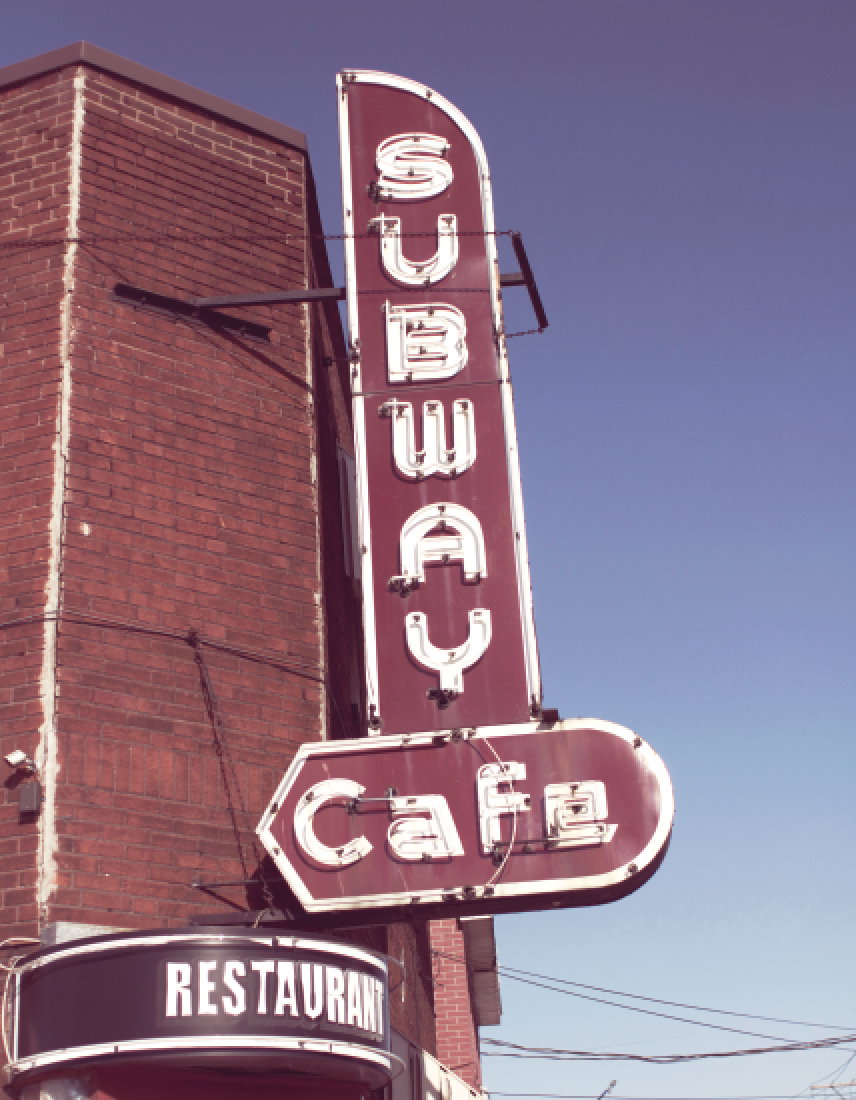
All Aboard for Lunch: For decades, locals have flocked to the Subway Cafe for great company, amazing pizza.

Screenshot 2014-02-28 08.39.26The sturdy, brick building known as the Subway Café is one of those few, iconic Harrisburg places that has withstood the test of time, operating for decades as a restaurant, bar and neighborhood hub.

Need proof? An ad in the Harrisburg Telegraph dating back to 1935 wishes readers “Seasons Greetings” from Subway Café owner Steve Costea and touts “homemade goulash” as the house specialty.

The cuisine wasn’t the only thing just a bit different back then.

The small establishment also featured live entertainment, as evidenced by another ad that ran that same year. Not lacking in hyperbole, the advertisement reads, “Dancing and entertainment your eyes have never seen before. Also the Balkan Knights. Tamburitsa Band. Radio Artists.”

Today, patrons may wonder how the Subway managed to fit live music and dancing into such a small space, which seats about 75. At the time, though, the focus was heavy on entertainment and light on food. Articles throughout the years refer to the business as a “taproom,” and, in 1942, the Telegraph referenced a bit of legal trouble stemming from a “gambling device” discovered on the premises.

Enter Liana and Donato Giusti.

When the Giustis purchased the café in 1948, they made a great effort to improve the reputation of the establishment, located smack-dab in the midst of Harrisburg’s industrial zone, up the block from the Herr Street underpass. Liana’s son Donato Giusti, Jr., recalls, “Two spittoons were the first things my parents eliminated when they took over.”

The couple aimed to elevate the business from a beer den and nightclub to a restaurant, serving up Italian favorites like lasagna, spaghetti and meatballs and their now-famous pizza. Working-class folks from nearby businesses packed the place during lunch and after work to enjoy the freshly made personal pies with the savory sauce and cracker-like crust.

“Harrisburg Steel Company was the main clientele during the World War II years. Their major product was bombshell casings, which were converted to pressurized gas cylinders after the war,” said Donato, Jr.

Business boomed for quite some time before a series of setbacks occurred.

Hurricane Agnes swept through the place in 1972, leaving only the ceiling of the café unscathed. Donato, Jr. said his mother’s repeated quote to the customers, in her thick accent, was “we leana butta we no falla!” This inspired the family to run a newspaper ad with the phrase, alongside a picture of the Leaning Tower of Pisa, to announce that the café was, once again, up and running.

Today, diners can see the remarkable high-water marks from both the 1972 and 1936 floods, which are memorialized on a wall near the entrance.

The 1980s ushered in more challenges. Liana lost her husband in 1984, and the nearby TRW plant burned to the ground not long after, taking with it patrons who no longer found it a convenient lunch or dinner stop. The subsequent closing of the steel mill didn’t help.

A woman of lesser strength would have sold the place and retired, but not no-nonsense Liana.

She credited her father, who owned an Italian café and macaroni manufacturing business near Florence, Italy, for her business sense and tenacity. Tall and stately, she glided through the dining room overseeing everything. Nothing got past her, often to the chagrin of the staff, but she had a soft side and a sense of humor, too.

Liana ran the café until she passed away in 2001 at the age of 90. Donato, Jr. and his wife Pat took over until 2004, when they sold it to Christina and Fotios Lamnatos, who decided to retain the loyal staff that patrons had come to know and enjoy.

Long-time bartender Scott Hohe, with his trademark smile and jocular personality, has been serving up drinks at the Subway Café for 38 years. “I love coming to work every day to meet old friends and make new ones. I’m the hostess with the mostest,” he boasts with a hearty guffaw. Reviewers on Foursquare and TripAdvisor seem to agree, often giving the popular bartender shout-outs.

Romano Premici, who retired in 2009, also was a long-timer, serving more than five decades as cook. Waitress Lisa Kettering has been a loyal employee, as well, serving up food with a smile for almost three decades now.

The current owners have made small adjustments to keep up with the times.

“The changes they made are good ones. They are now open on Saturday nights, and they take credit cards,” said Hohe.

They still serve the popular “fishy bowls” of beer (as Liana used to call them), and the food offerings differ only slightly. Salads now include Greek and Caesar, and they’ve added homemade eclairs, which are hugely popular. The age-old pizza recipe has been retained, earning The Subway Café the PennLive Pizza Party award as the best pizza in Harrisburg just last year.

Meanwhile, the restaurant’s loyal fan base continues to expand. “Three and four generations of family members are coming in now,” said Hohe, who entertains them all.

Bob Schott of Harrisburg has been a regular since 1985. “I’m there every week. Initially, it was because of the pizza, but then I started meeting people,” he said of the family-like atmosphere and camaraderie. Schott recommends not only the pizza, but the lasagna, too.

The Lamnatos have carried on the Subway Café tradition of valuing their loyal staff and customers, serving up good food and welcoming newcomers. For those who have yet to visit, now might be a good time to treat your taste buds to one of the best pizzas around.

The Subway Café, 1000 Herr St., Harrisburg, 717-412-7128, www.subwaycafepizza.com.

Continue Reading