Tag Archives: harrisburg

Street Closures Announced in Advance of Clinton Rally

BroadStreetMarket

The Broad Street Market stands ready to host the Hillary Clinton/Tim Kaine rally tomorrow.

The arrival of Hillary Clinton in Harrisburg is still a day away, but the heart of Midtown soon will become a no-drive zone.

Harrisburg will be among the first stops for the newly minted Democratic presidential nominee and her vice presidential running mate, Sen. Tim Kaine, following the conclusion of the Democratic National Convention in Philadelphia tonight.

A rally for the Democratic ticket will take place Friday in front of the Broad Street Market at N. 3rd and Verbeke streets starting at 8:30 p.m.

To host the rally, Harrisburg will have to endure almost two days of street closures. According to the city, these include the following:

  • N. 3rd Street from Forster to Reily streets will close to through traffic from 5 p.m. today until “further notice.”
  • Local traffic on N. 3rd Street will be permitted until noon tomorrow from Forster to Cumberland streets and from Sayford to Reily streets. After 12 p.m., those streets will close to all traffic.
  • Verbeke Street will be closed to traffic from N. 2nd to N. 6th streets.

Detours will include:

  • N. 3rd Street northbound—N. 2nd Street and Commonwealth and N. 6th streets.
  • N. 3rd Street southbound—Front Street and Commonwealth and N. 6th streets.
  • Verbeke Street—Forster or Reily streets.

Free parking will be available to Harrisburg residents from Friday morning through noon Saturday at the 7th Street Parking Garage, according to the city. Residents should bring their IDs to the parking garage. They will receive a ticket upon entry and will not have to pay when exiting before noon Saturday.

For rally-goers, free parking will be available at HACC Midtown lots 4, 5, 6, and 7 to accommodate the thousands of people expected to attend.

Continue Reading

Housing Bill Unchanged as Council Turns Back Mayoral Veto

CityCouncilWeb

Harrisburg City Council

Harrisburg City Council tonight overrode a mayoral veto, thereby permitting seven nonprofit groups to receive federal housing funds.

Council voted unanimously to override Mayor Eric Papenfuse’s first-ever veto, returning from summer recess to cast their votes.

Last week, Papenfuse vetoed the annual bill that distributes federal Community Development Block Grant (CDBG) funds, saying that council selected nonprofit groups to receive funding without sufficient public input.

“There was no public comment on any of these specific changes, many of which drastically altered the funding amounts requested by the sub-recipients,” he said.

However, council President Wanda Williams tonight disputed Papenfuse’s version of events.

“In 11 years that I have been in this position, it has been the practice and responsibility for council to discuss and enact any changes they feel are in the best interests of the residents regarding CDBG funding,” she said, in a prepared statement. “All discussions were held in public settings, which involved public comments.”

PennLive’s Christine Vendel has reported that, despite two public meetings on CDBG funding, council members reached consensus on final recipients and allocations “through email and private conversations.”

Originally, Papenfuse proposed that the city retain all $1.9 million in CDBG funds for its own needs. However, council unanimously decided to carve out $295,000 and distribute it to a handful of service organizations.

In the end, the following groups received funds:

  • Habitat for Humanity of the Greater Harrisburg Area, $80,000
  • Heinz-Menaker Senior Center, $40,000
  • African American Chamber of Commerce, $30,000
  • East Shore YMCA, $30,000
  • MidPenn Legal Services, $30,000
  • Fair Housing Council, $25,000
  • Christian Recovery Aftercare Ministries, $25,000

MidPenn Legal Services was the only group that received all the money it requested, while others received considerably less. Council also awarded $35,000 to the Ferguson Group, which helps nonprofits with grant writing.

In vetoing the bill, Papenfuse specifically cited the Ferguson Group, saying that it was not eligible to receive CDBG funds. Following tonight’s meeting, he reiterated this position.

“We still won’t be able to fund the Ferguson Group,” he said. “They’re not an eligible sub-recipient.”

Before the override vote, several residents spoke to defend their requests for CDBG money. Members of the Latino Hispanic American Community Center, for instance, went to the microphone to urge council members to reconsider their request. Though the group has been funded in past years, it was denied funding this year.

Melvin Johnson, chairman of the Fair Housing Council of the Capital Region, appealed for additional money, saying that this year’s grant represented just 6 percent of his budget. Meanwhile, the demands on his organization continue to grow, he said, including finding new homes for residents displaced by the recent condemnation of the McFarland apartment building following the collapse of a retaining wall near the Mulberry Street Bridge.

Afterwards, Williams apologized to the room, stating that debt obligations prevented council from being able to fund more groups and at higher levels. In the end, council passed the veto override without proposing any changes to the bill.

The city needed to reserve the single-largest amount of CDBG money—$641,113—to repay a federal loan it backed for the once-bankrupt Capitol View Commerce Center, as well as for other federal community development loans dating back about 15 years.

The Papenfuse administration has sent a letter to Julian Castro, secretary of the U.S. Department of Housing and Urban Development, asking for relief from the remaining balance of the Capitol View Commerce Center loan, as the developer, David Dodd, defaulted on the loan and was later convicted on federal fraud charges. No response has yet been announced.


Continue Reading

Community Parties Planned for CRW Greening Initiative

RiverWeb

Capital Region Water’s greening initiative should help improve the quality of area waterways, including the Susquehanna River.

Capital Region Water will hold a series of community “parties” over the next two weeks to gather information for its greening initiative.

In the three neighborhood parties, CRW will gather information and offer possible solutions as part of its City Beautiful H2O program. It also will offer free food, music, activities and prizes, said Andrew Bliss, community outreach manager.

At the three events, CRW will set up education stations to offer information on water issues and community greening, Bliss said. Other stations will present community greening concepts, giving residents a chance to comment.

The events are:

South Harrisburg Party
July 26, 5 to 7 p.m.
Cloverly Heights Park (18th and Pemberton streets)

Allison Hill Party
July 30, 11 a.m. to 2 p.m.
Heart of the Community Garden (1418 Derry St.)

Uptown Party
Aug. 2, 5 to 7 p.m.
Camp Curtin YMCA (2135 N. 6th St.)

“This is our community’s plan. Your plan for today and for future generations,” said CRW CEO Shannon Williams. “We want you to tell us what you need in your neighborhood. Our job is to see how we can meet those needs through community greening projects.”

City Beautiful H2O is part of a years-long project to improve water quality and reduce combined sewer overflows. The greening plan is partially funded by the Pennsylvania Department of Conservation and Natural Resources, Bureau of Recreation and Conservation and the Environmental Stewardship Fund.

Bliss added that City Beautiful H2O is more than a plan to improve water quality. It’s also a chance to improve and beautify neighborhoods through community greening projects.

Click here to see a video about CRW’s initiative.

Continue Reading

Harrisburg Mayor Vetoes Housing Bill that Disbursed Money to Nonprofits

PapenfuseWeb

Harrisburg Mayor Eric Papenfuse

Mayor Eric Papenfuse today vetoed a bill that dramatically altered his spending priorities in the annual allocation of federal housing funds.

In a statement, Papenfuse said he vetoed the recently passed Community Development Block Grant (CDBG) bill because City Council made major changes to his proposal without any public comment on those changes.

“My primary objection is the lack of public process in debating the substantial amendments that were passed by Harrisburg City Council on July 5,” he said. “There was no public comment on any of these specific changes, many of which drastically altered the funding amounts requested by the sub-recipients.”

City Council is on summer break until late August, meaning that a special session would have to be called to try to override Papenfuse’s veto.

On July 5, council selected seven nonprofit groups to receive federal housing funds, bucking the wishes of the mayor.

Papenfuse had proposed that the city retain all $1.9 million in CDBG funds for its own use. However, council unanimously decided to carve out $295,000 and distribute it to a handful of service organizations, as it has in past years. The following groups received funds:

  • Habitat for Humanity of the Greater Harrisburg Area, $80,000
  • Heinz-Menaker Senior Center, $40,000
  • African American Chamber of Commerce, $30,000
  • East Shore YMCA, $30,000
  • MidPenn Legal Services, $30,000
  • Fair Housing Council, $25,000
  • Christian Recovery Aftercare Ministries, $25,000

MidPenn Legal Services was the only group that received all the money it requested, while others received considerably less. Council also awarded $35,000 to the Ferguson Group, which helps nonprofits with grant writing.

In addition to his objections over public input, Papenfuse specifically objected to the allocation to the Ferguson Group, which, he stated, “is clearly not an eligible sub-recipient and had not even applied for such funding.” Thirdly, he said that several recipients, including the African American Chamber of Commerce, never appeared before council to promote or defend their applications.

Most of the money distributed to the groups came from $165,000 that Papenfuse had earmarked to restart a school resource officer program for the Harrisburg school district. Council, citing a lack of buy-in from the district, killed the proposal in favor of funding the nonprofits. Smaller amounts were taken from grant administration, housing rehabilitation and emergency demolition.

The city reserved the single-largest amount of CDBG money—$641,113—to repay a federal loan it backed for the once-bankrupt Capitol View Commerce Center, as well as for other federal community development loans dating back about 15 years.

The Papenfuse administration has sent a letter to Julian Castro, secretary of the U.S. Department of Housing and Urban Development, asking for relief from the remaining balance of the Capitol View Commerce Center loan, as the developer, David Dodd, defaulted on the loan and was later convicted on federal fraud charges. At press time, no response had been announced.

Continue Reading

Wonder Wall: Beautiful murals once lined the Mulberry Street Bridge. A group now is trying to put them back on view

Screenshot 2016-06-23 14.53.02For about a decade, two enormous murals adorned the Mulberry Street Bridge in Harrisburg.

You may remember them: 86 panels, 43 panels per mural, spanning 640 feet in total, showing colorful scenes of life in Harrisburg.

In April 2014, PennDOT removed the murals to rehabilitate the bridge, with no plans to reinstall them. So, for the past two years, they’ve been in storage in Harrisburg’s old central post office on Market Street, in space donated by Blue Bell-based Equilibrium Equities, which now owns the building.

But a volunteer group—the Mulberry Street Bridge Mural Preservation and Relocation Committee—has formed to free them from storage and put them back before the public.

“We’re five volunteers with a monumental task,” said member Tara Leo Auchey, who also runs the online publication today’s the day Harrisburg.

The committee has engaged Navarro & Wright Consulting Engineers and has a preliminary arrangement with the YWCA of Greater Harrisburg to display one of the murals, the one that faced north on the bridge, at the corner of Cameron and Market streets.

Despite the all-volunteer effort, the expense to relocate and mount the murals is monumental. Besides their size, the unique makeup of the murals makes their re-display a costly effort.

“They were created on ‘parachute fabric’—polytab mural fabric,” said Lauren Nye, the exhibitions manager at the Susquehanna Art Museum and a committee member. “And that fused to the surface of the bridge, so there was no peeling it off.”

When the committee talks about preserving and relocating these murals, Auchey said, they are not just 86 panels of art. They are enormous sheets of metal, each one 7-feet tall and 7-feet wide.

The north mural depicts a single scene across 43 panels, a history of Harrisburg from its early days through the City Beautiful movement of the early 1900s. The committee is dedicated not only to keeping all of the north mural’s panels together in sequence, but to keeping it at the intersection of downtown and Allison Hill, the two neighborhoods the Mulberry Street Bridge connects.

The south mural is a series of individual scenes across two and three panels each, featuring people affiliated with the arts group, Danzante, and from around Allison Hill.

“We were at the South Allison Hill Multicultural Festival,” said Nye, “So many people—at every event that we go to—walk by and say, ‘Oh my God, I remember these! Do they still exist?’ They’re like, ‘My cousin is on there!’ ‘My daughter is on there!’ ‘A portrait of my friend is on there!’”

These interactions illustrate the committee’s other important mission, besides raising money: outreach to the community.

“That’s the biggest thing we want people to know, that they are still safe and there is still a group of people who are invested in bringing them back to the public,” said Nye.


A Gift

These works of art need to be displayed again not just because they’re beautiful, but to demonstrate Harrisburg’s identity as a unified city and to contribute to its economic development as a source of tourism, say committee members.

“For the 10 years they were up on the Mulberry Street Bridge, there was no graffiti on them,” said Harrisburg artist Nancy Mendes, a committee member. “That shows that people loved and respected it. Why not give it back to them as a gift?”

During its campaign, the committee has formed relationships with people and companies that have helped with various aspects of the project. In addition, they say they have the support of the city, which has promised flood clearances to mount the murals on the Y’s property at Cameron and Market. However, when they applied for tourism funding, Dauphin County rejected their application. So, to raise money, the committee has begun throwing events.

“But it’s not $1,000” they need, said Auchey, referring to the average amount an event pulls in.

In fact, the installation for the north murals alone will require a budget of $250,000.

Auchey said the goal now is to have a small fundraiser every two to three months. Fortunately, both of the artists who worked on the murals are dedicated to preserving and restoring them.

Elody Gyekis, who painted the north murals, donated a piece of art to the committee’s last auction. The committee also wants to launch a Kickstarter campaign featuring photo prints by south mural artist Cesar Viveros of his work on the north Philadelphia mural “The Sacred Now,” which was painted for Pope Francis’ 2015 visit to Philadelphia (the pope signed it).

Indeed, if the Mulberry Street Bridge murals are ever going to be a part of the community again, the effort is going to need to be bigger than just a five-person committee. When committee members attended the Multicultural Festival, Nye said, they saw a man walk by.

“He totally didn’t care about anything,” she said. “He’s walking down the street. He sees our picture and stops. He’s like, ‘Oh my God. I remember those murals! You guys have them?”

Nye told him that, yes, they did. He then pulled out his wallet.

“He said, ‘My wife gave me $2 today to spend however I want. I want you to have it. This is important.’”

To learn more about the effort to save and re-mount the murals, please visit the Facebook page: Mulberry Street Bridge Murals Preservation and Relocation.


Continue Reading

What Kind of City? Harrisburg is changing, redeveloping—and we need to be comfortable with that.

Screenshot 2016-06-23 14.43.34A few months back, a reporter asked to interview me for a story about Midtown Harrisburg.

It was a little strange—one journalist interviewing another journalist. But there I was, sitting at a table in Zeroday Brewing Co. on a cold winter morning, giving my impressions of the redevelopment of the neighborhood.

Maybe 10 minutes into the conversation, he said to me, “What about gentrification?”

Ah, so there it was. The real reason he wanted to talk to me. He planned to do a piece on gentrification.

Now, he hadn’t tipped me off to this beforehand, so the topic, coming with no warning, was a surprise. It turned out that he had received some criticism after a previous, positive piece he had done on development in Midtown, so was looking to balance the scales.

The people who complained, however, wouldn’t talk to him on the record. So, he chose to spring it on me.

I thought about my response for a few seconds.

“To me,” I said, “development comes down to two things. The first is, ‘what is a city?’ And the second is, ‘what do you want your city to be?’”

I’m not sure that this philosophical answer was what he was looking for, but it was my answer. So, then, what is a city?

To me, a city means density, diversity and complexity. It’s a population of people, typically from a variety of backgrounds, living in close proximity. This nearness may create friction, but it usually also produces great dynamism—in culture, in economy, in creativity.

The second question is more a matter of taste. Some people want their city to be large and imposing; others prefer small and quaint. Many people, when thinking of a city, have in mind the so-called golden age, a relatively brief period of time between the late 19th century and World War II, when the Industrial Age and immigration quickly transformed towns and small cities into imposing urban centers.

Harrisburg’s history reflects the American city experience, if on a smaller scale. Steel, railroads and other heavy industry brought in people, money and development, and Harrisburg became an important manufacturing and transportation center. It then suffered punch after punch—the Depression, de-industrialization, suburbanization, floods—so that, by the late 1970s, it was one of the poorest, most desolate cities in the country.

Over the last 20 years, Harrisburg has made progress redeveloping, but it’s hard to shake off decades of depopulation and disinvestment.

So, I ask again—what do you want your city to be?

Is your city supposed to be impoverished? Is it supposed to be a place where commuters flee after work? Is it supposed to be a place dominated by dilapidation, ruled by slumlords? Is it supposed to be a place with vast fields of nothing, where there once were people, businesses and activity? Is that the natural state of your city? Is it the natural state of any city?

When I arrived here, Harrisburg seemed out of whack. The economy was small and focused on a few blocks downtown. Once-grand historic buildings stood empty. The development that did occur was pathologically dependent on one man’s control and his dubious financial dealings. The city looked rundown, and too much of it felt bleak and menacing.

That is not healthy, nor is it sustainable.

Fortunately, things have improved. Harrisburg still has far too many empty fields, dilapidated properties and negligent property owners. However, the trend is a positive one. Over the past few years, historic buildings have been restored and repurposed; wonderful small businesses have opened; the Broad Street Market has revived. Even stodgy old downtown is finding new life as a residential and tech center.

Isn’t that what we want?

For many decades, Harrisburg skewed too far in the wrong direction: too few people, too much poverty, too much crime, too little development. Over the years, there have been many efforts to try to reverse this trend, but none were very successful. Finally, we may be reaching a tipping point.

In the end, it’s about balance. I doubt that Harrisburg will ever be a little San Francisco, where the median cost of a house exceeds $1 million. But it also shouldn’t be satisfied to be a little Detroit—broken and depopulated. The aim should be to be somewhere in the middle: vibrant and appealing, affordable and diverse.

To reach that goal, Harrisburg needs to be comfortable accepting redevelopment. It needs to be comfortable accepting new residents, businesses and visitors, which will lead to a larger, more diversified economy, more jobs, more tax revenue and a healthier municipal budget that can offer greater services to its people.

That’s the kind of city I’d like Harrisburg to be.

Lawrance Binda is editor-in-chief of TheBurg.


Continue Reading

Sweet Dreams (Are Made of This): Midtown welcomes a new bakery to the mix.

Screenshot 2016-06-23 14.48.13When Samra Alic left the corporate world to pursue her passion, she discovered that she had found the perfect recipe for fulfillment.

In May, the Summerdale resident claimed her piece of the pie and opened Dalicia Bakery and Coffee Shop in Harrisburg, a stone’s throw from HACC’s Midtown campus.

The ebullient proprietress greeted me with a big smile and a hearty greeting when I entered the charming shop that once housed a salon. I remarked on the chalk pastry art that decorates the walls, and she told me that her daughter had created the cute cake drawings on squares of chalkboard paint.

Walls in hues of sage and tangerine complement the tan tables spaced comfortably around the room. Chair backs containing cutouts that resemble floating coffee cups with steam rising add a bit of whimsy to the décor.

Alic pointed out other special touches.

“See the sign?” she said, pointing to the window emblazoned with the business name. “If you look closely, you’ll see the word ‘Alic’ in there.

And, indeed, the endeavor is a family affair, with her husband Mirsad, daughter Ajla and son Ajdin all contributing in one manner or another.

Originally from Sarajevo, Bosnia, Alic learned to bake at a young age and credits her grandmother for cultivating her talent.

“She taught me all the traditional stuff,” she said.

By age 18, she had fled her troubled home country.

“I was lucky that I could leave,” she said.

As a young woman, Alic spent time in Germany, where she met her husband and honed her skills by working in a bakery. Because of the country’s location in central Europe, she was able to travel to Italy and France to gain even more insight into the bakery business. Today, she pays tribute to those regions with small pictures placed around the restaurant.

In addition to the baked goods, Dalicia’s menu features simple, healthy fare. Breakfast offerings include a “hot pocket,” just not the ubiquitous, frozen, processed kind. Alic’s “hot pocket” is a creamy mixture of egg, cheese and vegetables wrapped in a choice of homemade bread. Other early morning options include Belgian waffles with peanut butter and banana, Nutella or fresh fruit and a yogurt-and-fruit parfait.

Vegetarians, in particular, will enjoy Dalicia.

Patrons can choose from among hot sandwiches like the “Garlic Lovers,” with red peppers, onions, feta cheese and herbs served between two warm slices of artisan garlic bread; the “Roasted Pepper Wheaty,” comprised of mixed roasted peppers, leeks, zucchini and mozzarella on ciabatta; and the “Veggie Sandwich,” with pesto, mushrooms, mozzarella and provolone on artisan vegetable bread.

Cold sandwiches include the “Skinny,” a low-calorie option that includes cream cheese, provolone, cucumbers and tomatoes served on wheat bread; the “tomato basil,” with provolone, tomato, avocado and lettuce on tomato basil bread; and the house wrap on wheat or white, with provolone, vegetables and cheese.

It may seem a bit incongruous to offer healthy fare with baked goods, but Alic succeeds in appealing to those who are calorie conscious but want a little bite of something to satisfy their sweet tooth. With one peek into the glass case located up front, you’ll see that there are plenty of wee-bites from which to choose.

In addition to mini-bonbons and adorable little chocolate mousse cups, Dalicia offers cheesecake, brownies, cannoli, tiramisu and some of the moistest, cream-filled cupcakes you’ll ever taste. Pair any of these with a cup of Little Amps coffee served onsite, and you’ll have a perfect match.

Chris Scott, manager at Midtown Scholar Bookstore up the street, said he is happy for the additional dining option and the reasonable prices.

“I love that everything is vegetarian, but even those who aren’t vegetarian will likely appreciate having nice, light options,” he said.

Scott was glad to learn that the business is open on Mondays, too.

“So many places in this area are closed on Monday,” he said.

One of Scott’s favorite choices is the “Skinny Sandwich” paired with one of many varieties of infused waters like pineapple tangerine, peach mango, lemon mint, berry and ginger cucumber.

As for business, Alic said that things are going well so far.

“I’m reaching my goal,” she said. “And my favorite part about it is seeing their faces when they like it, and I see more and more people coming back.”

Alic said that she is thrilled to be able to finally fulfill her dream and create her idea of the perfect coffee shop and bakery. And, today, Midtown is just a little sweeter for it.

Dalicia Bakery and Coffee Shop is located at 1419 N. 3rd Street, Harrisburg. To learn more, call 717-525-7496 or visit www.daliciabakery.com or their Facebook page.

Continue Reading

It’s in His Blood: Jeb Stuart has spent his life devoted to a single cause—the welfare of the historic capital city.

Screenshot 2016-06-23 14.45.26Ask Jeb Stuart to speak about himself, and he’ll likely steer the conversation right to Harrisburg.

Growing up in Camp Hill, he used to ride his bicycle into the capital city, taking in the church architecture, getting a haircut at the old Penn Harris Hotel, and dropping by his father’s clothing store.

“I gravitated toward Harrisburg,” he said. “It was in my blood from day one.”

Stuart’s maternal grandparents lived on N. Front Street, in a 1927 southern Colonial-style home built by his grandfather, E. C. Snyder—founder of a Harrisburg lumber mill—in 1911.

The Snyder home is now the residence of Stuart and his wife, Robin. Its preservation in near-original appearance has been an extensive labor of love for the couple, one that earned the Historic Harrisburg Preservation Award in 2008.

But that’s just one of Stuart’s many efforts on behalf of the city. Historian, preservationist, developer, civil servant—he’s done it all.

For his lifetime of commitment, Historic Harrisburg recently sponsored “A Toast to Jeb Stuart.” Appropriately, the celebration was held at Harrisburg’s most historic building, the John Harris and Simon Cameron Mansion, which celebrates its 250th anniversary this year.

“Few people have contributed to the vitality of this community as extensively, and with as much dedication, as Jeb Stuart, “ said HHA interim executive director David Morrison. “Jeb has devoted his life to Harrisburg.”


A Different Path

Stuart might easily have become a businessperson—that was in his blood, too. His father, Allan Stuart, opened his first store in 1935. Later, he ran the 212 Men’s Shop in the Mary Sachs store before going off on his own again.

But the younger Stuart took a different path. A special consultant to the city of Harrisburg for 10 years, he helped coordinate the Civil War Trails project. He also was involved in the creation of the African-American Heritage Trail and chaired the Harrisburg SusqueCentennial Commission from 2009 to 2010.

Among other commitments, Stuart is a board member of the Historical Society of Dauphin County, the Harrisburg Cemetery Association and Historic Harrisburg’s Community Historic Preservation Fund.

Previously, he was on the boards of Historic Harrisburg Association and the National Civil War Museum.

In fact, Stuart shares the name of a famous Civil War general, but, ironically, one from the Confederate side. His given name is James Allan III, but even before birth, he was told, his father called him “Little Jeb.”

“My father went to the University of Virginia and was always into the romance of the South,” he said.


A Gem

After graduating with a bachelor’s degree in psychology from Susquehanna University, Stuart went to work for Harrisburg—as city clerk. He hasn’t stopped serving the city since.

It’s hard to summarize all of his accomplishments, so I asked him what he considers to be most significant. One, he said, was historic preservation.

Decades ago, when the Harristown Urban Renewal Plan was being developed, one of the goals of the Downtown Harrisburg Historic Preservation Project, which Stuart directed, was to target buildings for preservation that were potentially included on the plan’s demolition list.

This was particularly true with Old City Hall on Walnut Street. Stuart nominated it to be listed on the National Register of Historic Places, and it was subsequently sold for adaptive re-use and market rate housing.

Another was the Cameron School project, for which Stuart was managing general partner, with Arnie Kogan as his business partner. Stuart oversaw the drive to convert the old schoolhouse, in a transitional neighborhood, to 35 upscale apartments.

“The apartment project, the Simon Cameron School Apartments, at 1839 Green St., planted the seed to transform and stabilize the neighborhood,” Stuart said.

He placed the property on the National Register of Historic Places and gained historic tax credits to bring in an investor. He also managed the building for 12 years.

Stuart also was director of the Dauphin County Office of Economic Development and a charter member of the Susquehanna Area Regional Airport Authority, as well as chair of the Authority’s Economic Development Committee.

From 2011 on, he has been a consultant-at-large. He was instrumental in reestablishing the Harrisburg Parks Foundation, which he chairs. The foundation raises funds to support the preservation, maintenance, expansion and development of parks throughout the city.

A golf outing sponsored by the foundation recently raised $8,000, a portion of which was used to buy a new swing set for an Allison Hill playground. This summer’s outing will raise money for the band shell in Reservoir Park.

Stuart is not a man of intensely pursued hobbies. He works “all the time,” he said, including on his landmark house. But he does enjoy classical music—especially Baroque—and historic photography.

“I’m a stay-at-home guy,” he said.

With one clear exception. He and Robin always make time for the beach they love at their house in Cape Hatteras, N.C.

Still, his ongoing love affair with Harrisburg takes precedence. When David Morrison interviewed him as a “living legacy” as part of the SusqueCentennial celebration, Stuart spoke eloquently.

“The city is a wonderful urban environment,” he said. “The setting is stunning…. It is architecturally a gem.”

Continue Reading

Sense of Place: An historian reflects on American identity during this patriotic season.

Screenshot 2016-06-23 14.45.39American history, says Brent Glass, is “a resource for understanding our own times and our own lives.” Its study is patriotic, even when it unearths injustice and the fight against oppression.

You might remember Glass. From 1987 to 2002, he was executive director of the Pennsylvania Museum and Historical Commission, helping win PA Keystone funding to maintain historic sites. He left Harrisburg for Washington to become director of the Smithsonian’s National Museum of American History, managing a two-year overhaul before retiring in 2011.

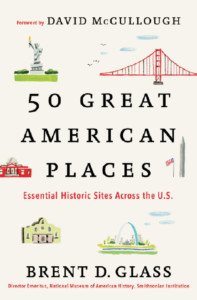
So, when you hear that Glass has written “50 Great American Places: Essential Historic Sites across the U.S.,” with a foreword by no less than his friend David McCullough, you have to figure he knows his stuff.

Glass often returns to Harrisburg to visit family, and on a recent trip, he shared the thinking behind his new book, published by Simon & Schuster Paperbacks. There’s no magic in the list, and it’s certainly not definitive, he said. Presented chronologically, the sites encapsulate the themes of freedom, war, innovation, diversity and land and landscape.

“American identity is defined, I think, by those five things,” Glass said. “Other countries may have those same five things, but not in that unique configuration.”

Hence, the Alamo is followed by the upstate New York birthplace of the women’s movement. The tragic Indian Wars sites of Little Big Horn and Wounded Knee precede “The Bridge and The Statue”—you know the ones—in New York City.

“It’s an introduction to American history, and it’s also an appeal to public memory, that we need to remember and value these places because of how they reflect our traditions and values and ideals,” Glass said.


Overcoming Barriers

The book’s first listing, the National Mall in Washington, D.C., is the only site presented non-chronologically.

As a kid, Glass visited the monument-dotted span he now calls “America’s front porch.” As National Museum of American History director, he stepped onto that porch almost daily. Under his watch, the museum underwent renovations reflecting new thinking in use of public space.

Under those renovations, the preserved fragments of the original Star Spangled Banner got a new gallery, and a replica of the massive 30-by-42-foot original, “meant to be seen at a great distance,” is sometimes unfurled for visitors to hold while singing the National Anthem.

It is, said Glass, “a patriotic moment,” but he added that patriotism means different things to different people. Profiling essential sites doesn’t mean glossing over the dark patches in American history. Someone once asked him, “What’s so great about Wounded Knee?” where U.S. cavalry soldiers massacred 300 Native Americans in 1890.

“What is great about it is that it’s essential to know about Wounded Knee if we’re going to understand how American history involves overcoming barriers,” he said. “And to be a democracy and to really be patriotic, we have to acknowledge the fact that there is some tragedy in our history, and we recognize it, and at least in this country, we talk about it and we acknowledge it. We don’t try to bury it.”

Similarly, from his Smithsonian tenure, Glass cities the counter from the Greensboro, N.C., Woolworth’s, where, in 1960, sit-in participants re-enacted their defiance against segregation. A schoolchild on a museum tour once asked Glass, “Did this really happen?”

“He couldn’t fathom it, that we had laws and customs enforcing segregation,” he recalled. “That was something I was proud of, that we could make history accessible, not only through our collection, which is the best in the world, but using the museum as a stage for providing the content.”


What-Ifs

Asked his definition of patriotism, Harrisburg political consultant Charlie Gerow said that America needs citizens who “know a little bit more about history and a little bit more about civics.” The history buff, who hadn’t yet read Glass’ book but looked forward to picking up a copy, quoted 19th-century U.S. Senator Carl Schurz: “My Country! When right, keep it right; when wrong, set it right!”

But a warts-and-all view of history must be put in context, said Gerow, CEO of Harrisburg-based Quantum Communications. Any discussion of the World War II internment of Japanese-Americans should be paired with the “vicious, malicious, unprovoked attack on the American people by the imperial Japanese government,” he said.

“This is the most exceptional country in the history of the world, built on very high ideals,” he said. “Because we are human beings, we sometimes fall short of those ideals, and, when we do, it’s important to reflect on how it happened and what we need to do to correct it, but that’s not an indictment of the country or its system of government.”

Glass does, indeed, feature consecutive chapters on the Pearl Harbor attack and Minidoka Camp in Idaho, where 120,000 forcibly relocated Japanese-Americans built a community and erected an honor roll of internees who performed military service “even while family and friends were held captive in the high desert of Idaho.”

Pennsylvania appears often in Glass’ book. Gettysburg, the Liberty Bell and the forks of the Ohio River at Pittsburgh’s Point get their own chapters. Other Keystone State sites and people make cameo appearances. Gifford Pinchot butts heads with fellow conservationist John Muir. In charming but tumultuous New Castle, Del., freewheeling descendants of Dutch settlers rebel against control by the conservative Quaker government of William Penn’s Pennsylvania.

By selecting still-standing sites, Glass paid tribute to historic preservationists, including President Dwight Eisenhower, advocate for protection of the Gettysburg battlefield.

“The past is not inevitable,” Glass said. “It is not inevitable that we have these places. People made decisions to save some of these structures. And people made decisions that gave these places their historic meaning. When you go to Gettysburg, you really can appreciate how history is contingent on so many individual decisions and so many what-ifs.”

Even Harrisburg, which receives one mention as the end goal for Robert E. Lee’s Army of Northern Virginia, has scored telling victories with the City Beautiful movement and preservation of its unique riverfront, said Glass.

“You can’t go wrong if you have access to that scene,” he said.

Harrisburg also embodies a theme of the book—that history is in our midst and easily accessible. Glass believes it’s time to stop complaining about the excess of nontaxable state properties in the city and, instead, market their tourism value, especially the Capitol, Forum building and State Museum.

“All those buildings were built at a time when they paid artists to decorate them,” he said. “I would put the Harrisburg Capitol as one of the best, not only for the Capitol building but the whole complex.”

Public disinvestment in heritage sites “is very shortsighted,” Glass said, but the passion that historical assets generate is heartening. Investments in visible history “have such a tremendous effect on the morale of people, to know they are connected to a bigger story.”

“You can’t measure that,” Glass said. “There aren’t a lot of metrics to say, ‘What’s the return on that investment?’ But I’m really convinced that we’re enriched by preserving history and knowing the history and telling that story to the next generation and getting them engaged in it.”

“50 Great American Places: Essential Historic Sites across the U.S.” by Brent Glass is available in bookstores and online.

Save

Continue Reading

Car Models: The beautiful, the sleek strut their stuff for Supercars on State Street.

Screenshot 2016-06-23 14.44.13Not every exotic car show is a memorial tribute to a friend’s mother, but that’s exactly what motivated Evan Ross to start Supercars on State Street.

Ross, a 2011 Central Dauphin High School graduate now living in Florida, began the annual event in 2010 to benefit the American Cancer Society in honor of Patti Burkhardt, who lost her life to breast cancer at 42. She was the mother of Evan Ross’ close friend, Sarah Burkhardt.

“It’s a labor of love,” Ross said of the car show.

This year’s event, scheduled for July 30, features makes of cars—Maserati, DeLorean and Lotus, for example—not often seen on the streets of Harrisburg. The show quickly has become one of the largest exotic car shows in the northeast. Last year, 350 registrants hailed from 11 states, numbers that organizers expect to top.

“You typically don’t see a lot of Lamborghinis and Ferraris around Harrisburg,” said Ed Ross of Susquehanna Township, who organizes Supercars with son, Evan. “Other car shows in the area are for cars that are antiques, classics or muscle cars.”

Evan Ross never knew Patti Burkhardt because she died months before he and Sarah Burkhardt met as sixth-graders at Linglestown Junior High. What he did know, however, was that his young friend bore a painful grief from her mother’s early death that would never totally ebb.

Today, Sarah Burkhardt, a first-grade teacher in the East Pennsboro School District, carries memories of her mother that are warm and wistful.

“As soon as you walked into a room, my mom could make you smile,” she said. “She was the glue that held the family together. She was always good at bringing out the best in people.”


Passion for Cars

As teens, Sarah and Evan began taking part in fundraisers like car washes and the “Making Strides Against Breast Cancer” walk held each year on City Island to benefit the Patti’s Light Foundation, named in honor of Sarah’s mother.

Then Evan came up with the idea to hold a car show fundraiser that would benefit the American Cancer Society in Patti Burkhardt’s honor. Supercars on State Street was born.

“I just always had a passion for cars,” Evan explained. “It sparked my interest. I thought (the car show) would be fun and a surprise for Sarah with a check in her mother’s memory. I thought it could be something that she was involved with and not have to do a lot of work.”

Sarah said she didn’t know anything about what was happening until Evan told her to come to State Street one Saturday morning in the summer of 2010. That’s where she spotted 60 exotic cars lined up near the state Capitol complex for what was the first Supercars on State Street.

“She was shocked,” Evan recalled

“I was really surprised. I had no clue,” Sarah recounted. “Evan just told me to that I had to be at State Street. He didn’t say anything about a car show. He was just one of those people who was always there for me. It was just such an honor that he would do this.”

For the first year, Supercars on State Street raised $2,100 for the American Cancer Society. Last year, the show raised around $10,000, pulling in a total of more than $30,000 in its first five years. Ed Ross said he hopes this year’s show earns $20,000.

Ed Ross, who lives in Lower Paxton Township, said that he does most of the “local duties,” while Evan takes care of the show’s website from Florida.

“My son and I have always been interested in cars,” he noted. “We’ve been to a lot of car shows, so we had some idea of what it involved to organize one. However, a lot of cars shows are held at fairgrounds. They don’t have to deal with a lot of logistics that we do.”


Many Friends

The show runs on State Street from Front Street to 3rd Street, and on Front Street from Forster Street to the Walnut Street Bridge. For the first time this year, cars also will be shown on N. 3rd Street from South Street to North Street, which includes 120 parking spaces situated near the steps leading to the Capitol.

One of Ed’s many duties is wrestling with several local agencies to clear parking for the event, which includes pre-show parking on City Island. This year, the job has been made a little easier, said Ed, because Standard Parking has become an event sponsor. Until now, the Rosses were forced to buy out parking meters in the area of the show.

Ed also makes the show’s trophies, which are comprised of a wood base topped with various used car parts. This year’s award categories will highlight five Ferrari classes, with the remainder being People’s Choice awards.

Over the years, the Rosses have made many friends through the show, including Adam Frank of Monroe Township. Frank said he helps out and has participated in the show for the past three years after first learning about it on social media.

“Today, I was passing out show flyers in the State Street area,” he said. “I like being at the show and seeing people from all over the country with their support. I heard that this is one of the biggest car shows on the whole East Coast. We love to do charity.”

Supercars on State Street takes place in downtown Harrisburg on July 30, noon to 5 p.m. Vehicle check-in runs 8 to 11 a.m. For more information, visit www.supercarsonstatestreet.com.

Continue Reading