Tag Archives: harrisburg

Language Barrier: The Spanish-speaking population is surging in the midstate. What’s a company to do?

Screenshot 2016-08-24 20.52.29Businesses that want to sell to and serve our area’s growing Latino population find themselves in something of a double bind.

They need to be able to communicate with consumers who frequently feel more comfortable speaking Spanish than English. But, to do so, they first must attract qualified workers who are bilingual, a high-demand skill set often difficult to find.

“Hiring bilingual talent is incredibly important to PNC’s business strategy, especially as our customer and client base becomes increasingly diverse,” affirmed Amanda Snow, vice president, talent acquisition for the Pittsburgh-based financial services company. “Having employees with diverse experiences and skills, including bilingual, can better serve clients and customers throughout our footprint.”

PNC has a great need for English/Spanish speakers across many different lines of business. It employs bilingual employees in customer service, retail banking, investments, wealth management and corporate and institutional banking.

Data show the challenges that companies like PNC face in our area. Dauphin County’s total population rose a scant 1.8 percent from 2010 to 2015, but Latino residents jumped by 25 percent. Today, about 23,400 county residents, 8.6 percent, are of Hispanic origin, according to the U.S. Census.

It’s no surprise then that south-central Pennsylvania’s Latinos wield a hefty buying power of $2.1 billion, according to George Fernandez, CEO of Latino Connection, a marketing and communication firm linking businesses with Latino audiences. But are businesses doing enough to attract Latinos as both customers and employees? While some companies say they’re trying, Fernandez is calling on the business community to do more.

Many companies have “put a certain dollar value” on trying to reach Latino customers and potential hires through advertising, but “that amount is next to nothing,” Fernandez said. “It’s withholding them from success and from attracting more and more multicultural talent moving to the region.”

In the meantime, young Latinos are finding opportunities in other parts of Pennsylvania, including Philadelphia and Berks and Lehigh counties, he said.


Why Diversity?

As with the banking sector, health care companies face similar dual-language barriers.

As in any business, communication assures delivery of quality services, but health care providers must also “make sure patients are receiving the information you’re giving them and complying with the information you’re giving them,” said Tina Nixon, PinnacleHealth vice president, mission effectiveness and chief diversity officer.

In the past, children were often de facto interpreters for non-English speaking parents, but that meant translating medical terms and “information that is really not age-appropriate,” she said.

Today, PinnacleHealth relies on phone and Skype interpretation services to translate many conversations. But, when live translation is needed, the call goes out for a certified healthcare interpreter. At Pinnacle, the staffer responding might be Patient Representative Elisabeth Pérez.

Pérez, who grew up speaking Spanish at home, pursued the rigorous certification because she was often getting calls to interpret but, lacking the authorization to join healthcare conversations, couldn’t intercede. Effective communication assures that patients understand their plan of care, comply with instructions, and “are more compliant in returning for follow-up care,” she said.

“They will return because they know there’s someone to assist them,” she said. “The patient does feel more comfortable in that environment when someone’s there who’s familiar with their language.”


Hiring Challenges

Businesses seeking bilingual employees must understand that language gaps also signal cultural differences, said Fernandez. One client from an elderly-services business got little traction from an ad showing a woman playing cards, because “for some seniors and Latinos that are considered Catholic or Christian, that ad would be offensive,” he said.

Businesses advertising in Spanish to attract Spanish-speaking customers better have bilingual staff and materials to serve them, he added.

“It all boils right back down to recruitment,” Fernandez said. “The common goal is to educate the corporate organizations and help them strategize where they are now, where do they want to be, where do they need to go, and where do they start. That’s the key. Where do you start?”

For PNC, corporate-wide “and in Harrisburg specifically, finding and hiring bilingual employees is a constant challenge for us,” said Regional President Jim Hoehn. “Being bilingual is always a difference-maker when considering employment decisions.”

PNC seeks talent through online posts, working with Latino Connection and other outlets, and partnering with national and local diversity organizations, he said.

That may be a good start, but not enough businesses are on board, said Fernandez. His new membership-based initiative “Hola Harrisburg,” founded to attract Latino professionals by touting the midstate’s quality-of-life advantages, has signed only two members toward the goal of 15.

And yet, Latino audiences are as non-homogenous as any other, demanding specialized outreach, he said. As consumer researcher Nielsen classified them, they may be traditional “Latinistas;” bicultural but preferably Spanish-speaking “Heritage Keepers;” progressive “Savvy Blenders;” or culturally American “Ameri-Fans.” Each group demands different messages and tactics to reach them at their specific phases of life and circumstances, Fernandez said.


Some Solutions

Businesses should become not just bilingual but bicultural, said Fernandez. Bicultural means recognizing the perspectives and values shared by customers and potential hires.

“They need to welcome upper management and executives that are bilingual, that look like the population they are looking to hire, to welcome more than one language being spoken in the business place,” he said.

Immigrants should learn English, he said, but “it does take its time.”

“In order for businesses in southcentral Pennsylvania and all of Pennsylvania to become more successful and to get a return on investment for doing business with the largest-growing minority population in the United States, they must become bicultural businesses,” he said.

At PinnacleHealth, Nixon is revising the certified healthcare interpreter process to train more people more cost-effectively. She also schedules “cultural awareness trainings,” well received by staff accustomed to lifelong learning and intent on communicating in terms their patients understand.

“We have to look at our footprint and the individuals we are serving and educate our medical staff on how to provide those services,” she said. “We did cultural awareness trainings for how to understand our Muslim patients, how to understand our Somali patients, how to understand our Nepali patients, because those are some of the communities that are growing in this area.”

Patient Representative Pérez has been with PinnacleHealth since 1992. In her daily work, she greets former patients who return to express their appreciation, and she gets thank-yous from co-workers thrilled by any aid that bridges language barriers in delivering medical care.

“I can honestly tell you that I love my job,” she said.

That infusion of cultural awareness and language capabilities throughout the system, including executive offices, helps attract and retain bilingual staff, said Nixon.

“If people see that, and they see that dedication, they think, ‘This is great. This is where I want to be,’” she said. “All of it comes from the top.”

For more information on this issue, including how to market to the area’s Latino population, visit Latino Connection at www.thelatinoconnection.net.

Author: M. Diane McCormick

Continue Reading

August News Digest

Bar Decision Appealed

Harrisburg is appealing a judge’s ruling that requires it to issue a business license to an embattled city bar.

The city administration last month provided notice that it intends to appeal a decision by Dauphin County Judge Andrew Dowling, who mandated that Harrisburg issue a 2016 business license to the Third Street Café. It did not immediately cite the grounds for its appeal.

In July, Dowling rejected the city’s argument that the Third Street Café is a magnet for trouble. He also said that state regulations override city rules for establishments that hold a liquor license.

Harrisburg has been trying to shut down the Midtown bar since early last year, when it revoked its 2015 business license. It then refused to issue the bar a 2016 business license, leading the bar to file suit.

The administration has successfully closed two other bars after revoking their business licenses. Those bars did not appeal the decision to the court.


Calls for Healing, Peace

Both the city and the family have issued calls for peace following the police-involved shooting last month of a Harrisburg resident.

Police shot and killed Earl Shaleek Pinckney in his Uptown home after responding to a call that the 20-year-old man was threatening his mother, Kim Thomas, with a knife. Last December, Thomas requested court protection from Pinckney after he allegedly threatened to kill her, and he was arrested several times last year for domestic incidents.

Thomas later disputed the police department’s version of events, stating that her son didn’t have a knife at her throat and that there was no need to shoot him.

Nonetheless, she asked the community to come together and not resort to violence during a meeting at Goodwin Memorial Baptist Church. City Police Chief Thomas Carter and other city officials also spoke at the meeting.

Thomas had her harshest words for demonstrators, saying that she didn’t want outsiders causing trouble in Harrisburg, as well as for the media, which she said provided misleading information and exploited the situation.

Shortly afterwards, a group called This Stops Today Harrisburg sent a letter to the U.S. Department of Justice asking for an independent investigation of the incident.


Samarin Pleads Guilty 

The man who posed as a Harrisburg High School student pleaded guilty last month to a litany of charges that could lead to his deportation.

Artur Samarin, a citizen of Ukraine, admitted guilt on fraud and sex-related charges and said he planned to plead guilty to federal fraud charges, as well.

For several years, Samarin posed as a teenager named Asher Potts, attending high school and receiving numerous academic accolades. In fact, he was in his 20s and in the country illegally after his visa expired.

He faces sentencing this month in Dauphin County court on several charges, including allegedly having sex with a 15-year-old girl he met in school. The federal case relates to alleged passport and Social Security violations.


Housing Sales Up

Area housing sales continued a yearlong climb in July, with unit sales and median prices both rising 4.8 percent, according to the Greater Harrisburg Area Association of Realtors.

GHAR reported that sales totaled 938 units compared to 895 units in July 2015, while the median price climbed to $175,500 from $167,500 for the area that includes Dauphin, Cumberland and Perry countries and portions of York, Lebanon and Juniata counties.

In Dauphin County, sales edged up to 308 units versus 307 units in the year-ago period, while the median price rose to $155,900 from $155,000. Cumberland County saw significant increases, with unit sales totaling 374 units against 335 units in July 2015 and the median price rising to $217,642 from 216,646.

In Perry County, sales increased to 34 units from 33 last July, while the median price rose to $187,400 from $155,000. 


So Noted

Bollywood Bar & Grille opened for dining last month in the heart of “restaurant row” in downtown Harrisburg. The Indian-style restaurant serves both lunch and dinner at 110 N. 2nd St., the long-time home of Zia’s at Red Door. 

Buddy Boy Winery has begun offering samples and selling bottles from a satellite location in the Broad Street Market in Harrisburg. The Perry County-based winery has become known for its sweeter wines, its fruit wines and its irreverent names and labels.

Harristown Enterprises last month previewed its two newest apartment buildings: Fifteen @ Twenty-Two and SoMa on Third. The buildings are across the street from one another in downtown Harrisburg and both begin leasing this month. Earlier in the summer, Harristown began accepting tenants for its first apartment project, the Flats @ Strawberry Square.

The Millworks last month opened its rooftop beer garden and its new brewery, run by brewmaster Jeff Musselman. No reservations are needed for rooftop tables, as it’s first-come, first-served in the space at 340 Verbeke St., Harrisburg.

Nest Egg Interiors relocated last month from Marysville to Cumberland County. The home décor and specialty furniture shop is now located at 315 Bridge St., New Cumberland. Grand opening is scheduled for Sept. 3, 10 a.m. to 4 p.m.

Pikowski’s Pierogi Place debuted last month to brisk business in the stone building of the Broad Street Market. Owner Carolyn Pikowski offers a wide assortment of the Polish staple, some traditional and others quite creative.


Changing Hands

Alricks St., 650: K. Gautsch to Consolidated Holdings International LLC, $160,000

Boas St., 428: C. Brown to B. Weber, $128,600

Brookwood St., 2408: J. McPherson to K. & M. Walter, $92,900

Caledonia St., 1917: S. Sabella to J. Gerena, $86,500

Chestnut St., 1940: PA Deals LLC to C. Austin, $63,000

Emerald Ct., 2450: J. Seaton & S. Beckner to E. Manly Spain, $67,000

Forster St., 212: J. & J. Spagnolo to N&R. Group LLC, $43,500

Forster St., 1600: A. & B. Briley to R. Lopez, $161,000

Green St., 1614: J. & MJ Hess to N. Foote & A. Schwarzl, $144,000

Green St., 1932: WCI Partners LP to M. Roos, $205,000

Harris St., 344: C. Wilson to PA Deals LLC, $45,000

Herr St., 215: Crested Enterprises to Z. & W. Zogby, $110,000

Kensington St., 2246: S. Duong to D. Tran & N. Nguyen, $61,000

Kensington St., 2341: Donald L. Pong Trust to I. Trigueros, $45,000

Market St., 2448: K. Haas & D. Maguire to B. Wilson, $110,000

N. 2nd St., 1426: M. & K. Moosa to C. Albers, $153,000

N. 3rd St., 2419: M. & S. Kreines to F. & K. Wilson, $154,900

N. 3rd St., 3027: R. Finck to D. Myers, $127,000

N. 3rd St., 3113: New 4 You Property Solutions LLC to J. & L. Kincaid, $107,500

N. 4th St., 1632: K. & K. Leaver to A. Fiorucci, $87,500

N. 4th St., 1725: LSF9 Master Participation Trust to PA Deals LLC, $54,900

N. 4th St., 3209: C. DePauli to M. Schuessler, $106,500

N. 5th St., 1630: Federal Home Loan Mortgage Corp. to R. Williams, $45,000

N. 6th St., 3115: A. Starr to A. Smith, $30,000

N. 6th St., 3205, 3209 & 3205 N. 7th St.: D. & J. Klaiber to SBN LLC, $310,000

N. 7th St., 3205 & 3133: Bass Pallets Realty LLC to Consolidated Holdings International LLC, $810,000

N. 16th St., 1100: T. Simpson to HSBC Bank USA, $92,000

Paxton St., 118 & 109 Vine St.: R. Aronson, D. Stern & C/O Service Oil Co. to R. Aronson & R&D Landholdings LLC, $275,000

Penn St., 924: D. Roberts to L. Felix & E. Smith, $35,000

Penn St., 1723: Pennymac Corp. to PA Deals LLC, $78,000

Pennwood Rd., 3207: J. Fry to C. Gaither, $104,000

Reily St., 223: M. Jameson to J. Chadwick, $149,900

Rudy Rd., 2413: PA Deals LLC to G. & J. Modi, $134,900

Rumson Dr., 321: J. Quinlin to S. Nguyen, $64,900

Rumson Dr., 2772: Federal Home Loan Mortgage Corp. to PA Deals LLC, $32,250

Rumson Dr., 2801: R. & M. Gingrich to R. Adams, $74,000

S. 18th St., 1014: G. Stevenson to T. Martin, $112,000

S. 19th St., 258: S. Sugden to A. Santos, $30,000

State St., 231, Unit 503: LUX 1 LP to G. Shook, $167,400

State St., 231, Unit 605: LUX 1 LP to A. Neilay, $160,000

Swatara St., 2045: COBA Inc., Oreo TD Bank NA & TD Bank NA to R. Williams, $47,000

Sycamore St., 1807: A. Williams to R. & V. Thompson, $30,000

Wiconisco St., 524: PA Deals LLC to S. Orr, $60,000

Harrisburg property sales for July 2016, greater than $30,000. Source: Dauphin County. Data is assumed to be accurate.

Author: Lawrance Binda


Continue Reading

Peace, Healing

Last month, Harrisburg was shaken by the police-involved shooting of city resident Earl Shaleek Pinckney.

In the wake of the tragedy, Goodwin Memorial Baptist Church hosted a community meeting where many residents and city officials spoke, including Police Chief Thomas Carter. Pinckney’s mother, Kim Thomas, also gave a lengthy, heartfelt speech for peace, justice, patience and healing. Then, in a particularly touching moment, Carter and Thomas embraced. We thought we would share a selection of images from that night taken by our photographer, Dani Fresh.

Screenshot 2016-08-24 17.09.23 Screenshot 2016-08-24 17.08.47 Screenshot 2016-08-24 17.07.44 Screenshot 2016-08-24 17.06.19

Author: Lawrance Binda and Dani Fresh

Save

Continue Reading

Learning Tower: Experience Harrisburg train history at the Harris Tower Railroad Museum.

There’s a small, brick building you may have never noticed, though it’s located in plain sight.

Screenshot 2016-08-24 17.11.20 Screenshot 2016-08-24 17.11.09It’s little more than a stone’s throw from the East Wing of the Pennsylvania State Capitol, nestled between Forum Place and the State Street Bridge. And it’s played a big role in the history of Harrisburg.
Built in 1929, the Harris Tower long served as a critical link in a network of railroad towers that once controlled burgeoning passenger and freight train traffic, especially for the bustling Harrisburg Railroad Station (now the Harrisburg Transportation Center).

It’s been out of service since 1991, a victim to technology and automation. But, now, thanks to the intrepid efforts of the Harrisburg Chapter of the National Railway Historical Society, the tower—renamed the Harris Tower Railroad Museum—has new life and new importance.

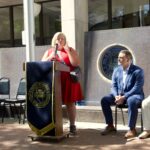
Last month, society members and train buffs gathered to unveil a special plaque designating the tower as a site on the National Register of Historic Places, a list of locations and buildings deemed historically significant by the U.S. government.

“We hope this leads to a greater appreciation for the city of Harrisburg’s rich railroad heritage,” said John W. Smith Jr., president of the Harrisburg Chapter of NRHS.


Back in Time

Upon entering the tower and ascending to the open second floor, one has the feeling of being transported back in time. You’re immediately drawn to a bank of restored, chestnut wood-trimmed windows that allow you to peer out upon the sprawling Amtrak and Norfolk Southern railroad yard.

At its operational zenith in the 1930s and ‘40s, Harris Tower was staffed daily by 18 full-time operators, six men for each eight-hour shift. They masterfully choreographed the movement of more than 100 passenger and 25 freight trains among 14 sets of tracks through the bustling train yard and into the nearby Harrisburg station.

Since acquiring the tower, society members have been working quietly to restore it to its 1940s vintage appearance. Work has included refurbishing windows and walls, painting radiators, refinishing floors and baseboards, installing new pipe insulation and toilets.

The centerpiece of the museum is the tower’s “interlocking machine.” The electro-pneumatic interlocking failsafe machine system console helped operators whose job it was to safely orchestrate the movements of massive locomotives and their passenger and freight cars.

Built by Union Switch and Signal Company for the Pennsylvania Railroad in the 1920s, the original system was a technological marvel of its day, designed to control switches and signals in the area to prevent conflicting routes—and collisions—from occurring. It is covered with an intricate array of switches, indicator lamps and more than 100 levers to assist operators in carrying out their critical tasks of safely moving passengers and freight.

“You become train director and sit in the control nerve center to get a hands-on feel for how it feels to actually operate the interlocking machine and other equipment and learn firsthand what running a railroad was like at a time before the advent of modern operation,” Smith said.

To elevate the experience, the interlocking control machine, the model track board, communications panels and other devices have been painstakingly restored and reconfigured to operate via computer, which simulates train movements over the Harris Tower operational terrain based upon actual train schedules from the 1940s.

The tower is among the society’s crown jewels. Others include the PA Railroad GG-1 Electric Locomotive No. 4859. Also listed on the National Register of Historic Places and designated as the state electric locomotive by the Pennsylvania General Assembly, the GG-1 pulled the first electric passenger train into Harrisburg in January 1938. It is joined by the former PA Railroad N6b Cabin Car No. 980016. Restored, owned and maintained by NRHS, they both are housed in a train shed at the nearby transportation center.


 Complete Story

Currently, the tower’s first floor is not open to the public, but that should soon change.

Smith recently returned from a 1,700-mile trip to the Arkansas home of Kathleen Farrell to retrieve a treasure trove of Pennsylvania Railroad model gems collected by her late husband, John. They include 65 Pennsylvania Railroad diesels, four Pennsylvania steam engines, five GG1 HO scale (1/87th scale) engines and several unique Harrisburg industrial/train building models.

These and other items will be included in a diorama planned for the museum’s first floor, which is currently undergoing restoration.

“We’re working to have the first floor open so we can tell more of the complete story on the technology and human interest aspects of Harrisburg railroad history,” said Smith.

The Harris Tower Railway Museum is located at 637 Walnut St., Harrisburg. It is open Saturdays, 9 a.m. to 3 p.m., through the end of October. Admission is free. For more information, see visit www.harristower.org or www.harrisburgnrhs.org.

Watch our Burg in Focus video that accompanies this story.

Author: Bob Bunty


Continue Reading

From Burbs to Burg: For decades, companies headed in one direction–from Harrisburg to the suburbs. Welcome back!

Screenshot 2016-07-27 19.31.00

World Trade Center Harrisburg (Capitol View Commerce Center), Cameron and Herr streets.

Once upon a time, in the late 1980s, a group called the Hospital Association of Pennsylvania built its suburban ideal in Swatara Township. Plenty of surface parking. Fun stores and restaurants nearby. Accessible to highways and airport. Even for a statewide association, the struggling capital city wasn’t seen as a good home.

Fast-forward 27 years. Government has gained prominence in a complex health care system. Seeking proximity to lawmakers, what is now the Hospital & Healthsystem Association of Pennsylvania is moving back into Harrisburg proper, where—surprise—there’s convenient parking and fun stores and restaurants nearby.

“To be six miles away from the center of decision-making for Pennsylvania struck me as a lost opportunity to be both visible and accessible to policymakers who are asking hundreds of questions about health care,” said HAP President and CEO Andy Carter, who helped lead the board in making the move. “I want to be there when they ask those questions so we can give our answer as part of their due diligence.”

Nationwide, businesses have been pulling up stakes from suburban campuses or outlying spots and resettling into cities. Likewise, businesses here increasingly are making high-profile moves from the ‘burbs to the ‘Burg. Of course, finances drive the decisions, but so do proximity to power, attracting talent to remain competitive, and commitments to rebuilding the urban hub that powers the region.

“We think we’re stepping into a very rich, diverse field that will accrue many benefits,” said Carter.


Love the Location

This month, HAP moves into a building on 3rd Street, in the shadow of the Capitol dome. Meanwhile, later in August, health care data analyst Geneia will leave its cramped Swatara Township digs to take occupancy in the resurrected Capitol View Commerce Center on Cameron Street. In fact, that building has been renamed “World Trade Center Harrisburg” in honor of its eponymous anchor tenant, which is moving in this fall from York.

And that’s not all. Last year, analytics firm VisiQuate left Rossmoyne to take up one floor of a rehabbed 19th-century mansion. And Chemical Solutions, Ltd., left its overcrowded Mechanicsburg quarters for a former plasma donation center at Herr and 7th streets.

VisiQuate grabbed the opportunity to lease space in the circa-1804 mansion at 111 N. Front Street “because we just loved the location,” said President JK Kolmansberger. With three offices in the United States and two in Eastern Europe, VisiQuate was accustomed to the amenities and convenience of working and hosting clients in urban settings. From Rossmoyne, “it was always a bit of a hassle to get our employees and clients close to where hotels are,” said Kolmansberger.

VisiQuate spotted the national and worldwide trend to reoccupy cities, but Kolmansberger said he hesitated to move into Harrisburg before recovery took hold. Now, “people are starting to come back downtown and are starting to see the city in a better place.”

Geneia left business park space where employees were working “two and three to an office,” or assigned to working from home solely for lack of room, said CEO Mark Caron.

“Many of them are very anxious for the new building,” he said. “It’s cool to have the flexibility to work at home, but it’s also really important to have a connection with teams.”

As needs of the workforce evolve, operating in the city offers businesses “access to an even more diverse potential workforce,” said Carter. People leaving state government for the private or nonprofit sectors “don’t have to change location,” and convenient access from the entire midstate will attract talent from all parts of the region, he said.

Once, Carter led a nonprofit located next to the statehouse in Columbus, Ohio. There, he often struck up “serendipitous conversations” just by “stumbling into the speaker of the House or secretary of human services,” he said. But from the suburbs, HAP often had to ration the trips allowed into Harrisburg.

Moving the organization to 3rd and Walnut streets, catty-corner to the Capitol complex, allows his organization to “take advantage of the stone’s-throw location,” attending more hearings, “more readily scheduling pick-up meetings” with state officials, and enticing busy lawmakers to events.

The location also could make it convenient for visiting HAP members to “tack on some visits” with state officials and lawmakers.

“We want to strengthen the relationship between our members and the policymakers who are helping us to shape the delivery system of the future,” Carter said.


Fun Town

Like Geneia, Chemical Solutions, Ltd., left cramped space.

“We were literally moving people out of their offices to move new instruments in,” said President Brian LaBine, who moved his company into customized space straddling downtown and Midtown Harrisburg.

Many of Chemical Solutions’ employees are chemists who appreciate Harrisburg’s balance of urban environment with livability, he said. One “wonderful chemist” moved from Delaware, where “the cost-of-living differential” was substantial.

“We think Harrisburg is going in the right direction,” LaBine said. “It’s a fun town. We like the Midtown area. Being able to walk out the door and walk to the Broad Street Market or Jackson House is perhaps a nice combination of having that city feel that some of the younger generation really likes, yet not having the traffic or the prices that come with relocating to, say, Philadelphia or a larger city.”

Geneia competes for skilled talent in the “pretty tight” analytics field, said Caron. Its new space offers the “creature features” that tech-oriented people expect, including a healthy café, treadmill desks, a fitness center, “open space for people to ideate,” and high-tech videoconferencing.

“As a techy and nerd, you want the latest software tools to build the latest products,” he said. “You want an organization that’s invested in its people.”

At any technology company, “you’ll find we don’t work 9 to 5,” said Kolmansberger.

Potential hires want to work wherever they can get the job done, whether from home or on a bench by the river, and the new space is “a very functional, high-tech office that our employees find very comfortable and useful. If you need to have a client in for a meeting, it shows very well. Clients like to come here because it’s a bright, cheery office that overlooks the river.”

Downtown sites also create proximity to learning opportunities that help employees grow and that cultivate future talent, especially through internships with Harrisburg University of Science and Technology students. In Swatara Township, HAP was isolated from downtown’s “rich mix of professionals” at universities and advocacy organizations, Carter said.

“Especially, since we think of ourselves as the leading edge of the trend, we hope that more of others in this world will consider moving downtown, as well, and then we’re going to have an even richer environment,” he said.


Part of the Solution

Though the business factors driving their decisions vary, the resettlers agree that helping rebuild a once-shattered city was on their minds. Access to “the best possible workforce” only comes from providing a competitive working and living environment, with quality housing, schools, health care and amenities, “and you aren’t going to get all that if you don’t have enough people who are being hired and brought into the city,” said Carter. Metropolitan areas “struggle to thrive if the city center is withering.”

“In many ways, by moving downtown, along with many other businesses, we’re showing our cards that we believe in the health of the city, and, in promoting its health by working down there and bringing its employees and their pocketbooks into the city, that we’re going to be creating a stronger future for the city,” he said

Chemical Solutions is showing its passion for education with plans to host local students in science and chemistry activities. Employees have helped a Friends of Midtown neighborhood cleanup. The business itself, under the leadership of Technical Director Francine Walker, takes pride in “taking a formerly dormant building, vacant for six years, and transforming it,” said LaBine

“We’re definitely attracted to the concept of urban renewal,” he said. “We’ve loved the decision since the day we made it.”

Geneia has “a real conscience in investing in the community,” said Caron, and the firm has found strong partners in the effort. World Trade Center Harrisburg developer John Moran “has been incredibly accommodating,” and the tax incentives for settling in a Keystone Opportunity Zone are “an attraction to a small start-up where you can save on taxes and put those dollars to other uses investing in people.”

In Kolmansberger’s travels, he finds that “the best areas always have strong downtown life and strong city life and good hotels and good restaurants.” He wanted the same for his clients and employees. Harrisburg, he said, “is definitely a city that is on the rebound.”

“I can sit out in the suburbs and complain that Harrisburg isn’t recovering fast enough or Harrisburg doesn’t have enough good restaurants,” he said. “Or I can try to be part of the solution, and that’s by bringing business to the city and embracing our capital city and embracing the business environment in downtown Harrisburg. That’s ultimately what I decided to do, and I found a good location in the middle of everything.”

Author: M. Diane McCormick

Save

Save

Continue Reading

A Student Story: Class of ’51 revisits William Penn HS, with memories, regrets.

Members of the class of ‘51 sing their alma mater.

Members of the class of ‘51 sing their alma mater.

Just across from the lush, green, life-filled Italian Lake is a contrasting site.

William Penn High School closed its doors permanently in 2010 and now sits gray, lifeless, crumbling. Its empty halls, once bustling with the sounds of students, lay silent.

Recently, though, a bus stopped at the entrance, its cargo not teenagers of 2016, but students of a past era.

Alumni from the William Penn High School class of 1951, 35 of them, gathered at the school in May to visit their alma mater.

After taking a bus tour of Uptown Harrisburg, the eclectic group, who hailed from as far away as Arizona, mingled and waited for a Harrisburg district representative to let them into the school.

When asked how it felt to be here again, Edgar Alston—“Eggie” as he was affectionately known way back when—chirped an enthusiastic “Great!” When asked about his fondest memories from William Penn, he replied, “Sports.” Fred Dougherty, another alumnus, piped in over Alston’s shoulder, “The best,” referring to Alston.

Alston, who participated in football, baseball and track, proudly recalled that the football team was undefeated in 1951. He received scholarships to attend college, but, after about a year, he left to join the Air Force and head overseas.

“I didn’t wait to go,” he said.

It had been 65 years since many folks had been to the school, and their faces showed them sorting through the tickler file of memories. Some had an easier time than others. The nametags, dotted orange identifying the alumni, helped. Alston said he only remembered one face—that of class President Jim Smith.

Smith recalled with zeal the things he’d done since leaving William Penn. He graduated from Lehigh University and worked as a geophysicist. After retiring from the Office of Naval Research, he bicycled across Cuba in 2000. Classmate Carl Nurick, who traveled from Texas, chimed in about Smith.

“He has retained a position of respect from all of us,” he said.

It was apparent that this class exudes admiration for their school and one another.


Kinder, Gentler

Mara (Layton) Moore lives in the Philadelphia area and hadn’t been to William Penn since she graduated. She recalled that, on nice days, she ate her brown-bag lunch at Italian Lake, riding the bus one way for 7 cents (walking the other) and paying 3 cents for a school milk.

Boyd Strain recollected that it was a kinder and gentler time.

“I don’t even relate to what’s going on in the schools today,” he said.

While times were good, they weren’t perfect.

“We were poor,” Strain said.

He noted that black folks worked mainly janitorial or housekeeping jobs, and white folks had better paying manufacturing and railroad work. He added that school was mainly equal—aside from the segregated sock hops—but life outside of school was not.

“The opportunities weren’t there because our parents didn’t have good jobs,” he added.


Sweat and Tears

John Gallagher, director of facilities for the school district, arrived and unlocked the doors for the eager octogenarians.

As they entered the school, the first thing they noticed was the dark. The electricity was out. Just inside the entrance, to the right, stood a large trophy case—empty.

Smith inquired about the trophies before entering the school and, upon seeing them gone, said, “A lot of people had sweat and tears in those.”

Likewise, a number of his classmates expressed concern about the trophies’ whereabouts.

Next came the auditorium. On the wall, hidden in the inky blackness, rests the school’s life motto. Edna (Heck) Baker didn’t need the light to recall it. She pronounced it aloud: “So teach us to number our days so that we may apply our hearts to wisdom” (Psalm 90:12).

As the group continued to the right, sunlight illuminated the hallways of their youth. The peeling paint and fallen plaster served as a reminder of the school’s age—it opened in September 1926.

For some, it was hard to see the school in such disrepair. Alston, with nostalgia across his face, described the 43-acre campus he remembered.

“That hall goes a quarter-mile that way.”

He pointed left.

“There’s the football field and two tennis courts,” he said. “It was a beautiful school.”

He added that it was a shame that no one could find a way to keep it up.

Kenneth Markley, a member of the reunion committee, joked that he didn’t have a note from his mother.

“It’s been 65 years since I’ve been here,” he said. “I might get detention!”

Some alumni wanted to venture further into the school, but safety wouldn’t allow it. The friendly banter and memory-sharing continued as they meandered outside. Their visit was over.

As the Class of 1951 made their way to the bus, much slower than the last time they boarded here, some walked with assistance from canes or companions. It was impossible not to see the similarities between these people and the building. Both still stand proud, even as age has affected them, and both remain filled with wonderful memories of William Penn High School.

Author: Susan Ryder

Save

Continue Reading

A Crime Story: In Harrisburg, the media often is the message.

Illustration by Rich Hauck.

Illustration by Rich Hauck.

Have you heard about the recent crime wave over this long, hot summer?

  • thefts
  • drug possession
  • hit and runs
  • assaults
  • vandalism

And that’s not all. Since January, there have been numerous burglaries, robberies, assaults, drug arrests and vehicle break-ins.

Where is this pit of criminal activity? No, not Harrisburg, but in the symbol of our area’s safe, wealthy, white suburb—Camp Hill.

I don’t mean to dump on Camp Hill—I like Camp Hill. Nor am I directly comparing Camp Hill to Harrisburg. Harrisburg, after all, is a densely populated city, with many times the people and poverty rate of Camp Hill. So, of course, Harrisburg has more crime—and more serious crime at that.

I’m saying that, when it comes to crime, perception can be reality. PennLive and the TV news push a daily diet of Harrisburg crime, causing people to irrationally fear and avoid the city. But when’s the last time you read about crime in everyone’s favorite, secure, West Shore town? I’m here to tell you that it’s nearly an every day occurrence.

I once had a journalism professor who spoke of the “hidden rich.” These are the people who live in huge houses off of leafy streets with names like Golf View Road and Country Club Place—and you never hear a word about them. What’s going on behind those wrought iron gates and long driveways? No one seems to know, and the state cops sure aren’t saying. But we do know what’s happening on city streets. It’s right in view, it gets all the attention of reporters, and it’s a staple of the click- and ratings-obsessed media.

Now, every media outlet has its own approach to covering crime.

I’ve long been fascinated with how the Washington Post goes about it. Get a copy of the Post, and you’ll see that the front page often has a couple of national and international stories, a policy piece, maybe the start of a lengthy feature. It rarely includes a crime story in a city dense with crime.

In the Washington Post, most crime stories are relegated to the interior pages of the “Metro” section and, even then, are tiny briefs—maybe a few paragraphs long. If you turn to page B3, you’ll see these afterthoughts under the bland heading of “Local Digest.” Here are three samples buried deep in the paper on a recent, random Tuesday.

  • “Man Shot by Agent Is Ordered Detained”
  • “Police Identify Victim in Southeast Shooting”
  • “Deaths Declared Murder-Suicide”

A few days later, there was this item: “Police Chase involving Gun Prompts Capitol Lockdown.” In this case, gunfire from a MAC-11 semiautomatic erupted from a speeding car being chased by police in the middle of the afternoon in downtown Washington, resulting in the U.S. Capitol complex being placed on lockdown, the second time that had happened in a week. This short story, nine paragraphs in total, was hidden on page B-6.

I sometimes wonder how stories like these would be handled in the Harrisburg media. No doubt, each one would include screaming headlines, multiple articles, breathless prose and hundreds of comments from people swearing they’ll never set foot in Harrisburg again for fear of their lives.

Indeed, these are very serious crimes, but the Post doesn’t exploit them. So, readers get a completely different feel for crime in D.C., perhaps a more honest one, since the chances of any individual falling victim to one of these crimes, while not zero, is quite low. It would be a tragedy if someone decided to forgo the many wonderful things in Washington because news coverage made them afraid. As for other crime stories you see each day in the Harrisburg media—muggings, burglaries, drug arrests—they’re so numerous that they don’t even rate an article in D.C.

TheBurg has its own way of covering crime. We’re not really a daily news outlet, nor do we shamelessly chase clicks for money, so we don’t usually cover individual occurrences. When we do cover crime, we typically write a trend story that tries to offer as much context as possible or a feature piece, such as the wonderful long-form story that Paul Barker wrote for our January issue about Rayon Braxton and Braxton Hall.

Sometimes, people ask me if TheBurg would consider publishing more frequently, perhaps weekly. If we did, we would give more coverage to crime stories, but, again, would try to do so in a respectful, contextual, informative and non-exploitative way. For instance, we certainly would have covered the recent tragic murder of Steve Esworthy, but would have done it, as we do everything, with the community firmly in mind.

PennLive may not cover crime in Camp Hill, but that doesn’t mean it doesn’t exist. It may cover nearly every crime in Harrisburg, but that doesn’t mean that’s all there is.

Harrisburg has amazing parks, restaurants, theater and nightlife. It has a professional baseball team, an incredible river, a vibrant community market, the country’s most beautiful statehouse and plenty of history. It is so much more than a crime story. It’s a city worthy of time, understanding, exploration.

To read more about crime in Camp Hill, visit www.camphillpolice.org.

Lawrance Binda is editor-in-chief of TheBurg.

Save

Continue Reading

Lesser Case: From criminal mastermind to common thief?

Illustration by Ryan Spahr

Illustration by Ryan Spahr

It was all so clear a year ago.

Steve Reed, the seven-term, former “mayor for life,” was exposed for what he was—a municipal mastermind, shuffling projects, political allies and toxic debt among the various branches of Harrisburg city government. The grand jury report, made public in July 2015, laid it out in exquisite detail. We learned, or thought we learned, about how Reed handled detractors. (“Thank you. You are fired,” he supposedly told a naysaying engineer.) We learned, or thought we learned, about the “binge artifact buying ‘addiction’” behind his repeated borrowing. (“You’ve got to stop this, you’ve got to cut it out, it’s just going to kill your career,” a key Reed aide supposedly warned.) And we saw, or thought we saw, how the “prudent stewardship and innovative thinking” of Reed’s early years eventually warped into a tendency to “gratify his own interests at the city’s expense.”

With these and other zingers, the report made for good reading. It told a story that one longtime Reed skeptic described as “Shakespearian,” striking upon themes of youthful ambition, the fickleness of fortune, and the corrupting influence of power. But was any of it true? In May, a judge tossed out 305 of the 449 criminal counts against Reed, saying they fell outside the statute of limitations. A month later, the state attorney general’s office announced it wouldn’t appeal. The remaining charges have to do with the alleged theft of artifacts and other city property that residents watched agents haul out of Reed’s Cumberland Street home earlier in 2015. Those are serious charges—the state solicitor general, Bruce Castor, noted that they carry a maximum combined sentence of 886 years—but they don’t include the running of a years-long “corrupt organization” alleged in the complaint. This raises an interesting question about the original grand jury report. If the charges are out, what becomes of the gripping story that supported them?

Earlier this year, the New Yorker’s Jeffrey Toobin profiled Preet Bharara, the U.S. attorney for the Southern District of New York, whose office has brought headline-grabbing cases against Wall Street traders and corrupt state legislators. Among other things, the profile discusses Bharara’s use of “speaking complaints,” in which lengthy, descriptive narratives of the alleged crimes accompany the more legalistic affidavits of probable cause. Toobin ties their use in part to the proliferation of plea deals in federal prosecutions—with some 97 percent of federal defendants pleading guilty, a prosecutor might be tempted to write a detailed complaint telling the story of a crime that would otherwise have come out at trial. But these narratives can also deeply color a case with scintillating accusations that are far from proven. The article quotes a defense attorney, Henry Mazurek, who describes such complaints as “unnerving and disturbing and fundamentally unfair.” “The complaints tell a story and set a tone, especially in the press, that’s very hard to counteract,” Mazurek is quoted as saying.

The case against Reed is a state, not federal, prosecution, and there’s no evidence that the former mayor sought or was offered a plea deal. And, of course, it was Reed’s attorneys who raised the statute of limitations challenge against most of the charges; the fact that he won’t be fighting most of the criminal “narrative” in court is, in the end, a victory for the defense. Nonetheless, it’s worth wondering about some of the more alluring sections in the grand jury report, now that they are unlikely to be interrogated at trial. What to make, for instance, of the “bizarre meeting” with Reed, recalled by former City Council President Richard House, during which House “anxiously, and silently, wrote out and held up a note asking Reed whether he was recording the conversation”? The report concludes, elusively, “Reed responded by writing down that he was not recording the conversation and then asked if Mr. House was recording it.” Was this sinister, or was House simply paranoid? Needless to say, it would have been illuminating to see this fleshed out on the stand. (Jeffrey Johnson, a spokesman for the attorney general’s office, said the presentment is “still a public document” that “gives a detailed narrative,” and that it was released “with every intention of proceeding with the prosecution.”)

Despite the dropped charges, the case appears to be far from over. The grand jury report referred to an “ongoing investigation” into “those named herein and others as yet unnamed”; as several have pointed out, it’s hard to run a corrupt organization on your own. There is still the possibility of a civil suit over the incinerator debt—last September, the state retained a D.C. law firm to pursue potential claims. The attorney general’s office, even if it files no additional criminal charges, could still issue an informational report, as it did in the grand jury investigation into sex abuse in the Catholic Church’s Altoona diocese.

For now, though, the cake is only half-baked. Residents who hoped an investigation would shed light on the city’s political disintegration and crippling debt have only a partial answer—a theory of corruption, but not the proof. (They also have a blanket denial from Reed, who said the grand jury report “contained so many mischaracterizations, so many misrepresentations, so many untrue things that it flabbergasts me.”)

Last summer, we heard a saga spanning three decades, one that began with a “dynamic and forceful” politician and ended with a shopping addiction and a city Reed had built as “a monument to him and not administered for the common good.” After the charges were dismissed, the attorney general’s office released a quieter, narrower statement. “With his fascination for the Wild West, this man used other people’s money to decorate his house and office with antiques,” it quoted Solicitor General Castor as saying. “But, Pennsylvania is not the Wild West. We have the rule of law here. We look forward to presenting our evidence in court.”

Paul Barker is a former senior writer for TheBurg.


Save

Continue Reading

July News Digest


Housing Money Disbursed

Harrisburg City Council last month selected seven nonprofit groups to receive federal housing funds, but not before overriding a mayoral veto.

Council President Wanda Williams called members back from their summer recess to vote to override Mayor Eric Papenfuse’s first-ever veto.

Papenfuse objected to several parts of the bill, but especially opposed a lack of public input on changes that council made to his original bill.

“There was no public comment on any of these specific changes, many of which drastically altered the funding amounts requested by the sub-recipients,” he said.

Originally, Papenfuse proposed that the city retain all $1.9 million in federal Community Development Block Grant funds for its own needs. However, council unanimously decided to carve out $295,000 and distribute it to a handful of service organizations, as it has in past years.

The following groups received funds:

  • Habitat for Humanity of the Greater Harrisburg Area, $80,000
  • Heinz-Menaker Senior Center, $40,000
  • African American Chamber of Commerce, $30,000
  • East Shore YMCA, $30,000
  • MidPenn Legal Services, $30,000
  • Fair Housing Council, $25,000
  • Christian Recovery Aftercare Ministries, $25,000

MidPenn Legal Services was the only group that received all the money it requested, while others received considerably less. Council also awarded $35,000 to the Ferguson Group, which helps nonprofits with grant writing.

Papenfuse had earmarked $165,000 to restart a school resource officer program for the Harrisburg school district. Council, citing a lack of buy-in from the district, killed the proposal in favor of funding the nonprofits. Smaller amounts were taken from grant administration, housing rehabilitation and emergency demolition.

The city reserved the single-largest amount of money—$641,113—to repay a federal loan it backed for the once-bankrupt Capitol View Commerce Center, as well as for other federal community development loans dating back about 15 years.

The Papenfuse administration has sent a letter to Julian Castro, secretary of the U.S. Department of Housing and Urban Development, asking for relief from the remaining balance of the Capitol View Commerce Center loan, as the developer, David Dodd, defaulted on the loan and was later convicted on federal fraud charges. At press time, no response had been announced.


Pot Penalties Eased

Harrisburg last month joined several other cities in Pennsylvania in reducing penalties for marijuana possession.

A unanimous City Council lowered the penalty for possession of small amounts of cannabis from a misdemeanor to a summary offense. The penalty for possessing marijuana paraphernalia likewise was lowered.

Fines were set at $75 for possession and $150 for use.

After a third offense, the penalty reverts to a misdemeanor, but only if all three citations occur within a five-year period.

The vote came after several public meetings in which dozens of residents voiced their opinions for and against lowering the status of possession. Many residents supported the change for recreational or medical use of marijuana, while others argued that pot can lead to the use of harsher drugs.


Gun Suit Dismissed

A judge last month threw out a longstanding lawsuit over Harrisburg’s gun ordinances.

Dauphin County Judge Andrew Dowling dismissed a lawsuit by a group called U.S. Law Shield, which had sued Harrisburg over five of its gun control laws. Dowling ruled that the plaintiffs lacked standing to bring the suit, as none lived in or had been cited by the city.

U.S. Law Shield filed the lawsuit after the state passed a law known as Act 192, which gave entities automatic standing to sue Pennsylvania municipalities over gun restrictions. The Commonwealth Court later declared that law unconstitutional.

Many municipalities had already repealed their gun control ordinances under threat of a lawsuit. However, Harrisburg and several other cities chose to fight the suits.


Sewer Line Cleaning

Capital Region Water has begun cleaning out major sewer lines in its service area, work that will continue through November.

Crews from CRW, Terra Contracting and CDM Smith will be accessing manholes along the lines, called interceptors, to perform the pipe-cleaning work, said Andrew Bliss, CRW’s community outreach manager. The project includes the Paxton Creek, Paxton Creek Relief, Hemlock Street, Spring Creek and Front Street interceptors.

Bliss said that disruptions to traffic flow are not expected, but that CRW would provide notification through social media if they do occur.

CRW interceptors are up to 60 inches in diameter and convey about 20 million gallons of sewage every day. Bliss said that initial analysis determined that some sections of the interceptors are 50-percent clogged by sediment, adding that the cleaning will remove about 2,300 tons of sediment.

According to CRW, there is no record of when the interceptors were last cleaned.

Bliss said that the $1.4 million project will allow for more storage in the interceptors, which will help reduce combined sewer overflows. Cleaning also will allow for a more detailed condition assessment of the interceptors, which will identify necessary repairs, he said.


Judge Sides with Bar

A Dauphin County judge last month ordered Harrisburg to issue a business license to the 3rd Street Café, allowing the embattled bar to stay open.

In his opinion, Judge Andrew Dowling stated that state liquor laws trump the city’s own restrictions, limiting the extent to which the city can regulate a business that serves alcohol. Dowling also criticized the cases cited by the city to support its contention that the bar serves as a magnet for crime, saying that most of the alleged criminal activity took place entirely outside of the bar, with few involving bar patrons.

Harrisburg had declared the 3rd Street Café a nuisance and refused to issue it a 2016 business license. Last year, it also revoked the Midtown bar’s 2015 business license, but a court injunction allowed it to remain open through the end of the year.


Parking Default Declared

Harrisburg last month declared the entities that run the city’s parking system to be in default of their complex, long-term leasing agreement.

The Harrisburg Parking Authority voted to send a default notice to the Pennsylvania Economic Development Finance Agency over nearly $1.5 million in payments the city claims it is owed.

Under the agreement, Harrisburg stands first in line for “waterfall” payments, which is money left over after operating expenses and debt payments.

However, in the agreement’s first two years, the system did not generate enough money from fees and tickets to pay the city’s full share. The sides are now in dispute over what happens when revenue falls short.

The parties have 90 days to resolve the issue. If not, the matter could be turned over to a judge to decide.


New Police Hires

Harrisburg last month swore in seven new police officers to replace officers who are retiring or have left the force.

The city has about 130 sworn officers, unchanged over the past few years. The budget allows for 141 officers.

Police Chief Thomas Carter said that his department has had problems maintaining manpower because some long-term officers are retiring, while others are departing for nearby jurisdictions that offer higher pay and a less stressful work environment.


Video Camera Database

Harrisburg police last month urged residents to register their video cameras as part of a new database aimed at battling crime.

Increasingly, businesses and even residents are setting up surveillance cameras outside their stores and homes. Police would like to know the location of these cameras as footage could help to investigate crimes that occur near them.

Separately, police unveiled a new crime-mapping website that allows residents to see where crimes have occurred and even offer crime tips to police. The website can be located at www.raidsonline.com.


Miller Sworn In

Long-time Harrisburg official Dan Miller took the oath of office last month as the city’s new treasurer.

A split City Council selected Miller in June over three other candidates: former city Councilman Brad Koplinski and attorneys Karen Balaban and Peter Marks. The position was open following the resignation of Tyrell Spradley, who served as treasurer for just 18 months.

Miller, a CPA who runs his own accounting practice, has previously served as city councilman and controller. Three years ago, he ran for mayor, but lost in a hard-fought race to Eric Papenfuse.


Housing Sales Up

Housing sales in the Harrisburg area continued their upward climb, according to the Greater Harrisburg Association of Realtors.

GHAR reported that sales totaled 1,101 units in June versus 905 in the year-ago period for the area that includes all of Dauphin, Cumberland and Perry counties and parts of York, Lebanon and Juniata counties.

The median sales price rose to $175,000 from $173,500, while average days on the market dipped to 65 from 79 compared to June 2015, said GHAR.


So Noted

Hershey-Harrisburg Regional Visitors Bureau last month launched the Hershey Harrisburg Sports & Events Authority to attract more sports tourism and large-scale event business to the region. The announcement was made during the kickoff to the 3rd Annual Mecum Auction at the PA Farm Show Complex. 

Harrisburg International Airport last month reached an agreement with Uber to allow the car-sharing service to operate at the airport. Uber expanded into the Harrisburg area early last year, but had been prevented from picking up or dropping off airline passengers. 

Raising the Bar bakery opened last month in the stone building of the Broad Street Market, offering a wide selection of freshly baked breads, cookies, muffins and other treats. Owners Casey Callahan and Timishia Goodson are veterans of Caio! Bakery in downtown Harrisburg.


Changing Hands

Balm St., 22: M. Kenny to B. Garrison, $45,000

Calder St., 109: A. Carlson to P. & J. Lawson, $150,000

Calder St., 111: C. & L. Adamson to C. Bailey, $128,000

Calder St., 508: PA Deals LLC to J. Tucker, $110,000

Chestnut St., 2312: W. Morgan & A. Winans to P. & J. Vander Kraats, $136,000

Conoy St., 117: Mannjeim LLC to Marjulisadan Enterprises LLC, $130,500

Division St., 609: G. Barone & L. Ambrosino to M. Della Porta, $189,900

Duke St., 2431: A. & V. Bruckhart to F. Zeray, $45,000

Green St., 1718: M. Matlock & M. Kauffman to A. Bargh & S. Moore, $163,000

Green St., 1931: WCI Partners LP to N. Condon, $209,900

Green St., 2238: LSF9 Master Participation Trust to S. Maurer, $258,900

Green St., 2345: J. & J. DeMarco to J. Chirdon, $68,000

Harris St., 437: Arthur Kusic Real Estate Investments to V. Lacerra, $65,000

Harris Terr., 2453: Santander Bank NA to S. Maurer, $30,800

Hudson St., 825, 835, 840 & 851 S. 19th St.: H&S Investment Co. & J. Diaz to Harrisburg Properties Associates LLC, $250,000

Kensington St., 2149: Federal Home Loan Mortgage Corp. to PA Double Deals LLC, $40,000

N. 2nd St., 1704: C. Goodhart to R. & A. Allan, $140,000

N. 2nd St., 2654: A. & C. Lang to U. Culpepper, $120,000

N. 2nd St., 3004: 8219 Ventures LLC to S. Jusufovic, $60,000

N. 2nd St., 3015: D. & A. Standish to A. Zecha, $182,500

N. 3rd St., 1519: Campus Bookseller LP & GreenWorks Development LLC to CPenn Patriot Properties Midtown LLC, $180,000

N. 4th St., 1432: D. Placide to D. Martin & N. Douglas, $60,000

N. 4th St., 1621: GWD Capitol Heights LP to B. Parfitt, $100,000

N. 4th St., 3213: Federal National Mortgage Association to A. Semancik, $40,000

N. 5th St., 1624: Fifth Third Mortgage Co. to B. Davis, $50,500

N. 6th St., 2013: Victor Ventures Inc. to Condor Ventures LLC, $75,000

N. 10th St., 125 & 137: H. Gordon to D&F Realty Holdings LP, $212,500

N. 14th St., 236: KAB Rentals LLC to Afterkey Property Solutions LLC, $32,900

N. 16th St., 1310: R. Floyd to D. & K. Scott, $65,000

N. Front St., 2837, Unit 402: M. Lane Jr. to F. Clark, $110,000

N. Front St., 2901: R. Edwards to C. & E. Bryce, $280,800

Peffer St., 417: Peffer Street Associates LLC to S. Maurer, $30,000

Peffer St., 434: D. & M. Watts to S. Maurer, $38,000

Penn St., 917: L. Ware Jr. to B. Fritz, $86,000

Rolleston St., 1031: V. Harper to M. Sanz

Rudy Rd., 2133: C. Duffield & K. Bertin to J. & K. Kio, $123,900

Rumson Dr., 297: A. Segiin to G. Cayamcela & N. Perez, $70,000

Rumson Dr., 2979: Z. Farber to Sangrey Properties LLC, $32,000

Showers St., 585: J. & J. Duthie to A. & K. Morris, $120,000

S. 16th St., 417: D. & K. Kaiser to M. Olshefski, $59,000

S. 20th St., 838: Leasing Solutions LLC to Harrisburg Properties Associates LLC, $320,000

S. Front St., 809½: B. Gabler & R. Foreman to Q. Chau, A. Chaplin & A. Nguyen, $90,000

Vernon St., 1306: Hancock Investments LLC to Sweet Properties of Philadelphia LLC, $58,000


Harrisburg property sales for June 2016, greater than $30,000. Source: Dauphin County. Data is assumed to be accurate.

Author: Lawrance Binda


Continue Reading

Recycled Good: The ReStore’s mission–to house, and to help.

Screenshot 2016-07-27 19.33.08What could be described as a textbook example of sustainability oddly takes place in a very industrial setting, across a large surface parking lot and in a building that once housed the Troeg’s brewery.

The store within sells used building materials at a deep discount, keeping those same building materials out of landfills. And all of the money earned builds affordable homes for those in need.

Harrisburg’s ReStore has been open for three years and, in that time, has generated more than $1 million for Habitat for Humanity of the Greater Harrisburg Area, according to manager Lindsay Kirkwood.

Just as impressive, the Paxton Street store has kept about 2 million pounds of usable materials out of landfills.

The store attracts “treasure-hunters, do-it-yourself folks, contractors—all walks of life,” said Kirkwood.

One of those treasure hunters is Ted Harris, who showed off the two antique oil lamps he had just purchased. He said it was his third time in the store that week.

“It’s possibly a slight addiction,” he said. “You really do never know what’s going to show up.”

Folks carry measuring tape as they walk around examining interior and exterior doors, tables of home goods and sets of kitchen cabinets. A large display of windows, lined vertically side-by-side, looks as if each window has been freshly plucked from someone’s house—because it has.

Kirkwood said that many of the ReStore’s customers are frequent shoppers.

“What’s so great about the ReStore is that so many of our customers are regulars, and they want to tell us what they are working on, and we want to hear it,” she said.


Transformation

Hugh Dorsey, one of the regulars, looked intently at the inventory.

He pulled out his phone and scrolled through pictures of his work, made possible by the ReStore. One project utilized an old fireplace mantle and a few pieces of molding to create a beautiful threshold. He boasted about it as “a $500 look for $28.” He has purchased doors, light fixtures, patio furniture and furnaces for the bed and breakfast he’s renovating and a restaurant, Tia Simones, he’s planning to open at 7th and Maclay streets in Harrisburg.

The ReStore has relationships with local organizations, as well. It recently formalized partnerships with Open Stage and the Sundae Best Variety Show. The store offers discounts on materials, storage when available, and free pickup from shows. In return, Open Stage and Sundae Best provide ads in playbills and volunteer hours, which are essential to the ReStore. The store has only five staff and operates primarily on volunteer power.

Pecola Letterlough (aka Grammi) serves as one of those volunteers. Letterlough is a bundle of energy and all business, with a smile. When asked if I could talk to her, she said, “You can help.” As we arranged picture frames, Letterlough credited her granddaughter, who also volunteers, with telling her about the store.

“I always told my children to give for nothing,” she said. “You give for nothing, and you get a whole lot back.”

The ReStore also relies on donations from individuals and organizations.

“The list of what we take is a lot longer than the list of things we don’t take,” remarked Kirkwood.

More specifically, they accept appliances, building materials, furniture, home décor, cabinets and much more. The store also accepts paint. Kirkwood spouts its requirements like a memorized slogan: “Latex-based, half full, never frozen.” The store offers pick up for larger items.

To better serve the community, the ReStore recently underwent renovations, holding its grand reopening in June. Kirkwood said that the store needed to better display its wares, particularly furniture, and needed a more functional layout for customers to navigate and volunteers to work. Pennsy Supply, the ReStore’s neighbor, donated cement for a new ramp that was a part of the transformation.


The Mission

Most of the ReStore’s inventory goes for rock-bottom prices, with one exception—the massive replica of the Great Shield of the United States, a ceramic eagle holding olive branches, arrows and a shield that sits above Kirkwood’s office door.

This item sells for $75,000. Yes, $75,000—the price to build a Habitat house. Kirkwood would be happy to sell it to anyone who’s willing to pay the price. But, more importantly, the eagle offers an opportunity to talk with customers about why the ReStore exists—to fund Habitat’s mission to build housing for folks who need it.

The ReStore functions as much more than a home improvement retailer, and its name means more than reusing stuff. It restores the environment by keeping usable materials out of landfills; restores the community by providing affordable means of home improvement; and restores families by providing funds to create homes.

Who would think that so much could be accomplished by donating stuff that might be thrown away?

The Habitat for Humanity of the Greater Harrisburg Area ReStore is located at 800 Paxton St., Harrisburg. For more information, visit www.harrisburgrestore.org or call 717-480-5083.

Check out TheBurg/GK Visual’s “Burg in Focus” video that accompanies this story.


Save

Save

Save

Continue Reading