Tag Archives: Harrisburg State Hospital

Dog Gone? City aims to toughen leash enforcement following complaints

Illustration by Rich Hauck

Citations for off-leash dogs are on the rise in Harrisburg, but some residents want the city to do more to enforce leash laws.

Animal control officers working for the Harrisburg Police Bureau have cited 22 dog owners so far in 2017 for letting their animals run off-leash. That figure is up from 14 in 2016, 15 in 2015, and zero in 2014, according to data from the Harrisburg Police Bureau.

But many dog owners say that off-leash dogs remain a problem in certain neighborhoods of the city, particularly Italian Lake and the former William Penn High School. Dogs must be restrained on a leash in all public places, including parks, according to Harrisburg City Ordinance 33.

The issue surfaced at an Oct. 10 City Council meeting. One resident said her service dog was attacked by unrestrained dogs at the State Hospital Grounds in Susquehanna Township, where she started going to avoid off-leash dogs in Harrisburg.

“I don’t think this problem is being taken seriously,” she said, adding that an attack like the one her service dog suffered could ruin its training.

Randall Gooding, a Wormleysburg resident who walks his dog on City Island and in Riverfront Park, said that he encounters many more off-leash dogs in Harrisburg than in his home borough. He wants stricter leash enforcement to keep people and animals safe.

“I get so frustrated when unattended, off-leash dogs come running up to me and my dog while the owner [says] that the dog is friendly,” Gooding said. “I can’t protect their dog while handling my own.”

Unsupervised dogs appear to be a problem in residential areas as well as parks. Naomi Reyes used to walk from her home on 3rd street to her workplace on 7th street, until too many neighbors started letting their dogs outside unsupervised.

“I had to stop doing my walks because of loose dogs that didn’t look friendly,” Reyes said.

City Councilman Cornelius Johnson, chair of the Public Safety Committee, said he spoke about the issue with animal enforcement officers this week. The city currently employs two animal enforcement officers.

Johnson said that one possible solution is increased cooperation between animal enforcement officers and the city park rangers, who are responsible for patrolling Harrisburg’s 26 parks.

Mayor Eric Papenfuse said on Friday that the city hopes to budget for another park ranger in 2018, bringing the total rank to three.

Park rangers cannot write tickets, but they make ticket referrals to the police or report stray dogs, Papenfuse said. Animal enforcement officers are also responsible for collecting stray animals, and have picked up 78 this year.

Above all, Johnson said, communication is key. He asks residents to report off-leash dog violations when they see them.

“The best thing a resident can do when they come across an issue is call it in,” Johnson said on Thursday. “When we get calls, there’s accountability.”

Continue Reading

Harrisburg Region to Make Joint Bid for New Amazon Headquarters

Harrisburg and surrounding counties will try to convince Amazon.com to locate its new headquarters on the grounds of the former State Hospital.

Harrisburg officials confirmed late Tuesday that the city is participating in a joint, regional application for the Amazon.com headquarters project, which promises to bring as many as 50,000 jobs to a city in North America.

Jackie Parker, Harrisburg’s director of Community and Economic Development, said that the city’s partners in the bid are Dauphin, York, Lancaster, Cumberland and Lebanon counties. She also confirmed that the application will pitch the former Harrisburg State Hospital grounds off of Cameron Street as the future site of the Amazon campus.

The 295-acre property currently is owned by the state Department of General Services, but consultants hired earlier this year recommended its sale, and most state workers already have been relocated off the sprawling site.

In what has been described as the “Olympics of the Business World,” online retail giant Amazon.com announced earlier this month that it would open a public bidding process for a new, $4 billion second headquarters. The announcement sent mayors and business leaders across the country scrambling to market their cities.

“This type of project is a game changer for any region with huge employment opportunities for executives, managers, software engineers, attorneys, accountants and technical/administrative jobs,” said a statement by the Harrisburg Regional Chamber and CREDC, which Parker said would lead the application effort.

One of the major components of the application is presenting a package of benefits and tax incentives. In Pennsylvania, those benefits are codified at the municipal level – one factor that complicates a regional application.

Eight acres of the State Hospital property are in Harrisburg city limits, but the vast majority is in Susquehanna Township.

Susquehanna Township Manager David Kratzer said that the township currently has no tax breaks or incentives in place. He added that he and members of the application team have considered options such as a LERTA tax abatement district or Tax Increment Financing district (TIF).

The township will have to clear any incentive proposals with its local taxing bodies, including the board of commissioners and school district. Kratzer couldn’t say when those public discussions would take place. According to the Harrisburg Regional Chamber and CREDC, regional partners are still pulling workforce data and evaluating site selection criteria.

Harrisburg’s portion of the property would be covered by its LERTA tax abatement program. Mayor Eric Papenfuse said that he is in favor of the city offering incentives, since he believes the long-term benefits of such a major project would pay the region back over time.

He said that Harrisburg’s strengths include its location on the East Coast and its proximity to the Route 81 corridor, as well as the availability of the State Hospital grounds for immediate redevelopment.

He conceded that the region’s population could count against it. Amazon specified that it’s seeking a metro area with at least 1 million people, but the regional partners do come close to that collectively, Papenfuse said. He also said that the lack of a leading research university in the area could be perceived as a weakness.

Despite these potential limitations, Papenfuse said that Harrisburg is committed to submitting an application by the Oct. 19 deadline.

“I can’t really envision a scenario in which the city wouldn’t be interested in moving forward,” he said. “This is a great opportunity to advertise central Pennsylvania and Harrisburg.”

He also said that the application’s sponsors do not often work together on projects of this magnitude, and he hopes the cooperation could promote regional unity.

“Anything we can do to promote regional cooperation is a good thing,” Papenfuse said. “We have too many artificial divides, and the process of planning for an application like this can bring us closer together.”


Continue Reading

“Prime” Location? Harrisburg area suggested for new Amazon headquarters.

Could the old State Hospital grounds be the perfect spot for a new Amazon.com headquarters?

Amazon.com announced this morning that it is scouting locations for a second headquarters complex—and cities across the country are gearing up to woo.

The announcement that Amazon would build a $5 billion facility supporting 50,000 jobs immediately lit up social media. Some local activists and officials suggested that the sprawling, for-sale Harrisburg State Hospital grounds off Cameron Street would be a perfect fit.

Indeed, the Harrisburg metropolitan area is already home to four Amazon warehouses. But what else would it need to beat other cities vying for the headquarters project?

For starters, another half-million people, said David Black, president of the Harrisburg Regional Chamber of Commerce & CREDC.

“Harrisburg is too small to put in a bid, but I do think there’s an opportunity to put in a bid with partners in York and Lancaster,” Black said on Thursday.

He said that the population of the Harrisburg metro hovers near 560,000 people, falling short of Amazon’s preference for metro areas with more than 1 million people.

Black thinks that the city could offer a competitive application if it works as part of a regional team. He said that the region’s existing relationship with Amazon distribution centers could distinguish it from other cities, as could its proximity to highways, major East Coast cities and the resources of the Penn State network.

“Working with the broader region is the only way this will work,” Black said.

In the press release announcing the location search, Amazon CEO Jeff Bezos said that the new headquarters will be a “full equal” to the company’s 8.1-million-square-foot headquarters in Seattle. That location, which comprises 33 buildings housing more than 40,000 employees, has a yearly operating budget of $1.4 billion.

Harrisburg might score better on a few other criteria that Amazon outlined: a stable and business-friendly environment; urban or suburban locations with the potential to attract and retain strong technical talent; and communities that think big and creatively when considering locations and real estate options.

One potential pitfall of a regional application is that it would require a patchwork of incentives, since most of these programs are created at a municipal level.

Harrisburg has a LERTA tax abatement program to encourage building in the city, and Black said that neighboring municipalities have programs ranging from LERTAs to Keystone Opportunity Zone designations. Since applications for the program are due Oct. 19, there is no hope of creating uniform incentive programs on a regional level.

“We can only offer what’s in place now,” Black said, adding that there are 103 municipalities in Dauphin and Perry counties alone.

He did say that input from the commonwealth could strengthen the incentives portion of the application, since it has successfully negotiated with Amazon in the past to build warehouses.

“The state did work with Amazon on some of their distribution facilities in PA, and they put together a nice package,” Black said. “Since this is a generic application, the state can say, ‘We offer incentive packages based on more detail.’”

On the whole, Black believes that business and political leaders in the midstate could put together a thoughtful bid for the Amazon project. He thinks that workforce data from the Penn State Data Center will strengthen the bid, as will the region’s established relationship with the company.

“We have a track record with Amazon,” Black said. “They’re here, they know the workforce, and it’s not like we’re coming in out of the cold.”

Black cautioned the public from becoming too excited about the prospect of Amazon breaking ground in the midstate, but said he believes that the application process itself will benefit the community.

“Whether or not we get it, the exercise is worthwhile,” Black said.

Members of the city’s legislative branch made moves on Thursday to begin considering an application. Councilman Westburn Majors said he contacted city officials and business leaders shortly after seeing the morning announcement.

“It is my hope that the administration can work with the county, the commonwealth, local business groups such as the Chamber, CREDC, etc., to determine if putting in an application is something that they would consider,” Majors said.

“We would love to have Amazon come here and will see what we can do as a collective team to make it happen,” said Ben Allatt, chair of the council’s finance committee.

Continue Reading

State Sale: Report released on future of Harrisburg State Hospital.

State Hospital2

The vast former Harrisburg State Hospital grounds should hit the market next year.

The state should move quickly to sell the former Harrisburg State Hospital grounds, potentially transforming the lightly developed area into a mix of commercial and residential uses, while preserving some of its historic structures and open spaces, according to a report just sent to the General Assembly.

The 161-page report by Lancaster-based RGS Associates recommends selling the entire 295-acre property as a single package at first. If a buyer can’t be found after a 180-day bidding period, the state should consider breaking up the land into four separate, saleable parcels, the report states.

“The Department of General Services fully supports the top recommendation to sell all four parcels together in order to put forth the most appealing opportunity for potential developers and enable them to develop the property in a way that will be most beneficial to the community,” said state General Services Secretary Curt Topper.

Nearly all of the land lies in Susquehanna Township. Only five acres is in Harrisburg proper. The RGS report recommends putting the property on the market in the first quarter of 2018.

The vast property, which extends in a meandering, broken path from N. Cameron Street to I-81, is best suited for a mix of commercial and residential uses, such as houses, businesses and hotels, said the report. However, RGS recommends putting in place a restrictive covenant to preserve three of the most historic structures on the property: the dedication stone for the original 1851 main building, the 1854 Dixmont Cottage and the 1854 Dix Library.

“These buildings represent the significant movement Dorthea (sic) Dix led in establishing facilities across the state and country for the care of the mentally ill and emotionally challenged individuals,” according to the report.

The state also should place a “high priority” on protecting and preserving other Victorian-era buildings that form the Beaux Arts core of the State Hospital campus, the report states.

Moreover, Harrisburg’s five acres off of N. Cameron Street should remain undeveloped, as much of the property lies in the floodplain.

The report includes an appraisal, which gives the 132-acre parcel containing most of the State Hospital buildings a current negative value of about $8 million. The value is negative due to the high cost of asbestos abatement and demolition of existing structures. However, the value would improve to negative-$950,000 if the state made certain improvements before selling, such as utility separation and substantial asbestos abatement.

The report makes clear that the state should try to sell the four parcels together to reduce the complexity of the transaction and to mitigate the negative value of the State Hospital parcel.

The state still occupies some buildings on the grounds. However, it plans to move its remaining 800 workers to new office space before the property is put on the market.

“We look forward to working with the Pennsylvania General Assembly to get the DGS Annex off of the commonwealth’s inventory and back onto the local tax rolls where it can contribute to the economy,” Topper said. “In addition, the sale would free up the $5 million in annual carrying costs associated with the DGS Annex and allow those taxpayer dollars to be put to better use elsewhere in state government.”

To read the full report, visit https://www.dgs.pa.gov/Documents/Real%20Estate%20Forms/DGS_HarrisburgAnnex_FinalReport_02-14-2017.pdf

Click here for our prior feature story on the future of the Harrisburg State Hospital.

Author: Lawrance Binda


Continue Reading

Grounds for Change: Before long, the sprawling State Hospital site will hit the market, and that has some people concerned.

Screenshot 2014-12-29 08.58.29Dick Norford has led hundreds of bicyclists on Greenbelt rides, and newbies always have the same reaction when the trail crosses into the lush grounds of the former Harrisburg State Hospital.

“They’re absolutely in awe that there’s that much green space right in the middle of the city, right next to one of the busiest roads in the city, with Cameron Street and that huge parking lot for the Farm Show building, and how close it is to Interstate 81, and yet here’s these hundreds of acres of green just sitting there,” says Norford, a spokesperson for the Capital Area Greenbelt Association and president of Bicycle South Central PA.

The verdant slopes and tall trees of the former State Hospital grounds are open to the public but largely unknown. Now, the state is preparing to sell several hundred acres of the largely undeveloped grounds, and the pending sale raises questions.

Is the State Hospital’s emergence into the light of day a blessing or a curse? Is it time for a hidden gem to take on a larger role as community asset? Will the sylvan setting be lost to developers hungry for rare urban acreage off an interstate highway? Can a local coalition help balance the preservation of natural and historic assets with the site’s economic development potential?

Tremendous Space

The Pennsylvania State Lunatic Hospital was founded in 1845, after reformer Dorothea Dix crusaded for humane treatment for the mentally ill. Her self-sustaining city offered peaceful, rolling hills, secluded from the capital city that would grow up near its boundaries. Even as government peeled off pieces of the 1,000-acre grounds for agency offices and the Farm Show complex, the State Hospital’s original core remained largely untouched.

Today, employees from the state Department of Public Welfare, Pennsylvania State Police and Department of General Services work in the old buildings, in what’s known as the DGS Annex, but they’re slated to exit for new digs at Strawberry Square’s Verizon Tower in 2016.

Before the land can go up for sale, possibly not until mid- to late-2016, DGS must develop a plan for legislative approval, recommending how to parcel it off.

“We’re at the very beginning of this process, and a lot of things have to take place before any sale could happen,” says DGS spokesperson Troy Thompson.

The targeted area includes part of the Capital Area Greenbelt. It also includes about 30 buildings from the original asylum and 183 acres in a surrounding arboretum that won National Register Historic District designation in 1986.

As news of the pending sale began to spread in early 2014, a Committee for the Future of Harrisburg State Hospital emerged to promote a balance of historic and environmental preservation with economic development.

The site’s original obscurity was, by design, to create “a refuge and an enclave” for the mentally ill, says David Morrison, interim executive director of Historic Harrisburg Association, a CFHSH leader. Maybe, adds Harrisburg historian and coalition member Jeb Stuart, a certain mystery has kept the site “not on the public radar. It’s a tremendous space, but it’s never been marketed, never been promoted.”

The site’s obscurity also explains why the Capital Area Greenbelt winds through it today, says Norford. Completion of the original Greenbelt, begun in the early 20th century, stalled before it could circle the city, he says. By the 1990s, the reborn Capital Area Greenbelt Association, striving to close the loop, sought out lands that had escaped the march of post-war development. The pristine State Hospital grounds helped close a gap from Reservoir Park to Wildwood Park.

“I don’t know if it’s been preserved or ignored or sacred ground,” Norford says. “At the end of the day, it was preserved.”

But even Norford, a self-described “student of the Civil War,” hadn’t known of the site’s pre-Civil War origins or its role as a kitchen for Union soldiers training at nearby Camp Curtin until he got involved in CFHSH.

A 60-foot easement protects the Greenbelt from development. On the buildings and grounds with National Register designation, private owners would face restrictions only if they sought public funding or federal or state permits. But large tracts remain available outside the green and historic sections, and the CFHSH hopes for a mindset that rises above restrictions and views development “through the lens of future opportunity,” says Morrison.

Perhaps “the stigma of being an off-limits institution” could be lifted by transferring recreation areas to Dauphin County or Susquehanna Township, where much of the land is situated, says Morrison. The CFHSH also hopes the state will declare the National Register portion eligible for federal historic rehabilitation tax credits.

“There are companies all over the country that look for these opportunities,” says Morrison. Pair up reuse of the historic portion with development of the non-historic areas, and “the net benefit to the region, to the community, to the municipalities, to the general public is enormous.”

“We’re not only not wringing our hands over the sale of this property, we’re saying it offers tremendous potential benefit,” says Morrison.

The sale offers “an exciting project from an aerial perspective,” says Chuck Heller, senior associate with Landmark Commercial Realty, based in East Pennsboro Township. “You have 600 acres there at the crossroads of 322 and 81 and quick access to downtown Harrisburg, the Farm Show complex.”

Many Uses

Other area developments, such as TecPort near the Harrisburg Mall and Rossmoyne in Upper Allen Township, have successfully converted open space into bustling commercial spots, with such uses as high-end office, research and development and warehousing, Heller says.

At the State Hospital grounds, “There’s going to be a lot of people pushing for large, big-box industrial,” Heller says. “That is a perfect location, but there’s enough for many uses.”

The site’s development potential far exceeds the vacant lots and buildings of nearby Cameron Street, Heller says. There, city taxes, flooding risks, low ceilings and brownfield remediation hinder reuse. The State Hospital grounds would probably require rezoning to allow development, but a lack of neighboring residents and many nearby assets—a large post office, Harrisburg Area Community College, Dauphin County’s Wildwood Park, PSECU, state offices—make it “a very interesting site.”

“It’s a good opportunity for the state to do something that’s forward-thinking to help the community,” Heller says.

CAGA doesn’t want to interfere with land sales, but “it would really be nice to save the historical and environmental and recreational value of the whole area,” Norford says. The sale could become a blessing or a curse, he believes, but, for now, the attention is elevating the site’s profile as a unique asset for all to enjoy.

“It’s very much a blessing that we can go just a short distance from any of our homes and enjoy that beautiful setting. We haven’t really used it. This is a facility that I don’t think we’ve ever exploited as a park setting, so maybe this whole effort will put this area into the focus of more people.”


Continue Reading

Hospital that Once Was: In a few decades, Harrisburg State Hospital went from thousands of patients to zero.

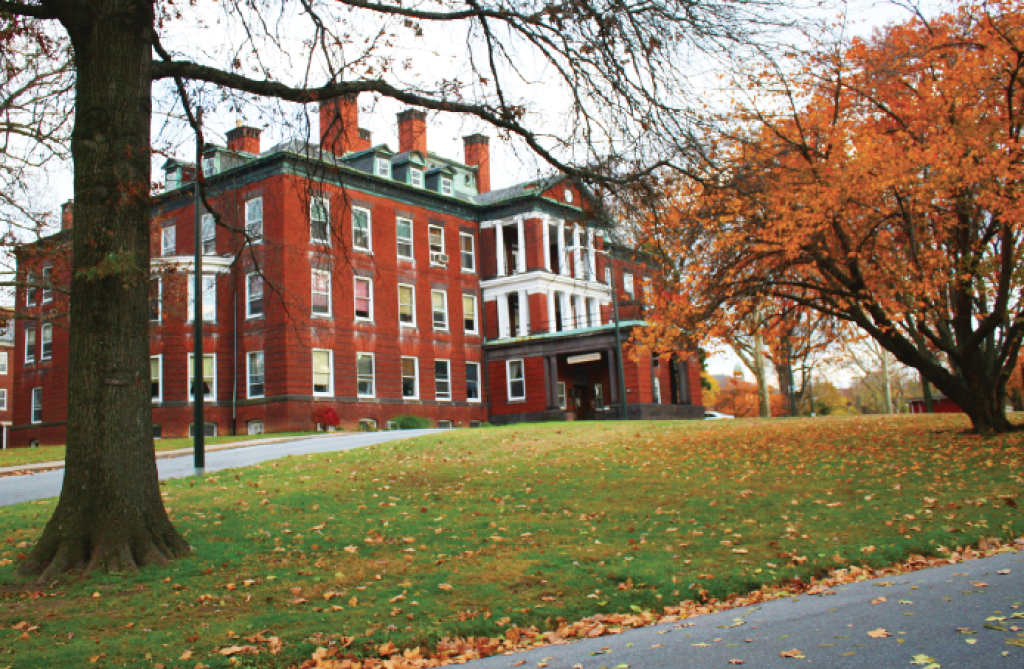
Just east of the Pennsylvania Farm Show Complex are the grounds of the Harrisburg State Hospital, the commonwealth’s first public facility for the mentally ill and disabled.

Originally planned in 1845, the official name became the Pennsylvania State Lunatic Hospital in 1848 and eventually just the Harrisburg State Hospital. The hospital was an outgrowth of progressive reforms in Pennsylvania government, but also the tireless lobbying efforts of famed social reformer Dorothea Dix.

The first “main” building was built and designed by architect John Haviland. The large structure could accommodate 300 patients, as well as hospital staff and administration. Room, board and treatment were funded by the patients themselves or provided for by the counties of admission. The initial fee was $2 a week per patient, but was later based upon ability to pay.

As admissions to the hospital grew, the construction of the north and south wings became necessary. One wing was for female patients and the other for male patients. Over time, more wings were added, each 20 feet back from the former.

This design, called the “Kirkbride Plan” was named for Dr. Thomas Kirkbride, superintendent of the Pennsylvania Hospital for the Insane in Philadelphia. This plan allowed as much air and natural light into the buildings as possible. To the rear of the main structure was a bakery and boiler facility for heating the hospital. As the 19th century wore on, the hospital kept expanding, including numerous types of trade buildings, such as a carpenter’s shop, blacksmith’s shop, paint shop and a 150-acre farm, which made the entire hospital largely self-sustaining.

By 1893, the main building was showing signs of wear. Therefore, the General Assembly appropriated $100,000 to remove it and build a new administrative building, completed by architect Addison Hutton in 1895. The commonwealth went on to appropriate more funds to remove old buildings and construct new ones, and the overall plan of the hospital was changed to what was termed the “cottage house” system.

Architect Hutton, along with John Dempwolfe, practically redesigned and reconstructed the hospital in its entirety from 1893 to 1912. The new hospital could accommodate 1,000 patients, and the male and female areas mirrored each other in construction. Numerous employee quarters were also constructed on the grounds, including physician quarters and residences for married employees. Tunnels connected the buildings and also served as conduits for steam and electric.

During the 1930s and ‘40s, the hospital continued to grow in terms of patients, but was able to avoid expansion through parole of patients, as well as transfers to other hospitals. At its peak in the 1940s, more than 3,000 patients were housed at the hospital. By the 1960s and ‘70s, changes in the approach and treatment of mental illness led to the gradual abandonment of numerous buildings.

Patients at the hospital decreased until the late 1990s. Governor Ed Rendell officially closed the Harrisburg State Hospital in 2006, but not after it gained some fame for being used in 1999 for the set of the film “Girl, Interrupted.” Most buildings have now been taken over for use by other state agencies, but a walk around the grounds is still a journey through the history of institutional architecture and mental health in Pennsylvania.

Jason Wilson is a historian for the Capitol Preservation Committee.

Continue Reading